Week 9, Lesson 1 Angular Motion in a Plane 1 
Angular Motion in a Plane – cont’d 
Week 9, Lesson 1 
• 
Centripetal Acceleration 
• 
Centripetal Force 
• 
Newton’s Law of Gravitation 
References/Reading Preparation: 
Schaum’s Outline Ch. 9 
Principles of Physics by Beuche – Ch.7
Week 9, Lesson 1 Angular Motion in a Plane 2 
Centripetal Acceleration 
A point mass m moving with constant speed v around a circle of 
radius r is undergoing acceleration. 
This is because although the magnitude of its linear velocity is not 
changing, the direction of the velocity is continually changing. 
This change in velocity gives rise to an acceleration ac of the mass – 
recall that acceleration ā = change in velocity / time taken. 
This acceleration is directed toward the centre of the circle, and is 
called the centripetal acceleration..
Week 9, Lesson 1 Angular Motion in a Plane 3 
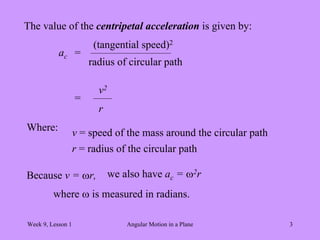
The value of the centripetal acceleration is given by: 
ac 
= 
(tangential speed)2 
radius of circular path 
= 
v2 
r 
Where: 
v = speed of the mass around the circular path 
r = radius of the circular path 
Because v = r, 
we also have ac = 2r 
where  is measured in radians.
Week 9, Lesson 1 Angular Motion in a Plane 4 
Centripetal Force 
Newton’s first law states that a net force must act on an object 
if the object is to be deflected from straight-line motion. 
Therefore an object traveling on a circular path must have a net 
force deflecting it from straight-line motion. 
For example, a ball being twirled in a circular path is compelled 
to follow this path by the center-ward pull of the string. 
If the string breaks, then the ball will follow a straight line path 
tangent to the circular path from the point at which it is released.
Week 9, Lesson 1 Angular Motion in a Plane 5 
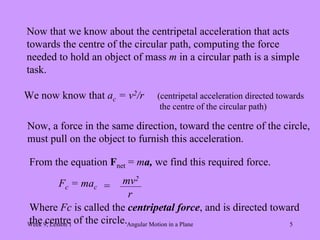
Now that we know about the centripetal acceleration that acts 
towards the centre of the circular path, computing the force 
needed to hold an object of mass m in a circular path is a simple 
task. 
We now know that ac = v2/r 
(centripetal acceleration directed towards 
the centre of the circular path) 
Now, a force in the same direction, toward the centre of the circle, 
must pull on the object to furnish this acceleration. 
From the equation Fnet = ma, we find this required force. 
Fc = mac 
= 
mv2 
r 
Where Fc is called the centripetal force, and is directed toward 
the centre of the circle.
Week 9, Lesson 1 Angular Motion in a Plane 6 
Worked Example 
A 1200 kg car is turning a corner at 8.00 m/s, and it travels along an arc of a 
circle in the process. 
a) 
If the radius of the circle is 9.00 m, how large a horizontal force must the 
pavement exert on the tires to hold the car in a circular path? 
b) 
What minimum coefficient of friction must exist in order for the car not 
to slip? 
(ans. 8530 N, 0.725)
Week 9, Lesson 1 Angular Motion in a Plane 7 
Worked Example 
A mass of 1.5 kg moves in a circle of radius 25 cm at 2 rev/s. 
Calculate a) the tangential velocity, b) the centripetal acceleration, 
and c) the required centripetal force for the motion. 
(ans. 3.14 m/s, 39.4 m/s2 radially inward, 59N)
Week 9, Lesson 1 Angular Motion in a Plane 8 
Worked Example 
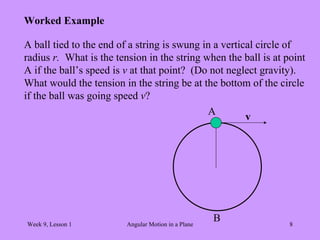
A ball tied to the end of a string is swung in a vertical circle of 
radius r. What is the tension in the string when the ball is at point 
A if the ball’s speed is v at that point? (Do not neglect gravity). 
What would the tension in the string be at the bottom of the circle 
if the ball was going speed v? 
v 
A 
B
Week 9, Lesson 1 Angular Motion in a Plane 9 
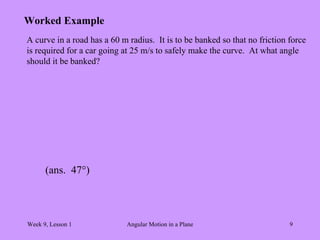
Worked Example 
A curve in a road has a 60 m radius. It is to be banked so that no friction force 
is required for a car going at 25 m/s to safely make the curve. At what angle 
should it be banked? 
(ans. 47°)
Week 9, Lesson 1 Angular Motion in a Plane 10 
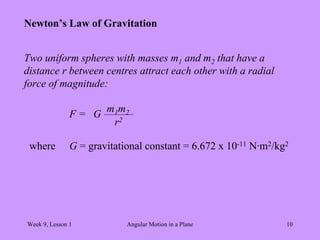
Newton’s Law of Gravitation 
Two uniform spheres with masses m1 and m2 that have a 
distance r between centres attract each other with a radial 
force of magnitude: 
F = 
G 
m1 m2 
r2 
where 
G = gravitational constant = 6.672 x 10⁻¹¹ N·m2/kg2
Week 9, Lesson 1 Angular Motion in a Plane 11 
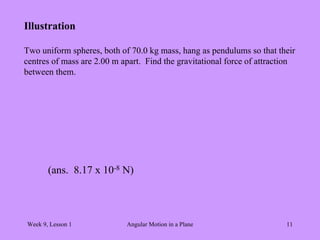
Illustration 
Two uniform spheres, both of 70.0 kg mass, hang as pendulums so that their 
centres of mass are 2.00 m apart. Find the gravitational force of attraction 
between them. 
(ans. 8.17 x 10⁻⁸ N)
Week 9, Lesson 1 Angular Motion in a Plane 12 
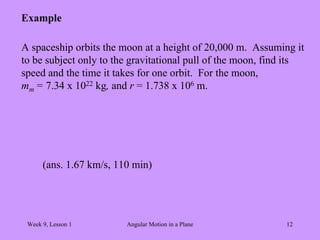
Example 
A spaceship orbits the moon at a height of 20,000 m. Assuming it 
to be subject only to the gravitational pull of the moon, find its 
speed and the time it takes for one orbit. For the moon, 
mm = 7.34 x 10²² kg, and r = 1.738 x 10⁶ m. 
(ans. 1.67 km/s, 110 min)

Physics 10

  • 1.
    Week 9, Lesson1 Angular Motion in a Plane 1 Angular Motion in a Plane – cont’d Week 9, Lesson 1 • Centripetal Acceleration • Centripetal Force • Newton’s Law of Gravitation References/Reading Preparation: Schaum’s Outline Ch. 9 Principles of Physics by Beuche – Ch.7
  • 2.
    Week 9, Lesson1 Angular Motion in a Plane 2 Centripetal Acceleration A point mass m moving with constant speed v around a circle of radius r is undergoing acceleration. This is because although the magnitude of its linear velocity is not changing, the direction of the velocity is continually changing. This change in velocity gives rise to an acceleration ac of the mass – recall that acceleration ā = change in velocity / time taken. This acceleration is directed toward the centre of the circle, and is called the centripetal acceleration..
  • 3.
    Week 9, Lesson1 Angular Motion in a Plane 3 The value of the centripetal acceleration is given by: ac = (tangential speed)2 radius of circular path = v2 r Where: v = speed of the mass around the circular path r = radius of the circular path Because v = r, we also have ac = 2r where  is measured in radians.
  • 4.
    Week 9, Lesson1 Angular Motion in a Plane 4 Centripetal Force Newton’s first law states that a net force must act on an object if the object is to be deflected from straight-line motion. Therefore an object traveling on a circular path must have a net force deflecting it from straight-line motion. For example, a ball being twirled in a circular path is compelled to follow this path by the center-ward pull of the string. If the string breaks, then the ball will follow a straight line path tangent to the circular path from the point at which it is released.
  • 5.
    Week 9, Lesson1 Angular Motion in a Plane 5 Now that we know about the centripetal acceleration that acts towards the centre of the circular path, computing the force needed to hold an object of mass m in a circular path is a simple task. We now know that ac = v2/r (centripetal acceleration directed towards the centre of the circular path) Now, a force in the same direction, toward the centre of the circle, must pull on the object to furnish this acceleration. From the equation Fnet = ma, we find this required force. Fc = mac = mv2 r Where Fc is called the centripetal force, and is directed toward the centre of the circle.
  • 6.
    Week 9, Lesson1 Angular Motion in a Plane 6 Worked Example A 1200 kg car is turning a corner at 8.00 m/s, and it travels along an arc of a circle in the process. a) If the radius of the circle is 9.00 m, how large a horizontal force must the pavement exert on the tires to hold the car in a circular path? b) What minimum coefficient of friction must exist in order for the car not to slip? (ans. 8530 N, 0.725)
  • 7.
    Week 9, Lesson1 Angular Motion in a Plane 7 Worked Example A mass of 1.5 kg moves in a circle of radius 25 cm at 2 rev/s. Calculate a) the tangential velocity, b) the centripetal acceleration, and c) the required centripetal force for the motion. (ans. 3.14 m/s, 39.4 m/s2 radially inward, 59N)
  • 8.
    Week 9, Lesson1 Angular Motion in a Plane 8 Worked Example A ball tied to the end of a string is swung in a vertical circle of radius r. What is the tension in the string when the ball is at point A if the ball’s speed is v at that point? (Do not neglect gravity). What would the tension in the string be at the bottom of the circle if the ball was going speed v? v A B
  • 9.
    Week 9, Lesson1 Angular Motion in a Plane 9 Worked Example A curve in a road has a 60 m radius. It is to be banked so that no friction force is required for a car going at 25 m/s to safely make the curve. At what angle should it be banked? (ans. 47°)
  • 10.
    Week 9, Lesson1 Angular Motion in a Plane 10 Newton’s Law of Gravitation Two uniform spheres with masses m1 and m2 that have a distance r between centres attract each other with a radial force of magnitude: F = G m1 m2 r2 where G = gravitational constant = 6.672 x 10⁻¹¹ N·m2/kg2
  • 11.
    Week 9, Lesson1 Angular Motion in a Plane 11 Illustration Two uniform spheres, both of 70.0 kg mass, hang as pendulums so that their centres of mass are 2.00 m apart. Find the gravitational force of attraction between them. (ans. 8.17 x 10⁻⁸ N)
  • 12.
    Week 9, Lesson1 Angular Motion in a Plane 12 Example A spaceship orbits the moon at a height of 20,000 m. Assuming it to be subject only to the gravitational pull of the moon, find its speed and the time it takes for one orbit. For the moon, mm = 7.34 x 10²² kg, and r = 1.738 x 10⁶ m. (ans. 1.67 km/s, 110 min)