Topic 4 – Oscillations and Waves
4.3 Wave Characteristics
Waves
● A wave is an oscillation that can move energy
from place to place without the transfer of
matter.
● An oscillation moves no energy nor matter
overall.
● Waves can either be a pulse or a continuous
travelling wave.
● In most cases the oscillations of the particles
making up the wave can be considered to be
simple harmonic motion.
Types of waves
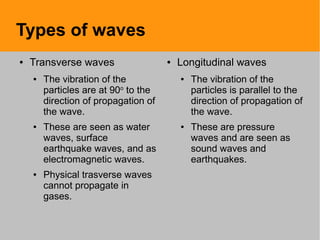
● Transverse waves
● The vibration of the
particles are at 90o
to the
direction of propagation of
the wave.
● These are seen as water
waves, surface
earthquake waves, and as
electromagnetic waves.
● Physical trasverse waves
cannot propagate in
gases.
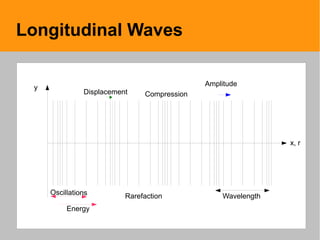
● Longitudinal waves
● The vibration of the
particles is parallel to the
direction of propagation of
the wave.
● These are pressure
waves and are seen as
sound waves and
earthquakes.
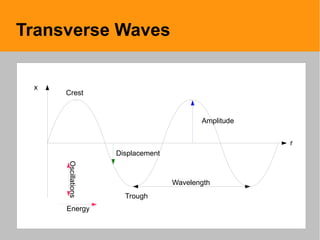
Transverse Waves
Crest
Trough
Amplitude
Wavelength
x
r
Oscillations
Energy
Displacement
Longitudinal Waves
Compression
Rarefaction
Amplitude
Wavelength
y
x, r
Oscillations
Energy
Displacement
Intensity and Amplitude
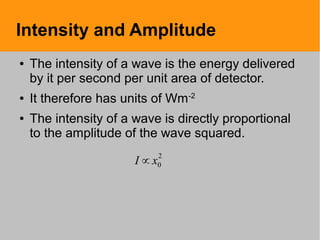
● The intensity of a wave is the energy delivered
by it per second per unit area of detector.
● It therefore has units of Wm-2
● The intensity of a wave is directly proportional
to the amplitude of the wave squared.
I ∝ x0
2
Frequency and Period
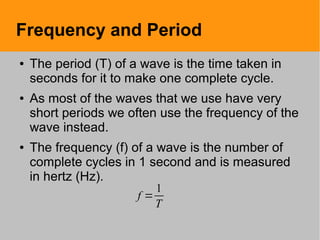
● The period (T) of a wave is the time taken in
seconds for it to make one complete cycle.
● As most of the waves that we use have very
short periods we often use the frequency of the
wave instead.
● The frequency (f) of a wave is the number of
complete cycles in 1 second and is measured
in hertz (Hz).
f =
1
T
Wave Speed
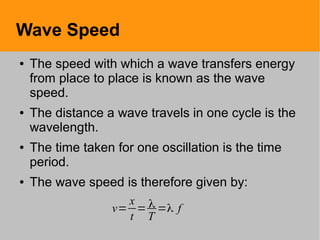
● The speed with which a wave transfers energy
from place to place is known as the wave
speed.
● The distance a wave travels in one cycle is the
wavelength.
● The time taken for one oscillation is the time
period.
● The wave speed is therefore given by:
v=
x
t
= λ
T
=λ f
Waves in 2 Dimensions
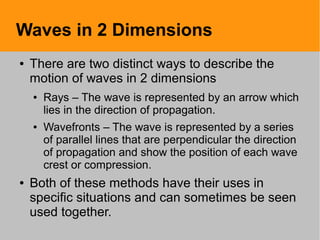
● There are two distinct ways to describe the
motion of waves in 2 dimensions
● Rays – The wave is represented by an arrow which
lies in the direction of propagation.
● Wavefronts – The wave is represented by a series
of parallel lines that are perpendicular the direction
of propagation and show the position of each wave
crest or compression.
● Both of these methods have their uses in
specific situations and can sometimes be seen
used together.
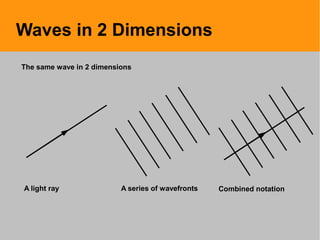
Waves in 2 Dimensions
A series of wavefrontsA light ray Combined notation
The same wave in 2 dimensions
Transverse Waves in 2 Dimensions
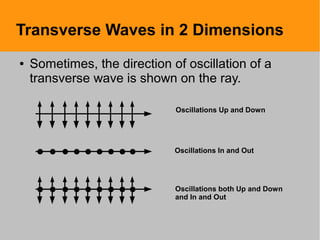
● Sometimes, the direction of oscillation of a
transverse wave is shown on the ray.
Oscillations Up and Down
Oscillations In and Out
Oscillations both Up and Down
and In and Out
Electromagnetic Waves
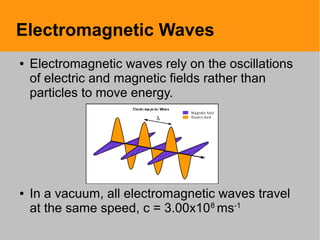
● Electromagnetic waves rely on the oscillations
of electric and magnetic fields rather than
particles to move energy.
● In a vacuum, all electromagnetic waves travel
at the same speed, c = 3.00x10⁸
ms-1
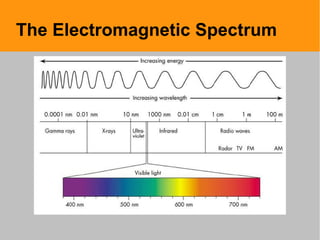
Electromagnetic Spectrum
● Electromagnetic waves can have any
frequency.
● The continuous spectrum of electromagnetic
waves goes from radio waves at low energy up
to high energy gamma waves
● Different wave bands are divided by their
wavelengths
The Electromagnetic Spectrum
Questions
● An electromagnetic wave has a frequency of
5.6x10¹²
Hz. What is the wavelength and
waveband of this radiation?
● High energy x-rays have a wavelength of 10pm.
What is the frequency of this radiation in a
vacuum?
● A red laser is fired in a vacuum. What is the
frequency of this radiation.
● A sound wave is measured to have a frequency
of 15kHz and a wavelength of 2.2cm. What is
the speed of this sound?

4.3 waves

  • 1.
    Topic 4 –Oscillations and Waves 4.3 Wave Characteristics
  • 2.
    Waves ● A waveis an oscillation that can move energy from place to place without the transfer of matter. ● An oscillation moves no energy nor matter overall. ● Waves can either be a pulse or a continuous travelling wave. ● In most cases the oscillations of the particles making up the wave can be considered to be simple harmonic motion.
  • 3.
    Types of waves ●Transverse waves ● The vibration of the particles are at 90o to the direction of propagation of the wave. ● These are seen as water waves, surface earthquake waves, and as electromagnetic waves. ● Physical trasverse waves cannot propagate in gases. ● Longitudinal waves ● The vibration of the particles is parallel to the direction of propagation of the wave. ● These are pressure waves and are seen as sound waves and earthquakes.
  • 4.
  • 5.
  • 6.
    Intensity and Amplitude ●The intensity of a wave is the energy delivered by it per second per unit area of detector. ● It therefore has units of Wm-2 ● The intensity of a wave is directly proportional to the amplitude of the wave squared. I ∝ x0 2
  • 7.
    Frequency and Period ●The period (T) of a wave is the time taken in seconds for it to make one complete cycle. ● As most of the waves that we use have very short periods we often use the frequency of the wave instead. ● The frequency (f) of a wave is the number of complete cycles in 1 second and is measured in hertz (Hz). f = 1 T
  • 8.
    Wave Speed ● Thespeed with which a wave transfers energy from place to place is known as the wave speed. ● The distance a wave travels in one cycle is the wavelength. ● The time taken for one oscillation is the time period. ● The wave speed is therefore given by: v= x t = λ T =λ f
  • 9.
    Waves in 2Dimensions ● There are two distinct ways to describe the motion of waves in 2 dimensions ● Rays – The wave is represented by an arrow which lies in the direction of propagation. ● Wavefronts – The wave is represented by a series of parallel lines that are perpendicular the direction of propagation and show the position of each wave crest or compression. ● Both of these methods have their uses in specific situations and can sometimes be seen used together.
  • 10.
    Waves in 2Dimensions A series of wavefrontsA light ray Combined notation The same wave in 2 dimensions
  • 11.
    Transverse Waves in2 Dimensions ● Sometimes, the direction of oscillation of a transverse wave is shown on the ray. Oscillations Up and Down Oscillations In and Out Oscillations both Up and Down and In and Out
  • 12.
    Electromagnetic Waves ● Electromagneticwaves rely on the oscillations of electric and magnetic fields rather than particles to move energy. ● In a vacuum, all electromagnetic waves travel at the same speed, c = 3.00x10⁸ ms-1
  • 13.
    Electromagnetic Spectrum ● Electromagneticwaves can have any frequency. ● The continuous spectrum of electromagnetic waves goes from radio waves at low energy up to high energy gamma waves ● Different wave bands are divided by their wavelengths
  • 14.
  • 15.
    Questions ● An electromagneticwave has a frequency of 5.6x10¹² Hz. What is the wavelength and waveband of this radiation? ● High energy x-rays have a wavelength of 10pm. What is the frequency of this radiation in a vacuum? ● A red laser is fired in a vacuum. What is the frequency of this radiation. ● A sound wave is measured to have a frequency of 15kHz and a wavelength of 2.2cm. What is the speed of this sound?