Topic 3 - Thermodynamics
3.3 – The Ideal Gas
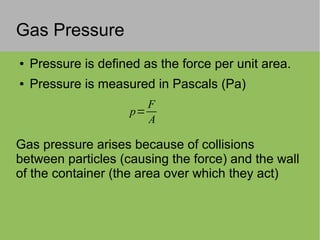
Gas Pressure
● Pressure is defined as the force per unit area.
● Pressure is measured in Pascals (Pa)
Gas pressure arises because of collisions
between particles (causing the force) and the wall
of the container (the area over which they act)
p=
F
A
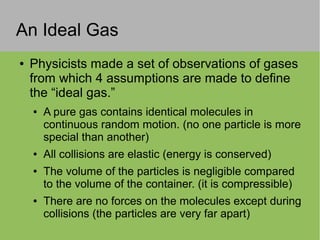
An Ideal Gas
● Physicists made a set of observations of gases
from which 4 assumptions are made to define
the “ideal gas.”
● A pure gas contains identical molecules in
continuous random motion. (no one particle is more
special than another)
● All collisions are elastic (energy is conserved)
● The volume of the particles is negligible compared
to the volume of the container. (it is compressible)
● There are no forces on the molecules except during
collisions (the particles are very far apart)
An Ideal Gas
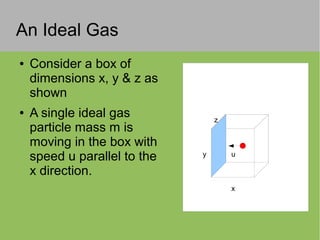
● Consider a box of
dimensions x, y & z as
shown
● A single ideal gas
particle mass m is
moving in the box with
speed u parallel to the
x direction.
x
z
y u
An Ideal Gas
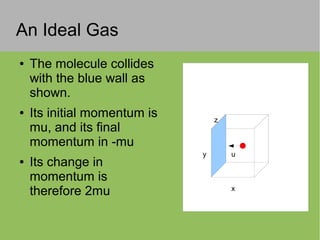
● The molecule collides
with the blue wall as
shown.
● Its initial momentum is
mu, and its final
momentum in -mu
● Its change in
momentum is
therefore 2mu x
z
y u
An Ideal Gas
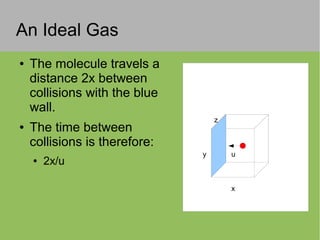
● The molecule travels a
distance 2x between
collisions with the blue
wall.
● The time between
collisions is therefore:
● 2x/u
x
z
y u
An Ideal Gas
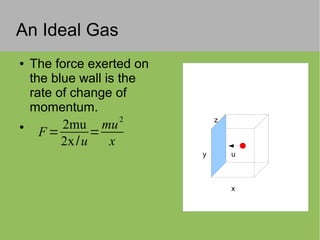
● The force exerted on
the blue wall is the
rate of change of
momentum.
●
x
z
y u
F=
2mu
2x/u
=
mu
2
x
An Ideal Gas
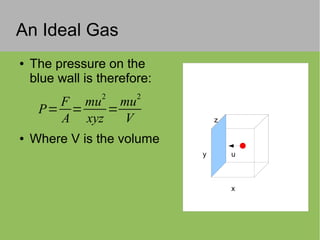
● The pressure on the
blue wall is therefore:
● Where V is the volume
x
z
y u
P=
F
A
=
mu
2
xyz
=
mu
2
V
An Ideal Gas
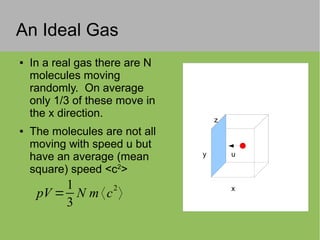
● In a real gas there are N
molecules moving
randomly. On average
only 1/3 of these move in
the x direction.
● The molecules are not all
moving with speed u but
have an average (mean
square) speed <c2
>
x
z
y u
pV =
1
3
N m 〈c
2
〉
Molecular Speed
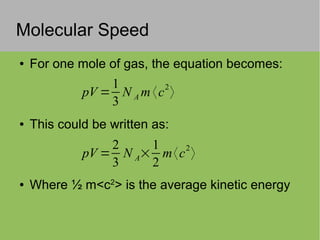
● For one mole of gas, the equation becomes:
● This could be written as:
● Where ½ m<c2
> is the average kinetic energy
pV =
1
3
N A m 〈c2
〉
pV =
2
3
N A×
1
2
m〈c
2
〉
Molecular Speed
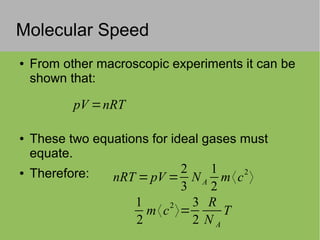
● From other macroscopic experiments it can be
shown that:
● These two equations for ideal gases must
equate.
● Therefore:
pV =nRT
nRT =pV =
2
3
NA
1
2
m〈c
2
〉
1
2
m〈c
2
〉=
3
2
R
N A
T
Molecular Speed
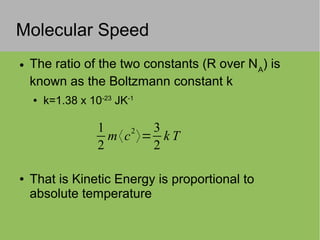
● The ratio of the two constants (R over NA
) is
known as the Boltzmann constant k
● k=1.38 x 10⁻²³
JK-1
● That is Kinetic Energy is proportional to
absolute temperature
1
2
m〈c2
〉=
3
2
k T
Summary of Ideal Gases
● For a real gas, the ideal gas rules can be used to give
approximate answers.
● An increase in volume will cause a longer time between
collisions, so the collisions will be less frequent, so the
pressure will decrease.
● An increase in temperature, will cause a higher KE, so the
time between collisions will increase and the force with
which they strike the container will increase. The pressure
will therefore increase.
● An increase in volume at constant pressure will cause the
particles to slow down, therefore causing a decrease in
temperature.

3.3 the ideal gas

  • 1.
    Topic 3 -Thermodynamics 3.3 – The Ideal Gas
  • 2.
    Gas Pressure ● Pressureis defined as the force per unit area. ● Pressure is measured in Pascals (Pa) Gas pressure arises because of collisions between particles (causing the force) and the wall of the container (the area over which they act) p= F A
  • 3.
    An Ideal Gas ●Physicists made a set of observations of gases from which 4 assumptions are made to define the “ideal gas.” ● A pure gas contains identical molecules in continuous random motion. (no one particle is more special than another) ● All collisions are elastic (energy is conserved) ● The volume of the particles is negligible compared to the volume of the container. (it is compressible) ● There are no forces on the molecules except during collisions (the particles are very far apart)
  • 4.
    An Ideal Gas ●Consider a box of dimensions x, y & z as shown ● A single ideal gas particle mass m is moving in the box with speed u parallel to the x direction. x z y u
  • 5.
    An Ideal Gas ●The molecule collides with the blue wall as shown. ● Its initial momentum is mu, and its final momentum in -mu ● Its change in momentum is therefore 2mu x z y u
  • 6.
    An Ideal Gas ●The molecule travels a distance 2x between collisions with the blue wall. ● The time between collisions is therefore: ● 2x/u x z y u
  • 7.
    An Ideal Gas ●The force exerted on the blue wall is the rate of change of momentum. ● x z y u F= 2mu 2x/u = mu 2 x
  • 8.
    An Ideal Gas ●The pressure on the blue wall is therefore: ● Where V is the volume x z y u P= F A = mu 2 xyz = mu 2 V
  • 9.
    An Ideal Gas ●In a real gas there are N molecules moving randomly. On average only 1/3 of these move in the x direction. ● The molecules are not all moving with speed u but have an average (mean square) speed <c2 > x z y u pV = 1 3 N m 〈c 2 〉
  • 10.
    Molecular Speed ● Forone mole of gas, the equation becomes: ● This could be written as: ● Where ½ m<c2 > is the average kinetic energy pV = 1 3 N A m 〈c2 〉 pV = 2 3 N A× 1 2 m〈c 2 〉
  • 11.
    Molecular Speed ● Fromother macroscopic experiments it can be shown that: ● These two equations for ideal gases must equate. ● Therefore: pV =nRT nRT =pV = 2 3 NA 1 2 m〈c 2 〉 1 2 m〈c 2 〉= 3 2 R N A T
  • 12.
    Molecular Speed ● Theratio of the two constants (R over NA ) is known as the Boltzmann constant k ● k=1.38 x 10⁻²³ JK-1 ● That is Kinetic Energy is proportional to absolute temperature 1 2 m〈c2 〉= 3 2 k T
  • 13.
    Summary of IdealGases ● For a real gas, the ideal gas rules can be used to give approximate answers. ● An increase in volume will cause a longer time between collisions, so the collisions will be less frequent, so the pressure will decrease. ● An increase in temperature, will cause a higher KE, so the time between collisions will increase and the force with which they strike the container will increase. The pressure will therefore increase. ● An increase in volume at constant pressure will cause the particles to slow down, therefore causing a decrease in temperature.