Chapter 7 Impulse and Momentum
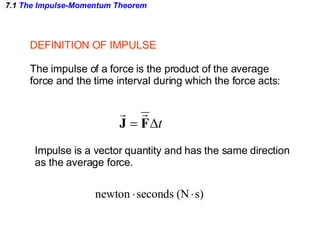
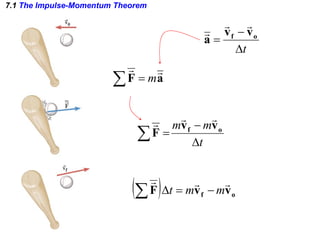
7.1  The Impulse-Momentum Theorem DEFINITION OF IMPULSE The impulse of a force is the product of the average force and the time interval during which the force acts: Impulse is a vector quantity and has the same direction as the average force.
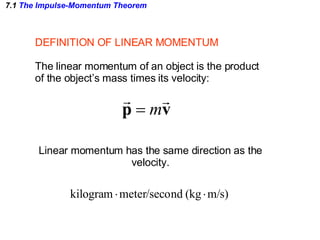
7.1  The Impulse-Momentum Theorem DEFINITION OF LINEAR MOMENTUM The linear momentum of an object is the product  of the object’s mass times its velocity: Linear momentum has the same direction as the velocity.
7.1  The Impulse-Momentum Theorem
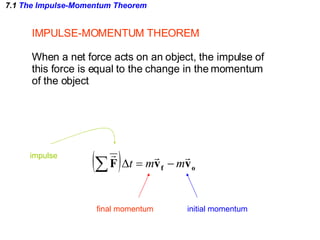
7.1  The Impulse-Momentum Theorem final momentum initial momentum IMPULSE-MOMENTUM THEOREM When a net force acts on an object, the impulse of this force is equal to the change in the momentum of the object impulse
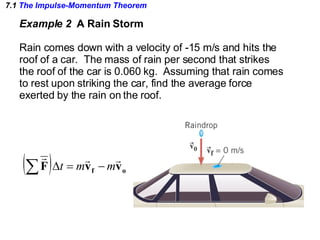
7.1  The Impulse-Momentum Theorem Example 2  A Rain Storm Rain comes down with a velocity of -15 m/s and hits the roof of a car.  The mass of rain per second that strikes the roof of the car is 0.060 kg.  Assuming that rain comes to rest upon striking the car, find the average force exerted by the rain on the roof.
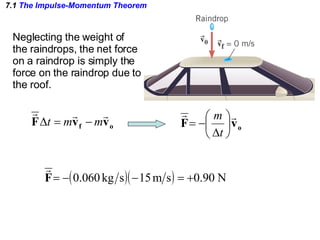
7.1  The Impulse-Momentum Theorem Neglecting the weight of  the raindrops, the net force on a raindrop is simply the force on the raindrop due to the roof.
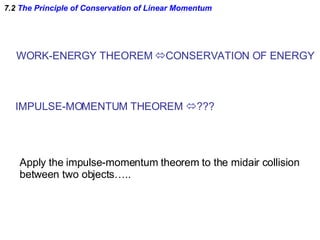
7.2  The Principle of Conservation of Linear Momentum WORK-ENERGY THEOREM   CONSERVATION OF ENERGY IMPULSE-MOMENTUM THEOREM   ??? Apply the impulse-momentum theorem to the midair collision between two objects…..
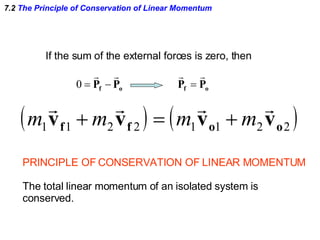
7.2  The Principle of Conservation of Linear Momentum If the sum of the external forces is zero, then  PRINCIPLE OF CONSERVATION OF LINEAR MOMENTUM The total linear momentum of an isolated system is conserved.
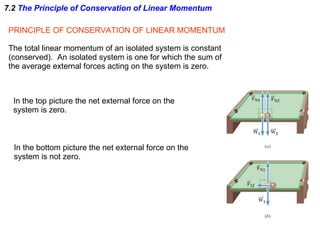
7.2  The Principle of Conservation of Linear Momentum PRINCIPLE OF CONSERVATION OF LINEAR MOMENTUM The total linear momentum of an isolated system is constant (conserved).  An isolated system is one for which the sum of the average external forces acting on the system is zero. In the top picture the net external force on the system is zero. In the bottom picture the net external force on the system is not zero.
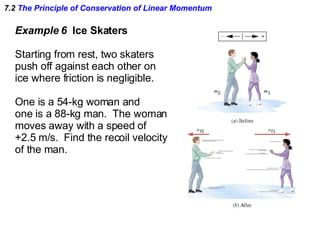
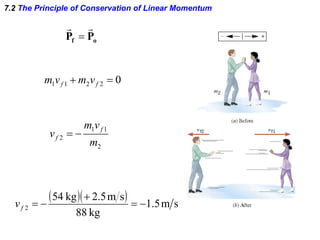
7.2  The Principle of Conservation of Linear Momentum Example 6  Ice Skaters Starting from rest, two skaters push off against each other on ice where friction is negligible. One is a 54-kg woman and  one is a 88-kg man.  The woman moves away with a speed of  +2.5 m/s.  Find the recoil velocity of the man.
7.2  The Principle of Conservation of Linear Momentum
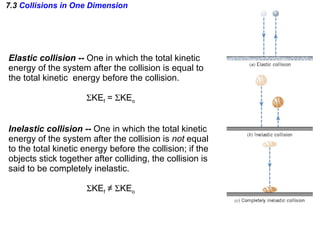
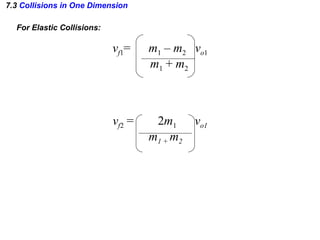
7.3  Collisions in One Dimension Elastic collision --  One in which the total kinetic  energy of the system after the collision is equal to  the total kinetic  energy before the collision.  Σ KE f  =  Σ KE o Inelastic collision --  One in which the total kinetic  energy of the system after the collision is  not  equal  to the total kinetic energy before the collision; if the  objects stick together after colliding, the collision is  said to be completely inelastic. Σ KE f  ≠  Σ KE o
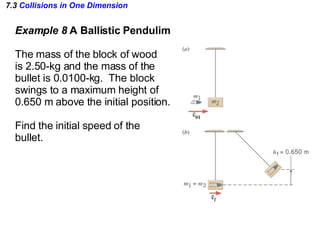
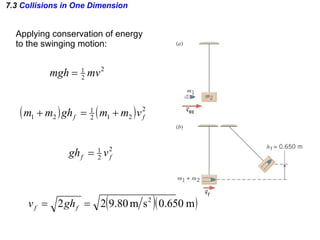
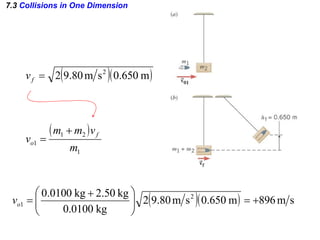
7.3  Collisions in One Dimension Example 8  A Ballistic Pendulim The mass of the block of wood is 2.50-kg and the mass of the  bullet is 0.0100-kg.  The block swings to a maximum height of 0.650 m above the initial position. Find the initial speed of the  bullet.
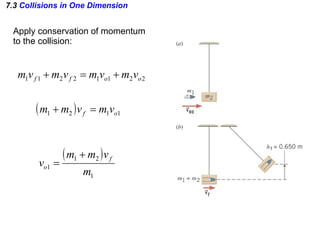
7.3  Collisions in One Dimension Apply conservation of momentum  to the collision:
7.3  Collisions in One Dimension Applying conservation of energy to the swinging motion:
7.3  Collisions in One Dimension
7.3  Collisions in One Dimension For Elastic Collisions: v f 1 =  m 1  –  m 2   v o 1 m 1  +  m 2 v f 2  =  2 m 1   v o1 m 1 +  m 2
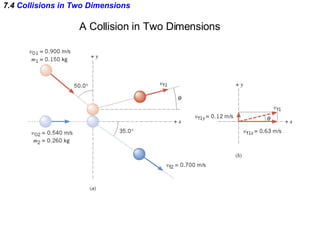
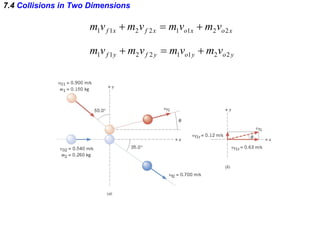
7.4  Collisions in Two Dimensions A Collision in Two Dimensions
7.4  Collisions in Two Dimensions
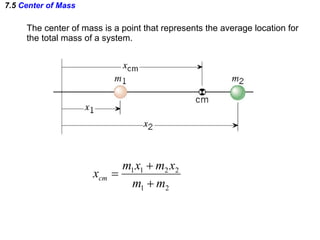
7.5  Center of Mass The center of mass is a point that represents the average location for the total mass of a system.
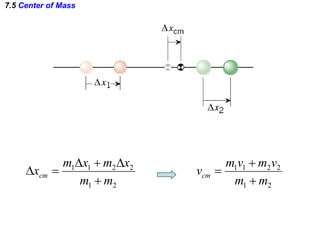
7.5  Center of Mass
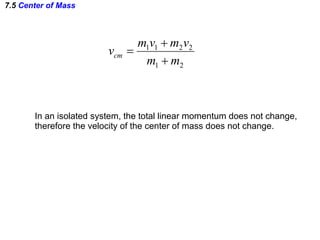
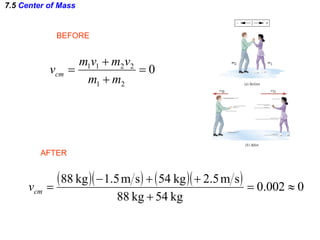
7.5  Center of Mass In an isolated system, the total linear momentum does not change, therefore the velocity of the center of mass does not change.
7.5  Center of Mass BEFORE AFTER

Chapter 7 Powerpoint

  • 1.
    Chapter 7 Impulseand Momentum
  • 2.
    7.1 TheImpulse-Momentum Theorem DEFINITION OF IMPULSE The impulse of a force is the product of the average force and the time interval during which the force acts: Impulse is a vector quantity and has the same direction as the average force.
  • 3.
    7.1 TheImpulse-Momentum Theorem DEFINITION OF LINEAR MOMENTUM The linear momentum of an object is the product of the object’s mass times its velocity: Linear momentum has the same direction as the velocity.
  • 4.
    7.1 TheImpulse-Momentum Theorem
  • 5.
    7.1 TheImpulse-Momentum Theorem final momentum initial momentum IMPULSE-MOMENTUM THEOREM When a net force acts on an object, the impulse of this force is equal to the change in the momentum of the object impulse
  • 6.
    7.1 TheImpulse-Momentum Theorem Example 2 A Rain Storm Rain comes down with a velocity of -15 m/s and hits the roof of a car. The mass of rain per second that strikes the roof of the car is 0.060 kg. Assuming that rain comes to rest upon striking the car, find the average force exerted by the rain on the roof.
  • 7.
    7.1 TheImpulse-Momentum Theorem Neglecting the weight of the raindrops, the net force on a raindrop is simply the force on the raindrop due to the roof.
  • 8.
    7.2 ThePrinciple of Conservation of Linear Momentum WORK-ENERGY THEOREM  CONSERVATION OF ENERGY IMPULSE-MOMENTUM THEOREM  ??? Apply the impulse-momentum theorem to the midair collision between two objects…..
  • 9.
    7.2 ThePrinciple of Conservation of Linear Momentum If the sum of the external forces is zero, then PRINCIPLE OF CONSERVATION OF LINEAR MOMENTUM The total linear momentum of an isolated system is conserved.
  • 10.
    7.2 ThePrinciple of Conservation of Linear Momentum PRINCIPLE OF CONSERVATION OF LINEAR MOMENTUM The total linear momentum of an isolated system is constant (conserved). An isolated system is one for which the sum of the average external forces acting on the system is zero. In the top picture the net external force on the system is zero. In the bottom picture the net external force on the system is not zero.
  • 11.
    7.2 ThePrinciple of Conservation of Linear Momentum Example 6 Ice Skaters Starting from rest, two skaters push off against each other on ice where friction is negligible. One is a 54-kg woman and one is a 88-kg man. The woman moves away with a speed of +2.5 m/s. Find the recoil velocity of the man.
  • 12.
    7.2 ThePrinciple of Conservation of Linear Momentum
  • 13.
    7.3 Collisionsin One Dimension Elastic collision -- One in which the total kinetic energy of the system after the collision is equal to the total kinetic energy before the collision. Σ KE f = Σ KE o Inelastic collision -- One in which the total kinetic energy of the system after the collision is not equal to the total kinetic energy before the collision; if the objects stick together after colliding, the collision is said to be completely inelastic. Σ KE f ≠ Σ KE o
  • 14.
    7.3 Collisionsin One Dimension Example 8 A Ballistic Pendulim The mass of the block of wood is 2.50-kg and the mass of the bullet is 0.0100-kg. The block swings to a maximum height of 0.650 m above the initial position. Find the initial speed of the bullet.
  • 15.
    7.3 Collisionsin One Dimension Apply conservation of momentum to the collision:
  • 16.
    7.3 Collisionsin One Dimension Applying conservation of energy to the swinging motion:
  • 17.
    7.3 Collisionsin One Dimension
  • 18.
    7.3 Collisionsin One Dimension For Elastic Collisions: v f 1 = m 1 – m 2 v o 1 m 1 + m 2 v f 2 = 2 m 1 v o1 m 1 + m 2
  • 19.
    7.4 Collisionsin Two Dimensions A Collision in Two Dimensions
  • 20.
    7.4 Collisionsin Two Dimensions
  • 21.
    7.5 Centerof Mass The center of mass is a point that represents the average location for the total mass of a system.
  • 22.
    7.5 Centerof Mass
  • 23.
    7.5 Centerof Mass In an isolated system, the total linear momentum does not change, therefore the velocity of the center of mass does not change.
  • 24.
    7.5 Centerof Mass BEFORE AFTER