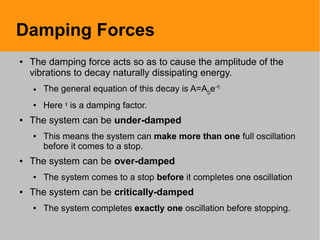
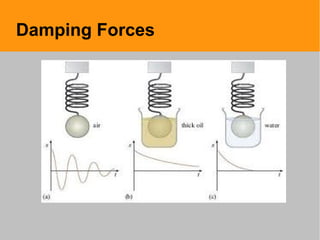
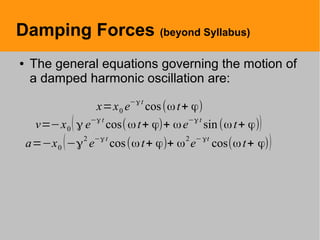
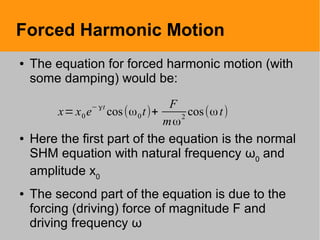
This document discusses damped and forced harmonic motion. It explains that in damped harmonic motion, a damping force acts opposite to the velocity to dissipate energy and stop vibrations. The damping causes the amplitude to decay exponentially over time. A system can be under-damped, over-damped, or critically damped depending on how quickly it stops oscillating. Forced harmonic motion occurs when an external periodic force drives the system, like pushing a swing. At resonance, the driving frequency matches the natural frequency, causing large amplitude oscillations. While resonance can be dangerous if it causes collapse, it can also be useful in applications like radios and musical instruments.