AP Physics Rapid Learning Series - 09 
Rapid Learning Center 
Chemistry :: Biology :: Physics :: Math 
Rapid Learning Center Presents …… 
Teach Yourself 
AP Physics in 24 Hours 
1/55 
*AP is a registered trademark of the College Board, which does not endorse, nor is 
affiliated in any way with the Rapid Learning courses. 
Gravitation and 
Circular Motion 
Physics Rapid Learning Series 
2/55 
Rapid Learning Center 
www.RapidLearningCenter.com/ 
© Rapid Learning Inc. All rights reserved. 
Wayne Huang, Ph.D. 
Keith Duda, M.Ed. 
Peddi Prasad, Ph.D. 
Gary Zhou, Ph.D. 
Michelle Wedemeyer, Ph.D. 
Sarah Hedges,Ph.D. 
© Rapid Learning Inc. All rights reserved. - http://www.RapidLearningCenter.com 1
AP Physics Rapid Learning Series - 09 
Learning Objectives 
By completing this tutorial, you will: 
„ Understand the nature of 
the gravitational force 
force. 
„ Calculate the gravitational 
force between objects. 
„ Describe uniform circular 
motion. 
„ C l l t t i t l f 
3/55 
Calculate centripetal force 
and centripetal 
acceleration. 
„ Describe simulated 
gravity situations. 
Concept Map 
Physics 
Studies 
Previous content 
New content 
Motion 
Caused by 
Motion Forces 
F 
Circular 
M ti 
Gravitation 
Described by 
Universal 
4/55 
Gravitational 
Constant 
Centripetal 
Force 
© Rapid Learning Inc. All rights reserved. - http://www.RapidLearningCenter.com 2
AP Physics Rapid Learning Series - 09 
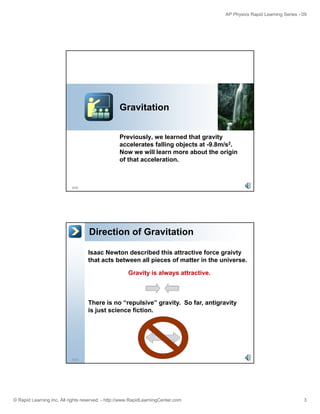
Gravitation 
Previously, we learned that gravity 
accelerates falling objects at -9 8m/s2 
5/55 
9.8m/s2. 
Now we will learn more about the origin 
of that acceleration. 
Direction of Gravitation 
Isaac Newton described this attractive force graivty 
that acts between all pieces of matter in the universe. 
Gravity is always attractive. 
There is no “repulsive” gravity. So far, antigravity 
is just science fiction. 
6/55 
© Rapid Learning Inc. All rights reserved. - http://www.RapidLearningCenter.com 3
AP Physics Rapid Learning Series - 09 
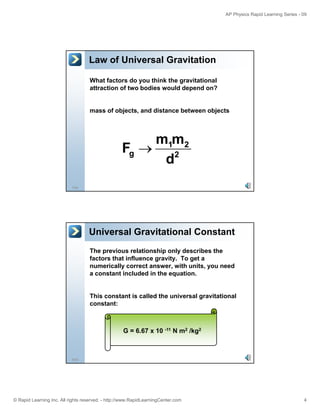
Law of Universal Gravitation 
What factors do you think the gravitational 
attraction of two bodies would depend on? 
mass of objects, and distance between objects 
F m1m2 
7/55 
1 2 
2 
→ 
g d 
Universal Gravitational Constant 
The previous relationship only describes the 
factors that influence gravity. To get a 
numerically correct answer, with units, you need 
a constant included in the equation. 
This constant is called the universal gravitational 
constant: 
8/55 
G = 6.67 x 10 -11 N m2 /kg2 
© Rapid Learning Inc. All rights reserved. - http://www.RapidLearningCenter.com 4
AP Physics Rapid Learning Series - 09 
Universal Law of Gravitation 
Universal 
gravitational 
constant 
Two 
masses, 
kg 
F = Gm m 
1 2 
2 
g d 
Force 
from 
Distance 
between 
bj t 
9/55 
gravity, N 
objects, 
m 
Because there is a quantity squared in the 
denominator of the fraction, this formula may be 
referred to as an inverse square law. 
Gravitation Calculation Example 
Calculate the gravitation force between the planet 
Mars, 6.4 x 10 23 kg, and the sun, 2 x 10 30 kg. Assume 
a distance of 2.0 x 10 11 m. 
Fg 
10/55 
© Rapid Learning Inc. All rights reserved. - http://www.RapidLearningCenter.com 5
AP Physics Rapid Learning Series - 09 
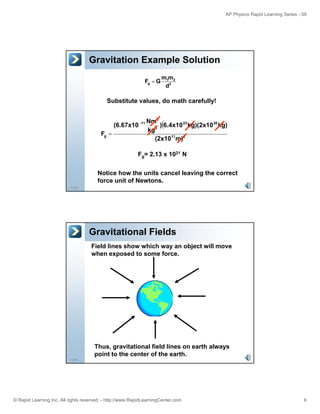
Gravitation Example Solution 
F = Gm m 
1 2 
2 
g d 
Substitute values, do math carefully! 
( 
23 30 
) 6.4x10 kg)(2x10 kg) 
(6.67x10 Nm 
kg 
F 
− 
= 
g (2x10 m) 
11 2 
2 
2 
11 
11/55 
Fg= 2.13 x 10²¹ N 
Notice how the units cancel leaving the correct 
force unit of Newtons. 
Gravitational Fields 
Field lines show which way an object will move 
when exposed to some force. 
12/55 
Thus, gravitational field lines on earth always 
point to the center of the earth. 
© Rapid Learning Inc. All rights reserved. - http://www.RapidLearningCenter.com 6
AP Physics Rapid Learning Series - 09 
Thought Question 
Imagine you are deep inside the earth in a cave. 
Would you weigh more, less, or the same as on 
the surface of the earth? 
13/55 
Thought Question Answer 
When on the surface of the earth, all of the mass 
of the earth is pulling you down. 
When underground, the mass above you actually 
pulls you up, countering some of pull from the bulk 
of the planet. You weigh less! 
14/55 
© Rapid Learning Inc. All rights reserved. - http://www.RapidLearningCenter.com 7
AP Physics Rapid Learning Series - 09 
Extension of Thought Question 
What would happen if you were at a cave at the 
center of the earth? 
15/55 
Because the gravitational pull from the matter 
equally all around you would cancel out, you 
would be weightless! Fnet would be 0. 
Planet Discovery 
Gravity can have much more subtle effects. 
The existence of Pluto and Neptune was predicted 
before they were ever observed. 
Their slight gravitational effects wobble the orbits of 
the other planets, betraying their presence before 
they were ever seen visually. 
16/55 
© Rapid Learning Inc. All rights reserved. - http://www.RapidLearningCenter.com 8
AP Physics Rapid Learning Series - 09 
Uniform 
Circular 
Motion 
Obviously, not all objects move in a 
linear path Another common occurrence 
17/55 
path. is constant motion in a circular path. 
Thought Question 
Imagine you are swinging a ball on the end of a 
string. The string suddenly breaks when the ball 
is at the top. 
Snap! 
18/55 
Which direction will the ball initially fly? 
© Rapid Learning Inc. All rights reserved. - http://www.RapidLearningCenter.com 9
AP Physics Rapid Learning Series - 09 
Inertia in Action 
When the string breaks, the ball will continue to 
move tangent to the circle. Linear inertia at 
work! 
Snap! 
19/55 
Obviously, if we were considering gravity, the ball 
would begin to fall also. 
Circular Motion 
In a line, we usually measure a speed or velocity 
in m/s, linear speed. 
However, when things travel in a circle we could 
describe a speed differently, rotational speed. 
Example: 3 revolutions per second 
20/55 
5 revolutions per minute (rpm) 
2π radians per second 
© Rapid Learning Inc. All rights reserved. - http://www.RapidLearningCenter.com 10
AP Physics Rapid Learning Series - 09 
Linear Speed Example 
If a tire on a car has a radius of .29m, and is 
being rotated at 830 rpm, what is the speed at 
the outer edge of the tire? 
830 l ti 
.29m 
revolutions 
per minute 
21/55 
Linear Speed Solution 
Use a previous formula: 
v = d 
t 
However, the distance is now in a circle. So we 
must find the distance around the circle… 
v = 2 π r 
t 
Circumference of a 
circle 
22/55 
We also need to consider that it covers 830 
circumferences in 1 minute 
25m/s 
v = 2π (.29m) 830 = 
60 sec 
830 rpm 
© Rapid Learning Inc. All rights reserved. - http://www.RapidLearningCenter.com 11
AP Physics Rapid Learning Series - 09 
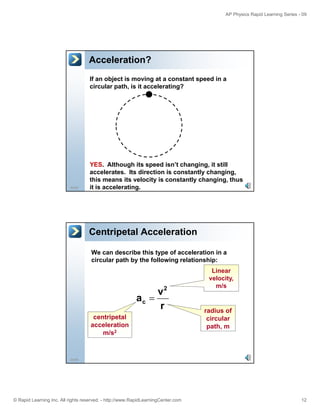
Acceleration? 
If an object is moving at a constant speed in a 
circular path, is it accelerating? 
23/55 
YES. Although its speed isn’t changing, it still 
accelerates. Its direction is constantly changing, 
this means its velocity is constantly changing, thus 
it is accelerating. 
Centripetal Acceleration 
We can describe this type of acceleration in a 
circular path by the following relationship: 
Linear 
Li 
velocity, 
m/s 
a v 
2 
r 
c = 
radius of 
centripetal 
i l 
24/55 
circular 
path, m 
acceleration 
m/s2 
© Rapid Learning Inc. All rights reserved. - http://www.RapidLearningCenter.com 12
AP Physics Rapid Learning Series - 09 
Accelerations Require Forces 
If an object is accelerating, it must have a net force 
applied to it! 
This is the force that is responsible for making an 
object travel in the circular path instead of a 
regular straight line. 
25/55 
Instantaneous 
velocity 
Centripetal 
force 
Centripetal Force 
Centripetal force is a “center seeking” force. It 
always points towards the center for an object 
moving in a circular path. 
Centripetal force 
Tangential or 
26/55 
g 
instantaneous 
velocity 
This isn’t some new force. Centripetal force can be 
provided by tension from a string, gravitational pull, 
friction on the road, etc. 
© Rapid Learning Inc. All rights reserved. - http://www.RapidLearningCenter.com 13
AP Physics Rapid Learning Series - 09 
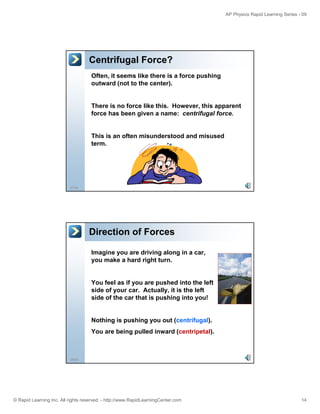
Centrifugal Force? 
Often, it seems like there is a force pushing 
outward (not to the center). 
There is no force like this. However, this apparent 
force has been given a name: centrifugal force. 
This is an often misunderstood and misused 
term 
27/55 
term. 
Direction of Forces 
Imagine you are driving along in a car, 
you make a hard right turn. 
You feel as if you are pushed into the left 
side of your car. Actually, it is the left 
side of the car that is pushing into you! 
28/55 
Nothing is pushing you out (centrifugal). 
You are being pulled inward (centripetal). 
© Rapid Learning Inc. All rights reserved. - http://www.RapidLearningCenter.com 14
AP Physics Rapid Learning Series - 09 
Fc Formula 
Linear 
velocity, 
m/s 
Mass, kg 
2 
F = mv 
c r 
Centripetal 
Radius of 
i l 
29/55 
force, N 
circular 
path, m 
Here is the formula for centripetal force. 
Similarities 
Notice how the formula for centripetal force 
contains the formula for centripetal acceleration 
within itself. 
Fnet = Fc 
2 
r 
ma = mv 
Newton’s 
2nd law: 
Fnet=ma 
Mass 
cancels 
out 
30/55 
a v 
2 
r 
c = 
© Rapid Learning Inc. All rights reserved. - http://www.RapidLearningCenter.com 15
AP Physics Rapid Learning Series - 09 
Centripetal Force Example 
Imagine you whirl a 0.1 kg rubber stopper attached to 
a string in a 1 m radius circle at 2 rev/sec. What is 
the centripetal force on that stopper? 
1m 
31/55 
Example Solution 
First change 2 rev/sec into m/s: 
=2 (2πr) /sec Circumference 
= 2(2 π 1m) / sec of f circle i l =2πr 
2 
= 12.6 m/s 
Linear 
velocity, 
m/s 
Then, substitute into the Fc formula: 
32/55 
Fc = .1kg (12.6 m/s)2 / 1m 
Fc = 15.8 kg m/s2 
=15.8 N 
© Rapid Learning Inc. All rights reserved. - http://www.RapidLearningCenter.com 16
AP Physics Rapid Learning Series - 09 
Centripetal Acceleration Example 
Imagine that a fighter pilot is traveling at 1000 km/hr, 
when he decides to make a sharp turn. He can 
withstand a maximum acceleration of 8g’s (8 times 
the normal acceleration from gravity). What is the 
smallest radius turn he can withstand? 
33/55 
Centripetal Acceleration Solution 
First, convert km/hr into m/s 
277m/s 
1000km× × 1hr 
= 
3600sec 
1000m 
1km 
hr 
Next, convert the acceleration he can withstand 
2 
2 
78m/s 
8g's× 9.8m/s = 
1g 
Finally, solve for the radius of the turn 
34/55 
a v 
2 
r 
c = 
983m 
2 
r v 2 
(277m/s) 
= = = 
78m/s 
a 
2 
c 
© Rapid Learning Inc. All rights reserved. - http://www.RapidLearningCenter.com 17
AP Physics Rapid Learning Series - 09 
Banked Turns for a Car 
Similarly, when a car is driving in a circular path, 
on a banked road, the centripetal force comes 
from a component of the normal force. 
normal force θ 
This component of 
the normal force is Fc 
weight 
i ht 
35/55 
θ 
These can be calculated using simple trigonometry. 
Example 
At the Daytona 500 speedway, the turns in the 
oval track have a maximum radius of 316 m and 
are banked at an angle of 31°. Assuming no 
friction, how fast could the cars make the turn? 
Hint: use the previous diagram/example. 
36/55 
© Rapid Learning Inc. All rights reserved. - http://www.RapidLearningCenter.com 18
AP Physics Rapid Learning Series - 09 
Banked Turn Diagram 
Use the right triangle to find the Fc: 
tanθ = opp 
adj 
tanθ = Fc 
W 
tanθ = Fc 
Fc 
normal force 
37/55 
31o 
weight 
mg 
Fc mg tanθ = 
Banked Turn Calculation 
Next, substitute our expression for Fc back into the 
formula to find v: 
mv2 
r 
F mv 
2 
c = 
mg tanθ mv 
r 
2 
= 
r g t tanθ θ = v2 
2 
Since the 
mass 
cancels 
out it is 
38/55 
out, irrelevant 
v r g tanθ 
= 2 = 
316m(9.8m/s )(tan31 ) 43m/s 
= 
D 
© Rapid Learning Inc. All rights reserved. - http://www.RapidLearningCenter.com 19
AP Physics Rapid Learning Series - 09 
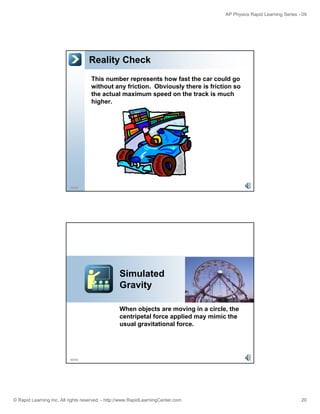
Reality Check 
This number represents how fast the car could go 
without any friction. Obviously there is friction so 
the actual maximum speed on the track is much 
higher. 
39/55 
Simulated 
Gravity 
When objects are moving in a circle, the 
centripetal force applied may mimic the 
40/55 
usual gravitational force. 
© Rapid Learning Inc. All rights reserved. - http://www.RapidLearningCenter.com 20
AP Physics Rapid Learning Series - 09 
Orbits 
When in a circular orbit, an object is continually 
falling ( under the influence of the earth’s gravity). 
However, it is continuing to move tangent to the earth, 
so it continues in a circular path at a constant speed. 
41/55 
Gravity Changes Direction 
Fc 
gravity 
it 
Tangential 
velocity 
42/55 
Notice that gravity does not pull the satellite 
forward or backward. Gravity simply acts as the 
centripetal force to keep it going in a circular orbit. 
© Rapid Learning Inc. All rights reserved. - http://www.RapidLearningCenter.com 21
AP Physics Rapid Learning Series - 09 
Gravity Equals Centripetal Force 
Since the centripetal force is provided by gravity, we 
can equate the two forces: 
FG = FFc 
2 
GmM = 
GM 2 
mv 
2 r 
r 
Notice the mass of 
the satellite cancels 
out! 
The speed of an 
i l biti 
43/55 
v2 
G = 
r 
v = GM 
r 
circular orbiting 
satellite depends only 
on the radius, 
gravitational constant 
and mass of the earth! 
Correct Distance Value 
The radius used in the previous equation is 
measured from the center of the orbit ( center of the 
earth). 
44/55 
Don’t just plug in the distance above the surface 
of the earth! 
© Rapid Learning Inc. All rights reserved. - http://www.RapidLearningCenter.com 22
AP Physics Rapid Learning Series - 09 
Importance of Mass 
This means that satellites of any mass will have the 
same orbital speed for any particular radius. 
A giant satellite will have the same speed as a tiny 
satellite in the same orbit. 
45/55 
However, it can be much more difficult to get that 
large satellite into orbit in the first place. 
Energy Costs 
It turns out that it takes 62,000,000 J of energy to 
put 1kg outside of the Earth’s orbit. (62 MJ) 
This is a large amount of energy, which is why it 
is so costly and difficult to put people and 
objects into space! 
46/55 
© Rapid Learning Inc. All rights reserved. - http://www.RapidLearningCenter.com 23
AP Physics Rapid Learning Series - 09 
Weight and Weightlessness 
You can feel weightless 
even though gravity is 
acting on you. 
Astronauts in free fall are 
still being pulled around 
the earth by gravity. 
47/55 
Artificial Gravity 
When astronauts live for long time periods in 
space, it impacts their bodies. Bones may 
weaken, muscles may lose mass, etc. 
48/55 
In the future, humans may design space ships that 
create “artificial” gravity. 
© Rapid Learning Inc. All rights reserved. - http://www.RapidLearningCenter.com 24
AP Physics Rapid Learning Series - 09 
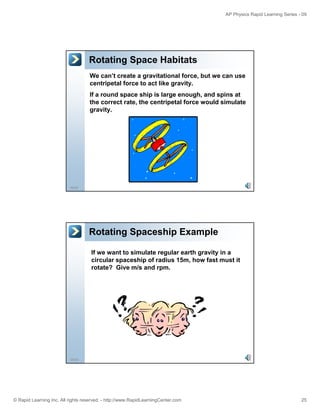
Rotating Space Habitats 
We can’t create a gravitational force, but we can use 
centripetal force to act like gravity. 
If a round space ship is large enough, and spins at 
the correct rate, the centripetal force would simulate 
gravity. 
49/55 
Rotating Spaceship Example 
If we want to simulate regular earth gravity in a 
circular spaceship of radius 15m, how fast must it 
rotate? Give m/s and rpm. 
50/55 
© Rapid Learning Inc. All rights reserved. - http://www.RapidLearningCenter.com 25
AP Physics Rapid Learning Series - 09 
Calculation of Linear Speed 
Normal 
a v 
2 
r 
c = 
Centripetal 
force 
formula 
acceleration 
from gravity 
on Earth. 
v acr = 
v = (9.8m/s2 )(15m) 
51/55 
v = 12.1m/s 
This gives the linear speed (in m/s) at the edge. 
Calculation of Rotational Speed 
Next, consider the number of revolutions it makes 
in 1 minute ( 60 sec). 
d 
Circumference 
C cu e e ce 
of a circle 
Linear 
speed 
previously 
found 
t 
v = v = 2 π r Xrevolutions 
60sec 
12 1m/s(60s) 
52/55 
Xrevolutions 
12.1m/= 
2 π r 
revolutions X = 7.7 rpm 
© Rapid Learning Inc. All rights reserved. - http://www.RapidLearningCenter.com 26
AP Physics Rapid Learning Series - 09 
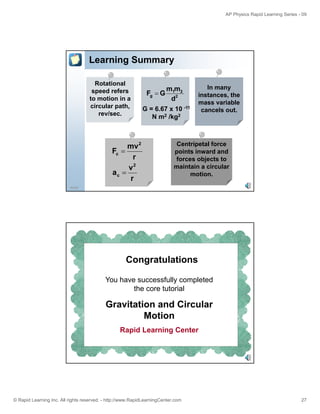
Learning Summary 
F = Gm m 
1 2 
d2 
2 
g d 
Rotational 
speed refers 
to motion in a 
In many 
instances, the 
G = 6.67 x 10 -11 
N m2 /kg2 
mass variable 
cancels out. 
2 
Centripetal force 
circular path, 
rev/sec. 
, 
53/55 
F mv 
r 
c 
= 
a v 
2 
r 
c 
= 
points inward and 
forces objects to 
maintain a circular 
motion. 
Congratulations 
You have successfully completed 
the core tutorial 
Gravitation and Circular 
Motion 
Rapid Learning Center 
© Rapid Learning Inc. All rights reserved. - http://www.RapidLearningCenter.com 27
AP Physics Rapid Learning Series - 09 
Rapid Learning Center 
Chemistry :: Biology :: Physics :: Math 
Wh What’s t’ Next N t 
… 
Step 1: Concepts – Core Tutorial (Just Completed) 
Æ Step 2: Practice – Interactive Problem Drill 
Step 3: Recap Super Review Cheat Sheet 
55/55 
– Go for it! 
http://www.RapidLearningCenter.com 
© Rapid Learning Inc. All rights reserved. - http://www.RapidLearningCenter.com 28

Circular Motion & Gravitation

  • 1.
    AP Physics RapidLearning Series - 09 Rapid Learning Center Chemistry :: Biology :: Physics :: Math Rapid Learning Center Presents …… Teach Yourself AP Physics in 24 Hours 1/55 *AP is a registered trademark of the College Board, which does not endorse, nor is affiliated in any way with the Rapid Learning courses. Gravitation and Circular Motion Physics Rapid Learning Series 2/55 Rapid Learning Center www.RapidLearningCenter.com/ © Rapid Learning Inc. All rights reserved. Wayne Huang, Ph.D. Keith Duda, M.Ed. Peddi Prasad, Ph.D. Gary Zhou, Ph.D. Michelle Wedemeyer, Ph.D. Sarah Hedges,Ph.D. © Rapid Learning Inc. All rights reserved. - http://www.RapidLearningCenter.com 1
  • 2.
    AP Physics RapidLearning Series - 09 Learning Objectives By completing this tutorial, you will: „ Understand the nature of the gravitational force force. „ Calculate the gravitational force between objects. „ Describe uniform circular motion. „ C l l t t i t l f 3/55 Calculate centripetal force and centripetal acceleration. „ Describe simulated gravity situations. Concept Map Physics Studies Previous content New content Motion Caused by Motion Forces F Circular M ti Gravitation Described by Universal 4/55 Gravitational Constant Centripetal Force © Rapid Learning Inc. All rights reserved. - http://www.RapidLearningCenter.com 2
  • 3.
    AP Physics RapidLearning Series - 09 Gravitation Previously, we learned that gravity accelerates falling objects at -9 8m/s2 5/55 9.8m/s2. Now we will learn more about the origin of that acceleration. Direction of Gravitation Isaac Newton described this attractive force graivty that acts between all pieces of matter in the universe. Gravity is always attractive. There is no “repulsive” gravity. So far, antigravity is just science fiction. 6/55 © Rapid Learning Inc. All rights reserved. - http://www.RapidLearningCenter.com 3
  • 4.
    AP Physics RapidLearning Series - 09 Law of Universal Gravitation What factors do you think the gravitational attraction of two bodies would depend on? mass of objects, and distance between objects F m1m2 7/55 1 2 2 → g d Universal Gravitational Constant The previous relationship only describes the factors that influence gravity. To get a numerically correct answer, with units, you need a constant included in the equation. This constant is called the universal gravitational constant: 8/55 G = 6.67 x 10 -11 N m2 /kg2 © Rapid Learning Inc. All rights reserved. - http://www.RapidLearningCenter.com 4
  • 5.
    AP Physics RapidLearning Series - 09 Universal Law of Gravitation Universal gravitational constant Two masses, kg F = Gm m 1 2 2 g d Force from Distance between bj t 9/55 gravity, N objects, m Because there is a quantity squared in the denominator of the fraction, this formula may be referred to as an inverse square law. Gravitation Calculation Example Calculate the gravitation force between the planet Mars, 6.4 x 10 23 kg, and the sun, 2 x 10 30 kg. Assume a distance of 2.0 x 10 11 m. Fg 10/55 © Rapid Learning Inc. All rights reserved. - http://www.RapidLearningCenter.com 5
  • 6.
    AP Physics RapidLearning Series - 09 Gravitation Example Solution F = Gm m 1 2 2 g d Substitute values, do math carefully! ( 23 30 ) 6.4x10 kg)(2x10 kg) (6.67x10 Nm kg F − = g (2x10 m) 11 2 2 2 11 11/55 Fg= 2.13 x 10²¹ N Notice how the units cancel leaving the correct force unit of Newtons. Gravitational Fields Field lines show which way an object will move when exposed to some force. 12/55 Thus, gravitational field lines on earth always point to the center of the earth. © Rapid Learning Inc. All rights reserved. - http://www.RapidLearningCenter.com 6
  • 7.
    AP Physics RapidLearning Series - 09 Thought Question Imagine you are deep inside the earth in a cave. Would you weigh more, less, or the same as on the surface of the earth? 13/55 Thought Question Answer When on the surface of the earth, all of the mass of the earth is pulling you down. When underground, the mass above you actually pulls you up, countering some of pull from the bulk of the planet. You weigh less! 14/55 © Rapid Learning Inc. All rights reserved. - http://www.RapidLearningCenter.com 7
  • 8.
    AP Physics RapidLearning Series - 09 Extension of Thought Question What would happen if you were at a cave at the center of the earth? 15/55 Because the gravitational pull from the matter equally all around you would cancel out, you would be weightless! Fnet would be 0. Planet Discovery Gravity can have much more subtle effects. The existence of Pluto and Neptune was predicted before they were ever observed. Their slight gravitational effects wobble the orbits of the other planets, betraying their presence before they were ever seen visually. 16/55 © Rapid Learning Inc. All rights reserved. - http://www.RapidLearningCenter.com 8
  • 9.
    AP Physics RapidLearning Series - 09 Uniform Circular Motion Obviously, not all objects move in a linear path Another common occurrence 17/55 path. is constant motion in a circular path. Thought Question Imagine you are swinging a ball on the end of a string. The string suddenly breaks when the ball is at the top. Snap! 18/55 Which direction will the ball initially fly? © Rapid Learning Inc. All rights reserved. - http://www.RapidLearningCenter.com 9
  • 10.
    AP Physics RapidLearning Series - 09 Inertia in Action When the string breaks, the ball will continue to move tangent to the circle. Linear inertia at work! Snap! 19/55 Obviously, if we were considering gravity, the ball would begin to fall also. Circular Motion In a line, we usually measure a speed or velocity in m/s, linear speed. However, when things travel in a circle we could describe a speed differently, rotational speed. Example: 3 revolutions per second 20/55 5 revolutions per minute (rpm) 2π radians per second © Rapid Learning Inc. All rights reserved. - http://www.RapidLearningCenter.com 10
  • 11.
    AP Physics RapidLearning Series - 09 Linear Speed Example If a tire on a car has a radius of .29m, and is being rotated at 830 rpm, what is the speed at the outer edge of the tire? 830 l ti .29m revolutions per minute 21/55 Linear Speed Solution Use a previous formula: v = d t However, the distance is now in a circle. So we must find the distance around the circle… v = 2 π r t Circumference of a circle 22/55 We also need to consider that it covers 830 circumferences in 1 minute 25m/s v = 2π (.29m) 830 = 60 sec 830 rpm © Rapid Learning Inc. All rights reserved. - http://www.RapidLearningCenter.com 11
  • 12.
    AP Physics RapidLearning Series - 09 Acceleration? If an object is moving at a constant speed in a circular path, is it accelerating? 23/55 YES. Although its speed isn’t changing, it still accelerates. Its direction is constantly changing, this means its velocity is constantly changing, thus it is accelerating. Centripetal Acceleration We can describe this type of acceleration in a circular path by the following relationship: Linear Li velocity, m/s a v 2 r c = radius of centripetal i l 24/55 circular path, m acceleration m/s2 © Rapid Learning Inc. All rights reserved. - http://www.RapidLearningCenter.com 12
  • 13.
    AP Physics RapidLearning Series - 09 Accelerations Require Forces If an object is accelerating, it must have a net force applied to it! This is the force that is responsible for making an object travel in the circular path instead of a regular straight line. 25/55 Instantaneous velocity Centripetal force Centripetal Force Centripetal force is a “center seeking” force. It always points towards the center for an object moving in a circular path. Centripetal force Tangential or 26/55 g instantaneous velocity This isn’t some new force. Centripetal force can be provided by tension from a string, gravitational pull, friction on the road, etc. © Rapid Learning Inc. All rights reserved. - http://www.RapidLearningCenter.com 13
  • 14.
    AP Physics RapidLearning Series - 09 Centrifugal Force? Often, it seems like there is a force pushing outward (not to the center). There is no force like this. However, this apparent force has been given a name: centrifugal force. This is an often misunderstood and misused term 27/55 term. Direction of Forces Imagine you are driving along in a car, you make a hard right turn. You feel as if you are pushed into the left side of your car. Actually, it is the left side of the car that is pushing into you! 28/55 Nothing is pushing you out (centrifugal). You are being pulled inward (centripetal). © Rapid Learning Inc. All rights reserved. - http://www.RapidLearningCenter.com 14
  • 15.
    AP Physics RapidLearning Series - 09 Fc Formula Linear velocity, m/s Mass, kg 2 F = mv c r Centripetal Radius of i l 29/55 force, N circular path, m Here is the formula for centripetal force. Similarities Notice how the formula for centripetal force contains the formula for centripetal acceleration within itself. Fnet = Fc 2 r ma = mv Newton’s 2nd law: Fnet=ma Mass cancels out 30/55 a v 2 r c = © Rapid Learning Inc. All rights reserved. - http://www.RapidLearningCenter.com 15
  • 16.
    AP Physics RapidLearning Series - 09 Centripetal Force Example Imagine you whirl a 0.1 kg rubber stopper attached to a string in a 1 m radius circle at 2 rev/sec. What is the centripetal force on that stopper? 1m 31/55 Example Solution First change 2 rev/sec into m/s: =2 (2πr) /sec Circumference = 2(2 π 1m) / sec of f circle i l =2πr 2 = 12.6 m/s Linear velocity, m/s Then, substitute into the Fc formula: 32/55 Fc = .1kg (12.6 m/s)2 / 1m Fc = 15.8 kg m/s2 =15.8 N © Rapid Learning Inc. All rights reserved. - http://www.RapidLearningCenter.com 16
  • 17.
    AP Physics RapidLearning Series - 09 Centripetal Acceleration Example Imagine that a fighter pilot is traveling at 1000 km/hr, when he decides to make a sharp turn. He can withstand a maximum acceleration of 8g’s (8 times the normal acceleration from gravity). What is the smallest radius turn he can withstand? 33/55 Centripetal Acceleration Solution First, convert km/hr into m/s 277m/s 1000km× × 1hr = 3600sec 1000m 1km hr Next, convert the acceleration he can withstand 2 2 78m/s 8g's× 9.8m/s = 1g Finally, solve for the radius of the turn 34/55 a v 2 r c = 983m 2 r v 2 (277m/s) = = = 78m/s a 2 c © Rapid Learning Inc. All rights reserved. - http://www.RapidLearningCenter.com 17
  • 18.
    AP Physics RapidLearning Series - 09 Banked Turns for a Car Similarly, when a car is driving in a circular path, on a banked road, the centripetal force comes from a component of the normal force. normal force θ This component of the normal force is Fc weight i ht 35/55 θ These can be calculated using simple trigonometry. Example At the Daytona 500 speedway, the turns in the oval track have a maximum radius of 316 m and are banked at an angle of 31°. Assuming no friction, how fast could the cars make the turn? Hint: use the previous diagram/example. 36/55 © Rapid Learning Inc. All rights reserved. - http://www.RapidLearningCenter.com 18
  • 19.
    AP Physics RapidLearning Series - 09 Banked Turn Diagram Use the right triangle to find the Fc: tanθ = opp adj tanθ = Fc W tanθ = Fc Fc normal force 37/55 31o weight mg Fc mg tanθ = Banked Turn Calculation Next, substitute our expression for Fc back into the formula to find v: mv2 r F mv 2 c = mg tanθ mv r 2 = r g t tanθ θ = v2 2 Since the mass cancels out it is 38/55 out, irrelevant v r g tanθ = 2 = 316m(9.8m/s )(tan31 ) 43m/s = D © Rapid Learning Inc. All rights reserved. - http://www.RapidLearningCenter.com 19
  • 20.
    AP Physics RapidLearning Series - 09 Reality Check This number represents how fast the car could go without any friction. Obviously there is friction so the actual maximum speed on the track is much higher. 39/55 Simulated Gravity When objects are moving in a circle, the centripetal force applied may mimic the 40/55 usual gravitational force. © Rapid Learning Inc. All rights reserved. - http://www.RapidLearningCenter.com 20
  • 21.
    AP Physics RapidLearning Series - 09 Orbits When in a circular orbit, an object is continually falling ( under the influence of the earth’s gravity). However, it is continuing to move tangent to the earth, so it continues in a circular path at a constant speed. 41/55 Gravity Changes Direction Fc gravity it Tangential velocity 42/55 Notice that gravity does not pull the satellite forward or backward. Gravity simply acts as the centripetal force to keep it going in a circular orbit. © Rapid Learning Inc. All rights reserved. - http://www.RapidLearningCenter.com 21
  • 22.
    AP Physics RapidLearning Series - 09 Gravity Equals Centripetal Force Since the centripetal force is provided by gravity, we can equate the two forces: FG = FFc 2 GmM = GM 2 mv 2 r r Notice the mass of the satellite cancels out! The speed of an i l biti 43/55 v2 G = r v = GM r circular orbiting satellite depends only on the radius, gravitational constant and mass of the earth! Correct Distance Value The radius used in the previous equation is measured from the center of the orbit ( center of the earth). 44/55 Don’t just plug in the distance above the surface of the earth! © Rapid Learning Inc. All rights reserved. - http://www.RapidLearningCenter.com 22
  • 23.
    AP Physics RapidLearning Series - 09 Importance of Mass This means that satellites of any mass will have the same orbital speed for any particular radius. A giant satellite will have the same speed as a tiny satellite in the same orbit. 45/55 However, it can be much more difficult to get that large satellite into orbit in the first place. Energy Costs It turns out that it takes 62,000,000 J of energy to put 1kg outside of the Earth’s orbit. (62 MJ) This is a large amount of energy, which is why it is so costly and difficult to put people and objects into space! 46/55 © Rapid Learning Inc. All rights reserved. - http://www.RapidLearningCenter.com 23
  • 24.
    AP Physics RapidLearning Series - 09 Weight and Weightlessness You can feel weightless even though gravity is acting on you. Astronauts in free fall are still being pulled around the earth by gravity. 47/55 Artificial Gravity When astronauts live for long time periods in space, it impacts their bodies. Bones may weaken, muscles may lose mass, etc. 48/55 In the future, humans may design space ships that create “artificial” gravity. © Rapid Learning Inc. All rights reserved. - http://www.RapidLearningCenter.com 24
  • 25.
    AP Physics RapidLearning Series - 09 Rotating Space Habitats We can’t create a gravitational force, but we can use centripetal force to act like gravity. If a round space ship is large enough, and spins at the correct rate, the centripetal force would simulate gravity. 49/55 Rotating Spaceship Example If we want to simulate regular earth gravity in a circular spaceship of radius 15m, how fast must it rotate? Give m/s and rpm. 50/55 © Rapid Learning Inc. All rights reserved. - http://www.RapidLearningCenter.com 25
  • 26.
    AP Physics RapidLearning Series - 09 Calculation of Linear Speed Normal a v 2 r c = Centripetal force formula acceleration from gravity on Earth. v acr = v = (9.8m/s2 )(15m) 51/55 v = 12.1m/s This gives the linear speed (in m/s) at the edge. Calculation of Rotational Speed Next, consider the number of revolutions it makes in 1 minute ( 60 sec). d Circumference C cu e e ce of a circle Linear speed previously found t v = v = 2 π r Xrevolutions 60sec 12 1m/s(60s) 52/55 Xrevolutions 12.1m/= 2 π r revolutions X = 7.7 rpm © Rapid Learning Inc. All rights reserved. - http://www.RapidLearningCenter.com 26
  • 27.
    AP Physics RapidLearning Series - 09 Learning Summary F = Gm m 1 2 d2 2 g d Rotational speed refers to motion in a In many instances, the G = 6.67 x 10 -11 N m2 /kg2 mass variable cancels out. 2 Centripetal force circular path, rev/sec. , 53/55 F mv r c = a v 2 r c = points inward and forces objects to maintain a circular motion. Congratulations You have successfully completed the core tutorial Gravitation and Circular Motion Rapid Learning Center © Rapid Learning Inc. All rights reserved. - http://www.RapidLearningCenter.com 27
  • 28.
    AP Physics RapidLearning Series - 09 Rapid Learning Center Chemistry :: Biology :: Physics :: Math Wh What’s t’ Next N t … Step 1: Concepts – Core Tutorial (Just Completed) Æ Step 2: Practice – Interactive Problem Drill Step 3: Recap Super Review Cheat Sheet 55/55 – Go for it! http://www.RapidLearningCenter.com © Rapid Learning Inc. All rights reserved. - http://www.RapidLearningCenter.com 28