Topic 2 - Mechanics 2.1 - Kinematics
Velocity, Speed, Acceleration Kinematics is the study of linear motion.
There are a number of key terms to define; Displacement – This is the distance from a given starting point to the current position in a straight line.
Velocity – This is the speed of an object in a given direction Velocity is the rate of change of position Acceleration – This is the rate of change of velocity in a given direction.
All three of these quantities are vectors.
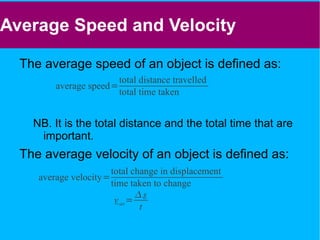
Average Speed and Velocity The average speed of an object is defined as: NB. It is the total distance and the total time that are important. The average velocity of an object is defined as:
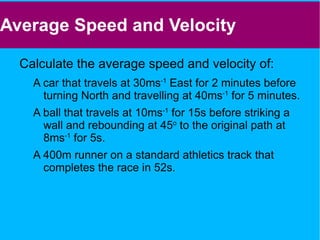
Average Speed and Velocity Calculate the average speed and velocity of: A car that travels at 30ms -1  East for 2 minutes before turning North and travelling at 40ms -1  for 5 minutes.
A ball that travels at 10ms -1  for 15s before striking a wall and rebounding at 45 o  to the original path at 8ms -1  for 5s.
A 400m runner on a standard athletics track that completes the race in 52s.
Instantaneous Motion Average values of displacement, velocity and acceleration give reasonable approximations of the behaviour of a system. They tell you what the system was like before and what it will be like afterwards. However, they do lack detail. They do not tell you how and object got from A to B only that it did. Instantaneous values for displacement, velocity and acceleration give a much clearer picture.
Instantaneous Motion Instantaneous displacement (position) is often simply measured. It can be recorded by various means including using cameras. Instantaneous velocity is calculated from a displacement time graph. As velocity is the rate of change of position it is the gradient of a displacement time graph Instantaneous acceleration is calculated from a velocity time graph. As acceleration is defined as the rate of change of velocity, it is found as the gradient of a velocity time graph.
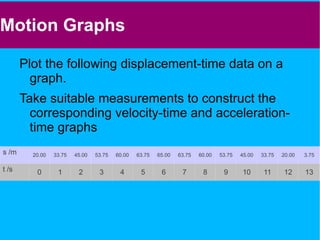
Motion Graphs Plot the following displacement-time data on a graph.
Take suitable measurements to construct the corresponding velocity-time and acceleration-time graphs s /m 20.00 33.75 45.00 53.75 60.00 63.75 65.00 63.75 60.00 53.75 45.00 33.75 20.00 3.75 t /s 0 1 2 3 4 5 6 7 8 9 10 11 12 13
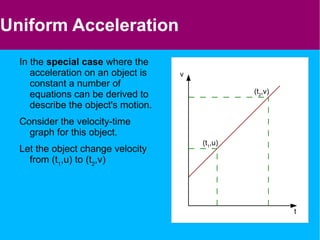
Uniform Acceleration In the  special case  where the acceleration on an object is constant a number of equations can be derived to describe the object's motion.
Consider the velocity-time graph for this object.
Let the object change velocity from (t 1 ,u) to (t 2 ,v) v t (t 1 ,u) (t 2 ,v)
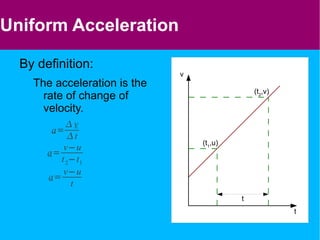
Uniform Acceleration By definition: The acceleration is the rate of change of velocity. v t (t 1 ,u) (t 2 ,v)
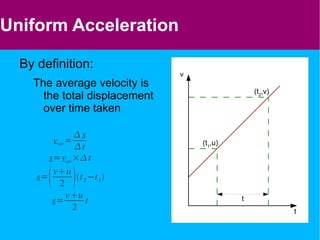
Uniform Acceleration By definition: The average velocity is the total displacement over time taken v t (t 1 ,u) (t 2 ,v)
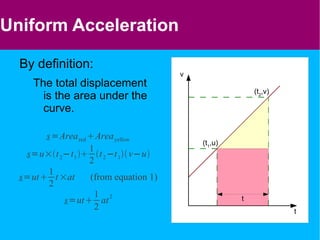
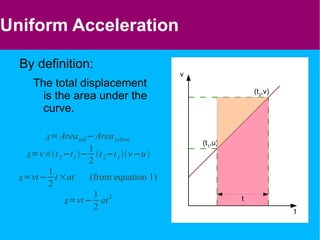
Uniform Acceleration By definition: The total displacement is the area under the curve. v t (t 1 ,u) (t 2 ,v)
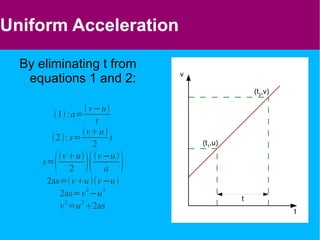
Uniform Acceleration By eliminating t from equations 1 and 2: v t (t 1 ,u) (t 2 ,v)
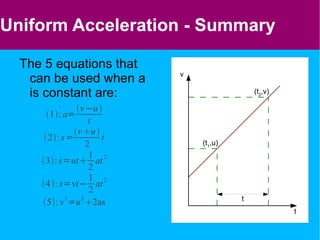
Uniform Acceleration - Summary The 5 equations that can be used when a is constant are: v t (t 1 ,u) (t 2 ,v)

2.1 linear motion

  • 1.
    Topic 2 -Mechanics 2.1 - Kinematics
  • 2.
    Velocity, Speed, AccelerationKinematics is the study of linear motion.
  • 3.
    There are anumber of key terms to define; Displacement – This is the distance from a given starting point to the current position in a straight line.
  • 4.
    Velocity – Thisis the speed of an object in a given direction Velocity is the rate of change of position Acceleration – This is the rate of change of velocity in a given direction.
  • 5.
    All three ofthese quantities are vectors.
  • 6.
    Average Speed andVelocity The average speed of an object is defined as: NB. It is the total distance and the total time that are important. The average velocity of an object is defined as:
  • 7.
    Average Speed andVelocity Calculate the average speed and velocity of: A car that travels at 30ms -1 East for 2 minutes before turning North and travelling at 40ms -1 for 5 minutes.
  • 8.
    A ball thattravels at 10ms -1 for 15s before striking a wall and rebounding at 45 o to the original path at 8ms -1 for 5s.
  • 9.
    A 400m runneron a standard athletics track that completes the race in 52s.
  • 10.
    Instantaneous Motion Averagevalues of displacement, velocity and acceleration give reasonable approximations of the behaviour of a system. They tell you what the system was like before and what it will be like afterwards. However, they do lack detail. They do not tell you how and object got from A to B only that it did. Instantaneous values for displacement, velocity and acceleration give a much clearer picture.
  • 11.
    Instantaneous Motion Instantaneousdisplacement (position) is often simply measured. It can be recorded by various means including using cameras. Instantaneous velocity is calculated from a displacement time graph. As velocity is the rate of change of position it is the gradient of a displacement time graph Instantaneous acceleration is calculated from a velocity time graph. As acceleration is defined as the rate of change of velocity, it is found as the gradient of a velocity time graph.
  • 12.
    Motion Graphs Plotthe following displacement-time data on a graph.
  • 13.
    Take suitable measurementsto construct the corresponding velocity-time and acceleration-time graphs s /m 20.00 33.75 45.00 53.75 60.00 63.75 65.00 63.75 60.00 53.75 45.00 33.75 20.00 3.75 t /s 0 1 2 3 4 5 6 7 8 9 10 11 12 13
  • 14.
    Uniform Acceleration Inthe special case where the acceleration on an object is constant a number of equations can be derived to describe the object's motion.
  • 15.
    Consider the velocity-timegraph for this object.
  • 16.
    Let the objectchange velocity from (t 1 ,u) to (t 2 ,v) v t (t 1 ,u) (t 2 ,v)
  • 17.
    Uniform Acceleration Bydefinition: The acceleration is the rate of change of velocity. v t (t 1 ,u) (t 2 ,v)
  • 18.
    Uniform Acceleration Bydefinition: The average velocity is the total displacement over time taken v t (t 1 ,u) (t 2 ,v)
  • 19.
    Uniform Acceleration Bydefinition: The total displacement is the area under the curve. v t (t 1 ,u) (t 2 ,v)
  • 20.
    Uniform Acceleration Bydefinition: The total displacement is the area under the curve. v t (t 1 ,u) (t 2 ,v)
  • 21.
    Uniform Acceleration Byeliminating t from equations 1 and 2: v t (t 1 ,u) (t 2 ,v)
  • 22.
    Uniform Acceleration -Summary The 5 equations that can be used when a is constant are: v t (t 1 ,u) (t 2 ,v)