2.4 Analysing Momentum
Learning Outcome :

   Define the momentum of an object
   Define momentum (p) as the product of mass
    ( m) and velocity (v), e. p=mv
   State the principle of conversation of
    momentum
   Describe applications of conservation of
    momentum.
   Momentum is a commonly used term in sports
   A team that has the
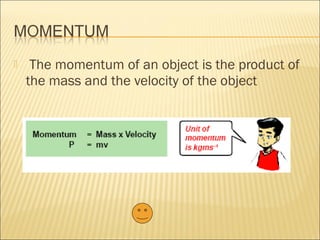
    The momentum of an object is the product of
    the mass and the velocity of the object
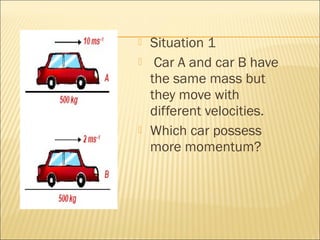
   Situation 1
    Car A and car B have
    the same mass but
    they move with
    different velocities.
   Which car possess
    more momentum?
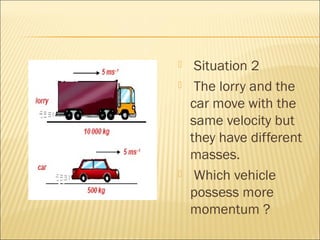
    Situation 2
    The lorry and the
    car move with the
    same velocity but
    they have different
    masses.
    Which vehicle
    possess more
    momentum ?
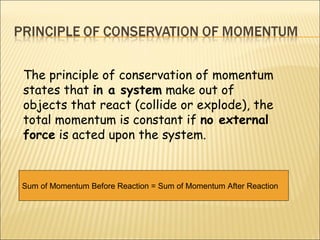
The principle of conservation of momentum
states that in a system make out of
objects that react (collide or explode), the
total momentum is constant if no external
force is acted upon the system.


Sum of Momentum Before Reaction = Sum of Momentum After Reaction
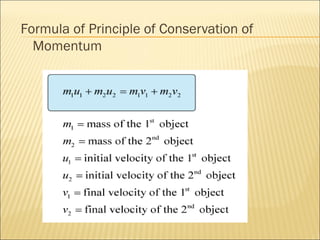
Formula of Principle of Conservation of
  Momentum
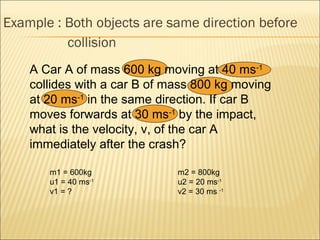
Example : Both objects are same direction before
          collision
    A Car A of mass 600 kg moving at 40 ms-1
    collides with a car B of mass 800 kg moving
    at 20 ms-1 in the same direction. If car B
    moves forwards at 30 ms-1 by the impact,
    what is the velocity, v, of the car A
    immediately after the crash?

       m1 = 600kg             m2 = 800kg
       u1 = 40 ms-1           u2 = 20 ms-1
       v1 = ?                 v2 = 30 ms -1
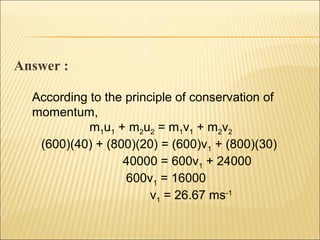
Answer :

  According to the principle of conservation of
  momentum,
            m1u1 + m2u2 = m1v1 + m2v2
   (600)(40) + (800)(20) = (600)v1 + (800)(30)
                  40000 = 600v1 + 24000
                   600v1 = 16000
                        v1 = 26.67 ms-1
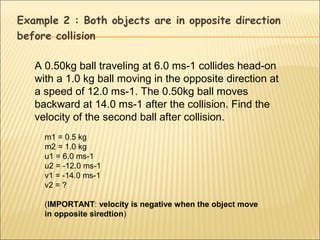
Example 2 : Both objects are in opposite direction
before collision

   A 0.50kg ball traveling at 6.0 ms-1 collides head-on
   with a 1.0 kg ball moving in the opposite direction at
   a speed of 12.0 ms-1. The 0.50kg ball moves
   backward at 14.0 ms-1 after the collision. Find the
   velocity of the second ball after collision.
     m1 = 0.5 kg
     m2 = 1.0 kg
     u1 = 6.0 ms-1
     u2 = -12.0 ms-1
     v1 = -14.0 ms-1
     v2 = ?

     (IMPORTANT: velocity is negative when the object move
     in opposite siredtion)
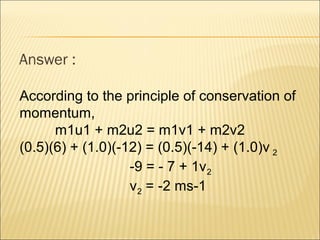
Answer :

According to the principle of conservation of
momentum,
      m1u1 + m2u2 = m1v1 + m2v2
(0.5)(6) + (1.0)(-12) = (0.5)(-14) + (1.0)v 2
                   -9 = - 7 + 1v 2
                   v2 = -2 ms-1
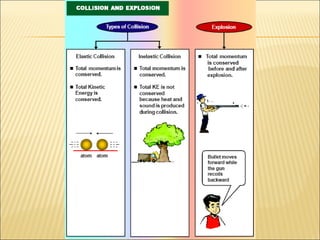
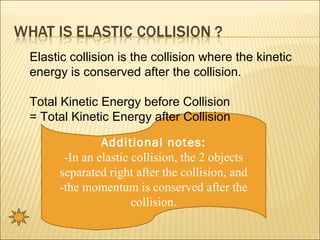
Elastic collision is the collision where the kinetic
energy is conserved after the collision.

Total Kinetic Energy before Collision
= Total Kinetic Energy after Collision

              Additional notes:
      -In an elastic collision, the 2 objects
     separated right after the collision, and
     -the momentum is conserved after the
                     collision.
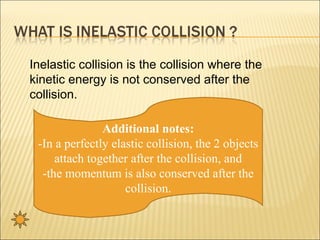
Inelastic collision is the collision where the
kinetic energy is not conserved after the
collision.

               Additional notes:
 -In a perfectly elastic collision, the 2 objects
     attach together after the collision, and
  -the momentum is also conserved after the
                    collision.
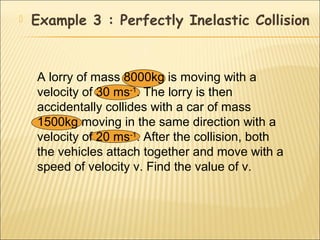
   Example 3 : Perfectly Inelastic Collision


    A lorry of mass 8000kg is moving with a
    velocity of 30 ms-1. The lorry is then
    accidentally collides with a car of mass
    1500kg moving in the same direction with a
    velocity of 20 ms-1. After the collision, both
    the vehicles attach together and move with a
    speed of velocity v. Find the value of v.
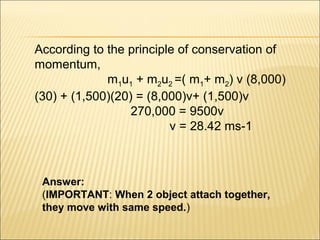
According to the principle of conservation of
momentum,
             m1u1 + m2u2 =( m1+ m2) v (8,000)
(30) + (1,500)(20) = (8,000)v+ (1,500)v
                  270,000 = 9500v
                         v = 28.42 ms-1


 Answer:
 (IMPORTANT: When 2 object attach together,
 they move with same speed.)
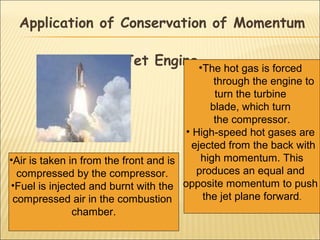
Application of Conservation of Momentum

                      : Jet Engine •The hot gas is forced
                                              through the engine to
                                              turn the turbine
                                             blade, which turn
                                              the compressor.
                                       • High-speed hot gases are
                                         ejected from the back with
•Air is taken in from the front and is     high momentum. This
  compressed by the compressor.           produces an equal and
•Fuel is injected and burnt with the opposite momentum to push
 compressed air in the combustion          the jet plane forward.
               chamber.

2.4 analysing momentum

  • 1.
  • 2.
    Learning Outcome :  Define the momentum of an object  Define momentum (p) as the product of mass ( m) and velocity (v), e. p=mv  State the principle of conversation of momentum  Describe applications of conservation of momentum.
  • 3.
    Momentum is a commonly used term in sports  A team that has the
  • 4.
    The momentum of an object is the product of the mass and the velocity of the object
  • 5.
    Situation 1  Car A and car B have the same mass but they move with different velocities.  Which car possess more momentum?
  • 6.
    Situation 2  The lorry and the car move with the same velocity but they have different masses.  Which vehicle possess more momentum ?
  • 7.
    The principle ofconservation of momentum states that in a system make out of objects that react (collide or explode), the total momentum is constant if no external force is acted upon the system. Sum of Momentum Before Reaction = Sum of Momentum After Reaction
  • 8.
    Formula of Principleof Conservation of Momentum
  • 9.
    Example : Bothobjects are same direction before collision A Car A of mass 600 kg moving at 40 ms-1 collides with a car B of mass 800 kg moving at 20 ms-1 in the same direction. If car B moves forwards at 30 ms-1 by the impact, what is the velocity, v, of the car A immediately after the crash? m1 = 600kg m2 = 800kg u1 = 40 ms-1 u2 = 20 ms-1 v1 = ? v2 = 30 ms -1
  • 10.
    Answer : According to the principle of conservation of momentum, m1u1 + m2u2 = m1v1 + m2v2 (600)(40) + (800)(20) = (600)v1 + (800)(30) 40000 = 600v1 + 24000 600v1 = 16000 v1 = 26.67 ms-1
  • 11.
    Example 2 :Both objects are in opposite direction before collision A 0.50kg ball traveling at 6.0 ms-1 collides head-on with a 1.0 kg ball moving in the opposite direction at a speed of 12.0 ms-1. The 0.50kg ball moves backward at 14.0 ms-1 after the collision. Find the velocity of the second ball after collision. m1 = 0.5 kg m2 = 1.0 kg u1 = 6.0 ms-1 u2 = -12.0 ms-1 v1 = -14.0 ms-1 v2 = ? (IMPORTANT: velocity is negative when the object move in opposite siredtion)
  • 12.
    Answer : According tothe principle of conservation of momentum, m1u1 + m2u2 = m1v1 + m2v2 (0.5)(6) + (1.0)(-12) = (0.5)(-14) + (1.0)v 2 -9 = - 7 + 1v 2 v2 = -2 ms-1
  • 14.
    Elastic collision isthe collision where the kinetic energy is conserved after the collision. Total Kinetic Energy before Collision = Total Kinetic Energy after Collision Additional notes: -In an elastic collision, the 2 objects separated right after the collision, and -the momentum is conserved after the collision.
  • 15.
    Inelastic collision isthe collision where the kinetic energy is not conserved after the collision. Additional notes: -In a perfectly elastic collision, the 2 objects attach together after the collision, and -the momentum is also conserved after the collision.
  • 16.
    Example 3 : Perfectly Inelastic Collision A lorry of mass 8000kg is moving with a velocity of 30 ms-1. The lorry is then accidentally collides with a car of mass 1500kg moving in the same direction with a velocity of 20 ms-1. After the collision, both the vehicles attach together and move with a speed of velocity v. Find the value of v.
  • 17.
    According to theprinciple of conservation of momentum, m1u1 + m2u2 =( m1+ m2) v (8,000) (30) + (1,500)(20) = (8,000)v+ (1,500)v 270,000 = 9500v v = 28.42 ms-1 Answer: (IMPORTANT: When 2 object attach together, they move with same speed.)
  • 18.
    Application of Conservationof Momentum : Jet Engine •The hot gas is forced through the engine to turn the turbine blade, which turn the compressor. • High-speed hot gases are ejected from the back with •Air is taken in from the front and is high momentum. This compressed by the compressor. produces an equal and •Fuel is injected and burnt with the opposite momentum to push compressed air in the combustion the jet plane forward. chamber.