Benign prostatic hyperplasia Prepared by Dr.sarwar N mahmood F.I.C.M.S( urology),F.E.B.U, E.A.U
 
 
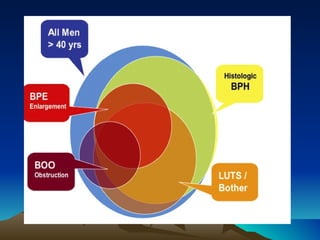
Incidence and epidemiology Histologic BPH 20% in men aged 41-50 , to 50% in men 51-60% and to over 90% in men older than 80. although clinical evidence of disease occurs less commonly. 55 year, approximately 25% of men report obstructive voiding symptoms (clinical BPH). at age of 75y, 50% of men complain of clinical BPH.
 
Risk factors Genetic predisposition  and some noted  racial  differences. 50% of men <60 year  who undergo surgery for BPH may have heritable form. first degree  male relatives of such patients carry an increase risk of  4 fold .  Etiology: Multifactorial
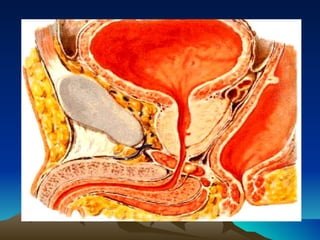
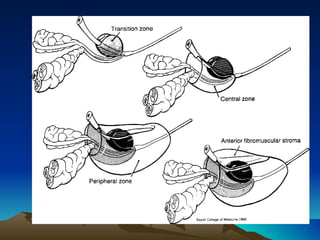
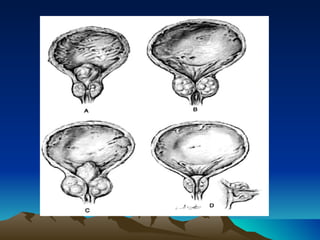
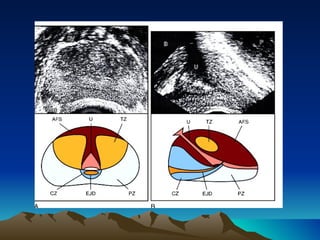
Pathology Fibro   musculo   glandular   hyperplasia
 
Clinical features  Divide into obstructive and irritative symptoms
Clinical features Irritative voiding symptoms Frequency Nocturia Urgency +/- incontinence A strong,  sudden desire  to urinate is caused by hyperactivity and irritability of the bladder, resulting from obstruction, In most circumstances, the patient is able to control temporarily the sudden need to void, but  loss of small amounts of urine  may occur (urgency incontinence).
Obstructive voiding symptoms Hesitancy  Hesitancy in initiating the urinary stream is one of the early symptoms of bladder outlet obstruction. As the degree of obstruction increases, hesitancy is prolonged and the patient often strains to force urine through the obstruction. Prostate obstruction and urethral stricture are common causes of this symptom.  Loss of Force and Decrease of Caliber of the Stream   Progressive loss of force and caliber of the urinary stream is noted as urethral resistance increases despite the generation of increased intravesical pressure. Terminal Dribbling  Terminal dribbling   becomes more and more noticeable as obstruction progresses and is a most distressing symptom.  Clinical features
Interruption of the Urinary Stream  Sense of Residual Urine  The patient often feels that urine is still in the bladder even after urination has been completed Acute Urinary Retention  Sudden inability to urinate may supervene. The patient experiences increasingly agonizing suprapubic pain associated with severe urgency and may dribble only small amounts of urine.  Chronic Urinary Retention   Chronic urinary retention may cause little discomfort to the patient . Constant dribbling of urine (paradoxic incontinence) may be experienced; it may be likened to water pouring over a dam.  .
Clinical findings physical examination  DRE focused neurological examination are performed on all patients. The nervous system is examined to detect a neurological lesions Distended bladder. DRE of BPH usually result in  smooth, firm, elastic enlargement of the prostate . Prostate  size  estimated by DRE does  not correlate  with severity of symptoms or  degree of obstruction . DRE can roughly estimate the true size of prostate and can’t assess the middle lobe.
investigation GUE  (to exclude infection or hematuria). Renal function test  (to asses renal function).  PSA Measurement to detect prostate cancer
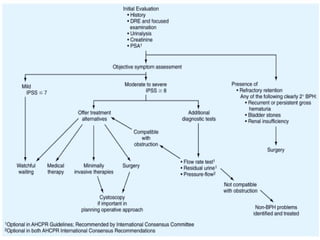
2. imaging: Upper tract imaging( IVP or renal ultrasound)  indicated in the presence of concomitant UTI ,or complication of BPH (e.g., hematuria UTI, renal insufficiency , hx of stone disease). 3. Measurement of flow rate, determination of post-void residual urine, and pressure-flow studies are considered optional . urinary flow rates; in normal circumstances with a full bladder a maximal flow of 20 mL/s should be achieved .
 
4.Additional Tests   Cystometrograms and Urodynamic profiles are reserved for patients with suspected  neurological disease  or those who have  failed prostate  surgery. 5.cystoscopy: Should always be done immediately  prior  to prostatectomy, whether it is being done transurethrally  or by open route to exclude a urethral stricture, bladder carcinoma, occasionally non opaque bladder stone
Complications of bladder outlet obstructions: 1.acute retention of urine 2. chronic retention with overflow incontinence 3.urinary tract infection. 4. vesical stone. 5.Hematuria. 6.Renal failure.
Treatment Treatment options range from watchful waiting to surgery. Absolute indications for surgery includes: Refractory urine retention (failure to void after catheter removal). Recurrent UTI from BPH. Recurrent gross hematuria from BPH. Bladder stone. Chronic retention and renal insufficiency. Large bladder diverticulum. Relative indications include failure of medical RX.
 
Watchful waiting For those with mild symptoms(symptom score 0-7), watchful waiting is the appropriate management.  Patient need to be seen 2-3 times per year to asses him for progression.
Medical treatment
 
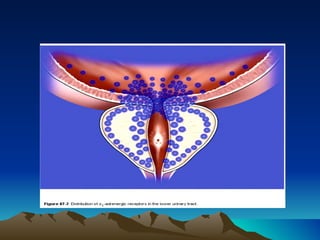
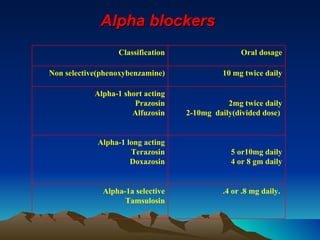
Alpha blockers   Classification Oral dosage Non selective(phenoxybenzamine) 10 mg twice daily Alpha-1 short acting Prazosin Alfuzosin 2mg twice daily 2-10mg  daily(divided dose)  Alpha-1 long acting Terazosin Doxazosin 5 or10mg daily 4 or 8 gm daily Alpha-1a selective Tamsulosin .4 or .8 mg daily.
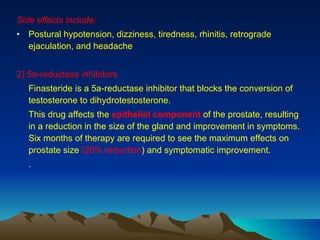
Side effects include: Postural hypotension, dizziness, tiredness, rhinitis, retrograde ejaculation, and headache 2) 5α-reductase inhibitors Finasteride is a 5a-reductase inhibitor that blocks the conversion of testosterone to dihydrotestosterone.  This drug affects the  epithelial component  of the prostate, resulting in a reduction in the size of the gland and improvement in symptoms. Six months of therapy are required to see the maximum effects on prostate size  (20% reduction ) and symptomatic improvement. .
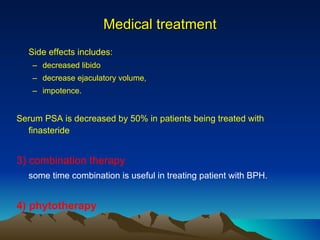
Side effects includes: decreased libido decrease ejaculatory volume, impotence.  Serum PSA is decreased by 50% in patients being treated with finasteride 3) combination therapy some time combination is useful in treating patient with BPH. 4) phytotherapy Medical treatment
conventional surgical therapy
 
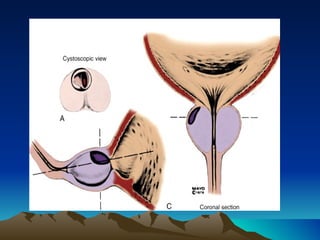
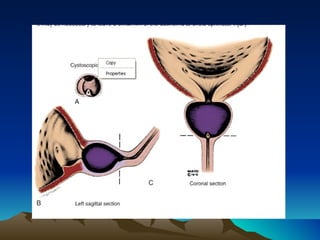
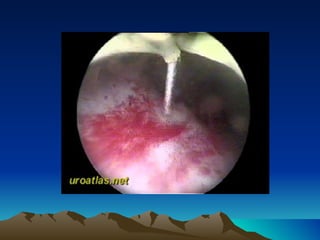
1.transurethral resection of prostate(TURP)
 
 
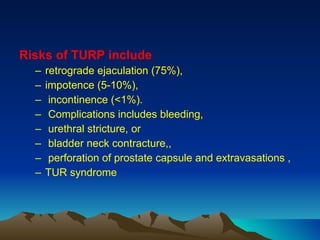
Risks of TURP include   retrograde ejaculation (75%),  impotence (5-10%), incontinence (<1%). Complications includes bleeding, urethral stricture, or bladder neck contracture,, perforation of prostate capsule and extravasations , TUR syndrome
  TUR syndrome   resulting from a hypervolemic, hyponatremic state due to absorption of the hypotonic irrigating solution.   Clinical manifestations of the TUR syndrome : nausea, vomiting, confusion, hypertension, bradycardia, and visual disturbances.  The risk of the TUR syndrome increases with resection times over 90 min. Treatment includes diuresis and, in severe cases, hypertonic saline administration
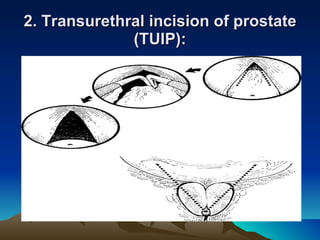
2. Transurethral incision of prostate (TUIP):
 
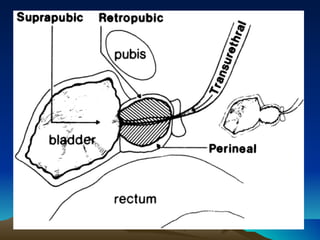
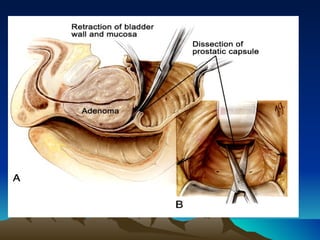
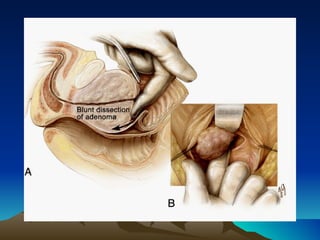
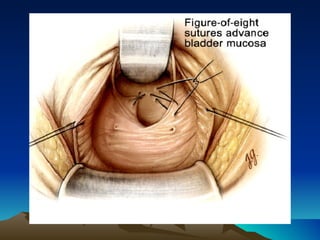
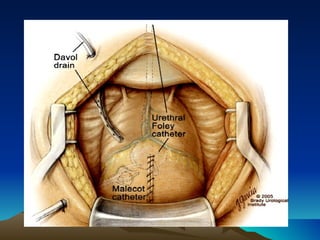
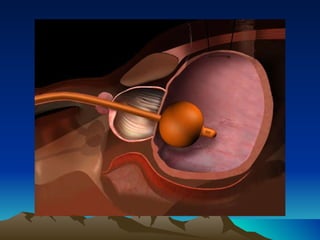
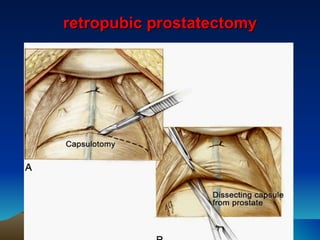
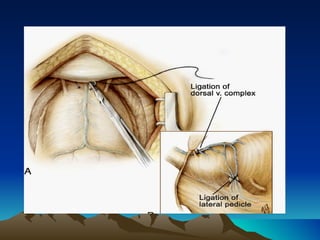
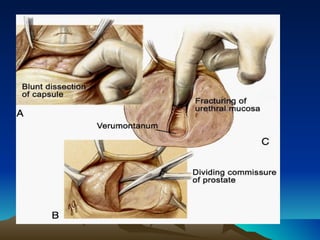
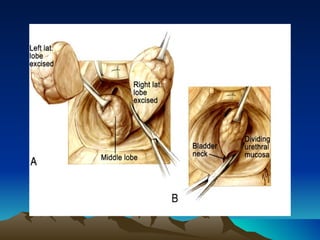
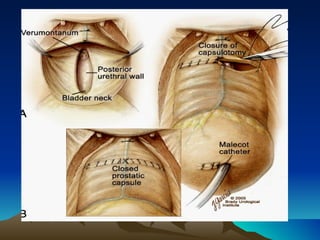
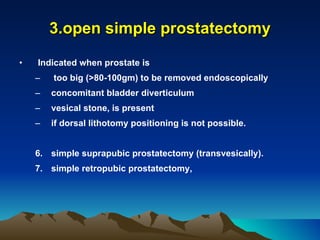
3.open simple prostatectomy Indicated when prostate is too big (>80-100gm) to be removed endoscopically concomitant bladder diverticulum  vesical stone, is present  if dorsal lithotomy positioning is not possible. simple suprapubic prostatectomy (transvesically). simple retropubic prostatectomy,
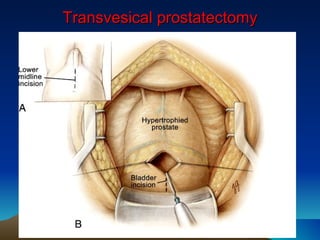
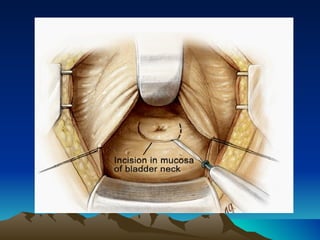
Transvesical prostatectomy


Transvesical prostatectomy
retropubic prostatectomy


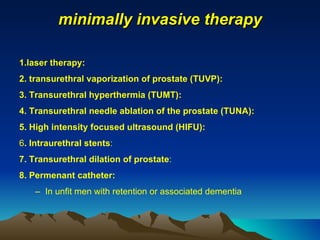
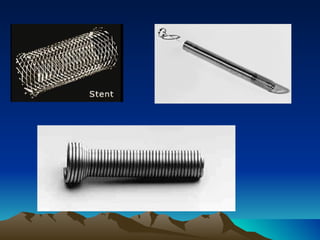
minimally invasive therapy 1.laser therapy: 2. transurethral vaporization of prostate (TUVP):  3. Transurethral hyperthermia (TUMT): 4. Transurethral needle ablation of the prostate (TUNA): 5. High intensity focused ultrasound (HIFU): 6 . Intraurethral stents : 7. Transurethral dilation of prostate : 8. Permenant catheter: In unfit men with retention or associated dementia
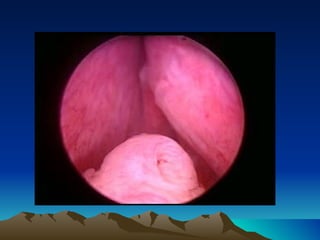
1.Laser therapy Advantages of laser surgery include (1) minimal blood loss. (2) rare instances of TUR syndrome. (3) ability to treat patients receiving anticoagulation therapy. (4) ability to be done as an outpatient procedure.
 
minimally invasive therapy 1.laser therapy: 2. transurethral vaporization of prostate (TUVP):   3. Transurethral hyperthermia (TUMT): 4. Transurethral needle ablation of the prostate (TUNA): 5. High intensity focused ultrasound (HIFU): 6 . Intraurethral stents : 7. Transurethral dilation of prostate : 8. Permenant catheter: In unfit men with retention or associated dementia
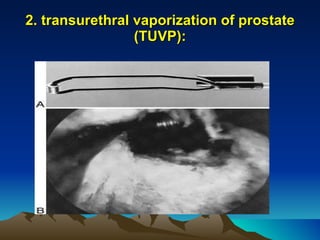
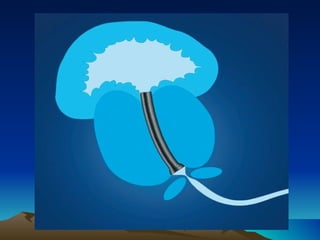
2. transurethral vaporization of prostate (TUVP):
minimally invasive therapy 1.laser therapy: 2. transurethral vaporization of prostate (TUVP):  3. Transurethral hyperthermia (TUMT): 4. Transurethral needle ablation of the prostate (TUNA): 5. High intensity focused ultrasound (HIFU): 6 . Intraurethral stents : 7. Transurethral dilation of prostate : 8. Permenant catheter: In unfit men with retention or associated dementia
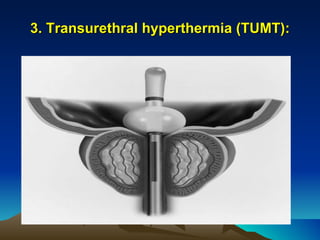
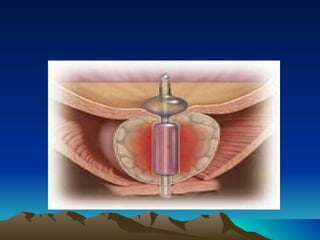
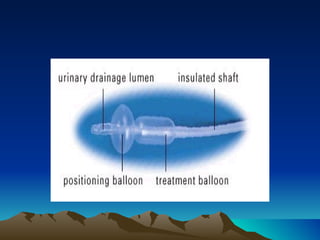
3. Transurethral hyperthermia (TUMT):
minimally invasive therapy 1.laser therapy: 2. transurethral vaporization of prostate (TUVP):  3. Transurethral hyperthermia (TUMT): 4. Transurethral needle ablation of the prostate (TUNA): 5. High intensity focused ultrasound (HIFU): 6 . Intraurethral stents : 7. Transurethral dilation of prostate : 8. Permenant catheter: In unfit men with retention or associated dementia
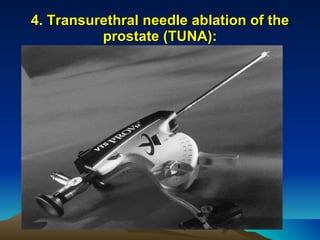
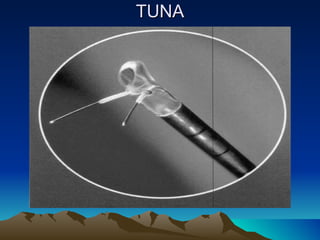
4. Transurethral needle ablation of the prostate (TUNA):
TUNA
minimally invasive therapy 1.laser therapy: 2. transurethral vaporization of prostate (TUVP):  3. Transurethral hyperthermia (TUMT): 4. Transurethral needle ablation of the prostate (TUNA): 5. High intensity focused ultrasound (HIFU): 6 . Intraurethral stents : 7. Transurethral dilation of prostate : 8. Permenant catheter: In unfit men with retention or associated dementia


Urology 5th year, 1st lecture (Dr. Sarwar)

  • 1.
    Benign prostatic hyperplasiaPrepared by Dr.sarwar N mahmood F.I.C.M.S( urology),F.E.B.U, E.A.U
  • 2.
  • 3.
  • 4.
    Incidence and epidemiologyHistologic BPH 20% in men aged 41-50 , to 50% in men 51-60% and to over 90% in men older than 80. although clinical evidence of disease occurs less commonly. 55 year, approximately 25% of men report obstructive voiding symptoms (clinical BPH). at age of 75y, 50% of men complain of clinical BPH.
  • 5.
  • 6.
    Risk factors Geneticpredisposition and some noted racial differences. 50% of men <60 year who undergo surgery for BPH may have heritable form. first degree male relatives of such patients carry an increase risk of 4 fold . Etiology: Multifactorial
  • 7.
    Pathology Fibro musculo glandular hyperplasia
  • 8.
  • 9.
    Clinical features Divide into obstructive and irritative symptoms
  • 10.
    Clinical features Irritativevoiding symptoms Frequency Nocturia Urgency +/- incontinence A strong, sudden desire to urinate is caused by hyperactivity and irritability of the bladder, resulting from obstruction, In most circumstances, the patient is able to control temporarily the sudden need to void, but loss of small amounts of urine may occur (urgency incontinence).
  • 11.
    Obstructive voiding symptomsHesitancy Hesitancy in initiating the urinary stream is one of the early symptoms of bladder outlet obstruction. As the degree of obstruction increases, hesitancy is prolonged and the patient often strains to force urine through the obstruction. Prostate obstruction and urethral stricture are common causes of this symptom. Loss of Force and Decrease of Caliber of the Stream Progressive loss of force and caliber of the urinary stream is noted as urethral resistance increases despite the generation of increased intravesical pressure. Terminal Dribbling Terminal dribbling becomes more and more noticeable as obstruction progresses and is a most distressing symptom. Clinical features
  • 12.
    Interruption of theUrinary Stream Sense of Residual Urine The patient often feels that urine is still in the bladder even after urination has been completed Acute Urinary Retention Sudden inability to urinate may supervene. The patient experiences increasingly agonizing suprapubic pain associated with severe urgency and may dribble only small amounts of urine. Chronic Urinary Retention Chronic urinary retention may cause little discomfort to the patient . Constant dribbling of urine (paradoxic incontinence) may be experienced; it may be likened to water pouring over a dam. .
  • 13.
    Clinical findings physicalexamination DRE focused neurological examination are performed on all patients. The nervous system is examined to detect a neurological lesions Distended bladder. DRE of BPH usually result in smooth, firm, elastic enlargement of the prostate . Prostate size estimated by DRE does not correlate with severity of symptoms or degree of obstruction . DRE can roughly estimate the true size of prostate and can’t assess the middle lobe.
  • 14.
    investigation GUE (to exclude infection or hematuria). Renal function test (to asses renal function). PSA Measurement to detect prostate cancer
  • 15.
    2. imaging: Uppertract imaging( IVP or renal ultrasound) indicated in the presence of concomitant UTI ,or complication of BPH (e.g., hematuria UTI, renal insufficiency , hx of stone disease). 3. Measurement of flow rate, determination of post-void residual urine, and pressure-flow studies are considered optional . urinary flow rates; in normal circumstances with a full bladder a maximal flow of 20 mL/s should be achieved .
  • 16.
  • 17.
    4.Additional Tests Cystometrograms and Urodynamic profiles are reserved for patients with suspected neurological disease or those who have failed prostate surgery. 5.cystoscopy: Should always be done immediately prior to prostatectomy, whether it is being done transurethrally or by open route to exclude a urethral stricture, bladder carcinoma, occasionally non opaque bladder stone
  • 18.
    Complications of bladderoutlet obstructions: 1.acute retention of urine 2. chronic retention with overflow incontinence 3.urinary tract infection. 4. vesical stone. 5.Hematuria. 6.Renal failure.
  • 19.
    Treatment Treatment optionsrange from watchful waiting to surgery. Absolute indications for surgery includes: Refractory urine retention (failure to void after catheter removal). Recurrent UTI from BPH. Recurrent gross hematuria from BPH. Bladder stone. Chronic retention and renal insufficiency. Large bladder diverticulum. Relative indications include failure of medical RX.
  • 20.
  • 21.
    Watchful waiting Forthose with mild symptoms(symptom score 0-7), watchful waiting is the appropriate management. Patient need to be seen 2-3 times per year to asses him for progression.
  • 22.
  • 23.
  • 24.
    Alpha blockers Classification Oral dosage Non selective(phenoxybenzamine) 10 mg twice daily Alpha-1 short acting Prazosin Alfuzosin 2mg twice daily 2-10mg daily(divided dose) Alpha-1 long acting Terazosin Doxazosin 5 or10mg daily 4 or 8 gm daily Alpha-1a selective Tamsulosin .4 or .8 mg daily.
  • 25.
    Side effects include:Postural hypotension, dizziness, tiredness, rhinitis, retrograde ejaculation, and headache 2) 5α-reductase inhibitors Finasteride is a 5a-reductase inhibitor that blocks the conversion of testosterone to dihydrotestosterone. This drug affects the epithelial component of the prostate, resulting in a reduction in the size of the gland and improvement in symptoms. Six months of therapy are required to see the maximum effects on prostate size (20% reduction ) and symptomatic improvement. .
  • 26.
    Side effects includes:decreased libido decrease ejaculatory volume, impotence. Serum PSA is decreased by 50% in patients being treated with finasteride 3) combination therapy some time combination is useful in treating patient with BPH. 4) phytotherapy Medical treatment
  • 27.
  • 28.
  • 29.
  • 30.
  • 31.
  • 32.
    Risks of TURPinclude retrograde ejaculation (75%), impotence (5-10%), incontinence (<1%). Complications includes bleeding, urethral stricture, or bladder neck contracture,, perforation of prostate capsule and extravasations , TUR syndrome
  • 33.
    TURsyndrome resulting from a hypervolemic, hyponatremic state due to absorption of the hypotonic irrigating solution. Clinical manifestations of the TUR syndrome : nausea, vomiting, confusion, hypertension, bradycardia, and visual disturbances. The risk of the TUR syndrome increases with resection times over 90 min. Treatment includes diuresis and, in severe cases, hypertonic saline administration
  • 34.
    2. Transurethral incisionof prostate (TUIP):
  • 35.
  • 36.
    3.open simple prostatectomyIndicated when prostate is too big (>80-100gm) to be removed endoscopically concomitant bladder diverticulum vesical stone, is present if dorsal lithotomy positioning is not possible. simple suprapubic prostatectomy (transvesically). simple retropubic prostatectomy,
  • 37.
  • 38.
  • 39.
  • 40.
  • 41.
  • 42.
  • 43.
  • 44.
  • 45.
  • 46.
  • 47.
  • 48.
  • 49.
  • 50.
    minimally invasive therapy1.laser therapy: 2. transurethral vaporization of prostate (TUVP): 3. Transurethral hyperthermia (TUMT): 4. Transurethral needle ablation of the prostate (TUNA): 5. High intensity focused ultrasound (HIFU): 6 . Intraurethral stents : 7. Transurethral dilation of prostate : 8. Permenant catheter: In unfit men with retention or associated dementia
  • 51.
    1.Laser therapy Advantagesof laser surgery include (1) minimal blood loss. (2) rare instances of TUR syndrome. (3) ability to treat patients receiving anticoagulation therapy. (4) ability to be done as an outpatient procedure.
  • 52.
  • 53.
    minimally invasive therapy1.laser therapy: 2. transurethral vaporization of prostate (TUVP): 3. Transurethral hyperthermia (TUMT): 4. Transurethral needle ablation of the prostate (TUNA): 5. High intensity focused ultrasound (HIFU): 6 . Intraurethral stents : 7. Transurethral dilation of prostate : 8. Permenant catheter: In unfit men with retention or associated dementia
  • 54.
    2. transurethral vaporizationof prostate (TUVP):
  • 55.
    minimally invasive therapy1.laser therapy: 2. transurethral vaporization of prostate (TUVP): 3. Transurethral hyperthermia (TUMT): 4. Transurethral needle ablation of the prostate (TUNA): 5. High intensity focused ultrasound (HIFU): 6 . Intraurethral stents : 7. Transurethral dilation of prostate : 8. Permenant catheter: In unfit men with retention or associated dementia
  • 56.
  • 57.
    minimally invasive therapy1.laser therapy: 2. transurethral vaporization of prostate (TUVP): 3. Transurethral hyperthermia (TUMT): 4. Transurethral needle ablation of the prostate (TUNA): 5. High intensity focused ultrasound (HIFU): 6 . Intraurethral stents : 7. Transurethral dilation of prostate : 8. Permenant catheter: In unfit men with retention or associated dementia
  • 58.
    4. Transurethral needleablation of the prostate (TUNA):
  • 59.
  • 60.
    minimally invasive therapy1.laser therapy: 2. transurethral vaporization of prostate (TUVP): 3. Transurethral hyperthermia (TUMT): 4. Transurethral needle ablation of the prostate (TUNA): 5. High intensity focused ultrasound (HIFU): 6 . Intraurethral stents : 7. Transurethral dilation of prostate : 8. Permenant catheter: In unfit men with retention or associated dementia
  • 61.
  • 62.
  • 63.
  • 64.