Benign Prostatic
Hyperplasia (BPH)
By,
Ms. Ekta. S. Patel,
I Yr M.Sc Nursing.
Also known as
•Benign Prostatic
Hypertrophy (BPH)
Benign
Prostatic
Hypertrophy/ Hyperplasia
Introduction:
• Benign prostatic hyperplasia (BPH) is a
benign enlargement of the prostate gland.
• In many patients older than 50 years, the
prostate gland enlarges, extending upward
into the bladder and obstructing the outflow
of urine by encroaching on the vesicle
orifice.
• This condition is known as benign prostatic
hyperplasia (BPH), the enlargement, or
hypertrophy, of the prostate.
• It is the most common urologic problem
in male adults.
• About 50% of all men in their lifetime
will develop BPH.
• Of these men, almost half of them will
have bothersome lower urinary tract
symptoms.
Definition:
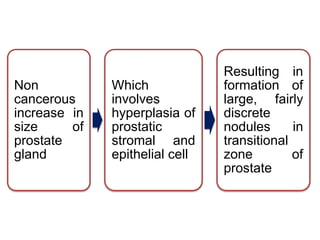
• It is defined as, “ noncancerous increase in
size of prostate gland which involves
hyperplasia of prostatic stromal and
epithelial cell resulting in formation of large,
fairly discrete nodules in transitional zone
of prostate, which push on and narrow the
urethra resulting in an increase resistance
to flow of urine from the bladder.”
Non
cancerous
increase in
size of
prostate
gland
Which
involves
hyperplasia of
prostatic
stromal and
epithelial cell
Resulting in
formation of
large, fairly
discrete
nodules in
transitional
zone of
prostate
Which push on
and narrow the
urethra
Resulting in an
increase
resistance to
flow of urine
from the bladder
Incidence:
• 50% of men having evidence of BPH
by age of 50years.
• 75% by age of 80 years.
Causes and risk
factors:
• Dihydrotestosterone (DHT).
• Risk factors for prostate gland
enlargement include:
• Aging. Prostate gland enlargement rarely
causes signs and symptoms in men
younger than age 40. About one-third of
men experience moderate to severe
symptoms by age 60 and about half do so
by age 80.
• Family history. Having a blood
relative, such as a father or brother,
with prostate problems means more
likely to have problems.
• Ethnic background. Prostate
enlargement is less common in Asian
men than in white and black men.
• Diabetes and heart disease.
Studies show that diabetes, as well
as heart disease and use of beta
blockers, might increase the risk of
BPH.
• Lifestyle. Obesity increases the risk
of BPH, while exercise can lower
your risk.
Clinical Manifestations:
• Hesitancy in starting urination
• Increased frequency of urination
• Nocturia
• Urgency
• Abdominal straining
• Decrease in volume and force of
urinary stream
• Interruption of urinary stream
• Dribbling.
• Sensation of incomplete emptying of
the bladder
• Acute urinary retention (more than 60
ml)
• Recurrent UTIS.
• Fatigue
• Anorexia
• Nausea and vomiting
• Pelvic discomfort and pain
• Ultimately azotemia
• Renal failure result with chronic
urinary retention and large residual
volumes
• Blood in the urine
Assessment and
Diagnostic Methods:
• History collection
• Physical examination- including
digital rectal examination(DRE)
• Urinalysis to screen for hematuria
and UTI.
• Prostate-specific antigen (PSA) level
is obtained if the patient has at least
a 10-year life expectancy and for
whom knowledge of the presence of
prostate cancer would change
management.
• Urinary flow-rate recording and the
measurement of postvoid residual (PVR)
urine.
• Urodynamic studies
• Urethrocystoscopy
• Ultrasound
• Complete blood studies, including clotting
studies.
Medical Management:
• The treatment plan depends on the cause,
severity of obstruction, and condition of the
patient. Treatment measures include the
following:
1. Immediate catheterization if patient cannot
void (an urologist may be consulted if an
ordinary catheter cannot be inserted).
2. A suprapubic cystostomy is sometimes
necessary.
3. “Watchful waiting” to monitor disease
progression.
Pharmacologic
Management
• Alpha blockers.
These medications relax bladder neck
muscles and muscle fibers in the prostate,
making urination easier. Alpha blockers —
which include alfuzosin (Uroxatral), doxazosin
(Cardura), tamsulosin (Flomax), and silodosin
(Rapaflo) — usually work quickly in men with
relatively small prostates.
• 5-alpha reductase inhibitors.
These medications shrink prostate by
preventing hormonal changes that
cause prostate growth. These
medications — which include finasteride
(Proscar) and dutasteride (Avodart) —
might take up to six months to be effective.
• Combination drug therapy.
Doctor might recommend taking an
alpha blocker and a 5-alpha
reductase inhibitor at the same time if
either medication alone isn't effective.
• Tadalafil (Cialis).
Studies suggest this medication, which is
often used to treat erectile dysfunction,
can also treat prostate enlargement.
However, this medication is not routinely
used for BPH and is generally prescribed
only to men who also experience erectile
dysfunction.
Surgical Management:
• Minimally
Invasive Therapy
1.
• Invasive Therapy
2.
(A). Minimally Invasive
Therapy.
Minimally invasive therapies are becoming
more common as an alternative to watchful
waiting and invasive treatment. They
generally do not require hospitalization or
catheterization.
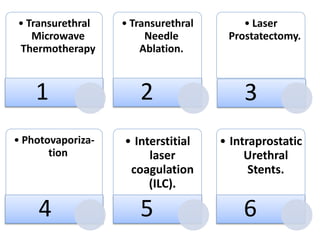
• Transurethral
Microwave
Thermotherapy
1
• Transurethral
Needle
Ablation.
2
• Laser
Prostatectomy.
3
• Photovaporiza-
tion
4
• Interstitial
laser
coagulation
(ILC).
5
• Intraprostatic
Urethral
Stents.
6
1. Transurethral Microwave
Thermotherapy.
• Transurethral microwave thermotherapy
(TUMT) is an outpatient procedure that
involves the delivery of microwaves
directly to the prostate through a
transurethral probe to raise the
temperature of the prostate tissue to about
113° F (45° C). The heat causes death of
tissue, thus relieving the obstruction.
• A rectal temperature probe is used during
the procedure to ensure that the
temperature is kept below 110° F (43.5°
C) to prevent rectal tissue damage.
• The procedure takes about 90 minutes.
Postoperative urinary retention is a
common complication. Thus the patient
is generally sent home with an indwelling
catheter for 2 to 7 days to maintain
urinary flow and to facilitate the passing
of small clots or necrotic tissue.
• Antibiotics, pain medication, and
bladder antispasmodic medications
are used tolerate and prevent post
procedure problems.
• The procedure is not appropriate for men
with rectal problems.
• Anticoagulant therapy should be stopped
10 days before treatment. Mild side
effects include occasional problems of
bladder spasm, hematuria, dysuria, and
retention.
2. Transurethral Needle
Ablation.
• Transurethral needle ablation (TUNA) is
another procedure that increases the
temperature of prostate tissue, thus causing
localized necrosis. TUNA differs from TUMT
in that low-wave radiofrequency is used to
heat the prostate. Only prostate tissue in
direct contact with the needle is affected,
thus allowing greater precision in removal of
the target tissue.
• The extent of tissue removed by this
process is determined by the amount
of tissue contact (needle length),
amount of energy delivered, and
duration of treatment.
• This procedure is performed in an outpatient
unit or physician’s office using local
anesthesia and IV or oral sedation. The
TUNA procedure lasts approximately 30
minutes. The patient typically experiences
little pain with an early return to regular
activities.
• Complications include urinary retention,
UTI, and irritative voiding symptoms (e.g.,
frequency, urgency, dysuria). Some
patients require a urinary catheter for a
short time. Patients often have hematuria
for up to a week.
3. Laser Prostatectomy.
• The use of laser therapy through visual or
ultrasound guidance is an effective alternative to
transurethral resection of the prostate (TURP) in
treating BPH.
• The laser beam is delivered transurethrally
through a fiber instrument and is used for cutting,
coagulation, and vaporization of prostatic tissue.
There are a variety of laser procedures using
different sources, wavelengths, and delivery
systems.
4. Photovaporization
• (PVP) uses a high-powergreen laser light
to vaporize prostate tissue. Improvements
in urine flow and symptoms are almost
immediate after the procedure. Bleeding is
minimal, and a catheter is usually inserted
for 24 to 48 hours afterward. PVP works
well for larger prostate glands.
5. Interstitial laser
coagulation (ILC).
• The prostate is viewed through a
cystoscope.
• A laser is used to quickly treat precise
areas of the enlarged
• prostate by placement of interstitial
light guides directly into the prostate
tissue.
6. Intraprostatic Urethral
Stents.
• Symptoms from obstruction in
patients who are poor surgical
candidates can be relieved with
intraprostatic urethral stents. The
stents are placed directly into the
prostatic tissue. Complications
include chronic pain, infection, and
encrustation.
(B). Invasive Therapy
(Surgery)
• Invasive treatment of symptomatic BPH
involves surgery. The choice of the
treatment approach depends on the size
and location of the prostatic enlargement
and patient factors such as age and
surgical risk.
1. Transurethral Resection
of the Prostate.
• Transurethral resection of the
prostate (TURP) is a surgical
procedure involving the removal of
prostate tissue using a resectoscope
inserted through the urethra.
• TURP has long been considered the gold
standard for surgical treatments of
obstructing BPH. Although this procedure
remains the most common operation
performed, the number of TURP procedures
done in recent years has declined due to
the development of less invasive
technologies.
• TURP is performed under a spinal or
general anesthetic and requires a 1-
to 2-day hospital stay. No external
surgical incision is made. A
resectoscope is inserted through the
urethra to excise and cauterize
obstructing prostatic tissue.
• A large three-way indwelling catheter with
a 30-mL balloon is inserted into the
bladder after the procedure to provide
hemostasis and to facilitate urinary
drainage. The bladder is irrigated, either
continuously or intermittently, usually for
the first 24 hours to prevent obstruction
from mucus and blood clots.
• The outcome for 80% to 90% of patients is
excellent, with marked improvements in
symptoms and urinary flow rates.
• Postoperative complications include
bleeding, clot retention, and dilutional
hyponatremia associated with irrigation.
2. Transurethral Incision of
the Prostate.
• Transurethral incision of the prostate (TUIP)
is a surgical procedure done under local
anesthesia for men with moderate to severe
symptoms. Several small incisions are made
into the prostate gland to expand the urethra,
which relieves pressure on the urethra and
improves urine flow.
• TUIP is an option for patients with a
small or moderately enlarged
prostate gland. TUIP has similar
patient outcomes to TURP in relieving
symptoms.
Nursing Assessment
• Obtain history of voiding symptoms,
including onset, frequency of day and
nighttime urination, presence of
urgency, dysuria, sensation of
incomplete bladder emptying, and
decreased force of stream.
Determine impact on quality of life.
• Perform rectal (palpate size, shape, and
consistency) and abdominal examination
to detect distended bladder, degree of
prostatic enlargement.
• Perform simple urodynamic measures
uroflowmetry and measurement of
postvoid residual, if indicated.
Patient Education and
Health Maintenance
• Explain to patient not undergoing
treatment the symptoms of
complications of BPH urinary
retention, cystitis, and increase in
irritative voiding symptoms.
Encourage reporting these problems.
• Advise patients with BPH to avoid
certain drugs that may impair voiding,
particularly OTC cold medicines
containing sympathomimetics such
as phenylpropanolamine.
• Advise patient that irritative voiding
symptoms do not immediately resolve
after relief of obstruction; symptoms
diminish over time.
• Tell patient postoperatively to avoid
sexual intercourse, straining at stool,
heavy lifting, and long periods of
sitting for 6 to 8 weeks after surgery,
until prostatic fossa is healed.
• Advise follow-up visits after treatment
because urethral stricture may occur
and regrowth of prostate is possible
after TURP.
• Be aware of herbal or natural•
products marketed for prostate
health.
Complications
• Acute urinary retention
• Involuntary bladder contractions
• Bladder diverticula
• Cystolithiasis
• Vesicoureteral reflux
• Hydroureter
• Hydronephrosis
• Gross hematuria
• UTI
Summary
Introduction
Definition
Incidence
Causes
Clinical manifestation
Diagnostic evaluation
Management
oMedical Management
oSurgical Management
oNursing Management
Complications
Thank You!!!

Benign prostatic hyperplasia (bph)

  • 1.
    Benign Prostatic Hyperplasia (BPH) By, Ms.Ekta. S. Patel, I Yr M.Sc Nursing.
  • 3.
    Also known as •BenignProstatic Hypertrophy (BPH)
  • 4.
  • 5.
  • 6.
  • 8.
    Introduction: • Benign prostatichyperplasia (BPH) is a benign enlargement of the prostate gland. • In many patients older than 50 years, the prostate gland enlarges, extending upward into the bladder and obstructing the outflow of urine by encroaching on the vesicle orifice.
  • 9.
    • This conditionis known as benign prostatic hyperplasia (BPH), the enlargement, or hypertrophy, of the prostate. • It is the most common urologic problem in male adults.
  • 10.
    • About 50%of all men in their lifetime will develop BPH. • Of these men, almost half of them will have bothersome lower urinary tract symptoms.
  • 11.
    Definition: • It isdefined as, “ noncancerous increase in size of prostate gland which involves hyperplasia of prostatic stromal and epithelial cell resulting in formation of large, fairly discrete nodules in transitional zone of prostate, which push on and narrow the urethra resulting in an increase resistance to flow of urine from the bladder.”
  • 12.
    Non cancerous increase in size of prostate gland Which involves hyperplasiaof prostatic stromal and epithelial cell Resulting in formation of large, fairly discrete nodules in transitional zone of prostate
  • 13.
    Which push on andnarrow the urethra Resulting in an increase resistance to flow of urine from the bladder
  • 14.
    Incidence: • 50% ofmen having evidence of BPH by age of 50years. • 75% by age of 80 years.
  • 15.
    Causes and risk factors: •Dihydrotestosterone (DHT).
  • 16.
    • Risk factorsfor prostate gland enlargement include: • Aging. Prostate gland enlargement rarely causes signs and symptoms in men younger than age 40. About one-third of men experience moderate to severe symptoms by age 60 and about half do so by age 80.
  • 17.
    • Family history.Having a blood relative, such as a father or brother, with prostate problems means more likely to have problems.
  • 18.
    • Ethnic background.Prostate enlargement is less common in Asian men than in white and black men.
  • 19.
    • Diabetes andheart disease. Studies show that diabetes, as well as heart disease and use of beta blockers, might increase the risk of BPH.
  • 20.
    • Lifestyle. Obesityincreases the risk of BPH, while exercise can lower your risk.
  • 21.
    Clinical Manifestations: • Hesitancyin starting urination • Increased frequency of urination • Nocturia • Urgency • Abdominal straining
  • 22.
    • Decrease involume and force of urinary stream • Interruption of urinary stream • Dribbling. • Sensation of incomplete emptying of the bladder
  • 23.
    • Acute urinaryretention (more than 60 ml) • Recurrent UTIS. • Fatigue • Anorexia
  • 24.
    • Nausea andvomiting • Pelvic discomfort and pain • Ultimately azotemia • Renal failure result with chronic urinary retention and large residual volumes • Blood in the urine
  • 25.
    Assessment and Diagnostic Methods: •History collection • Physical examination- including digital rectal examination(DRE) • Urinalysis to screen for hematuria and UTI.
  • 26.
    • Prostate-specific antigen(PSA) level is obtained if the patient has at least a 10-year life expectancy and for whom knowledge of the presence of prostate cancer would change management.
  • 27.
    • Urinary flow-raterecording and the measurement of postvoid residual (PVR) urine. • Urodynamic studies • Urethrocystoscopy • Ultrasound • Complete blood studies, including clotting studies.
  • 28.
    Medical Management: • Thetreatment plan depends on the cause, severity of obstruction, and condition of the patient. Treatment measures include the following:
  • 29.
    1. Immediate catheterizationif patient cannot void (an urologist may be consulted if an ordinary catheter cannot be inserted). 2. A suprapubic cystostomy is sometimes necessary. 3. “Watchful waiting” to monitor disease progression.
  • 30.
    Pharmacologic Management • Alpha blockers. Thesemedications relax bladder neck muscles and muscle fibers in the prostate, making urination easier. Alpha blockers — which include alfuzosin (Uroxatral), doxazosin (Cardura), tamsulosin (Flomax), and silodosin (Rapaflo) — usually work quickly in men with relatively small prostates.
  • 31.
    • 5-alpha reductaseinhibitors. These medications shrink prostate by preventing hormonal changes that cause prostate growth. These medications — which include finasteride (Proscar) and dutasteride (Avodart) — might take up to six months to be effective.
  • 32.
    • Combination drugtherapy. Doctor might recommend taking an alpha blocker and a 5-alpha reductase inhibitor at the same time if either medication alone isn't effective.
  • 33.
    • Tadalafil (Cialis). Studiessuggest this medication, which is often used to treat erectile dysfunction, can also treat prostate enlargement. However, this medication is not routinely used for BPH and is generally prescribed only to men who also experience erectile dysfunction.
  • 34.
  • 35.
  • 36.
    (A). Minimally Invasive Therapy. Minimallyinvasive therapies are becoming more common as an alternative to watchful waiting and invasive treatment. They generally do not require hospitalization or catheterization.
  • 37.
    • Transurethral Microwave Thermotherapy 1 • Transurethral Needle Ablation. 2 •Laser Prostatectomy. 3 • Photovaporiza- tion 4 • Interstitial laser coagulation (ILC). 5 • Intraprostatic Urethral Stents. 6
  • 38.
    1. Transurethral Microwave Thermotherapy. •Transurethral microwave thermotherapy (TUMT) is an outpatient procedure that involves the delivery of microwaves directly to the prostate through a transurethral probe to raise the temperature of the prostate tissue to about 113° F (45° C). The heat causes death of tissue, thus relieving the obstruction.
  • 39.
    • A rectaltemperature probe is used during the procedure to ensure that the temperature is kept below 110° F (43.5° C) to prevent rectal tissue damage.
  • 40.
    • The proceduretakes about 90 minutes. Postoperative urinary retention is a common complication. Thus the patient is generally sent home with an indwelling catheter for 2 to 7 days to maintain urinary flow and to facilitate the passing of small clots or necrotic tissue.
  • 41.
    • Antibiotics, painmedication, and bladder antispasmodic medications are used tolerate and prevent post procedure problems.
  • 42.
    • The procedureis not appropriate for men with rectal problems. • Anticoagulant therapy should be stopped 10 days before treatment. Mild side effects include occasional problems of bladder spasm, hematuria, dysuria, and retention.
  • 43.
    2. Transurethral Needle Ablation. •Transurethral needle ablation (TUNA) is another procedure that increases the temperature of prostate tissue, thus causing localized necrosis. TUNA differs from TUMT in that low-wave radiofrequency is used to heat the prostate. Only prostate tissue in direct contact with the needle is affected, thus allowing greater precision in removal of the target tissue.
  • 44.
    • The extentof tissue removed by this process is determined by the amount of tissue contact (needle length), amount of energy delivered, and duration of treatment.
  • 45.
    • This procedureis performed in an outpatient unit or physician’s office using local anesthesia and IV or oral sedation. The TUNA procedure lasts approximately 30 minutes. The patient typically experiences little pain with an early return to regular activities.
  • 46.
    • Complications includeurinary retention, UTI, and irritative voiding symptoms (e.g., frequency, urgency, dysuria). Some patients require a urinary catheter for a short time. Patients often have hematuria for up to a week.
  • 47.
    3. Laser Prostatectomy. •The use of laser therapy through visual or ultrasound guidance is an effective alternative to transurethral resection of the prostate (TURP) in treating BPH. • The laser beam is delivered transurethrally through a fiber instrument and is used for cutting, coagulation, and vaporization of prostatic tissue. There are a variety of laser procedures using different sources, wavelengths, and delivery systems.
  • 48.
    4. Photovaporization • (PVP)uses a high-powergreen laser light to vaporize prostate tissue. Improvements in urine flow and symptoms are almost immediate after the procedure. Bleeding is minimal, and a catheter is usually inserted for 24 to 48 hours afterward. PVP works well for larger prostate glands.
  • 49.
    5. Interstitial laser coagulation(ILC). • The prostate is viewed through a cystoscope. • A laser is used to quickly treat precise areas of the enlarged • prostate by placement of interstitial light guides directly into the prostate tissue.
  • 50.
    6. Intraprostatic Urethral Stents. •Symptoms from obstruction in patients who are poor surgical candidates can be relieved with intraprostatic urethral stents. The stents are placed directly into the prostatic tissue. Complications include chronic pain, infection, and encrustation.
  • 51.
    (B). Invasive Therapy (Surgery) •Invasive treatment of symptomatic BPH involves surgery. The choice of the treatment approach depends on the size and location of the prostatic enlargement and patient factors such as age and surgical risk.
  • 52.
    1. Transurethral Resection ofthe Prostate. • Transurethral resection of the prostate (TURP) is a surgical procedure involving the removal of prostate tissue using a resectoscope inserted through the urethra.
  • 54.
    • TURP haslong been considered the gold standard for surgical treatments of obstructing BPH. Although this procedure remains the most common operation performed, the number of TURP procedures done in recent years has declined due to the development of less invasive technologies.
  • 55.
    • TURP isperformed under a spinal or general anesthetic and requires a 1- to 2-day hospital stay. No external surgical incision is made. A resectoscope is inserted through the urethra to excise and cauterize obstructing prostatic tissue.
  • 56.
    • A largethree-way indwelling catheter with a 30-mL balloon is inserted into the bladder after the procedure to provide hemostasis and to facilitate urinary drainage. The bladder is irrigated, either continuously or intermittently, usually for the first 24 hours to prevent obstruction from mucus and blood clots.
  • 57.
    • The outcomefor 80% to 90% of patients is excellent, with marked improvements in symptoms and urinary flow rates. • Postoperative complications include bleeding, clot retention, and dilutional hyponatremia associated with irrigation.
  • 58.
    2. Transurethral Incisionof the Prostate. • Transurethral incision of the prostate (TUIP) is a surgical procedure done under local anesthesia for men with moderate to severe symptoms. Several small incisions are made into the prostate gland to expand the urethra, which relieves pressure on the urethra and improves urine flow.
  • 59.
    • TUIP isan option for patients with a small or moderately enlarged prostate gland. TUIP has similar patient outcomes to TURP in relieving symptoms.
  • 60.
    Nursing Assessment • Obtainhistory of voiding symptoms, including onset, frequency of day and nighttime urination, presence of urgency, dysuria, sensation of incomplete bladder emptying, and decreased force of stream. Determine impact on quality of life.
  • 61.
    • Perform rectal(palpate size, shape, and consistency) and abdominal examination to detect distended bladder, degree of prostatic enlargement. • Perform simple urodynamic measures uroflowmetry and measurement of postvoid residual, if indicated.
  • 62.
    Patient Education and HealthMaintenance • Explain to patient not undergoing treatment the symptoms of complications of BPH urinary retention, cystitis, and increase in irritative voiding symptoms. Encourage reporting these problems.
  • 63.
    • Advise patientswith BPH to avoid certain drugs that may impair voiding, particularly OTC cold medicines containing sympathomimetics such as phenylpropanolamine.
  • 64.
    • Advise patientthat irritative voiding symptoms do not immediately resolve after relief of obstruction; symptoms diminish over time.
  • 65.
    • Tell patientpostoperatively to avoid sexual intercourse, straining at stool, heavy lifting, and long periods of sitting for 6 to 8 weeks after surgery, until prostatic fossa is healed.
  • 66.
    • Advise follow-upvisits after treatment because urethral stricture may occur and regrowth of prostate is possible after TURP. • Be aware of herbal or natural• products marketed for prostate health.
  • 67.
    Complications • Acute urinaryretention • Involuntary bladder contractions • Bladder diverticula • Cystolithiasis • Vesicoureteral reflux
  • 68.
  • 70.
  • 71.