
BPH & Its Management
PRESENTED BY-
DR. NESAR AHMAD
MODERATOR-
DR. ABDUL HAQUE
D/O JARAHAT, AKTC, AMU
Introduction
• Benign Prostatic Hyperplasia is a chronic condition that
clinically manifests with LUTS
• It is a benign enlargement of the prostate gland
– age-related phenomenon in nearly all men, starting at approx
40 years of age.
• Histologically
– 10% of men in their 30s
– 20% in 40s
– 50-60% in 60s
– 80-90% in their 70s and 80s.
• Prostate size increases from
– 25g to 30g for men in 40s
– 30g to 40g in 50s
– 35g to 45g in 60s.
Anatomy of Prostate
Prostate is an accessory gland of the male reproductive system
It is fibro-muscular and glandular organ
In female the prostate is represented by the paraurethral glands
of Skene
Shape: Pyramidal shape, base-up, apex-down
Size: anteroposterior-2 cm, vertical-3 cm, width-4 cm
Situation: between neck of UB and urogenital diaphragm
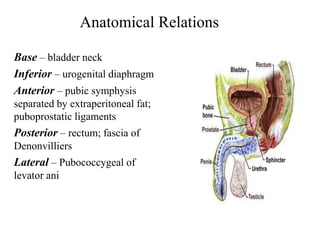
Anatomical Relations
Base – bladder neck
Inferior – urogenital diaphragm
Anterior – pubic symphysis
separated by extraperitoneal fat;
puboprostatic ligaments
Posterior – rectum; fascia of
Denonvilliers
Lateral – Pubococcygeal of
levator ani
Lobes of prostate: 5 in numbers
1 Anterior- anterior to prostatic urethra
1 Posterior- behiond the ejaculatory duct
1 Median- b/w urethra and ejaculatory duct
2 Lateral- lie one on each side of urethra
Capsules of prostate:
True capsule: formed by the condensation of the peripheral part of
the gland, fibromuscular in structure. It contains no plexus
False capsule: it is outside the true capsule and is derived from
pelvic fascia. Anteriorly the prostatic venous plexus is embedded in
it
Zones of prostate gland:
A) Inner smaller zone
1. zone of mucosal gland – involved in BPH
2. zone of submucosal glands
B) Outer larger zone – involved in malignancy
Arterial supply:
– Inferior vesical, middle rectal and internal pudendal arteries
Venous drainage:
– form a rich venous plexus and drain into the internal iliac vein
Lymphatic drainage:
- drain chiefly into internal Iliac LN and partly into external
iliac nodes
Innervations:
 from pelvic plexuses (inferior hypogastric plexus) formed by
the parasympathetic fibers that arise from the sacral levels(S2-
S4)
sympathetic fibers from the thoracolumbar levels (L1-L2).
Causes of BPH
• The exact cause of BPH is unclear.
• Two theories
1) Hormonal: serum testosterone levels decrease with
advancing age, however oestrogen levels are not
decreased equally, so the prostate enlarges because of
increased oestrogenic effects.
2) Neoplastic: acc.to this theory BPH is due to a benign
neoplasm i.e. adenoma or adenomyoma of the gland
BPH
Pathophysiology
• Slow and insidious changes occur in two main types—
overgrowth of the glandular elements and overgrowth of
connective tissue elements
• Initial hypertrophydetrussor decompensation poor
tonediverticula formationincreasing urine
volumehydronephrosisupper tract dysfunction
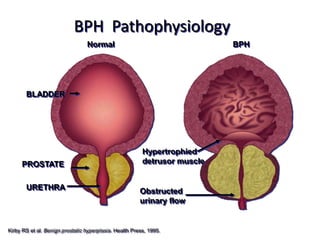
BPH Pathophysiology
Normal BPH
Hypertrophied
detrusor muscle
Obstructed
urinary flow
PROSTATE
BLADDER
URETHRA
Kirby RS et al. Benign prostatic hyperplasia. Health Press, 1995.
Effects of BPH
1. Changes in Urethra: prostatic urethra elongated, more above the
verumontanum about twice of its normal size. Normal posterior
curve may be so exaggerated that it recquires a curved catheter to
negotiate it.
2. Changes in Bladder: if BPH causes BOO, the detrusor muscle
hypertrophies ,due to this there will be (a) trabeculation of UB
wall, (b)hypertrophy of trigone, (c ) formation of diverticula
BPH may compress the prostatic venous plexus and causes
haematuria
3. Changes in ureters and kidneys: due to hypertrophy of
trigone and interureteric ridge, there is downward traction on the
intramural segmant of ureter. This causes hydroureter and
hydronephrosis
4. Changes in Sexual urge: in early stage of BPH there is
increased libido. Later on patient may become impotent
Lower Urinary Tract Symptoms (LUTS)
• Storage/ Irritative Symptoms
– Increased frequency
– Urgency ± urge
incontinence
– Nocturia
– Dysuria
– bladder pain
• Voiding/Obstructive Symptoms
– Hesitency
– Decreased urinary stream
– Straining to void
– Incomplete emptying
– Urinary retention
– Overflow incontinence
– Dribbling at the end of urination
– Pain or burning during urination
*LUTS does not equate to BPH but BPH is the most common
cause of LUTS*
Symptoms of BPH
Physical signs
General examination: performed carefully to exclude renal
insufficiency. Vitals should be examined
E/o Nervous system: to elimenate neurological lesions e.g. tabes
dorsalis, disseminated sclerosis, DM, Parkinson’s disease. Which
may give rise to bladder outflow obstruction
Local examination: Abdominal examination may only reveal a
full bladder at times
D.R.E.: when lateral lobes are enlarged, rectal examination detects
such enlargement. The surface of enlarged prostate is usually
smooth and convex and usually firm in consistency. A sulcus felt in
the midline b/w two lobes
4/25/2019 14
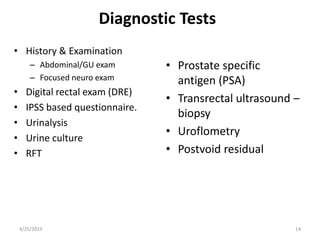
Diagnostic Tests
• History & Examination
– Abdominal/GU exam
– Focused neuro exam
• Digital rectal exam (DRE)
• IPSS based questionnaire.
• Urinalysis
• Urine culture
• RFT
• Prostate specific
antigen (PSA)
• Transrectal ultrasound –
biopsy
• Uroflometry
• Postvoid residual
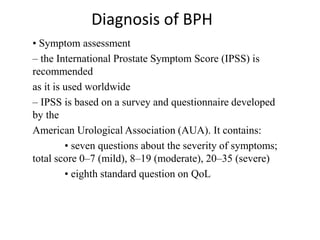
Diagnosis of BPH
• Symptom assessment
– the International Prostate Symptom Score (IPSS) is
recommended
as it is used worldwide
– IPSS is based on a survey and questionnaire developed
by the
American Urological Association (AUA). It contains:
• seven questions about the severity of symptoms;
total score 0–7 (mild), 8–19 (moderate), 20–35 (severe)
• eighth standard question on QoL
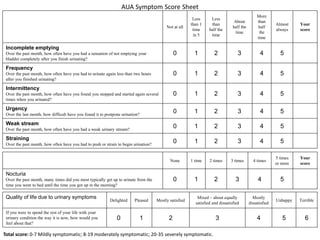
AUA Symptom Score Sheet
Not at all
Less
than 1
time
in 5
Less
than
half the
time
About
half the
time
More
than
half
the
time
Almost
always
Your
score
Incomplete emptying
Over the past month, how often have you had a sensation of not emptying your
bladder completely after you finish urinating?
0 1 2 3 4 5
Frequency
Over the past month, how often have you had to urinate again less than two hours
after you finished urinating?
0 1 2 3 4 5
Intermittency
Over the past month, how often have you found you stopped and started again several
times when you urinated?
0 1 2 3 4 5
Urgency
Over the last month, how difficult have you found it to postpone urination?
0 1 2 3 4 5
Weak stream
Over the past month, how often have you had a weak urinary stream?
0 1 2 3 4 5
Straining
Over the past month, how often have you had to push or strain to begin urination?
0 1 2 3 4 5
None 1 time 2 times 3 times 4 times
5 times
or more
Your
score
Nocturia
Over the past month, many times did you most typically get up to urinate from the
time you went to bed until the time you got up in the morning?
0 1 2 3 4 5
Quality of life due to urinary symptoms
Delighted Pleased Mostly satisfied
Mixed – about equally
satisfied and dissatisfied
Mostly
dissatisfied
Unhappy Terrible
If you were to spend the rest of your life with your
urinary condition the way it is now, how would you
feel about that?
0 1 2 3 4 5 6
Total score: 0-7 Mildly symptomatic; 8-19 moderately symptomatic; 20-35 severely symptomatic.
Investigations
Urine examination: to evaluate infection, presence of RBCs and
sugar. Urine should be cultured and tested for sensitivity to
different antibiotics
Blood examination: Serum urea, N.P.N. and creatinine should
be performed to assess renal function. Also haemogram should be
done.
Estimation of PSA: PSA is a glycoprotein measured by
immunoassay technique
Normal upper limit is about 4nmol/ml
in BPH the level goes upto 4-10nmol/ml
in Prostatic Ca the level goes upto 15-30nmol/ml
Cystourethroscopy: either done transurethrally or by the open
route to exclude a urethral stricture, a bladder Ca and the occasional
non-opaque vesical calculus.
USG: to detect size of prostate most accurately. Also indicate if
there is hydronephrosis or hydroureter.
Transrectal ultrasound scanning: used when the level of PSA is
high or the surface of prostate is hard and irregular. It offers
accurate estimation of prostaic size. More effective in detection of
associated early prostatic Ca.
Uroflowmetry
•Simple, non invasive, funnel or machine
•Calculates flow of urine over time
•Measures:- volume of urine voided
rate of flow in seconds
length of time until completion
•Converts information into a graph
•Helps evaluate function of LUT’S or determine if there is obstruction
Normal Values in Men
Average Flow Rate ;-
•Age 8-13 yrs = 12mls/sec
•Age 14-45 yrs = 21mls/sec
•Age 46-65yrs = 12mls/sec
•Age 66-80yrs = 9mls/sec
Management
• Watchful waiting & Life style modification
• Medical Therapies:
 Alpha 1-Blockers: e.g. Alfuzosin, Doxazosin, Tamsulosin,
Terazosin, Silodosin
 5- Alpha-reductase inhibitors (5-ARIs)
- Dutasteride
- Finasteride
 Combination Therapy
- Alpha blocker and 5-alpha-reductase inhibitor
- Alpha blocker and anticholinergics
 Anticholinergic Agents
 The Drug Speman has also been used with some success
• Surgery
Endoscope: TURP
Electrosurgical: TURVP
Laser: PVP, HoLRP, HoLEP
Ablation: TUMT, TUNA
Open surgery: open prostatectomy
Watchful Waiting and Behavioral
Modification
• Patients with mild symptoms of LUTS secondary to BPH (AUA-SI
score <8) and patients with moderate or severe symptoms (AUA-SI
score ≥8) who are not bothered by their LUTS should be managed using
a strategy of watchful waiting (active surveillance)
• Decrease caffeine, alcohol )diuretic effect(
• Avoid taking large amounts of fluid over a short period of time
• Void whenever the urge is present, every 2-3 hours
• Maintain normal fluid intake, do not restrict fluid
• Avoid bladder irritants to include dairy products, artificial sweeteners,
carbonated beverages
• decrease fluid intake at bedtime
• Regular prostatic massage may combat prostatic congestion
• Testosteron, if given, has produce improvement in the obstructive
symptoms by increasing vesical tone
Pharmacological Treatment
• Alpha-1-adrenergic antagonists
– appropriate and effective treatment alternatives for
patients with bothersome, moderate to severe LUTS
secondary to BPH (AUA-SI score ≥8(
– Relax smooth muscle in the bladder neck, prostate
capsule, and prostatic urethra
– Examples
• Terazosin, Doxazosin
– Initiate at bedtime (hypotension)
• Tamsulosin, Alfuzosin
– Lower potential to cause hypotension, syncope
– Major Side Effects
• HYPOTENSION!
• Ejaculatory Dysfunction (particularly Tamsulosin)
Pharmacological Treatment
• 5-alpha-reductase inhibitors
– 5-ARIs may be used to prevent progression of LUTS
secondary to BPH and to reduce the risk of urinary
retention and future prostate-related surgery
– Reduces the size of the prostate gland
– Prevents conversion of testosterone into
dihydrotestosterone (DHT)
– Indefinite treatment, as discontinuation may lead to
symptom relapse.
– Examples
• Finasteride (initiated and maintained at 5 mg once daily)
• Dutasteride
– Side Effects
• Sexual dysfunction
• Decrease PSA
Pharmacological Treatment
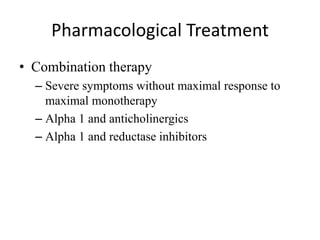
• Anticholinergics
– Use as monotherapy or in combination with alpha-
blockers for patients with predominantely irritated
symptoms related to overactive bladder
– Frequency, urgency, incontinence
– Examples
• Oxybutynin, Tolterodine
– Side Effects
• Dry mouth, blurred vision, tachycardia, constipation etc
Pharmacological Treatment
• Combination therapy
– Severe symptoms without maximal response to
maximal monotherapy
– Alpha 1 and anticholinergics
– Alpha 1 and reductase inhibitors
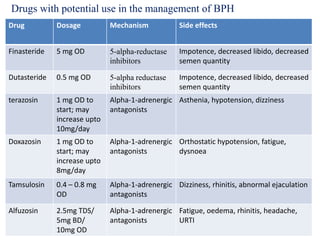
Drug Dosage Mechanism Side effects
Finasteride 5 mg OD 5-alpha-reductase
inhibitors
Impotence, decreased libido, decreased
semen quantity
Dutasteride 0.5 mg OD 5-alpha reductase
inhibitors
Impotence, decreased libido, decreased
semen quantity
terazosin 1 mg OD to
start; may
increase upto
10mg/day
Alpha-1-adrenergic
antagonists
Asthenia, hypotension, dizziness
Doxazosin 1 mg OD to
start; may
increase upto
8mg/day
Alpha-1-adrenergic
antagonists
Orthostatic hypotension, fatigue,
dysnoea
Tamsulosin 0.4 – 0.8 mg
OD
Alpha-1-adrenergic
antagonists
Dizziness, rhinitis, abnormal ejaculation
Alfuzosin 2.5mg TDS/
5mg BD/
10mg OD
Alpha-1-adrenergic
antagonists
Fatigue, oedema, rhinitis, headache,
URTI
Drugs with potential use in the management of BPH
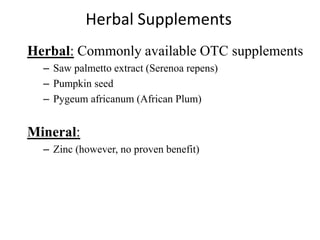
Herbal Supplements
Herbal: Commonly available OTC supplements
– Saw palmetto extract (Serenoa repens)
– Pumpkin seed
– Pygeum africanum (African Plum)
Mineral:
– Zinc (however, no proven benefit)
Surgical approach
Indications:
• Bothersome symptoms despite treatment
• Acute retention: in fit men with no other cause for retention
• Chronic retention: a residual urine of 200 mL or more, a raised blood
urea, hydroureter or hydronephrosis
• Complication of BOO: stone, infection and diverticulum formation
• Prostatism: considerable frequency of micturition in day and night,
dysuria, delay in starting and poor stream – all indicate for
prostatectomy
• Haemorrhage: venous bleeding from a ruptured vein overlying the
prostate will recquire prostectomy
• Surgical approach will depend on:
• Patient’s prostate size
• Surgeon’s judgment
• Patient’s co-morbidities
Surgical approaches for prostatectomy
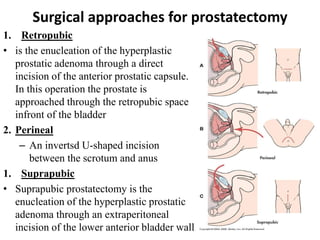
1. Retropubic
• is the enucleation of the hyperplastic
prostatic adenoma through a direct
incision of the anterior prostatic capsule.
In this operation the prostate is
approached through the retropubic space
infront of the bladder
2. Perineal
– An invertsd U-shaped incision
between the scrotum and anus
1. Suprapubic
• Suprapubic prostatectomy is the
enucleation of the hyperplastic prostatic
adenoma through an extraperitoneal
incision of the lower anterior bladder wall
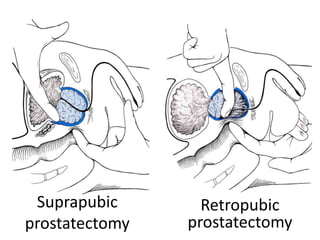
Suprapubic
prostatectomy
Retropubic
prostatectomy
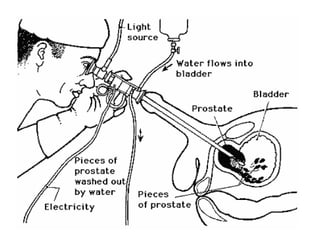
4. Transurethral Resection of Prostate (TURP)
TURP is “Gold Standard” of care for BPH
Uses an electrical “knife” to surgically cut and remove excess
prostate tissue
Effective in relieving symptoms and restoring urine flow
Strips of tissue are cut from the bladder neck down to the level of the
verumontanum
Cutting is performed by a high-frequency diathermy current, which
is applied across a loop mounted on the hand-held trigger of the
resectoscope.
Coagulation of bleeding points can be accurately achieved, and
damage to the external sphincter is avoided provided one uses the
verumontanum as a guide to the most distal point of the resection
Complications of Prostatectomy
1. Haemorrhage: reactionary haemorrhage occurs after any type of
prostatectomy, so the bladder promptly washed out using strict
aseptic technique
Secondary haemorrhage may occur around the 10th postoperative day due
to urinary infection or over exertion of the patient
2. Infection
3. Epididymitis
4. Renal failure
5. Stricture of urethra or baldder neck
6. Incontinence and perforation
7. Retrograde ejaculation and impotence
8. Cardiac and respiratory complication: pulmonary atelectasis,
pneumonia, MI, congestive cardiac failureand deep venous
thrombosis
9. Osteitis pubis
Minimally invasive therapy for BPH
• Transurethral balloon dilatation of the prostate (TUBDP)
• Transurethral incision of the prostate (TUIP)
• Intraprostatic stent
• Transurethral microwave thermotherapy (TUMT)
• Transurethral needle ablation of the prostate (TUNA)
• Transurethral electrovaporization of the prostate (TUVP)
• Photoselective vaporization of the prostate (PVP)
• Cryotherapy
• Transurethral ethanol ablation of the prostate (TEAP)
Minimally invasive therapy for BPH
• Transurethral laser-induced prostatectomy (TULIP)
• Visual laser ablation of the prostate (VLAP)
• Contact laser prostatectomy (CLP)
• Interstitial laser coagulation of the prostate (ILC)
• Holmium:YAG laser resection of the prostate (HoLRP)
• Holmium:YAG laser enucleation of the prostate (HoLEP)
• High-intensity focused ultrasound (HIFU)
• Coagulation
• Botulinum toxin-A injection of the prostate
TUIP:
 Indicated for the management of BOO secondary to a small
prostate esp. in younger men. The advantage is that antegrade
ejaculation is preserved
Intraurethral stents: are now being used in the management of
retention who are grossly unfit for surgery
Ballooof prostaten dilatation:
 It is simply performed, it is safe, minimal hospitalization, it
does not produced retrograde ejaculation.
 It is not used in decompensated bladder ,UTI, long large gland,
prominent middle lobe.
Hyperthermia:
 Prostate is susceptible to desiccation. Microwave hyperthermia
has been employed both transrectally and transurethrally.
Laser Treatment: two method has been used
 Non contact probe method: in this the probe is used to vaporize
the prostatic tissue under direct vision. Its advantage is that the
bleeding is minimal.
 Contact side-firing laser: in this method lower energy is used in
laser with greater penetration. This causes necrosis of the
prostate gland. The necrotic tissue slough out and a suprapubic
catheter is kept for several weeks for this purpose
BPH & its management by Dr Nesar

BPH & its management by Dr Nesar

  • 1.
    BPH & ItsManagement PRESENTED BY- DR. NESAR AHMAD MODERATOR- DR. ABDUL HAQUE D/O JARAHAT, AKTC, AMU
  • 2.
    Introduction • Benign ProstaticHyperplasia is a chronic condition that clinically manifests with LUTS • It is a benign enlargement of the prostate gland – age-related phenomenon in nearly all men, starting at approx 40 years of age. • Histologically – 10% of men in their 30s – 20% in 40s – 50-60% in 60s – 80-90% in their 70s and 80s. • Prostate size increases from – 25g to 30g for men in 40s – 30g to 40g in 50s – 35g to 45g in 60s.
  • 3.
    Anatomy of Prostate Prostateis an accessory gland of the male reproductive system It is fibro-muscular and glandular organ In female the prostate is represented by the paraurethral glands of Skene Shape: Pyramidal shape, base-up, apex-down Size: anteroposterior-2 cm, vertical-3 cm, width-4 cm Situation: between neck of UB and urogenital diaphragm
  • 4.
    Anatomical Relations Base –bladder neck Inferior – urogenital diaphragm Anterior – pubic symphysis separated by extraperitoneal fat; puboprostatic ligaments Posterior – rectum; fascia of Denonvilliers Lateral – Pubococcygeal of levator ani
  • 5.
    Lobes of prostate:5 in numbers 1 Anterior- anterior to prostatic urethra 1 Posterior- behiond the ejaculatory duct 1 Median- b/w urethra and ejaculatory duct 2 Lateral- lie one on each side of urethra Capsules of prostate: True capsule: formed by the condensation of the peripheral part of the gland, fibromuscular in structure. It contains no plexus False capsule: it is outside the true capsule and is derived from pelvic fascia. Anteriorly the prostatic venous plexus is embedded in it
  • 6.
    Zones of prostategland: A) Inner smaller zone 1. zone of mucosal gland – involved in BPH 2. zone of submucosal glands B) Outer larger zone – involved in malignancy
  • 7.
    Arterial supply: – Inferiorvesical, middle rectal and internal pudendal arteries Venous drainage: – form a rich venous plexus and drain into the internal iliac vein Lymphatic drainage: - drain chiefly into internal Iliac LN and partly into external iliac nodes Innervations:  from pelvic plexuses (inferior hypogastric plexus) formed by the parasympathetic fibers that arise from the sacral levels(S2- S4) sympathetic fibers from the thoracolumbar levels (L1-L2).
  • 8.
    Causes of BPH •The exact cause of BPH is unclear. • Two theories 1) Hormonal: serum testosterone levels decrease with advancing age, however oestrogen levels are not decreased equally, so the prostate enlarges because of increased oestrogenic effects. 2) Neoplastic: acc.to this theory BPH is due to a benign neoplasm i.e. adenoma or adenomyoma of the gland
  • 9.
    BPH Pathophysiology • Slow andinsidious changes occur in two main types— overgrowth of the glandular elements and overgrowth of connective tissue elements • Initial hypertrophydetrussor decompensation poor tonediverticula formationincreasing urine volumehydronephrosisupper tract dysfunction
  • 10.
    BPH Pathophysiology Normal BPH Hypertrophied detrusormuscle Obstructed urinary flow PROSTATE BLADDER URETHRA Kirby RS et al. Benign prostatic hyperplasia. Health Press, 1995.
  • 11.
    Effects of BPH 1.Changes in Urethra: prostatic urethra elongated, more above the verumontanum about twice of its normal size. Normal posterior curve may be so exaggerated that it recquires a curved catheter to negotiate it. 2. Changes in Bladder: if BPH causes BOO, the detrusor muscle hypertrophies ,due to this there will be (a) trabeculation of UB wall, (b)hypertrophy of trigone, (c ) formation of diverticula BPH may compress the prostatic venous plexus and causes haematuria 3. Changes in ureters and kidneys: due to hypertrophy of trigone and interureteric ridge, there is downward traction on the intramural segmant of ureter. This causes hydroureter and hydronephrosis 4. Changes in Sexual urge: in early stage of BPH there is increased libido. Later on patient may become impotent
  • 12.
    Lower Urinary TractSymptoms (LUTS) • Storage/ Irritative Symptoms – Increased frequency – Urgency ± urge incontinence – Nocturia – Dysuria – bladder pain • Voiding/Obstructive Symptoms – Hesitency – Decreased urinary stream – Straining to void – Incomplete emptying – Urinary retention – Overflow incontinence – Dribbling at the end of urination – Pain or burning during urination *LUTS does not equate to BPH but BPH is the most common cause of LUTS* Symptoms of BPH
  • 13.
    Physical signs General examination:performed carefully to exclude renal insufficiency. Vitals should be examined E/o Nervous system: to elimenate neurological lesions e.g. tabes dorsalis, disseminated sclerosis, DM, Parkinson’s disease. Which may give rise to bladder outflow obstruction Local examination: Abdominal examination may only reveal a full bladder at times D.R.E.: when lateral lobes are enlarged, rectal examination detects such enlargement. The surface of enlarged prostate is usually smooth and convex and usually firm in consistency. A sulcus felt in the midline b/w two lobes
  • 14.
    4/25/2019 14 Diagnostic Tests •History & Examination – Abdominal/GU exam – Focused neuro exam • Digital rectal exam (DRE) • IPSS based questionnaire. • Urinalysis • Urine culture • RFT • Prostate specific antigen (PSA) • Transrectal ultrasound – biopsy • Uroflometry • Postvoid residual
  • 15.
    Diagnosis of BPH •Symptom assessment – the International Prostate Symptom Score (IPSS) is recommended as it is used worldwide – IPSS is based on a survey and questionnaire developed by the American Urological Association (AUA). It contains: • seven questions about the severity of symptoms; total score 0–7 (mild), 8–19 (moderate), 20–35 (severe) • eighth standard question on QoL
  • 16.
    AUA Symptom ScoreSheet Not at all Less than 1 time in 5 Less than half the time About half the time More than half the time Almost always Your score Incomplete emptying Over the past month, how often have you had a sensation of not emptying your bladder completely after you finish urinating? 0 1 2 3 4 5 Frequency Over the past month, how often have you had to urinate again less than two hours after you finished urinating? 0 1 2 3 4 5 Intermittency Over the past month, how often have you found you stopped and started again several times when you urinated? 0 1 2 3 4 5 Urgency Over the last month, how difficult have you found it to postpone urination? 0 1 2 3 4 5 Weak stream Over the past month, how often have you had a weak urinary stream? 0 1 2 3 4 5 Straining Over the past month, how often have you had to push or strain to begin urination? 0 1 2 3 4 5 None 1 time 2 times 3 times 4 times 5 times or more Your score Nocturia Over the past month, many times did you most typically get up to urinate from the time you went to bed until the time you got up in the morning? 0 1 2 3 4 5 Quality of life due to urinary symptoms Delighted Pleased Mostly satisfied Mixed – about equally satisfied and dissatisfied Mostly dissatisfied Unhappy Terrible If you were to spend the rest of your life with your urinary condition the way it is now, how would you feel about that? 0 1 2 3 4 5 6 Total score: 0-7 Mildly symptomatic; 8-19 moderately symptomatic; 20-35 severely symptomatic.
  • 17.
    Investigations Urine examination: toevaluate infection, presence of RBCs and sugar. Urine should be cultured and tested for sensitivity to different antibiotics Blood examination: Serum urea, N.P.N. and creatinine should be performed to assess renal function. Also haemogram should be done. Estimation of PSA: PSA is a glycoprotein measured by immunoassay technique Normal upper limit is about 4nmol/ml in BPH the level goes upto 4-10nmol/ml in Prostatic Ca the level goes upto 15-30nmol/ml
  • 18.
    Cystourethroscopy: either donetransurethrally or by the open route to exclude a urethral stricture, a bladder Ca and the occasional non-opaque vesical calculus. USG: to detect size of prostate most accurately. Also indicate if there is hydronephrosis or hydroureter. Transrectal ultrasound scanning: used when the level of PSA is high or the surface of prostate is hard and irregular. It offers accurate estimation of prostaic size. More effective in detection of associated early prostatic Ca.
  • 19.
    Uroflowmetry •Simple, non invasive,funnel or machine •Calculates flow of urine over time •Measures:- volume of urine voided rate of flow in seconds length of time until completion •Converts information into a graph •Helps evaluate function of LUT’S or determine if there is obstruction Normal Values in Men Average Flow Rate ;- •Age 8-13 yrs = 12mls/sec •Age 14-45 yrs = 21mls/sec •Age 46-65yrs = 12mls/sec •Age 66-80yrs = 9mls/sec
  • 20.
    Management • Watchful waiting& Life style modification • Medical Therapies:  Alpha 1-Blockers: e.g. Alfuzosin, Doxazosin, Tamsulosin, Terazosin, Silodosin  5- Alpha-reductase inhibitors (5-ARIs) - Dutasteride - Finasteride  Combination Therapy - Alpha blocker and 5-alpha-reductase inhibitor - Alpha blocker and anticholinergics  Anticholinergic Agents  The Drug Speman has also been used with some success
  • 21.
    • Surgery Endoscope: TURP Electrosurgical:TURVP Laser: PVP, HoLRP, HoLEP Ablation: TUMT, TUNA Open surgery: open prostatectomy
  • 22.
    Watchful Waiting andBehavioral Modification • Patients with mild symptoms of LUTS secondary to BPH (AUA-SI score <8) and patients with moderate or severe symptoms (AUA-SI score ≥8) who are not bothered by their LUTS should be managed using a strategy of watchful waiting (active surveillance) • Decrease caffeine, alcohol )diuretic effect( • Avoid taking large amounts of fluid over a short period of time • Void whenever the urge is present, every 2-3 hours • Maintain normal fluid intake, do not restrict fluid • Avoid bladder irritants to include dairy products, artificial sweeteners, carbonated beverages • decrease fluid intake at bedtime • Regular prostatic massage may combat prostatic congestion • Testosteron, if given, has produce improvement in the obstructive symptoms by increasing vesical tone
  • 23.
    Pharmacological Treatment • Alpha-1-adrenergicantagonists – appropriate and effective treatment alternatives for patients with bothersome, moderate to severe LUTS secondary to BPH (AUA-SI score ≥8( – Relax smooth muscle in the bladder neck, prostate capsule, and prostatic urethra – Examples • Terazosin, Doxazosin – Initiate at bedtime (hypotension) • Tamsulosin, Alfuzosin – Lower potential to cause hypotension, syncope – Major Side Effects • HYPOTENSION! • Ejaculatory Dysfunction (particularly Tamsulosin)
  • 24.
    Pharmacological Treatment • 5-alpha-reductaseinhibitors – 5-ARIs may be used to prevent progression of LUTS secondary to BPH and to reduce the risk of urinary retention and future prostate-related surgery – Reduces the size of the prostate gland – Prevents conversion of testosterone into dihydrotestosterone (DHT) – Indefinite treatment, as discontinuation may lead to symptom relapse. – Examples • Finasteride (initiated and maintained at 5 mg once daily) • Dutasteride – Side Effects • Sexual dysfunction • Decrease PSA
  • 25.
    Pharmacological Treatment • Anticholinergics –Use as monotherapy or in combination with alpha- blockers for patients with predominantely irritated symptoms related to overactive bladder – Frequency, urgency, incontinence – Examples • Oxybutynin, Tolterodine – Side Effects • Dry mouth, blurred vision, tachycardia, constipation etc
  • 26.
    Pharmacological Treatment • Combinationtherapy – Severe symptoms without maximal response to maximal monotherapy – Alpha 1 and anticholinergics – Alpha 1 and reductase inhibitors
  • 27.
    Drug Dosage MechanismSide effects Finasteride 5 mg OD 5-alpha-reductase inhibitors Impotence, decreased libido, decreased semen quantity Dutasteride 0.5 mg OD 5-alpha reductase inhibitors Impotence, decreased libido, decreased semen quantity terazosin 1 mg OD to start; may increase upto 10mg/day Alpha-1-adrenergic antagonists Asthenia, hypotension, dizziness Doxazosin 1 mg OD to start; may increase upto 8mg/day Alpha-1-adrenergic antagonists Orthostatic hypotension, fatigue, dysnoea Tamsulosin 0.4 – 0.8 mg OD Alpha-1-adrenergic antagonists Dizziness, rhinitis, abnormal ejaculation Alfuzosin 2.5mg TDS/ 5mg BD/ 10mg OD Alpha-1-adrenergic antagonists Fatigue, oedema, rhinitis, headache, URTI Drugs with potential use in the management of BPH
  • 28.
    Herbal Supplements Herbal: Commonlyavailable OTC supplements – Saw palmetto extract (Serenoa repens) – Pumpkin seed – Pygeum africanum (African Plum) Mineral: – Zinc (however, no proven benefit)
  • 29.
    Surgical approach Indications: • Bothersomesymptoms despite treatment • Acute retention: in fit men with no other cause for retention • Chronic retention: a residual urine of 200 mL or more, a raised blood urea, hydroureter or hydronephrosis • Complication of BOO: stone, infection and diverticulum formation • Prostatism: considerable frequency of micturition in day and night, dysuria, delay in starting and poor stream – all indicate for prostatectomy • Haemorrhage: venous bleeding from a ruptured vein overlying the prostate will recquire prostectomy • Surgical approach will depend on: • Patient’s prostate size • Surgeon’s judgment • Patient’s co-morbidities
  • 30.
    Surgical approaches forprostatectomy 1. Retropubic • is the enucleation of the hyperplastic prostatic adenoma through a direct incision of the anterior prostatic capsule. In this operation the prostate is approached through the retropubic space infront of the bladder 2. Perineal – An invertsd U-shaped incision between the scrotum and anus 1. Suprapubic • Suprapubic prostatectomy is the enucleation of the hyperplastic prostatic adenoma through an extraperitoneal incision of the lower anterior bladder wall
  • 31.
  • 32.
    4. Transurethral Resectionof Prostate (TURP) TURP is “Gold Standard” of care for BPH Uses an electrical “knife” to surgically cut and remove excess prostate tissue Effective in relieving symptoms and restoring urine flow Strips of tissue are cut from the bladder neck down to the level of the verumontanum Cutting is performed by a high-frequency diathermy current, which is applied across a loop mounted on the hand-held trigger of the resectoscope. Coagulation of bleeding points can be accurately achieved, and damage to the external sphincter is avoided provided one uses the verumontanum as a guide to the most distal point of the resection
  • 34.
    Complications of Prostatectomy 1.Haemorrhage: reactionary haemorrhage occurs after any type of prostatectomy, so the bladder promptly washed out using strict aseptic technique Secondary haemorrhage may occur around the 10th postoperative day due to urinary infection or over exertion of the patient 2. Infection 3. Epididymitis 4. Renal failure 5. Stricture of urethra or baldder neck 6. Incontinence and perforation 7. Retrograde ejaculation and impotence 8. Cardiac and respiratory complication: pulmonary atelectasis, pneumonia, MI, congestive cardiac failureand deep venous thrombosis 9. Osteitis pubis
  • 35.
    Minimally invasive therapyfor BPH • Transurethral balloon dilatation of the prostate (TUBDP) • Transurethral incision of the prostate (TUIP) • Intraprostatic stent • Transurethral microwave thermotherapy (TUMT) • Transurethral needle ablation of the prostate (TUNA) • Transurethral electrovaporization of the prostate (TUVP) • Photoselective vaporization of the prostate (PVP) • Cryotherapy • Transurethral ethanol ablation of the prostate (TEAP)
  • 36.
    Minimally invasive therapyfor BPH • Transurethral laser-induced prostatectomy (TULIP) • Visual laser ablation of the prostate (VLAP) • Contact laser prostatectomy (CLP) • Interstitial laser coagulation of the prostate (ILC) • Holmium:YAG laser resection of the prostate (HoLRP) • Holmium:YAG laser enucleation of the prostate (HoLEP) • High-intensity focused ultrasound (HIFU) • Coagulation • Botulinum toxin-A injection of the prostate
  • 37.
    TUIP:  Indicated forthe management of BOO secondary to a small prostate esp. in younger men. The advantage is that antegrade ejaculation is preserved Intraurethral stents: are now being used in the management of retention who are grossly unfit for surgery Ballooof prostaten dilatation:  It is simply performed, it is safe, minimal hospitalization, it does not produced retrograde ejaculation.  It is not used in decompensated bladder ,UTI, long large gland, prominent middle lobe.
  • 38.
    Hyperthermia:  Prostate issusceptible to desiccation. Microwave hyperthermia has been employed both transrectally and transurethrally. Laser Treatment: two method has been used  Non contact probe method: in this the probe is used to vaporize the prostatic tissue under direct vision. Its advantage is that the bleeding is minimal.  Contact side-firing laser: in this method lower energy is used in laser with greater penetration. This causes necrosis of the prostate gland. The necrotic tissue slough out and a suprapubic catheter is kept for several weeks for this purpose