

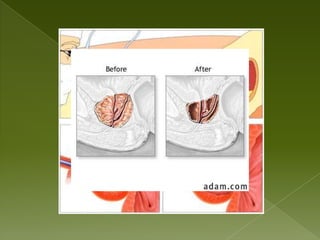






Filamer Christian CollegeCollege of NursingRoxas City  NCM 102 RENAL and URINARY SYSTEM Topics: Benign Prostatic HypertrophyUrinary IncontinenceNephrotic Syndrome Prepared byGroup 4- WATSON Aspera, Liza MarieBuencuchillo, KristineCesar, RoneilLacdo-o, Krisanta CamilleMontealegre, Lynmar KayeNobleza, ArgieTan, Jazel Cheene  Submitted to Miss Shenell A. Delfin, RNNCM 102 Lecturer    March 11, 2010Benign Prostatic Hypertrophy Enlargement of the prostate gland.
 The term BPH is a misnomer because the actual change is a hyperplasia & not hypertrophy.
 BPH becomes a disorder when enlargement obstructs the urinary channel and causes changes in the urinary tract with associated manifestations. The etiology of BPH is unclear.Two factors necessary for BPH to occur are:	(1) endocrine control (DHT)	(2) agingHormonal Alteration: The relative roles of androgen & estrogen in inducing BPH, however , are complex & not completely understood.- Prostatic enlargement eventually occurs in 80% of men. By age 50, about 50% of men have some degree of BPH. - Increased in African American men and is lower in Asians.
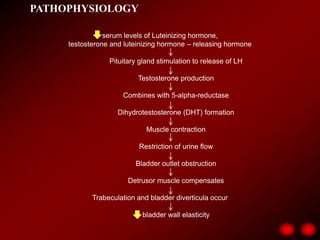
PATHOPHYSIOLOGYserum levels of Luteinizing hormone,testosterone and luteinizing hormone – releasing hormone    	Pituitary gland stimulation to release of LH 	Testosterone production 	Combines with 5-alpha-reductase 	Dihydrotestosterone (DHT) formation 	Muscle contraction	Restriction of urine flow 	Bladder outlet obstruction	Detrusor muscle compensates Trabeculation and bladder diverticula occur  	bladder wall elasticity
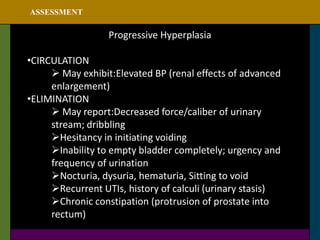
ASSESSMENTProgressive HyperplasiaCIRCULATION
 May exhibit:Elevated BP (renal effects of advanced enlargement)
ELIMINATION
 May report:Decreased force/caliber of urinary stream; dribbling
Hesitancy in initiating voiding
Inability to empty bladder completely; urgency and frequency of urination
Nocturia, dysuria, hematuria, Sitting to void
Recurrent UTIs, history of calculi (urinary stasis)
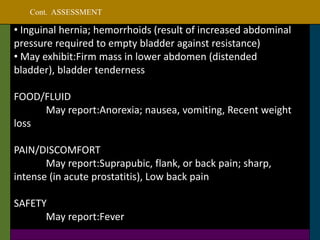
Chronic constipation (protrusion of prostate into rectum) Cont.  ASSESSMENT Inguinal hernia; hemorrhoids (result of increased abdominal pressure required to empty bladder against resistance)
 May exhibit:Firm mass in lower abdomen (distended bladder), bladder tenderness FOOD/FLUID 	May report:Anorexia; nausea, vomiting, Recent weight lossPAIN/DISCOMFORT 	May report:Suprapubic, flank, or back pain; sharp, intense (in acute prostatitis), Low back pain SAFETY 	May report:Fever
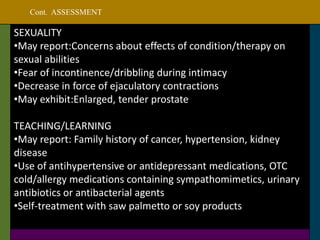
Cont.  ASSESSMENTSEXUALITY May report:Concerns about effects of condition/therapy on sexual abilities
Fear of incontinence/dribbling during intimacy
Decrease in force of ejaculatory contractions
May exhibit:Enlarged, tender prostate TEACHING/LEARNING May report: Family history of cancer, hypertension, kidney disease
Use of antihypertensive or antidepressant medications, OTC cold/allergy medications containing sympathomimetics, urinary antibiotics or antibacterial agents
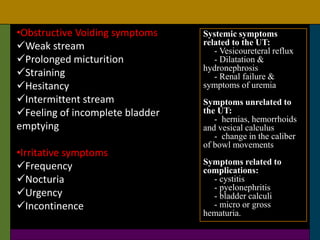
Self-treatment with saw palmetto or soy products Obstructive Voiding symptoms
Weak stream
Prolonged micturition
Straining
Hesitancy
Intermittent stream
Feeling of incomplete bladder emptying
Irritative symptoms
Frequency
Nocturia
Urgency
Incontinence Systemic symptoms related to the UT:     - Vesicoureteral reflux     - Dilatation & hydronephrosis     - Renal failure & symptoms of uremiaSymptoms unrelated to the UT:     -  hernias, hemorrhoids and vesical calculus     -  change in the caliber of bowl movementsSymptoms related to complications:     - cystitis     - pyelonephritis     - bladder calculi      - micro or gross hematuria.
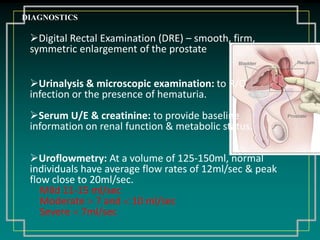
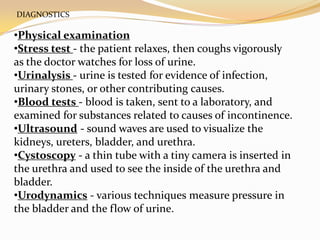
DIAGNOSTICSDigital Rectal Examination (DRE) – smooth, firm, symmetric enlargement of the prostate
Urinalysis & microscopic examination: to R/O infection or the presence of hematuria.
Serum U/E & creatinine: to provide baseline information on renal function & metabolic status.
Uroflowmetry: At a volume of 125-150ml, normal individuals have average flow rates of 12ml/sec & peak flow close to 20ml/sec.Mild 11-15 ml/sec    Moderate  7 and  10 ml/sec    Severe  7ml/sec
Residual Urine: estimated by U/S or catheterizations. Volumes >150 ml are considered significant since they constitute approximately one-third of normal bladder volume
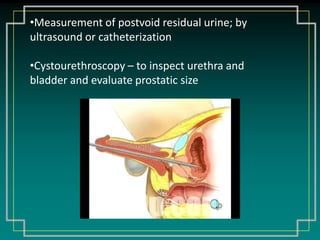
Serum Prostate-Specific Antigen (PSA) – to rule out cancer, but may also be elevated in BPH Optional diagnostics for further evaluation:Urodynamics –measures peak urine flow rate, voiding time and volume, and status of the bladder’s ability to effectively contract.Measurement of postvoid residual urine; by ultrasound or catheterization
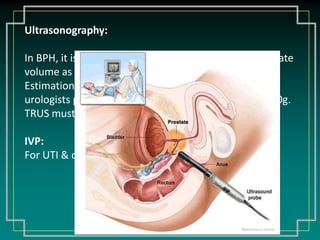
Cystourethroscopy – to inspect urethra and bladder and evaluate prostatic size Ultrasonography:In BPH, it is most useful for measuring bladder & prostate volume as well as residual urine.Estimation of prostatic size is important because most urologists prefer to perform TURP for glands under 100g.TRUS must be used as it is more accurate. IVP:For UTI & complications of BPH
COMPLICATIONS Acute urinary retention, involuntary bladder contractions, bladder diverticula, and cystolithiasis
Vesicourethral reflux, hydroureter, hydronephrosis
Gross hematuria, urinary tract infection
Renal impairment
Bladder stones
Bladder damage (trabeculations, cellules, diverticula)
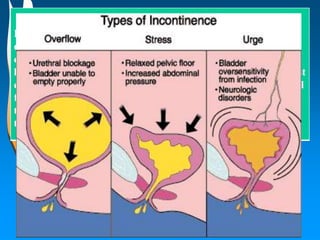
Overflow incontinence Interventions:Facilitating Urinary EliminationProvide privacy and time for patient to void
Assist with catheter introduction with guidewire or by way of suprapubic cystostomy as indicated.
Monitor intake and output
Maintain patency of catheter
Administer medications as ordered, and monitor for and teach patient about side effects.
Assess for and teach patient to report hematuria, signs of infectionPatient education and Health MaintenanceNURSING DIAGNOSIS1. Impaired Urinary Elimination related to obstruction of urethra.Rationale: BPH causes an enlargement that forms like a capsule in the urinary bladder that occludes urine flow causing changes in urinary elimination. The patient experiences manifestations such as frequency, urgency, hesitancy, change in stream, incontinence, retention and nocturia.

Urinary disorders watson (2)

  • 1.
    Filamer Christian CollegeCollegeof NursingRoxas City  NCM 102 RENAL and URINARY SYSTEM Topics: Benign Prostatic HypertrophyUrinary IncontinenceNephrotic Syndrome Prepared byGroup 4- WATSON Aspera, Liza MarieBuencuchillo, KristineCesar, RoneilLacdo-o, Krisanta CamilleMontealegre, Lynmar KayeNobleza, ArgieTan, Jazel Cheene  Submitted to Miss Shenell A. Delfin, RNNCM 102 Lecturer    March 11, 2010Benign Prostatic Hypertrophy Enlargement of the prostate gland.
  • 2.
    The termBPH is a misnomer because the actual change is a hyperplasia & not hypertrophy.
  • 3.
    BPH becomesa disorder when enlargement obstructs the urinary channel and causes changes in the urinary tract with associated manifestations. The etiology of BPH is unclear.Two factors necessary for BPH to occur are: (1) endocrine control (DHT) (2) agingHormonal Alteration: The relative roles of androgen & estrogen in inducing BPH, however , are complex & not completely understood.- Prostatic enlargement eventually occurs in 80% of men. By age 50, about 50% of men have some degree of BPH. - Increased in African American men and is lower in Asians.
  • 4.
    PATHOPHYSIOLOGYserum levels ofLuteinizing hormone,testosterone and luteinizing hormone – releasing hormone   Pituitary gland stimulation to release of LH  Testosterone production  Combines with 5-alpha-reductase  Dihydrotestosterone (DHT) formation  Muscle contraction Restriction of urine flow  Bladder outlet obstruction Detrusor muscle compensates Trabeculation and bladder diverticula occur   bladder wall elasticity
  • 5.
  • 6.
    May exhibit:ElevatedBP (renal effects of advanced enlargement)
  • 7.
  • 8.
    May report:Decreasedforce/caliber of urinary stream; dribbling
  • 9.
  • 10.
    Inability to emptybladder completely; urgency and frequency of urination
  • 11.
  • 12.
    Recurrent UTIs, historyof calculi (urinary stasis)
  • 13.
    Chronic constipation (protrusionof prostate into rectum) Cont. ASSESSMENT Inguinal hernia; hemorrhoids (result of increased abdominal pressure required to empty bladder against resistance)
  • 14.
    May exhibit:Firmmass in lower abdomen (distended bladder), bladder tenderness FOOD/FLUID May report:Anorexia; nausea, vomiting, Recent weight lossPAIN/DISCOMFORT May report:Suprapubic, flank, or back pain; sharp, intense (in acute prostatitis), Low back pain SAFETY May report:Fever
  • 15.
    Cont. ASSESSMENTSEXUALITYMay report:Concerns about effects of condition/therapy on sexual abilities
  • 16.
  • 17.
    Decrease in forceof ejaculatory contractions
  • 18.
    May exhibit:Enlarged, tenderprostate TEACHING/LEARNING May report: Family history of cancer, hypertension, kidney disease
  • 19.
    Use of antihypertensiveor antidepressant medications, OTC cold/allergy medications containing sympathomimetics, urinary antibiotics or antibacterial agents
  • 20.
    Self-treatment with sawpalmetto or soy products Obstructive Voiding symptoms
  • 21.
  • 22.
  • 23.
  • 24.
  • 25.
  • 26.
    Feeling of incompletebladder emptying
  • 27.
  • 28.
  • 29.
  • 30.
  • 31.
    Incontinence Systemic symptomsrelated to the UT: - Vesicoureteral reflux - Dilatation & hydronephrosis - Renal failure & symptoms of uremiaSymptoms unrelated to the UT: - hernias, hemorrhoids and vesical calculus - change in the caliber of bowl movementsSymptoms related to complications: - cystitis - pyelonephritis - bladder calculi - micro or gross hematuria.
  • 32.
    DIAGNOSTICSDigital Rectal Examination(DRE) – smooth, firm, symmetric enlargement of the prostate
  • 33.
    Urinalysis & microscopicexamination: to R/O infection or the presence of hematuria.
  • 34.
    Serum U/E &creatinine: to provide baseline information on renal function & metabolic status.
  • 35.
    Uroflowmetry: At avolume of 125-150ml, normal individuals have average flow rates of 12ml/sec & peak flow close to 20ml/sec.Mild 11-15 ml/sec Moderate  7 and  10 ml/sec Severe  7ml/sec
  • 36.
    Residual Urine: estimatedby U/S or catheterizations. Volumes >150 ml are considered significant since they constitute approximately one-third of normal bladder volume
  • 37.
    Serum Prostate-Specific Antigen(PSA) – to rule out cancer, but may also be elevated in BPH Optional diagnostics for further evaluation:Urodynamics –measures peak urine flow rate, voiding time and volume, and status of the bladder’s ability to effectively contract.Measurement of postvoid residual urine; by ultrasound or catheterization
  • 38.
    Cystourethroscopy – toinspect urethra and bladder and evaluate prostatic size Ultrasonography:In BPH, it is most useful for measuring bladder & prostate volume as well as residual urine.Estimation of prostatic size is important because most urologists prefer to perform TURP for glands under 100g.TRUS must be used as it is more accurate. IVP:For UTI & complications of BPH
  • 39.
    COMPLICATIONS Acute urinary retention,involuntary bladder contractions, bladder diverticula, and cystolithiasis
  • 40.
  • 41.
    Gross hematuria, urinarytract infection
  • 42.
  • 43.
  • 44.
    Bladder damage (trabeculations,cellules, diverticula)
  • 45.
    Overflow incontinence Interventions:FacilitatingUrinary EliminationProvide privacy and time for patient to void
  • 46.
    Assist with catheterintroduction with guidewire or by way of suprapubic cystostomy as indicated.
  • 47.
  • 48.
  • 49.
    Administer medications asordered, and monitor for and teach patient about side effects.
  • 50.
    Assess for andteach patient to report hematuria, signs of infectionPatient education and Health MaintenanceNURSING DIAGNOSIS1. Impaired Urinary Elimination related to obstruction of urethra.Rationale: BPH causes an enlargement that forms like a capsule in the urinary bladder that occludes urine flow causing changes in urinary elimination. The patient experiences manifestations such as frequency, urgency, hesitancy, change in stream, incontinence, retention and nocturia.