Drains 1-Rubber 2-Silicone 1- Active 2- Passive 1-Closed  2-Open
List of Things to Drain ·  Blood · Bile · Pus · Urine · Bowel anastomotic leaks · Saliva · Serum/lymph · Pancreatic secretion
Closed .Lower  infection  rate. · Reduce risk of  contaminating staff  and other patients. · Reduce  nursing  time  · more accurate  measurement  of drainage output. · Protect surrounding  skin  from irritating discharges.
Open Penrose for its softness and lower tendency to be  blocked. ·  Greater patient  comfort  and  mobility
Types of open drains  1. Corrugated Drain 2. Penrose Drain 3. Yeates drain
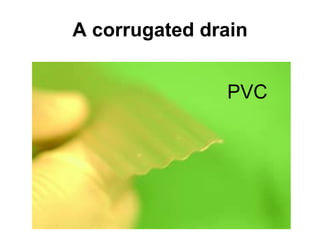
A corrugated drain PVC
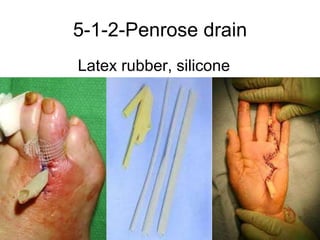
5-1-2-Penrose drain Latex rubber, silicone
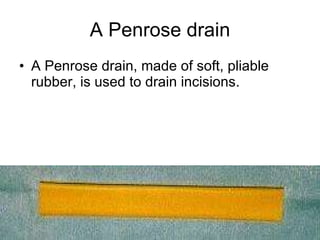
A Penrose drain A Penrose drain, made of soft, pliable rubber, is used to drain incisions .
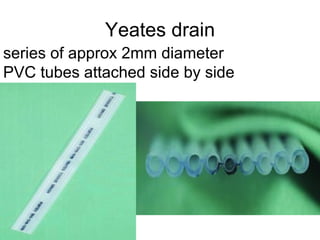
Yeates drain series of approx 2mm diameter  PVC tubes attached side by side
CLOSED PASSIVE DRAINS 1. Pig-tail Catheters 2. Percutaneous Transhepatic Biliary Drains 3. Urinary Catheter 4. Intercostal Catheter
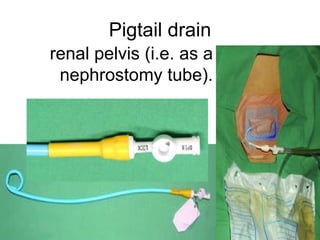
Pigtail drain renal pelvis (i.e. as a nephrostomy tube).
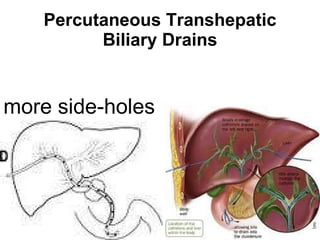
Percutaneous Transhepatic Biliary Drains more side - holes
Other CLOSED PASSIVE DRAINS Urinary Catheter see - Urological Catheters Intercostal Catheter see - Intercostal Catheter
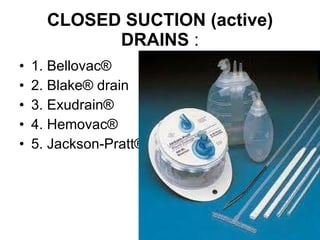
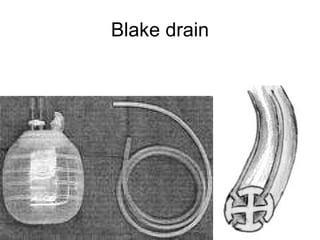
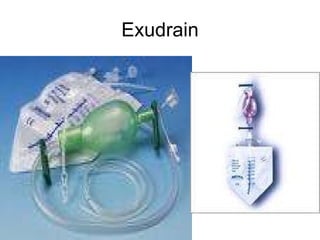
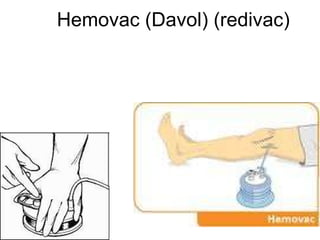
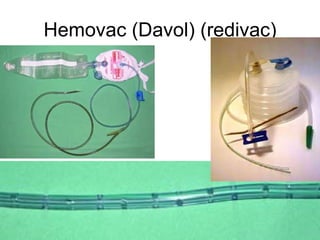
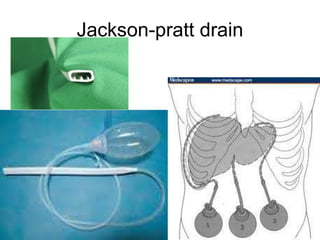
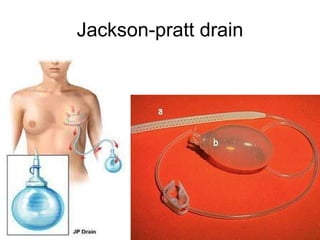
CLOSED SUCTION (active) DRAINS  : 1. Bellovac® 2. Blake® drain 3. Exudrain® 4. Hemovac® 5. Jackson-Pratt®
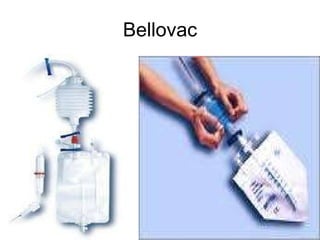
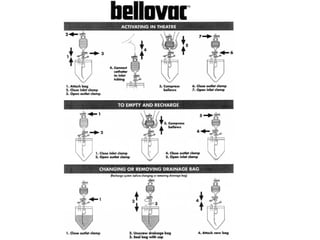
Bellovac
 
Blake drain
Exudrain
Hemovac (Davol) (redivac)
Jackson-pratt drain
Jackson-pratt drain
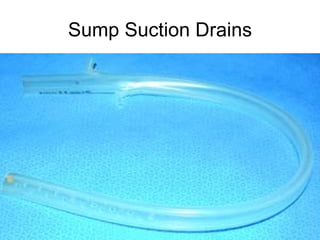
Sump Suction Drains
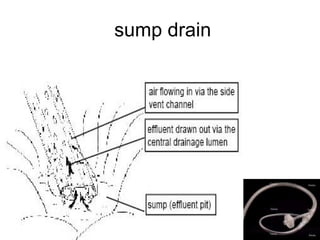
sump drain
1-Mechanical Problems of drains .Trauma  to tissues ·  Erosion  of adjacent tissues- may lead to perforation or fistula formation ,haemorrhage  ·  Herniation  of viscera through the drain tract. ·  Anastomotic leak-  drains are sometimes placed near anastomoses
2-PHYSIOLOGICAL PROBLEMS ·  Bacterial  colonization and sepsis- ·  Loss of  fluid and electrolytes Pain- Pneumothorax pneumoperito- ··  Restricted  mobility
3-DRAIN MALFUNCTION 1.Blocked Drain 2. Leaking Drain 3. Loose Drain 4. Drain retraction 5. Drain falling out 6. Broken Drain/ Tubing 7. Inflamed Drain Exit Site 8. Atypical Drainage Fluids; anastomotic leaks, or drain erosion into adjacent  structures e.g. bowel, bladder, or blood vessels. 9. High Drainage Output 10. Vacuum Failure for Suction Drains

Surgery 6th year, Tutorial (Dr. AbdulWahid)