Preformulation Studies for new Pharmaceutical substances
Pre-formulation concepts: drug excipients interactions-different methods, kinetics of stability, stability testing.
Theories of dispersion and pharmaceutical dispersion (Emulsion and Suspension, SMEDDS) preparation and stability.
Large and small volume parental-physiological and formulation consideration, manufacturing and evaluation.
Preformulation Studies for new Pharmaceutical substances
1.
DEPARTMENT OF PHARMACEUTICS
MODERNPHARMACEUTICS
TITLE: PREFORMULATION STUDIES
PRESENTED BY
MENAKA.V
M PHARM 1st
sem
DEPT. PHARMACEUTICS
EPCP PRESENTED TO
Dr.V.CHNADRAKALA
HOD&PROFESSOR
DEPT. PHARMACEUTICS
2.
CONTENTS
Pre-formulation concepts:drug excipients interactions-different methods, kinetics
of stability, stability testing.
Theories of dispersion and pharmaceutical dispersion (Emulsion and Suspension,
SMEDDS) preparation and stability.
Large and small volume parental-physiological and formulation consideration,
manufacturing and evaluation.
3.
Pre-formulation
Preformulation studiesare the investigations of physical and chemical
properties of a drug substance, alone and in combination with other
excipients,
Characterization of physical, chemical and mechanical properties of new
drug molecule in order to develop safe, effective, and stable dosage form.
Preformulation is branch of Pharmaceutical' science that utilizes
biopharmaceutical principles in the determination of physicochemical
properties of the drug substance.
Prior to the development of any dosage form new drug, it is essential that
certain fundamental physical & chemical properties of drug powder are
determined.
4.
Goals
To understandthe nature of the drug molecule.
To select a suitable dosage form (tablet, capsule, injection, etc.).
To determine what excipients can be safely used.
To predict instability problems (e.g., moisture sensitivity, oxidation,
hydrolysis).
To minimize failures during later formulation stages.
To improve bioavailability, stability, and patient compliance.
To reduce development time, cost, and effort
5.
objectives
To studythe drug’s physicochemical properties like solubility, pKa and
particle size.
To evaluate the chemical stability of the drug under various conditions.
To identify drug–excipient compatibility and choose suitable excipients.
To select the most appropriate dosage form based on drug properties.
To improve bioavailability through solubility or dissolution enhancement.
To assess powder flow, compressibility, and manufacturability.
To predict and prevent possible formulation and stability problems.
6.
Physicochemical parameters
1. Organolepticproperties
2. Bulk characterization studies
• Crystallinity and polymorphism
• Hygroscopicity
• Fine particle characterization
• Bulk density
• Powder flow properties
• Compression properties
7.
Physicochemical parameters
3. Solubilityanalysis
• pH & pKa determination
• Partition coefficient
• Dissolution studies
• Thermal effect
4. stability analysis
• In toxicology formulations
• Solution state stability
• Solid state stability
• Drug excipient compatibility studies.
8.
Drug-excipients compatability studies
Introduction
Drug-excipients studies is the first step for dosage form development.
The integral part of pre-formulation stage is a complete understanding of
physicochemical interaction of API and is necessary for consistent efficacy
safety and stability of products.
The physical and chemical interactions between drug and excipients affect the
therapeutic properties of dosage form.
Careful selection of excipients is required if you want a effective formulation of
dosage form that make administration easier, improve bioavailability, patient
compliance, promote release.
9.
Drug excipient compatibilitystudies
Pharmaceutical Excipients
An excipient is a pharmacologically inactive substance formulated alongside
the API of a medicine to impart specific qualities to them.
Role of Excipients
Provide bulk to the formulation
Protect, support or enhance the stability of formulation.
Improve bioavailability of drug
Drug Excipient compatibility
Drug substances are usually in intimate contact with excipient. Although
these are pharmacologically inert, they can undergo chemical and physical
interaction with drug substance under favorable condition. These interactions
can lead to instability resulting in the formulation of new entities.
10.
Importance of drugexcipient compatibility studies
Stability of dosage form can be maximized.
It helps to avoid the surprise problem.
Drug discovery can emerge only new chemical entity.
DECS data is essential for IND(investigational new drug) submission now
USFDA has made it compulsory to submit DECs data for any coming
formulation before its approval.
Determine a list of excipients that can be used in final dosage form.
To reduce associated side effect of drug due to DECS in dosage form.
11.
Goal of DEI
To find out the excipients that are incompatible with the API.
To find out that excipients do not have impact on the stability of the API.
To find out the excipients that can stability the unstable API.
To design and develop selective and stability indicating analytical methods
to determine the impurities wherein the dosage strength difference is very
large.
12.
Mechanism of drugexcipient interaction
1. Exact mechanism of drug excipients interaction is not clear.
2. However, there are several well documented mechanisms in the
literature.
3. Drug excipients interaction occurs more frequently than excipient-
excipients interaction. Drug-excipients interaction can either be
beneficial or detrimental, which can be simply classified as:
1. physical interactions.
2. chemical interactions.
3. Bio-pharmaceutical interactions.
13.
1. Physical interaction
Retain their chemical structure and changes alter the physical property.
It is quite common but it is difficult to detect.
Alter rate of dissolution, dosage uniformity, colour, odour, solubility, sedimentation
rate.
Difficult to detect.
Physical interaction can either be beneficial or detrimental to product performance.
Eg: primary amine drugs and microcrystalline.
14.
2. Chemical interaction
This involves the interaction of drug substance and excipients through chemical
degradation pathway.
The formulation undergoes a chemical reaction in which the constituent atoms are
rearranged via bond breakage and bond formation to produce an unstable
chemical entity.
Changes in the samples can detected by chromatographic or any other analytical
methods.
Eg: chemical drug-excipient interactions include: inhibitor of diclofenac sodium
release from matrix tablet by polymer chitosan at low pH. This occurs possibly via
formation of ionic complex between diclofenac sodium and ionized cationic
polymer.
15.
3. Biopharmaceutical interactions
These are the interaction observed after administration of the medication.
Interaction within the body is between medicine and body fluids which
influence the rate of absorption .
All excipient physiological way when they are administered along with
active pharmaceutical ingredients.
Eg: premature breakdown of enteric coated tablets
16.
Steps in compatibilitystudy
There are four steps to consider.
1. sample preparation.
2. statistical design.
3. storage.
4. method of analysis
Sample preparation:
For solid state reactions:
1. Sample A: mixture of drug and excipient.
2. Sample B: sample A+ 5% moisture.
3. Sample C : drug itself without excipients
17.
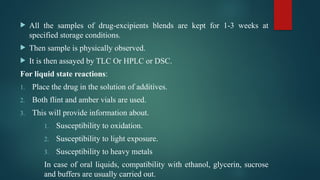
All thesamples of drug-excipients blends are kept for 1-3 weeks at
specified storage conditions.
Then sample is physically observed.
It is then assayed by TLC Or HPLC or DSC.
For liquid state reactions:
1. Place the drug in the solution of additives.
2. Both flint and amber vials are used.
3. This will provide information about.
1. Susceptibility to oxidation.
2. Susceptibility to light exposure.
3. Susceptibility to heavy metals
In case of oral liquids, compatibility with ethanol, glycerin, sucrose
and buffers are usually carried out.
18.
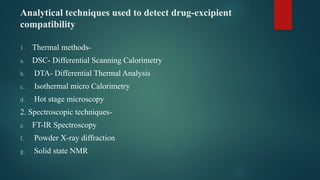
Analytical techniques usedto detect drug-excipient
compatibility
1. Thermal methods-
a. DSC- Differential Scanning Calorimetry
b. DTA- Differential Thermal Analysis
c. Isothermal micro Calorimetry
d. Hot stage microscopy
2. Spectroscopic techniques-
e. FT-IR Spectroscopy
f. Powder X-ray diffraction
g. Solid state NMR
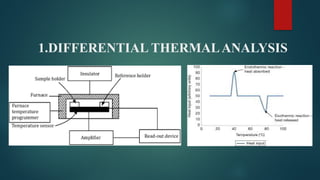
1. DIFFERENTIAL THERMALANALYSIS
•Thermal analysis is useful in the investigation of solid state interactions.
• It is also useful in the detection of eutectics.
• Thermograms are generated for pure components and their physical mixtures with
other components.
• In the absence of any interactions, the thermograms of mixtures show patterns
corresponding to those of the individual components.
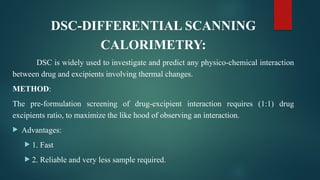
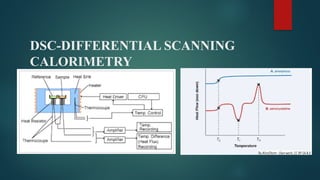
DSC-DIFFERENTIAL SCANNING
CALORIMETRY:
DSC iswidely used to investigate and predict any physico-chemical interaction
between drug and excipients involving thermal changes.
METHOD:
The pre-formulation screening of drug-excipient interaction requires (1:1) drug
excipients ratio, to maximize the like hood of observing an interaction.
Advantages:
1. Fast
2. Reliable and very less sample required.
3. Isothermal Microcalorimetry
In isothermal microcalorimetry, a known quantity of drug and excipient is mixed
and placed in a sealed sample ampoule, while an empty ampoule or excipient
alone is used as reference.
The ampoules are kept at a constant temperature in the instrument.
As the drug and excipient interact, very small amounts of heat may be released or
absorbed.
The instrument continuously measures this heat flow over time.
The presence of heat change indicates drug–excipient interaction, while little or
no heat change indicates compatibility.
26.
4. Hot stagemicroscopy
In hot stage microscopy, a small amount of drug and excipient mixture is placed
on a glass slide and covered with a cover slip.
The slide is kept on a hot stage microscope and the temperature is increased
gradually at a controlled rate.
The sample is observed continuously under the microscope while heating.
Any physical changes such as melting, color change, crystal deformation, or
formation of new phases are noted.
A change in melting behavior or appearance compared to the pure drug indicates
possible drug–excipient interaction, while no significant change suggests
compatibility.
27.
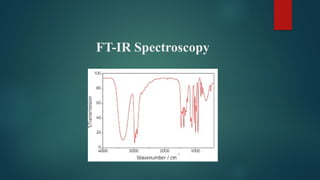
FT-IR Spectroscopy
InFTIR spectroscopy, the pure drug, excipient, and their physical mixture are first
prepared.
A small quantity of each sample is mixed with dry potassium bromide (KBr) and
compressed to form a thin pellet, or the sample is directly placed on the ATR
crystal.
The samples are then scanned in the FTIR spectrophotometer over a selected
wavenumber range.
The obtained spectra are compared for characteristic functional group peaks. Any
shift, disappearance, or appearance of new peaks in the drug–excipient mixture
indicates possible interaction, while no significant change in peaks indicates
compatibility.
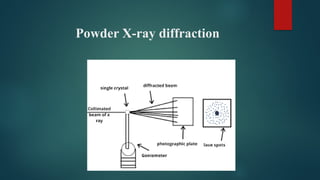
Powder X-ray diffraction
In PXRD, the pure drug, excipient, and their mixture are made into fine powders
and placed on the sample holder.
The sample is exposed to X-rays and a diffraction pattern is recorded.
The pattern of the mixture is compared with the patterns of the pure drug and
excipient.
Any change in peaks shows drug–excipient interaction, while no change shows
compatibility.
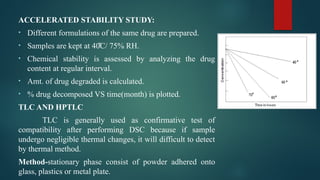
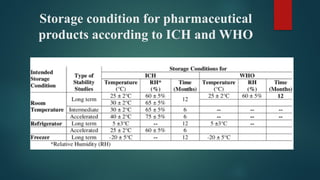
ACCELERATED STABILITY STUDY:
•Different formulations of the same drug are prepared.
• Samples are kept at 4 C/ 75% RH.
0̊
• Chemical stability is assessed by analyzing the drug
content at regular interval.
• Amt. of drug degraded is calculated.
• % drug decomposed VS time(month) is plotted.
TLC AND HPTLC
TLC is generally used as confirmative test of
compatibility after performing DSC because if sample
undergo negligible thermal changes, it will difficult to detect
by thermal method.
Method-stationary phase consist of powder adhered onto
glass, plastics or metal plate.
32.
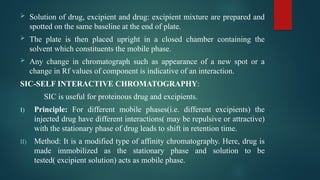
Solution ofdrug, excipient and drug: excipient mixture are prepared and
spotted on the same baseline at the end of plate.
The plate is then placed upright in a closed chamber containing the
solvent which constituents the mobile phase.
Any change in chromatograph such as appearance of a new spot or a
change in Rf values of component is indicative of an interaction.
SIC-SELF INTERACTIVE CHROMATOGRAPHY:
SIC is useful for proteinous drug and excipients.
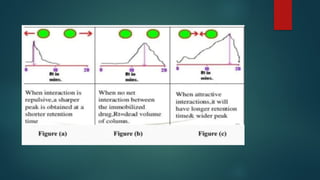
I) Principle: For different mobile phases(i.e. different excipients) the
injected drug have different interactions( may be repulsive or attractive)
with the stationary phase of drug leads to shift in retention time.
II) Method: It is a modified type of affinity chromatography. Here, drug is
made immobilized as the stationary phase and solution to be
tested( excipient solution) acts as mobile phase.
34.
Radiolabelled Techniques
Inthe radiolabelled technique, the drug is first tagged with a small amount of a
radioactive marker.
This radiolabelled drug is then mixed with the excipient and stored under
controlled conditions.
The mixture is analyzed using a radiation detector to observe the distribution or
movement of the labelled drug.
Any change in the drug’s behavior, binding, or distribution compared to the pure
drug indicates drug–excipient interaction, while no change indicates
compatibility.
35.
Fluorescence Spectroscopy
Influorescence spectroscopy, a solution of the pure drug is prepared and its
fluorescence spectrum is recorded.
The drug is then mixed with the excipient and the spectrum is recorded again.
The sample is excited with light of a specific wavelength and the emitted
fluorescence is measured.
Any change in fluorescence intensity or wavelength after adding the excipient
indicates drug–excipient interaction, while no change indicates compatibility.
36.
ZENETH IN-SILICO INTERACTION
PREDICTOR
Zeneth in-silico software is a commercially available program designed to predict
degradation pathways of pharmaceutical compounds.
It contains a chemical engine that allows the description and application of
degradation transformations; a reasoning engine that allows assessment of
transformation likelihood and; graphical interface that allows entry of query
structures and display of prediction results. Zeneth predicts degradation under the
influence of reaction conditions and optionally in the presence of other
compounds such as excipients.
The main advantages of Zeneth are total recall and the absence of bias. Besides, it
permits steady accumulation of knowledge about degradation chemistry in an
accessible form.
The power of prediction can be harnessed to develop focused stress testing
protocols and to serve as a tool for the structure elucidation to match predicted
degradant structures with HPLC-MS data.
37.
Kinetics of stability
Kinetics :Is study of the rate at which processes or changes occur.
The changes may be chemical such as decomposition of a drug, radiochemical decay.
physical such as transfer across a boundary, such as the intestinal lining or skin.
The rate of chemical change is influenced :
concentration of reactants, products, and other chemical species that may be present
and By factors such as solvent, pressure.
38.
Importance ofstudying kinetics
1. To determine half life
2. To determine shelf life
Selection of proper storage condition
1.Temperature and humidity
2.Advising patient on storage conditions.
Stability :Is the capacity of a drug product to remain within specifications
established to ensure its identity, strength, quality, and purity
Stability study: Is the study of the extent to which the properties of a drug
substance or drug product remain within specified limits at certain temperature and
humidity
The properties may be physical, chemical, microbiological, or performance
properties such as disintegration and dissolution.
39.
Importance of Stability:
Extensive chemical degradation result in a substantial loss of quantity of
therapeutic agent in the dosage form.
Degradation products may result in adverse events or be unsafe Instability may
cause
Undesired change in performance, i.e. dissolution/bioavailability
Substantial changes in physical appearance of the dosage form causing product
failures.
Order of reaction
Refers to the way in which the concentration of the reactant (s) influence the
rate of a chemical rxn.
Zero order reaction
The rate of rxn is independent of the concentration of the reactants and constant
with respect to time
40.
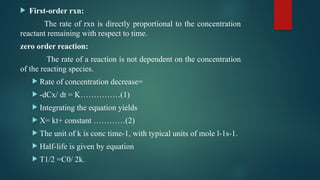
First-order rxn:
Therate of rxn is directly proportional to the concentration
reactant remaining with respect to time.
zero order reaction:
The rate of a reaction is not dependent on the concentration
of the reacting species.
Rate of concentration decrease=
-dCx/ dt = K……………(1)
Integrating the equation yields
X= kt+ constant …………(2)
The unit of k is conc time-1, with typical units of mole l-1s-1.
Half-life is given by equation
T1/2 =C0/ 2k.
41.
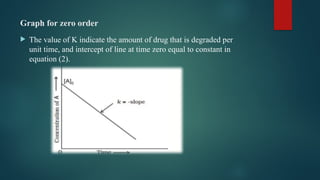
Graph for zeroorder
The value of K indicate the amount of drug that is degraded per
unit time, and intercept of line at time zero equal to constant in
equation (2).
42.
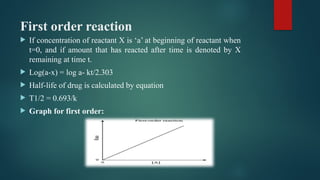
First order reaction
If concentration of reactant X is ‘a’ at beginning of reactant when
t=0, and if amount that has reacted after time is denoted by X
remaining at time t.
Log(a-x) = log a- kt/2.303
Half-life of drug is calculated by equation
T1/2 = 0.693/k
Graph for first order:
43.
Second order kinetics
Rate of change in conc. Of product and reactant is dependent on second
power of conc. Of single reactant or to first order of the concentration. Of
two reactants.
Unit of second order reaction is conc-1 time-1 and SI unit is Lmol-1sec-1.
Half-life in this case is t1/2 = 1/a k.
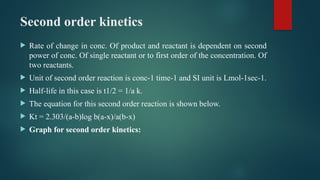
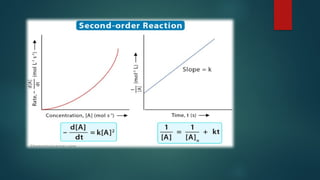
The equation for this second order reaction is shown below.
Kt = 2.303/(a-b)log b(a-x)/a(b-x)
Graph for second order kinetics:
45.
STABILITY TESTING:
Definition:
Stabilitydefined as capability of a particular formulation in a specific
container/closure system to remain within its physical, chemical, microbiological,
toxicological, specifications.
Why stability studies is necessary ?
1. Quality of the product.
2. Establish self life of the drug product.
3. Storage conditions.
4. Determine container closure system suitability.
5. For chemical degradation.
6. Toxic products may be formed.
46.
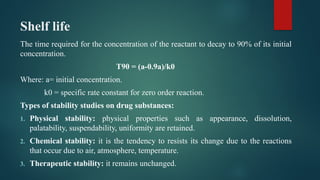
Shelf life
The timerequired for the concentration of the reactant to decay to 90% of its initial
concentration.
T90 = (a-0.9a)/k0
Where: a= initial concentration.
k0 = specific rate constant for zero order reaction.
Types of stability studies on drug substances:
1. Physical stability: physical properties such as appearance, dissolution,
palatability, suspendability, uniformity are retained.
2. Chemical stability: it is the tendency to resists its change due to the reactions
that occur due to air, atmosphere, temperature.
3. Therapeutic stability: it remains unchanged.
47.
Stability testing method:
Thestability testing procedure have been categorized into 4 types they are:
1. Real time stability testing.
2. Retained sample stability testing.
3. Cyclic temperature stress testing.
4. Accelerated stability testing.
1. Real time stability testing:
It is normally performed for a long duration of time to allow the degradation of
the product under the storage recommendation.
48.
While testingthe samples are collected at regular interval the data is collected at
the appropriate frequency.
2. Retained sample stability testing:
1. If the number of samples exceeds more than 50 then they are divided into 2
batches.
2. After introducing to the market the samples of every batch are taken which
decrease from 2%-5%.
3. This test help to predict the shelf-life.
3. Cyclic temperature stress testing:
4. In this testing the sampling is considered to be conducted by the 24 hrs.
5. Test of samples minimum and maximum temperature are noted by the
temperature , storage condition, chemical, and physical degradation of the
product.
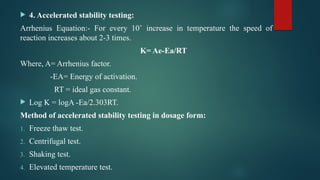
49.
4. Acceleratedstability testing:
Arrhenius Equation:- For every 10˚ increase in temperature the speed of
reaction increases about 2-3 times.
K= Ae-Ea/RT
Where, A= Arrhenius factor.
-EA= Energy of activation.
RT = ideal gas constant.
Log K = logA -Ea/2.303RT.
Method of accelerated stability testing in dosage form:
1. Freeze thaw test.
2. Centrifugal test.
3. Shaking test.
4. Elevated temperature test.
50.
Stability testing protocol
The stability study protocol should include the following
1. Number of batches.
2. Container and closure.
3. Orientation of storage of containers.
4. Sampling time points.
5. Test storage condition.
6. Test parameter.
51.
Stability testingis incorporated at all stages of drug product lifecycle, can
be segregated into 6 stages:
• STAGE 1- Early stage stress and accelerated testing with drug substances.
• STAGE 2- Stability on pre-formulation batches.
• STAGE 3- Stress testing on scale-up batches.
• STAGE 4- Accelerated and long term testing for registration purposes.
• STAGE 5- On-going stability testing.
• STAGE 6- Follow-up stabilities.
52.
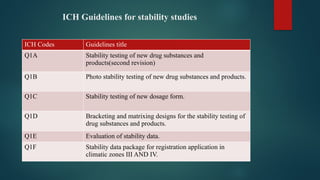
ICH Guidelines forstability studies
ICH Codes Guidelines title
Q1A Stability testing of new drug substances and
products(second revision)
Q1B Photo stability testing of new drug substances and products.
Q1C Stability testing of new dosage form.
Q1D Bracketing and matrixing designs for the stability testing of
drug substances and products.
Q1E Evaluation of stability data.
Q1F Stability data package for registration application in
climatic zones III AND IV.
53.
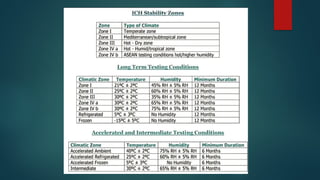
Climatic zones forstability testing
The stability studies of the drug should be done according to the climatic
conditions of a country.
According to the ICH guidelines for stability studies, the climate of the
world is divided into five different zones:
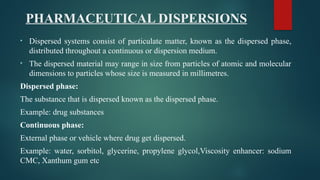
PHARMACEUTICAL DISPERSIONS
• Dispersedsystems consist of particulate matter, known as the dispersed phase,
distributed throughout a continuous or dispersion medium.
• The dispersed material may range in size from particles of atomic and molecular
dimensions to particles whose size is measured in millimetres.
Dispersed phase:
The substance that is dispersed known as the dispersed phase.
Example: drug substances
Continuous phase:
External phase or vehicle where drug get dispersed.
Example: water, sorbitol, glycerine, propylene glycol,Viscosity enhancer: sodium
CMC, Xanthum gum etc
57.
Theories of dispersion:
a)Viscosity theory:
As per this theory increase in viscosity of emulsion will leads to increase in stability of it.
Limitations:
This theory fails to explain the viscosity related to milk, as milk don’t possess viscous
nature but still it shows the good stability.
b) Film theory or adsorption theory:
As per this theory, the added emulsifying agent forms a mechanical by getting adsorbed at
the interface of the liquids( i.e. at the interface between the dispersed globules and the
dispersion medium).
• This offers stability to the emulsion.
Limitation:
1. This theory could not explain the formation of type of emulsion.
58.
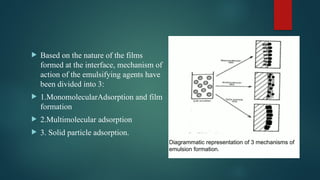
Based onthe nature of the films
formed at the interface, mechanism of
action of the emulsifying agents have
been divided into 3:
1.MonomolecularAdsorption and film
formation
2.Multimolecular adsorption
3. Solid particle adsorption.
59.
1. MONOMOLECULAR ADSORPTION
ANDFILM FORMATION
Surfactants adsorb at the oil-water interface and forms a monomolecular film.
This film rapidly envelops the droplets as soon as they are formed.
Agents having higher interfacial activity are better suited for this purpose.
The monomolecular film should be compact and strong enough so that it cannot
be easily broken.
If it is broken, it should be elastic and flexible enough, so that it can be
reformed on rapid agitation.
Combination of surfactants are used rather than a single one
60.
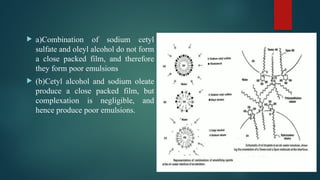
a)Combination ofsodium cetyl
sulfate and oleyl alcohol do not form
a close packed film, and therefore
they form poor emulsions
(b)Cetyl alcohol and sodium oleate
produce a close packed film, but
complexation is negligible, and
hence produce poor emulsions.
61.
2. MULTIMOLECULAR ADSORPTION
The emulsifying agents such as acacia and gelatin, tend to form a
multimolecular film around the globules and prevents the instability,
mainly coalescence.
They are effective at high concentrations, and promote the formation of
o/w type emulsion owing to their hydrophobicity.
62.
3. SOLID PARTICLEADSORPTION
The finely divided solid particles adsorb at the oil-water interface and forms
a rigid film of closely packed solids.
This film act as a mechanical barrier and prevents coalescence of globules.
These tend to produce coarse emulsions.
Depending upon the affinity of the emulsifier to a particular phase, one can
prepare both types of emulsions;
e.g.:
1.Bentonite-o/w and w/o
2.Veegum-o/w
63.
c) Wedge theory:
•According to this theory, monovalent soaps like sodium stearate gives o/w of the
emulsion and divalent soaps like calcium stearate gives w/o type emulsion.
• This was explained by the successful accommodation of the soap molecules of the
interface and subsequent possible orientation of the soap molecules to gives of
emulsion.
Limitations:
1. This theory could not explain the formulation of type of emulsion.
2. The calcium stearate will not obey this theory. It will ionize and will not exist as a
wedge.
64.
D) Interfacialtension theory:
Initially when the oil and water are
mixed together, they will become immiscible
due to the interfacial tension formed between
surface of oil and water.
• The added emulsifying agent reduces the
interfacial tension between the oil and the
water phase by emulsifying the mixture.
• Hence a stable emulsion is formed.
65.
EMULSION
An emulsionis a biphasic liquid preparation containing two immiscible
liquids, one of which is dispersed as minute globules into the other.
The liquid which is converted into minute globules is called the dispersed
phase' the liquid in which the globules are dispersed is called the 'continuous
phase'.
Normally, two immiscible liquids cannot be dispersed for a long period.
So, an emulsifying agent is added to the system.
It forms a film around the globules in order to scatter them indefinitely in the
continuous phase, so that a stable emulsion is formed.
The globule size in emulsion varies from 0.25 to 25 μm.
66.
Mechanism of emulsification
When two immiscible liquids are in contact with each other, the molecules at
the interface experiences a perpendicular force.
The net forces at the interface are called as interfacial tension and to minimize
the surface are of individual liquids.
In emulsion, the process of dispersion of one liquid in the other results in an
increase in the surface area between the dispersed droplets and dispersion
medium, and surface free energy, which can be expressed as follows:
ΔW=gΔA.
Where, ΔW= increase in the free energy at the interface.
ΔA = Increase in the surface area.
67.
Method of preparationof emulsion
Commercially, emulsions are prepared in large volume mixing tanks and
refined and stabilized by passage through a colloid mill or homogenizer
extemporaneous production is more concerned with small scale.
METHOD OF PREPARATION:
1. Dry gum method.
2. Wet gum method.
3. Bottle method.
4. Beaker method.
5. In-situ soap method.
68.
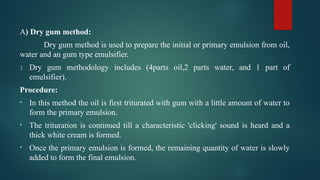
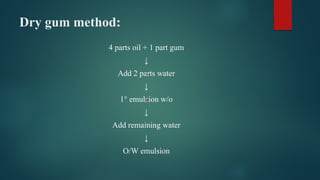
A) Dry gummethod:
Dry gum method is used to prepare the initial or primary emulsion from oil,
water and an gum type emulsifier.
1. Dry gum methodology includes (4parts oil,2 parts water, and 1 part of
emulsifier).
Procedure:
• In this method the oil is first triturated with gum with a little amount of water to
form the primary emulsion.
• The trituration is continued till a characteristic 'clicking' sound is heard and a
thick white cream is formed.
• Once the primary emulsion is formed, the remaining quantity of water is slowly
added to form the final emulsion.
69.
Dry gum method:
4parts oil + 1 part gum
↓
Add 2 parts water
↓
1° emulsion w/o
↓
Add remaining water
↓
O/W emulsion
70.
B) Wetgum method:
The wet gum method is a technique for preparing emulsions by mixing oil, water,
and an emulsifier. The method involves triturating the ingredients together in a
mortar and pestle until a thick emulsion is formed.
Procedure:
• As the name implies, in this method first gum and water are triturated together
to form a mucilage.
• The required quantity of oil is then added gradually in small proportions with
thorough trituration to form the primary emulsion.
• Once the primary emulsion has been formed remaining quantity of water is
added to make the final emulsion.
71.
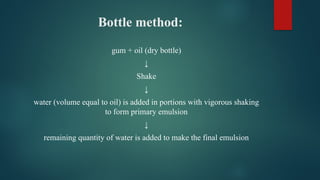
C) Bottle method:
The bottle method, also known as the Forbes bottle method, is a technique
for making emulsions of volatile oils and low-viscosity liquids. It’s a
variation of the dry gum method.
This method useful for the volatile and other non-viscous oils.
Because of low viscosity the volatile oils it requires greater amount of gum.
This method also called 4:4:2 method.
72.
Bottle method:
gum +oil (dry bottle)
↓
Shake
↓
water (volume equal to oil) is added in portions with vigorous shaking
to form primary emulsion
↓
remaining quantity of water is added to make the final emulsion
73.
d) Beaker Method
Procedure :
Dividing components into water soluble and oil soluble components.
All oil soluble components are dissolved in the oily phase in one beaker and
all water-soluble components are dissolved in the water in a separate beaker.
Oleaginous components are melted and both phases are heated to
approximately 70°C over a water bath.
The Internal phase is later added to the external phase with stirring until the
product reaches room temperature.
74.
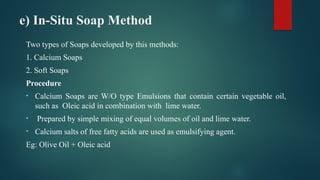
e) In-Situ SoapMethod
Two types of Soaps developed by this methods:
1. Calcium Soaps
2. Soft Soaps
Procedure
• Calcium Soaps are W/O type Emulsions that contain certain vegetable oil,
such as Oleic acid in combination with lime water.
• Prepared by simple mixing of equal volumes of oil and lime water.
• Calcium salts of free fatty acids are used as emulsifying agent.
Eg: Olive Oil + Oleic acid
75.
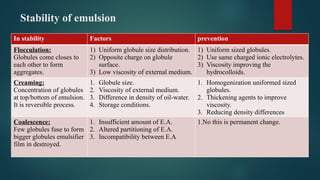
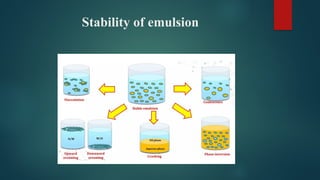
Stability of emulsion
Instability Factors prevention
Flocculation:
Globules come closes to
each other to form
aggregates.
1) Uniform globule size distribution.
2) Opposite charge on globule
surface.
3) Low viscosity of external medium.
1) Uniform sized globules.
2) Use same charged ionic electrolytes.
3) Viscosity improving the
hydrocolloids.
Creaming:
Concentration of globules
at top/bottom of emulsion.
It is reversible process.
1. Globule size.
2. Viscosity of external medium.
3. Difference in density of oil-water.
4. Storage conditions.
1. Homogenization uniformed sized
globules.
2. Thickening agents to improve
viscosity.
3. Reducing density differences
Coalescence:
Few globules fuse to form
bigger globules emulsifier
film in destroyed.
1. Insufficient amount of E.A.
2. Altered partitioning of E.A.
3. Incompatibility between E.A
1.No this is permanent change.
76.
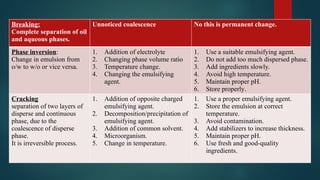
Breaking:
Complete separation ofoil
and aqueous phases.
Unnoticed coalescence No this is permanent change.
Phase inversion:
Change in emulsion from
o/w to w/o or vice versa.
1. Addition of electrolyte
2. Changing phase volume ratio
3. Temperature change.
4. Changing the emulsifying
agent.
1. Use a suitable emulsifying agent.
2. Do not add too much dispersed phase.
3. Add ingredients slowly.
4. Avoid high temperature.
5. Maintain proper pH.
6. Store properly.
Cracking
separation of two layers of
disperse and continuous
phase, due to the
coalescence of disperse
phase.
It is irreversible process.
1. Addition of opposite charged
emulsifying agent.
2. Decomposition/precipitation of
emulsifying agent.
3. Addition of common solvent.
4. Microorganism.
5. Change in temperature.
1. Use a proper emulsifying agent.
2. Store the emulsion at correct
temperature.
3. Avoid contamination.
4. Add stabilizers to increase thickness.
5. Maintain proper pH.
6. Use fresh and good-quality
ingredients.
SUSPENSION
SUSPENSIONS DEFINITION:
Suspension are the biphasic liquid dosage form of medicament in which the
finely divided solid particles ranging from 0.5 to 5.0 micron are dispersed in a
liquid or semisolid vehicle.
The solid particles act as disperse phase whereas liquid vehicle acts as the
continuous phase.
Suspension is generally taken orally or by parenteral route.
They are also used for external applications
79.
Mechanism of suspensionformation
A pharmaceutical suspension is a coarse dispersion in which internal phase
(therapeutically active ingredients) is dispersed uniformly throughout the
external phase, maintained uniformly through out the suspending vehicle with
aid of single or combination of suspending agent.
Suspending agent is a kind of viscous hydrophilic colloidal substance, which
can increase the viscosity of the dispersion medium to slow down the
sedimentation speed of particles and adsorb on the surface of the particles to
became a barrier to prevent the aggregation and agglomeration of particles.
Method of preparation
Suspension can be prepared by 2 methods:
1) Dispersion method.
2) Precipitation method
80.
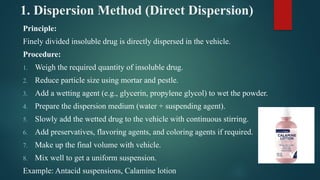
1. Dispersion Method(Direct Dispersion)
Principle:
Finely divided insoluble drug is directly dispersed in the vehicle.
Procedure:
1. Weigh the required quantity of insoluble drug.
2. Reduce particle size using mortar and pestle.
3. Add a wetting agent (e.g., glycerin, propylene glycol) to wet the powder.
4. Prepare the dispersion medium (water + suspending agent).
5. Slowly add the wetted drug to the vehicle with continuous stirring.
6. Add preservatives, flavoring agents, and coloring agents if required.
7. Make up the final volume with vehicle.
8. Mix well to get a uniform suspension.
Example: Antacid suspensions, Calamine lotion
81.
2. Precipitation Method
Principle:
Suspensionis formed by precipitating the drug from a solution.
Procedure:
1. Dissolve the drug in a suitable solvent.
2. Add this solution to another liquid in which the drug is insoluble.
3. Drug gets precipitated as fine particles.
4. Add suspending agent to prevent settling.
5. Add other additives (preservatives, flavor).
6. Adjust the final volume and mix well.
Example:
Sulfur suspension, Hydrocortisone suspension
82.
Stability of suspensions
1)Small particle size:
• Reduction in the size of the dispersed particles increase the total surface of the
solid.
• The greater the degree the subdivision of a given solid the surface area.
• The increase in surface area leading to increase in viscosity of a system.
2) Temperature:
• Another factor which negatively affects the stability and usefulness of
pharmaceutical suspensions is fluctuation of temperature.
• Temperature fluctuation can lead caking of claying.
83.
3. Increasing theviscosity:
• Increasing the viscosity of the continuous phase can lead to the stability of
suspension this is so because the rate of sedimentation can be reduce by increase
in viscosity.
• Viscosity increase is brought about by addition of thickening agents to the
external phase. In water these must be either soluble or swell.
• It is important to note that the rate of release of a drug from a suspension is also
dependent on viscosity of a product.
• The more viscous the preparation, the slower Is likely to be the release of a drug
sometimes this property may be desirable for depot preparations.
84.
Self- Micro EmulsifyingDrug Delivery System
INTRODUCTION:
1. It is found that 40% of active substances are poorly water soluble.
2. The oral delivery of such drugs is complicated because of their high inter and
intra-subject variability, and low bio-availabilty, non-linear kinetics.
3. solubility is one of the most important parameter to achieve desired
concentration of drug in systemic circulation for therapeutic response.
4. it is a major challenge for pharmaceutical scientist to convert those molecules
into orally administered formulation with desired bioavailability.
5. to overcome the problem of low solubility, various formulation strategies have
been exploited.
E.g. solid dispersion, nanosuspension, SMEDDS.
85.
SELF-EMULSIFYING DRUG DELIVERYSYSTEM
Self-emulsifying drug delivery systems (SEDDS) or self-emulsifying oil
formulations (SEOF) or self micro emulsifying drug delivery system
(SMEDDS) are defined as isotropic mixtures of natural or synthetic oils, solid
or liquid surfactants, isotropic sometimes containing co-solvent/ surfactants,
which when introduced into aqueous media upon mild agitation, such as GI
fluids, these system can form fine o/w (oil-in-water) emulsions or micro
emulsion( SMEDDS).
Size : less than 150nm.
Transparent isotropic mixture.
Advantages of SMEDDS:
1. Enhanced oral solubility of poorly water soluble drugs.
2. They improve oral bioavailability of lipophilic drugs.
86.
• Rapid drugrelease occurs after administration.
• Absorption of drug is faster.
• First-pass metabolism is decreased.
• They provide uniform drug absorption.
• Dose variation between patients is reduced.
• They protect drug from degradation in GI tract.
• Formulation process is simple.
• They are thermodynamically stable.
• They can be filled in soft or hard gelatin capsules.
• Patient compliance is improved.
87.
DISADVANTAGES
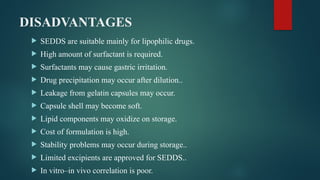
SEDDS aresuitable mainly for lipophilic drugs.
High amount of surfactant is required.
Surfactants may cause gastric irritation.
Drug precipitation may occur after dilution..
Leakage from gelatin capsules may occur.
Capsule shell may become soft.
Lipid components may oxidize on storage.
Cost of formulation is high.
Stability problems may occur during storage..
Limited excipients are approved for SEDDS..
In vitro–in vivo correlation is poor.
88.
Mechanism of supersaturable SMEDDS
The free energy of the conventional emulsion is a direct function of the
energy required to create a new surface between the oil and water phase.
Free energy in the micro-emulsion formation is directly proportional to
the energy required to create new surface between the two phases, and is
given by the equation.
ΔG=ΣNi πr2σ
Where,
ΔG= the free energy associated with the process
N= the number of droplets.
r= the radius of droplets.
Σ= interfacial energy with time.
89.
Comparison between SEDDSand SMEDDS
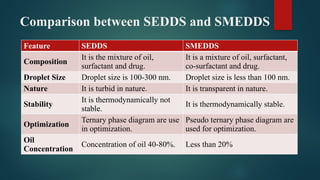
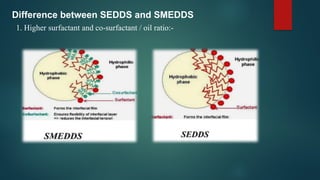
Feature SEDDS SMEDDS
Composition
It is the mixture of oil,
surfactant and drug.
It is a mixture of oil, surfactant,
co-surfactant and drug.
Droplet Size Droplet size is 100-300 nm. Droplet size is less than 100 nm.
Nature It is turbid in nature. It is transparent in nature.
Stability
It is thermodynamically not
stable.
It is thermodynamically stable.
Optimization
Ternary phase diagram are use
in optimization.
Pseudo ternary phase diagram are
used for optimization.
Oil
Concentration
Concentration of oil 40-80%. Less than 20%
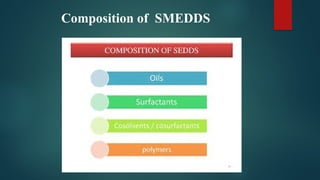
1. Oil phase
•Oils from natural sources and their derivatives are used.
• The oil represents the most important excipient in the SMEDDS formulations.
• Oil solubilizes the hydrophobic drug and aids in self emulsification.
• Both long chain triglycerides (LCT) and medium chain triglycerides (MCT) oils
with different degrees of saturation have been used.
• Unmodified edible oils have poor ability to dissolve large amount of hydrophilic
drugs.
• Modified or hydrolyzed vegetable or edible oils have contributed widely to the
success of SEDDSs owing to their formulation and physiological advantages.
93.
• MCTs werepreferred in earlier self-emulsifying formulations because of higher
fluidity, better solubility properties and self-emulsification ability.
• Absorption enhancement is greater when using unsaturated fatty acids.
• Very polar or nonpolar oils tend to form poor emulsion.
• Examples of Oils:
• Corn oil mono,di,tri-glycerides
• DL-alpha-Tocopherol
• Fractionated triglyceride of coconut oil (MCT)
• Fractionated triglyceride of palm seed oil (MCT)
• Oleic acid
• Sesame oil
• Soyabean oil
• Peanut oil
• Beeswax.
94.
2. Surfactants
• Surfactantsare responsible for forming a stable emulsion upon dilution and
stabilize the internal phase in an emulsion.
• Surfactants with an HLB value of more than 12 is necessary in SMEDDS.
• Emulsifiers of natural origin are not widely used because of their poor self
emulsification property.
• Non-ionic surfactants are less toxic and are widely used.
• Usually the surfactant concentration ranges between 30-60% w/w to form a
stable formulation.
• Increase in surfactant concentration causes a decrease in droplet size.
• Examples of Surfactants: Polysorbate 20 (Tween 20), Polysorbate 80 (Tween
80), Sorbitan monooleate (Span 80), Polyoxy-35-castor oil (Cremophor RH40),
D-alpha Tocopheryl polyethylene glycol 1000 succinate (TPGS) .
95.
3. Co-Surfactants andCo-Solvents
• Co-surfactants: Used to enhance the effectiveness of a surfactant.
• They reduce interfacial tension, increase interface fluidity, and destroy liquid
crystalline or gel structures .
• Co-solvents: Promote the formation of low viscosity microemulsions and help
dissolve the drug or hydrophilic surfactant in the lipid base .
• Alcohol is not included in SEDDS/SMEDDS due to its migration.
• Drug release is increased with increasing concentration of cosurfactant.
• Examples: PEG 200/400/600, Ethanol, Propylene glycol, Propylene carbonate,
Glycofurol.
4. polymers
• Polymers like HPMC and ethyl cellulose are widely used in controlled/sustained
released SEDDS
96.
Formulation of SMEDDS
•Drug has to dissolve in to oil phase (lipophilic part) of microemulsion.
• Water phase is combined with the surfactant and then cosurfactant is added
slowly with constant stirring until the system is become transparent.
• The amount of surfactant and co-surfactant to be added and the parent oil
phase that can be incorporated is determined with the help of pseudo
ternary phase diagram.
• Ultrasonicator can finally used to achieve the desired range for the
dispersed phase.
• It is then allow to equilibrate.
• Gel may be prepared by the addition of the gelling agent to above
microemulsion.
97.
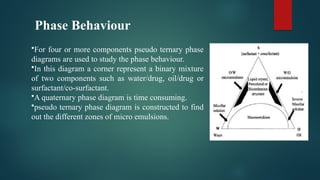
Phase Behaviour
•For fouror more components pseudo ternary phase
diagrams are used to study the phase behaviour.
•In this diagram a corner represent a binary mixture
of two components such as water/drug, oil/drug or
surfactant/co-surfactant.
•A quaternary phase diagram is time consuming.
•pseudo ternary phase diagram is constructed to find
out the different zones of micro emulsions.
98.
METHOD OF PREPARATION
1.Phase Titration Method
•dilution of an oil-surfactant mixture with water (w/o).
•dilution of a water-surfactant mixture with oil (o/w).
•mixing all components at once.
•In some systems, the order of ingredient addition may determine whether a
microemulsion forms.
2. Phase inversion method
•Phase Inversion Temperature (PIT), i.e., the temperature range in which an o/w
microemulsion inverts to a w/o type or vice versa.
99.
Evaluation Test
1.Thermodynamic StabilityStudies.
2.Dispersibility test.
3.Turbidimetric Evaluation.
4.Viscosity Determination.
5.Droplet Size Analysis and Particle Size Measurements.
6.Refractive Index and Percent Transmittance.
7.Electro Conductivity Study.
8.In vitro Diffusion Study.
9.Drug Content.
10.In vivo permeability studies.
100.
1.THERMODYNAMIC STABILITY
STUDIES
• Preparethe SEDDS formulation properly.
• Subject the formulation to heating–cooling cycles (for example, 4 °C and 45 °C
for several cycles).
• Observe the formulation for any phase separation, cracking, or precipitation.
• Then perform a centrifugation test at high speed 3500rom for 30min.
• Check again for any phase separation or drug precipitation.
• Stable formulations show no separation or precipitation after these tests.