GI Hemorrhage ABDWAHID M SALIS, M.D
Incidence 1-2% of all hospital admissions Most common diagnosis of new ICU admits 5-12% mortality 40% for recurrent bleeders 85% stop sponateously Those with massive bleeding need urgent intervention Only 5-10% need operative intervention after endoscopic interventions
Site Upper Esophageal Stomach Doudenum Hepatic Pancreatic Lower Small bowel Colon Anus
 
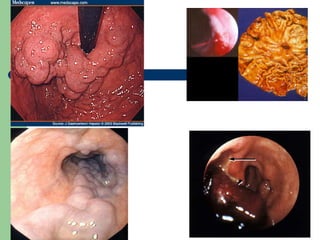
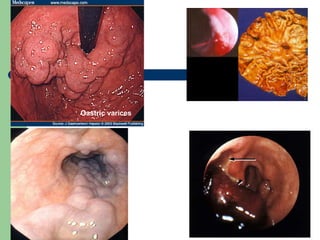
Gastric varices
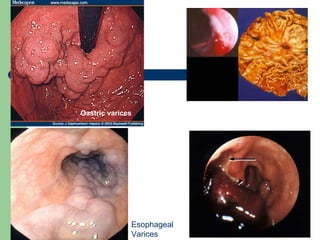
Gastric varices Esophageal Varices
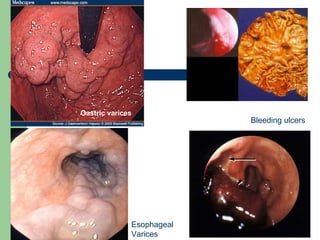
Gastric varices Bleeding ulcers Esophageal Varices
 
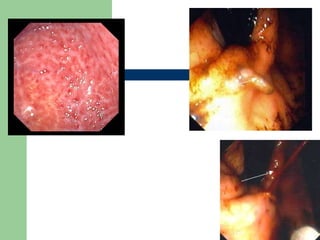
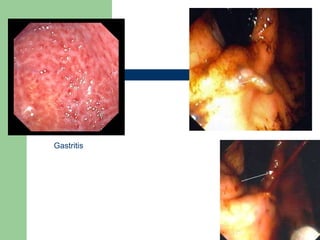
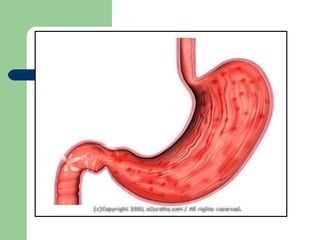
Gastritis
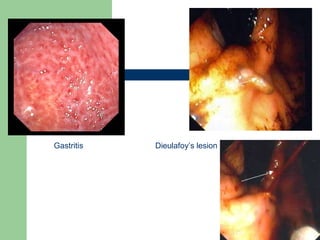
Gastritis Dieulafoy’s lesion
 
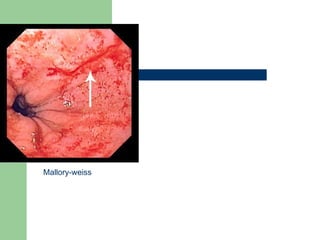
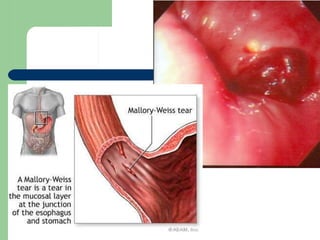
Mallory-weiss


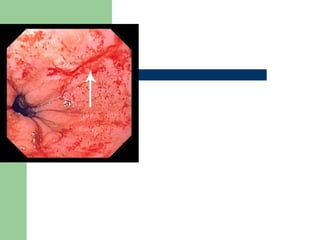
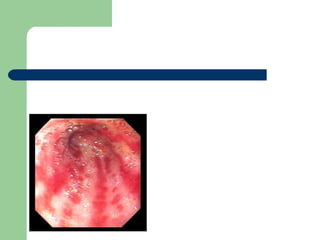
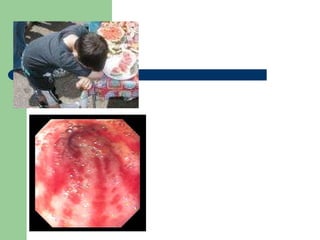
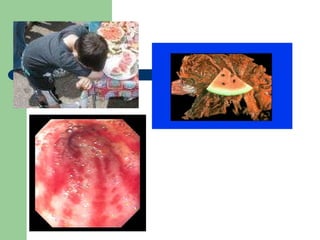
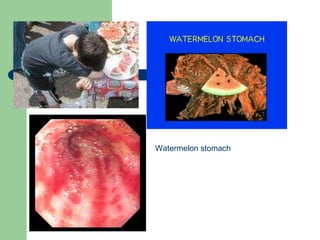
Watermelon stomach
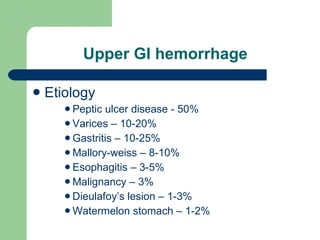
Upper GI hemorrhage Etiology Peptic ulcer disease - 50% Varices – 10-20% Gastritis – 10-25% Mallory-weiss – 8-10% Esophagitis – 3-5% Malignancy – 3% Dieulafoy’s lesion – 1-3% Watermelon stomach – 1-2%
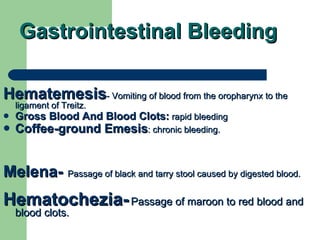
Gastrointestinal Bleeding Hematemesis - Vomiting of blood from the oropharynx to the ligament of Treitz.  Gross Blood And Blood Clots:  rapid bleeding Coffee-ground Emesis : chronic bleeding.  Melena-   Passage of black and tarry stool caused by digested blood. Hematochezia-   Passage of maroon to red blood and blood clots.
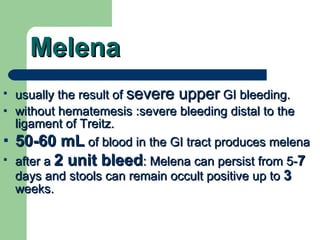
Melena usually the result of  severe upper  GI bleeding.  without hematemesis :severe bleeding distal to the ligament of Treitz. 50-60 mL  of blood in the GI tract produces melena after a  2 unit bleed : Melena can persist from 5- 7  days and stools can remain occult positive up to  3  weeks.
Nose bleeds- Rarely the cause of major bleeding.
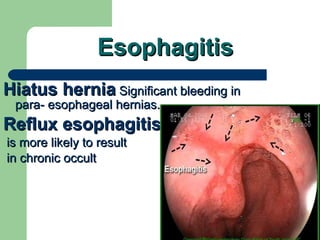
Esophagitis Hiatus hernia  Significant bleeding in para- esophageal hernias. Reflux esophagitis is more likely to result in chronic occult
 
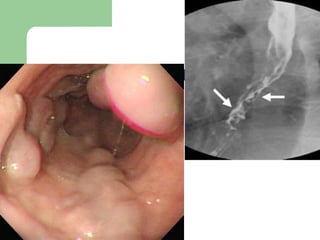
Varices Esophageal And Gastric :  in the presence of  liver  disease are life threatening situations precipitated by the inability of the liver to synthesize  clotting factors  Alcoholism  hepatitis B and C
 
Mucosal tear (Mallory-Weiss) Esophagogastric mucosal tear Initially the patient has  vomiting without  blood. Continued emesis leads to pain from the  tear  and eventually the patient develops  hematemesis .
 
Gastritis Diffuse gastritis .   Erosions  are usually  multiple  and found primarily in the fundus and body of the stomach.  Chronic slow  bleeds are most commonly associated with  H. pylori Brisk Bleeding : ingested substances as NSAIDs, alcohol, steroids, or other drugs.
 
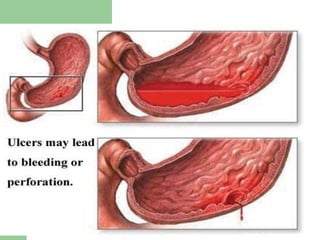
Peptic ulcer Most common cause of upper GI bleed 1/2- 2/3. Causes:H. pylori 40-50%,NSAID’s 40-50% andOther (Z-E syndrome)   Duodenal bleed is  four times  more common than gastric ulcer bleed.  Duodenal ulcers are usually  posterior  and involve branches of the gastroduodenal artery. Benign gastric ulcers bleed more than malignant ulcers. There will be  significant bleeding in 10-15% surgical intervention is needed in 20%

Duodenal ulcers located on the  anterior  wall are prone to  perforation  and present as peritonitis and free air.  Those on the  posterior  wall, which is the more common location, lead to  bleeding  The gastroduodenal artery
 
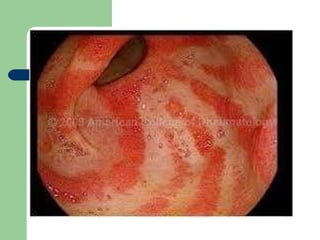
Gastric antral vascular ectasia (GAVE)  watermelon stomach   Dilated  small blood vessels in the  antrum , or the last part of the Streaky long red areas.
 
Stress ulcers Acute gastroduodenal lesions that arise after episodes of  shock, sepsis, surgery, trauma, burns   (curling’s ulcer),   or intracrainial pathology or surgery  (cushing’s ulcer).  The result of  bile reflux  damage to the gastric protective barrier combined with decreased gastric blood flow secondary to  splanchnic vasoconstriction. Sepsis,  coagulopathy , and activation of cytokines may also play a role.
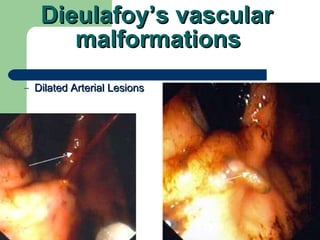
Dieulafoy’s vascular  malformations   Dilated Arterial Lesions
Other causes Gastric neoplasms : malignant and benign  usually mild and chronic.  Aorto-enteric fistulas  : As a herald bleed followed by a massive bleed In patients with prior aortic reconstructions.  Hematobilia  : following hepatic injuries or manipulations.
الحمد لله

Surgery 6th year, Tutorial (Dr. AbdulWahid)

  • 1.
  • 2.
    Incidence 1-2% ofall hospital admissions Most common diagnosis of new ICU admits 5-12% mortality 40% for recurrent bleeders 85% stop sponateously Those with massive bleeding need urgent intervention Only 5-10% need operative intervention after endoscopic interventions
  • 3.
    Site Upper EsophagealStomach Doudenum Hepatic Pancreatic Lower Small bowel Colon Anus
  • 4.
  • 5.
  • 6.
  • 7.
    Gastric varices Bleedingulcers Esophageal Varices
  • 8.
  • 9.
  • 10.
  • 11.
  • 12.
  • 13.
  • 14.
  • 15.
  • 16.
  • 17.
    Upper GI hemorrhageEtiology Peptic ulcer disease - 50% Varices – 10-20% Gastritis – 10-25% Mallory-weiss – 8-10% Esophagitis – 3-5% Malignancy – 3% Dieulafoy’s lesion – 1-3% Watermelon stomach – 1-2%
  • 18.
    Gastrointestinal Bleeding Hematemesis- Vomiting of blood from the oropharynx to the ligament of Treitz. Gross Blood And Blood Clots: rapid bleeding Coffee-ground Emesis : chronic bleeding. Melena- Passage of black and tarry stool caused by digested blood. Hematochezia- Passage of maroon to red blood and blood clots.
  • 19.
    Melena usually theresult of severe upper GI bleeding. without hematemesis :severe bleeding distal to the ligament of Treitz. 50-60 mL of blood in the GI tract produces melena after a 2 unit bleed : Melena can persist from 5- 7 days and stools can remain occult positive up to 3 weeks.
  • 20.
    Nose bleeds- Rarelythe cause of major bleeding.
  • 21.
    Esophagitis Hiatus hernia Significant bleeding in para- esophageal hernias. Reflux esophagitis is more likely to result in chronic occult
  • 22.
  • 23.
    Varices Esophageal AndGastric : in the presence of liver disease are life threatening situations precipitated by the inability of the liver to synthesize clotting factors Alcoholism hepatitis B and C
  • 24.
  • 25.
    Mucosal tear (Mallory-Weiss)Esophagogastric mucosal tear Initially the patient has vomiting without blood. Continued emesis leads to pain from the tear and eventually the patient develops hematemesis .
  • 26.
  • 27.
    Gastritis Diffuse gastritis. Erosions are usually multiple and found primarily in the fundus and body of the stomach. Chronic slow bleeds are most commonly associated with H. pylori Brisk Bleeding : ingested substances as NSAIDs, alcohol, steroids, or other drugs.
  • 28.
  • 29.
    Peptic ulcer Mostcommon cause of upper GI bleed 1/2- 2/3. Causes:H. pylori 40-50%,NSAID’s 40-50% andOther (Z-E syndrome) Duodenal bleed is four times more common than gastric ulcer bleed. Duodenal ulcers are usually posterior and involve branches of the gastroduodenal artery. Benign gastric ulcers bleed more than malignant ulcers. There will be significant bleeding in 10-15% surgical intervention is needed in 20%

  • 30.
    Duodenal ulcers locatedon the anterior wall are prone to perforation and present as peritonitis and free air. Those on the posterior wall, which is the more common location, lead to bleeding The gastroduodenal artery
  • 31.
  • 32.
    Gastric antral vascularectasia (GAVE) watermelon stomach Dilated small blood vessels in the antrum , or the last part of the Streaky long red areas.
  • 33.
  • 34.
    Stress ulcers Acutegastroduodenal lesions that arise after episodes of shock, sepsis, surgery, trauma, burns (curling’s ulcer), or intracrainial pathology or surgery (cushing’s ulcer). The result of bile reflux damage to the gastric protective barrier combined with decreased gastric blood flow secondary to splanchnic vasoconstriction. Sepsis, coagulopathy , and activation of cytokines may also play a role.
  • 35.
    Dieulafoy’s vascular malformations Dilated Arterial Lesions
  • 36.
    Other causes Gastricneoplasms : malignant and benign usually mild and chronic. Aorto-enteric fistulas : As a herald bleed followed by a massive bleed In patients with prior aortic reconstructions. Hematobilia : following hepatic injuries or manipulations.
  • 37.

Editor's Notes

  • #17 Watermelon stomach = Gastric antral vascular ectasia