PRINCIPLES OF MANAGEMENT
    OF BENIGN PROSTATIC
        HYPERPLASIA
     BY DR E.S ENAMINE
         27/4/2011
OUTLINE
        INTRODUCTION
           ANATOMY
EPIDEMIOLOGY/NATURAL HISTORY
      PATHOPHYSIOLOGY
      CLINICAL FEATURE
          DIAGNOSIS
        INVESTIGATION
          TREATMENT
       COMPLICATIONS
• BPH is the proliferation of the epithelial and
  stromal element of the prostate evidenced by
  enlargement of the gland as detected by DRE/
  TRUS.
• Subdivided into 3;
 Histological BPH
 Macroscopic BPH
 Clinical BPH.
RELEVANT ANATOMY
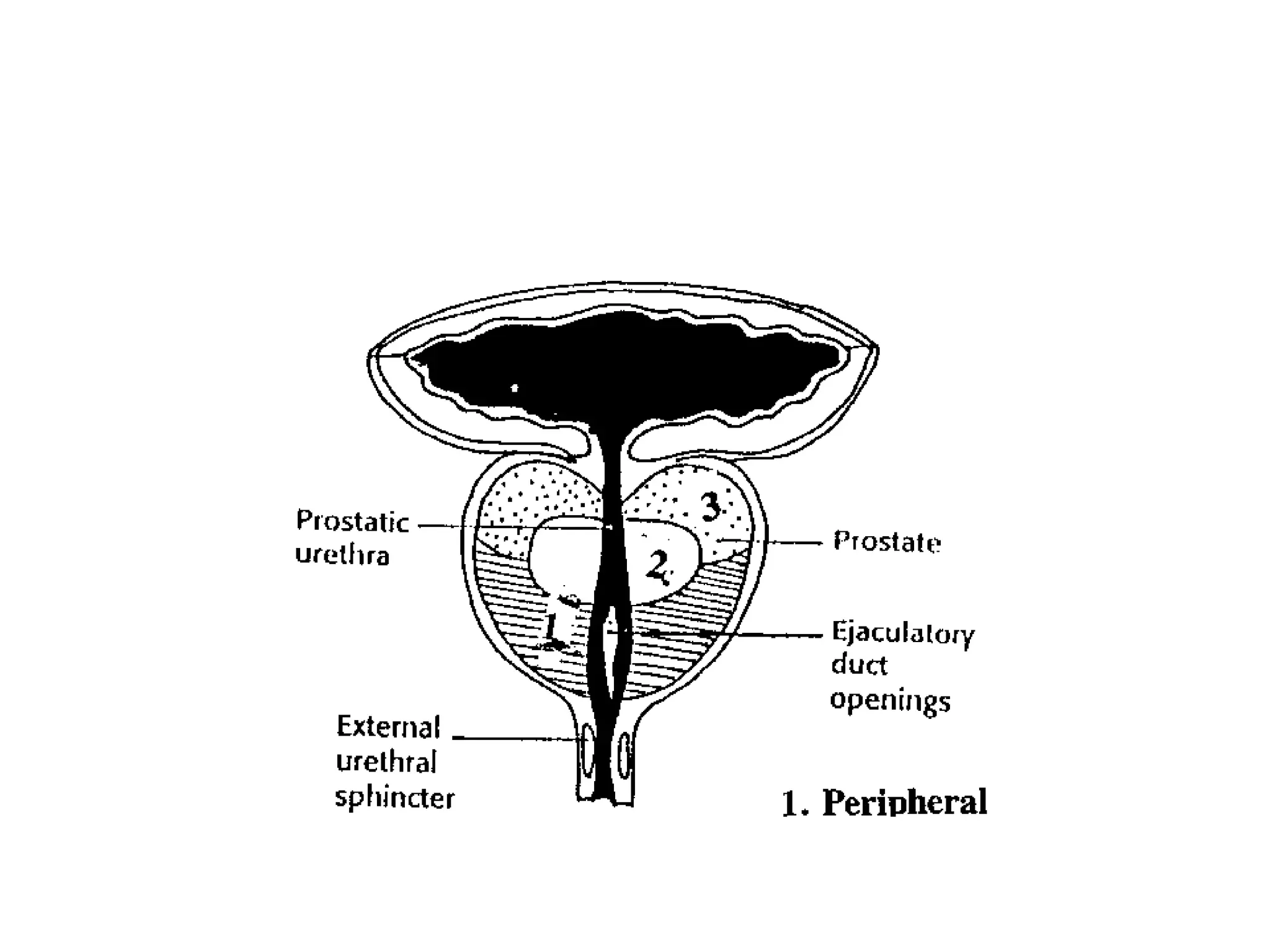
• Divided into 4 glandular zones and 1 non-
   glandular zone:
• Peripheral zone (PZ).
  -70% of CAP originate here.
  -largest anatomical subdivision.
  -contains 70-75% of normal prostatic glandular
   tissue
  -no contribution to BPH.
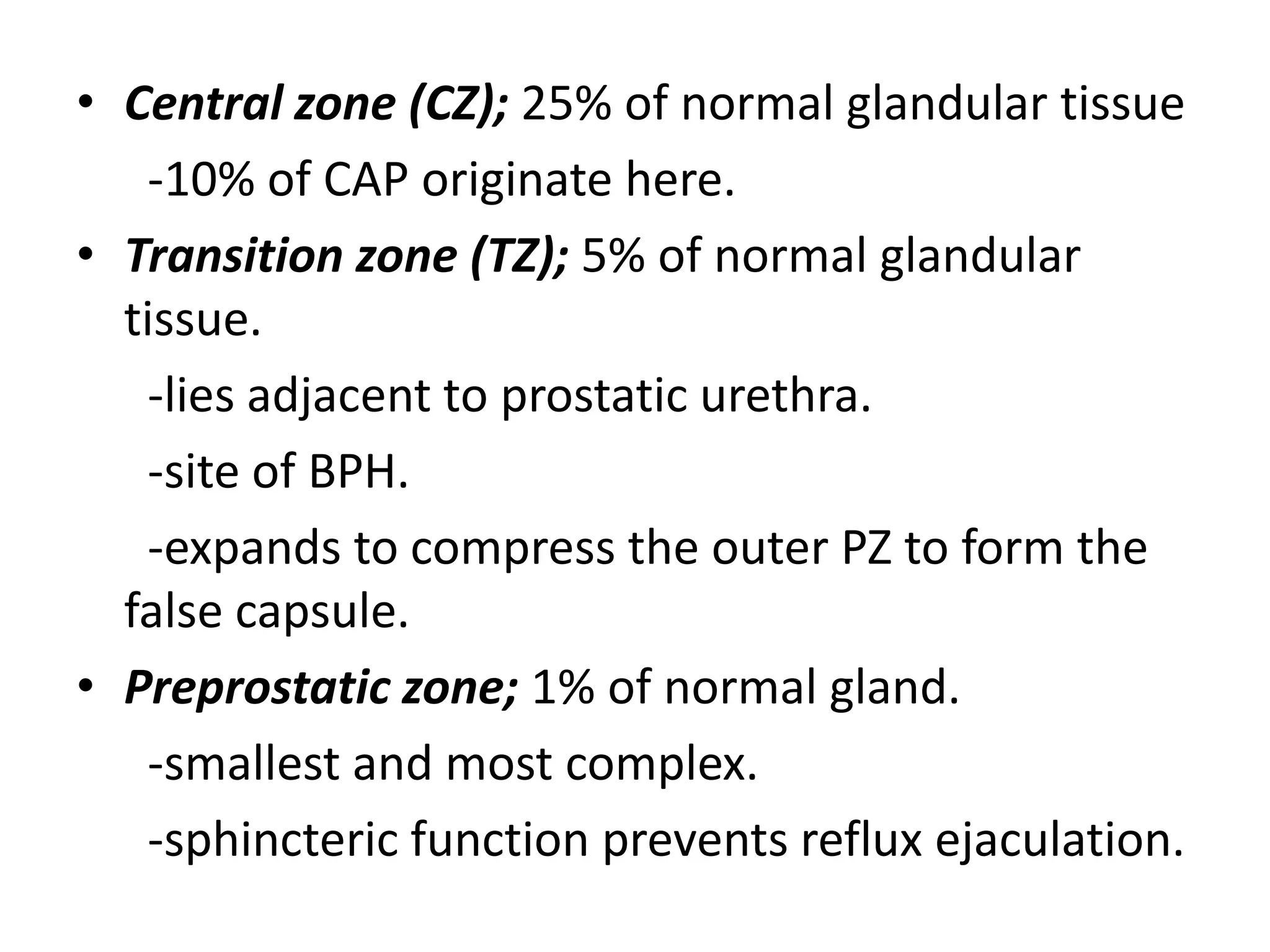
• Central zone (CZ); 25% of normal glandular tissue
   -10% of CAP originate here.
• Transition zone (TZ); 5% of normal glandular
  tissue.
   -lies adjacent to prostatic urethra.
   -site of BPH.
   -expands to compress the outer PZ to form the
  false capsule.
• Preprostatic zone; 1% of normal gland.
   -smallest and most complex.
   -sphincteric function prevents reflux ejaculation.
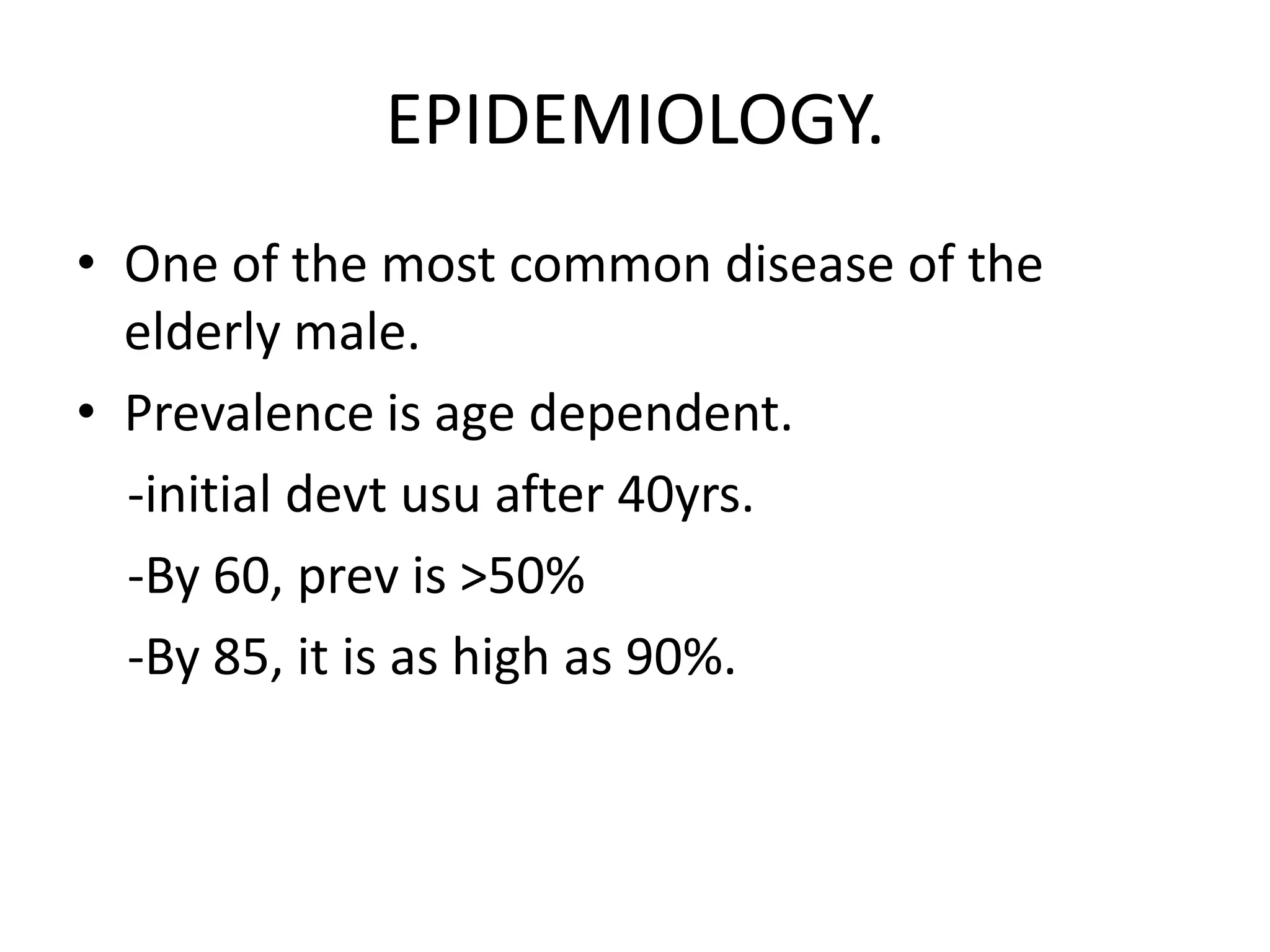
EPIDEMIOLOGY.
• One of the most common disease of the
  elderly male.
• Prevalence is age dependent.
  -initial devt usu after 40yrs.
  -By 60, prev is >50%
  -By 85, it is as high as 90%.
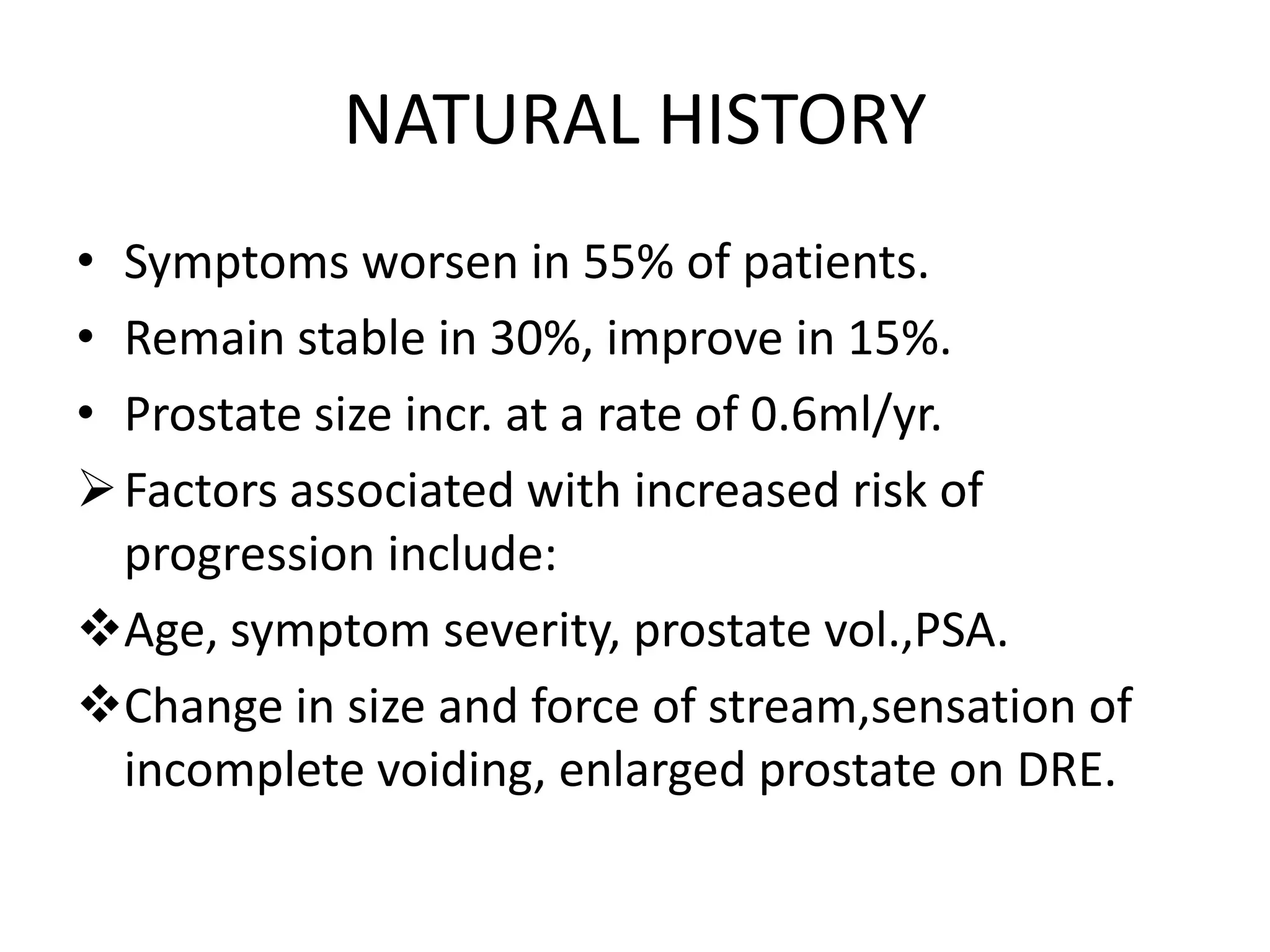
NATURAL HISTORY
• Symptoms worsen in 55% of patients.
• Remain stable in 30%, improve in 15%.
• Prostate size incr. at a rate of 0.6ml/yr.
 Factors associated with increased risk of
  progression include:
Age, symptom severity, prostate vol.,PSA.
Change in size and force of stream,sensation of
  incomplete voiding, enlarged prostate on DRE.
PATHOPHYSIOLOGY
• The devt of the histological BPH, requires age and
  androgens.
• Dihydrotestosterone (DHT) is the specific angdrogen
  mediating prostate growth.
• Testosterone is converted to DHT by 5-alpha reductase
  enz.
• Others GF involved are IGF, EGF etc.
• Obstruction to urine flow is due to static component
  from the bulk of glandular and fibromuscular tissue.
• Dynamic component is due to contraction of smooth
  muscle mediated by alpha 1a adrenoceptors.
CLINICAL FEATURES
• IRRITATIVE SYMPTOMS:
  -frequency, urgency, nocturia.
• OBSTRUCTIVE:
  -poor stream, incomplete bladder emptying.
  -straining on micturition.
  -intermittency, hesitancy.
  -urine retention (acute/chronic)
• Others:
  -haematuria.
  -recurrent UTI
  - AKI and CKD.
GUIDELINES FOR DIAGNOSIS
• 3 questions:
 Do you wake up at night?
Do you have problem of urine flow?
Is your bladder bothersome?
• If ‘yes’ , IPSS score should be done.
• General exam
• UGS
• DRE
INVESTIGATIONS
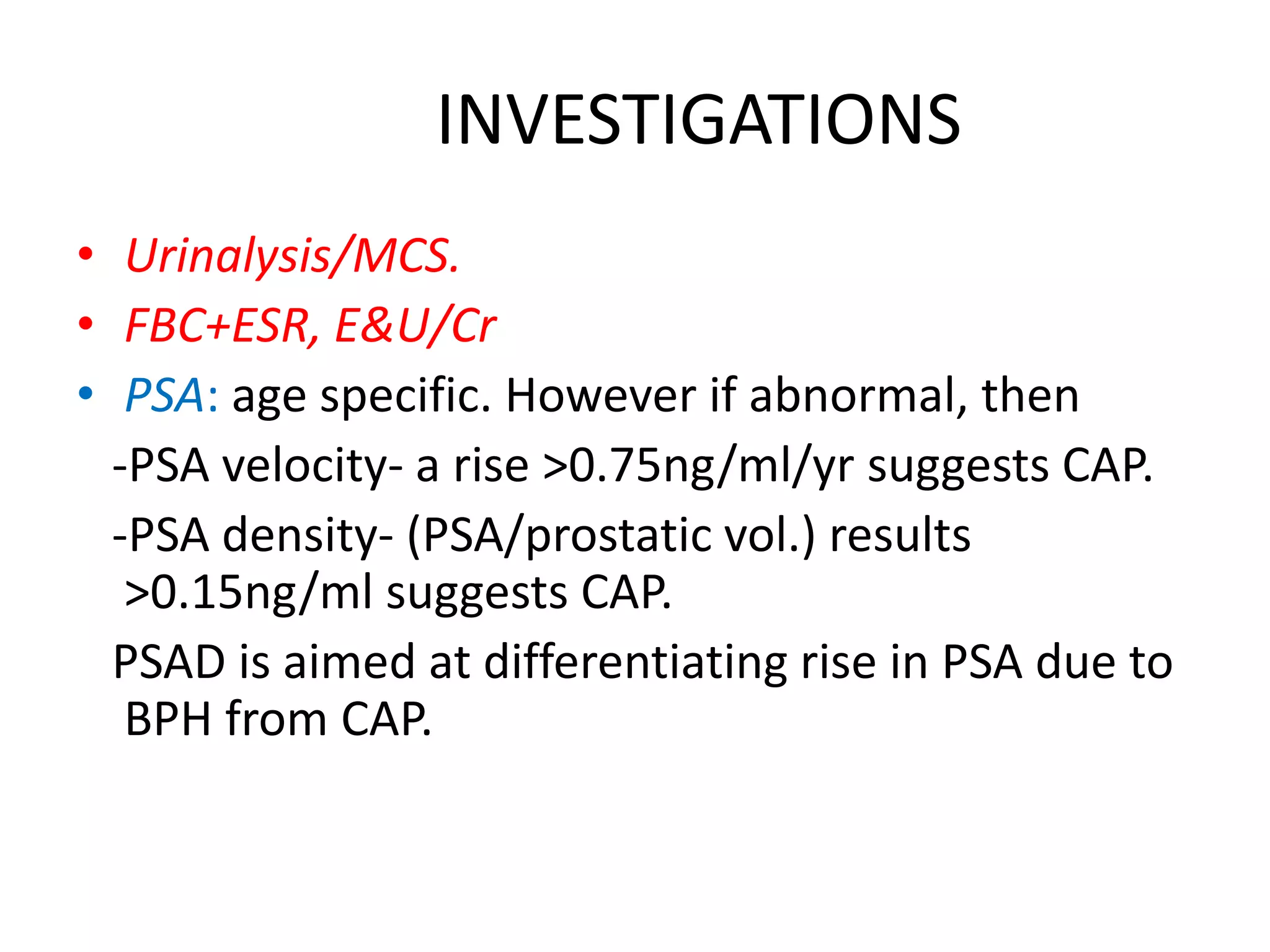
• Urinalysis/MCS.
• FBC+ESR, E&U/Cr
• PSA: age specific. However if abnormal, then
  -PSA velocity- a rise >0.75ng/ml/yr suggests CAP.
  -PSA density- (PSA/prostatic vol.) results
   >0.15ng/ml suggests CAP.
  PSAD is aimed at differentiating rise in PSA due to
   BPH from CAP.
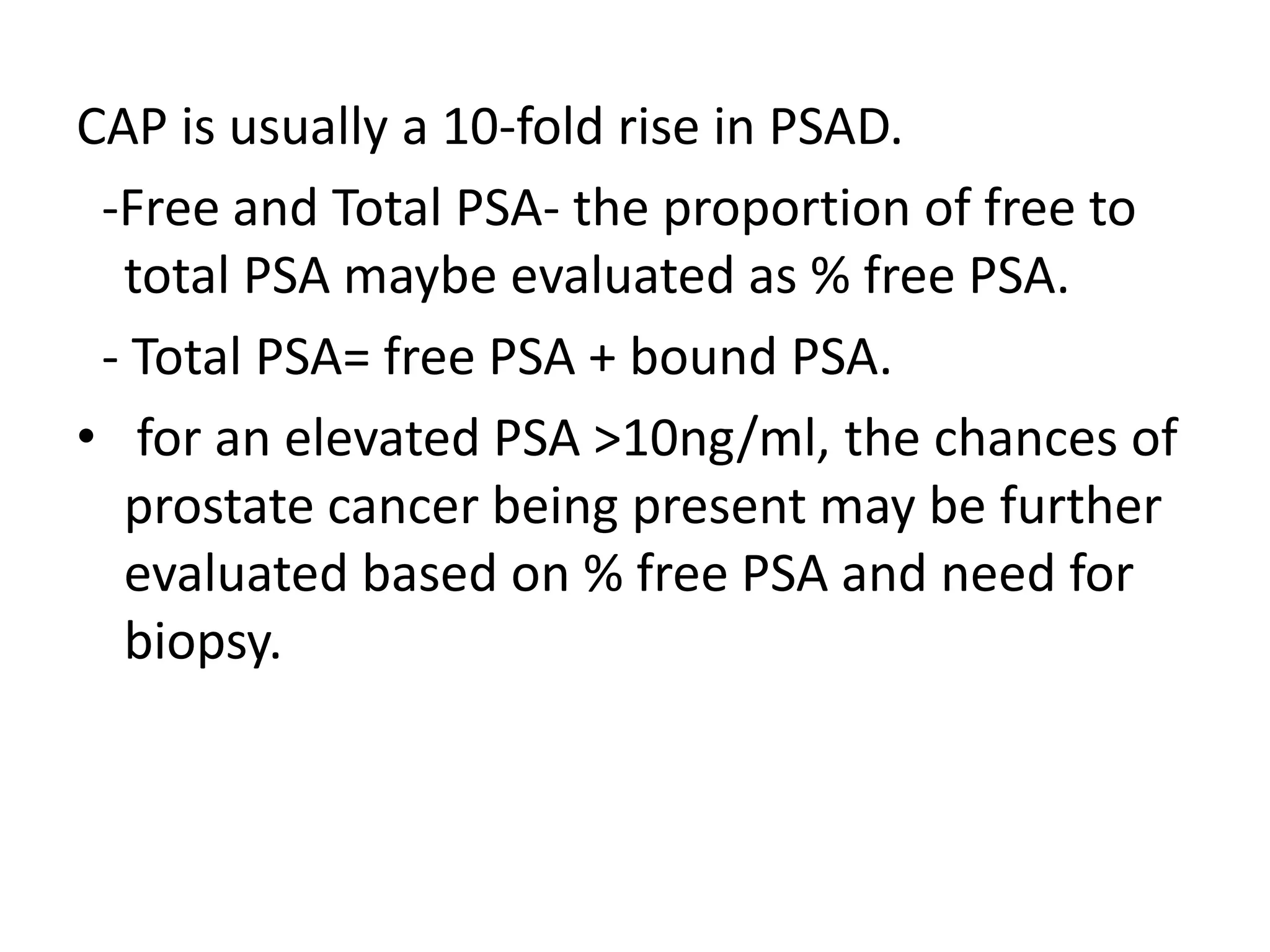
CAP is usually a 10-fold rise in PSAD.
 -Free and Total PSA- the proportion of free to
  total PSA maybe evaluated as % free PSA.
 - Total PSA= free PSA + bound PSA.
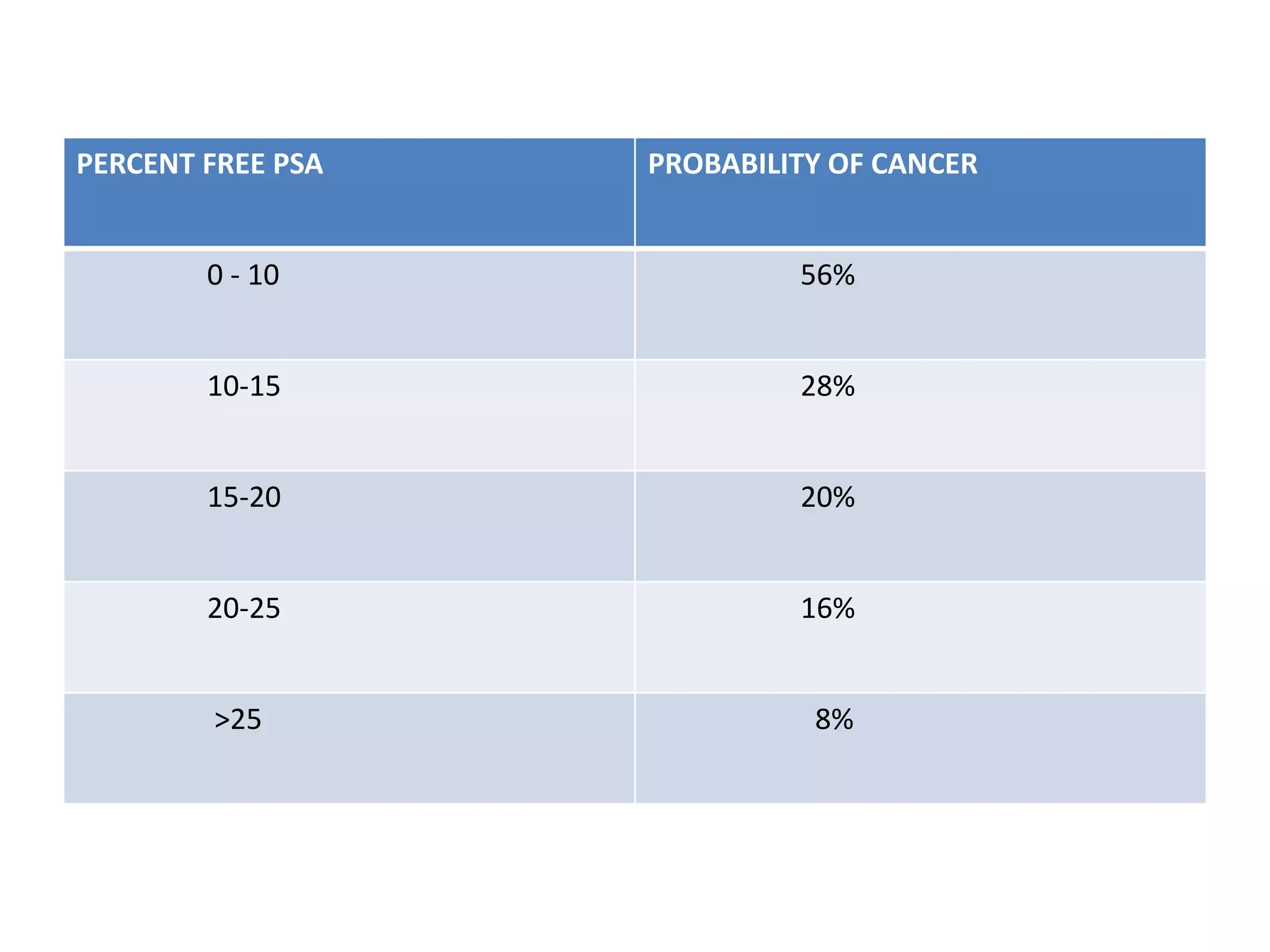
• for an elevated PSA >10ng/ml, the chances of
  prostate cancer being present may be further
  evaluated based on % free PSA and need for
  biopsy.
PERCENT FREE PSA   PROBABILITY OF CANCER


        0 - 10              56%


        10-15               28%


        15-20               20%


        20-25               16%


        >25                  8%
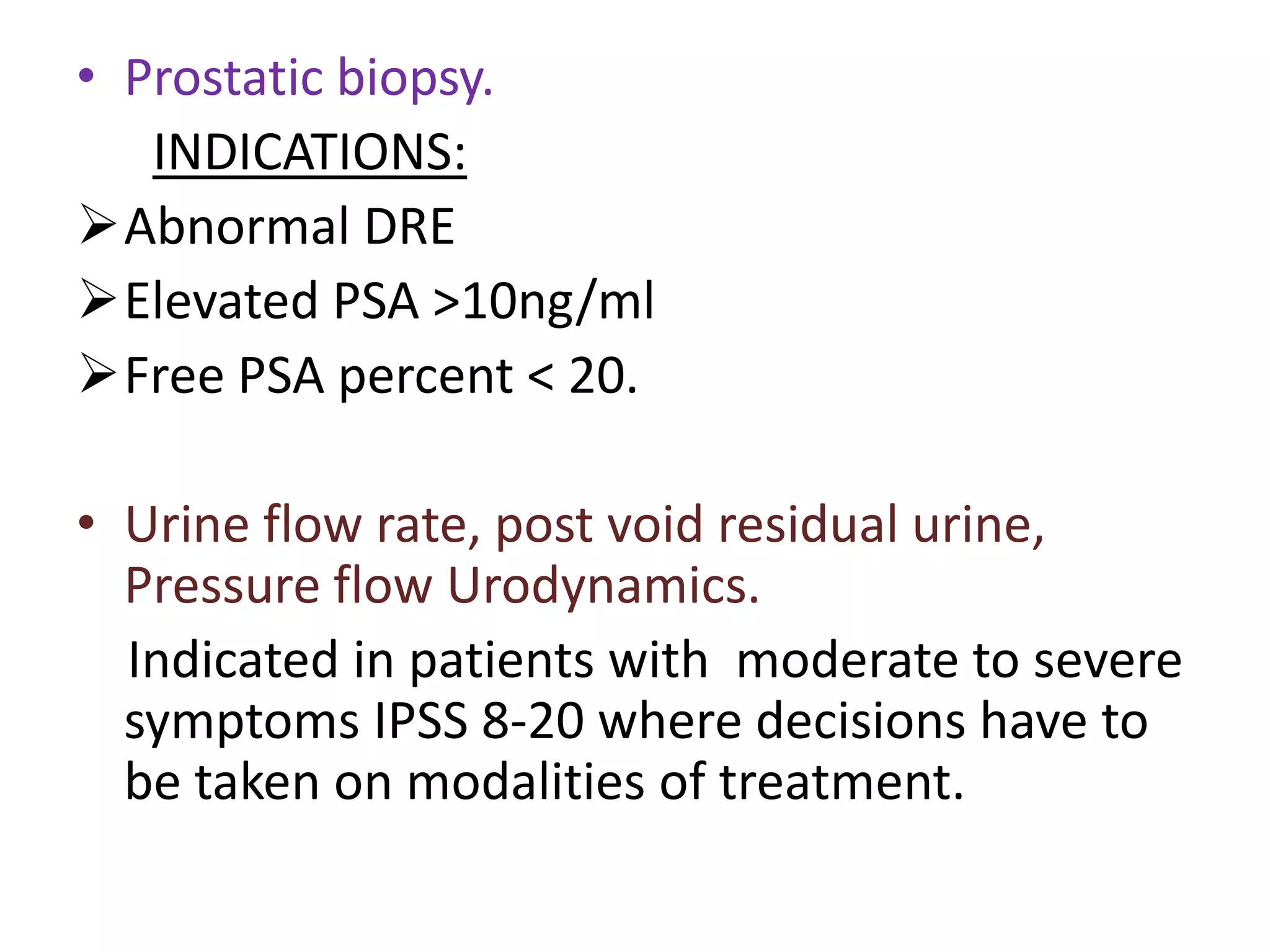
• Prostatic biopsy.
   INDICATIONS:
Abnormal DRE
Elevated PSA >10ng/ml
Free PSA percent < 20.

• Urine flow rate, post void residual urine,
  Pressure flow Urodynamics.
  Indicated in patients with moderate to severe
  symptoms IPSS 8-20 where decisions have to
  be taken on modalities of treatment.
• URINE FLOW RATE.
  -Peak Flow Rate (PFR) >15ml/s = normal.
                          10-15ml/s = equivocal
                         <10ml/s suggests BOO.
• POST VOID RESIDUAL VOLUME.
  -measured by transabd USS.
   value >200ml indicate need for surgery.
• Urethrocystoscopy. Indicated prior to surgery
  to select the correct operative modalities.
• Imaging of upper tract:
  - IVU
  -Abdominal USS
• TRUS and TRUS-guided biopsy.
• Colour doppler imaging of the prostate.
TREATMENT
MODALTIES INCLUDE:
• Waitful watching
• Medical therapy
• Minimally invasive Rx
• Surgery.
• WATCHFUL WAITING:
• Offer to pts with IPSS < or =8 who are not
  bothered by their symptoms.
• Involves regular assessment of IPSS, PSA, PFR,
  PVR.
• Contraindications: AUR, chronic retention,
  recurrent UTI, dilatation of upper tracts.
• MEDICAL THERAPY:
• Indicated for pts with IPSS <19 with bothersome
   symptoms but no complication after exclusion of
   CAP.
 Androgen suppression;
  i. 5-alpha reductase inhibitors- finesteride,
   episteride.
     reduces prostate vol by 20%
     reduces PSA value by 50%.
  ii. Flutamide-an androgen receptor antagonist.
      has no effect on IPSS, PFR and bothersome
   symptoms
Alpha adrenergic blockers;
 - e.g Tamsulosin.
Combination therapy.
   -5 alpha reductase inhibitor+ alpha 1 blocker
  shrinks the prostate by 25% in a year and 20%
  improvement of symptoms.
Phytotherapy.
    Various plant extract shave been used to treat
  BPH empirically though without clinical and
  safety value proven scientifically.
•   They include:
   pygeum africannum (African plum)
   serenoa repens B (American dwarf palm)
   sabal serrulatum (Dwarf palm)
   urtica spp (stinging nettle)
   hypoxis roopers (South African grass)
   cucurbitapepo (pumpkin seed)
• MINIMALLY INVASIVE TREATMENT.
• indicated in pts with IPSS 8-19
• Pts unfit for major surgery-pulmonary
  dxs, liver dxs, MI etc.
• CONTRAINDICATIONS:
• Recurrent episodes of haematuria
• Bladder stone due to BPH
• Upper tract dilatation
• Recurrent UTI
• Renal insufficiency.
• OPTIONS:
High intensity focused ultrasound (HIFU)
Transurethral vapourisation of prostate
Transurethral laser therapy (TULIP)
Intra-urethral stents
Transurethral needle ablation of prostate
  (TUNA)
Transurethral balloon dilatation.
SURGERY

OPTIONS
    OPEN PROSTATECTOMY
    TRANSURETHRAL RESECTION OF PROSTATE
    TRANSURETHRAL INCISION OF PROSTATE
INDICATIONS
    IPSS 19-35
     Moderate to severe Bothersome symptoms
  which are not Relieved By medical Rx/minimally
  invasive Rx
TUIP
• Suitable For small Prostate with tight Bladder
  Neck and No middle lobe Enlargement
• Incision made using a Collins Knife Below the
  ureteric orifice and carried thru to the Bladder
  neck
• Post op PFR-18mls/sec
• Incidence of Retrograde Ejaculation is 10%
• 10% of Px will Relapse and will Require TURP
TURP
• Done using a Resectoscope
• Used to Remove the Obstructing tissue in all
  but the most enormous tissue,thereby carving
  a passage way from the bladder
• Hospital stay is short
• Little Risk of DVT/Pulmonary Embolism
• Performed by specialist Urologist
• 80% of Px improve after TURP with reduction
  in IPSS, improve PFR from 8 -18 mls/sec in
  85% of Px.
• Likelihood of re-operation for BPH in 5yrs is
  3.4%
Indications for TURP
• Prostate <60g.
• LUTS not responding to change in
  lifestyle/medical therapy
• Recurrent acute urinary retention.
• Renal impairment due to BOO
• Recurrent hematuria due to BPH
• Small bladder stones due to BPH.
Complications of TURP
• Hemorrhage; primary and secondary.

• Urinary incontinence; maybe due to pre
  existing detrusor instability +/- sphincter
  weakness. Stress incontinence maybe due to
  sphincter damage
• Retrograde Ejaculation; usually during
  ejaculation there is reflex closure of the
  internal sphincter when semen enters the
  prostatic urethra.

• Urethral stricture; common sites--- ext
  urethral meatus, bladder neck and
  penoscrotal jxn.
   0ccurs 4-10 months post surgery.
Trans urethral Resection Syndrome
    Arises from infusion of large vol of Hypotonic
  irrigating sol during the Procedure e.g glycine
  Manifest as confusion,seizures,visual
  disturbance,bradycardia.
Central to this syndrome is dilutional
  Hyponatremia.
Can be prevented thus;limit Resection time,
• Avoid aggressive resection near the the
  capsule
• Use a continous irrigating cystoscope-this
  provides low pressure irrigation
OPEN PROSTATECTOMY
• Two types
 Retropubic
 Transvesical
• Indications
Prostate gland 70-100g
Bladder diverticulum
Large Hard ca stone
Marked ankylosis of the Hip preventing
  lithotomy position
• It is the most effective method of treating
  BOO due to BPH
• PFR inceasesto>20mls/s,symptoms improve
  markedly.
• Likelyhood of px requiring further surgery is
  0.4%,compaared to TURP 3.4%
• Complication rate 31.7% compared to TURP
  16.1%
COMPLICATIONS
• Haemorrhage-Follows inadequate haemostas
• Clot Retention,folows severe bleed and
  inadequate nursing care
• UTI
• Epididymo-orchitis-Arise from retrograde spread
  of infxn from prostatic fossa along the vas to the
  Epididymis
• Erectile Dysfxn-carvenosal nerve controlling
  erection may be destroyed during prostatectomy
• Damage to the ureters
• Retrograde ejaculation-bladder neck is
  removed in prostatectomy
• Infertility
• Incontinence of urine-Due to mech effect of
  the urethral catheter on the int sphincter of
  the bladder neck
• DVT
REFERENCES
• Badoe E.A,Archampong E.Q et al. (Eds) the
  prostate;3rd Edn. Ghana Publishing
  Corporation;2000; 47,850-866.
• Bailey and love 25th Ed pg 1344-1353
• Surgical Oncology contemporary principle and
  practice;Kirby .i.Baid,John .m. Daly
• Campbell walsh urology 9th Ed,WB
  Saunders,sect viii,chap 46;pg223-226
• American Urology Association
• Oxford Hand Book of Urology 1st Ed
• THANK YOU FOR YOUR TIME

Principles of management,bph

  • 1.
    PRINCIPLES OF MANAGEMENT OF BENIGN PROSTATIC HYPERPLASIA BY DR E.S ENAMINE 27/4/2011
  • 2.
    OUTLINE INTRODUCTION ANATOMY EPIDEMIOLOGY/NATURAL HISTORY PATHOPHYSIOLOGY CLINICAL FEATURE DIAGNOSIS INVESTIGATION TREATMENT COMPLICATIONS
  • 3.
    • BPH isthe proliferation of the epithelial and stromal element of the prostate evidenced by enlargement of the gland as detected by DRE/ TRUS. • Subdivided into 3;  Histological BPH  Macroscopic BPH  Clinical BPH.
  • 4.
    RELEVANT ANATOMY • Dividedinto 4 glandular zones and 1 non- glandular zone: • Peripheral zone (PZ). -70% of CAP originate here. -largest anatomical subdivision. -contains 70-75% of normal prostatic glandular tissue -no contribution to BPH.
  • 5.
    • Central zone(CZ); 25% of normal glandular tissue -10% of CAP originate here. • Transition zone (TZ); 5% of normal glandular tissue. -lies adjacent to prostatic urethra. -site of BPH. -expands to compress the outer PZ to form the false capsule. • Preprostatic zone; 1% of normal gland. -smallest and most complex. -sphincteric function prevents reflux ejaculation.
  • 7.
    EPIDEMIOLOGY. • One ofthe most common disease of the elderly male. • Prevalence is age dependent. -initial devt usu after 40yrs. -By 60, prev is >50% -By 85, it is as high as 90%.
  • 8.
    NATURAL HISTORY • Symptomsworsen in 55% of patients. • Remain stable in 30%, improve in 15%. • Prostate size incr. at a rate of 0.6ml/yr.  Factors associated with increased risk of progression include: Age, symptom severity, prostate vol.,PSA. Change in size and force of stream,sensation of incomplete voiding, enlarged prostate on DRE.
  • 9.
    PATHOPHYSIOLOGY • The devtof the histological BPH, requires age and androgens. • Dihydrotestosterone (DHT) is the specific angdrogen mediating prostate growth. • Testosterone is converted to DHT by 5-alpha reductase enz. • Others GF involved are IGF, EGF etc. • Obstruction to urine flow is due to static component from the bulk of glandular and fibromuscular tissue. • Dynamic component is due to contraction of smooth muscle mediated by alpha 1a adrenoceptors.
  • 10.
    CLINICAL FEATURES • IRRITATIVESYMPTOMS: -frequency, urgency, nocturia. • OBSTRUCTIVE: -poor stream, incomplete bladder emptying. -straining on micturition. -intermittency, hesitancy. -urine retention (acute/chronic)
  • 11.
    • Others: -haematuria. -recurrent UTI - AKI and CKD.
  • 12.
    GUIDELINES FOR DIAGNOSIS •3 questions:  Do you wake up at night? Do you have problem of urine flow? Is your bladder bothersome? • If ‘yes’ , IPSS score should be done. • General exam • UGS • DRE
  • 13.
    INVESTIGATIONS • Urinalysis/MCS. • FBC+ESR,E&U/Cr • PSA: age specific. However if abnormal, then -PSA velocity- a rise >0.75ng/ml/yr suggests CAP. -PSA density- (PSA/prostatic vol.) results >0.15ng/ml suggests CAP. PSAD is aimed at differentiating rise in PSA due to BPH from CAP.
  • 14.
    CAP is usuallya 10-fold rise in PSAD. -Free and Total PSA- the proportion of free to total PSA maybe evaluated as % free PSA. - Total PSA= free PSA + bound PSA. • for an elevated PSA >10ng/ml, the chances of prostate cancer being present may be further evaluated based on % free PSA and need for biopsy.
  • 15.
    PERCENT FREE PSA PROBABILITY OF CANCER 0 - 10 56% 10-15 28% 15-20 20% 20-25 16% >25 8%
  • 16.
    • Prostatic biopsy. INDICATIONS: Abnormal DRE Elevated PSA >10ng/ml Free PSA percent < 20. • Urine flow rate, post void residual urine, Pressure flow Urodynamics. Indicated in patients with moderate to severe symptoms IPSS 8-20 where decisions have to be taken on modalities of treatment.
  • 17.
    • URINE FLOWRATE. -Peak Flow Rate (PFR) >15ml/s = normal. 10-15ml/s = equivocal <10ml/s suggests BOO. • POST VOID RESIDUAL VOLUME. -measured by transabd USS. value >200ml indicate need for surgery.
  • 18.
    • Urethrocystoscopy. Indicatedprior to surgery to select the correct operative modalities. • Imaging of upper tract: - IVU -Abdominal USS • TRUS and TRUS-guided biopsy. • Colour doppler imaging of the prostate.
  • 19.
    TREATMENT MODALTIES INCLUDE: • Waitfulwatching • Medical therapy • Minimally invasive Rx • Surgery.
  • 20.
    • WATCHFUL WAITING: •Offer to pts with IPSS < or =8 who are not bothered by their symptoms. • Involves regular assessment of IPSS, PSA, PFR, PVR. • Contraindications: AUR, chronic retention, recurrent UTI, dilatation of upper tracts.
  • 21.
    • MEDICAL THERAPY: •Indicated for pts with IPSS <19 with bothersome symptoms but no complication after exclusion of CAP.  Androgen suppression; i. 5-alpha reductase inhibitors- finesteride, episteride. reduces prostate vol by 20% reduces PSA value by 50%. ii. Flutamide-an androgen receptor antagonist. has no effect on IPSS, PFR and bothersome symptoms
  • 22.
    Alpha adrenergic blockers; - e.g Tamsulosin. Combination therapy. -5 alpha reductase inhibitor+ alpha 1 blocker shrinks the prostate by 25% in a year and 20% improvement of symptoms. Phytotherapy. Various plant extract shave been used to treat BPH empirically though without clinical and safety value proven scientifically.
  • 23.
    They include:  pygeum africannum (African plum)  serenoa repens B (American dwarf palm)  sabal serrulatum (Dwarf palm)  urtica spp (stinging nettle)  hypoxis roopers (South African grass)  cucurbitapepo (pumpkin seed)
  • 24.
    • MINIMALLY INVASIVETREATMENT. • indicated in pts with IPSS 8-19 • Pts unfit for major surgery-pulmonary dxs, liver dxs, MI etc. • CONTRAINDICATIONS: • Recurrent episodes of haematuria • Bladder stone due to BPH • Upper tract dilatation • Recurrent UTI • Renal insufficiency.
  • 25.
    • OPTIONS: High intensityfocused ultrasound (HIFU) Transurethral vapourisation of prostate Transurethral laser therapy (TULIP) Intra-urethral stents Transurethral needle ablation of prostate (TUNA) Transurethral balloon dilatation.
  • 26.
    SURGERY OPTIONS OPEN PROSTATECTOMY TRANSURETHRAL RESECTION OF PROSTATE TRANSURETHRAL INCISION OF PROSTATE INDICATIONS IPSS 19-35 Moderate to severe Bothersome symptoms which are not Relieved By medical Rx/minimally invasive Rx
  • 27.
    TUIP • Suitable Forsmall Prostate with tight Bladder Neck and No middle lobe Enlargement • Incision made using a Collins Knife Below the ureteric orifice and carried thru to the Bladder neck • Post op PFR-18mls/sec • Incidence of Retrograde Ejaculation is 10% • 10% of Px will Relapse and will Require TURP
  • 28.
    TURP • Done usinga Resectoscope • Used to Remove the Obstructing tissue in all but the most enormous tissue,thereby carving a passage way from the bladder • Hospital stay is short
  • 29.
    • Little Riskof DVT/Pulmonary Embolism • Performed by specialist Urologist • 80% of Px improve after TURP with reduction in IPSS, improve PFR from 8 -18 mls/sec in 85% of Px. • Likelihood of re-operation for BPH in 5yrs is 3.4%
  • 30.
    Indications for TURP •Prostate <60g. • LUTS not responding to change in lifestyle/medical therapy • Recurrent acute urinary retention. • Renal impairment due to BOO • Recurrent hematuria due to BPH • Small bladder stones due to BPH.
  • 31.
    Complications of TURP •Hemorrhage; primary and secondary. • Urinary incontinence; maybe due to pre existing detrusor instability +/- sphincter weakness. Stress incontinence maybe due to sphincter damage
  • 32.
    • Retrograde Ejaculation;usually during ejaculation there is reflex closure of the internal sphincter when semen enters the prostatic urethra. • Urethral stricture; common sites--- ext urethral meatus, bladder neck and penoscrotal jxn. 0ccurs 4-10 months post surgery.
  • 33.
    Trans urethral ResectionSyndrome Arises from infusion of large vol of Hypotonic irrigating sol during the Procedure e.g glycine Manifest as confusion,seizures,visual disturbance,bradycardia. Central to this syndrome is dilutional Hyponatremia. Can be prevented thus;limit Resection time,
  • 34.
    • Avoid aggressiveresection near the the capsule • Use a continous irrigating cystoscope-this provides low pressure irrigation
  • 35.
    OPEN PROSTATECTOMY • Twotypes  Retropubic  Transvesical • Indications Prostate gland 70-100g Bladder diverticulum Large Hard ca stone Marked ankylosis of the Hip preventing lithotomy position
  • 36.
    • It isthe most effective method of treating BOO due to BPH • PFR inceasesto>20mls/s,symptoms improve markedly. • Likelyhood of px requiring further surgery is 0.4%,compaared to TURP 3.4% • Complication rate 31.7% compared to TURP 16.1%
  • 37.
    COMPLICATIONS • Haemorrhage-Follows inadequatehaemostas • Clot Retention,folows severe bleed and inadequate nursing care • UTI • Epididymo-orchitis-Arise from retrograde spread of infxn from prostatic fossa along the vas to the Epididymis • Erectile Dysfxn-carvenosal nerve controlling erection may be destroyed during prostatectomy • Damage to the ureters
  • 38.
    • Retrograde ejaculation-bladderneck is removed in prostatectomy • Infertility • Incontinence of urine-Due to mech effect of the urethral catheter on the int sphincter of the bladder neck • DVT
  • 39.
    REFERENCES • Badoe E.A,ArchampongE.Q et al. (Eds) the prostate;3rd Edn. Ghana Publishing Corporation;2000; 47,850-866. • Bailey and love 25th Ed pg 1344-1353 • Surgical Oncology contemporary principle and practice;Kirby .i.Baid,John .m. Daly • Campbell walsh urology 9th Ed,WB Saunders,sect viii,chap 46;pg223-226 • American Urology Association
  • 40.
    • Oxford HandBook of Urology 1st Ed
  • 41.
    • THANK YOUFOR YOUR TIME