Prostatitis  Prepared by Dr.sarwar N mahmood F.I.C.M.S( urology),F.E.B.U, E.A.U
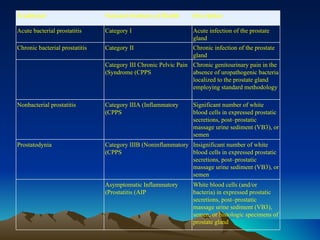
Traditional National Institutes of Health Description Acute bacterial prostatitis Category I Acute infection of the prostate gland Chronic bacterial prostatitis Category II Chronic infection of the prostate gland   Category III Chronic Pelvic Pain Syndrome (CPPS) Chronic genitourinary pain in the absence of uropathogenic bacteria localized to the prostate gland employing standard methodology Nonbacterial prostatitis Category IIIA (Inflammatory CPPS) Significant number of white blood cells in expressed prostatic secretions, post–prostatic massage urine sediment (VB3), or semen Prostatodynia Category IIIB (Noninflammatory CPPS) Insignificant number of white blood cells in expressed prostatic secretions, post–prostatic massage urine sediment (VB3), or semen   Asymptomatic Inflammatory Prostatitis (AIP) White blood cells (and/or bacteria) in expressed prostatic secretions, post–prostatic massage urine sediment (VB3), semen, or histologic specimens of prostate gland
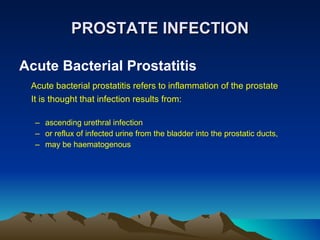
PROSTATE INFECTION Acute Bacterial Prostatitis Acute bacterial prostatitis refers to inflammation of the prostate  It is thought that infection results from: ascending urethral infection or reflux of infected urine from the bladder into the prostatic ducts, may be haematogenous
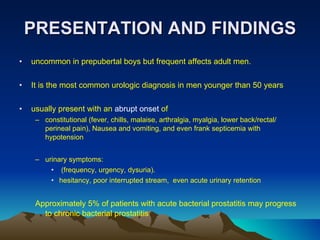
PRESENTATION AND FINDINGS uncommon in prepubertal boys but frequent affects adult men. It is the most common urologic diagnosis in men younger than 50 years usually present with an  abrupt onset  of  constitutional (fever, chills, malaise, arthralgia, myalgia, lower back/rectal/ perineal pain), Nausea and vomiting, and even frank septicemia with hypotension  urinary symptoms: (frequency, urgency, dysuria). hesitancy, poor interrupted stream,  even acute urinary retention  Approximately 5% of patients with acute bacterial prostatitis may progress to chronic bacterial prostatitis
Digital rectal examination reveals The prostate itself is usually described as hot, boggy, and exquisitely tender leukocytosis. PSA are often elevated. A urine culture is the only laboratory evaluation of the lower urinary tract required. It has been suggested that the vigorous prostatic massage necessary to produce EPS can exacerbate the clinical situation,. A midstream urine specimen will show significant leukocytosis and bacteriuria microscopically, and culturing usually discloses typical uropathogens. Blood cultures may show the same organism
Culture of urine usually identifies a single organism, but occasionally, polymicrobial infection may occur.  E. coli  is the most common causative organism  Other gram-negative bacteria  ( Proteus, Klebsiella, Enterobacter, Pseudomonas,  and  Serratia  spp.) and enterococci are less frequent pathogens.  Anaerobic  and other  gram-positive  bacteria are rarely a cause of acute prostatitis.
RADIOLOGIC IMAGING Radiologic imaging is rarely indicated in patients with acute prostatitis.  Bladder ultrasonography may be useful in determining the amount of residual urine. Transrectal ultrasonography is only indicated in patients who do not respond to conventional therapy.
MANAGEMENT Empiric therapy directed against instituted immediately, while awaiting the culture results. Trimethoprim and fluoroquinolones have high drug penetration into prostatic tissue and are recommended for 4–6 weeks. The long duration of antibiotic treatment is to allow complete sterilization of the prostatic tissue to prevent complications such as chronic prostatitis and abscess formation.
Patients who have  sepsis , are  immunocompromised  or in  acute urinary  retention, or have significant  medical comorbidities hospitalization  parenteral antibiotics. Ampicillin and an aminoglycoside provide effective therapy against both gram-negative bacteria and enterococci. Patients with urinary retention secondary to acute prostatitis should be managed with a  suprapubic catheter  because transurethral catheterization or instrumentation is contraindicated.
Chronic Bacterial Prostatitis In contrast to the acute form, chronic bacterial prostatitis has a more insidious onset characterized by relapsing, recurrent UTI caused by the persistence of pathogen in the prostatic fluid despite antibiotic therapy.  The prevalence of bacterial prostatitis ranges from 5% to 15% of prostatitis cases.
PRESENTATION AND FINDINGS history  of documented recurrent or relapsing UTI, urethritis, or epididymitis caused by the same organism. (25%-43%) asymptomatic  between acute episodes, long history dysuria,  urgency,  frequency,  nocturia,  and low back/perineal pain. Others are  asymptomatic , but the diagnosis is made after investigation for bacteriuria.
digital rectal examination of the prostate is  often normal . occasionally, tenderness, firmness, or prostatic calculi may be found on examination.
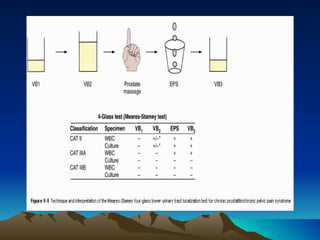
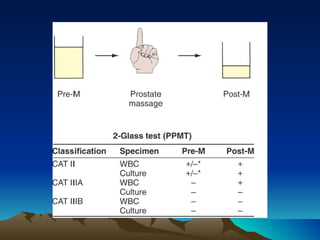
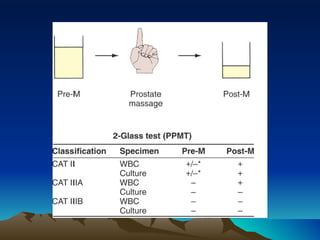
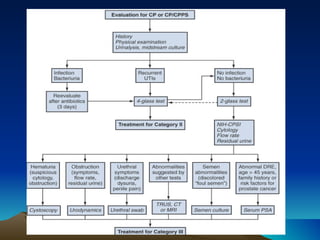
Urinalysis demonstrates a variable degree of  WBCs and bacteria  in the urine, depending on the extent of the disease. Serum does not show any evidence of leukocytosis. Prostate-specific antigen levels may be elevated. Diagnosis is made after identification of  bacteria from prostate expressate  or urine specimen after a prostatic massage, using the  4-cup test . The causative organisms are similar to those of acute bacterial prostatitis
RADIOLOGIC IMAGING Radiologic imaging is rarely indicated in patients with chronic prostatitis. Transrectal ultrasonography is only indicated if a prostatic abscess is suspected.
 
 
MANAGEMENT the duration of antibiotic therapy may be 3–4 months. Using fluoroquinolones,  The addition of an alpha blocker to antibiotic therapy has been shown to reduce symptom recurrences.  Despite maximal therapy, cure is not often achieved due to poor penetration of antibiotic into prostatic tissue and relative isolation of the bacterial foci within the prostate. When recurrent episodes of infection occur despite antibiotic therapy, suppressive antibiotic (TMP-SMX 1 single-strength tablet daily,  nitrofurantoin 100 mg daily,  ciprofloxacin 250 mg daily) may be used.
Transurethral resection of the prostate has been used to treat patients with refractory disease; however, the success rate has been variable and this approach is not generally recommended .
Tuberculosis of the prostate Tuberculosis of the prostate is rare and associated with renal tuberculosis in 1/3 of cases there is a history of pulmonary tuberculosis within 5 years of the onset of the genital tubeculosis . rectal examination reveals nodules in one or both lateral lobes.  Patients usually present with the following Urethral discharge painful and sometime blood stained ejaculation perineal pain, infertility, dysuria, abscess formation.
Radiography sometimes displays area of calcification in the prostate and seminal vesicles. Prostate expressate, seminal fluid and sometime prostate biopsy bacteriological examination yields positive cultures for tubercle bacilli. Treatment : The general Rx is that for tuberculosis. If the prostatic abscess forms it should be drained transurethrally.
Prostate Abscess Most cases of prostatic abscess result from complications of  acute bacterial prostatitis that were    inadequately or    inappropriately treated.   Prostatic abscesses are often seen in patients with  diabetes; those receiving chronic dialysis. patients who are immunocompromised. undergoing urethral instrumentation. who have chronic indwelling catheters .
PRESENTATION AND FINDINGS Patients with prostatic abscess present with similar symptoms to those with acute bacterial prostatitis.  Typically, these patients were treated for acute bacterial prostatitis previously and had a good initial response to treatment with antibiotics.  However, their symptoms recurred during treatment, suggesting development of prostatic abscesses. On digital rectal examination, the prostate is usually  tender and swollen. Fluctuance  is only seen in 16% of patients with prostatic abscess. .
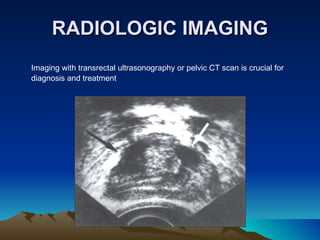
RADIOLOGIC IMAGING Imaging with transrectal ultrasonography or pelvic CT scan is crucial for diagnosis and treatment
MANAGEMENT Antibiotic therapy in conjunction with drainage of the abscess is required.  Transrectal ultrasonography or CT scan can be used to direct transrectal drainage of the abscess . Transurethral resection and drainage may be required if transrectal drainage is inadequate.  When properly diagnosed and treated, most cases of prostatic abscess resolve without significant sequelae.
Chronic Pelvic Pain Syndrome CPPS The presenting symptoms of inflammatory category IIIA CPPS (chronic nonbacterial Prostatitis) are indistinguishable from those of patients with noninflammatory category IIIB disease  prostatodynia. The predominant symptom is  pain,localized to perineum, suprapubic area, and penis but can also occur in the testes, groin, or low back. Pain during or after ejaculation  is one of the most  prominent,  important, and bothersome feature in many patients . Irritative and obstructive voiding symptoms Erectile dysfunction and sexual disturbances
By definition, the syndrome becomes chronic after  3 months ' duration.  The symptoms tend to  wax and wane  over time; approximately  one third  of patients improve over 1 year (usually patients with shorter duration and fewer symptoms) . The impact of this condition on health status is significant. The quality of life of many patients diagnosed with CP/CPPS is impaired  The differentiation of the two subtypes of category III CPPS depend on  cytologic examination of the urine or EPS or both.
 
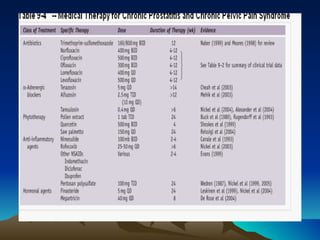
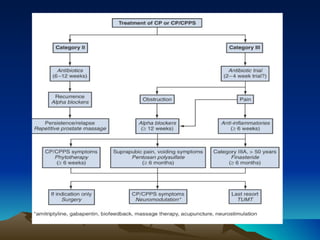
MEDICAL THERAPY Antibiotics α-adrenergic blockers anti-inflammatory agents hormonal therapies phytotherapies   The following medical therapies have shown benefits in placebo controlled studies in CPPS:   Marked benefit— none   Moderate benefit—α-adrenergic blockers  Modest benefit—anti-inflammatory agents, phytotherapies
Minimal invasive surgery transurethral needle ablation (TUNA) of the prostate. Microwave  Hyperthermia and Thermotherapy.  TURP or even radical prostatectomy


Urology 5th year, 3rd lecture (Dr. Sarwar)

  • 1.
    Prostatitis Preparedby Dr.sarwar N mahmood F.I.C.M.S( urology),F.E.B.U, E.A.U
  • 2.
    Traditional National Institutesof Health Description Acute bacterial prostatitis Category I Acute infection of the prostate gland Chronic bacterial prostatitis Category II Chronic infection of the prostate gland   Category III Chronic Pelvic Pain Syndrome (CPPS) Chronic genitourinary pain in the absence of uropathogenic bacteria localized to the prostate gland employing standard methodology Nonbacterial prostatitis Category IIIA (Inflammatory CPPS) Significant number of white blood cells in expressed prostatic secretions, post–prostatic massage urine sediment (VB3), or semen Prostatodynia Category IIIB (Noninflammatory CPPS) Insignificant number of white blood cells in expressed prostatic secretions, post–prostatic massage urine sediment (VB3), or semen   Asymptomatic Inflammatory Prostatitis (AIP) White blood cells (and/or bacteria) in expressed prostatic secretions, post–prostatic massage urine sediment (VB3), semen, or histologic specimens of prostate gland
  • 3.
    PROSTATE INFECTION AcuteBacterial Prostatitis Acute bacterial prostatitis refers to inflammation of the prostate It is thought that infection results from: ascending urethral infection or reflux of infected urine from the bladder into the prostatic ducts, may be haematogenous
  • 4.
    PRESENTATION AND FINDINGSuncommon in prepubertal boys but frequent affects adult men. It is the most common urologic diagnosis in men younger than 50 years usually present with an abrupt onset of constitutional (fever, chills, malaise, arthralgia, myalgia, lower back/rectal/ perineal pain), Nausea and vomiting, and even frank septicemia with hypotension urinary symptoms: (frequency, urgency, dysuria). hesitancy, poor interrupted stream, even acute urinary retention Approximately 5% of patients with acute bacterial prostatitis may progress to chronic bacterial prostatitis
  • 5.
    Digital rectal examinationreveals The prostate itself is usually described as hot, boggy, and exquisitely tender leukocytosis. PSA are often elevated. A urine culture is the only laboratory evaluation of the lower urinary tract required. It has been suggested that the vigorous prostatic massage necessary to produce EPS can exacerbate the clinical situation,. A midstream urine specimen will show significant leukocytosis and bacteriuria microscopically, and culturing usually discloses typical uropathogens. Blood cultures may show the same organism
  • 6.
    Culture of urineusually identifies a single organism, but occasionally, polymicrobial infection may occur. E. coli is the most common causative organism Other gram-negative bacteria ( Proteus, Klebsiella, Enterobacter, Pseudomonas, and Serratia spp.) and enterococci are less frequent pathogens. Anaerobic and other gram-positive bacteria are rarely a cause of acute prostatitis.
  • 7.
    RADIOLOGIC IMAGING Radiologicimaging is rarely indicated in patients with acute prostatitis. Bladder ultrasonography may be useful in determining the amount of residual urine. Transrectal ultrasonography is only indicated in patients who do not respond to conventional therapy.
  • 8.
    MANAGEMENT Empiric therapydirected against instituted immediately, while awaiting the culture results. Trimethoprim and fluoroquinolones have high drug penetration into prostatic tissue and are recommended for 4–6 weeks. The long duration of antibiotic treatment is to allow complete sterilization of the prostatic tissue to prevent complications such as chronic prostatitis and abscess formation.
  • 9.
    Patients who have sepsis , are immunocompromised or in acute urinary retention, or have significant medical comorbidities hospitalization parenteral antibiotics. Ampicillin and an aminoglycoside provide effective therapy against both gram-negative bacteria and enterococci. Patients with urinary retention secondary to acute prostatitis should be managed with a suprapubic catheter because transurethral catheterization or instrumentation is contraindicated.
  • 10.
    Chronic Bacterial ProstatitisIn contrast to the acute form, chronic bacterial prostatitis has a more insidious onset characterized by relapsing, recurrent UTI caused by the persistence of pathogen in the prostatic fluid despite antibiotic therapy. The prevalence of bacterial prostatitis ranges from 5% to 15% of prostatitis cases.
  • 11.
    PRESENTATION AND FINDINGShistory of documented recurrent or relapsing UTI, urethritis, or epididymitis caused by the same organism. (25%-43%) asymptomatic between acute episodes, long history dysuria, urgency, frequency, nocturia, and low back/perineal pain. Others are asymptomatic , but the diagnosis is made after investigation for bacteriuria.
  • 12.
    digital rectal examinationof the prostate is often normal . occasionally, tenderness, firmness, or prostatic calculi may be found on examination.
  • 13.
    Urinalysis demonstrates avariable degree of WBCs and bacteria in the urine, depending on the extent of the disease. Serum does not show any evidence of leukocytosis. Prostate-specific antigen levels may be elevated. Diagnosis is made after identification of bacteria from prostate expressate or urine specimen after a prostatic massage, using the 4-cup test . The causative organisms are similar to those of acute bacterial prostatitis
  • 14.
    RADIOLOGIC IMAGING Radiologicimaging is rarely indicated in patients with chronic prostatitis. Transrectal ultrasonography is only indicated if a prostatic abscess is suspected.
  • 15.
  • 16.
  • 17.
    MANAGEMENT the durationof antibiotic therapy may be 3–4 months. Using fluoroquinolones, The addition of an alpha blocker to antibiotic therapy has been shown to reduce symptom recurrences. Despite maximal therapy, cure is not often achieved due to poor penetration of antibiotic into prostatic tissue and relative isolation of the bacterial foci within the prostate. When recurrent episodes of infection occur despite antibiotic therapy, suppressive antibiotic (TMP-SMX 1 single-strength tablet daily, nitrofurantoin 100 mg daily, ciprofloxacin 250 mg daily) may be used.
  • 18.
    Transurethral resection ofthe prostate has been used to treat patients with refractory disease; however, the success rate has been variable and this approach is not generally recommended .
  • 19.
    Tuberculosis of theprostate Tuberculosis of the prostate is rare and associated with renal tuberculosis in 1/3 of cases there is a history of pulmonary tuberculosis within 5 years of the onset of the genital tubeculosis . rectal examination reveals nodules in one or both lateral lobes. Patients usually present with the following Urethral discharge painful and sometime blood stained ejaculation perineal pain, infertility, dysuria, abscess formation.
  • 20.
    Radiography sometimes displaysarea of calcification in the prostate and seminal vesicles. Prostate expressate, seminal fluid and sometime prostate biopsy bacteriological examination yields positive cultures for tubercle bacilli. Treatment : The general Rx is that for tuberculosis. If the prostatic abscess forms it should be drained transurethrally.
  • 21.
    Prostate Abscess Mostcases of prostatic abscess result from complications of acute bacterial prostatitis that were inadequately or inappropriately treated. Prostatic abscesses are often seen in patients with diabetes; those receiving chronic dialysis. patients who are immunocompromised. undergoing urethral instrumentation. who have chronic indwelling catheters .
  • 22.
    PRESENTATION AND FINDINGSPatients with prostatic abscess present with similar symptoms to those with acute bacterial prostatitis. Typically, these patients were treated for acute bacterial prostatitis previously and had a good initial response to treatment with antibiotics. However, their symptoms recurred during treatment, suggesting development of prostatic abscesses. On digital rectal examination, the prostate is usually tender and swollen. Fluctuance is only seen in 16% of patients with prostatic abscess. .
  • 23.
    RADIOLOGIC IMAGING Imagingwith transrectal ultrasonography or pelvic CT scan is crucial for diagnosis and treatment
  • 24.
    MANAGEMENT Antibiotic therapyin conjunction with drainage of the abscess is required. Transrectal ultrasonography or CT scan can be used to direct transrectal drainage of the abscess . Transurethral resection and drainage may be required if transrectal drainage is inadequate. When properly diagnosed and treated, most cases of prostatic abscess resolve without significant sequelae.
  • 25.
    Chronic Pelvic PainSyndrome CPPS The presenting symptoms of inflammatory category IIIA CPPS (chronic nonbacterial Prostatitis) are indistinguishable from those of patients with noninflammatory category IIIB disease prostatodynia. The predominant symptom is pain,localized to perineum, suprapubic area, and penis but can also occur in the testes, groin, or low back. Pain during or after ejaculation is one of the most prominent, important, and bothersome feature in many patients . Irritative and obstructive voiding symptoms Erectile dysfunction and sexual disturbances
  • 26.
    By definition, thesyndrome becomes chronic after 3 months ' duration. The symptoms tend to wax and wane over time; approximately one third of patients improve over 1 year (usually patients with shorter duration and fewer symptoms) . The impact of this condition on health status is significant. The quality of life of many patients diagnosed with CP/CPPS is impaired The differentiation of the two subtypes of category III CPPS depend on cytologic examination of the urine or EPS or both.
  • 27.
  • 28.
    MEDICAL THERAPY Antibioticsα-adrenergic blockers anti-inflammatory agents hormonal therapies phytotherapies   The following medical therapies have shown benefits in placebo controlled studies in CPPS:   Marked benefit— none Moderate benefit—α-adrenergic blockers Modest benefit—anti-inflammatory agents, phytotherapies
  • 29.
    Minimal invasive surgerytransurethral needle ablation (TUNA) of the prostate. Microwave Hyperthermia and Thermotherapy. TURP or even radical prostatectomy
  • 30.
  • 31.
  • 32.