Microwave Remote Sensing
History US has a long history in Microwave  Remote Sensing. Clutter Measurement program after the WW-II. Ohio State University collected a large data base of clutter on variety of targets. Earnest studies for the remote sensing of the earth can be considered to have began 1960s. In 1960s NASA initiated studies to investigate the use of microwave technology to earth observation.
History The research NASA and other agencies initiated resulted in: Development of ground-based and airborne sensors.  Measurement of emission and scattering characteristics of many natural targets. Development of models to explain and understand measured data. Space missions with microwave sensors. NIMBUS Radiometers. SKYLAB Radar and Radiometers
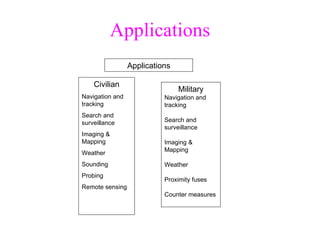
Applications Applications Civilian Navigation and tracking Search and surveillance Imaging & Mapping Weather  Sounding Probing Remote sensing Military Navigation and tracking Search and surveillance Imaging & Mapping Weather Proximity fuses Counter measures
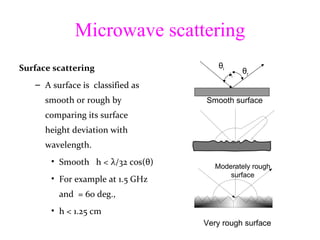
Microwave scattering Surface scattering  A surface is  classified as smooth or rough by comparing its surface height deviation with wavelength.  Smooth  h <  λ /32 cos( θ ) For example at 1.5 GHz and  = 60 deg., h < 1.25 cm Smooth surface Moderately rough surface Very rough surface θ i θ r
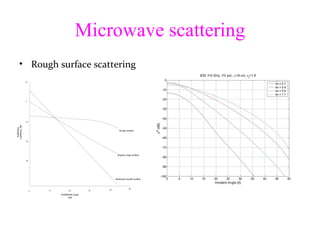
Microwave scattering Rough surface scattering
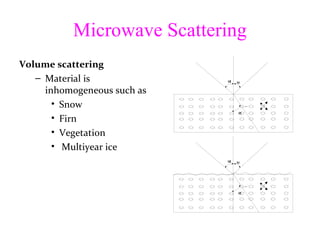
Microwave Scattering Volume scattering Material is inhomogeneous such as Snow Firn Vegetation Multiyear ice
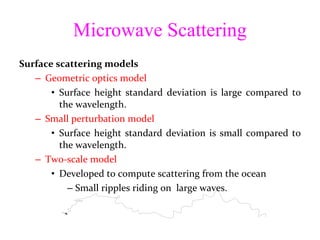
Microwave Scattering Surface scattering models Geometric optics model Surface height standard deviation is large compared to the wavelength.  Small perturbation model Surface height standard deviation is small compared to the wavelength. Two-scale model Developed to compute scattering from the ocean Small ripples riding on  large waves.
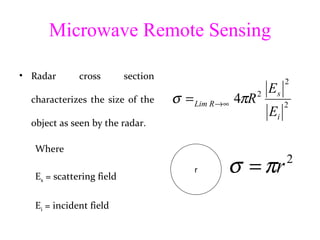
Microwave Remote Sensing Radar cross section characterizes the size of the object as seen by the radar. Where E s  = scattering field E i  = incident field r
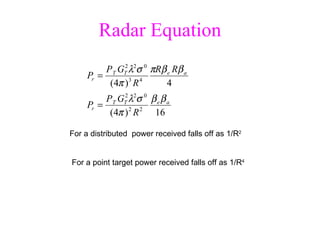
Radar Equation For a distributed  power received falls off as 1/R 2 For a point target power received falls off as 1/R 4
Microwave Remote Sensing— Atmosphere and Precipitation Global precipitation mission Will consist of a primary spacecraft and a constellation. Primary Spacecraft  Dual-frequency radar. 14 and 35 GHz. Passive Microwave Radiometer Constellation Spacecraft  Passive Microwave Radiometer
Microwave Remote Sensing Research and application of microwave technology to remote sensing of Oceans and ice Solid earth and Natural hazards.. Atmosphere and precipitation. Vegetation and Soil moisture
Microwave Remote Sensing— Ocean and Ice Winds Scatterometer. Quickscat, Seawinds Polarimetric radiometer Ocean topography Radar altimeters Ocean salinity AQUARIUS Radiometer and radar combination. Radar to measure winds for correcting for the effect of surface roughness.
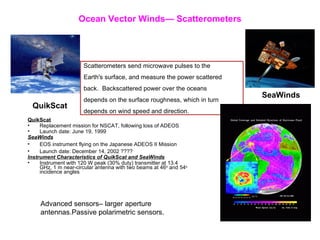
Ocean Vector Winds— Scatterometers QuikScat Replacement mission for NSCAT, following loss of ADEOS Launch date: June 19, 1999 SeaWinds EOS instrument flying on the Japanese ADEOS II Mission Launch date: December 14, 2002 ???? Instrument Characteristics of QuikScat and SeaWinds Instrument with 120 W peak (30% duty) transmitter at 13.4 GHz, 1 m near-circular antenna with two beams at 46 o  and 54 o  incidence angles Scatterometers send microwave pulses to the  Earth's surface, and measure the power scattered  back.  Backscattered power over the oceans  depends on the surface roughness, which in turn  depends on wind speed and direction. QuikScat SeaWinds Advanced sensors– larger aperture antennas.Passive polarimetric sensors.
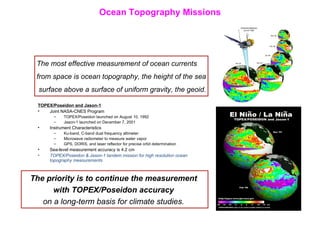
Ocean Topography Missions TOPEX/Poseidon and Jason-1 Joint NASA-CNES Program TOPEX/Poseidon launched on August 10, 1992 Jason-1 launched on December 7, 2001 Instrument Characteristics Ku-band, C-band dual frequency altimeter Microwave radiometer to measure water vapor GPS, DORIS, and laser reflector for precise orbit determination Sea-level measurement accuracy is 4.2 cm TOPEX/Poseidon & Jason-1 tandem mission for high resolution ocean topography measurements The most effective measurement of ocean currents  from space is ocean topography, the height of the sea surface above a surface of uniform gravity, the geoid. The priority is to continue the measurement  with TOPEX/Poseidon accuracy   on a long-term basis for climate studies. 
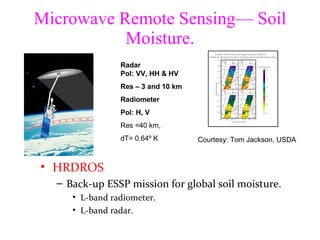
Microwave Remote Sensing— Soil Moisture. HRDROS Back-up ESSP mission for global soil moisture. L-band radiometer. L-band radar. Courtesy: Tom Jackson, USDA SGP’97 Radar Pol: VV, HH & HV Res – 3 and 10 km Radiometer Pol: H, V Res =40 km,  dT= 0.64º K
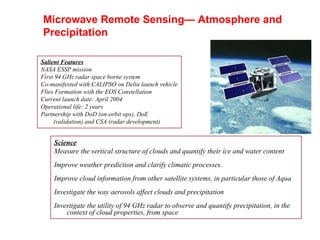
Salient Features NASA ESSP mission First 94 GHz radar space borne system Co-manifested with CALIPSO on Delta launch vehicle Flies Formation with the EOS Constellation Current launch date: April 2004 Operational life: 2 years Partnership with DoD (on-orbit ops), DoE (validation) and CSA (radar development) Science Measure the vertical structure of clouds and quantify their ice and water content Improve weather prediction and clarify climatic processes. Improve cloud information from other satellite systems, in particular those of Aqua Investigate the way aerosols affect clouds and precipitation Investigate the utility of 94 GHz radar to observe and quantify precipitation, in the context of cloud properties, from space Microwave Remote Sensing— Atmosphere and Precipitation
The End ……  Thank You ……

Microwave remote sensing

  • 1.
  • 2.
    History US hasa long history in Microwave Remote Sensing. Clutter Measurement program after the WW-II. Ohio State University collected a large data base of clutter on variety of targets. Earnest studies for the remote sensing of the earth can be considered to have began 1960s. In 1960s NASA initiated studies to investigate the use of microwave technology to earth observation.
  • 3.
    History The researchNASA and other agencies initiated resulted in: Development of ground-based and airborne sensors. Measurement of emission and scattering characteristics of many natural targets. Development of models to explain and understand measured data. Space missions with microwave sensors. NIMBUS Radiometers. SKYLAB Radar and Radiometers
  • 4.
    Applications Applications CivilianNavigation and tracking Search and surveillance Imaging & Mapping Weather Sounding Probing Remote sensing Military Navigation and tracking Search and surveillance Imaging & Mapping Weather Proximity fuses Counter measures
  • 5.
    Microwave scattering Surfacescattering A surface is classified as smooth or rough by comparing its surface height deviation with wavelength. Smooth h < λ /32 cos( θ ) For example at 1.5 GHz and = 60 deg., h < 1.25 cm Smooth surface Moderately rough surface Very rough surface θ i θ r
  • 6.
    Microwave scattering Roughsurface scattering
  • 7.
    Microwave Scattering Volumescattering Material is inhomogeneous such as Snow Firn Vegetation Multiyear ice
  • 8.
    Microwave Scattering Surfacescattering models Geometric optics model Surface height standard deviation is large compared to the wavelength. Small perturbation model Surface height standard deviation is small compared to the wavelength. Two-scale model Developed to compute scattering from the ocean Small ripples riding on large waves.
  • 9.
    Microwave Remote SensingRadar cross section characterizes the size of the object as seen by the radar. Where E s = scattering field E i = incident field r
  • 10.
    Radar Equation Fora distributed power received falls off as 1/R 2 For a point target power received falls off as 1/R 4
  • 11.
    Microwave Remote Sensing—Atmosphere and Precipitation Global precipitation mission Will consist of a primary spacecraft and a constellation. Primary Spacecraft Dual-frequency radar. 14 and 35 GHz. Passive Microwave Radiometer Constellation Spacecraft Passive Microwave Radiometer
  • 12.
    Microwave Remote SensingResearch and application of microwave technology to remote sensing of Oceans and ice Solid earth and Natural hazards.. Atmosphere and precipitation. Vegetation and Soil moisture
  • 13.
    Microwave Remote Sensing—Ocean and Ice Winds Scatterometer. Quickscat, Seawinds Polarimetric radiometer Ocean topography Radar altimeters Ocean salinity AQUARIUS Radiometer and radar combination. Radar to measure winds for correcting for the effect of surface roughness.
  • 14.
    Ocean Vector Winds—Scatterometers QuikScat Replacement mission for NSCAT, following loss of ADEOS Launch date: June 19, 1999 SeaWinds EOS instrument flying on the Japanese ADEOS II Mission Launch date: December 14, 2002 ???? Instrument Characteristics of QuikScat and SeaWinds Instrument with 120 W peak (30% duty) transmitter at 13.4 GHz, 1 m near-circular antenna with two beams at 46 o and 54 o incidence angles Scatterometers send microwave pulses to the Earth's surface, and measure the power scattered back. Backscattered power over the oceans depends on the surface roughness, which in turn depends on wind speed and direction. QuikScat SeaWinds Advanced sensors– larger aperture antennas.Passive polarimetric sensors.
  • 15.
    Ocean Topography MissionsTOPEX/Poseidon and Jason-1 Joint NASA-CNES Program TOPEX/Poseidon launched on August 10, 1992 Jason-1 launched on December 7, 2001 Instrument Characteristics Ku-band, C-band dual frequency altimeter Microwave radiometer to measure water vapor GPS, DORIS, and laser reflector for precise orbit determination Sea-level measurement accuracy is 4.2 cm TOPEX/Poseidon & Jason-1 tandem mission for high resolution ocean topography measurements The most effective measurement of ocean currents from space is ocean topography, the height of the sea surface above a surface of uniform gravity, the geoid. The priority is to continue the measurement with TOPEX/Poseidon accuracy on a long-term basis for climate studies. 
  • 16.
    Microwave Remote Sensing—Soil Moisture. HRDROS Back-up ESSP mission for global soil moisture. L-band radiometer. L-band radar. Courtesy: Tom Jackson, USDA SGP’97 Radar Pol: VV, HH & HV Res – 3 and 10 km Radiometer Pol: H, V Res =40 km, dT= 0.64º K
  • 17.
    Salient Features NASAESSP mission First 94 GHz radar space borne system Co-manifested with CALIPSO on Delta launch vehicle Flies Formation with the EOS Constellation Current launch date: April 2004 Operational life: 2 years Partnership with DoD (on-orbit ops), DoE (validation) and CSA (radar development) Science Measure the vertical structure of clouds and quantify their ice and water content Improve weather prediction and clarify climatic processes. Improve cloud information from other satellite systems, in particular those of Aqua Investigate the way aerosols affect clouds and precipitation Investigate the utility of 94 GHz radar to observe and quantify precipitation, in the context of cloud properties, from space Microwave Remote Sensing— Atmosphere and Precipitation
  • 18.
    The End …… Thank You ……