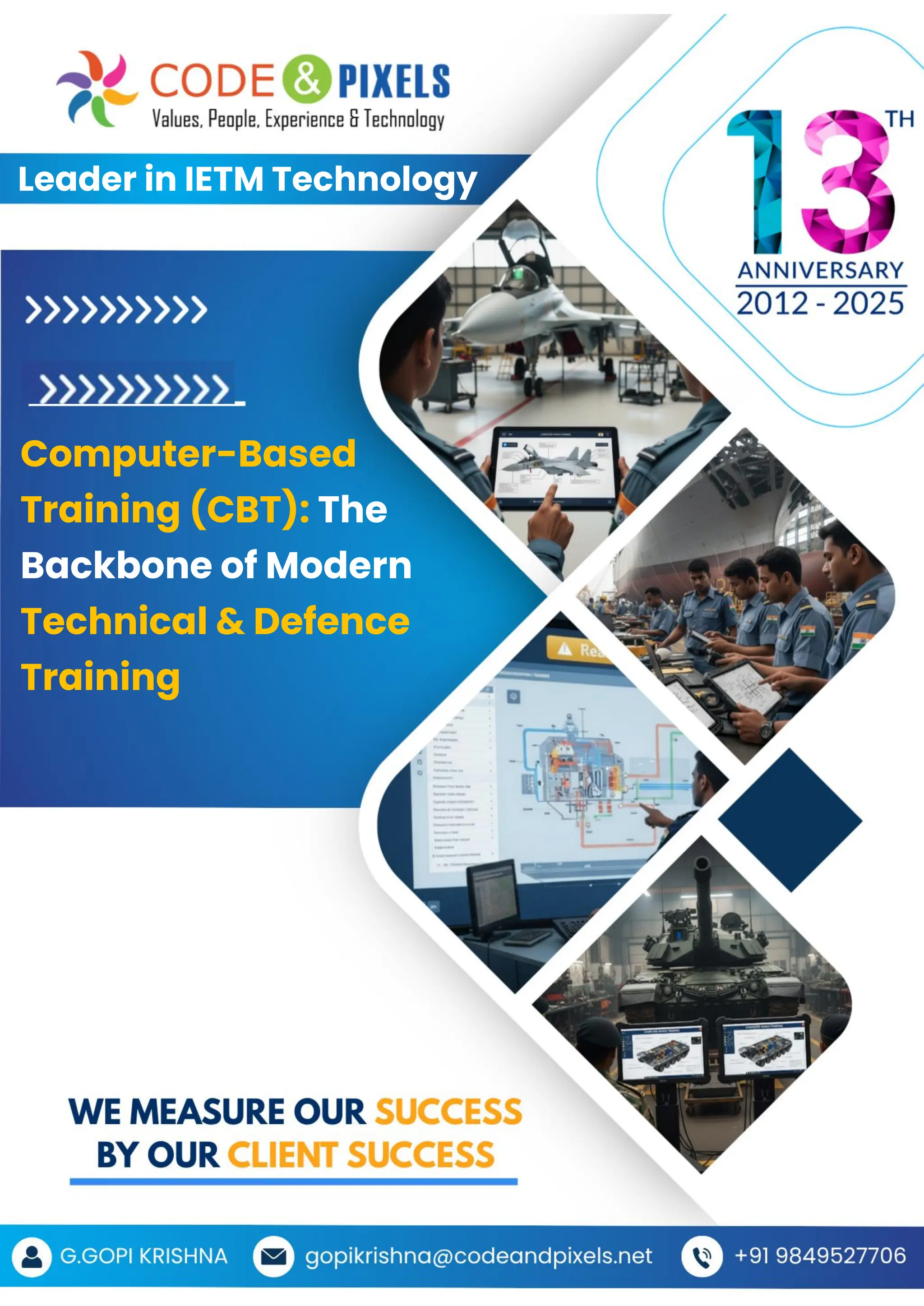
Computer-Based
Training (CBT): The
Backbone of Modern
Technical & Defence
Training
Leader in IETM Technology
CODEANDPIXELS.NET IETM@CODEANDPIXELS.NET 9849527706 Page 2
In today’s technology-driven world, Computer-Based Training (CBT) has
become an essential method for delivering structured, effective, and scalable
learning especially in technical and defence environments. CBT enables personnel
to gain indepth theoretical knowledge of systems, equipment, software, and
machinery before ever touching the actual hardware, reducing risk, cost, and
dependency on physical resources.
This blog explains what CBT is, its structure, scope, applications, and why it is
mission-critical for defence forces, while also highlighting how Code and Pixels
Interactive Technologies Pvt Ltd. helps OEMs, defence labs, and system integrators
build world-class CBT solutions.
What is Computer-Based Training (CBT)?
Computer-Based Training refers to any instructional or educational programme
delivered through a computer using multimedia elements such as:
• Text and graphics
• Images and line diagrams
• Audio narration (voiceovers)
• Video clips
• 2D & 3D animations
• Interactive simulations and assessments
CBT can be self-paced or trainer-led, and it forms the foundation of blended
learning, where classroom instruction and hands-on training are combined with
digital learning modules.
In simple terms:
If training is delivered using a computer, it is called Computer-Based Training.
With the evolution of digital platforms, CBT is also known as e-learning, multimedia
tutor, or e-content development all of which are often used interchangeably.
CODEANDPIXELS.NET IETM@CODEANDPIXELS.NET 9849527706 Page 3
Purpose and Scope of CBT
The primary objective of CBT is to ensure that a trainee gains complete theoretical
understanding before practical exposure.
A standard CBT typically covers:
• System introduction and overview
• Technical specifications
• Working principles
• Deployment and installation
• Assembly & disassembly
• Operation procedures
• Maintenance (scheduled & unscheduled)
• Troubleshooting and fault diagnostics
When a user attains strong theoretical knowledge through CBT, hands on training
becomes faster, safer, and more effective. This makes CBT a powerful foundation
tool for operators and maintainers alike.
Key Components of a Standard CBT Package
Although CBT structure may vary based on system complexity, most defence
grade CBTs include the following three core modules:
CODEANDPIXELS.NET IETM@CODEANDPIXELS.NET 9849527706 Page 4
1. Description & Operation (D&O) CBT
• System overview and working principles
• Subsystems and LRUs (Line Replaceable Units)
• Electrical power supply & signal flow
• Indications, warnings, and cautions
• System level animations and visual explanations
• Quiz-based assessments with system wise question banks
2. Maintenance (MNT) CBT
Developed using:
• Scheduled Maintenance Manuals
• Unscheduled Maintenance Manuals
• Engine Maintenance Manuals
• Calendar based and Hour based inspections
• Vendor specific manuals
This module trains users on inspection, servicing, repair, and replacement
activities.
3. Symptoms Fault Correlation (SFC)
• Troubleshooting logic
• Symptom to fault mapping
• Maintenance decision making support
• Acts as a theoretical expert system for diagnostics
Note: Not every CBT must include all three modules. The structure is finalized
based on system sensitivity, depth, and end-user requirements.
General Characteristics of a Defence-Grade CBT
A professional CBT must be:
• User-friendly and intuitive
CODEANDPIXELS.NET IETM@CODEANDPIXELS.NET 9849527706 Page 5
• Browser-independent
• Compatible with current & future OS and browser versions
• Secure with login and password protection
Multimedia & Interactivity Features
• Text with synchronized audio narration
• 2D & 3D animations aligned with content
• Videos, cross-sections, exploded views
• 360-degree interactive views of LRUs
• High quality male & female English voiceovers
Graphical User Interface (GUI) Features
• Timeline slider for animation/audio control
• Tree-structured index with multilevel navigation
• Volume control
• Next / Previous / Pause buttons
• Screen numbers & progress indicators
• Downloadable handouts (PDFs)
• Integrated glossary for technical terms
CODEANDPIXELS.NET IETM@CODEANDPIXELS.NET 9849527706 Page 6
CBT Delivery Formats in India
Earlier, CBTs were delivered in EXE format via DVDs, suitable only for Windows
systems. With the rise of mobile and varied screen sizes, HTML5 based CBT has
become the industry standard.
Why HTML5 CBT?
• Plays on desktops, laptops, tablets
• Responsive across screen sizes
• Future-proof technology
• Secure and browser-friendly
Although corporates often call this e-learning, the Indian defence ecosystem
continues to use the term “Computer-Based Tutor (CBT)”, as training is primarily
computer-centric.
Applications of Computer-Based Training
CBT is widely adopted across industries such as:
• Defence & aerospace
• Aviation
• Manufacturing
• Healthcare
• Information Technology
• Education & skill development
CBT in Indian Defence Forces
The Army, Navy, and Air Force operate complex systems requiring continuous
training. Physical training alone is:
• Costly
• Resource-intensive
• Dependent on SME availability
CODEANDPIXELS.NET IETM@CODEANDPIXELS.NET 9849527706 Page 7
To address this, CBTs jointly developed by OEMs and multimedia experts are
deployed across multiple training centers. CBTs are now explicitly mandated in
RFPs, SOTRs, RFQs, and TSPs, making them a compulsory deliverable alongside
systems.
CBT as Part of Training Aggregates (TA)
In defence contracts, CBT is delivered along with:
• Technical Manuals (Part 1–4)
• Operator & Maintainer Handbooks
• Training Work Modules (TWM)
• Videos & animations
• Charts, blow-ups, and sun boards
• IETM (Level 3 / Level 4)
These are developed as per JSS 0251 standards and delivered in both digital and
hardcopy formats, as specified by the end user.
How Code and Pixels Changed the CBT Game in the Defence
Sector
Through Innovation, Experience, and Defence Domain Expertise
In the Indian defence ecosystem, Computer-Based Training (CBT) is not just
another digital learning tool it is a mandatory operational deliverable that directly
impacts readiness, safety, and mission success. Over the years, the expectations
from CBTs have evolved from basic multimedia presentations to highly interactive,
defence-compliant, simulation-driven training systems.
This transformation has been significantly influenced by Code and Pixels
Interactive Technologies Pvt Ltd., whose innovation first approach and deep
domain experience have redefined how CBTs are conceptualised, designed, and
delivered for the Army, Navy, and Air Force.
From “Presentation CBTs” to Operational Training Systems
Earlier-generation CBTs in the defence sector were largely:
CODEANDPIXELS.NET IETM@CODEANDPIXELS.NET 9849527706 Page 8
• Linear slide based presentations
• Limited to text, images, and voiceovers
• Used only as introductory classroom material
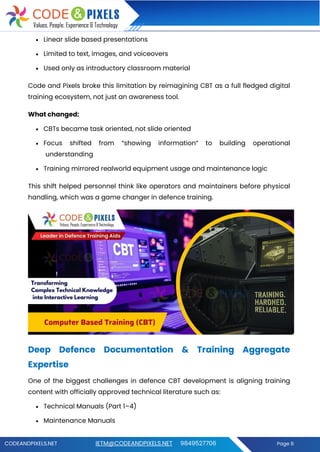
Code and Pixels broke this limitation by reimagining CBT as a full fledged digital
training ecosystem, not just an awareness tool.
What changed:
• CBTs became task oriented, not slide oriented
• Focus shifted from “showing information” to building operational
understanding
• Training mirrored realworld equipment usage and maintenance logic
This shift helped personnel think like operators and maintainers before physical
handling, which was a game changer in defence training.
Deep Defence Documentation & Training Aggregate
Expertise
One of the biggest challenges in defence CBT development is aligning training
content with officially approved technical literature such as:
• Technical Manuals (Part 1–4)
• Maintenance Manuals
CODEANDPIXELS.NET IETM@CODEANDPIXELS.NET 9849527706 Page 9
• OEM vendor manuals
• JSS / JSG / SOTR requirements
Code and Pixels brought unmatched strength by combining:
• CBT development expertise
• IETM Level 3 & Level 4 experience
• Training Aggregate (TA) compliance knowledge
As a result, CBTs developed by Code and Pixels are:
• Always audit ready
• Seamlessly mapped to manuals
• Accepted smoothly by QA agencies and end users
This eliminated rework, rejections, and delays a critical innovation in defence
project execution.
HTML5 & Future Proof CBT Architecture
Well before HTML5 became mainstream, Code and Pixels adopted responsive CBT
design, ensuring:
• Compatibility across all screen sizes
• Longevity of training content
• Independence from obsolete EXE-based delivery
• Smooth performance on evolving OS and browsers
This foresight ensured that defence CBTs remain usable for decades, matching
the long lifecycle of defence platforms.
Experience Across System Scales: 3 Hours to 100+ Hours
CBTs
Most CBT developers struggle to scale content.
Code and Pixels leveraged its experience to handle:
• Small subsystem CBTs (3–5 hours)
CODEANDPIXELS.NET IETM@CODEANDPIXELS.NET 9849527706 Page 10
• Medium platform CBTs (20–50 hours)
• Large defence system CBTs (100+ hours)
With every project, reusable frameworks, templates, and methodologies were
refined reducing cost, improving consistency, and accelerating delivery for future
programmes.
CBT Integrated with the Complete Training Ecosystem
Unlike isolated vendors, Code and Pixels treats CBT as one component of a larger
training architecture, integrating it with:
• Training Work Modules (TWM)
• Video films
• Slides and brochures
• IETM (Interactive Electronic Technical Manuals)
• Charts, blowups, and training aids
This holistic vision ensured uniform knowledge delivery across all training media,
a capability rarely achieved in defence projects.
CODEANDPIXELS.NET IETM@CODEANDPIXELS.NET 9849527706 Page 11

Computer-Based Training (CBT) The Backbone of Modern Technical & Defence Training

  • 1.
    Computer-Based Training (CBT): The Backboneof Modern Technical & Defence Training Leader in IETM Technology
  • 2.
    CODEANDPIXELS.NET IETM@CODEANDPIXELS.NET 9849527706Page 2 In today’s technology-driven world, Computer-Based Training (CBT) has become an essential method for delivering structured, effective, and scalable learning especially in technical and defence environments. CBT enables personnel to gain indepth theoretical knowledge of systems, equipment, software, and machinery before ever touching the actual hardware, reducing risk, cost, and dependency on physical resources. This blog explains what CBT is, its structure, scope, applications, and why it is mission-critical for defence forces, while also highlighting how Code and Pixels Interactive Technologies Pvt Ltd. helps OEMs, defence labs, and system integrators build world-class CBT solutions. What is Computer-Based Training (CBT)? Computer-Based Training refers to any instructional or educational programme delivered through a computer using multimedia elements such as: • Text and graphics • Images and line diagrams • Audio narration (voiceovers) • Video clips • 2D & 3D animations • Interactive simulations and assessments CBT can be self-paced or trainer-led, and it forms the foundation of blended learning, where classroom instruction and hands-on training are combined with digital learning modules. In simple terms: If training is delivered using a computer, it is called Computer-Based Training. With the evolution of digital platforms, CBT is also known as e-learning, multimedia tutor, or e-content development all of which are often used interchangeably.
  • 3.
    CODEANDPIXELS.NET IETM@CODEANDPIXELS.NET 9849527706Page 3 Purpose and Scope of CBT The primary objective of CBT is to ensure that a trainee gains complete theoretical understanding before practical exposure. A standard CBT typically covers: • System introduction and overview • Technical specifications • Working principles • Deployment and installation • Assembly & disassembly • Operation procedures • Maintenance (scheduled & unscheduled) • Troubleshooting and fault diagnostics When a user attains strong theoretical knowledge through CBT, hands on training becomes faster, safer, and more effective. This makes CBT a powerful foundation tool for operators and maintainers alike. Key Components of a Standard CBT Package Although CBT structure may vary based on system complexity, most defence grade CBTs include the following three core modules:
  • 4.
    CODEANDPIXELS.NET IETM@CODEANDPIXELS.NET 9849527706Page 4 1. Description & Operation (D&O) CBT • System overview and working principles • Subsystems and LRUs (Line Replaceable Units) • Electrical power supply & signal flow • Indications, warnings, and cautions • System level animations and visual explanations • Quiz-based assessments with system wise question banks 2. Maintenance (MNT) CBT Developed using: • Scheduled Maintenance Manuals • Unscheduled Maintenance Manuals • Engine Maintenance Manuals • Calendar based and Hour based inspections • Vendor specific manuals This module trains users on inspection, servicing, repair, and replacement activities. 3. Symptoms Fault Correlation (SFC) • Troubleshooting logic • Symptom to fault mapping • Maintenance decision making support • Acts as a theoretical expert system for diagnostics Note: Not every CBT must include all three modules. The structure is finalized based on system sensitivity, depth, and end-user requirements. General Characteristics of a Defence-Grade CBT A professional CBT must be: • User-friendly and intuitive
  • 5.
    CODEANDPIXELS.NET IETM@CODEANDPIXELS.NET 9849527706Page 5 • Browser-independent • Compatible with current & future OS and browser versions • Secure with login and password protection Multimedia & Interactivity Features • Text with synchronized audio narration • 2D & 3D animations aligned with content • Videos, cross-sections, exploded views • 360-degree interactive views of LRUs • High quality male & female English voiceovers Graphical User Interface (GUI) Features • Timeline slider for animation/audio control • Tree-structured index with multilevel navigation • Volume control • Next / Previous / Pause buttons • Screen numbers & progress indicators • Downloadable handouts (PDFs) • Integrated glossary for technical terms
  • 6.
    CODEANDPIXELS.NET IETM@CODEANDPIXELS.NET 9849527706Page 6 CBT Delivery Formats in India Earlier, CBTs were delivered in EXE format via DVDs, suitable only for Windows systems. With the rise of mobile and varied screen sizes, HTML5 based CBT has become the industry standard. Why HTML5 CBT? • Plays on desktops, laptops, tablets • Responsive across screen sizes • Future-proof technology • Secure and browser-friendly Although corporates often call this e-learning, the Indian defence ecosystem continues to use the term “Computer-Based Tutor (CBT)”, as training is primarily computer-centric. Applications of Computer-Based Training CBT is widely adopted across industries such as: • Defence & aerospace • Aviation • Manufacturing • Healthcare • Information Technology • Education & skill development CBT in Indian Defence Forces The Army, Navy, and Air Force operate complex systems requiring continuous training. Physical training alone is: • Costly • Resource-intensive • Dependent on SME availability
  • 7.
    CODEANDPIXELS.NET IETM@CODEANDPIXELS.NET 9849527706Page 7 To address this, CBTs jointly developed by OEMs and multimedia experts are deployed across multiple training centers. CBTs are now explicitly mandated in RFPs, SOTRs, RFQs, and TSPs, making them a compulsory deliverable alongside systems. CBT as Part of Training Aggregates (TA) In defence contracts, CBT is delivered along with: • Technical Manuals (Part 1–4) • Operator & Maintainer Handbooks • Training Work Modules (TWM) • Videos & animations • Charts, blow-ups, and sun boards • IETM (Level 3 / Level 4) These are developed as per JSS 0251 standards and delivered in both digital and hardcopy formats, as specified by the end user. How Code and Pixels Changed the CBT Game in the Defence Sector Through Innovation, Experience, and Defence Domain Expertise In the Indian defence ecosystem, Computer-Based Training (CBT) is not just another digital learning tool it is a mandatory operational deliverable that directly impacts readiness, safety, and mission success. Over the years, the expectations from CBTs have evolved from basic multimedia presentations to highly interactive, defence-compliant, simulation-driven training systems. This transformation has been significantly influenced by Code and Pixels Interactive Technologies Pvt Ltd., whose innovation first approach and deep domain experience have redefined how CBTs are conceptualised, designed, and delivered for the Army, Navy, and Air Force. From “Presentation CBTs” to Operational Training Systems Earlier-generation CBTs in the defence sector were largely:
  • 8.
    CODEANDPIXELS.NET IETM@CODEANDPIXELS.NET 9849527706Page 8 • Linear slide based presentations • Limited to text, images, and voiceovers • Used only as introductory classroom material Code and Pixels broke this limitation by reimagining CBT as a full fledged digital training ecosystem, not just an awareness tool. What changed: • CBTs became task oriented, not slide oriented • Focus shifted from “showing information” to building operational understanding • Training mirrored realworld equipment usage and maintenance logic This shift helped personnel think like operators and maintainers before physical handling, which was a game changer in defence training. Deep Defence Documentation & Training Aggregate Expertise One of the biggest challenges in defence CBT development is aligning training content with officially approved technical literature such as: • Technical Manuals (Part 1–4) • Maintenance Manuals
  • 9.
    CODEANDPIXELS.NET IETM@CODEANDPIXELS.NET 9849527706Page 9 • OEM vendor manuals • JSS / JSG / SOTR requirements Code and Pixels brought unmatched strength by combining: • CBT development expertise • IETM Level 3 & Level 4 experience • Training Aggregate (TA) compliance knowledge As a result, CBTs developed by Code and Pixels are: • Always audit ready • Seamlessly mapped to manuals • Accepted smoothly by QA agencies and end users This eliminated rework, rejections, and delays a critical innovation in defence project execution. HTML5 & Future Proof CBT Architecture Well before HTML5 became mainstream, Code and Pixels adopted responsive CBT design, ensuring: • Compatibility across all screen sizes • Longevity of training content • Independence from obsolete EXE-based delivery • Smooth performance on evolving OS and browsers This foresight ensured that defence CBTs remain usable for decades, matching the long lifecycle of defence platforms. Experience Across System Scales: 3 Hours to 100+ Hours CBTs Most CBT developers struggle to scale content. Code and Pixels leveraged its experience to handle: • Small subsystem CBTs (3–5 hours)
  • 10.
    CODEANDPIXELS.NET IETM@CODEANDPIXELS.NET 9849527706Page 10 • Medium platform CBTs (20–50 hours) • Large defence system CBTs (100+ hours) With every project, reusable frameworks, templates, and methodologies were refined reducing cost, improving consistency, and accelerating delivery for future programmes. CBT Integrated with the Complete Training Ecosystem Unlike isolated vendors, Code and Pixels treats CBT as one component of a larger training architecture, integrating it with: • Training Work Modules (TWM) • Video films • Slides and brochures • IETM (Interactive Electronic Technical Manuals) • Charts, blowups, and training aids This holistic vision ensured uniform knowledge delivery across all training media, a capability rarely achieved in defence projects.
  • 11.