Remote Sensing{Elective-III}
Kathmandu Engineering College
E-mail: shankar62099@gmal.com
Shankar Gangaju
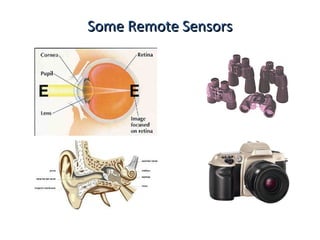
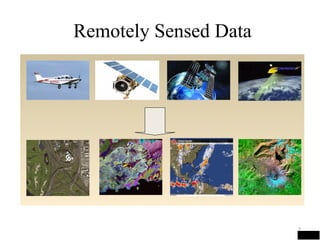
Some Remote SensorsSome Remote Sensors
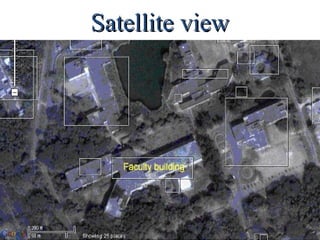
Satellite viewSatellite view
Remotely Sensed Data
Landsat/Ikonos/Quickbard/Aster
5
Remotely Sensed Data
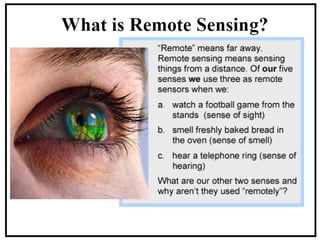
Remote Sensing: A Definition
"Remote sensing is the science (and to
some extent, art) of acquiring information
about the Earth's surface without actually
being in contact with it.”
This is done by sensing and recording
reflected or emitted energy and processing,
analyzing, and applying that information.
• Remote Sensing:
–The art and science of obtaining information
about an object without physically contact
between the object and sensor
–The processes of collecting information about
Earth surfaces and phenomena using sensors
not in physical contact with the surfaces and
phenomena of interest.
–There is a medium of transmission involved
i.e. Earth’s Atmosphere.
• Remote sensing is a tool or technique similar to
mathematics using sophisticated sensors to measure
the amount of electromagnetic energy existing an
object or geographic area from a distance, and then
extracting valuable information from the data using
mathematically and statistically based algorithms is a
scientific activity.
• Scientists are concerned with observing nature,
making careful observations and measurements, and
then attempting to accept or reject hypothesis
concerning these phenomena.
• The data collection may take place directly in
the field, or at some remote distance from the
object or area of interest.
• Data that are collected directly in the field are
termed as In Situ Data, and the data collected
remotely called Remote Sensing Data.
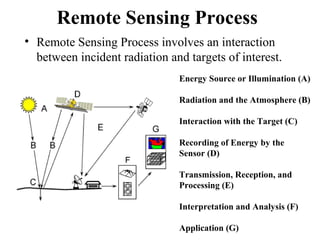
Remote Sensing Process
• Remote Sensing Process involves an interaction
between incident radiation and targets of interest.
Energy Source or Illumination (A)
Radiation and the Atmosphere (B)
Interaction with the Target (C)
Recording of Energy by the
Sensor (D)
Transmission, Reception, and
Processing (E)
Interpretation and Analysis (F)
Application (G)
1. Energy Source or Illumination (A)
The first requirement for remote sensing is to have an energy source which
illuminates or provides electromagnetic energy to the target of interest.
2. Radiation and the Atmosphere (B)
As the energy travels from its source to the target, it will come in contact with
and interact with the atmosphere it passes through. This interaction may take
place a second time as the energy travels from the target to the sensor.
3.Interaction with the Target (C)
once the energy makes its way to the target through the atmosphere, it interacts
with the target depending on the properties of both the target and the
radiation.
4. Recording of Energy by the Sensor (D)
after the energy has been scattered by, or emitted from the target, we require a
sensor (remote - not in contact with the target) to collect and record the
electromagnetic radiation.
5. Transmission, Reception and Processing (E)
the energy recorded by the sensor has to be transmitted, often in electronic form,
to a receiving and processing station where the data are processed into an
image (hardcopy and/or digital).
6. Interpretation and Analysis ( F)
The processed image is interpreted, visually and/or digitally or electronically, to
extract information about the target which was illuminated.
7. Application ( G)
The final element of the remote sensing process is achieved when we apply the
information we have been able to extract from the imagery about the target in
order to better understand it, reveal some new information, or assist in solving a
particular problem.
Remote Sensing Organizations
ISPRS: International Society for photogrammetry and
Remote Sensing
NASA: National Aeronautical and Space Administration
(USA)
ESA: European Space Agency (Europe)
NASDA: National Space Development Agency (Japan)
DARA: German Space Agency
CSA: Canadian Space Agency
NRSA: National Remote Sensing Agency of India
IGARSS: International Geosciences and Remote Sensing
Symposium
Technical and Historical Perspectives
of Remote Sensing
1. Non-photographic Sensor systems
• 1800 Discovery of the IR Spectral region by sir
William Herschel
• 1879 Use of the bolometer by Langley to make
temperature measurements of electrical objects.
• 1889 Hertz demonstrated reflection of radio
waves from solid objects.
• 1916 Aircraft tracked in flight by Hoffman
using thermopiles to detect heat effects.
• 1930 British and Germans work on systems to locate
airplanes from their thermal patterns at night.
• 1940 Development of incoherent radar systems by the
British and United states to detect and track aircraft and ships
during W.W.II.
• 1950’s Extensive studies of IR systems at university of
Michigan and elsewhere.
• 1951 First concepts of a moving coherent radar system.
• 1953 Flight of an x-band coherent radar
• 1954 Formulation of synthetic aperture concept (SAR) in
radar.
• 1960’s Development of various detectors which allowed
building of imaging and non-imaging radiometers, scanners,
spectrometers and polarimeters.
2. Photographic Methods
• 1840 photographic camera has served as a prime
remote sensor for more than 150 years.
• 1860 idea of aerial photography (photographing
the Earth’s surface)
• 1879 cameras on kites
• 1897 photos from small rockets from a height of
about 100 meters
• 1908 photos from airplanes, first by wilbur wright
(co-developer of first airplane)
• 1946 Start of space research
3. Space Imaging/Observation Systems
• 1960 TV cameras- TIROS (Television
Infrared observation satellite ) used to scan wide
areas at a time (devoted to looking at clouds) low
resolution, black and white images.
• 1970’s High resolution images using the EM
spectrum beyond the visible into the near and
thermal infrared regions.
Classifications of Remote Sensing
• Remote sensing may be classified from many perspectives
like based on platform, source of energy, regions of
electromagnetic spectrum, number of bands, imaging media
etc.
• Classification based on Platform:
• Airborne remote sensing
• Space-borne remote sensing
• Classification based on energy source:
• Active remote sensing
• Passive remote sensing
• Classification based on imaging media:
• Photographic imaging remote sensing
• Digital imaging remote sensing
• Classification based on region of electromagnetic
spectrum:
• Optical remote sensing
• Photographic remote sensing
• Thermal remote sensing
• Microwave remote sensing
• Classification based on number of bands:
• Panchromatic remote sensing
• Multi spectral remote sensing
• Hyper spectral remote sensing
Advantages of Remote Sensing
• Provides a synoptic view, which is the ability to see large areas
at the same time. So it reduces the data acquisition time and
there by cost in comparison to the traditional surveying
methods.
• Remote sensing from satellite provides repetitive looks at the
same area at a regular time interval which helps in monitoring
several earth-surface features continuously.
• Remote sensing can be used for collecting data about areas that
are physically inaccessible.
• Remote sensors “see” over a broader portion of the spectrum
than the human eye. Some remote sensors operate in all
seasons, at night and in bad weather.
• Remote sensing science yields fundamental scientific
information or data systematically.
Remote Sensing Applications
• Land-use mapping
• Forest and agriculture applications
• Telecommunication Planning
• Environmental Application
• Hydrology and coastal mapping
• Urban planning
• Emergencies and Hazards
• Global change and Methodology
Applicat
Urbanization & Transportation
ion of Remote Sensing
• Urban planning
• Roads network and
transportation planning
• City expansion
• City boundaries by time
• Wetland delineation
Image source: www.ldeo.columbia.edu
Image source: www.geospectra.net
The application of remote
sensing in agriculture include:
- Soil sensing
- Farm classification
- Farm condition assessment
- Agriculture estimation
- Mapping of farm and
agricultural land characteristics
- Mapping of land management
practices
- Compliance monitoring
© Wageningen UR 2002
Application
Agriculture
of Remote Sensing
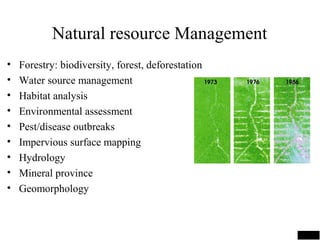
• Forestry: biodiversity, forest, deforestation
• Water source management
• Habitat analysis
• Environmental assessment
• Pest/disease outbreaks
• Impervious surface mapping
• Hydrology
• Mineral province
• Geomorphology
App
Natural resource Management
lication of Remote Sensing
Md. Bodruddoza Mia
Satellite image of deforestation
© Wageningen UR 2002
Comparison of an aerial photograph (bottom) with a
radar image (top) of deforestation along a road
Comparison of an aerial photograph (bottom) with a
radar image (top) of deforestation along a road
Satellite image of deforestation
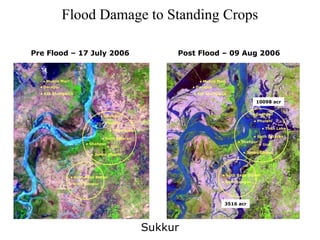
Pre Flood – 17 July 2006 Post Flood – 09 Aug 2006
10098 acr
3516 acr
● Phulani
● Goth Lataran
● Ural
● Junno Dhand
● Shahpur
● Godhpur
● Than Lake
● Goth Azizpur
● Goth Raza Mahar
● Phulani
● Goth Lataran
● Ural
● Junno Dhand
● Shahpur
● Godhpur
● Than Lake
● Goth Azizpur
● Goth Raza Mahar
● Muhro Mari
● Darapur
● Kot Shahgarch
● Muhro Mari
● Darapur
● Kot Shahgarch
Flood Damage to Standing Crops
Sukkur

Chapter 1 (Introduction to remote sensing)

  • 1.
    Remote Sensing{Elective-III} Kathmandu EngineeringCollege E-mail: shankar62099@gmal.com Shankar Gangaju
  • 3.
  • 4.
  • 5.
  • 6.
    Remote Sensing: ADefinition "Remote sensing is the science (and to some extent, art) of acquiring information about the Earth's surface without actually being in contact with it.” This is done by sensing and recording reflected or emitted energy and processing, analyzing, and applying that information.
  • 7.
    • Remote Sensing: –Theart and science of obtaining information about an object without physically contact between the object and sensor –The processes of collecting information about Earth surfaces and phenomena using sensors not in physical contact with the surfaces and phenomena of interest. –There is a medium of transmission involved i.e. Earth’s Atmosphere.
  • 8.
    • Remote sensingis a tool or technique similar to mathematics using sophisticated sensors to measure the amount of electromagnetic energy existing an object or geographic area from a distance, and then extracting valuable information from the data using mathematically and statistically based algorithms is a scientific activity. • Scientists are concerned with observing nature, making careful observations and measurements, and then attempting to accept or reject hypothesis concerning these phenomena.
  • 9.
    • The datacollection may take place directly in the field, or at some remote distance from the object or area of interest. • Data that are collected directly in the field are termed as In Situ Data, and the data collected remotely called Remote Sensing Data.
  • 10.
    Remote Sensing Process •Remote Sensing Process involves an interaction between incident radiation and targets of interest. Energy Source or Illumination (A) Radiation and the Atmosphere (B) Interaction with the Target (C) Recording of Energy by the Sensor (D) Transmission, Reception, and Processing (E) Interpretation and Analysis (F) Application (G)
  • 11.
    1. Energy Sourceor Illumination (A) The first requirement for remote sensing is to have an energy source which illuminates or provides electromagnetic energy to the target of interest. 2. Radiation and the Atmosphere (B) As the energy travels from its source to the target, it will come in contact with and interact with the atmosphere it passes through. This interaction may take place a second time as the energy travels from the target to the sensor. 3.Interaction with the Target (C) once the energy makes its way to the target through the atmosphere, it interacts with the target depending on the properties of both the target and the radiation. 4. Recording of Energy by the Sensor (D) after the energy has been scattered by, or emitted from the target, we require a sensor (remote - not in contact with the target) to collect and record the electromagnetic radiation. 5. Transmission, Reception and Processing (E) the energy recorded by the sensor has to be transmitted, often in electronic form, to a receiving and processing station where the data are processed into an image (hardcopy and/or digital).
  • 12.
    6. Interpretation andAnalysis ( F) The processed image is interpreted, visually and/or digitally or electronically, to extract information about the target which was illuminated. 7. Application ( G) The final element of the remote sensing process is achieved when we apply the information we have been able to extract from the imagery about the target in order to better understand it, reveal some new information, or assist in solving a particular problem.
  • 13.
    Remote Sensing Organizations ISPRS:International Society for photogrammetry and Remote Sensing NASA: National Aeronautical and Space Administration (USA) ESA: European Space Agency (Europe) NASDA: National Space Development Agency (Japan) DARA: German Space Agency CSA: Canadian Space Agency NRSA: National Remote Sensing Agency of India IGARSS: International Geosciences and Remote Sensing Symposium
  • 14.
    Technical and HistoricalPerspectives of Remote Sensing 1. Non-photographic Sensor systems • 1800 Discovery of the IR Spectral region by sir William Herschel • 1879 Use of the bolometer by Langley to make temperature measurements of electrical objects. • 1889 Hertz demonstrated reflection of radio waves from solid objects. • 1916 Aircraft tracked in flight by Hoffman using thermopiles to detect heat effects.
  • 15.
    • 1930 Britishand Germans work on systems to locate airplanes from their thermal patterns at night. • 1940 Development of incoherent radar systems by the British and United states to detect and track aircraft and ships during W.W.II. • 1950’s Extensive studies of IR systems at university of Michigan and elsewhere. • 1951 First concepts of a moving coherent radar system. • 1953 Flight of an x-band coherent radar • 1954 Formulation of synthetic aperture concept (SAR) in radar. • 1960’s Development of various detectors which allowed building of imaging and non-imaging radiometers, scanners, spectrometers and polarimeters.
  • 16.
    2. Photographic Methods •1840 photographic camera has served as a prime remote sensor for more than 150 years. • 1860 idea of aerial photography (photographing the Earth’s surface) • 1879 cameras on kites • 1897 photos from small rockets from a height of about 100 meters • 1908 photos from airplanes, first by wilbur wright (co-developer of first airplane) • 1946 Start of space research
  • 17.
    3. Space Imaging/ObservationSystems • 1960 TV cameras- TIROS (Television Infrared observation satellite ) used to scan wide areas at a time (devoted to looking at clouds) low resolution, black and white images. • 1970’s High resolution images using the EM spectrum beyond the visible into the near and thermal infrared regions.
  • 18.
    Classifications of RemoteSensing • Remote sensing may be classified from many perspectives like based on platform, source of energy, regions of electromagnetic spectrum, number of bands, imaging media etc. • Classification based on Platform: • Airborne remote sensing • Space-borne remote sensing • Classification based on energy source: • Active remote sensing • Passive remote sensing • Classification based on imaging media: • Photographic imaging remote sensing • Digital imaging remote sensing
  • 19.
    • Classification basedon region of electromagnetic spectrum: • Optical remote sensing • Photographic remote sensing • Thermal remote sensing • Microwave remote sensing • Classification based on number of bands: • Panchromatic remote sensing • Multi spectral remote sensing • Hyper spectral remote sensing
  • 20.
    Advantages of RemoteSensing • Provides a synoptic view, which is the ability to see large areas at the same time. So it reduces the data acquisition time and there by cost in comparison to the traditional surveying methods. • Remote sensing from satellite provides repetitive looks at the same area at a regular time interval which helps in monitoring several earth-surface features continuously. • Remote sensing can be used for collecting data about areas that are physically inaccessible. • Remote sensors “see” over a broader portion of the spectrum than the human eye. Some remote sensors operate in all seasons, at night and in bad weather. • Remote sensing science yields fundamental scientific information or data systematically.
  • 21.
    Remote Sensing Applications •Land-use mapping • Forest and agriculture applications • Telecommunication Planning • Environmental Application • Hydrology and coastal mapping • Urban planning • Emergencies and Hazards • Global change and Methodology
  • 22.
    Applicat Urbanization & Transportation ionof Remote Sensing • Urban planning • Roads network and transportation planning • City expansion • City boundaries by time • Wetland delineation Image source: www.ldeo.columbia.edu Image source: www.geospectra.net
  • 23.
    The application ofremote sensing in agriculture include: - Soil sensing - Farm classification - Farm condition assessment - Agriculture estimation - Mapping of farm and agricultural land characteristics - Mapping of land management practices - Compliance monitoring © Wageningen UR 2002 Application Agriculture of Remote Sensing
  • 24.
    • Forestry: biodiversity,forest, deforestation • Water source management • Habitat analysis • Environmental assessment • Pest/disease outbreaks • Impervious surface mapping • Hydrology • Mineral province • Geomorphology App Natural resource Management lication of Remote Sensing Md. Bodruddoza Mia
  • 25.
    Satellite image ofdeforestation © Wageningen UR 2002 Comparison of an aerial photograph (bottom) with a radar image (top) of deforestation along a road Comparison of an aerial photograph (bottom) with a radar image (top) of deforestation along a road Satellite image of deforestation
  • 26.
    Pre Flood –17 July 2006 Post Flood – 09 Aug 2006 10098 acr 3516 acr ● Phulani ● Goth Lataran ● Ural ● Junno Dhand ● Shahpur ● Godhpur ● Than Lake ● Goth Azizpur ● Goth Raza Mahar ● Phulani ● Goth Lataran ● Ural ● Junno Dhand ● Shahpur ● Godhpur ● Than Lake ● Goth Azizpur ● Goth Raza Mahar ● Muhro Mari ● Darapur ● Kot Shahgarch ● Muhro Mari ● Darapur ● Kot Shahgarch Flood Damage to Standing Crops Sukkur