Lecture 23 - Microwave
   Remote Sensing

     3 December
        2007
                         1
Recommended Readings
• Chapter 13, pages 291-313 in Jensen


                                        2
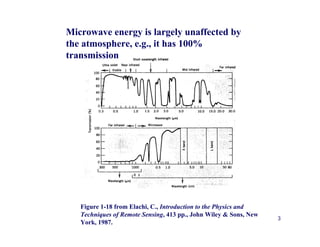
Microwave energy is largely unaffected by
the atmosphere, e.g., it has 100%
transmission


   Figure 1-18 from Elachi, C., Introduction to the Physics and
   Techniques of Remote Sensing, 413 pp., John Wiley & Sons, New
                                                                   3
   York, 1987.
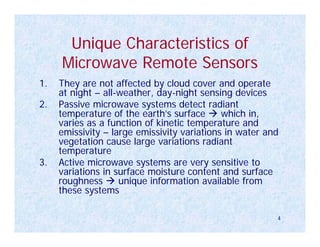
Unique Characteristics of
     Microwave Remote Sensors
1.   They are not affected by cloud cover and operate
     at night – all-weather, day-night sensing devices
2.   Passive microwave systems detect radiant
     temperature of the earth’s surface      which in,
     varies as a function of kinetic temperature and
     emissivity – large emissivity variations in water and
     vegetation cause large variations radiant
     temperature
3.   Active microwave systems are very sensitive to
     variations in surface moisture content and surface
     roughness      unique information available from
     these systems

                                                         4
Types of Microwave Remote Sensors
 – Microwave radiometers
   •   Measure the emittance of EM energy within the
       microwave region of the EM spectrum, just like thermal
       IR sensors
 – Non-imaging RADARs
   1. Altimeters – measure the elevation of the earth’s
      surface
   2. Scatterometers – detect variations in microwave
      backscatter from a large area - measure variations in
      surface roughness, used to estimate ocean wind speed
 – Imaging RADARs
   •   Synthetic Aperture Radars – map variations in
       microwave backscatter at fine spatial scales (10 to 50
       m), used to create an image – measure variations in
       surface roughness and surface moisture


                                                                5
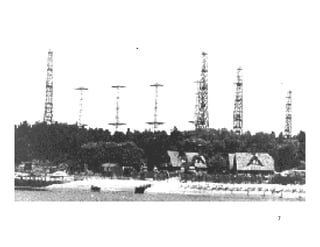
RADAR – Radio Detection and Ranging

• Concept behind radars discovered in 1923
• RADARs systems invented in the 1930s
  – A high powered, radio transmitter/receiver
    system was developed that would transmit
    a signal that was reflected from a distant
    object, and then detected by the receiver
  – Thus, RADAR’s initial function was to
    detect and determine the range to a target

                                             6
7
Key Components of a Radar System

• Microwave Transmitter – electronic device
  used to generate the microwave EM energy
  transmitted by the radar
• Microwave Receiver – electronic device used
  to detect the microwave pulse that is
  reflected by the area being imaged by the
  radar
• Antenna – electronic component used
  through which microwave pulses are
  transmitted and received
                                                8
Measurements made with a
          simple radar
•   Range to the target
•   Intensity of the returned pulse
•   Azimuth resolution
•   Range resolution


                                      9
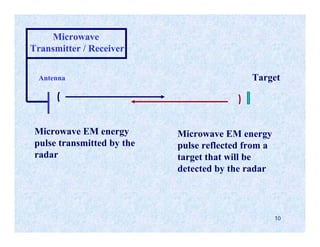
Microwave
Transmitter / Receiver

  Antenna                                    Target


 Microwave EM energy        Microwave EM energy
 pulse transmitted by the   pulse reflected from a
 radar                      target that will be
                            detected by the radar


                                                     10
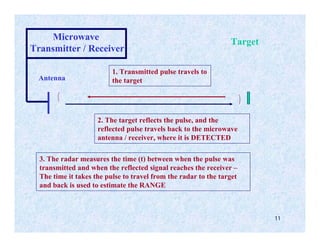
Microwave                                                    Target
Transmitter / Receiver

                          1. Transmitted pulse travels to
  Antenna                 the target


                     2. The target reflects the pulse, and the
                     reflected pulse travels back to the microwave
                     antenna / receiver, where it is DETECTED

  3. The radar measures the time (t) between when the pulse was
  transmitted and when the reflected signal reaches the receiver –
  The time it takes the pulse to travel from the radar to the target
  and back is used to estimate the RANGE


                                                                          11
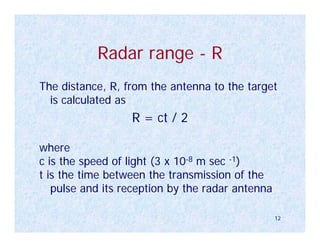
Radar range - R
The distance, R, from the antenna to the target
  is calculated as
                  R = ct / 2

where
c is the speed of light (3 x 10⁻⁸ m sec -1)
t is the time between the transmission of the
   pulse and its reception by the radar antenna

                                                  12
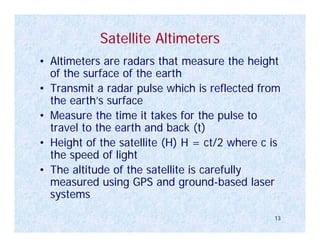
Satellite Altimeters
• Altimeters are radars that measure the height
  of the surface of the earth
• Transmit a radar pulse which is reflected from
  the earth’s surface
• Measure the time it takes for the pulse to
  travel to the earth and back (t)
• Height of the satellite (H) H = ct/2 where c is
  the speed of light
• The altitude of the satellite is carefully
  measured using GPS and ground-based laser
  systems
                                               13
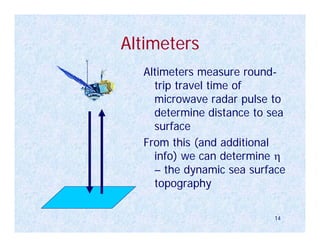
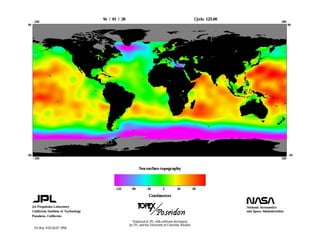
Altimeters
  Altimeters measure round-
    trip travel time of
    microwave radar pulse to
    determine distance to sea
    surface
  From this (and additional
    info) we can determine η
    – the dynamic sea surface
    topography

                          14
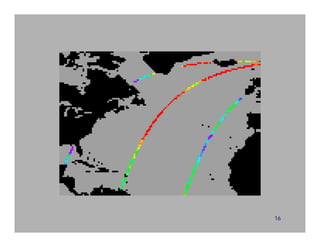
Altimeter Missions
• NASA GEOS-3, 1975-1978
• NASA Seasat, 1978
• NAVY Geosat, 1985-1989 (first 2 years
  classified)
• ESA ERS-1/2, 1991-1996 and 1995-
• NASA/CNES TOPEX/Poseidon, late 1992-
• NASA/CNES Jason-1, late 2000-

                                     15
16
17
Measurements made with a
          simple radar
•   Range to the target
•   Intensity of the returned pulse
•   Azimuth resolution
•   Range resolution


                                      18
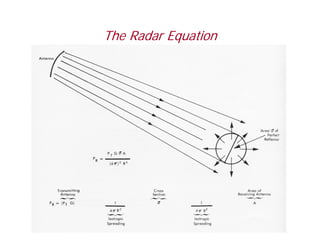
The Radar Equation


                     19
σ - is the radar surface backscatter
  coefficient
It represents the fraction of incoming EM
   radiation that is scattered from the surface in
   the direction of the transmitted energy
   (hence the term “backscatter)
It is equivalent to the reflection coefficient in
   thevisible/RIR region of the EM spectrum

                                                 20
Factors controlling variations in σ

• Surface roughness
• Surface dielectric constant


                                  21
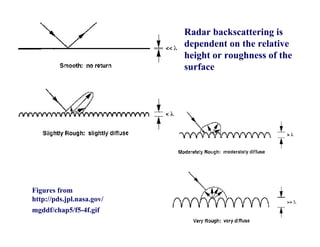
Surface Reflectance or Scattering


• Specular reflection or scattering

• Diffuse reflection or scattering


                                     22
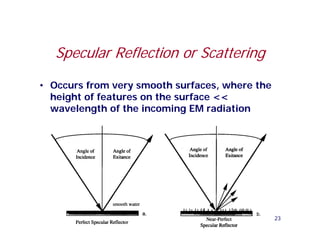
Specular Reflection or Scattering

• Occurs from very smooth surfaces, where the
  height of features on the surface <<
  wavelength of the incoming EM radiation


                                                23
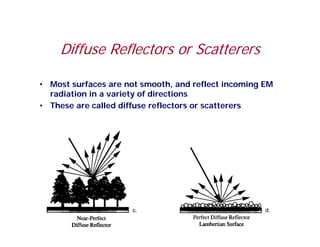
Diffuse Reflectors or Scatterers

• Most surfaces are not smooth, and reflect incoming EM
  radiation in a variety of directions
• These are called diffuse reflectors or scatterers


                                                          24
Radar backscattering is
                           dependent on the relative
                           height or roughness of the
                           surface


Figures from
http://pds.jpl.nasa.gov/
mgddf/chap5/f5-4f.gif
                                                25
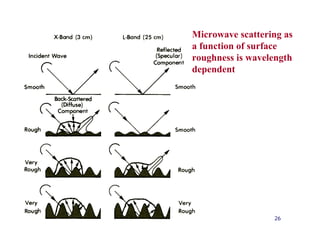
Microwave scattering as
a function of surface
roughness is wavelength
dependent


                  26
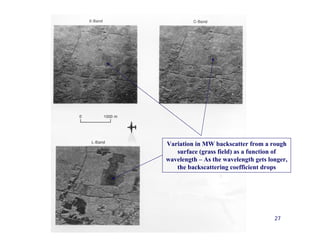
Variation in MW backscatter from a rough
   surface (grass field) as a function of
wavelength – As the wavelength gets longer,
   the backscattering coefficient drops


                                      27
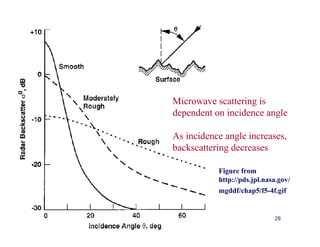
Microwave scattering is
dependent on incidence angle

As incidence angle increases,
backscattering decreases

           Figure from
           http://pds.jpl.nasa.gov/
           mgddf/chap5/f5-4f.gif


                             28
Factors controlling σ

• Surface roughness
• Surface dielectric constant


                                29
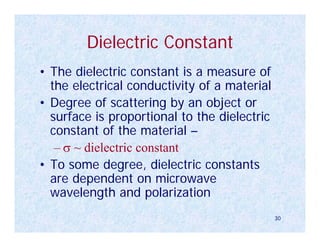
Dielectric Constant
• The dielectric constant is a measure of
  the electrical conductivity of a material
• Degree of scattering by an object or
  surface is proportional to the dielectric
  constant of the material –
   – σ ~ dielectric constant
• To some degree, dielectric constants
  are dependent on microwave
  wavelength and polarization
                                              30
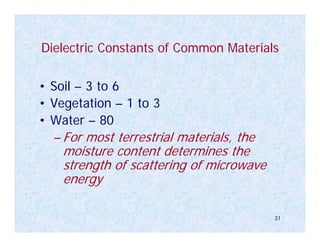
Dielectric Constants of Common Materials

• Soil – 3 to 6
• Vegetation – 1 to 3
• Water – 80
   – For most terrestrial materials, the
    moisture content determines the
    strength of scattering of microwave
    energy

                                           31
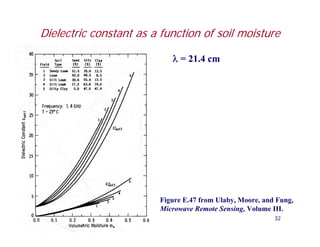
Dielectric constant as a function of soil moisture

                           λ = 21.4 cm


                        Figure E.47 from Ulaby, Moore, and Fung,
                        Microwave Remote Sensing, Volume III.
                                                          32
33
34
Moderate Burn All Years

                          0

                          -2       y = 0.3299x - 18.268
                          -4             R2 = 0.82
ERS-2 Backscatter (dB)


                          -6
                                                                                       All Years
                          -8
                                                                                       2003-4 Validation Sites
                         -10
                                                                                       Linear (All Years)
                         -12

                         -14

                         -16

                         -18
                               0       10          20         30         40       50
                                            6 cm % Volumetric Moisture


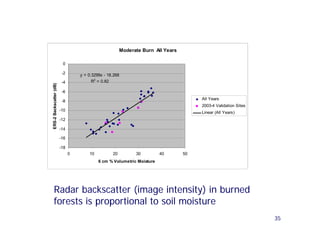
    Radar backscatter (image intensity) in burned
    forests is proportional to soil moisture
                                                                                                                 35
Microwave Scattering
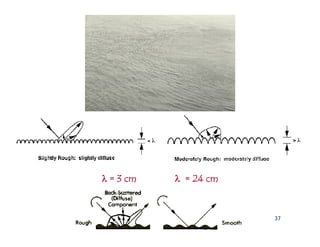
        from a Water Surface
Water has a dielectric constant of 80
• All scattering from water bodies in the
 Microwave region of the EM Spectrum is
 from surface scattering as no EM
 energy penetrates the water surface


                                            36
λ = 3 cm   λ = 24 cm


                       37
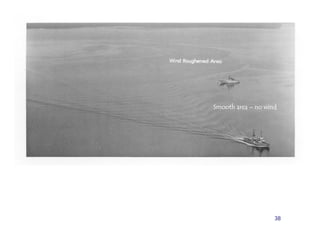
Smooth area – no wind


                    38
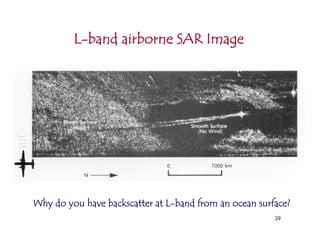
L-band airborne SAR Image


Why do you have backscatter at L-band from an ocean surface?
                                                        39
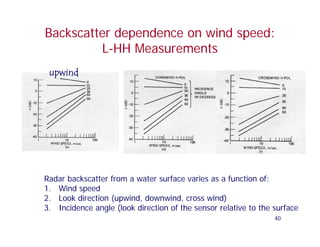
Backscatter dependence on wind speed:
         L-HH Measurements
 upwind


Radar backscatter from a water surface varies as a function of:
1. Wind speed
2. Look direction (upwind, downwind, cross wind)
3. Incidence angle (look direction of the sensor relative to the surface
                                                                 40
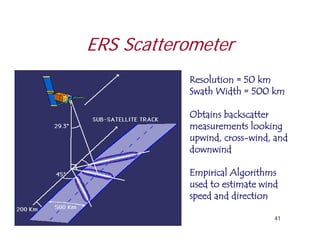
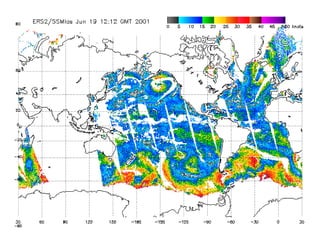
ERS Scatterometer
           Resolution = 50 km
           Swath Width = 500 km

           Obtains backscatter
           measurements looking
           upwind, cross-wind, and
           downwind

           Empirical Algorithms
           used to estimate wind
           speed and direction

                               41
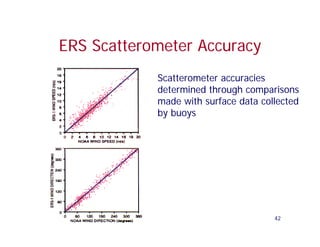
ERS Scatterometer Accuracy
            Scatterometer accuracies
            determined through comparisons
            made with surface data collected
            by buoys


                                      42
43
Microwave Radiometers

• Land and water surfaces not only emit
  EM energy that can be detected in
  thermal IR wavelengths, but also in
  microwave wavelengths (1 cm to > 1 m)
• Microwave radiometers have the ability
  to measure the brightness temperature
  (TB) of the earth’s surface

                                       44
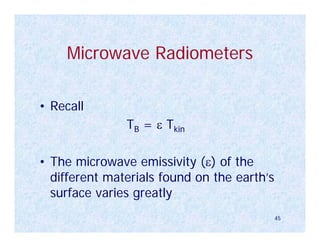
Microwave Radiometers

• Recall
               TB = ε Tkin

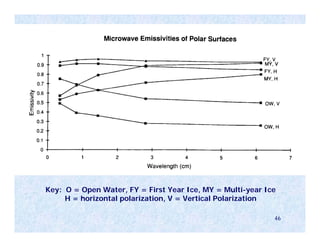
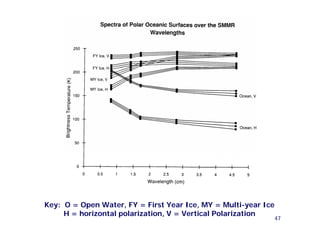
• The microwave emissivity (ε) of the
  different materials found on the earth’s
  surface varies greatly
                                             45
Key: O = Open Water, FY = First Year Ice, MY = Multi-year Ice
     H = horizontal polarization, V = Vertical Polarization

                                                            46
Key: O = Open Water, FY = First Year Ice, MY = Multi-year Ice
     H = horizontal polarization, V = Vertical Polarization
                                                                47
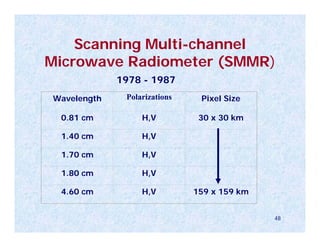
Scanning Multi-channel
Microwave Radiometer (SMMR)
             1978 - 1987
Wavelength    Polarizations    Pixel Size

 0.81 cm          H,V          30 x 30 km

 1.40 cm          H,V

 1.70 cm          H,V

 1.80 cm          H,V

 4.60 cm          H,V         159 x 159 km


                                             48
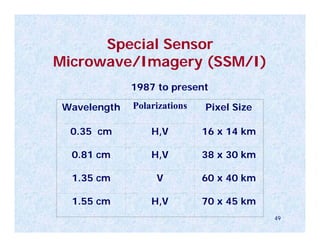
Special Sensor
Microwave/Imagery (SSM/I)
              1987 to present

 Wavelength   Polarizations   Pixel Size

  0.35 cm         H,V         16 x 14 km

  0.81 cm         H,V         38 x 30 km

  1.35 cm          V          60 x 40 km

  1.55 cm         H,V         70 x 45 km
                                           49
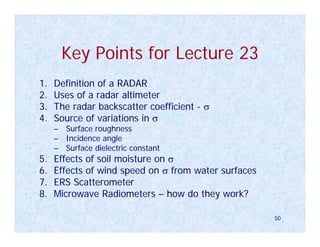
Key Points for Lecture 23
1.   Definition of a RADAR
2.   Uses of a radar altimeter
3.   The radar backscatter coefficient - σ
4.   Source of variations in σ
     – Surface roughness
     – Incidence angle
     – Surface dielectric constant
5.   Effects of soil moisture on σ
6.   Effects of wind speed on σ from water surfaces
7.   ERS Scatterometer
8.   Microwave Radiometers – how do they work?

                                                      50

Lecture 23 notes

  • 1.
    Lecture 23 -Microwave Remote Sensing 3 December 2007 1
  • 2.
    Recommended Readings • Chapter13, pages 291-313 in Jensen 2
  • 3.
    Microwave energy islargely unaffected by the atmosphere, e.g., it has 100% transmission Figure 1-18 from Elachi, C., Introduction to the Physics and Techniques of Remote Sensing, 413 pp., John Wiley & Sons, New 3 York, 1987.
  • 4.
    Unique Characteristics of Microwave Remote Sensors 1. They are not affected by cloud cover and operate at night – all-weather, day-night sensing devices 2. Passive microwave systems detect radiant temperature of the earth’s surface which in, varies as a function of kinetic temperature and emissivity – large emissivity variations in water and vegetation cause large variations radiant temperature 3. Active microwave systems are very sensitive to variations in surface moisture content and surface roughness unique information available from these systems 4
  • 5.
    Types of MicrowaveRemote Sensors – Microwave radiometers • Measure the emittance of EM energy within the microwave region of the EM spectrum, just like thermal IR sensors – Non-imaging RADARs 1. Altimeters – measure the elevation of the earth’s surface 2. Scatterometers – detect variations in microwave backscatter from a large area - measure variations in surface roughness, used to estimate ocean wind speed – Imaging RADARs • Synthetic Aperture Radars – map variations in microwave backscatter at fine spatial scales (10 to 50 m), used to create an image – measure variations in surface roughness and surface moisture 5
  • 6.
    RADAR – RadioDetection and Ranging • Concept behind radars discovered in 1923 • RADARs systems invented in the 1930s – A high powered, radio transmitter/receiver system was developed that would transmit a signal that was reflected from a distant object, and then detected by the receiver – Thus, RADAR’s initial function was to detect and determine the range to a target 6
  • 7.
  • 8.
    Key Components ofa Radar System • Microwave Transmitter – electronic device used to generate the microwave EM energy transmitted by the radar • Microwave Receiver – electronic device used to detect the microwave pulse that is reflected by the area being imaged by the radar • Antenna – electronic component used through which microwave pulses are transmitted and received 8
  • 9.
    Measurements made witha simple radar • Range to the target • Intensity of the returned pulse • Azimuth resolution • Range resolution 9
  • 10.
    Microwave Transmitter / Receiver Antenna Target Microwave EM energy Microwave EM energy pulse transmitted by the pulse reflected from a radar target that will be detected by the radar 10
  • 11.
    Microwave Target Transmitter / Receiver 1. Transmitted pulse travels to Antenna the target 2. The target reflects the pulse, and the reflected pulse travels back to the microwave antenna / receiver, where it is DETECTED 3. The radar measures the time (t) between when the pulse was transmitted and when the reflected signal reaches the receiver – The time it takes the pulse to travel from the radar to the target and back is used to estimate the RANGE 11
  • 12.
    Radar range -R The distance, R, from the antenna to the target is calculated as R = ct / 2 where c is the speed of light (3 x 10⁻⁸ m sec -1) t is the time between the transmission of the pulse and its reception by the radar antenna 12
  • 13.
    Satellite Altimeters • Altimetersare radars that measure the height of the surface of the earth • Transmit a radar pulse which is reflected from the earth’s surface • Measure the time it takes for the pulse to travel to the earth and back (t) • Height of the satellite (H) H = ct/2 where c is the speed of light • The altitude of the satellite is carefully measured using GPS and ground-based laser systems 13
  • 14.
    Altimeters Altimetersmeasure round- trip travel time of microwave radar pulse to determine distance to sea surface From this (and additional info) we can determine η – the dynamic sea surface topography 14
  • 15.
    Altimeter Missions • NASAGEOS-3, 1975-1978 • NASA Seasat, 1978 • NAVY Geosat, 1985-1989 (first 2 years classified) • ESA ERS-1/2, 1991-1996 and 1995- • NASA/CNES TOPEX/Poseidon, late 1992- • NASA/CNES Jason-1, late 2000- 15
  • 16.
  • 17.
  • 18.
    Measurements made witha simple radar • Range to the target • Intensity of the returned pulse • Azimuth resolution • Range resolution 18
  • 19.
  • 20.
    σ - isthe radar surface backscatter coefficient It represents the fraction of incoming EM radiation that is scattered from the surface in the direction of the transmitted energy (hence the term “backscatter) It is equivalent to the reflection coefficient in thevisible/RIR region of the EM spectrum 20
  • 21.
    Factors controlling variationsin σ • Surface roughness • Surface dielectric constant 21
  • 22.
    Surface Reflectance orScattering • Specular reflection or scattering • Diffuse reflection or scattering 22
  • 23.
    Specular Reflection orScattering • Occurs from very smooth surfaces, where the height of features on the surface << wavelength of the incoming EM radiation 23
  • 24.
    Diffuse Reflectors orScatterers • Most surfaces are not smooth, and reflect incoming EM radiation in a variety of directions • These are called diffuse reflectors or scatterers 24
  • 25.
    Radar backscattering is dependent on the relative height or roughness of the surface Figures from http://pds.jpl.nasa.gov/ mgddf/chap5/f5-4f.gif 25
  • 26.
    Microwave scattering as afunction of surface roughness is wavelength dependent 26
  • 27.
    Variation in MWbackscatter from a rough surface (grass field) as a function of wavelength – As the wavelength gets longer, the backscattering coefficient drops 27
  • 28.
    Microwave scattering is dependenton incidence angle As incidence angle increases, backscattering decreases Figure from http://pds.jpl.nasa.gov/ mgddf/chap5/f5-4f.gif 28
  • 29.
    Factors controlling σ •Surface roughness • Surface dielectric constant 29
  • 30.
    Dielectric Constant • Thedielectric constant is a measure of the electrical conductivity of a material • Degree of scattering by an object or surface is proportional to the dielectric constant of the material – – σ ~ dielectric constant • To some degree, dielectric constants are dependent on microwave wavelength and polarization 30
  • 31.
    Dielectric Constants ofCommon Materials • Soil – 3 to 6 • Vegetation – 1 to 3 • Water – 80 – For most terrestrial materials, the moisture content determines the strength of scattering of microwave energy 31
  • 32.
    Dielectric constant asa function of soil moisture λ = 21.4 cm Figure E.47 from Ulaby, Moore, and Fung, Microwave Remote Sensing, Volume III. 32
  • 33.
  • 34.
  • 35.
    Moderate Burn AllYears 0 -2 y = 0.3299x - 18.268 -4 R2 = 0.82 ERS-2 Backscatter (dB) -6 All Years -8 2003-4 Validation Sites -10 Linear (All Years) -12 -14 -16 -18 0 10 20 30 40 50 6 cm % Volumetric Moisture Radar backscatter (image intensity) in burned forests is proportional to soil moisture 35
  • 36.
    Microwave Scattering from a Water Surface Water has a dielectric constant of 80 • All scattering from water bodies in the Microwave region of the EM Spectrum is from surface scattering as no EM energy penetrates the water surface 36
  • 37.
    λ = 3cm λ = 24 cm 37
  • 38.
    Smooth area –no wind 38
  • 39.
    L-band airborne SARImage Why do you have backscatter at L-band from an ocean surface? 39
  • 40.
    Backscatter dependence onwind speed: L-HH Measurements upwind Radar backscatter from a water surface varies as a function of: 1. Wind speed 2. Look direction (upwind, downwind, cross wind) 3. Incidence angle (look direction of the sensor relative to the surface 40
  • 41.
    ERS Scatterometer Resolution = 50 km Swath Width = 500 km Obtains backscatter measurements looking upwind, cross-wind, and downwind Empirical Algorithms used to estimate wind speed and direction 41
  • 42.
    ERS Scatterometer Accuracy Scatterometer accuracies determined through comparisons made with surface data collected by buoys 42
  • 43.
  • 44.
    Microwave Radiometers • Landand water surfaces not only emit EM energy that can be detected in thermal IR wavelengths, but also in microwave wavelengths (1 cm to > 1 m) • Microwave radiometers have the ability to measure the brightness temperature (TB) of the earth’s surface 44
  • 45.
    Microwave Radiometers • Recall TB = ε Tkin • The microwave emissivity (ε) of the different materials found on the earth’s surface varies greatly 45
  • 46.
    Key: O =Open Water, FY = First Year Ice, MY = Multi-year Ice H = horizontal polarization, V = Vertical Polarization 46
  • 47.
    Key: O =Open Water, FY = First Year Ice, MY = Multi-year Ice H = horizontal polarization, V = Vertical Polarization 47
  • 48.
    Scanning Multi-channel Microwave Radiometer(SMMR) 1978 - 1987 Wavelength Polarizations Pixel Size 0.81 cm H,V 30 x 30 km 1.40 cm H,V 1.70 cm H,V 1.80 cm H,V 4.60 cm H,V 159 x 159 km 48
  • 49.
    Special Sensor Microwave/Imagery (SSM/I) 1987 to present Wavelength Polarizations Pixel Size 0.35 cm H,V 16 x 14 km 0.81 cm H,V 38 x 30 km 1.35 cm V 60 x 40 km 1.55 cm H,V 70 x 45 km 49
  • 50.
    Key Points forLecture 23 1. Definition of a RADAR 2. Uses of a radar altimeter 3. The radar backscatter coefficient - σ 4. Source of variations in σ – Surface roughness – Incidence angle – Surface dielectric constant 5. Effects of soil moisture on σ 6. Effects of wind speed on σ from water surfaces 7. ERS Scatterometer 8. Microwave Radiometers – how do they work? 50