Ali Ghadiri
2024_11
Introduction to Radar
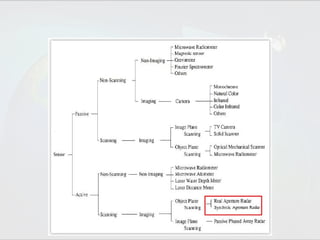
Passive / Active Remote Sensing
Brief History of RADAR Remote Sensing
RADAR System Components
RADAR/Surface Interactions
LIDAR
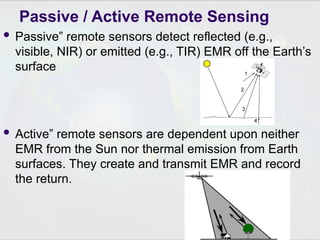
Passive / Active Remote Sensing
 Passive” remote sensors detect reflected (e.g.,
visible, NIR) or emitted (e.g., TIR) EMR off the Earth’s
surface
 Active” remote sensors are dependent upon neither
EMR from the Sun nor thermal emission from Earth
surfaces. They create and transmit EMR and record
the return.
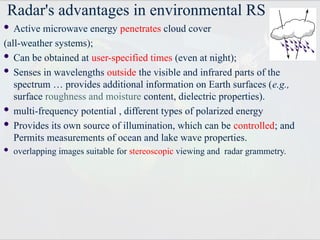
Radar's advantages in environmental RS
 Active microwave energy penetrates cloud cover
(all-weather systems);
 Can be obtained at user-specified times (even at night);
 Senses in wavelengths outside the visible and infrared parts of the
spectrum … provides additional information on Earth surfaces (e.g.,
surface roughness and moisture content, dielectric properties).
 multi-frequency potential , different types of polarized energy
 Provides its own source of illumination, which can be controlled; and
Permits measurements of ocean and lake wave properties.
 overlapping images suitable for stereoscopic viewing and radar grammetry.
Backscatter
Backscatter
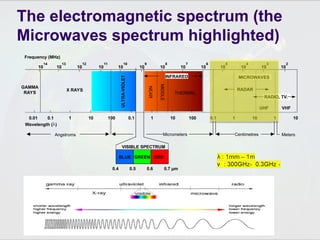
The electromagnetic spectrum (the
Microwaves spectrum highlighted)
12 10 9 8 7 6 5 4 3 2
13 11
10 10 10 10 10 10 10 10 10 10 10 10
10
14
0.01 0.1 1 10 100 1 1
10 10
100 10
0.1 0.1 1
0.4 0.5 0.6 0.7 µm
VISIBLE SPECTRUM
X RAYS
GAMMA
RAYS
Wavelength ()
Frequency (MHz)
Angstroms Micrometers Centimetres Meters
UHF VHF
MICROWAVES
BLUE GREEN RED
RADAR
MIDDLE
NEAR
ULTRA-VIOLET
THERMAL
RADIO, TV.
INFRARED
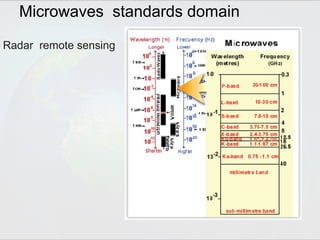
Microwaves standards domain
Radar remote sensing
1 2 3 4 5 6 7 8 9
100
60
40
20
0
80
Ice clouds
Water clouds
X L Bands
C
Atmospheric
transmissivity
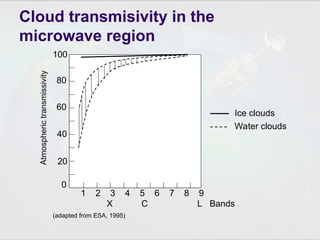
Cloud transmisivity in the
microwave region
(adapted from ESA, 1995)
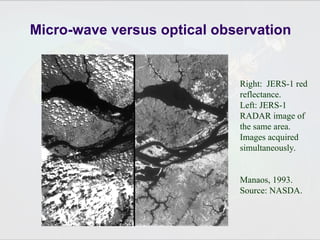
Micro-wave versus optical observation
Right: JERS-1 red
reflectance.
Left: JERS-1
RADAR image of
the same area.
Images acquired
simultaneously.
Manaos, 1993.
Source: NASDA.
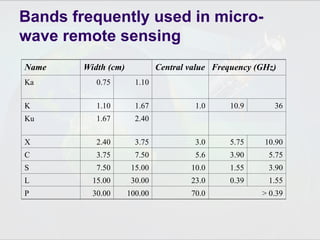
Name Width (cm) Central value Frequency (GHz)
Ka 0.75 1.10
K 1.10 1.67 1.0 10.9 36
Ku 1.67 2.40
X 2.40 3.75 3.0 5.75 10.90
C 3.75 7.50 5.6 3.90 5.75
S 7.50 15.00 10.0 1.55 3.90
L 15.00 30.00 23.0 0.39 1.55
P 30.00 100.00 70.0 > 0.39
Bands frequently used in micro-
wave remote sensing
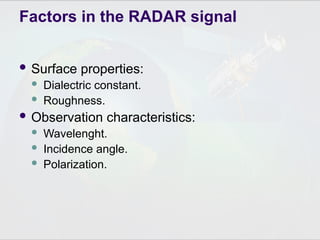
Factors in the RADAR signal
 Surface properties:
 Dialectric constant.
 Roughness.
 Observation characteristics:
 Wavelenght.
 Incidence angle.
 Polarization.
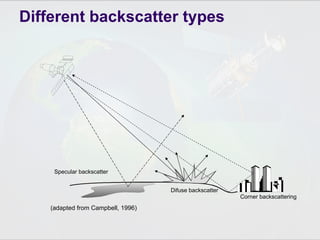
Difuse backscatter
Corner backscattering
Specular backscatter
Different backscatter types
(adapted from Campbell, 1996)
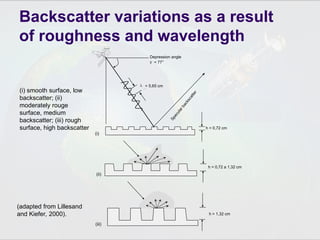
h = 0,72 a 1,32 cm
 = 5,65 cm
Depression angle
 = 77°
S
p
e
c
u
l
a
r
b
a
c
k
s
c
a
t
t
e
r
h < 0,72 cm
h > 1,32 cm
(i)
(ii)
(iii)
(i) smooth surface, low
backscatter; (ii)
moderately rouge
surface, medium
backscatter; (iii) rough
surface, high backscatter
(adapted from Lillesand
and Kiefer, 2000).
Backscatter variations as a result
of roughness and wavelength
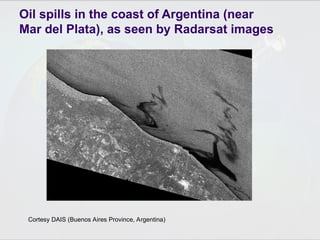
Cortesy DAIS (Buenos Aires Province, Argentina)
Oil spills in the coast of Argentina (near
Mar del Plata), as seen by Radarsat images
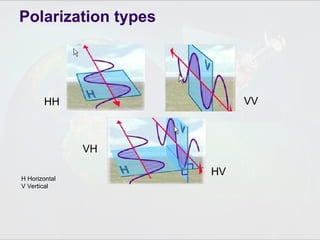
VH
HH
HV
VV
Polarization types
H Horizontal
V Vertical
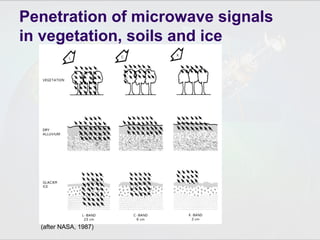
(after NASA, 1987)
Penetration of microwave signals
in vegetation, soils and ice

introduction to satelite radar remote senisng

  • 1.
  • 2.
    Passive / ActiveRemote Sensing Brief History of RADAR Remote Sensing RADAR System Components RADAR/Surface Interactions LIDAR
  • 3.
    Passive / ActiveRemote Sensing  Passive” remote sensors detect reflected (e.g., visible, NIR) or emitted (e.g., TIR) EMR off the Earth’s surface  Active” remote sensors are dependent upon neither EMR from the Sun nor thermal emission from Earth surfaces. They create and transmit EMR and record the return.
  • 5.
    Radar's advantages inenvironmental RS  Active microwave energy penetrates cloud cover (all-weather systems);  Can be obtained at user-specified times (even at night);  Senses in wavelengths outside the visible and infrared parts of the spectrum … provides additional information on Earth surfaces (e.g., surface roughness and moisture content, dielectric properties).  multi-frequency potential , different types of polarized energy  Provides its own source of illumination, which can be controlled; and Permits measurements of ocean and lake wave properties.  overlapping images suitable for stereoscopic viewing and radar grammetry.
  • 6.
  • 7.
  • 8.
    The electromagnetic spectrum(the Microwaves spectrum highlighted) 12 10 9 8 7 6 5 4 3 2 13 11 10 10 10 10 10 10 10 10 10 10 10 10 10 14 0.01 0.1 1 10 100 1 1 10 10 100 10 0.1 0.1 1 0.4 0.5 0.6 0.7 µm VISIBLE SPECTRUM X RAYS GAMMA RAYS Wavelength () Frequency (MHz) Angstroms Micrometers Centimetres Meters UHF VHF MICROWAVES BLUE GREEN RED RADAR MIDDLE NEAR ULTRA-VIOLET THERMAL RADIO, TV. INFRARED
  • 9.
  • 11.
    1 2 34 5 6 7 8 9 100 60 40 20 0 80 Ice clouds Water clouds X L Bands C Atmospheric transmissivity Cloud transmisivity in the microwave region (adapted from ESA, 1995)
  • 12.
    Micro-wave versus opticalobservation Right: JERS-1 red reflectance. Left: JERS-1 RADAR image of the same area. Images acquired simultaneously. Manaos, 1993. Source: NASDA.
  • 13.
    Name Width (cm)Central value Frequency (GHz) Ka 0.75 1.10 K 1.10 1.67 1.0 10.9 36 Ku 1.67 2.40 X 2.40 3.75 3.0 5.75 10.90 C 3.75 7.50 5.6 3.90 5.75 S 7.50 15.00 10.0 1.55 3.90 L 15.00 30.00 23.0 0.39 1.55 P 30.00 100.00 70.0 > 0.39 Bands frequently used in micro- wave remote sensing
  • 14.
    Factors in theRADAR signal  Surface properties:  Dialectric constant.  Roughness.  Observation characteristics:  Wavelenght.  Incidence angle.  Polarization.
  • 15.
    Difuse backscatter Corner backscattering Specularbackscatter Different backscatter types (adapted from Campbell, 1996)
  • 16.
    h = 0,72a 1,32 cm  = 5,65 cm Depression angle  = 77° S p e c u l a r b a c k s c a t t e r h < 0,72 cm h > 1,32 cm (i) (ii) (iii) (i) smooth surface, low backscatter; (ii) moderately rouge surface, medium backscatter; (iii) rough surface, high backscatter (adapted from Lillesand and Kiefer, 2000). Backscatter variations as a result of roughness and wavelength
  • 17.
    Cortesy DAIS (BuenosAires Province, Argentina) Oil spills in the coast of Argentina (near Mar del Plata), as seen by Radarsat images
  • 18.
  • 19.
    (after NASA, 1987) Penetrationof microwave signals in vegetation, soils and ice

Editor's Notes

  • #5 Supports interferometric operation using two antennas for 3-D mapping, and analysis of incident-angle signatures of objects