APPLICATION OF REMOTE SENSING AND
GEOGRAPHICAL INFORMATION SYSTEM IN
CIVIL ENGINEERING
Date:
INSTRUCTOR
DR. MOHSIN SIDDIQUE
ASSIST. PROFESSOR
DEPARTMENT OF CIVIL ENGINEERING
Electromagnetic (EM) Spectrum
2
The portion of the spectrum of
more recent interest to remote
sensing is the microwave region
from about 1mm to 1m.
This covers the longest wavelengths
used for remote sensing.
The shorter wavelengths have
properties similar to the thermal
infrared region while the longer
wavelengths approach the
wavelengths used for radio
broadcasts.
The remote sensing using
microwave spectrum is termed
as microwave sensing
Microwave Spectrum
3
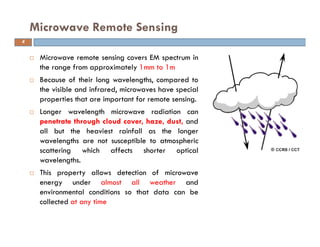
Microwave remote sensing covers EM spectrum in
the range from approximately 1mm to 1m
Because of their long wavelengths, compared to
the visible and infrared, microwaves have special
properties that are important for remote sensing.
Longer wavelength microwave radiation can
penetrate through cloud cover, haze, dust, and
all but the heaviest rainfall as the longer
wavelengths are not susceptible to atmospheric
scattering which affects shorter optical
wavelengths.
This property allows detection of microwave
energy under almost all weather and
environmental conditions so that data can be
collected at any time
Microwave Remote Sensing
4
Type of Microwave Remote Sensing
5
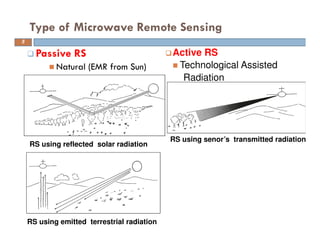
Passive RS
Natural (EMR from Sun)
RS using reflected solar radiation
RS using emitted terrestrial radiation
Active RS
Technological Assisted
Radiation
RS using senor’s transmitted radiation
Passive microwave sensing is similar in concept to thermal remote sensing.
All objects emit microwave energy of some magnitude, but the amounts are
generally very small.
A passive microwave sensor detects the naturally emitted microwave energy
within its field of view. This emitted energy is related to the temperature and
moisture properties of the emitting object or surface.
Because the wavelengths are so long, the energy available is quite small
compared to optical wavelengths. Thus, the fields of view must be large to
detect enough energy to record a signal.
Most passive microwave sensors are therefore characterized by low spatial
resolution.
Applications of passive microwave remote sensing include meteorology,
hydrology, and oceanography
Passive microwave sensing
6
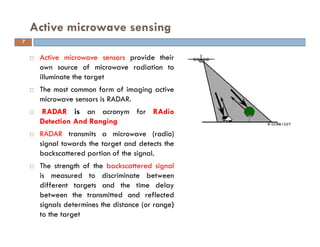
Active microwave sensors provide their
own source of microwave radiation to
illuminate the target
The most common form of imaging active
microwave sensors is RADAR.
RADAR is an acronym for RAdio
Detection And Ranging
RADAR transmits a microwave (radio)
signal towards the target and detects the
backscattered portion of the signal.
The strength of the backscattered signal
is measured to discriminate between
different targets and the time delay
between the transmitted and reflected
signals determines the distance (or range)
to the target
Active microwave sensing
7
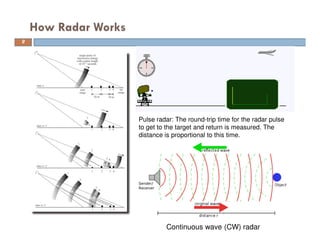
A radar is essentially a ranging or distance
measuring device.
It consists fundamentally of a transmitter, a
receiver, an antenna, and an electronics system to
process and record the data.
The transmitter generates successive short bursts (or
pulses of microwave (A) at regular intervals which
are focused by the antenna into a beam (B). The
radar beam illuminates the surface obliquely at a
right angle to the motion of the platform.
The antenna receives a portion of the transmitted
energy reflected (or backscattered) from various
objects within the illuminated beam (C).
How Radar Works
By measuring the time delay between the transmission of a pulse and the
reception of the backscattered "echo" from different targets, their distance
from the radar and thus their location can be determined
8
How Radar Works
Pulse radar: The round-trip time for the radar pulse
to get to the target and return is measured. The
distance is proportional to this time.
Continuous wave (CW) radar
9
Fundamental Radar Equation
10
Ka, K, and Ku bands: very short
wavelengths used in early airborne radar
systems but uncommon today.
X-band: used extensively on airborne
systems for military reconnaissance and
terrain mapping.
C-band: common on many airborne
research systems, ERS-1 and 2 and
RADARSAT).
S-band: used on board the Russian
ALMAZ satellite.
L-band: used onboard American SEASAT
and Japanese JERS-1 satellites and
NASA airborne system.
P-band: longest radar wavelengths, used
on NASA experimental airborne research
system.
Wavelength ranges or bands of microwave
Ranges and bands were given
code letters during World War II,
and remain to this day.
11
Wavelength ranges or bands of microwave
Band Designations
(common wavelengths Wavelength (λ) Frequency (υ)
shown in parentheses) in cm in GHz
_______________________________________________
Ka (0.86 cm) 0.75 - 1.18 40.0 to 26.5
K 1.18 - 1.67 26.5 to 18.0
Ku 1.67 - 2.4 18.0 to 12.5
X (3.0 and 3.2 cm) 2.4 - 3.8 12.5 - 8.0
C (7.5, 6.0 cm) 3.8 - 7.5 8.0 - 4.0
S (8.0, 9.6, 12.6 cm) 7.5 - 15.0 4.0 - 2.0
L (23.5, 24.0, 25.0 cm) 15.0 - 30.0 2.0 - 1.0
P (68.0 cm) 30.0 - 100 1.0 - 0.3
12
Types of radar
Nonimaging radar
Traffic police use handheld Doppler radar system determine the speed by
measuring frequency shift between transmitted and return microwave
signal
Plan position indicator (PPI) radars use a rotating antenna to detect targets
over a circular area, such as NEXRDA
Satellite-based radar altimeters (low spatial resolution but high vertical
resolution)
Imaging radar
Usually high spatial resolution,
Consists of a transmitter, a receiver, one or more antennas, GPS, computers
13
Radar Nomenclature
14
Azimuth Direction
– direction of travel of aircraft or orbital track of satellite
Range angle
– direction of radar illumination, usually perpendicular to azimuth direction
Depression angle
– angle between horizontal plane and microwave pulse (near range
depression angle > far range depression angle)
Incident angle
– angle between microwave pulse and a line perpendicular to the local
surface slope
Polarization
– linearly polarized microwave energy emitted/received by the sensor
(HH, VV, HV, VH)
Radar Nomenclature
15
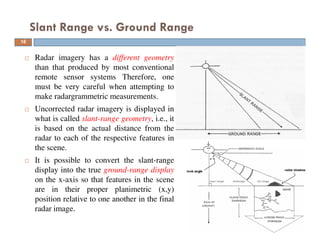
Radar imagery has a different geometry
than that produced by most conventional
remote sensor systems Therefore, one
must be very careful when attempting to
make radargrammetric measurements.
Uncorrected radar imagery is displayed in
what is called slant-range geometry, i.e., it
is based on the actual distance from the
radar to each of the respective features in
the scene.
It is possible to convert the slant-range
display into the true ground-range display
on the x-axis so that features in the scene
are in their proper planimetric (x,y)
position relative to one another in the final
radar image.
Slant Range vs. Ground Range
16
Radar layover
At near range, the top of a tall
object is closer to the antenna than is
its base. As a result, the echo from
the top of the object reaches the
antenna before the echo from the
base.
Because the radar can measure only
slant-range distances, AB and BC are
projected onto the slant-range
domain, represented by the line bac.
Geometric errors
17
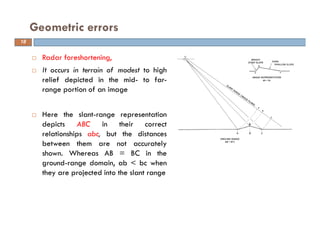
Radar foreshortening,
It occurs in terrain of modest to high
relief depicted in the mid- to far-
range portion of an image
Here the slant-range representation
depicts ABC in their correct
relationships abc, but the distances
between them are not accurately
shown. Whereas AB = BC in the
ground-range domain, ab < bc when
they are projected into the slant range
Geometric errors
18
Polarization of the radiation is also important. Polarization refers to the
orientation of the electric field.
Most radars are designed to transmit microwave radiation either horizontally
polarized (H) or vertically polarized (V).
Similarly, the antenna receives either the horizontally or vertically polarized
backscattered energy, and some radars can receive both.
Four combinations of both transmit and receive polarizations as follows:
HH - for horizontal transmit and horizontal receive,
VV - for vertical transmit and vertical receive,
HV - for horizontal transmit and vertical receive, and
VH - for vertical transmit and horizontal receive.
The first two polarization combinations are referred to as like-polarized and
the last two combinations are referred to as cross-polarized
Polarization
19
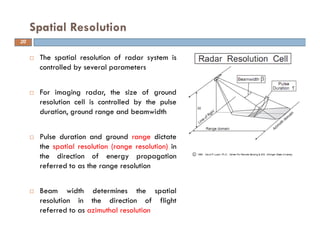
The spatial resolution of radar system is
controlled by several parameters
For imaging radar, the size of ground
resolution cell is controlled by the pulse
duration, ground range and beamwidth
Pulse duration and ground range dictate
the spatial resolution (range resolution) in
the direction of energy propagation
referred to as the range resolution
Beam width determines the spatial
resolution in the direction of flight
referred to as azimuthal resolution
Spatial Resolution
20
Spatial Resolution
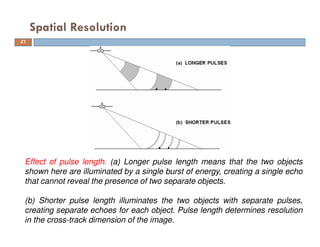
Effect of pulse length. (a) Longer pulse length means that the two objects
shown here are illuminated by a single burst of energy, creating a single echo
that cannot reveal the presence of two separate objects.
(b) Shorter pulse length illuminates the two objects with separate pulses,
creating separate echoes for each object. Pulse length determines resolution
in the cross-track dimension of the image.
21
Spatial Resolution
Azimuth resolution. For real aperture radar, the ability of the system to
acquire fine detail in the along-track axis derives from its ability to focus
the radar beam to illuminate a small area.
Beam width, in relation to range (R), determines detail—region 1 at
range R1 will be imaged in greater detail than region 2 at greater range
R2
22
SLAR (Side-Looking Airborne Radar)
- develop in the 1950's
- airborne, fixed antenna width, sends one pulse at a time and measures what
gets scattered back
- resolution determined by wavelength and antenna size (narrow antenna
width = higher resolution)
SAR (Synthetic Aperture Radar)
- also developed by those responsible for SLAR, but this configuration is not
dependent on the physical antenna size although to achieve higher resolution
the receiving antenna components and transmitter components need to be
separated.
- "synthesizes" a very broad antenna by sending multiple pulses
Types of Imaging Radar
23
Synthetic Aperture Radar
24
Look direction, the direction at which the radar signal strikes the landscape, is
important in both natural and man-made landscapes.
Look angle, the depression angle of the radar, varies across an image, from
relatively steep at the near-range side of the image to relatively shallow at
the far-range side
In natural landscapes, look directions especially important when terrain
features display a preferential alignment.
Look directions perpendicular to topographic alignment will tend to maximize
radar shadow, whereas look directions parallel to topographic orientation will
tend to minimize radar shadow
Radar Shadow
25
The portion of the outgoing radar
signal that the target redirects
directly back towards the radar
antenna is termed as backscattering
When a radar system transmits a
pulse of energy to the ground (A), it
scatters off the ground in all
directions (C). A portion of the
scattered energy is directed back
toward the radar receiver (B), and
this portion is referred to as
"backscatter".
Backscatter
26
Speckle
A=Specular Reflection,
B=Diffuse scattering Corner Reflector Volume Scattering
SAR images are subject to fine-textured effects that can create a grainy
salt-and-pepper appearance when viewed in detail called speckle
Speckle is created by radar illumination of separate scatterers that are
too small to be individually resolved
Volume scattering is the scattering of radar energy within a volume or medium, and
usually consists of multiple bounces and reflections from different components within
the volume
27
The incidence angle is defined as the angle between
the axis of the incident radar signal and a
perpendicular to the surface that the signal strikes
If the surface is homogeneous with respect to its
electrical properties and “smooth” with respect to
the wavelength of the signal, then the reflected
signal will be reflected at an angle equal to the
incidence angle, with most of the energy directed in
a single direction (i.e., specular reflection).
For “rough” surfaces, reflection will not depend as
much on incidence angle, and the signal will be
scattered more or less equally in all directions (i.e.,
diffuse, or isotropic, scattering)
Incident angle and scattering
Incidence
Angle
Local incidence angle
28
A radar signal that strikes a surface will be reflected in a manner that
depends both on characteristics of the surface and properties of the radar
wave, as determined by the radar system and the conditions under which it is
operated
Surface Roughness
According to Rayleigh roughness
criterion
h = the vertical relief (average
height of surface irregularities)
= the radar wavelength
(measured in cm)
= the depression angle
29
Surface Roughness
30
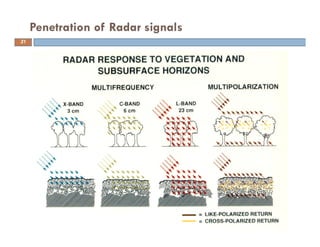
Penetration of Radar signals
31
Flood mapping, Snow mapping, Oil Slicks
Sea ice type, Crop classification,
Forest biomass / timber estimation, tree height
Soil moisture mapping, soil roughness mapping /
monitoring
Wave height monitoring
Crop yield, crop stress
Flood prediction
Landslide prediction
Applications
32
Comments….
Questions….
Suggestions….
33
I am grateful to all the information sources (regarding
remote sensing and GIS) on internet that I accessed
and utilized for the preparation of present lecture.
Thank you !
Feel free contact
34

Microwave remote sensing

  • 1.
    APPLICATION OF REMOTESENSING AND GEOGRAPHICAL INFORMATION SYSTEM IN CIVIL ENGINEERING Date: INSTRUCTOR DR. MOHSIN SIDDIQUE ASSIST. PROFESSOR DEPARTMENT OF CIVIL ENGINEERING
  • 2.
  • 3.
    The portion ofthe spectrum of more recent interest to remote sensing is the microwave region from about 1mm to 1m. This covers the longest wavelengths used for remote sensing. The shorter wavelengths have properties similar to the thermal infrared region while the longer wavelengths approach the wavelengths used for radio broadcasts. The remote sensing using microwave spectrum is termed as microwave sensing Microwave Spectrum 3
  • 4.
    Microwave remote sensingcovers EM spectrum in the range from approximately 1mm to 1m Because of their long wavelengths, compared to the visible and infrared, microwaves have special properties that are important for remote sensing. Longer wavelength microwave radiation can penetrate through cloud cover, haze, dust, and all but the heaviest rainfall as the longer wavelengths are not susceptible to atmospheric scattering which affects shorter optical wavelengths. This property allows detection of microwave energy under almost all weather and environmental conditions so that data can be collected at any time Microwave Remote Sensing 4
  • 5.
    Type of MicrowaveRemote Sensing 5 Passive RS Natural (EMR from Sun) RS using reflected solar radiation RS using emitted terrestrial radiation Active RS Technological Assisted Radiation RS using senor’s transmitted radiation
  • 6.
    Passive microwave sensingis similar in concept to thermal remote sensing. All objects emit microwave energy of some magnitude, but the amounts are generally very small. A passive microwave sensor detects the naturally emitted microwave energy within its field of view. This emitted energy is related to the temperature and moisture properties of the emitting object or surface. Because the wavelengths are so long, the energy available is quite small compared to optical wavelengths. Thus, the fields of view must be large to detect enough energy to record a signal. Most passive microwave sensors are therefore characterized by low spatial resolution. Applications of passive microwave remote sensing include meteorology, hydrology, and oceanography Passive microwave sensing 6
  • 7.
    Active microwave sensorsprovide their own source of microwave radiation to illuminate the target The most common form of imaging active microwave sensors is RADAR. RADAR is an acronym for RAdio Detection And Ranging RADAR transmits a microwave (radio) signal towards the target and detects the backscattered portion of the signal. The strength of the backscattered signal is measured to discriminate between different targets and the time delay between the transmitted and reflected signals determines the distance (or range) to the target Active microwave sensing 7
  • 8.
    A radar isessentially a ranging or distance measuring device. It consists fundamentally of a transmitter, a receiver, an antenna, and an electronics system to process and record the data. The transmitter generates successive short bursts (or pulses of microwave (A) at regular intervals which are focused by the antenna into a beam (B). The radar beam illuminates the surface obliquely at a right angle to the motion of the platform. The antenna receives a portion of the transmitted energy reflected (or backscattered) from various objects within the illuminated beam (C). How Radar Works By measuring the time delay between the transmission of a pulse and the reception of the backscattered "echo" from different targets, their distance from the radar and thus their location can be determined 8
  • 9.
    How Radar Works Pulseradar: The round-trip time for the radar pulse to get to the target and return is measured. The distance is proportional to this time. Continuous wave (CW) radar 9
  • 10.
  • 11.
    Ka, K, andKu bands: very short wavelengths used in early airborne radar systems but uncommon today. X-band: used extensively on airborne systems for military reconnaissance and terrain mapping. C-band: common on many airborne research systems, ERS-1 and 2 and RADARSAT). S-band: used on board the Russian ALMAZ satellite. L-band: used onboard American SEASAT and Japanese JERS-1 satellites and NASA airborne system. P-band: longest radar wavelengths, used on NASA experimental airborne research system. Wavelength ranges or bands of microwave Ranges and bands were given code letters during World War II, and remain to this day. 11
  • 12.
    Wavelength ranges orbands of microwave Band Designations (common wavelengths Wavelength (λ) Frequency (υ) shown in parentheses) in cm in GHz _______________________________________________ Ka (0.86 cm) 0.75 - 1.18 40.0 to 26.5 K 1.18 - 1.67 26.5 to 18.0 Ku 1.67 - 2.4 18.0 to 12.5 X (3.0 and 3.2 cm) 2.4 - 3.8 12.5 - 8.0 C (7.5, 6.0 cm) 3.8 - 7.5 8.0 - 4.0 S (8.0, 9.6, 12.6 cm) 7.5 - 15.0 4.0 - 2.0 L (23.5, 24.0, 25.0 cm) 15.0 - 30.0 2.0 - 1.0 P (68.0 cm) 30.0 - 100 1.0 - 0.3 12
  • 13.
    Types of radar Nonimagingradar Traffic police use handheld Doppler radar system determine the speed by measuring frequency shift between transmitted and return microwave signal Plan position indicator (PPI) radars use a rotating antenna to detect targets over a circular area, such as NEXRDA Satellite-based radar altimeters (low spatial resolution but high vertical resolution) Imaging radar Usually high spatial resolution, Consists of a transmitter, a receiver, one or more antennas, GPS, computers 13
  • 14.
  • 15.
    Azimuth Direction – directionof travel of aircraft or orbital track of satellite Range angle – direction of radar illumination, usually perpendicular to azimuth direction Depression angle – angle between horizontal plane and microwave pulse (near range depression angle > far range depression angle) Incident angle – angle between microwave pulse and a line perpendicular to the local surface slope Polarization – linearly polarized microwave energy emitted/received by the sensor (HH, VV, HV, VH) Radar Nomenclature 15
  • 16.
    Radar imagery hasa different geometry than that produced by most conventional remote sensor systems Therefore, one must be very careful when attempting to make radargrammetric measurements. Uncorrected radar imagery is displayed in what is called slant-range geometry, i.e., it is based on the actual distance from the radar to each of the respective features in the scene. It is possible to convert the slant-range display into the true ground-range display on the x-axis so that features in the scene are in their proper planimetric (x,y) position relative to one another in the final radar image. Slant Range vs. Ground Range 16
  • 17.
    Radar layover At nearrange, the top of a tall object is closer to the antenna than is its base. As a result, the echo from the top of the object reaches the antenna before the echo from the base. Because the radar can measure only slant-range distances, AB and BC are projected onto the slant-range domain, represented by the line bac. Geometric errors 17
  • 18.
    Radar foreshortening, It occursin terrain of modest to high relief depicted in the mid- to far- range portion of an image Here the slant-range representation depicts ABC in their correct relationships abc, but the distances between them are not accurately shown. Whereas AB = BC in the ground-range domain, ab < bc when they are projected into the slant range Geometric errors 18
  • 19.
    Polarization of theradiation is also important. Polarization refers to the orientation of the electric field. Most radars are designed to transmit microwave radiation either horizontally polarized (H) or vertically polarized (V). Similarly, the antenna receives either the horizontally or vertically polarized backscattered energy, and some radars can receive both. Four combinations of both transmit and receive polarizations as follows: HH - for horizontal transmit and horizontal receive, VV - for vertical transmit and vertical receive, HV - for horizontal transmit and vertical receive, and VH - for vertical transmit and horizontal receive. The first two polarization combinations are referred to as like-polarized and the last two combinations are referred to as cross-polarized Polarization 19
  • 20.
    The spatial resolutionof radar system is controlled by several parameters For imaging radar, the size of ground resolution cell is controlled by the pulse duration, ground range and beamwidth Pulse duration and ground range dictate the spatial resolution (range resolution) in the direction of energy propagation referred to as the range resolution Beam width determines the spatial resolution in the direction of flight referred to as azimuthal resolution Spatial Resolution 20
  • 21.
    Spatial Resolution Effect ofpulse length. (a) Longer pulse length means that the two objects shown here are illuminated by a single burst of energy, creating a single echo that cannot reveal the presence of two separate objects. (b) Shorter pulse length illuminates the two objects with separate pulses, creating separate echoes for each object. Pulse length determines resolution in the cross-track dimension of the image. 21
  • 22.
    Spatial Resolution Azimuth resolution.For real aperture radar, the ability of the system to acquire fine detail in the along-track axis derives from its ability to focus the radar beam to illuminate a small area. Beam width, in relation to range (R), determines detail—region 1 at range R1 will be imaged in greater detail than region 2 at greater range R2 22
  • 23.
    SLAR (Side-Looking AirborneRadar) - develop in the 1950's - airborne, fixed antenna width, sends one pulse at a time and measures what gets scattered back - resolution determined by wavelength and antenna size (narrow antenna width = higher resolution) SAR (Synthetic Aperture Radar) - also developed by those responsible for SLAR, but this configuration is not dependent on the physical antenna size although to achieve higher resolution the receiving antenna components and transmitter components need to be separated. - "synthesizes" a very broad antenna by sending multiple pulses Types of Imaging Radar 23
  • 24.
  • 25.
    Look direction, thedirection at which the radar signal strikes the landscape, is important in both natural and man-made landscapes. Look angle, the depression angle of the radar, varies across an image, from relatively steep at the near-range side of the image to relatively shallow at the far-range side In natural landscapes, look directions especially important when terrain features display a preferential alignment. Look directions perpendicular to topographic alignment will tend to maximize radar shadow, whereas look directions parallel to topographic orientation will tend to minimize radar shadow Radar Shadow 25
  • 26.
    The portion ofthe outgoing radar signal that the target redirects directly back towards the radar antenna is termed as backscattering When a radar system transmits a pulse of energy to the ground (A), it scatters off the ground in all directions (C). A portion of the scattered energy is directed back toward the radar receiver (B), and this portion is referred to as "backscatter". Backscatter 26
  • 27.
    Speckle A=Specular Reflection, B=Diffuse scatteringCorner Reflector Volume Scattering SAR images are subject to fine-textured effects that can create a grainy salt-and-pepper appearance when viewed in detail called speckle Speckle is created by radar illumination of separate scatterers that are too small to be individually resolved Volume scattering is the scattering of radar energy within a volume or medium, and usually consists of multiple bounces and reflections from different components within the volume 27
  • 28.
    The incidence angleis defined as the angle between the axis of the incident radar signal and a perpendicular to the surface that the signal strikes If the surface is homogeneous with respect to its electrical properties and “smooth” with respect to the wavelength of the signal, then the reflected signal will be reflected at an angle equal to the incidence angle, with most of the energy directed in a single direction (i.e., specular reflection). For “rough” surfaces, reflection will not depend as much on incidence angle, and the signal will be scattered more or less equally in all directions (i.e., diffuse, or isotropic, scattering) Incident angle and scattering Incidence Angle Local incidence angle 28
  • 29.
    A radar signalthat strikes a surface will be reflected in a manner that depends both on characteristics of the surface and properties of the radar wave, as determined by the radar system and the conditions under which it is operated Surface Roughness According to Rayleigh roughness criterion h = the vertical relief (average height of surface irregularities) = the radar wavelength (measured in cm) = the depression angle 29
  • 30.
  • 31.
  • 32.
    Flood mapping, Snowmapping, Oil Slicks Sea ice type, Crop classification, Forest biomass / timber estimation, tree height Soil moisture mapping, soil roughness mapping / monitoring Wave height monitoring Crop yield, crop stress Flood prediction Landslide prediction Applications 32
  • 33.
    Comments…. Questions…. Suggestions…. 33 I am gratefulto all the information sources (regarding remote sensing and GIS) on internet that I accessed and utilized for the preparation of present lecture. Thank you ! Feel free contact
  • 34.