DBMS
		Data Storage HierarchyBit: it is smallest unit of data a single binary Digit.
Character: Multiple related bits are combine to form a character(M,8,$..etc).
Field: Multiple related character are combine to form field. (employee code, emp name).
Record: Multiple related field are combined to form record. (a student record will contain field containing data of the students)		Data Storage HierarchyFile: Multiple related file are combine to form a file.(a collection of all employee record of a company will be employee file.)
Database: Multiple related file are integrated to form a Database. (multiple employee file such as salary file, Personnel information file, Skill Set file)		Database Model				A database model defines the manner in which the various files of a database are linked together.
The commonly used database model are:Hierarchical Database.Network Database.Relational Database.Object Oriented Database.
Hierarchical Database ModelThe data element are linked in form of inverted tree structure.
Root at the top.
Parent-child relationship
Parent data element is one and can have one or more subordinate or child element.
There may be many child but only one parent data element.Hierarchical Database ModelThe data element of many applications can be neatly organized with this model
The main limitation is, it does not support flexible data access because the data can only be accessed by following the tree structure.
Hence the mapping of data and their relationship in tree structure is very important when the database is first design.Network Database Model			It is extension of Hierarchical Database model.
It follows parent-child relationship.
The mapping of data and their relationship is very important when the database is first design.
Here the child data can have more than one parent and can have no parent at all.
Here the extraction of information can be from any data element in database structure instead of root data element.Relational Database Model							Here the data element are organized in form of multiple tables with rows and columns.
Each table represents separate file.
Each table column are represent as field.
Each table row are represent as data record.
The data in one table are related to data in another table by common field.Relational Database Model							It provide grater flexibility in data organization and future enhancement.
If new data is to be added then it is not necessary to redesign the database rather new table can be easily added. Database Model							Some Limitation Of Database Models Are:Ability to model complex nested entities such as engineering objects, multimedia documents.Have only a limited set of data types they do not allow storage and retrieval of long unstructured data such as images, audio and textual documents.
Object-Oriented DATABASE MODEL							It was introduced to overcome the above listed shortcoming.
IT is a collection of object whose behavior, state and relationship is defined according to object oriented concept.Object-Oriented DATABASE MODEL
Main Components of DBMS:							Data Definition Language (DDL).
Data Manipulation Language (DML)
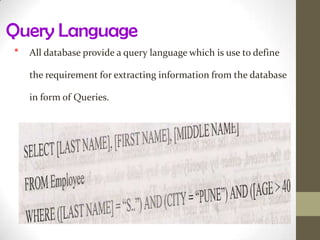
Query Language
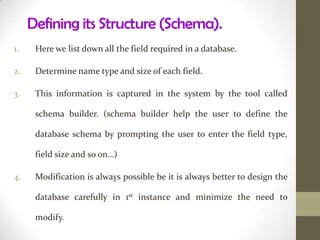
Report Generator.Data Definition Language (DDL). 							IT is use to define the structure of a Database. The database structure definition (Schema)  typically includes the following:Defining all data element.
Defining data element field  and records.
Defining the name, field length, and field type for each data type.
Defining control for field that can have only selective values.
Defining the logical relationship among various data element.
Defining access control for security purpose.Data Definition Language (DDL)In short every thing about the database structure is included in its schema.
This description can be use by system analyst in defining new application.
Database fundamentals

  • 1.
  • 2.
    Data Storage HierarchyBit:it is smallest unit of data a single binary Digit.
  • 3.
    Character: Multiple relatedbits are combine to form a character(M,8,$..etc).
  • 4.
    Field: Multiple relatedcharacter are combine to form field. (employee code, emp name).
  • 5.
    Record: Multiple relatedfield are combined to form record. (a student record will contain field containing data of the students) Data Storage HierarchyFile: Multiple related file are combine to form a file.(a collection of all employee record of a company will be employee file.)
  • 6.
    Database: Multiple relatedfile are integrated to form a Database. (multiple employee file such as salary file, Personnel information file, Skill Set file) Database Model A database model defines the manner in which the various files of a database are linked together.
  • 7.
    The commonly useddatabase model are:Hierarchical Database.Network Database.Relational Database.Object Oriented Database.
  • 8.
    Hierarchical Database ModelThedata element are linked in form of inverted tree structure.
  • 9.
  • 10.
  • 11.
    Parent data elementis one and can have one or more subordinate or child element.
  • 12.
    There may bemany child but only one parent data element.Hierarchical Database ModelThe data element of many applications can be neatly organized with this model
  • 13.
    The main limitationis, it does not support flexible data access because the data can only be accessed by following the tree structure.
  • 14.
    Hence the mappingof data and their relationship in tree structure is very important when the database is first design.Network Database Model It is extension of Hierarchical Database model.
  • 15.
  • 16.
    The mapping ofdata and their relationship is very important when the database is first design.
  • 17.
    Here the childdata can have more than one parent and can have no parent at all.
  • 18.
    Here the extractionof information can be from any data element in database structure instead of root data element.Relational Database Model Here the data element are organized in form of multiple tables with rows and columns.
  • 19.
    Each table representsseparate file.
  • 20.
    Each table columnare represent as field.
  • 21.
    Each table roware represent as data record.
  • 22.
    The data inone table are related to data in another table by common field.Relational Database Model It provide grater flexibility in data organization and future enhancement.
  • 23.
    If new datais to be added then it is not necessary to redesign the database rather new table can be easily added. Database Model Some Limitation Of Database Models Are:Ability to model complex nested entities such as engineering objects, multimedia documents.Have only a limited set of data types they do not allow storage and retrieval of long unstructured data such as images, audio and textual documents.
  • 24.
    Object-Oriented DATABASE MODEL Itwas introduced to overcome the above listed shortcoming.
  • 25.
    IT is acollection of object whose behavior, state and relationship is defined according to object oriented concept.Object-Oriented DATABASE MODEL
  • 26.
    Main Components ofDBMS: Data Definition Language (DDL).
  • 27.
  • 28.
  • 29.
    Report Generator.Data DefinitionLanguage (DDL). IT is use to define the structure of a Database. The database structure definition (Schema) typically includes the following:Defining all data element.
  • 30.
    Defining data elementfield and records.
  • 31.
    Defining the name,field length, and field type for each data type.
  • 32.
    Defining control forfield that can have only selective values.
  • 33.
    Defining the logicalrelationship among various data element.
  • 34.
    Defining access controlfor security purpose.Data Definition Language (DDL)In short every thing about the database structure is included in its schema.
  • 35.
    This description canbe use by system analyst in defining new application.