Remote Sensing
MASHHOOD ARIF
Contents
 Definition
 Types of Remote Sensing
 Elements involved in Remote
Sensing
 Process of Remote Sensing
 Sensors
 Usual Platforms
 Interaction with Atmosphere
 Remote Sensing & GIS
Aerial Remote Sensing
Image Processing in Remote Sensing
Types of Resolution
Correction
Advantages & Disadvantages of
Remote Sensing
Applications
Conclusion
DEFINITION
It is the acquisition of information about an object or
phenomenon without making physical contact with the object
In modern usage, the term generally refers to the use of aerial
sensor technologies to detect and classify objects on Earth by
means of propagated signals
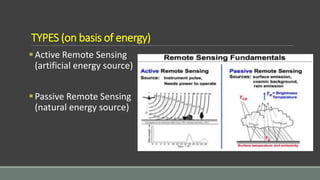
TYPES (on basis of energy)
Active Remote Sensing
(artificial energy source)
Passive Remote Sensing
(natural energy source)
TYPES (on basis of range of electromagnetic radiation)
 Optical Remote Sensing
(wavelength range 300nm-3000nm)
 Thermal Remote Sensing
(wavelength range 3000-14000nm)
 Microwave Remote Sensing
(wavelength range 1mm-1m)
ELEMENTS INVOLVED IN REMOTE SENSING
Source of energy
Radiation and the atmosphere
Interaction with object
Recording of energy by sensor
Transmission, reception and processing
Interpretation and analysis
Application
PROCESS OF REMOTE SENSING
Data acquisition
Processing
Analysis
Accuracy assessment
Information distribution to users
SENSORS
Imaging Sensors
Sensors which provide output to create image
Example: LISS I, LISS II, LISS III, etc (Linear Imaging Self Scanning Sensor LISS)
Non-imaging Sensors
Sensors which provide numerical output with respect to quantum of radiation
Example: Radiometer, Scatterometer, etc
USUAL PLATFORMS
AIRCRAFT
 Helicopters
 Microlites
 Low altitude aircrafts
 High altitude aircrafts
SATELLITE
 Orbiting satellites
 Geostationary satellites
INTERACTION WITH THE ATMOSPHERE
Radiation used for remote sensing has to travel through Earth’s
atmosphere
Particles and gases in the atmosphere can affect it
These effects are caused by mechanisms of scattering and
absorption
Remote Sensing & GIS
 The science of acquiring information about the Earth using remote
instruments, such as satellites
 It is inherently useful for disaster management
 Satellites offer accurate, frequent and almost instantaneous data
over large areas anywhere in the world
 When a disaster strikes, remote sensing is often the only way to
view what is happening on the ground
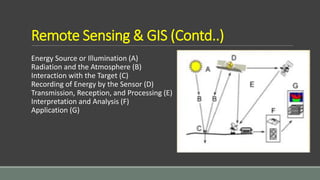
Remote Sensing & GIS (Contd..)
Energy Source or Illumination (A)
Radiation and the Atmosphere (B)
Interaction with the Target (C)
Recording of Energy by the Sensor (D)
Transmission, Reception, and Processing (E)
Interpretation and Analysis (F)
Application (G)
Aerial Remote Sensing
Aerial Remote Sensing Aerial photography is the most commonly
used form of remote sensing and is widely used for topographic
mapping, surveys for geological, soil and forestry mapping,
engineering, town planning and environmental surveys on larger
scale
IMAGE PROCESSING IN REMOTE SENSING
 Input data
 Reconstruction/ correction
 Transformation
 Classification
 Output
TYPES OF RESOLUTION
Spatial Resolution
The size of a pixel that is recorded in a raster image
Spectral Resolution
The wavelength width of the different frequency bands recorded
Radiometric Resolution
The number of different intensities of radiation the sensor is able to distinguish
Temporal Resolution
The frequency of flyovers by the satellite or plane
CORRECTION
Radiometric correction
Gives a scale to the pixel values
Topographic correction
In rugged mountains, as a result of terrain, the effective illumination
of pixels varies considerably. The purpose of topographic correction
is to eliminate this effect
Atmospheric correction
Elimination of atmospheric haze by rescaling each frequency band
ADVANTAGES OF REMOTE SENSING
 Real time
 Spatial locations and extent of features can be corrected accurately
 Cheaper
 Faster
 Different scales
 Easy updation
 More analytical themes
 Remote sensors "see" over a broader portion of the spectrum than the
human eye
DISADVANTAGES OF REMOTE SENSING
 Expensive to build and operate
 Measurement uncertainty can be large
 Data interpretation can be difficult
APPLICATIONS OF REMOTE SENSING
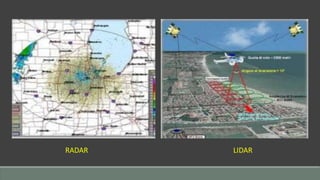
 Conventional radar is mostly associated with aerial traffic control,
early warning, and certain large scale meteorological data
 Altimeters measure wind speeds and direction, and surface ocean
currents and directions
 Light detection and ranging (LIDAR) is well known in examples of
weapon ranging, laser illuminated homing of projectiles
 Radiometers and photometers are the most common instrument in
use, collecting reflected and emitted radiation in a wide range of
frequencies
RADAR LIDAR
APPLICATIONS OF REMOTE SENSING (Contd..)
 Stereographic pairs of aerial photographs have often been used to
make topographic maps
 Hyperspectral imagers are used in various applications including
mineralogy, biology, defense, and environmental measurements
 remote sensing allows to follow-up and monitor risk areas in the
long term, to determine desertification factors
Conclusion
 Remote Sensing and GIS technology is very effective tool for
suggesting action plans /management strategies for various
disciplines
 The technique of obtaining information about objects through the
analysis of data collected by special instruments that are not in
physical contact with the objects of investigation

Remote sensing

  • 1.
  • 2.
    Contents  Definition  Typesof Remote Sensing  Elements involved in Remote Sensing  Process of Remote Sensing  Sensors  Usual Platforms  Interaction with Atmosphere  Remote Sensing & GIS Aerial Remote Sensing Image Processing in Remote Sensing Types of Resolution Correction Advantages & Disadvantages of Remote Sensing Applications Conclusion
  • 3.
    DEFINITION It is theacquisition of information about an object or phenomenon without making physical contact with the object In modern usage, the term generally refers to the use of aerial sensor technologies to detect and classify objects on Earth by means of propagated signals
  • 4.
    TYPES (on basisof energy) Active Remote Sensing (artificial energy source) Passive Remote Sensing (natural energy source)
  • 6.
    TYPES (on basisof range of electromagnetic radiation)  Optical Remote Sensing (wavelength range 300nm-3000nm)  Thermal Remote Sensing (wavelength range 3000-14000nm)  Microwave Remote Sensing (wavelength range 1mm-1m)
  • 7.
    ELEMENTS INVOLVED INREMOTE SENSING Source of energy Radiation and the atmosphere Interaction with object Recording of energy by sensor Transmission, reception and processing Interpretation and analysis Application
  • 8.
    PROCESS OF REMOTESENSING Data acquisition Processing Analysis Accuracy assessment Information distribution to users
  • 9.
    SENSORS Imaging Sensors Sensors whichprovide output to create image Example: LISS I, LISS II, LISS III, etc (Linear Imaging Self Scanning Sensor LISS) Non-imaging Sensors Sensors which provide numerical output with respect to quantum of radiation Example: Radiometer, Scatterometer, etc
  • 10.
    USUAL PLATFORMS AIRCRAFT  Helicopters Microlites  Low altitude aircrafts  High altitude aircrafts SATELLITE  Orbiting satellites  Geostationary satellites
  • 11.
    INTERACTION WITH THEATMOSPHERE Radiation used for remote sensing has to travel through Earth’s atmosphere Particles and gases in the atmosphere can affect it These effects are caused by mechanisms of scattering and absorption
  • 12.
    Remote Sensing &GIS  The science of acquiring information about the Earth using remote instruments, such as satellites  It is inherently useful for disaster management  Satellites offer accurate, frequent and almost instantaneous data over large areas anywhere in the world  When a disaster strikes, remote sensing is often the only way to view what is happening on the ground
  • 13.
    Remote Sensing &GIS (Contd..) Energy Source or Illumination (A) Radiation and the Atmosphere (B) Interaction with the Target (C) Recording of Energy by the Sensor (D) Transmission, Reception, and Processing (E) Interpretation and Analysis (F) Application (G)
  • 14.
    Aerial Remote Sensing AerialRemote Sensing Aerial photography is the most commonly used form of remote sensing and is widely used for topographic mapping, surveys for geological, soil and forestry mapping, engineering, town planning and environmental surveys on larger scale
  • 15.
    IMAGE PROCESSING INREMOTE SENSING  Input data  Reconstruction/ correction  Transformation  Classification  Output
  • 16.
    TYPES OF RESOLUTION SpatialResolution The size of a pixel that is recorded in a raster image Spectral Resolution The wavelength width of the different frequency bands recorded Radiometric Resolution The number of different intensities of radiation the sensor is able to distinguish Temporal Resolution The frequency of flyovers by the satellite or plane
  • 17.
    CORRECTION Radiometric correction Gives ascale to the pixel values Topographic correction In rugged mountains, as a result of terrain, the effective illumination of pixels varies considerably. The purpose of topographic correction is to eliminate this effect Atmospheric correction Elimination of atmospheric haze by rescaling each frequency band
  • 18.
    ADVANTAGES OF REMOTESENSING  Real time  Spatial locations and extent of features can be corrected accurately  Cheaper  Faster  Different scales  Easy updation  More analytical themes  Remote sensors "see" over a broader portion of the spectrum than the human eye
  • 19.
    DISADVANTAGES OF REMOTESENSING  Expensive to build and operate  Measurement uncertainty can be large  Data interpretation can be difficult
  • 20.
    APPLICATIONS OF REMOTESENSING  Conventional radar is mostly associated with aerial traffic control, early warning, and certain large scale meteorological data  Altimeters measure wind speeds and direction, and surface ocean currents and directions  Light detection and ranging (LIDAR) is well known in examples of weapon ranging, laser illuminated homing of projectiles  Radiometers and photometers are the most common instrument in use, collecting reflected and emitted radiation in a wide range of frequencies
  • 21.
  • 22.
    APPLICATIONS OF REMOTESENSING (Contd..)  Stereographic pairs of aerial photographs have often been used to make topographic maps  Hyperspectral imagers are used in various applications including mineralogy, biology, defense, and environmental measurements  remote sensing allows to follow-up and monitor risk areas in the long term, to determine desertification factors
  • 24.
    Conclusion  Remote Sensingand GIS technology is very effective tool for suggesting action plans /management strategies for various disciplines  The technique of obtaining information about objects through the analysis of data collected by special instruments that are not in physical contact with the objects of investigation