Ocean Optics: Fundamentals & Naval Applications


                                          Instructor:
                                       Jeffrey H. Smart


ATI Course Schedule: http://www.ATIcourses.com/schedule.htm

ATI's Ocean Optics:   http://www.aticourses.com/Ocean_Optics_Fundamentals_Naval_Applications.htm
www.ATIcourses.com

Boost Your Skills                                             349 Berkshire Drive
                                                              Riva, Maryland 21140
with On-Site Courses                                          Telephone 1-888-501-2100 / (410) 965-8805

Tailored to Your Needs
                                                              Fax (410) 956-5785
                                                              Email: ATI@ATIcourses.com

The Applied Technology Institute specializes in training programs for technical professionals. Our courses keep you
current in the state-of-the-art technology that is essential to keep your company on the cutting edge in today’s highly
competitive marketplace. Since 1984, ATI has earned the trust of training departments nationwide, and has presented
on-site training at the major Navy, Air Force and NASA centers, and for a large number of contractors. Our training
increases effectiveness and productivity. Learn from the proven best.

For a Free On-Site Quote Visit Us At: http://www.ATIcourses.com/free_onsite_quote.asp

For Our Current Public Course Schedule Go To: http://www.ATIcourses.com/schedule.htm
My Background in Ocean Optics
            (some dates are approximate)
1988-1996: Environmental Specialist for Active Optics Project

• Acquire and learn how to use multi-spectral radiance/irradiance sensor system, optical
backscatter sensors, and beam transmissometers
• Develop software to provide analysis products such as optical attenuation profiles vs.
wavelength
• Test experimental systems to “measure” nighttime “K”
• Participated in 5 major sea tests plus numerous smaller sea tests
• Write environmental summary reports on temporal & spatial variability

1992-1994: Environmental Specialist for MIW Program

• Deploy multi-spectral radiance /irradiance sensor system, optical backscatter sensors,
and beam transmissometers in shallow coastal sites off Panama City & off Ocean City,
Md
• Write environmental summary reports on short-term temporal variability (< 1 week) at
fixed sites
My Background in Ocean Optics
            (some dates are approximate)

1994 to 1997: Project Manager & PI for bio-optical monitoring system
• Analyze & document results for sensors
• Analyzed data from associated platforms

1996-2010: Environmental Specialist for active optics program

1995 to present: Proj Mgr/PI for ONR World-wide Ocean Optics Database (WOOD)

2001-2003: Littoral Warfare Advanced Development (LWAD)

• Project Scientist in the Yellow Sea supporting hyper-spectral optics system
• Environmental expert for several sea tests, including exercise in East China Sea
Various Naval Applications of Ocean Optics
•    Mine Warfare:
             - Sonar systems are typically used to find Mine-like Objects
             - Electro-Optical Identification (EOID) sensors are used to classify those
               objects
             - Examples of EOID systems*:
                 - Areté Associates Streak Tube Imaging LIDAR (STIL) system
                 - Northrop Grumman Laser Line Scan (LLS) system
                 - Raytheon LLS system

•    Special Operations Forces
       – Detectability of SEAL Delivery Vehicles
       – Detectability of submerged divers

•    Underwater Communications
       – Optical properties of water directly impacts range & quality of transmission

•    Port Security & Anti-Submarine Warfare (ASW)
       – Passive Detectability
       – Active (e.g. Laser) Detectability

•    Other Possible Application: Bathymetry Mapping


    * Ref: “Electro-optic Identification Research Program,” James S. Taylor, Jr. and Mary C. Hulgan, Fifth International
    Symposium on Technology and Mine Problem, 22-25 Apr 2002, Monterey, CA
Airborne Mine Countermeasures (AMCM)
•    The MH-60S, fitted with Airborne Mine Countermeasures (AMCM) made its
     first flight in July 2003.

•    Lockheed Martin Systems Integration… is integrator for the MH-60S mine
     countermeasures systems which includes:
       – Raytheon Airborne Mine Neutralization System (AMNS) with BAE Systems
         Archerfish expendable underwater vehicle that destroys the mines;
       – Northrop Grumman Rapid Airborne Mine Clearance System (RAMICS), a non-towed
         mine neutralization system that will clear near-surface and surface-moored mines
         using a Kaman Aerospace laser target sensor and a 30mm mk44 gun;
       – Raytheon AN/AQS-20A towed sonar with mine identification system which entered
         production in September 2005;
       – Northrop Grumman airborne laser mine detection system, AN/AES-1 ALMDS,


•    AN/AES-1 ALMDS detects and classifies floating and near-surface moored
     mines, using pulsed laser light. The ALMDS pod is mechanically attached to
     the MH-60S with a standard Bomb Rack Unit 14 (BRU-14) mount.


    Ref: http://www.naval-technology.com/projects/mh_60s/
Airborne Laser Mine Detection System
              (ALMDS)
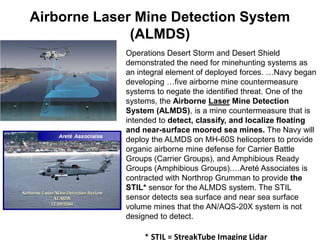
             Operations Desert Storm and Desert Shield
             demonstrated the need for minehunting systems as
             an integral element of deployed forces. …Navy began
             developing …five airborne mine countermeasure
             systems to negate the identified threat. One of the
             systems, the Airborne Laser Mine Detection
             System (ALMDS), is a mine countermeasure that is
             intended to detect, classify, and localize floating
             and near-surface moored sea mines. The Navy will
             deploy the ALMDS on MH-60S helicopters to provide
             organic airborne mine defense for Carrier Battle
             Groups (Carrier Groups), and Amphibious Ready
             Groups (Amphibious Groups).…Areté Associates is
             contracted with Northrop Grumman to provide the
             STIL* sensor for the ALMDS system. The STIL
             sensor detects sea surface and near sea surface
             volume mines that the AN/AQS-20X system is not
             designed to detect.

                 * STIL = StreakTube Imaging Lidar
Airborne Mine Neutralization System (AMNS)


 • Raytheon is receiving $14.7M for seven more
   AMNS systems
 • Ref: info by Jeff Steelman via email from George
   Pollitt, 9-23-10

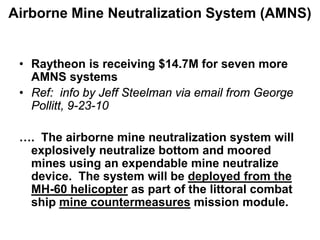
 …. The airborne mine neutralization system will
  explosively neutralize bottom and moored
  mines using an expendable mine neutralize
  device. The system will be deployed from the
  MH-60 helicopter as part of the littoral combat
  ship mine countermeasures mission module.
EOID Sensor Systems
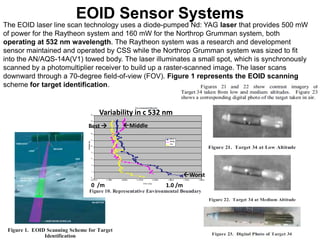
The EOID laser line scan technology uses a diode-pumped Nd: YAG laser that provides 500 mW
of power for the Raytheon system and 160 mW for the Northrop Grumman system, both
operating at 532 nm wavelength. The Raytheon system was a research and development
sensor maintained and operated by CSS while the Northrop Grumman system was sized to fit
into the AN/AQS-14A(V1) towed body. The laser illuminates a small spot, which is synchronously
scanned by a photomultiplier receiver to build up a raster-scanned image. The laser scans
downward through a 70-degree field-of-view (FOV). Figure 1 represents the EOID scanning
scheme for target identification.


                             Variability in c 532 nm
                          Best      Middle


                                                           Worst
                           0 /m                   1.0 /m
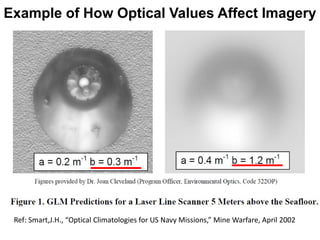
Example of How Optical Values Affect Imagery


 Ref: Smart,J.H., “Optical Climatologies for US Navy Missions,” Mine Warfare, April 2002
Airborne Mine Neutralization System
                (AMNS):

uses “Archerfish” UUV controlled via fiber-
optic link to helo; UUV has sonar & optical
                   sensors
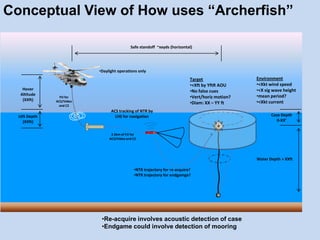
Conceptual View of How uses “Archerfish”

                                           Safe standoff ~xxyds (horizontal)


                          •Daylight operations only
                                                                           Target                Environment
                                                                           •<Xft by YftR AOU     •<Xkt wind speed
   Hover                                                                   •No false cues        •<X sig wave height
  Altitude                                                                                       •mean period?
                FO for                                                     •Vert/horiz motion?
   (XXft)     ACS/Video
                                                                           •Diam: XX – YY ft     •<Xkt current
               and C2
                                ACS tracking of NTR by
  LHS Depth                       LHS for navigation                                                    Case Depth
    (XXft)                                                                                                 0-XX’


                                3.5km of FO for
                               ACS/Video and C2


                                                                                                 Water Depth > XXft

                                             •NTR trajectory for re-acquire?
                                             •NTR trajectory for endgamge?


                           •Re-acquire involves acoustic detection of case
                           •Endgame could involve detection of mooring
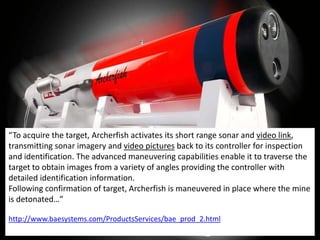
“To acquire the target, Archerfish activates its short range sonar and video link,
transmitting sonar imagery and video pictures back to its controller for inspection
and identification. The advanced maneuvering capabilities enable it to traverse the
target to obtain images from a variety of angles providing the controller with
detailed identification information.
Following confirmation of target, Archerfish is maneuvered in place where the mine
is detonated…”

http://www.baesystems.com/ProductsServices/bae_prod_2.html
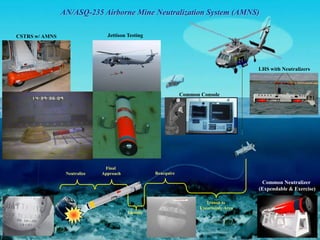
AN/ASQ-235 Airborne Mine Neutralization System (AMNS)

CSTRS w/ AMNS                   Jettison Testing


                                                                                          LHS with Neutralizers


                                                                Common Console


                               Final
                 Neutralize   Approach              Reacquire

                                                                                           Common Neutralizer
                                                                                          (Expendable & Exercise)

                                                                         Transit to
                                                                       Uncertainty Area
                                         Identify
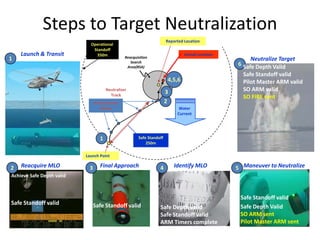
Steps to Target Neutralization
                                                                        Reported Location
                             Operational
                              Standoff
    Launch & Transit           350m                                              Actual Location
1                                                Reacquisition
                                                    Search
                                                                                                        Neutralize Target
                                                  Area(RSA)
                                                                                                   6 Safe Depth Valid
                                                                                                     Safe Standoff valid
                                                                        4,5,6                        Pilot Master ARM valid
                                       Neutralizer
                                                                        3                            SO ARM valid
                                         Track                                                       SO FIRE sent
                                4 Way Points                            2
                                   shown                                      Water
                                                                             Current


                                   1                    Safe Standoff
                                                            250m

                           Launch Point

2   Reacquire MLO           3      Final Approach                  4        Identify MLO           5 Maneuver to Neutralize
Achieve Safe Depth valid


                                                                                                    Safe Standoff valid
Safe Standoff valid             Safe Standoff valid                Safe Depth valid                 Safe Depth Valid
                                                                   Safe Standoff valid              SO ARM sent
                                                                   ARM Timers complete              Pilot Master ARM sent
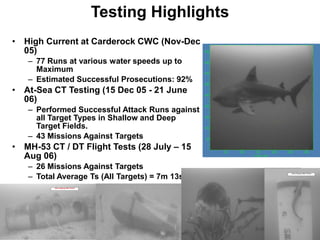
Testing Highlights
• High Current at Carderock CWC (Nov-Dec
  05)
   – 77 Runs at various water speeds up to
     Maximum
   – Estimated Successful Prosecutions: 92%
• At-Sea CT Testing (15 Dec 05 - 21 June
  06)
   – Performed Successful Attack Runs against
     all Target Types in Shallow and Deep
     Target Fields.
   – 43 Missions Against Targets
• MH-53 CT / DT Flight Tests (28 July – 15
  Aug 06)
   – 26 Missions Against Targets
   – Total Average Ts (All Targets) = 7m 13s
Special Operations (SPECOP) Forces

• Possible Concerns:
         -Detection of underwater light sources used by SPECOP forces:
             -Light sticks were developed by the U.S. Navy as an inconspicuous and
             easily shielded illumination tool for special operations forces dropped
             behind enemy lines. Besides their use as children's toys, they are also
             used extensively as a navigation aid by divers searching in muddy
             water. The light sticks glow as a result of the energy released by a
             chemical reaction.
             Ref: http://www.articlesbase.com/education-articles/importance-of-chemiluminescence-and-bioluminescence-
             2075376.html


        - Detection of bioluminescence from SEAL Delivery Vehicle or swimmers
ASW Applications:
Daytime Passive Optical Detection
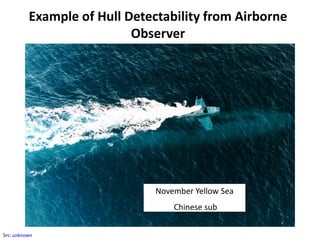
Example of Hull Detectability from Airborne
                           Observer


                               November Yellow Sea
                                   Chinese sub


Src: unknown
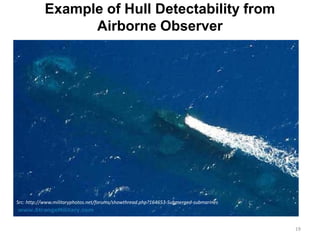
Example of Hull Detectability from
                 Airborne Observer


Src: http://www.militaryphotos.net/forums/showthread.php?164653-Submerged-submarines


                                                                                       19
Passive Optical Hull Detection

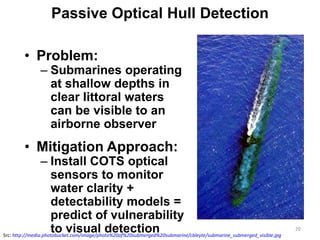
        • Problem:
               – Submarines operating
                 at shallow depths in
                 clear littoral waters
                 can be visible to an
                 airborne observer
        • Mitigation Approach:
                 – Install COTS optical
                     sensors to monitor
                     water clarity +
                     detectability models =
                     predict of vulnerability
                     to visual detection
Src: http://media.photobucket.com/image/photo%20of%20submerged%20submarine/cbleyte/submarine_submerged_visible.jpg
                                                                                                                     20
Passive Optical Hull & Surface Wake
                              Detection
   Visual Detection
         Submarines operating at or near the surface are potentially vulnerable to visual
         detection. Anything that protrudes above the surface, such as a periscope,
         antenna, or mast will leave a significant wake if the submarine is moving at any
         speed over a few knots. And, since depth control and steerage is quite difficult at
         low speeds, it is not uncommon for submarines to be traveling at least 4 or 5
         knots just below the surface.
         The periscope (for example) will create a wake, called "feather", which is quite
         visible, and will also leave a remnant of its passage, called a "scar". The scar is a
         long streak of foam or bubbles left behind after the object passes. The feather
         may be just a few meters, but the scar may be tens of meters long. Either may be
         visible for up to 10 miles, and are easily spotted by low flying aircraft in the
         vicinity.
         Periscopes and other protruding masts and antennas are also often painted in
         dark or camouflage colors to reduce their visibility.
         If the water is especially clear, the submarine hull or its shadow may be visible for
         a few hundred feet under water, but is usually not distinguishable unless the
         water is shallow with a light colored bottom (like white sand).


Src: see notes page

                                                                                             21
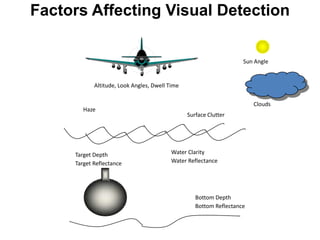
Factors Affecting Visual Detection

                                                                    Sun Angle


            Altitude, Look Angles, Dwell Time

                                                                        Clouds
        Haze
                                                Surface Clutter


     Target Depth                         Water Clarity
     Target Reflectance                   Water Reflectance


                                                   Bottom Depth
                                                   Bottom Reflectance
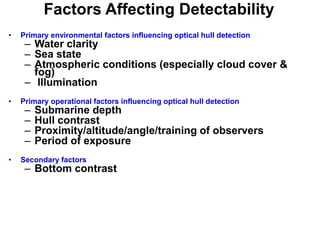
Factors Affecting Detectability
•   Primary environmental factors influencing optical hull detection
     – Water clarity
     – Sea state
     – Atmospheric conditions (especially cloud cover &
       fog)
     – Illumination
•   Primary operational factors influencing optical hull detection
     –   Submarine depth
     –   Hull contrast
     –   Proximity/altitude/angle/training of observers
     –   Period of exposure
•   Secondary factors
     – Bottom contrast
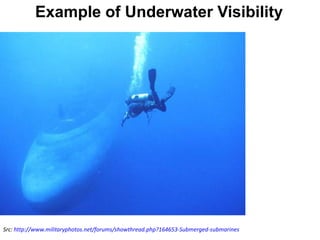
Example of Underwater Visibility


Src: http://www.militaryphotos.net/forums/showthread.php?164653-Submerged-submarines
Diver visibility range & attenuation

                               ln CL                 From Radiative Transfer Theory,
 visibility range ( m ), V = −                       • Priesendorfer (1976)
                                  c                  • Duntley (1963)
 CL     contrast detection limit for human being
 c      optical beam attenuation coefficient (m-1)


           4.8
V=
   [1.18c(650) + 0.081]
              Accuracy better than 10%


      Backscattering is NOT a
       good proxy for visibility


                                                                  Zaneveld and Pegau (2003)
Other Possible ASW Applications:
Nighttime Passive Optical Detection due
          to Bioluminescence
Bioluminescence:
            Why Should the Navy Care?


• Complements acoustics - does not replace it

• Prevalent in the acoustically noisy littorals where
boats must operate shallow

• Many initial submarine detections are by non-
acoustics
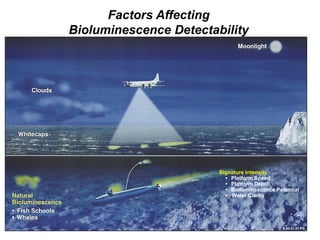
Factors Affecting
Bioluminescence Detectability


                        Signature Intensity
                          • Platform Speed
                          • Platform Depth
                          • Bioluminescence Potential
                          • Water Clarity
Summary of Concept Demo
          on US Submarine
• Photometer successfully collected
  Bioluminescence intensity while a USS
  Submarine was underway
• Could distinguish night/day Bioluminescence in
  signatures, even without validated time stamps
• Could distinguish higher/lower Bioluminescence
  based on depth of Submarine
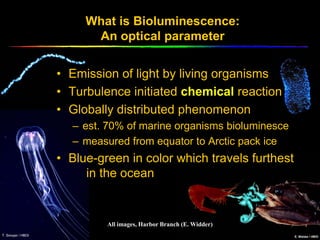
What is Bioluminescence:
      An optical parameter


• Emission of light by living organisms
• Turbulence initiated chemical reaction
• Globally distributed phenomenon
  – est. 70% of marine organisms bioluminesce
  – measured from equator to Arctic pack ice
• Blue-green in color which travels furthest
     in the ocean


         All images, Harbor Branch (E. Widder)
UNCLASSIFIED

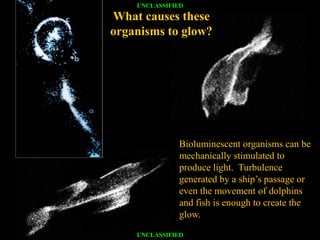
What causes these
organisms to glow?


              Bioluminescent organisms can be
              mechanically stimulated to
              produce light. Turbulence
              generated by a ship’s passage or
              even the movement of dolphins
              and fish is enough to create the
              glow.

    UNCLASSIFIED
UNCLASSIFIED

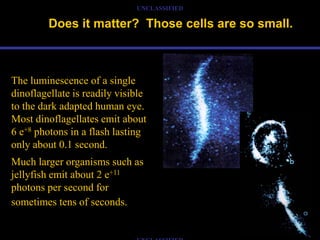
         Does it matter? Those cells are so small.


The luminescence of a single
dinoflagellate is readily visible
to the dark adapted human eye.
Most dinoflagellates emit about
6 e+8 photons in a flash lasting
only about 0.1 second.
Much larger organisms such as
jellyfish emit about 2 e+11
photons per second for
sometimes tens of seconds.
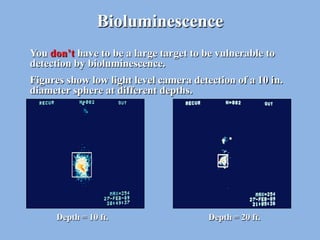
Bioluminescence
You don’t have to be a large target to be vulnerable to
detection by bioluminescence.
Figures show low light level camera detection of a 10 in.
diameter sphere at different depths.


      Depth = 10 ft.                    Depth = 20 ft.
Optical Clarity


• The clarity of the water depends on multiple factors
  and varies depending on depth, location, currents,
  outflow from rivers to name a few factors.
• Objects may be vulnerable due to color and
  configuration. If the target has a high contrast
  against the background it is more likely to be
  spotted.
• In clear, shallow areas where bottom reflectance is
  high (e.g., white sand, light colored coral), vertical
  (downward) detection of relatively dark objects will
  be enhanced due to contrast.
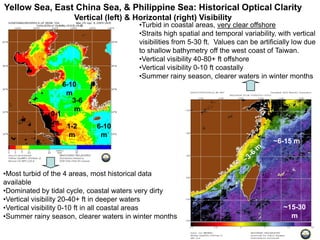
Yellow Sea, East China Sea, & Philippine Sea: Historical Optical Clarity
                       Vertical (left) & Horizontal (right) Visibility
                                          •Turbid in coastal areas, very clear offshore
                                          •Straits high spatial and temporal variability, with vertical
                                          visibilities from 5-30 ft. Values can be artificially low due
                                          to shallow bathymetry off the west coast of Taiwan.
                                          •Vertical visibility 40-80+ ft offshore
                                          •Vertical visibility 0-10 ft coastally
                                          •Summer rainy season, clearer waters in winter months
                    6-10
                     m
                       3-6
                        m
              0-1
               m
                     1-2     6-10
                      m       m
                                                                                        ~6-15 m


•Most turbid of the 4 areas, most historical data
available
•Dominated by tidal cycle, coastal waters very dirty
•Vertical visibility 20-40+ ft in deeper waters
•Vertical visibility 0-10 ft in all coastal areas                                          ~15-30
•Summer rainy season, clearer waters in winter months                                        m
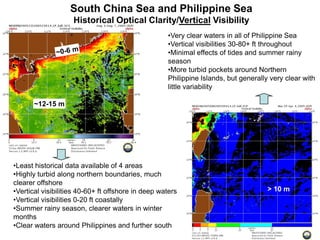
South China Sea and Philippine Sea
                    Historical Optical Clarity/Vertical Visibility
                                                    •Very clear waters in all of Philippine Sea
                                                    •Vertical visibilities 30-80+ ft throughout
                                                    •Minimal effects of tides and summer rainy
                                                    season
                                                    •More turbid pockets around Northern
                                                    Philippine Islands, but generally very clear with
                                                    little variability

       ~12-15 m


•Least historical data available of 4 areas
•Highly turbid along northern boundaries, much
clearer offshore
•Vertical visibilities 40-60+ ft offshore in deep waters                             > 10 m
•Vertical visibilities 0-20 ft coastally
•Summer rainy season, clearer waters in winter
months
•Clear waters around Philippines and further south
Other Possible Applications:
Bathymetry Mapping in Shallow Coastal Waters
Bathymetry from Ocean Color
  •   Knowledge of ocean bathymetry is important for navigation & for
      scientific studies of the ocean's volume, ecology, and circulation, all
      of which are related to Earth's climate.
  •   In coastal regions detailed bathymetric maps are critical for storm
      surge modeling, marine power plant planning, understanding of
      ecosystem connectivity, coastal management, and change analyses.
  •    Because ocean areas are enormously large and ship surveys have
      limited coverage, adequate bathymetric data are still lacking
      throughout the global ocean.
  •   Satellite altimetry can produce reasonable estimates of bathymetry
      for the deep ocean [Sandwell et al., 2003, 2006], but the spatial
      resolution is very coarse (∼6–9 kilometers) and can be highly
      inaccurate in shallow waters, where gravitational effects are small.
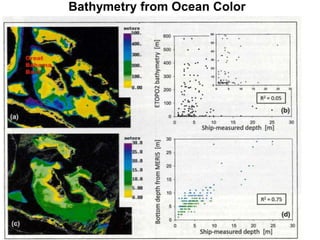
  •   Depths retrieved from the ETOPO2 bathymetry database for the Great
      Bahama Bank are seriously in error when compared with ship
      surveys & no statistical correlation was found between the two
  •   Determining a higher-spatial-resolution (e.g., 300-meter) bathymetry
      of this region with ship surveys would require ~ 4 years of nonstop
      effort.


Ref: Lee, Z., et.al., "Global Shallow-Water Bathymetry From Satellite Ocean Color Data,” EOS, Transactions American
Geophysical Union, VOL. 91, NO. 46, P. 429, 2010, doi:10.1029/2010EO460002
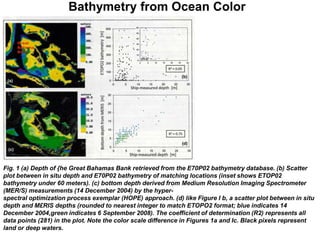
Bathymetry from Ocean Color


Fig. 1 (a) Depth of {he Great Bahamas Bank retrieved from the E70P02 bathymetry database. (b) Scatter
plot between in situ depth and E70P02 bathymetry of matching locations (inset shows ETOP02
bathymetry under 60 meters). (c) bottom depth derived from Medium Resolution Imaging Spectrometer
(MER/S) measurements (14 December 2004) by the hyper-
spectral optimization process exemplar (HOPE) approach. (d) like Figure I b, a scatter plot between in situ
depth and M£RIS depths (rounded to nearest integer to match ETOPO2 format; blue indicates 14
December 2004,green indicates 6 September 2008). The coefficient of determination (R2) represents all
data points (281) in the plot. Note the color scale difference in Figures 1a and Ic. Black pixels represent
land or deep waters.
Bathymetry from Ocean Color
To learn more please attend this ATI course


    Please post your comments and questions to our blog:
        http://www.aticourses.com/blog/

     Sign-up for ATI's monthly Course Schedule Updates :
http://www.aticourses.com/email_signup_page.html

Ocean Optics: Fundamentals & Naval Applications Technical Training Short Course Sampler

  • 1.
    Ocean Optics: Fundamentals& Naval Applications Instructor: Jeffrey H. Smart ATI Course Schedule: http://www.ATIcourses.com/schedule.htm ATI's Ocean Optics: http://www.aticourses.com/Ocean_Optics_Fundamentals_Naval_Applications.htm
  • 2.
    www.ATIcourses.com Boost Your Skills 349 Berkshire Drive Riva, Maryland 21140 with On-Site Courses Telephone 1-888-501-2100 / (410) 965-8805 Tailored to Your Needs Fax (410) 956-5785 Email: ATI@ATIcourses.com The Applied Technology Institute specializes in training programs for technical professionals. Our courses keep you current in the state-of-the-art technology that is essential to keep your company on the cutting edge in today’s highly competitive marketplace. Since 1984, ATI has earned the trust of training departments nationwide, and has presented on-site training at the major Navy, Air Force and NASA centers, and for a large number of contractors. Our training increases effectiveness and productivity. Learn from the proven best. For a Free On-Site Quote Visit Us At: http://www.ATIcourses.com/free_onsite_quote.asp For Our Current Public Course Schedule Go To: http://www.ATIcourses.com/schedule.htm
  • 3.
    My Background inOcean Optics (some dates are approximate) 1988-1996: Environmental Specialist for Active Optics Project • Acquire and learn how to use multi-spectral radiance/irradiance sensor system, optical backscatter sensors, and beam transmissometers • Develop software to provide analysis products such as optical attenuation profiles vs. wavelength • Test experimental systems to “measure” nighttime “K” • Participated in 5 major sea tests plus numerous smaller sea tests • Write environmental summary reports on temporal & spatial variability 1992-1994: Environmental Specialist for MIW Program • Deploy multi-spectral radiance /irradiance sensor system, optical backscatter sensors, and beam transmissometers in shallow coastal sites off Panama City & off Ocean City, Md • Write environmental summary reports on short-term temporal variability (< 1 week) at fixed sites
  • 4.
    My Background inOcean Optics (some dates are approximate) 1994 to 1997: Project Manager & PI for bio-optical monitoring system • Analyze & document results for sensors • Analyzed data from associated platforms 1996-2010: Environmental Specialist for active optics program 1995 to present: Proj Mgr/PI for ONR World-wide Ocean Optics Database (WOOD) 2001-2003: Littoral Warfare Advanced Development (LWAD) • Project Scientist in the Yellow Sea supporting hyper-spectral optics system • Environmental expert for several sea tests, including exercise in East China Sea
  • 5.
    Various Naval Applicationsof Ocean Optics • Mine Warfare: - Sonar systems are typically used to find Mine-like Objects - Electro-Optical Identification (EOID) sensors are used to classify those objects - Examples of EOID systems*: - Areté Associates Streak Tube Imaging LIDAR (STIL) system - Northrop Grumman Laser Line Scan (LLS) system - Raytheon LLS system • Special Operations Forces – Detectability of SEAL Delivery Vehicles – Detectability of submerged divers • Underwater Communications – Optical properties of water directly impacts range & quality of transmission • Port Security & Anti-Submarine Warfare (ASW) – Passive Detectability – Active (e.g. Laser) Detectability • Other Possible Application: Bathymetry Mapping * Ref: “Electro-optic Identification Research Program,” James S. Taylor, Jr. and Mary C. Hulgan, Fifth International Symposium on Technology and Mine Problem, 22-25 Apr 2002, Monterey, CA
  • 6.
    Airborne Mine Countermeasures(AMCM) • The MH-60S, fitted with Airborne Mine Countermeasures (AMCM) made its first flight in July 2003. • Lockheed Martin Systems Integration… is integrator for the MH-60S mine countermeasures systems which includes: – Raytheon Airborne Mine Neutralization System (AMNS) with BAE Systems Archerfish expendable underwater vehicle that destroys the mines; – Northrop Grumman Rapid Airborne Mine Clearance System (RAMICS), a non-towed mine neutralization system that will clear near-surface and surface-moored mines using a Kaman Aerospace laser target sensor and a 30mm mk44 gun; – Raytheon AN/AQS-20A towed sonar with mine identification system which entered production in September 2005; – Northrop Grumman airborne laser mine detection system, AN/AES-1 ALMDS, • AN/AES-1 ALMDS detects and classifies floating and near-surface moored mines, using pulsed laser light. The ALMDS pod is mechanically attached to the MH-60S with a standard Bomb Rack Unit 14 (BRU-14) mount. Ref: http://www.naval-technology.com/projects/mh_60s/
  • 7.
    Airborne Laser MineDetection System (ALMDS) Operations Desert Storm and Desert Shield demonstrated the need for minehunting systems as an integral element of deployed forces. …Navy began developing …five airborne mine countermeasure systems to negate the identified threat. One of the systems, the Airborne Laser Mine Detection System (ALMDS), is a mine countermeasure that is intended to detect, classify, and localize floating and near-surface moored sea mines. The Navy will deploy the ALMDS on MH-60S helicopters to provide organic airborne mine defense for Carrier Battle Groups (Carrier Groups), and Amphibious Ready Groups (Amphibious Groups).…Areté Associates is contracted with Northrop Grumman to provide the STIL* sensor for the ALMDS system. The STIL sensor detects sea surface and near sea surface volume mines that the AN/AQS-20X system is not designed to detect. * STIL = StreakTube Imaging Lidar
  • 8.
    Airborne Mine NeutralizationSystem (AMNS) • Raytheon is receiving $14.7M for seven more AMNS systems • Ref: info by Jeff Steelman via email from George Pollitt, 9-23-10 …. The airborne mine neutralization system will explosively neutralize bottom and moored mines using an expendable mine neutralize device. The system will be deployed from the MH-60 helicopter as part of the littoral combat ship mine countermeasures mission module.
  • 9.
    EOID Sensor Systems TheEOID laser line scan technology uses a diode-pumped Nd: YAG laser that provides 500 mW of power for the Raytheon system and 160 mW for the Northrop Grumman system, both operating at 532 nm wavelength. The Raytheon system was a research and development sensor maintained and operated by CSS while the Northrop Grumman system was sized to fit into the AN/AQS-14A(V1) towed body. The laser illuminates a small spot, which is synchronously scanned by a photomultiplier receiver to build up a raster-scanned image. The laser scans downward through a 70-degree field-of-view (FOV). Figure 1 represents the EOID scanning scheme for target identification. Variability in c 532 nm Best  Middle Worst 0 /m 1.0 /m
  • 10.
    Example of HowOptical Values Affect Imagery Ref: Smart,J.H., “Optical Climatologies for US Navy Missions,” Mine Warfare, April 2002
  • 11.
    Airborne Mine NeutralizationSystem (AMNS): uses “Archerfish” UUV controlled via fiber- optic link to helo; UUV has sonar & optical sensors
  • 12.
    Conceptual View ofHow uses “Archerfish” Safe standoff ~xxyds (horizontal) •Daylight operations only Target Environment •<Xft by YftR AOU •<Xkt wind speed Hover •No false cues •<X sig wave height Altitude •mean period? FO for •Vert/horiz motion? (XXft) ACS/Video •Diam: XX – YY ft •<Xkt current and C2 ACS tracking of NTR by LHS Depth LHS for navigation Case Depth (XXft) 0-XX’ 3.5km of FO for ACS/Video and C2 Water Depth > XXft •NTR trajectory for re-acquire? •NTR trajectory for endgamge? •Re-acquire involves acoustic detection of case •Endgame could involve detection of mooring
  • 13.
    “To acquire thetarget, Archerfish activates its short range sonar and video link, transmitting sonar imagery and video pictures back to its controller for inspection and identification. The advanced maneuvering capabilities enable it to traverse the target to obtain images from a variety of angles providing the controller with detailed identification information. Following confirmation of target, Archerfish is maneuvered in place where the mine is detonated…” http://www.baesystems.com/ProductsServices/bae_prod_2.html
  • 14.
    AN/ASQ-235 Airborne MineNeutralization System (AMNS) CSTRS w/ AMNS Jettison Testing LHS with Neutralizers Common Console Final Neutralize Approach Reacquire Common Neutralizer (Expendable & Exercise) Transit to Uncertainty Area Identify
  • 15.
    Steps to TargetNeutralization Reported Location Operational Standoff Launch & Transit 350m Actual Location 1 Reacquisition Search Neutralize Target Area(RSA) 6 Safe Depth Valid Safe Standoff valid 4,5,6 Pilot Master ARM valid Neutralizer 3 SO ARM valid Track SO FIRE sent 4 Way Points 2 shown Water Current 1 Safe Standoff 250m Launch Point 2 Reacquire MLO 3 Final Approach 4 Identify MLO 5 Maneuver to Neutralize Achieve Safe Depth valid Safe Standoff valid Safe Standoff valid Safe Standoff valid Safe Depth valid Safe Depth Valid Safe Standoff valid SO ARM sent ARM Timers complete Pilot Master ARM sent
  • 16.
    Testing Highlights • HighCurrent at Carderock CWC (Nov-Dec 05) – 77 Runs at various water speeds up to Maximum – Estimated Successful Prosecutions: 92% • At-Sea CT Testing (15 Dec 05 - 21 June 06) – Performed Successful Attack Runs against all Target Types in Shallow and Deep Target Fields. – 43 Missions Against Targets • MH-53 CT / DT Flight Tests (28 July – 15 Aug 06) – 26 Missions Against Targets – Total Average Ts (All Targets) = 7m 13s
  • 17.
    Special Operations (SPECOP)Forces • Possible Concerns: -Detection of underwater light sources used by SPECOP forces: -Light sticks were developed by the U.S. Navy as an inconspicuous and easily shielded illumination tool for special operations forces dropped behind enemy lines. Besides their use as children's toys, they are also used extensively as a navigation aid by divers searching in muddy water. The light sticks glow as a result of the energy released by a chemical reaction. Ref: http://www.articlesbase.com/education-articles/importance-of-chemiluminescence-and-bioluminescence- 2075376.html - Detection of bioluminescence from SEAL Delivery Vehicle or swimmers
  • 18.
  • 19.
    Example of HullDetectability from Airborne Observer November Yellow Sea Chinese sub Src: unknown
  • 20.
    Example of HullDetectability from Airborne Observer Src: http://www.militaryphotos.net/forums/showthread.php?164653-Submerged-submarines 19
  • 21.
    Passive Optical HullDetection • Problem: – Submarines operating at shallow depths in clear littoral waters can be visible to an airborne observer • Mitigation Approach: – Install COTS optical sensors to monitor water clarity + detectability models = predict of vulnerability to visual detection Src: http://media.photobucket.com/image/photo%20of%20submerged%20submarine/cbleyte/submarine_submerged_visible.jpg 20
  • 22.
    Passive Optical Hull& Surface Wake Detection Visual Detection Submarines operating at or near the surface are potentially vulnerable to visual detection. Anything that protrudes above the surface, such as a periscope, antenna, or mast will leave a significant wake if the submarine is moving at any speed over a few knots. And, since depth control and steerage is quite difficult at low speeds, it is not uncommon for submarines to be traveling at least 4 or 5 knots just below the surface. The periscope (for example) will create a wake, called "feather", which is quite visible, and will also leave a remnant of its passage, called a "scar". The scar is a long streak of foam or bubbles left behind after the object passes. The feather may be just a few meters, but the scar may be tens of meters long. Either may be visible for up to 10 miles, and are easily spotted by low flying aircraft in the vicinity. Periscopes and other protruding masts and antennas are also often painted in dark or camouflage colors to reduce their visibility. If the water is especially clear, the submarine hull or its shadow may be visible for a few hundred feet under water, but is usually not distinguishable unless the water is shallow with a light colored bottom (like white sand). Src: see notes page 21
  • 23.
    Factors Affecting VisualDetection Sun Angle Altitude, Look Angles, Dwell Time Clouds Haze Surface Clutter Target Depth Water Clarity Target Reflectance Water Reflectance Bottom Depth Bottom Reflectance
  • 24.
    Factors Affecting Detectability • Primary environmental factors influencing optical hull detection – Water clarity – Sea state – Atmospheric conditions (especially cloud cover & fog) – Illumination • Primary operational factors influencing optical hull detection – Submarine depth – Hull contrast – Proximity/altitude/angle/training of observers – Period of exposure • Secondary factors – Bottom contrast
  • 25.
    Example of UnderwaterVisibility Src: http://www.militaryphotos.net/forums/showthread.php?164653-Submerged-submarines
  • 26.
    Diver visibility range& attenuation ln CL From Radiative Transfer Theory, visibility range ( m ), V = − • Priesendorfer (1976) c • Duntley (1963) CL contrast detection limit for human being c optical beam attenuation coefficient (m-1) 4.8 V= [1.18c(650) + 0.081] Accuracy better than 10% Backscattering is NOT a good proxy for visibility Zaneveld and Pegau (2003)
  • 27.
    Other Possible ASWApplications: Nighttime Passive Optical Detection due to Bioluminescence
  • 28.
    Bioluminescence: Why Should the Navy Care? • Complements acoustics - does not replace it • Prevalent in the acoustically noisy littorals where boats must operate shallow • Many initial submarine detections are by non- acoustics
  • 29.
    Factors Affecting Bioluminescence Detectability Signature Intensity • Platform Speed • Platform Depth • Bioluminescence Potential • Water Clarity
  • 30.
    Summary of ConceptDemo on US Submarine • Photometer successfully collected Bioluminescence intensity while a USS Submarine was underway • Could distinguish night/day Bioluminescence in signatures, even without validated time stamps • Could distinguish higher/lower Bioluminescence based on depth of Submarine
  • 31.
    What is Bioluminescence: An optical parameter • Emission of light by living organisms • Turbulence initiated chemical reaction • Globally distributed phenomenon – est. 70% of marine organisms bioluminesce – measured from equator to Arctic pack ice • Blue-green in color which travels furthest in the ocean All images, Harbor Branch (E. Widder)
  • 32.
    UNCLASSIFIED What causes these organismsto glow? Bioluminescent organisms can be mechanically stimulated to produce light. Turbulence generated by a ship’s passage or even the movement of dolphins and fish is enough to create the glow. UNCLASSIFIED
  • 33.
    UNCLASSIFIED Does it matter? Those cells are so small. The luminescence of a single dinoflagellate is readily visible to the dark adapted human eye. Most dinoflagellates emit about 6 e+8 photons in a flash lasting only about 0.1 second. Much larger organisms such as jellyfish emit about 2 e+11 photons per second for sometimes tens of seconds.
  • 34.
    Bioluminescence You don’t haveto be a large target to be vulnerable to detection by bioluminescence. Figures show low light level camera detection of a 10 in. diameter sphere at different depths. Depth = 10 ft. Depth = 20 ft.
  • 35.
    Optical Clarity • Theclarity of the water depends on multiple factors and varies depending on depth, location, currents, outflow from rivers to name a few factors. • Objects may be vulnerable due to color and configuration. If the target has a high contrast against the background it is more likely to be spotted. • In clear, shallow areas where bottom reflectance is high (e.g., white sand, light colored coral), vertical (downward) detection of relatively dark objects will be enhanced due to contrast.
  • 36.
    Yellow Sea, EastChina Sea, & Philippine Sea: Historical Optical Clarity Vertical (left) & Horizontal (right) Visibility •Turbid in coastal areas, very clear offshore •Straits high spatial and temporal variability, with vertical visibilities from 5-30 ft. Values can be artificially low due to shallow bathymetry off the west coast of Taiwan. •Vertical visibility 40-80+ ft offshore •Vertical visibility 0-10 ft coastally •Summer rainy season, clearer waters in winter months 6-10 m 3-6 m 0-1 m 1-2 6-10 m m ~6-15 m •Most turbid of the 4 areas, most historical data available •Dominated by tidal cycle, coastal waters very dirty •Vertical visibility 20-40+ ft in deeper waters •Vertical visibility 0-10 ft in all coastal areas ~15-30 •Summer rainy season, clearer waters in winter months m
  • 37.
    South China Seaand Philippine Sea Historical Optical Clarity/Vertical Visibility •Very clear waters in all of Philippine Sea •Vertical visibilities 30-80+ ft throughout •Minimal effects of tides and summer rainy season •More turbid pockets around Northern Philippine Islands, but generally very clear with little variability ~12-15 m •Least historical data available of 4 areas •Highly turbid along northern boundaries, much clearer offshore •Vertical visibilities 40-60+ ft offshore in deep waters > 10 m •Vertical visibilities 0-20 ft coastally •Summer rainy season, clearer waters in winter months •Clear waters around Philippines and further south
  • 38.
    Other Possible Applications: BathymetryMapping in Shallow Coastal Waters
  • 39.
    Bathymetry from OceanColor • Knowledge of ocean bathymetry is important for navigation & for scientific studies of the ocean's volume, ecology, and circulation, all of which are related to Earth's climate. • In coastal regions detailed bathymetric maps are critical for storm surge modeling, marine power plant planning, understanding of ecosystem connectivity, coastal management, and change analyses. • Because ocean areas are enormously large and ship surveys have limited coverage, adequate bathymetric data are still lacking throughout the global ocean. • Satellite altimetry can produce reasonable estimates of bathymetry for the deep ocean [Sandwell et al., 2003, 2006], but the spatial resolution is very coarse (∼6–9 kilometers) and can be highly inaccurate in shallow waters, where gravitational effects are small. • Depths retrieved from the ETOPO2 bathymetry database for the Great Bahama Bank are seriously in error when compared with ship surveys & no statistical correlation was found between the two • Determining a higher-spatial-resolution (e.g., 300-meter) bathymetry of this region with ship surveys would require ~ 4 years of nonstop effort. Ref: Lee, Z., et.al., "Global Shallow-Water Bathymetry From Satellite Ocean Color Data,” EOS, Transactions American Geophysical Union, VOL. 91, NO. 46, P. 429, 2010, doi:10.1029/2010EO460002
  • 40.
    Bathymetry from OceanColor Fig. 1 (a) Depth of {he Great Bahamas Bank retrieved from the E70P02 bathymetry database. (b) Scatter plot between in situ depth and E70P02 bathymetry of matching locations (inset shows ETOP02 bathymetry under 60 meters). (c) bottom depth derived from Medium Resolution Imaging Spectrometer (MER/S) measurements (14 December 2004) by the hyper- spectral optimization process exemplar (HOPE) approach. (d) like Figure I b, a scatter plot between in situ depth and M£RIS depths (rounded to nearest integer to match ETOPO2 format; blue indicates 14 December 2004,green indicates 6 September 2008). The coefficient of determination (R2) represents all data points (281) in the plot. Note the color scale difference in Figures 1a and Ic. Black pixels represent land or deep waters.
  • 41.
  • 42.
    To learn moreplease attend this ATI course Please post your comments and questions to our blog: http://www.aticourses.com/blog/ Sign-up for ATI's monthly Course Schedule Updates : http://www.aticourses.com/email_signup_page.html