“In Pursuit Of Global Competitiveness”
Government College Of Engineering,
           Aurangabad.

  REMOTE SENSING &
   IT’S APPLICATION

 Created By-
             Nikhil Pakwanne


                                    1
 Remote   Sensing is:

  “Theart and science of obtaining information
  about an object without being in direct
  contact with the object”.

  There   is a medium of transmission involved.
 All
    remote sensing systems have four
 types of resolution:-
Spatial Resolution -- what size we can resolve.
Spectral Resolution -- what wavelengths do we
  use.
Radiometric Resolution -- degree of detail
  observed.
Temporal Resolution -- how often do we
  observe.
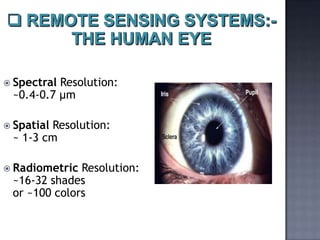
 SpectralResolution:
 ~0.4-0.7 µm

 Spatial
        Resolution:
 ~ 1-3 cm

 Radiometric Resolution:
 ~16-32 shades
 or ~100 colors
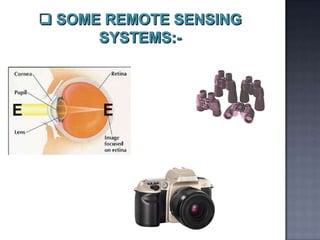
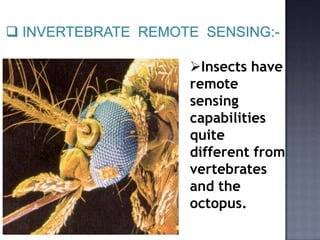
Insects have
remote
sensing
capabilities
quite
different from
vertebrates
and the
octopus.
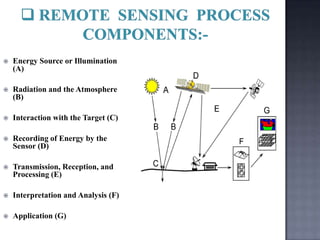
   Energy Source or Illumination
    (A)

   Radiation and the Atmosphere
    (B)

   Interaction with the Target (C)

   Recording of Energy by the
    Sensor (D)

   Transmission, Reception, and
    Processing (E)

   Interpretation and Analysis (F)

   Application (G)
 Remote Sensing is unique in that it
 can be used to collect data, unlike
 other techniques, such as thematic
 cartography, geographic information
 systems, or statistics that must rely
 on data that are already available.
 The principal advantages of remote
 sensing are the speed at which data
 can be acquired from large areas of
 the earth’s surface, and the related
 fact that comparatively inaccessible
 areas may be investigated in this
 way.
   Based on Range of Electromagnetic
  Spectrum:-
1. Optical Remote Sensing.
2. Thermal Remote Sensing.

3.   Microwave Remote Sensing.

    Based on the source of the energy:-
1.   Active remote sensing.
2.   Passive remote sensing.
   Optical Remote Sensing:-
    The optical remote sensing devices operate
    in the visible, near infrared, middle
    infrared and short wave infrared portion of
    the electromagnetic spectrum.

   These devices are sensitive to the
    wavelengths ranging from 300 nm to
    3000 nm.
 Thesensors, which operate in
 thermal range of electromagnetic
 spectrum record, the energy
 emitted from the earth features in
 the wavelength range of 3000 nm to
 5000 nm and 8000 nm to 14000 nm.
A microwave remote sensor records
 the backscattered microwaves in the
 wavelength range of 1 mm to 1 m of
 electromagnetic spectrum.

 Mostof the microwave sensors are
 active sensors, having there own
 sources of energy.
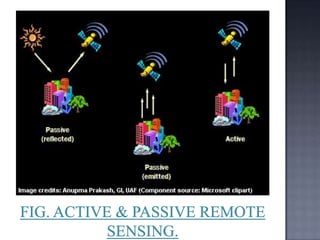
   Active remote sensing:-
 Active   remote sensing uses an artificial
  source for energy.
 For example the satellite itself can send a
  pulse of energy which can interact with the
  target.
 In active remote sensing, humans can control
  the nature (wavelength, power, duration) of
  the source energy. Active remote sensing can
  be carried out during day and night and in all
  weather conditions.
 Passive remote sensing depends on a
 natural source to provide energy.

 Thesun is the most powerful and
 commonly used source of energy for
 passive remote sensing.

 Thesatellite sensor in this case records
 primarily the radiation that is reflected
 from the target.
   LANDSAT:-

 Landsat   satellite sensors are one of the
    most popular remote sensing systems, the
    imagery acquired from these are widely
    used across the globe.

 NASA’s    Landsat satellite programme was
    started in 1972. It was formerly known as
    ERTS (Earth Resource Technology
    Satellite) programme.
    SPOT (System Pour Observation
    Terre) was developed by the French
    National Centre.

    The first satellite of SPOT
    mission, SPOT-1 was launched in
    1986. It was followed by SPOT-2 (in
    1990), SPOT-3 (in 1993), SPOT-4 (in
    1998) and SPOT-5 (in 2002).
    The Indian Remote Sensing
    programme began with the
    launch of IRS-1A in 1988.

    After that IRS-1B (1999), IRS-1C
    (1995) and IRS-1D (1997) was
    launched.
 Provides a regional view (large areas).
 Provides repetitive looks at the same
  area.
 Remote sensors "see" over a broader.
  portion of the spectrum than the human
  eye.
 Provides geo-referenced, digital, data.
 Some remote sensors operate in all
  seasons, at night, and in bad weather.
• Expensive to build and
operate!

 • Measurement uncertainty can
be large.

 • Data interpretation can be
difficult.
   Agriculture:-

   Crop type classification.
   Crop condition assessment.
   Crop yield estimation.
   Mapping of soil characteristic.
   Soil moisture estimation.
   Geology:-

 Lithological mapping.
 Mineral exploration.
 Environmental geology.
 Sedimentation mapping
 and monitoring.
 Geo-hazard mapping.
 Glacier mapping.
   Urban Planning:-

   Land parcel mapping.
   Infrastructure mapping.
   Land use change detection.
   Future urban expansion planning.
   Hydrology:-
 Watershed mapping and
 management.
 Flood delineation and mapping.
 Ground water targeting.


   Land Use/Land Cover
    mapping:-
   Natural resource management.
   Wildlife protection.
   Encroachment.
   Forestry And Ecosystem:-

   Forest cover and density mapping.
   Deforestation mapping.
   Forest fire mapping.
   Wetland mapping and monitoring.
   Biomass estimation.
   Species inventory.
   Ocean applications:-

 Storm  forecasting.
 Water quality monitoring.
 Aquaculture inventory and
  monitoring.
 Navigation routing.
 Coastal vegetation mapping.
 Oil spill.
http://en.wikipedia.org


www.microimages.com
Appreciate
      your time and attention!

Remote sensing and application by Nikhil Pakwanne

  • 1.
    “In Pursuit OfGlobal Competitiveness” Government College Of Engineering, Aurangabad. REMOTE SENSING & IT’S APPLICATION  Created By- Nikhil Pakwanne 1
  • 2.
     Remote Sensing is:  “Theart and science of obtaining information about an object without being in direct contact with the object”.  There is a medium of transmission involved.
  • 4.
     All remote sensing systems have four types of resolution:- Spatial Resolution -- what size we can resolve. Spectral Resolution -- what wavelengths do we use. Radiometric Resolution -- degree of detail observed. Temporal Resolution -- how often do we observe.
  • 5.
     SpectralResolution: ~0.4-0.7µm  Spatial Resolution: ~ 1-3 cm  Radiometric Resolution: ~16-32 shades or ~100 colors
  • 6.
  • 7.
    Energy Source or Illumination (A)  Radiation and the Atmosphere (B)  Interaction with the Target (C)  Recording of Energy by the Sensor (D)  Transmission, Reception, and Processing (E)  Interpretation and Analysis (F)  Application (G)
  • 8.
     Remote Sensingis unique in that it can be used to collect data, unlike other techniques, such as thematic cartography, geographic information systems, or statistics that must rely on data that are already available.
  • 9.
     The principaladvantages of remote sensing are the speed at which data can be acquired from large areas of the earth’s surface, and the related fact that comparatively inaccessible areas may be investigated in this way.
  • 10.
    Based on Range of Electromagnetic Spectrum:- 1. Optical Remote Sensing. 2. Thermal Remote Sensing. 3. Microwave Remote Sensing.  Based on the source of the energy:- 1. Active remote sensing. 2. Passive remote sensing.
  • 11.
    Optical Remote Sensing:-  The optical remote sensing devices operate in the visible, near infrared, middle infrared and short wave infrared portion of the electromagnetic spectrum.  These devices are sensitive to the wavelengths ranging from 300 nm to 3000 nm.
  • 12.
     Thesensors, whichoperate in thermal range of electromagnetic spectrum record, the energy emitted from the earth features in the wavelength range of 3000 nm to 5000 nm and 8000 nm to 14000 nm.
  • 13.
    A microwave remotesensor records the backscattered microwaves in the wavelength range of 1 mm to 1 m of electromagnetic spectrum.  Mostof the microwave sensors are active sensors, having there own sources of energy.
  • 14.
    Active remote sensing:-  Active remote sensing uses an artificial source for energy.  For example the satellite itself can send a pulse of energy which can interact with the target.  In active remote sensing, humans can control the nature (wavelength, power, duration) of the source energy. Active remote sensing can be carried out during day and night and in all weather conditions.
  • 15.
     Passive remotesensing depends on a natural source to provide energy.  Thesun is the most powerful and commonly used source of energy for passive remote sensing.  Thesatellite sensor in this case records primarily the radiation that is reflected from the target.
  • 17.
    LANDSAT:-  Landsat satellite sensors are one of the most popular remote sensing systems, the imagery acquired from these are widely used across the globe.  NASA’s Landsat satellite programme was started in 1972. It was formerly known as ERTS (Earth Resource Technology Satellite) programme.
  • 18.
    SPOT (System Pour Observation Terre) was developed by the French National Centre.  The first satellite of SPOT mission, SPOT-1 was launched in 1986. It was followed by SPOT-2 (in 1990), SPOT-3 (in 1993), SPOT-4 (in 1998) and SPOT-5 (in 2002).
  • 19.
    The Indian Remote Sensing programme began with the launch of IRS-1A in 1988.  After that IRS-1B (1999), IRS-1C (1995) and IRS-1D (1997) was launched.
  • 20.
     Provides aregional view (large areas).  Provides repetitive looks at the same area.  Remote sensors "see" over a broader. portion of the spectrum than the human eye.  Provides geo-referenced, digital, data.  Some remote sensors operate in all seasons, at night, and in bad weather.
  • 21.
    • Expensive tobuild and operate! • Measurement uncertainty can be large. • Data interpretation can be difficult.
  • 22.
    Agriculture:-  Crop type classification.  Crop condition assessment.  Crop yield estimation.  Mapping of soil characteristic.  Soil moisture estimation.
  • 23.
    Geology:-  Lithological mapping.  Mineral exploration.  Environmental geology.  Sedimentation mapping and monitoring.  Geo-hazard mapping.  Glacier mapping.
  • 24.
    Urban Planning:-  Land parcel mapping.  Infrastructure mapping.  Land use change detection.  Future urban expansion planning.
  • 25.
    Hydrology:-  Watershed mapping and management.  Flood delineation and mapping.  Ground water targeting.  Land Use/Land Cover mapping:-  Natural resource management.  Wildlife protection.  Encroachment.
  • 26.
    Forestry And Ecosystem:-  Forest cover and density mapping.  Deforestation mapping.  Forest fire mapping.  Wetland mapping and monitoring.  Biomass estimation.  Species inventory.
  • 27.
    Ocean applications:-  Storm forecasting.  Water quality monitoring.  Aquaculture inventory and monitoring.  Navigation routing.  Coastal vegetation mapping.  Oil spill.
  • 28.
  • 29.
    Appreciate your time and attention!