LANDSAT 1, 2, 3, 4, 5, 6, 7 Satellites and Their Specification
                    The Landsat celebrating Successful 40 Years.
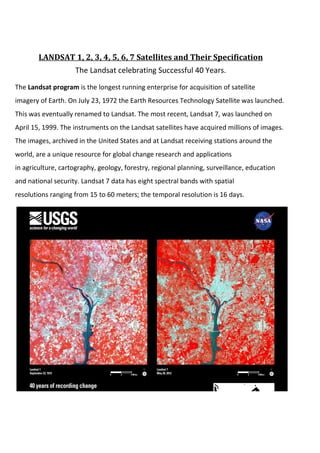
The Landsat program is the longest running enterprise for acquisition of satellite
imagery of Earth. On July 23, 1972 the Earth Resources Technology Satellite was launched.
This was eventually renamed to Landsat. The most recent, Landsat 7, was launched on
April 15, 1999. The instruments on the Landsat satellites have acquired millions of images.
The images, archived in the United States and at Landsat receiving stations around the
world, are a unique resource for global change research and applications
in agriculture, cartography, geology, forestry, regional planning, surveillance, education
and national security. Landsat 7 data has eight spectral bands with spatial
resolutions ranging from 15 to 60 meters; the temporal resolution is 16 days.
General Features
                 LANDSAT 1       LANDSAT 2       LANDSAT 3         LANDSAT 4            LANDSAT 5        LANDSAT 6         LANDSAT 7
Launch Date     July 23, 1972    January 22,      March 5,        July 16 , 1982       March 1, 1984     October 5,       April 15, 1999
                                    1975             1978                                                    1993
   Status         Expired,        Expired,      Expired,      Decommissioned,        TM still               lost at   Operational despite
                 January 6,      February 5,    March 31,     June 15, 2001          operational! MSS      launch     Scan Line Corrector
                    1978            1982        1983                                 instrument                       (SLC) failure May 31,
                                                                                     decommissioned                   2003


   Sensors       RBV, MSS         RBV, MSS       RBV, MSS            TM, MSS              TM, MSS          ETM               ETM+
  Altitude         900 km           900 km         900 km             705 km               705 km                            705 km
 Inclination        99.2°            99.2°          99.2°              98.2°                98.2°                             98.2°
    Orbit        polar, sun-      polar, sun-    polar, sun-        polar, sun-          polar, sun-                       polar, sun-
                synchronous      synchronous    synchronous        synchronous          synchronous                       synchronous
  Equatorial     nominally      9:42 AM mean      9:42 AM      nominally 9:45 AM     9:45 AM (± 15                     10 AM (± 15 min.)
Crossing Time     9:42 AM       local time       mean local      (± 15 min.) local   min.) local time                      local time
                 mean local     (descending         time        time (descending     (descending                       (descending node)
                    time        node)           (descending            node)         node)
                (descending                         node)
                    node)
  Period of     103 minutes;     103 minutes;   103 minutes;   99 minutes; ~14.5     99 minutes; ~14.5                  99 minutes; ~14.5
 Revolution          ~14             ~14            ~14        orbits/day               orbits/day                         orbits/day
                 orbits/day       orbits/day     orbits/day

   Repeat         18 days          18 days        18 days           16 days               16 days                            16 days
  Coverage

LANDSAT

  • 1.
    LANDSAT 1, 2,3, 4, 5, 6, 7 Satellites and Their Specification The Landsat celebrating Successful 40 Years. The Landsat program is the longest running enterprise for acquisition of satellite imagery of Earth. On July 23, 1972 the Earth Resources Technology Satellite was launched. This was eventually renamed to Landsat. The most recent, Landsat 7, was launched on April 15, 1999. The instruments on the Landsat satellites have acquired millions of images. The images, archived in the United States and at Landsat receiving stations around the world, are a unique resource for global change research and applications in agriculture, cartography, geology, forestry, regional planning, surveillance, education and national security. Landsat 7 data has eight spectral bands with spatial resolutions ranging from 15 to 60 meters; the temporal resolution is 16 days.
  • 2.
    General Features LANDSAT 1 LANDSAT 2 LANDSAT 3 LANDSAT 4 LANDSAT 5 LANDSAT 6 LANDSAT 7 Launch Date July 23, 1972 January 22, March 5, July 16 , 1982 March 1, 1984 October 5, April 15, 1999 1975 1978 1993 Status Expired, Expired, Expired, Decommissioned, TM still lost at Operational despite January 6, February 5, March 31, June 15, 2001 operational! MSS launch Scan Line Corrector 1978 1982 1983 instrument (SLC) failure May 31, decommissioned 2003 Sensors RBV, MSS RBV, MSS RBV, MSS TM, MSS TM, MSS ETM ETM+ Altitude 900 km 900 km 900 km 705 km 705 km 705 km Inclination 99.2° 99.2° 99.2° 98.2° 98.2° 98.2° Orbit polar, sun- polar, sun- polar, sun- polar, sun- polar, sun- polar, sun- synchronous synchronous synchronous synchronous synchronous synchronous Equatorial nominally 9:42 AM mean 9:42 AM nominally 9:45 AM 9:45 AM (± 15 10 AM (± 15 min.) Crossing Time 9:42 AM local time mean local (± 15 min.) local min.) local time local time mean local (descending time time (descending (descending (descending node) time node) (descending node) node) (descending node) node) Period of 103 minutes; 103 minutes; 103 minutes; 99 minutes; ~14.5 99 minutes; ~14.5 99 minutes; ~14.5 Revolution ~14 ~14 ~14 orbits/day orbits/day orbits/day orbits/day orbits/day orbits/day Repeat 18 days 18 days 18 days 16 days 16 days 16 days Coverage