Image interpretation
keys & image
resolution
• Introduction
•Image interpretation keys
•Image resolutions
•Conclusion
• Reference
 Remote sensing is the process of sensing and
measuring objects from a distance without directly
coming physically into contact with them. According to
the physics of remote sensing, different surface objects
return different amounts of energy in different
wavelength of the electromagnetic spectrum. Remote
sensing through airborne and satellite based across
covers surveying and monitoring which are essential for
the planning and management of national resources
 A systematic study of aerial photographs and satellite
imageries usually ,involves several characteristics of
features shown on an image and it depend upon field of
application.
 Most of the application consider the following basic
characteristics or variation in them ,which aid the visual
interpretation process of satellites imagery
 Although there is a difference of opinion on the number of
elements ,there is namely
tone,size,shape,texture,pattern,location,association,shado
w and resolution
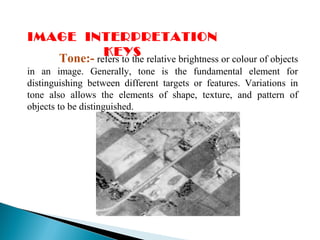
Tone:- refers to the relative brightness or colour of objects
in an image. Generally, tone is the fundamental element for
distinguishing between different targets or features. Variations in
tone also allows the elements of shape, texture, and pattern of
objects to be distinguished.
IMAGE INTERPRETATION
KEYS
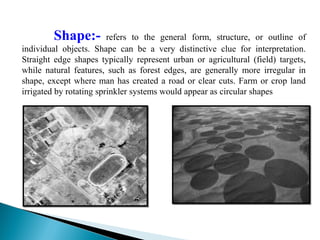
Shape:- refers to the general form, structure, or outline of
individual objects. Shape can be a very distinctive clue for interpretation.
Straight edge shapes typically represent urban or agricultural (field) targets,
while natural features, such as forest edges, are generally more irregular in
shape, except where man has created a road or clear cuts. Farm or crop land
irrigated by rotating sprinkler systems would appear as circular shapes
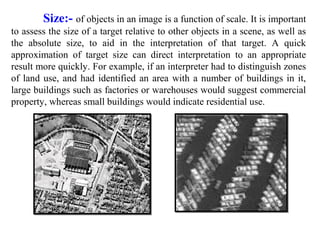
Size:- of objects in an image is a function of scale. It is important
to assess the size of a target relative to other objects in a scene, as well as
the absolute size, to aid in the interpretation of that target. A quick
approximation of target size can direct interpretation to an appropriate
result more quickly. For example, if an interpreter had to distinguish zones
of land use, and had identified an area with a number of buildings in it,
large buildings such as factories or warehouses would suggest commercial
property, whereas small buildings would indicate residential use.
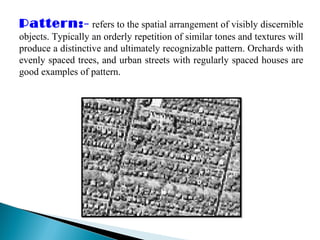
Pattern:- refers to the spatial arrangement of visibly discernible
objects. Typically an orderly repetition of similar tones and textures will
produce a distinctive and ultimately recognizable pattern. Orchards with
evenly spaced trees, and urban streets with regularly spaced houses are
good examples of pattern.
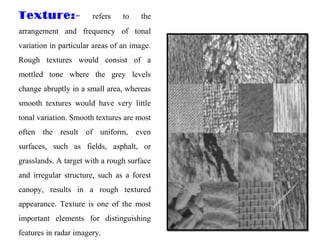
Texture:- refers to the
arrangement and frequency of tonal
variation in particular areas of an image.
Rough textures would consist of a
mottled tone where the grey levels
change abruptly in a small area, whereas
smooth textures would have very little
tonal variation. Smooth textures are most
often the result of uniform, even
surfaces, such as fields, asphalt, or
grasslands. A target with a rough surface
and irregular structure, such as a forest
canopy, results in a rough textured
appearance. Texture is one of the most
important elements for distinguishing
features in radar imagery.
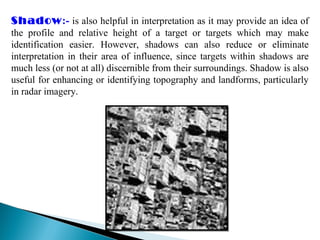
Shadow:- is also helpful in interpretation as it may provide an idea of
the profile and relative height of a target or targets which may make
identification easier. However, shadows can also reduce or eliminate
interpretation in their area of influence, since targets within shadows are
much less (or not at all) discernible from their surroundings. Shadow is also
useful for enhancing or identifying topography and landforms, particularly
in radar imagery.
Association:- takes into account the relationship between other
recognizable objects or features in proximity to the target of interest.
The identification of features that one would expect to associate with
other features may provide information to facilitate identification. In
the example given above, commercial properties may be associated
with proximity to major transportation routes, whereas residential
areas would be associated with schools, playgrounds, and sports
fields. In our example, a lake is associated with boats, a marina, and
adjacent recreational land.
Site:-refers to the vocational
characteristic of
object such as topography, soil,
vegetation and
cultural features
 Image resolution describes the detail of an image. The
term applies to raster digital images, film images and
other type of images. Higher resolution
means more image details they are
1 Pixel resolution
2 Spatial resolution
3 Spectral resolutions
4 Temporal resolutions
5 Radiometric resolutions
 The term resolutions is often used for pixel count in
digital imaging. An image of N pixels high by M pixels
wide can have any resolutions less than n lines per
picture height. But when the pixel counts are referred to
as resolutions
 Another popular convention is to lite resolutions as the
total number of pixels in the image. Typically given as
number of megapixels
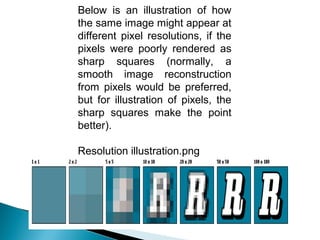
Below is an illustration of how
the same image might appear at
different pixel resolutions, if the
pixels were poorly rendered as
sharp squares (normally, a
smooth image reconstruction
from pixels would be preferred,
but for illustration of pixels, the
sharp squares make the point
better).
Resolution illustration.png
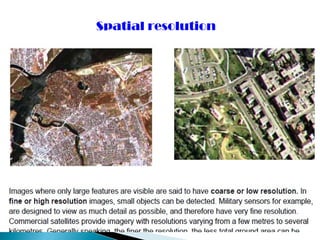
 The measure of how many closely lines can be resolved
in an image is called spatial resolution, and it depends
on properties of the system creating the image, not just
the pixel resolution in pixel per inch.
 In GIS spatial resolution is measured by the ground
simple distance of an image
Spatial resolution
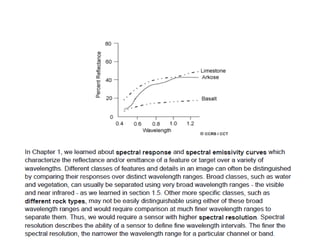
 Color images distinguish light of different spectra.
 Multi-spectral images resolve even finer differences
spectrum or wave length than is needed to reproduce
color
 Movie camera and high speed cameras can
resolve events at different point in time.
 The time resolution used for movies is usually 15-
30 frames/sec,while high speed cameras resolve
100-1000 frames one even more
 It determines how finely a system can represent and is
usually expressed as a number of levels or a number of
bits. The higher radiometric resolution the better sub
difference of intensity or reflectivity can be represented
at least in theory.
 i) Elements of image such as size, shape, pattern,
texture, shadow, association and site helps in the
identification of different object in a scene and it contain
considerable information.
 ii) The technique of interpreting can easily
understanding the identification of the images and
interpreted the studies.
Books:
•Aerial photography by S N Pandey p no 20- 45
•Photo geology by Miller and Miller p no. 1- 20
Websites:
i). www.ccrs.nrcan.gc.ca
ii). www.cnrhome.uidaho.edu
iii). www.geog.ucsb.edu
Image interpretation keys & image resolution

Image interpretation keys & image resolution

  • 1.
  • 2.
    • Introduction •Image interpretationkeys •Image resolutions •Conclusion • Reference
  • 3.
     Remote sensingis the process of sensing and measuring objects from a distance without directly coming physically into contact with them. According to the physics of remote sensing, different surface objects return different amounts of energy in different wavelength of the electromagnetic spectrum. Remote sensing through airborne and satellite based across covers surveying and monitoring which are essential for the planning and management of national resources
  • 4.
     A systematicstudy of aerial photographs and satellite imageries usually ,involves several characteristics of features shown on an image and it depend upon field of application.  Most of the application consider the following basic characteristics or variation in them ,which aid the visual interpretation process of satellites imagery  Although there is a difference of opinion on the number of elements ,there is namely tone,size,shape,texture,pattern,location,association,shado w and resolution
  • 5.
    Tone:- refers tothe relative brightness or colour of objects in an image. Generally, tone is the fundamental element for distinguishing between different targets or features. Variations in tone also allows the elements of shape, texture, and pattern of objects to be distinguished. IMAGE INTERPRETATION KEYS
  • 6.
    Shape:- refers tothe general form, structure, or outline of individual objects. Shape can be a very distinctive clue for interpretation. Straight edge shapes typically represent urban or agricultural (field) targets, while natural features, such as forest edges, are generally more irregular in shape, except where man has created a road or clear cuts. Farm or crop land irrigated by rotating sprinkler systems would appear as circular shapes
  • 7.
    Size:- of objectsin an image is a function of scale. It is important to assess the size of a target relative to other objects in a scene, as well as the absolute size, to aid in the interpretation of that target. A quick approximation of target size can direct interpretation to an appropriate result more quickly. For example, if an interpreter had to distinguish zones of land use, and had identified an area with a number of buildings in it, large buildings such as factories or warehouses would suggest commercial property, whereas small buildings would indicate residential use.
  • 8.
    Pattern:- refers tothe spatial arrangement of visibly discernible objects. Typically an orderly repetition of similar tones and textures will produce a distinctive and ultimately recognizable pattern. Orchards with evenly spaced trees, and urban streets with regularly spaced houses are good examples of pattern.
  • 9.
    Texture:- refers tothe arrangement and frequency of tonal variation in particular areas of an image. Rough textures would consist of a mottled tone where the grey levels change abruptly in a small area, whereas smooth textures would have very little tonal variation. Smooth textures are most often the result of uniform, even surfaces, such as fields, asphalt, or grasslands. A target with a rough surface and irregular structure, such as a forest canopy, results in a rough textured appearance. Texture is one of the most important elements for distinguishing features in radar imagery.
  • 10.
    Shadow:- is alsohelpful in interpretation as it may provide an idea of the profile and relative height of a target or targets which may make identification easier. However, shadows can also reduce or eliminate interpretation in their area of influence, since targets within shadows are much less (or not at all) discernible from their surroundings. Shadow is also useful for enhancing or identifying topography and landforms, particularly in radar imagery.
  • 11.
    Association:- takes intoaccount the relationship between other recognizable objects or features in proximity to the target of interest. The identification of features that one would expect to associate with other features may provide information to facilitate identification. In the example given above, commercial properties may be associated with proximity to major transportation routes, whereas residential areas would be associated with schools, playgrounds, and sports fields. In our example, a lake is associated with boats, a marina, and adjacent recreational land. Site:-refers to the vocational characteristic of object such as topography, soil, vegetation and cultural features
  • 12.
     Image resolutiondescribes the detail of an image. The term applies to raster digital images, film images and other type of images. Higher resolution means more image details they are 1 Pixel resolution 2 Spatial resolution 3 Spectral resolutions 4 Temporal resolutions 5 Radiometric resolutions
  • 13.
     The termresolutions is often used for pixel count in digital imaging. An image of N pixels high by M pixels wide can have any resolutions less than n lines per picture height. But when the pixel counts are referred to as resolutions  Another popular convention is to lite resolutions as the total number of pixels in the image. Typically given as number of megapixels
  • 14.
    Below is anillustration of how the same image might appear at different pixel resolutions, if the pixels were poorly rendered as sharp squares (normally, a smooth image reconstruction from pixels would be preferred, but for illustration of pixels, the sharp squares make the point better). Resolution illustration.png
  • 15.
     The measureof how many closely lines can be resolved in an image is called spatial resolution, and it depends on properties of the system creating the image, not just the pixel resolution in pixel per inch.  In GIS spatial resolution is measured by the ground simple distance of an image
  • 16.
  • 17.
     Color imagesdistinguish light of different spectra.  Multi-spectral images resolve even finer differences spectrum or wave length than is needed to reproduce color
  • 19.
     Movie cameraand high speed cameras can resolve events at different point in time.  The time resolution used for movies is usually 15- 30 frames/sec,while high speed cameras resolve 100-1000 frames one even more
  • 20.
     It determineshow finely a system can represent and is usually expressed as a number of levels or a number of bits. The higher radiometric resolution the better sub difference of intensity or reflectivity can be represented at least in theory.
  • 21.
     i) Elementsof image such as size, shape, pattern, texture, shadow, association and site helps in the identification of different object in a scene and it contain considerable information.  ii) The technique of interpreting can easily understanding the identification of the images and interpreted the studies.
  • 22.
    Books: •Aerial photography byS N Pandey p no 20- 45 •Photo geology by Miller and Miller p no. 1- 20 Websites: i). www.ccrs.nrcan.gc.ca ii). www.cnrhome.uidaho.edu iii). www.geog.ucsb.edu