SensorsA device.
Measure a physical quantity and covert it into a signal
which can be read by an observer by an instrument.
For example:
 Mercury-in-glass thermometer-converts the measured
temperature into expansion.
Types:
Active
Energy leading to radiation received comes from an
external source, e.g., the Sun
Example: Mobile Satellite Service (MSS)
Passive
Energy generated from within the sensor system is
beamed outward, and the fraction returned is measured
Example: radar
Types:
Imaging
Measures the radiation received from all points in the
sensed target, integrates this, and reports the result as
an electrical signal strength or some other quantitative
attribute, such as radiance.
Types:
Non-imaging
The electrons released and captured by the detector.
The electrons are used to excite or ionize a substance
like silver (Ag) in film or to drive an image producing
device like a TV or computer monitor or a cathode ray
tube or oscilloscope or a battery of electronic detectors.
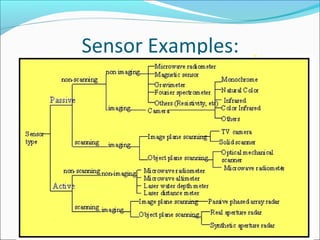
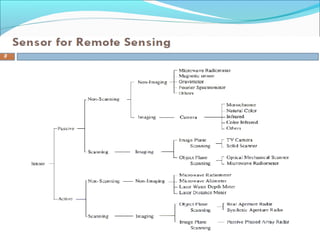
Sensor Examples:
If the scene is sensed point by point (equivalent to
small areas within the
scene) along successive lines over a finite time,
this mode of measurement
makes up a scanning system.
And if the entire scene is sensed directly with the
sensor then its terms as nonscanning system
Sensor Operation Principle:
The remote sensing apply the EM radiation for most
of its source.
That the bulk of the radiation sensed is either
reflected or emitted from the target.
The radiation travel through the air and detected by
sensors.
Sensor Classes:
Sensor Classes:
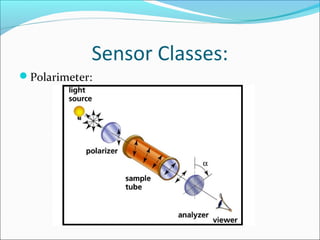
Polarimeter
An instrument used in polarimetry which uses two Nicol
prisms, one fixed (the polarizer) and one rotatable (the
analyzer), with the sample between them, to measure optical
activity and other aspects of polarization.
Mechanism of polarimeter:
The plane of polarization of the sodium light from the
polarizer is rotated as it passes through a solution of
optically active substances such as sucrose.
The extent of the rotation is determined by rotating the
analyzer until no light reaches the observer.
The slits in the analyzer are then at right angles to the final
plane of polarization
Sensor Classes:
Polarimeter:
A scatterometer is a
microwave radar
sensor used to measure
the reflection or
scattering effect
produced while
scanning the surface of
the earth from an
aircraft or a satellite.
What is a Scatterometer?
Sensor classes:
Scatterometer
Satellite remote sensor.
Active microwave sensors
Determine the wind direction over water.
Send out a signal and measure how much of that signal
returns after interacting with the target.
The fraction of energy returned to the satellite
(backscatter) is a function of wind speed and wind
direction.
Sensor Classes:
Radiometer
Instrument that quantitatively measures the EM
radiation in some interval of the EM spectrum.
Spectrometer
Instrument used to measure properties of light over a
specific portion of the electromagnetic spectrum.
Spectro-radiometer
Sensors that collect the dispersed radiation in
bands rather than discrete wavelengths.
Active sensor:
Sensor that able to direct energy at an object in the
form of electromagnetic radiation (EMR).
Object is scanned and the sensors detect any
radiation reflected back from the object.
Types of active remote sensing:
Active Optical Remote Sensing
Active Thermal Remote Sensing
Active Microwave Remote Sensing
Active Optical Remote Sensing
Active optical remote sensing involves using a laser
beam upon a remote target to illuminate it, analyzing
the reflected or backscattered radiation in order to
acquire certain properties about the target.
The velocity, location, temperature and material
composition of a distant target can be determined
using this method.
Example:
LIDAR( Light Detection and Ranging)
Active Optical Remote Sensing
• LIDAR( Light Detection and Ranging)
 The instrument works by using a transmitter and a
receiver.
 The laser generates pulses which excite the specified
target, causing it to absorb radiation at certain
wavelengths.
 The target then reflects radiation in the form of photons
which are detected by the LIDAR's sensors and converted
to an electrical signal.
Active Thermal Remote Sensing
Thermal remote sensing deals with information
acquired primarily in the thermal infrared range.
The majority of the thermal remote sensing is done
using passive sensors.
Active Microwave Remote Sensing
Active microwave remote sensing uses sensors that
operate in the microwave region of the
electromagnetic spectrum.
Example:
RADAR (Radio detection and ranging)
Active Microwave Remote Sensing
RADAR
The sensor transmits a microwave (radio) signal upon a
specified target.
The reflected or backscattered radiation from the target
is then detected by the active sensors which measure
the round trip time delay to targets allowing the system
to calculate the distance of the target from the sensors.
Passive Sensor:
Passive sensors detect electromagnetic radiation
emitted from an object.
Record incoming radiation that has been scattered,
absorbed and transmitted from the Earth in transit
from its original source, the Sun.
Passive Sensor:
Gamma-ray spectrometer
Passive sensor that detects gamma rays.
The sources for the radiation is are generally upper-soil
layers as well as rock layers.
Caused by radioactive decay.
 Used to explore mineral deposits.
Passive Sensor:
Aerial cameras
Used in aerial photography.
Aircraft serve as a platform as well as many low-earth
orbiting satellites deploy many aerial cameras.
Used for topographic mapping.
Passive Sensor:
Thermal infrared video cameras
Equipped to detect radiation in the near-infrared range.
Sometimes combined with active sensors, such as
radar, to provide additional information.
Aircraft as well as satellites can serve as platforms.
Passive Sensor:
Multispectral scanner
Records information in the visible and infrared
spectrum.
Scans the Earth's surface for various wavelength bands.
Satellites act as platforms for such passive sensors.
Used for geological purposes.
Passive Sensor:
Imaging Spectrometer
Similar to the multispectral scanner.
Scans very narrow wavelength bands of the spectrum.
Satellites are used as platforms.
Used for determining the mineral composition of the
Earth's surface and concentrations of suspended
matter in surface water.
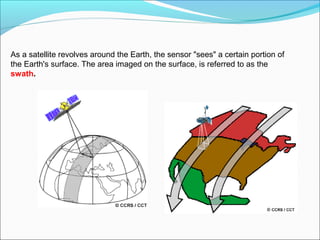
As a satellite revolves around the Earth, the sensor "sees" a certain portion of
the Earth's surface. The area imaged on the surface, is referred to as the
swath.
•Orbit will be elliptical or near circular
• Time taken by a satellite to complete one revolution in its orbit around the
earth is called the Orbital period.
• Angle of inclination of orbital plane with respect to equator is measured
clockwise (typically 99o for RS Satellite)
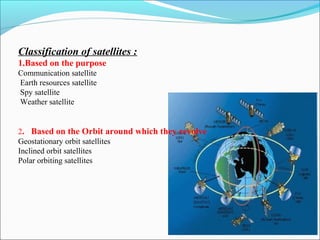
Classification of satellites :
1.Based on the purpose
Communication satellite
Earth resources satellite
Spy satellite
Weather satellite
2. Based on the Orbit around which they revolve
Geostationary orbit satellites
Inclined orbit satellites
Polar orbiting satellites
Geostationary Satellites remain
over the same point above the
Earth, traveling at the same
speed as the rotation of the
Earth. (35,786 km )
Geostationary orbits (side
view).
Geostationary orbits (top view).
Polar Orbiting Satellites circle/orbit round
the Earth in a polar direction, and with
each orbit pass over the equator about 30
degrees west of the previous orbit. This is
because the Earth continues to rotate
below the satellite.
Sensors
Sensors
Sensors
Sensors
Sensors
Sensors
Sensors
Sensors
Sensors
Sensors
Sensors
Sensors

Sensors

  • 2.
    SensorsA device. Measure aphysical quantity and covert it into a signal which can be read by an observer by an instrument. For example:  Mercury-in-glass thermometer-converts the measured temperature into expansion.
  • 3.
    Types: Active Energy leading toradiation received comes from an external source, e.g., the Sun Example: Mobile Satellite Service (MSS) Passive Energy generated from within the sensor system is beamed outward, and the fraction returned is measured Example: radar
  • 4.
    Types: Imaging Measures the radiationreceived from all points in the sensed target, integrates this, and reports the result as an electrical signal strength or some other quantitative attribute, such as radiance.
  • 5.
    Types: Non-imaging The electrons releasedand captured by the detector. The electrons are used to excite or ionize a substance like silver (Ag) in film or to drive an image producing device like a TV or computer monitor or a cathode ray tube or oscilloscope or a battery of electronic detectors.
  • 6.
  • 8.
    If the sceneis sensed point by point (equivalent to small areas within the scene) along successive lines over a finite time, this mode of measurement makes up a scanning system. And if the entire scene is sensed directly with the sensor then its terms as nonscanning system
  • 9.
    Sensor Operation Principle: Theremote sensing apply the EM radiation for most of its source. That the bulk of the radiation sensed is either reflected or emitted from the target. The radiation travel through the air and detected by sensors.
  • 10.
  • 11.
    Sensor Classes: Polarimeter An instrumentused in polarimetry which uses two Nicol prisms, one fixed (the polarizer) and one rotatable (the analyzer), with the sample between them, to measure optical activity and other aspects of polarization. Mechanism of polarimeter: The plane of polarization of the sodium light from the polarizer is rotated as it passes through a solution of optically active substances such as sucrose. The extent of the rotation is determined by rotating the analyzer until no light reaches the observer. The slits in the analyzer are then at right angles to the final plane of polarization
  • 12.
  • 13.
    A scatterometer isa microwave radar sensor used to measure the reflection or scattering effect produced while scanning the surface of the earth from an aircraft or a satellite. What is a Scatterometer?
  • 14.
    Sensor classes: Scatterometer Satellite remotesensor. Active microwave sensors Determine the wind direction over water. Send out a signal and measure how much of that signal returns after interacting with the target. The fraction of energy returned to the satellite (backscatter) is a function of wind speed and wind direction.
  • 15.
    Sensor Classes: Radiometer Instrument thatquantitatively measures the EM radiation in some interval of the EM spectrum. Spectrometer Instrument used to measure properties of light over a specific portion of the electromagnetic spectrum. Spectro-radiometer Sensors that collect the dispersed radiation in bands rather than discrete wavelengths.
  • 16.
    Active sensor: Sensor thatable to direct energy at an object in the form of electromagnetic radiation (EMR). Object is scanned and the sensors detect any radiation reflected back from the object. Types of active remote sensing: Active Optical Remote Sensing Active Thermal Remote Sensing Active Microwave Remote Sensing
  • 17.
    Active Optical RemoteSensing Active optical remote sensing involves using a laser beam upon a remote target to illuminate it, analyzing the reflected or backscattered radiation in order to acquire certain properties about the target. The velocity, location, temperature and material composition of a distant target can be determined using this method. Example: LIDAR( Light Detection and Ranging)
  • 18.
    Active Optical RemoteSensing • LIDAR( Light Detection and Ranging)  The instrument works by using a transmitter and a receiver.  The laser generates pulses which excite the specified target, causing it to absorb radiation at certain wavelengths.  The target then reflects radiation in the form of photons which are detected by the LIDAR's sensors and converted to an electrical signal.
  • 19.
    Active Thermal RemoteSensing Thermal remote sensing deals with information acquired primarily in the thermal infrared range. The majority of the thermal remote sensing is done using passive sensors.
  • 20.
    Active Microwave RemoteSensing Active microwave remote sensing uses sensors that operate in the microwave region of the electromagnetic spectrum. Example: RADAR (Radio detection and ranging)
  • 21.
    Active Microwave RemoteSensing RADAR The sensor transmits a microwave (radio) signal upon a specified target. The reflected or backscattered radiation from the target is then detected by the active sensors which measure the round trip time delay to targets allowing the system to calculate the distance of the target from the sensors.
  • 22.
    Passive Sensor: Passive sensorsdetect electromagnetic radiation emitted from an object. Record incoming radiation that has been scattered, absorbed and transmitted from the Earth in transit from its original source, the Sun.
  • 23.
    Passive Sensor: Gamma-ray spectrometer Passivesensor that detects gamma rays. The sources for the radiation is are generally upper-soil layers as well as rock layers. Caused by radioactive decay.  Used to explore mineral deposits.
  • 24.
    Passive Sensor: Aerial cameras Usedin aerial photography. Aircraft serve as a platform as well as many low-earth orbiting satellites deploy many aerial cameras. Used for topographic mapping.
  • 25.
    Passive Sensor: Thermal infraredvideo cameras Equipped to detect radiation in the near-infrared range. Sometimes combined with active sensors, such as radar, to provide additional information. Aircraft as well as satellites can serve as platforms.
  • 26.
    Passive Sensor: Multispectral scanner Recordsinformation in the visible and infrared spectrum. Scans the Earth's surface for various wavelength bands. Satellites act as platforms for such passive sensors. Used for geological purposes.
  • 27.
    Passive Sensor: Imaging Spectrometer Similarto the multispectral scanner. Scans very narrow wavelength bands of the spectrum. Satellites are used as platforms. Used for determining the mineral composition of the Earth's surface and concentrations of suspended matter in surface water.
  • 28.
    As a satelliterevolves around the Earth, the sensor "sees" a certain portion of the Earth's surface. The area imaged on the surface, is referred to as the swath.
  • 29.
    •Orbit will beelliptical or near circular • Time taken by a satellite to complete one revolution in its orbit around the earth is called the Orbital period. • Angle of inclination of orbital plane with respect to equator is measured clockwise (typically 99o for RS Satellite)
  • 30.
    Classification of satellites: 1.Based on the purpose Communication satellite Earth resources satellite Spy satellite Weather satellite 2. Based on the Orbit around which they revolve Geostationary orbit satellites Inclined orbit satellites Polar orbiting satellites
  • 32.
    Geostationary Satellites remain overthe same point above the Earth, traveling at the same speed as the rotation of the Earth. (35,786 km )
  • 33.
  • 34.
  • 36.
    Polar Orbiting Satellitescircle/orbit round the Earth in a polar direction, and with each orbit pass over the equator about 30 degrees west of the previous orbit. This is because the Earth continues to rotate below the satellite.