Presented to:-
Ms. Aparajita Ranjan
Assistant professor
Department of Civil
Invertis University, Bareilly
Presented by:-
Prajjwal Paudel
Contents
1. Introduction
2. Image Processing
3. Satellite Imagery
4. Image characteristics and format
5. Image Histogram
6. Examples of Satellite images
7. Introduction to image Rectification
8. Image Enhancement
9. Land cover and land use
10. Application of land use and remote sensing
11. Supervised classification
12. Application of Satellite Images
INTRODUCTION
Image processing is an action undertaken on the digital data to alter
digital image using sophisticated software, e.g., ERDAS Imagine,
Geomatica and ENVI. It involves a manipulation of the pixels in an original
image to produce the new image.
Image processing is generally carried out to:-
a) Improve the visual appearance of an image,
b) Prepare an image for measuring the features and structures present in it,
c) Remove noise and clean up an image,
d) Improve the contrast of an image,
e) highlight the elements with certain characteristics in an image,
f) Overcome distortions, and
g) Compensate for uneven illumination.
WHAT IS SATELLITE IMAGE
PROCESSING PROCESSING?
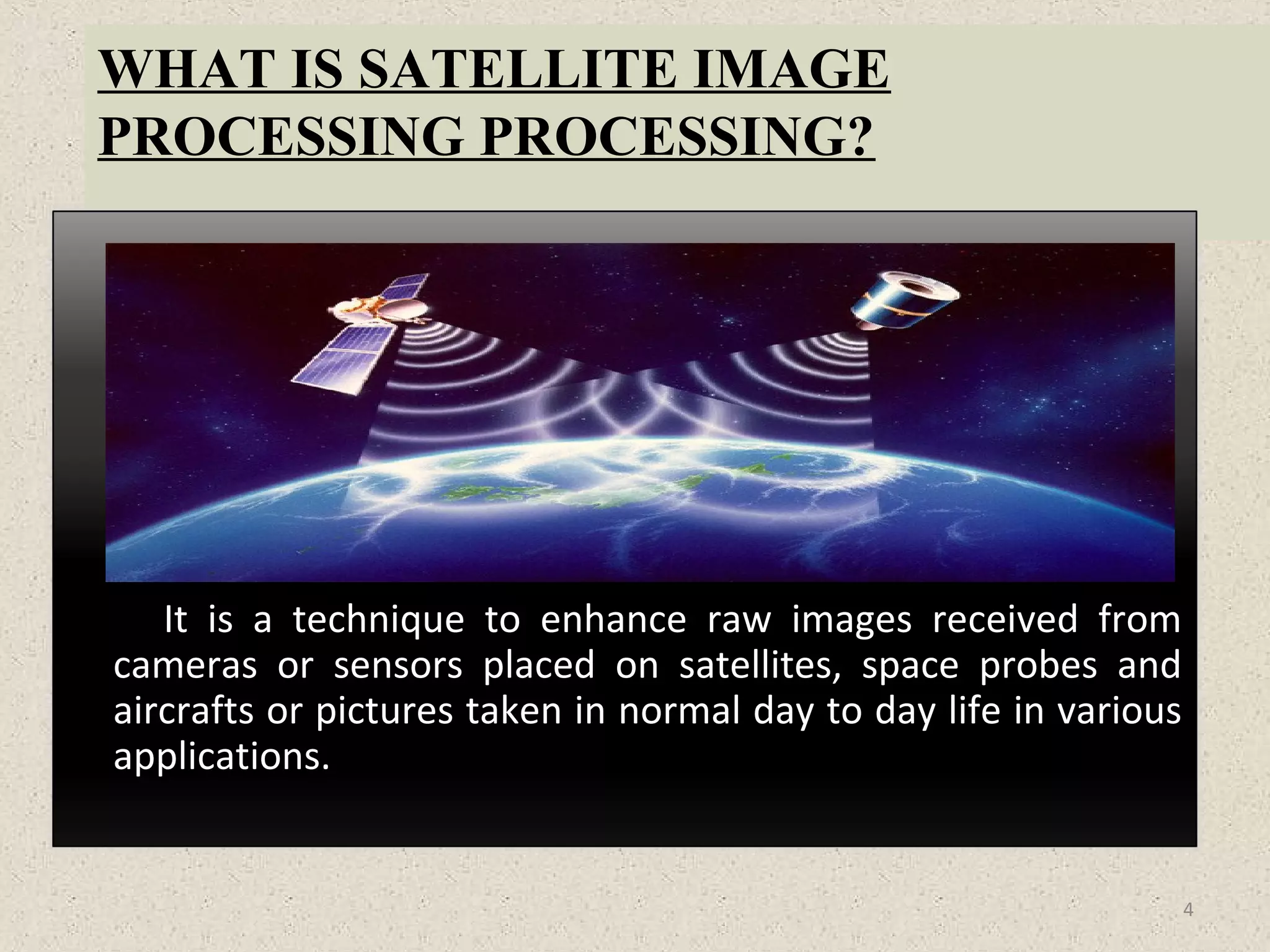
It is a technique to enhance raw images received from
cameras or sensors placed on satellites, space probes and
aircrafts or pictures taken in normal day to day life in various
applications.
4
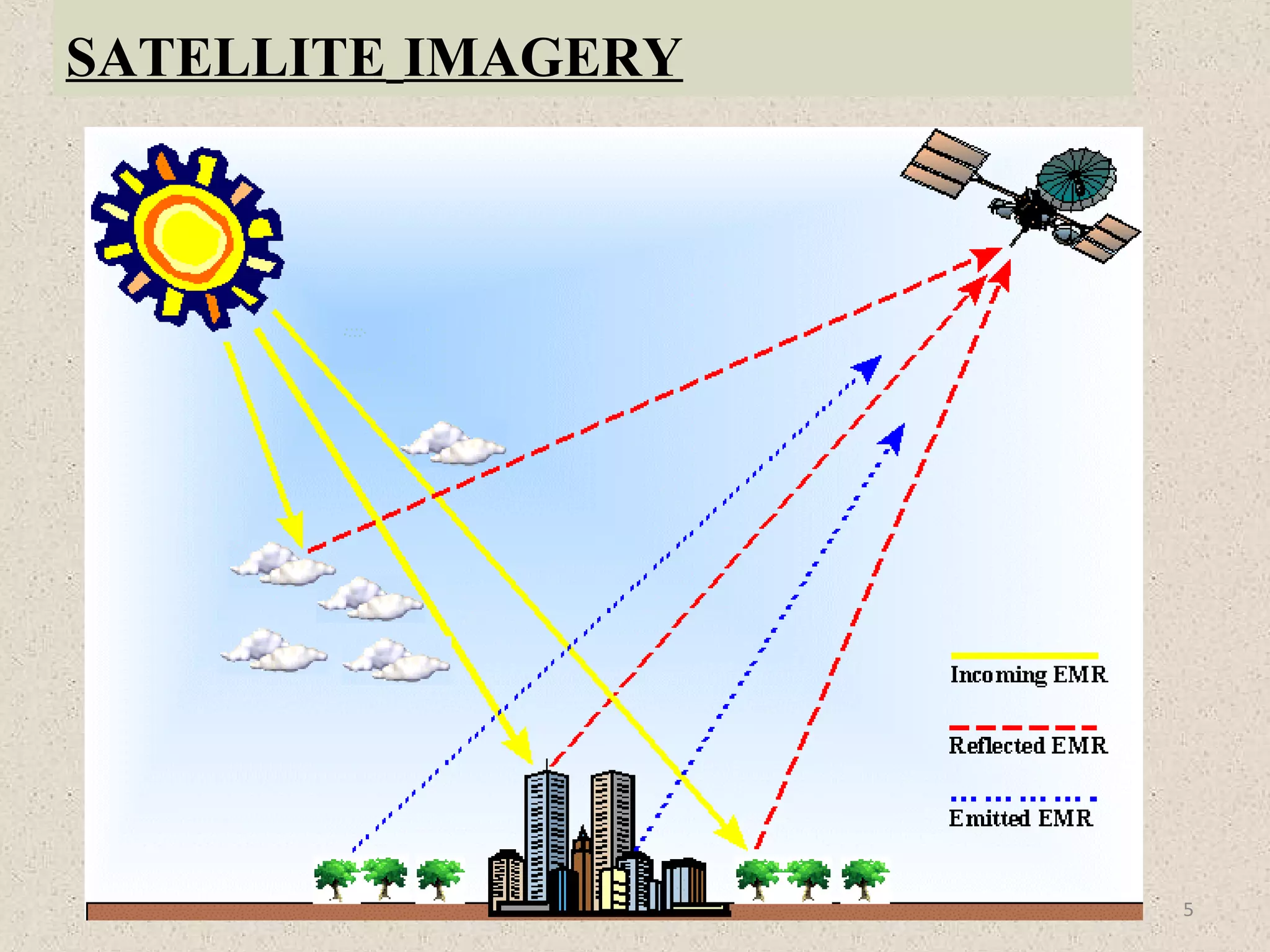
SATELLITE IMAGERY
5
SATELLITE IMAGERY
The resolution of the sensor defines the pixel size and the detail
and accuracy.
1. Spatial resolution :It is the area on ground
represented by each pixel
2. Temporal resolution : It tells how often a satellite
obtaining imagery of particular area.
3. Spectral resolution : It is the specific wavelength
interval in electromagnetic spectrum.
4. Radiometric resolution : It tells how the sensor
changes brightness of object . It’s range is expressed
as power of 2n
.
5. View angle resolution: Number of angles at which
ground objects are recorded.
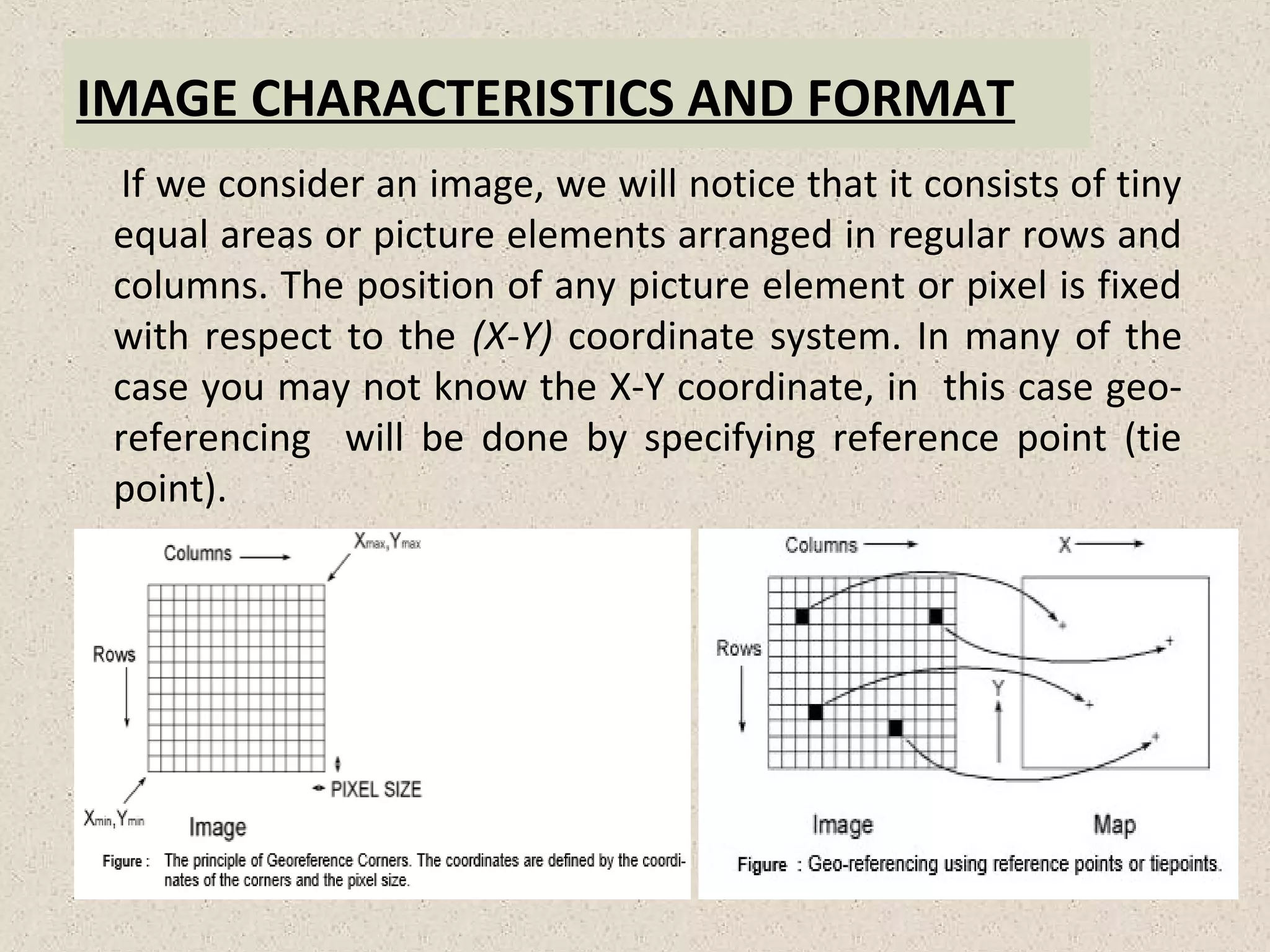
IMAGE CHARACTERISTICS AND FORMAT
If we consider an image, we will notice that it consists of tiny
equal areas or picture elements arranged in regular rows and
columns. The position of any picture element or pixel is fixed
with respect to the (X-Y) coordinate system. In many of the
case you may not know the X-Y coordinate, in this case geo-
referencing will be done by specifying reference point (tie
point).
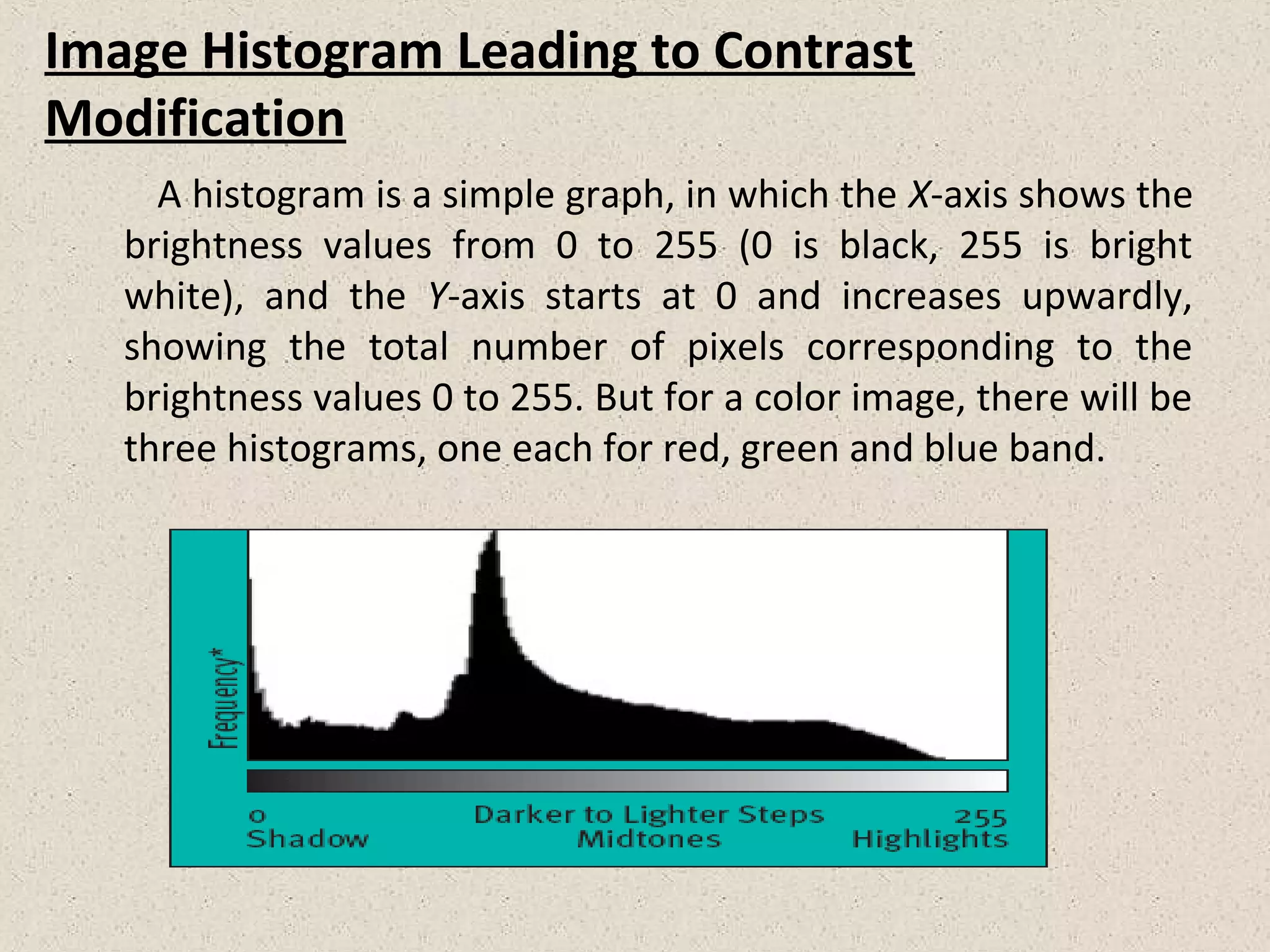
Image Histogram Leading to Contrast
Modification
A histogram is a simple graph, in which the X-axis shows the
brightness values from 0 to 255 (0 is black, 255 is bright
white), and the Y-axis starts at 0 and increases upwardly,
showing the total number of pixels corresponding to the
brightness values 0 to 255. But for a color image, there will be
three histograms, one each for red, green and blue band.
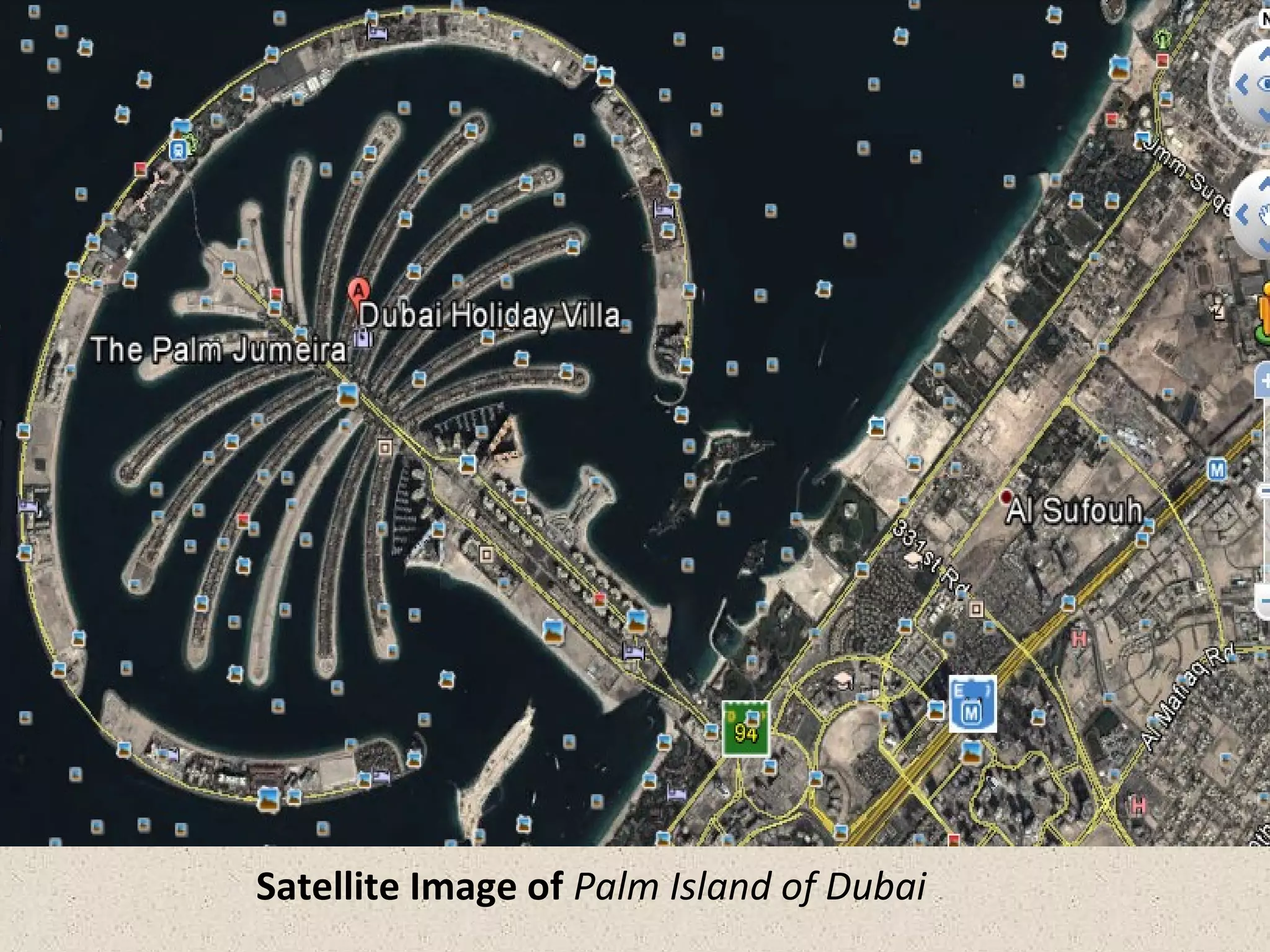
Satellite Image of Palm Island of Dubai
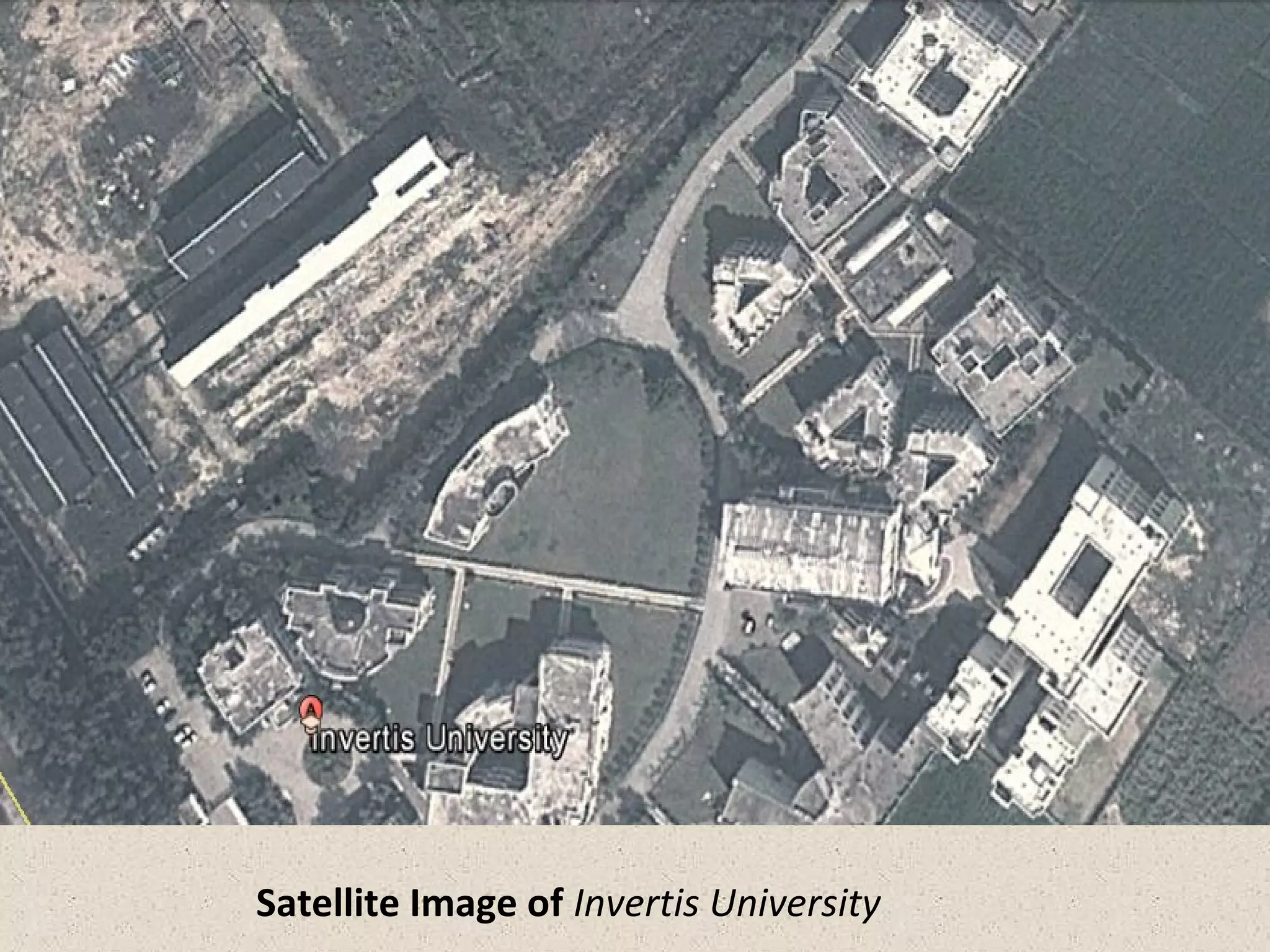
Satellite Image of Invertis University
INTRODUCATION TO IMAGE RECTIFICATION
An image recorded by an MMS (Multispectral Scanner)
usually has some distortions, both radiometry and geometric.
These distortions are caused by platform effects, sensor
effects, scene effects, and atmospheric effects.
Image Rectification is a transformation process used to
project two-or-more images onto a common image plane. It
corrects image distortion by transforming the image into a
standard coordinate system.
 It is used b computer stereo vision to simplify the problem of
finding matching points between images.
 It is used in geographic information systems to merge images
taken from multiple perspectives into a common map
coordinate system.
IMAGE ENHANCEMENT
Enhancement is the modification of an image to alter its
impact on the viewer. To carry out, the original digital values
are changed.
Two types:-
a) One that uses individual pixels without without references to
their spatial context, known as contrast modification, and
b) One that makes use of spatial information, referred to as
spatial filtering.
LAND COVER AND LAND USE
Land cover correspond to the physical conditions of the
ground surface. For e.g., forest, grassland, etc. It refers to
features of land surface, which may be natural, semi-natural,
managed or manmade. They are directly observable by a
remote sensor.
But land use reflects human activities such as the use of
land, for e.g. industrial zones, residential zones, agricultural
fields, etc. It refers to activities on land or classification of
land according to how it is used, such as residential,
industrial, commercial, agricultural, recreational, urban, rural,
etc. They are not always directly observable, inferences
about land use can often be made from land cover.
LAND USE APPLICATIONS OF REMOTE SENSING
 Natural resource management.
 Wildlife habitat protection.
 Baseline mapping for GIS input.
 Urban expansion/ encroachment.
 Routing and logistics planning for seismic/ exploration/
resource extraction activities.
 Damage delineation (tornadoes, flooding, volcanic, seismic,
fire and terrorist activities).
 Legal boundaries for tax and property evaluation.
 Target detection-identification of landing strips, roads,
clearings, bridges and land/water interface.
SUPERVISED CLASSIFICATION
In a supervised classification, independent information is
utilized to define the training data. The latter are then used to
establish the classification categories. The independent
information may be:-
a) The spectral reflectance data and
b) A combination of fieldwork, analysis of aerial photographs,
maps and experience.
Note:-The image analyst uses this data to choose the
information categories.
APPLICATION
 Satellite imaging is prevalent in many consumer apps
today .e.g. googlemaps, Google earth , GPS cars.
 The real time processing of satellite images on grid
architectures could reveal geographic and environmental
information. e.g., soil, vegetation, water-depth and air.
 Pegasus-mapping engine of dataflow.
 Geo-eye 1-satellite launched in 2008 has highest resolution .
 EROS satellites are light weight, has high resolution and high
performance.
 Meteo-sat 2 is a geostationary weather satellite.
References
 Google earth
 www.geomatica.como
 www.satelliteimages.com
 Course book
 www.slideshares.com
18

Satellite Image

  • 1.
    Presented to:- Ms. AparajitaRanjan Assistant professor Department of Civil Invertis University, Bareilly Presented by:- Prajjwal Paudel
  • 2.
    Contents 1. Introduction 2. ImageProcessing 3. Satellite Imagery 4. Image characteristics and format 5. Image Histogram 6. Examples of Satellite images 7. Introduction to image Rectification 8. Image Enhancement 9. Land cover and land use 10. Application of land use and remote sensing 11. Supervised classification 12. Application of Satellite Images
  • 3.
    INTRODUCTION Image processing isan action undertaken on the digital data to alter digital image using sophisticated software, e.g., ERDAS Imagine, Geomatica and ENVI. It involves a manipulation of the pixels in an original image to produce the new image. Image processing is generally carried out to:- a) Improve the visual appearance of an image, b) Prepare an image for measuring the features and structures present in it, c) Remove noise and clean up an image, d) Improve the contrast of an image, e) highlight the elements with certain characteristics in an image, f) Overcome distortions, and g) Compensate for uneven illumination.
  • 4.
    WHAT IS SATELLITEIMAGE PROCESSING PROCESSING? It is a technique to enhance raw images received from cameras or sensors placed on satellites, space probes and aircrafts or pictures taken in normal day to day life in various applications. 4
  • 5.
  • 6.
    SATELLITE IMAGERY The resolutionof the sensor defines the pixel size and the detail and accuracy. 1. Spatial resolution :It is the area on ground represented by each pixel 2. Temporal resolution : It tells how often a satellite obtaining imagery of particular area. 3. Spectral resolution : It is the specific wavelength interval in electromagnetic spectrum. 4. Radiometric resolution : It tells how the sensor changes brightness of object . It’s range is expressed as power of 2n . 5. View angle resolution: Number of angles at which ground objects are recorded.
  • 7.
    IMAGE CHARACTERISTICS ANDFORMAT If we consider an image, we will notice that it consists of tiny equal areas or picture elements arranged in regular rows and columns. The position of any picture element or pixel is fixed with respect to the (X-Y) coordinate system. In many of the case you may not know the X-Y coordinate, in this case geo- referencing will be done by specifying reference point (tie point).
  • 8.
    Image Histogram Leadingto Contrast Modification A histogram is a simple graph, in which the X-axis shows the brightness values from 0 to 255 (0 is black, 255 is bright white), and the Y-axis starts at 0 and increases upwardly, showing the total number of pixels corresponding to the brightness values 0 to 255. But for a color image, there will be three histograms, one each for red, green and blue band.
  • 9.
    Satellite Image ofPalm Island of Dubai
  • 10.
    Satellite Image ofInvertis University
  • 11.
    INTRODUCATION TO IMAGERECTIFICATION An image recorded by an MMS (Multispectral Scanner) usually has some distortions, both radiometry and geometric. These distortions are caused by platform effects, sensor effects, scene effects, and atmospheric effects. Image Rectification is a transformation process used to project two-or-more images onto a common image plane. It corrects image distortion by transforming the image into a standard coordinate system.  It is used b computer stereo vision to simplify the problem of finding matching points between images.  It is used in geographic information systems to merge images taken from multiple perspectives into a common map coordinate system.
  • 12.
    IMAGE ENHANCEMENT Enhancement isthe modification of an image to alter its impact on the viewer. To carry out, the original digital values are changed. Two types:- a) One that uses individual pixels without without references to their spatial context, known as contrast modification, and b) One that makes use of spatial information, referred to as spatial filtering.
  • 13.
    LAND COVER ANDLAND USE Land cover correspond to the physical conditions of the ground surface. For e.g., forest, grassland, etc. It refers to features of land surface, which may be natural, semi-natural, managed or manmade. They are directly observable by a remote sensor. But land use reflects human activities such as the use of land, for e.g. industrial zones, residential zones, agricultural fields, etc. It refers to activities on land or classification of land according to how it is used, such as residential, industrial, commercial, agricultural, recreational, urban, rural, etc. They are not always directly observable, inferences about land use can often be made from land cover.
  • 14.
    LAND USE APPLICATIONSOF REMOTE SENSING  Natural resource management.  Wildlife habitat protection.  Baseline mapping for GIS input.  Urban expansion/ encroachment.  Routing and logistics planning for seismic/ exploration/ resource extraction activities.  Damage delineation (tornadoes, flooding, volcanic, seismic, fire and terrorist activities).  Legal boundaries for tax and property evaluation.  Target detection-identification of landing strips, roads, clearings, bridges and land/water interface.
  • 15.
    SUPERVISED CLASSIFICATION In asupervised classification, independent information is utilized to define the training data. The latter are then used to establish the classification categories. The independent information may be:- a) The spectral reflectance data and b) A combination of fieldwork, analysis of aerial photographs, maps and experience. Note:-The image analyst uses this data to choose the information categories.
  • 16.
    APPLICATION  Satellite imagingis prevalent in many consumer apps today .e.g. googlemaps, Google earth , GPS cars.  The real time processing of satellite images on grid architectures could reveal geographic and environmental information. e.g., soil, vegetation, water-depth and air.  Pegasus-mapping engine of dataflow.  Geo-eye 1-satellite launched in 2008 has highest resolution .  EROS satellites are light weight, has high resolution and high performance.  Meteo-sat 2 is a geostationary weather satellite.
  • 17.
    References  Google earth www.geomatica.como  www.satelliteimages.com  Course book  www.slideshares.com
  • 18.