REMOTE SENSING PLATFORMS
AND SENSORS
D.UDAY KUMAR,
LECTURER,
NBKRIST,VIDYANAGAR
ORBITS OF REMOTE SENSING
SATELLITE:
Satellite is any object man made or natural
that revolves around the earth
TYPES OF ORBITS:
• Low Earth Orbit (LEO) < 2000 km
• Medium Earth Orbit (MEO) 2000-35786 km
• High Earth Orbit (HEO) > 35786 km
Low Earth Orbit:
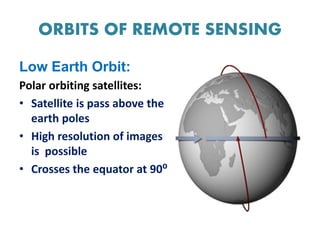
Polar orbiting satellites:
• Satellite is pass above the
earth poles
• High resolution of images
is possible
• Crosses the equator at 90⁰
ORBITS OF REMOTE SENSING
Low Earth Orbit:
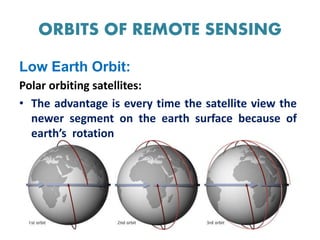
Polar orbiting satellites:
• The advantage is every time the satellite view the
newer segment on the earth surface because of
earth’s rotation
ORBITS OF REMOTE SENSING
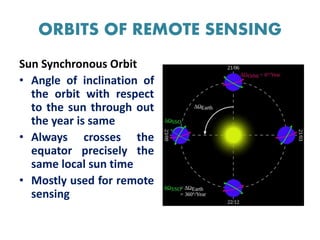
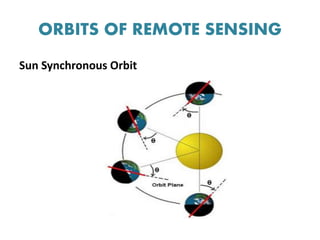
Sun Synchronous Orbit
• Angle of inclination of
the orbit with respect
to the sun through out
the year is same
• Always crosses the
equator precisely the
same local sun time
• Mostly used for remote
sensing
ORBITS OF REMOTE SENSING
Sun Synchronous Orbit
ORBITS OF REMOTE SENSING
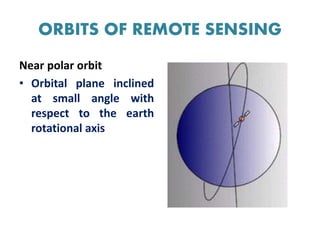
Near polar orbit
• Orbital plane inclined
at small angle with
respect to the earth
rotational axis
ORBITS OF REMOTE SENSING
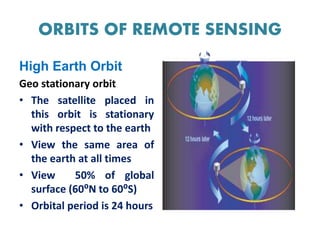
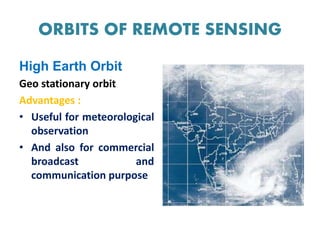
High Earth Orbit
Geo stationary orbit
• The satellite placed in
this orbit is stationary
with respect to the earth
• View the same area of
the earth at all times
• View 50% of global
surface (60⁰N to 60⁰S)
• Orbital period is 24 hours
ORBITS OF REMOTE SENSING
High Earth Orbit
Geo stationary orbit
Advantages :
• Useful for meteorological
observation
• And also for commercial
broadcast and
communication purpose
ORBITS OF REMOTE SENSING
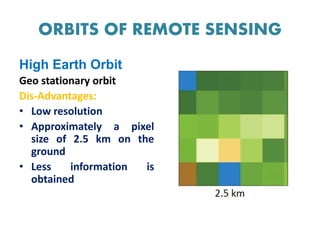
High Earth Orbit
Geo stationary orbit
Dis-Advantages:
• Low resolution
• Approximately a pixel
size of 2.5 km on the
ground
• Less information is
obtained
Choice of orbit:
• It is dependent on the its mission
• Remote sensing satellites placed in LEO
because it needs high resolution
• Commercial broadcast or Communication
satellites are provided in HEO because it
should receive and send signals from large
geographical are
ORBITS OF REMOTE SENSING
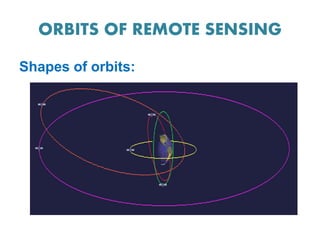
Shapes of orbits:
ORBITS OF REMOTE SENSING
Types of platforms :
Ground based platforms
Short range systems(50-100 m)
Medium Range Systems ( 150-250 m)
Long range Systems (up to 1 km)
Airborne platforms
Space-borne platforms
REMOTE SENSING PLATFORMS
Types of platforms :
Ground Based Platforms:
Mobile hydraulic platforms (up to 15 m height)
REMOTE SENSING PLATFORMS
Types of platforms :
Portable Masts
• Unstable in wind conditions
REMOTE SENSING PLATFORMS
Types of platforms :
Towers:
• Greater rigidity than masts
REMOTE SENSING PLATFORMS
Types of platforms :
Weather Surveillance Radar
• Detects and tracks
typhoons and cloud
masses
REMOTE SENSING PLATFORMS
Types of platforms :
Airborne Platforms:
Balloons based :
• Altitude range is 22-40
km
• Tool to probing the
atmosphere
• Useful to test the
instruments under
development
REMOTE SENSING PLATFORMS
Types of platforms :
Airborne Platforms:
Radiosonde:
Measure pressure,
Temperature and
Relative humidity in
the atmosphere
Rawinsonde:
Measure wind velocity,
temperature, pressure
and relative humidity
REMOTE SENSING PLATFORMS
Types of platforms :
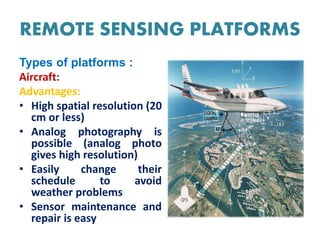
Aircraft:
Advantages:
• High spatial resolution (20
cm or less)
• Analog photography is
possible (analog photo
gives high resolution)
• Easily change their
schedule to avoid
weather problems
• Sensor maintenance and
repair is easy
REMOTE SENSING PLATFORMS
Types of platforms :
Aircraft:
Dis Advantages:
• Permission to intrude into foreign airspace is
required
• Many passes to cover larger area
• Swath is much less compare to satellite
• High cost per unit area
REMOTE SENSING PLATFORMS
Types of platforms :
Space borne platforms:
• Sensors are mounted
on-board a spacecraft
• Rockets , satellites and
space shuttles
Advantages :
• Cover large area
• Repetitive coverage of
an area of interest
REMOTE SENSING SENSORS
Sensor :
Common Definition :
• Sensors are Sophisticated devices that are
frequently used to detect and respond to
electrical or optical signals
• A Sensor converts the Physical parameter
into a signal which can be measured
electrically
REMOTE SENSING SENSORS
Sensor :
Definition in Remote Sensing :
• Sensor is a device that gathers energy (EMR)
converts into signal and present it into a signal and
present it in a form (image) suitable for obtaining
information about the objet under investigation
REMOTE SENSING SENSORS
Types of sensors :
REMOTE SENSING SENSORS
Types of sensors :
Active sensors:
These sensors detect reflected responses
from objects which are irradiated from
artificially generated energy sources
Ex : Radar, camera with flash light
Passive sensors:
These sensors detect reflected EMR from
natural source
Ex : camera without flash light (depends on
solar energy), and all RS sensors
REMOTE SENSING SENSORS
Types of sensors :
Non Scanning or Framing sensors:
Measure the radiation coming from entire scene at
once
Ex: Our eyes, Photo cameras
REMOTE SENSING SENSORS
Types of sensors :
Imaging sensors:
Form image by collected
radiation
1. Scanning sensors:
The scene is sensed by
point by point or
measure the radiation
coming from point by
point (equivalent to
small areas with in the
scene)
Along track Scanners:
Image is acquired by line
by line
REMOTE SENSING SENSORS
Types of sensors :
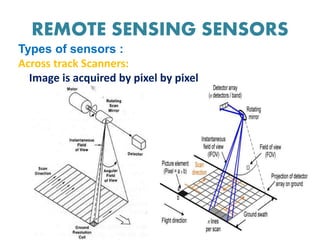
Across track Scanners:
Image is acquired by pixel by pixel
REMOTE SENSING SENSORS
Types of sensors :
2. Non imaging sensors:
• These sensors do not form the image
• These are used to record spectral
quantity or parameter as a function of
time
Ex: temperature measurement, study of
atmosphere
REMOTE SENSING SENSORS
Types of sensors :
Image Plane Scanning:
Lens is used after the
scan mirror to focus
the light on the
detector
REMOTE SENSING SENSORS
Types of sensors :
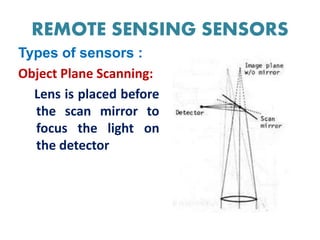
Object Plane Scanning:
Lens is placed before
the scan mirror to
focus the light on
the detector
CHARECTERISTICS OF SENSORS
1. Spatial resolution
2. Spectral resolution
3. Radiometric resolution
4. Temporal resolution
CHARECTERISTICS OF SENSORS
Spatial resolution
• It refers to the size of the
smallest possible object
that can be detected
• It depends on the
Instantaneous Field Of
View (IFOV) and the
height of the satellite
orbit
• It tells the pixel size on
the ground surface
CHARECTERISTICS OF SENSORS
Spatial resolution
CHARECTERISTICS OF SENSORS
Spatial resolution
CHARECTERISTICS OF SENSORS
Spatial resolution
CHARECTERISTICS OF SENSORS
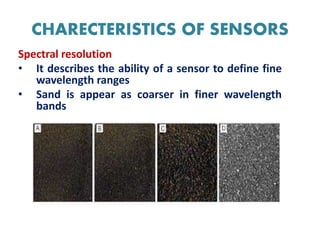
Spectral resolution
• It describes the ability of a sensor to define fine
wavelength ranges
• Sand is appear as coarser in finer wavelength
bands
CHARECTERISTICS OF SENSORS
Radiometric resolution
• It describes the ability of sensor to discriminate
very slight differences in energy
• The number of brightness levels depends upon the
number of bits used
CHARECTERISTICS OF SENSORS
Radiometric resolution
CHARECTERISTICS OF SENSORS
Temporal resolution
It refers to how often it records imagery of
a particular area, which means the
frequency of repetitive coverage

Remote Sensing Platforms and Sensors

  • 1.
    REMOTE SENSING PLATFORMS ANDSENSORS D.UDAY KUMAR, LECTURER, NBKRIST,VIDYANAGAR
  • 2.
    ORBITS OF REMOTESENSING SATELLITE: Satellite is any object man made or natural that revolves around the earth TYPES OF ORBITS: • Low Earth Orbit (LEO) < 2000 km • Medium Earth Orbit (MEO) 2000-35786 km • High Earth Orbit (HEO) > 35786 km
  • 3.
    Low Earth Orbit: Polarorbiting satellites: • Satellite is pass above the earth poles • High resolution of images is possible • Crosses the equator at 90⁰ ORBITS OF REMOTE SENSING
  • 4.
    Low Earth Orbit: Polarorbiting satellites: • The advantage is every time the satellite view the newer segment on the earth surface because of earth’s rotation ORBITS OF REMOTE SENSING
  • 5.
    Sun Synchronous Orbit •Angle of inclination of the orbit with respect to the sun through out the year is same • Always crosses the equator precisely the same local sun time • Mostly used for remote sensing ORBITS OF REMOTE SENSING
  • 6.
  • 7.
    Near polar orbit •Orbital plane inclined at small angle with respect to the earth rotational axis ORBITS OF REMOTE SENSING
  • 8.
    High Earth Orbit Geostationary orbit • The satellite placed in this orbit is stationary with respect to the earth • View the same area of the earth at all times • View 50% of global surface (60⁰N to 60⁰S) • Orbital period is 24 hours ORBITS OF REMOTE SENSING
  • 9.
    ORBITS OF REMOTESENSING High Earth Orbit Geo stationary orbit Advantages : • Useful for meteorological observation • And also for commercial broadcast and communication purpose
  • 10.
    ORBITS OF REMOTESENSING High Earth Orbit Geo stationary orbit Dis-Advantages: • Low resolution • Approximately a pixel size of 2.5 km on the ground • Less information is obtained
  • 11.
    Choice of orbit: •It is dependent on the its mission • Remote sensing satellites placed in LEO because it needs high resolution • Commercial broadcast or Communication satellites are provided in HEO because it should receive and send signals from large geographical are ORBITS OF REMOTE SENSING
  • 12.
    ORBITS OF REMOTESENSING Shapes of orbits:
  • 13.
  • 14.
    Types of platforms: Ground based platforms Short range systems(50-100 m) Medium Range Systems ( 150-250 m) Long range Systems (up to 1 km) Airborne platforms Space-borne platforms REMOTE SENSING PLATFORMS
  • 15.
    REMOTE SENSING PLATFORMS Typesof platforms : Ground Based Platforms: Mobile hydraulic platforms (up to 15 m height)
  • 16.
    REMOTE SENSING PLATFORMS Typesof platforms : Portable Masts • Unstable in wind conditions
  • 17.
    REMOTE SENSING PLATFORMS Typesof platforms : Towers: • Greater rigidity than masts
  • 18.
    REMOTE SENSING PLATFORMS Typesof platforms : Weather Surveillance Radar • Detects and tracks typhoons and cloud masses
  • 19.
    REMOTE SENSING PLATFORMS Typesof platforms : Airborne Platforms: Balloons based : • Altitude range is 22-40 km • Tool to probing the atmosphere • Useful to test the instruments under development
  • 20.
    REMOTE SENSING PLATFORMS Typesof platforms : Airborne Platforms: Radiosonde: Measure pressure, Temperature and Relative humidity in the atmosphere Rawinsonde: Measure wind velocity, temperature, pressure and relative humidity
  • 21.
    REMOTE SENSING PLATFORMS Typesof platforms : Aircraft: Advantages: • High spatial resolution (20 cm or less) • Analog photography is possible (analog photo gives high resolution) • Easily change their schedule to avoid weather problems • Sensor maintenance and repair is easy
  • 22.
    REMOTE SENSING PLATFORMS Typesof platforms : Aircraft: Dis Advantages: • Permission to intrude into foreign airspace is required • Many passes to cover larger area • Swath is much less compare to satellite • High cost per unit area
  • 23.
    REMOTE SENSING PLATFORMS Typesof platforms : Space borne platforms: • Sensors are mounted on-board a spacecraft • Rockets , satellites and space shuttles Advantages : • Cover large area • Repetitive coverage of an area of interest
  • 24.
    REMOTE SENSING SENSORS Sensor: Common Definition : • Sensors are Sophisticated devices that are frequently used to detect and respond to electrical or optical signals • A Sensor converts the Physical parameter into a signal which can be measured electrically
  • 25.
    REMOTE SENSING SENSORS Sensor: Definition in Remote Sensing : • Sensor is a device that gathers energy (EMR) converts into signal and present it into a signal and present it in a form (image) suitable for obtaining information about the objet under investigation
  • 26.
  • 27.
    REMOTE SENSING SENSORS Typesof sensors : Active sensors: These sensors detect reflected responses from objects which are irradiated from artificially generated energy sources Ex : Radar, camera with flash light Passive sensors: These sensors detect reflected EMR from natural source Ex : camera without flash light (depends on solar energy), and all RS sensors
  • 28.
    REMOTE SENSING SENSORS Typesof sensors : Non Scanning or Framing sensors: Measure the radiation coming from entire scene at once Ex: Our eyes, Photo cameras
  • 29.
    REMOTE SENSING SENSORS Typesof sensors : Imaging sensors: Form image by collected radiation 1. Scanning sensors: The scene is sensed by point by point or measure the radiation coming from point by point (equivalent to small areas with in the scene) Along track Scanners: Image is acquired by line by line
  • 30.
    REMOTE SENSING SENSORS Typesof sensors : Across track Scanners: Image is acquired by pixel by pixel
  • 31.
    REMOTE SENSING SENSORS Typesof sensors : 2. Non imaging sensors: • These sensors do not form the image • These are used to record spectral quantity or parameter as a function of time Ex: temperature measurement, study of atmosphere
  • 32.
    REMOTE SENSING SENSORS Typesof sensors : Image Plane Scanning: Lens is used after the scan mirror to focus the light on the detector
  • 33.
    REMOTE SENSING SENSORS Typesof sensors : Object Plane Scanning: Lens is placed before the scan mirror to focus the light on the detector
  • 34.
    CHARECTERISTICS OF SENSORS 1.Spatial resolution 2. Spectral resolution 3. Radiometric resolution 4. Temporal resolution
  • 35.
    CHARECTERISTICS OF SENSORS Spatialresolution • It refers to the size of the smallest possible object that can be detected • It depends on the Instantaneous Field Of View (IFOV) and the height of the satellite orbit • It tells the pixel size on the ground surface
  • 36.
  • 37.
  • 38.
  • 39.
    CHARECTERISTICS OF SENSORS Spectralresolution • It describes the ability of a sensor to define fine wavelength ranges • Sand is appear as coarser in finer wavelength bands
  • 40.
    CHARECTERISTICS OF SENSORS Radiometricresolution • It describes the ability of sensor to discriminate very slight differences in energy • The number of brightness levels depends upon the number of bits used
  • 41.
  • 42.
    CHARECTERISTICS OF SENSORS Temporalresolution It refers to how often it records imagery of a particular area, which means the frequency of repetitive coverage