APPLICATION OF REMOTE SENSING AND
GEOGRAPHICAL INFORMATION SYSTEM IN
CIVIL ENGINEERING
Date:
INSTRUCTOR
DR. MOHSIN SIDDIQUE
ASSIST. PROFESSOR
DEPARTMENT OF CIVIL ENGINEERING
Remote Sensing (RS)
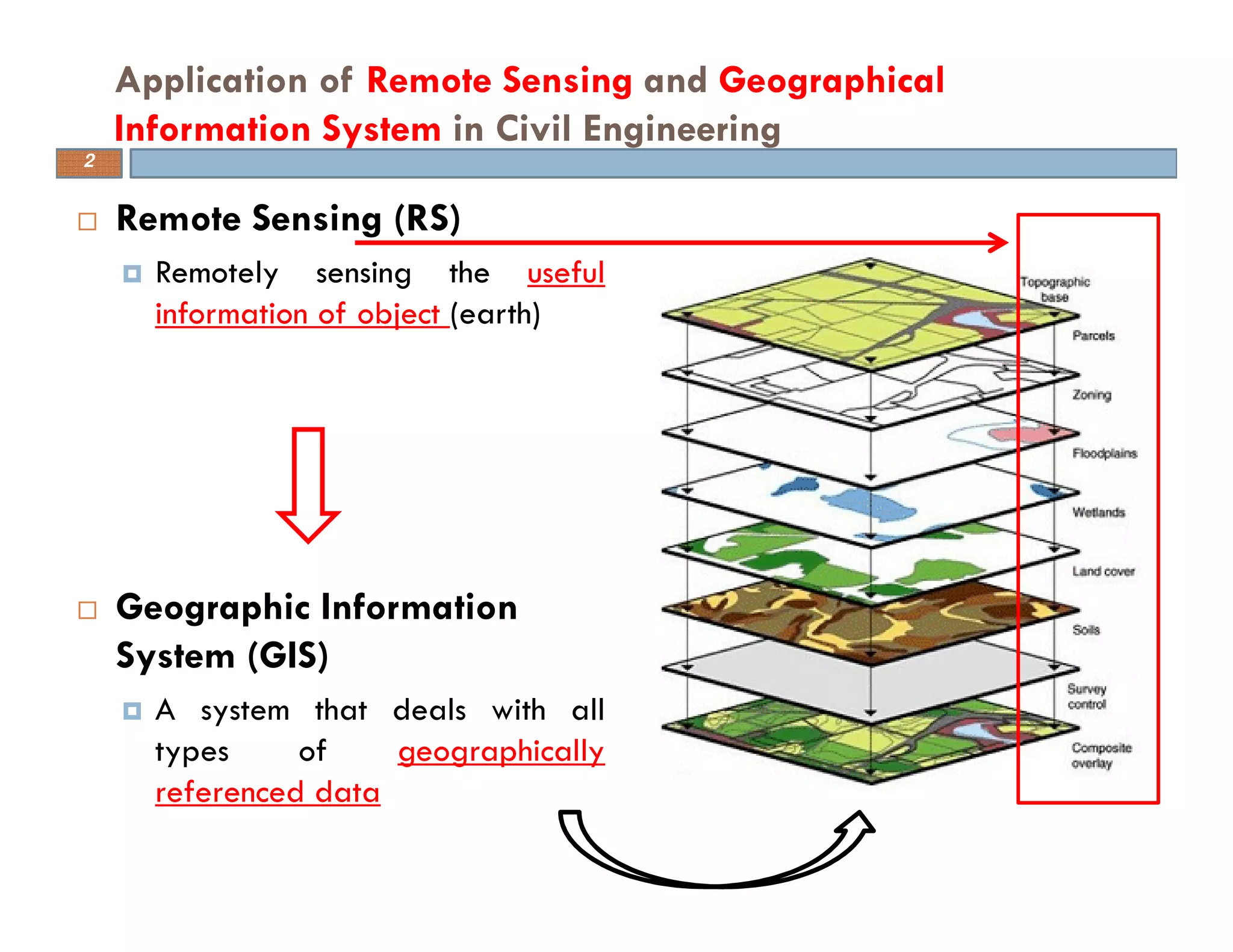
Remotely sensing the useful
information of object (earth)
Geographic Information
System (GIS)
A system that deals with all
types of geographically
referenced data
Application of Remote Sensing and Geographical
Information System in Civil Engineering
2
Remote Sensing (RS)
Remotely sensing the useful
information of object (earth)
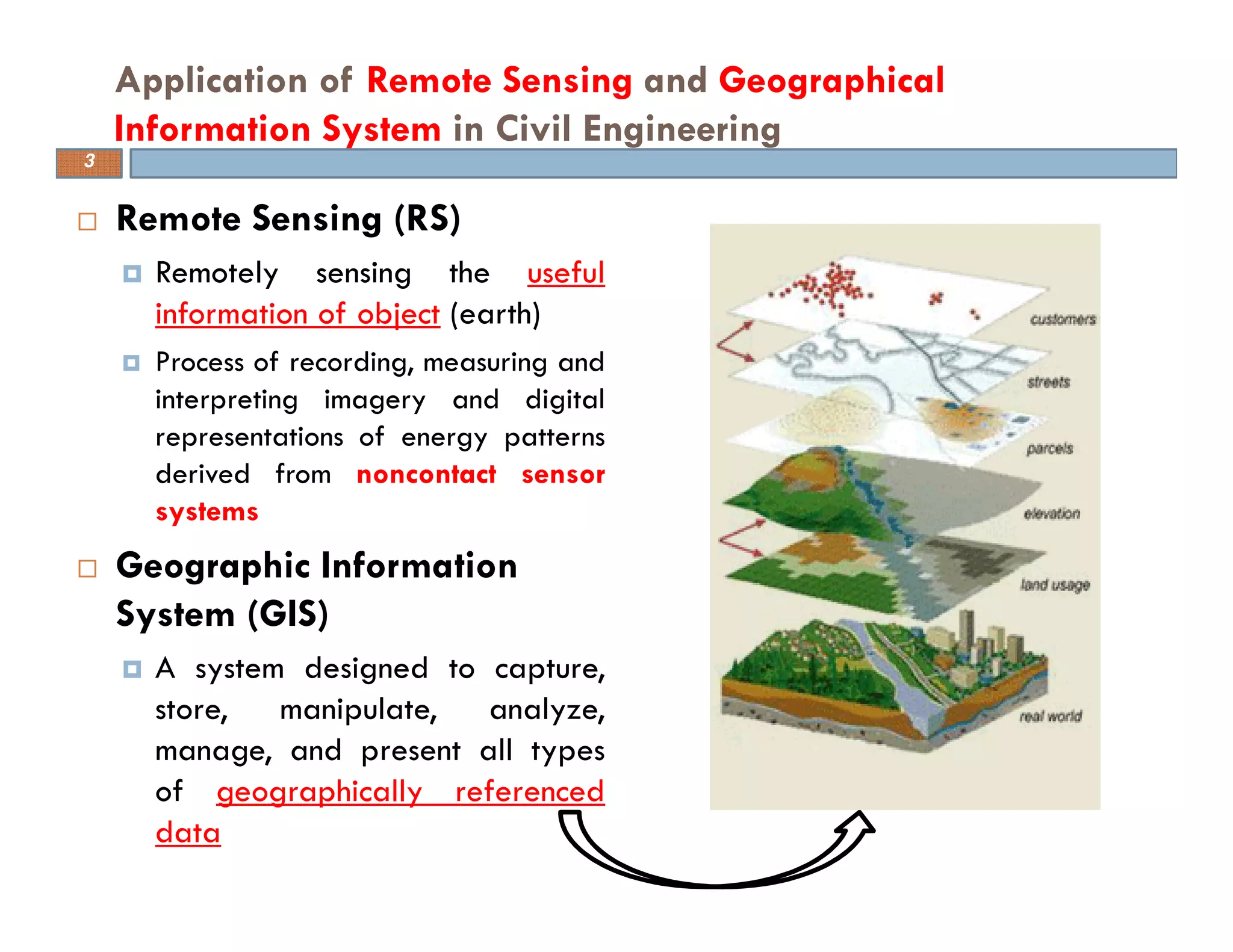
Process of recording, measuring and
interpreting imagery and digital
representations of energy patterns
derived from noncontact sensor
systems
Geographic Information
System (GIS)
A system designed to capture,
store, manipulate, analyze,
manage, and present all types
of geographically referenced
data
Application of Remote Sensing and Geographical
Information System in Civil Engineering
3
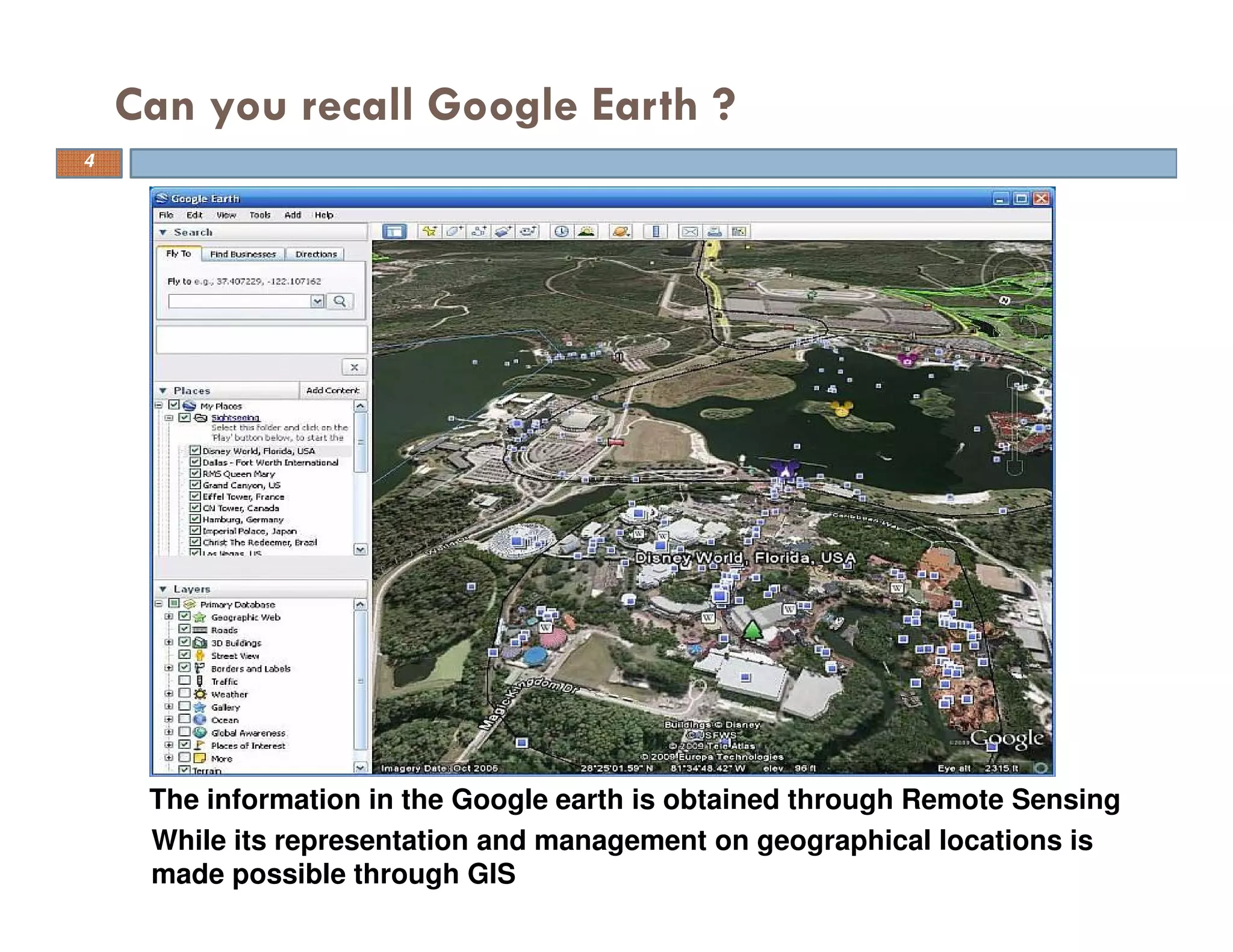
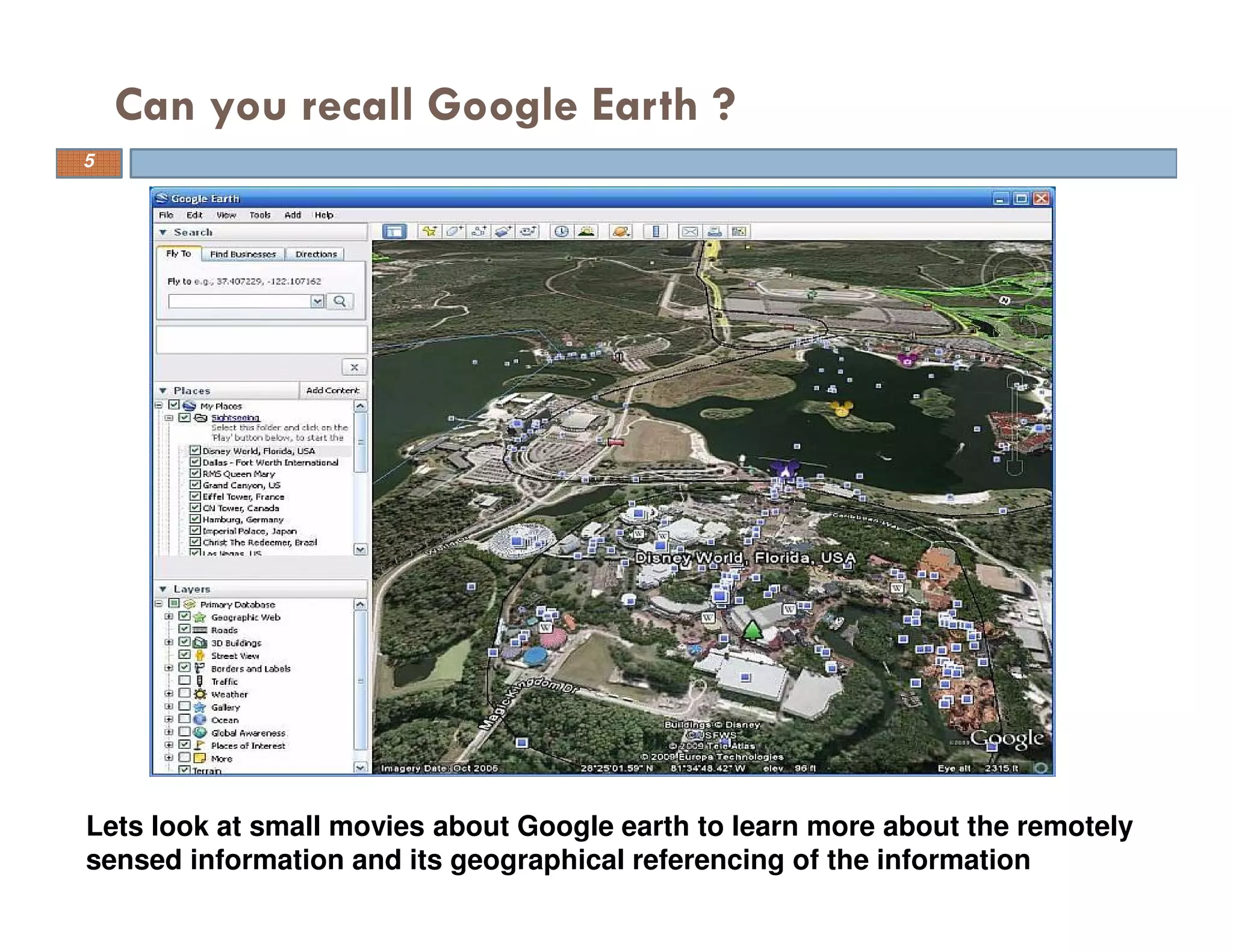
Can you recall Google Earth ?
While its representation and management on geographical locations is
made possible through GIS
The information in the Google earth is obtained through Remote Sensing
4
Can you recall Google Earth ?
Lets look at small movies about Google earth to learn more about the remotely
sensed information and its geographical referencing of the information
5
Remote sensing has been variously defined but basically it is the art or science
of telling something about an object without touching it. (Fischer et al.,
1976, p. 34)
Remote sensing is the acquisition of physical data of an object without touch
or contact. (Lintz and Simonett, 1976, p. 1)
Remote sensing is the observation of a target by a device separated from it
by some distance. (Barrett and Curtis, 1976, p. 3)
The term “remote sensing” in its broadest sense merely means
“reconnaissance at a distance.” (Colwell, 1966, p. 71)
Remote sensing is the art, science and technology of obtaining reliable
information about physical objects and the environment, through the
process of recording, measuring and interpreting imagery and digital
representations of energy patterns derived from noncontact sensor systems
(Lecture Note by Wataru, 2009)
Remote Sensing
6
Remote sensing is the science of deriving information about an object from
measurements made at a distance from the object, i.e., without actually
coming in contact with it. The quantity most frequently measured in present-
day remote sensing systems is the electromagnetic energy emanating from
objects of interest, and although there are other possibilities (e.g., seismic
waves, sonic waves, and gravitational force), our attention . . . is focused upon
systems which measure electromagnetic energy. (D. A. Landgrebe, quoted in
Swain and Davis, 1978, p. 1)
Remote sensing is the practice of deriving information about the Earth’s land and
water surfaces using images acquired from an overhead perspective, using
electromagnetic radiation in one or more regions of the electromagnetic
spectrum, reflected or emitted from the Earth’s surface. (James B.
Campbell, Randolph H. Wynne (2011): Introduction to Remote Sensing)
Remote Sensing
7
Is remote sensing limited to use of electromagnetic radiation !!!?
Natural:
Oldest Compound Eyes
Artificial:
1800: Discovery of infrared by Sir William Herschel
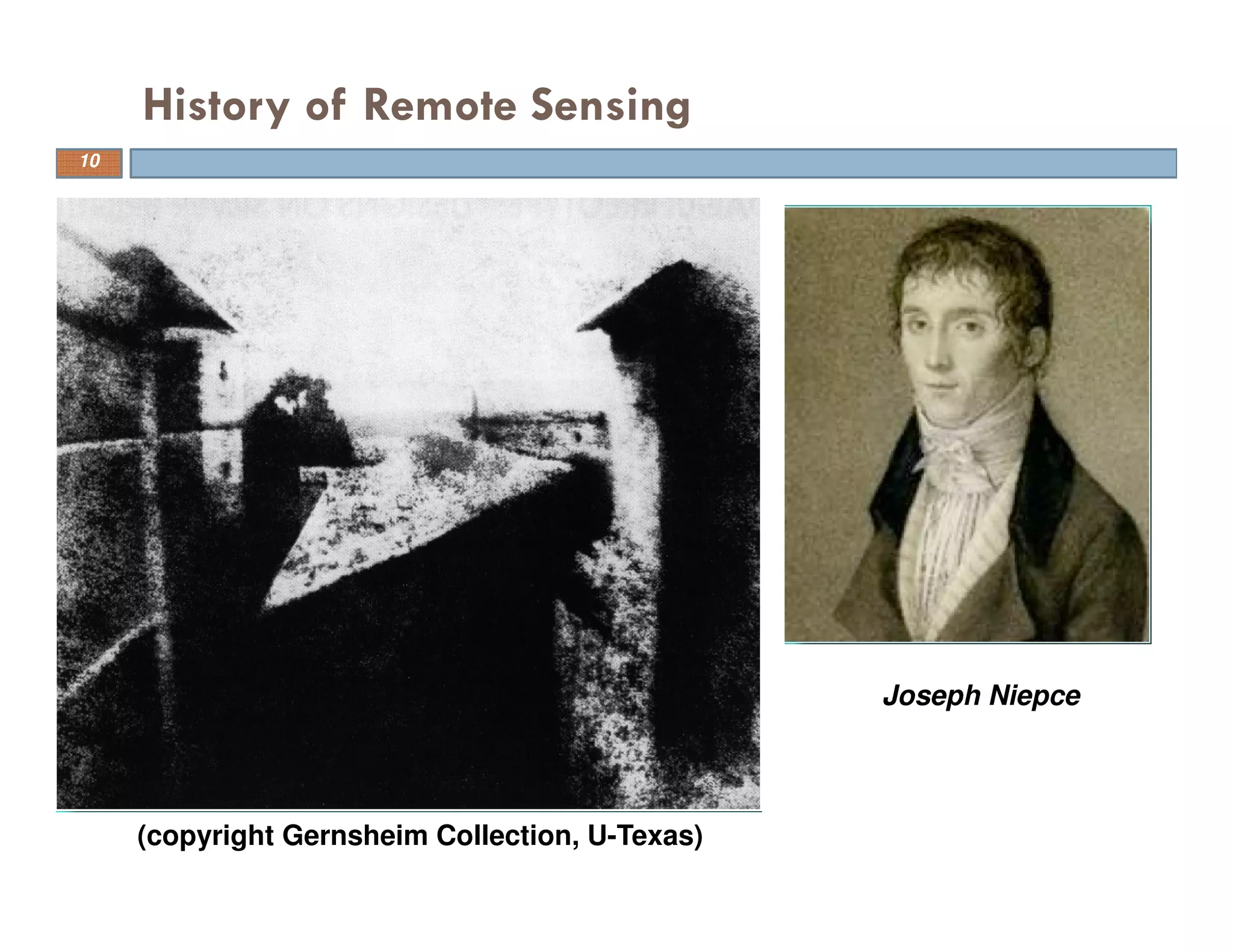
1826: Joseph Niepce takes first photograph
1839: Beginning of practice of photography
1850–1860: Photography from balloons
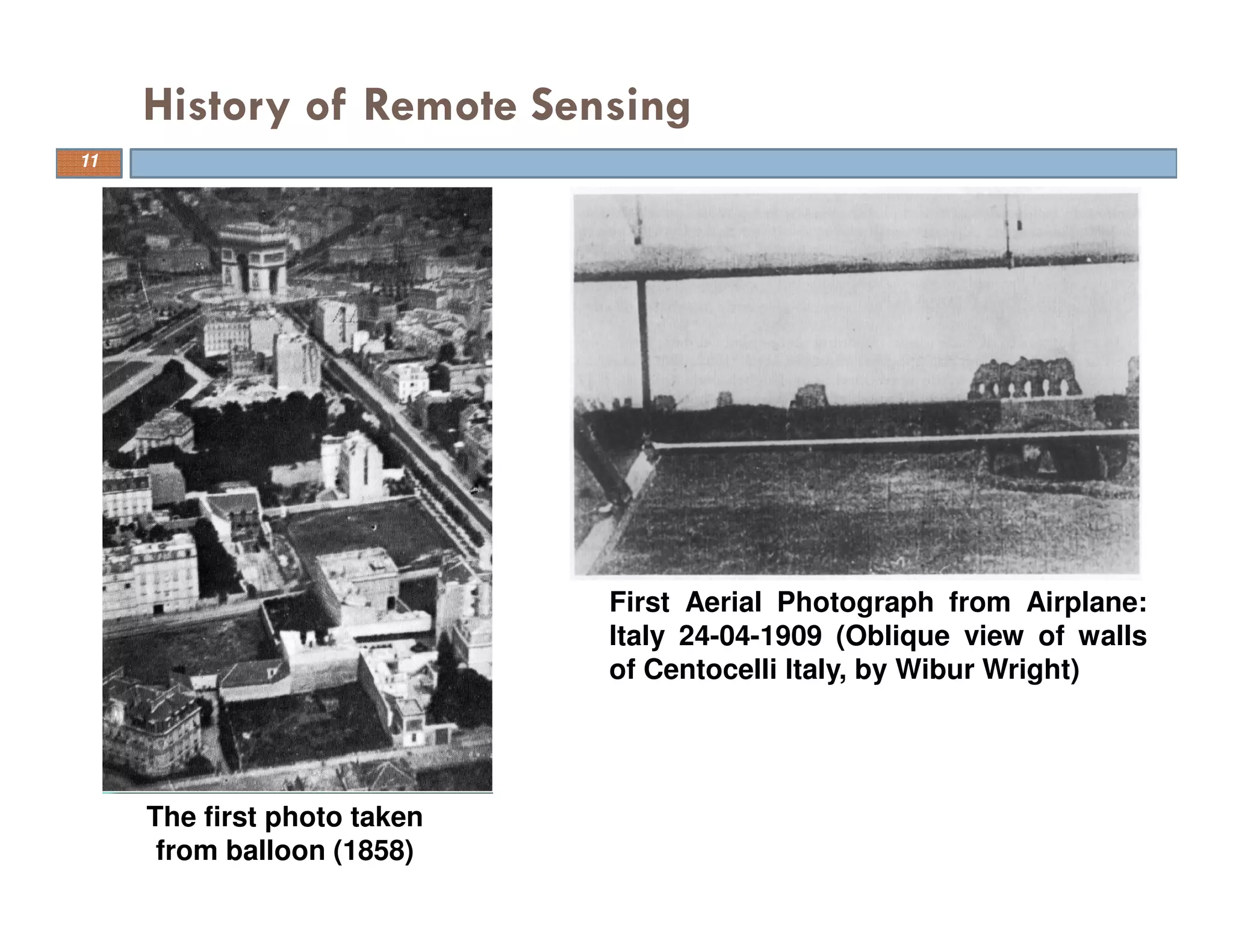
1858: Gaspard Tournachon takes first aerial photograph from a balloon
1847: Infrared spectrum shown by A. H. L. Fizeau and J. B. L. Foucault to share
properties with visible light
1873: Theory of electromagnetic energy developed by James Clerk Maxwell
1909: Photography from airplanes
1914-1918 World War I: Aerial reconnaissance
1920–1930: Development and initial applications of aerial photography and
photogrammetry
History of Remote Sensing
8
1929–1939: Economic depression generates environmental crises that lead to
governmental applications of aerial photography
1930–1940: Development of radars in Germany, US, and UK
1939–1945: World War II: applications of nonvisible portions of electromagnetic
spectrum; training of persons in acquisition and interpretation of airphotos
1950–1960: Military research and development
1956 Colwell’s research on plant disease detection with infrared photography
1960–1970: First use of term remote sensing TIROS weather satellite Skylab remote
sensing observations from space
1972: Launch of Landsat 1
1970–1980: Rapid advances in digital image processing
1980–1990: Landsat 4: new generation of Landsat sensors
1986: SPOT French Earth observation satellite
1980s: Development of hyperspectral sensors
1990s: Global remote sensing systems, lidars
History of Remote Sensing
9
History of Remote Sensing
10
Joseph Niepce
(copyright Gernsheim Collection, U-Texas)
History of Remote Sensing
11
First Aerial Photograph from Airplane:
Italy 24-04-1909 (Oblique view of walls
of Centocelli Italy, by Wibur Wright)
The first photo taken
from balloon (1858)
History of Remote Sensing
12
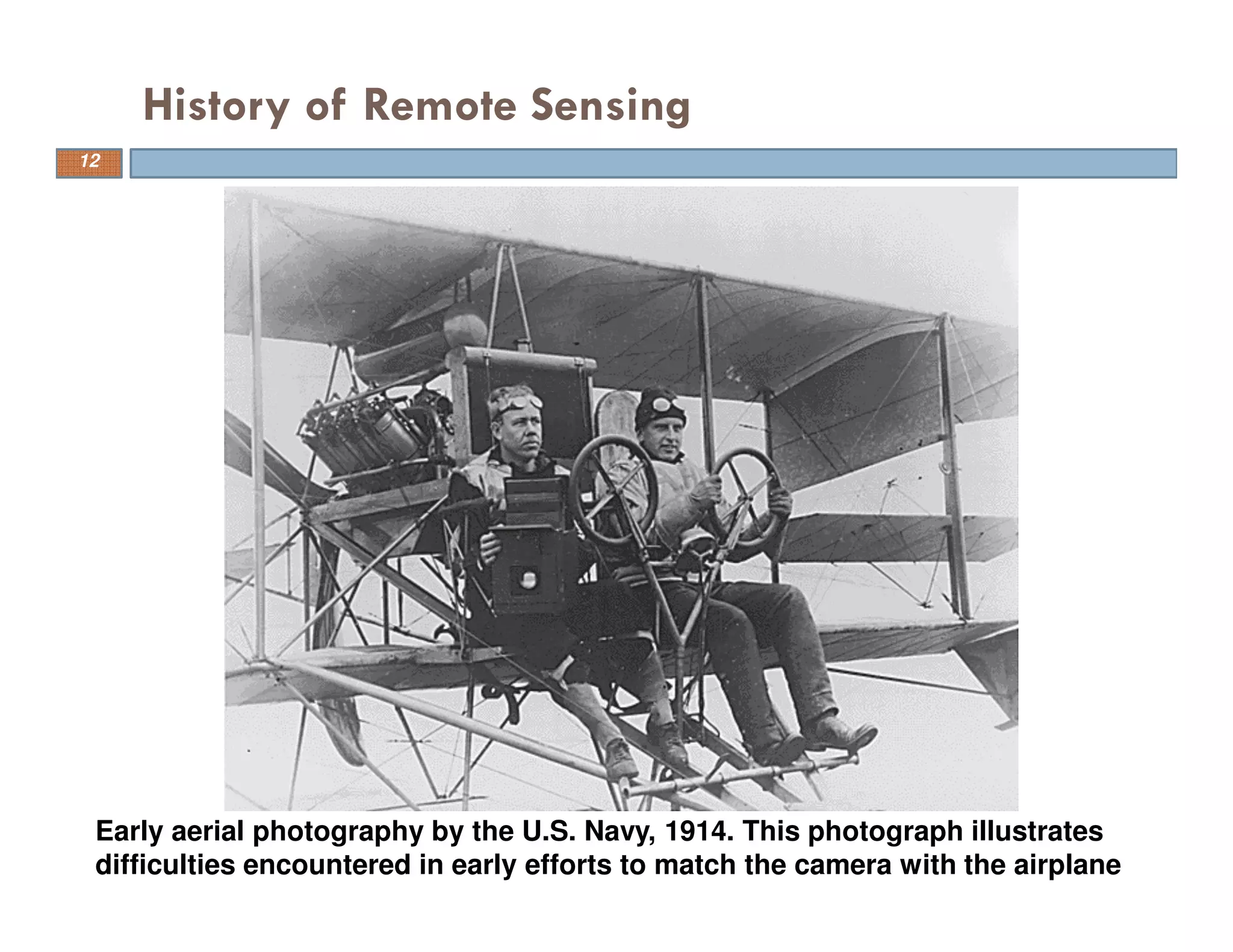
Early aerial photography by the U.S. Navy, 1914. This photograph illustrates
difficulties encountered in early efforts to match the camera with the airplane
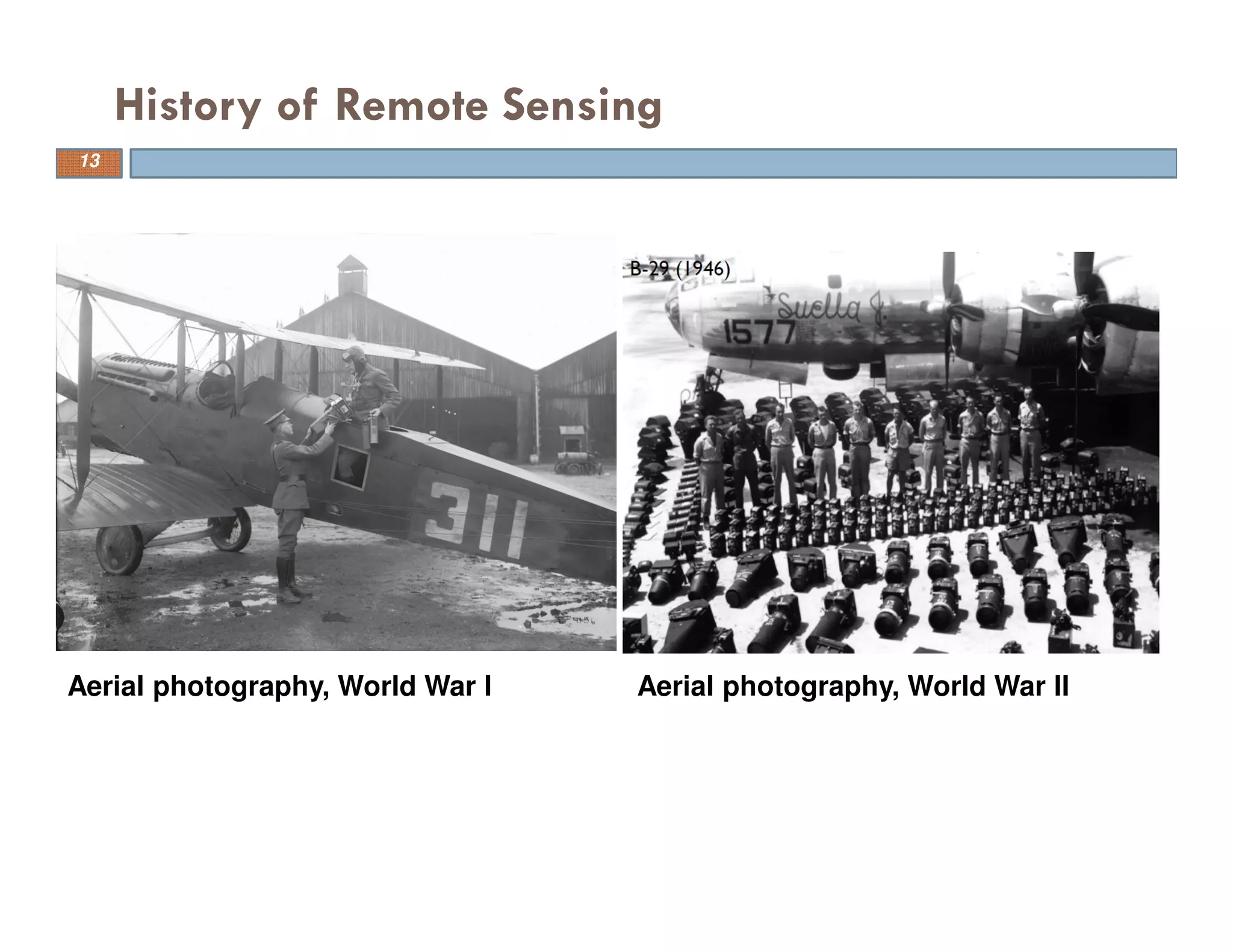
History of Remote Sensing
Aerial photography, World War I Aerial photography, World War II
13
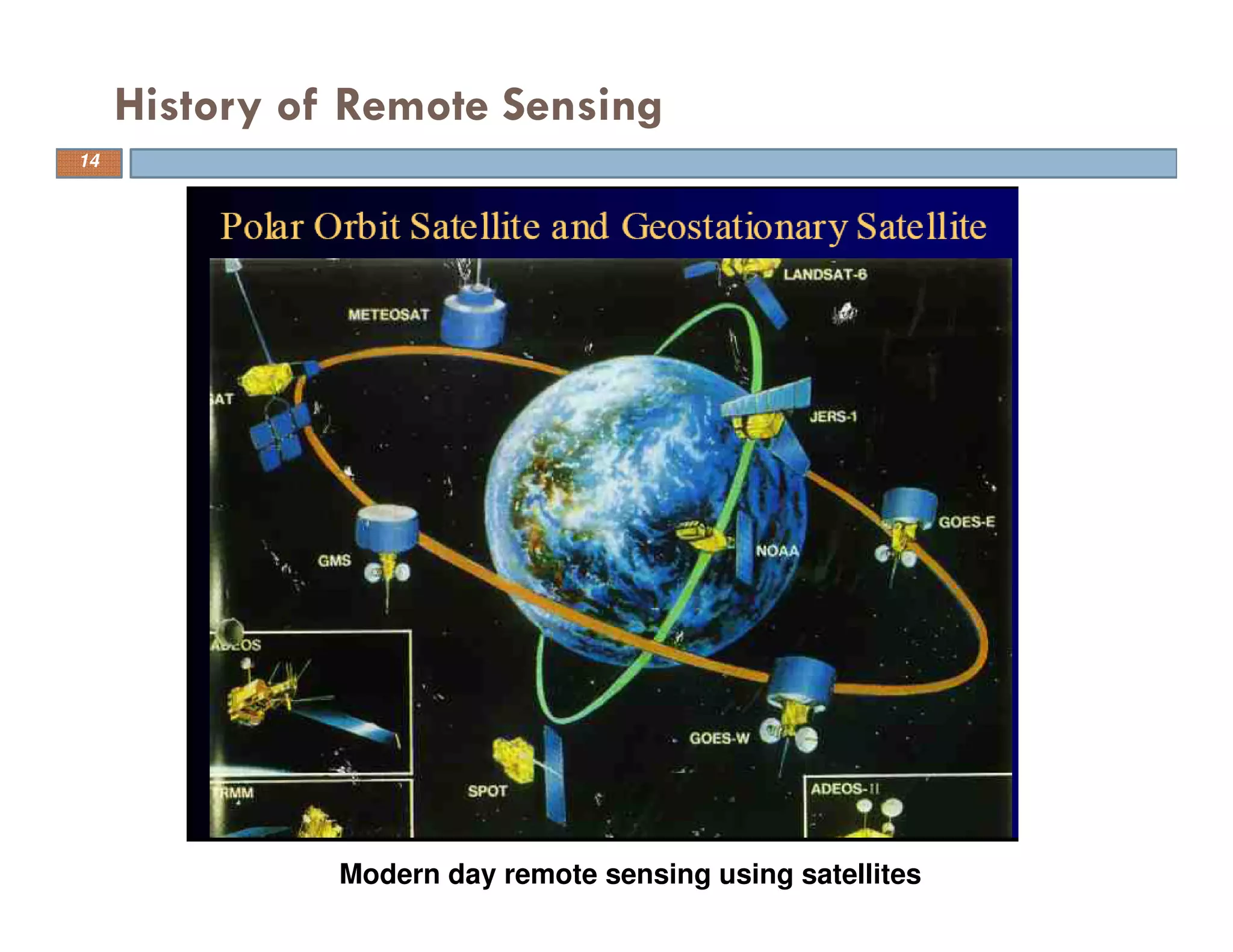
History of Remote Sensing
Modern day remote sensing using satellites
14
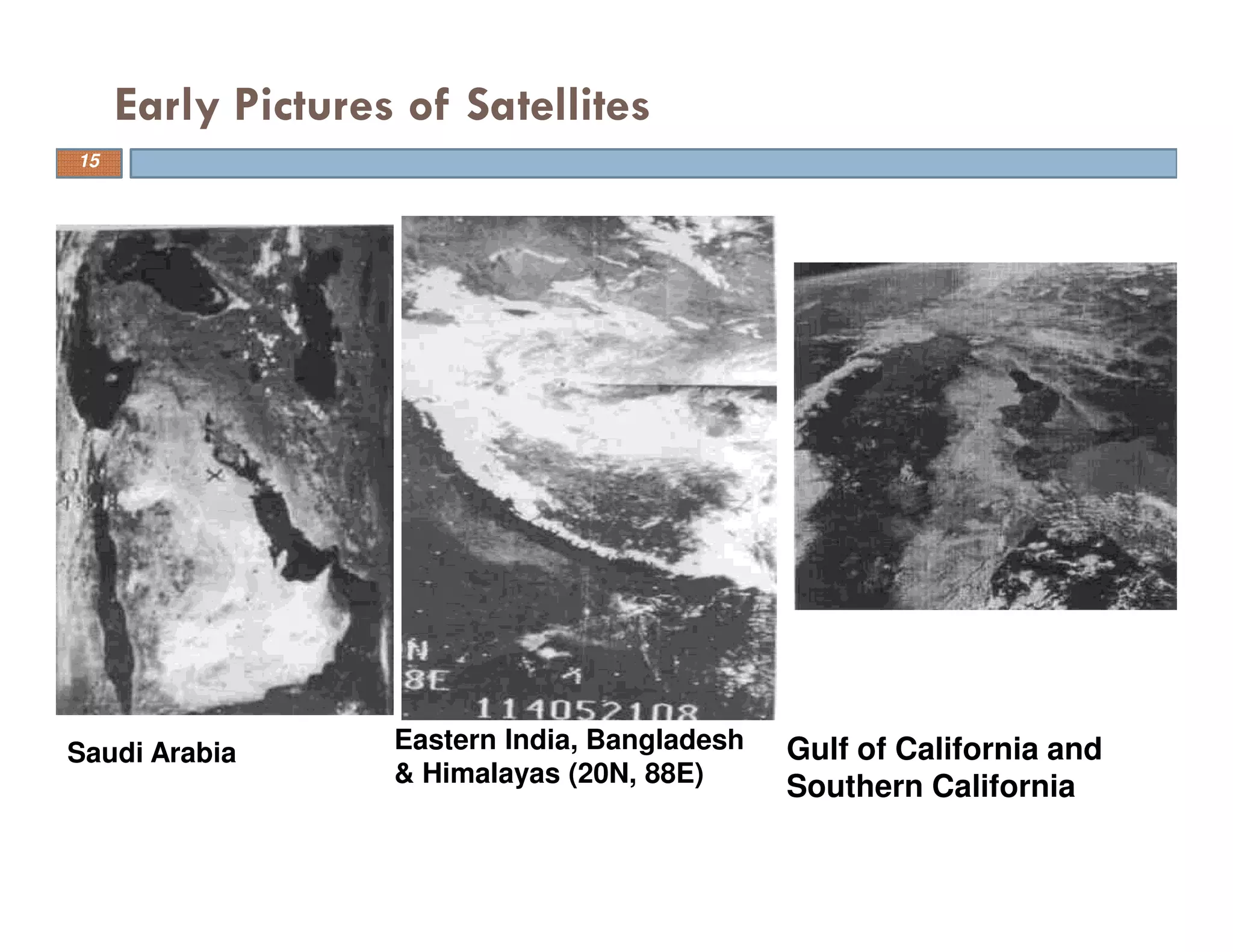
Early Pictures of Satellites
15
Saudi Arabia Eastern India, Bangladesh
& Himalayas (20N, 88E)
Gulf of California and
Southern California
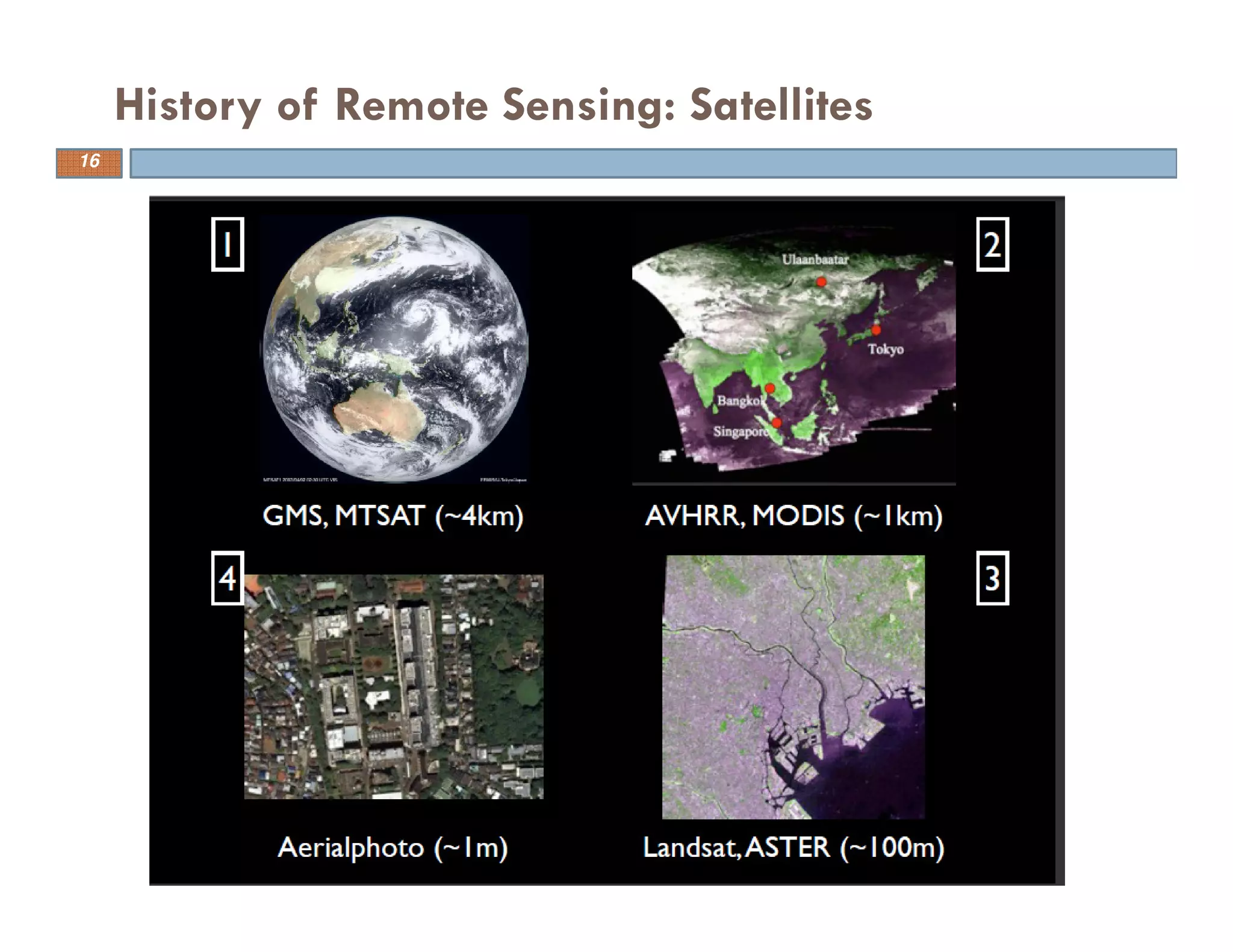
History of Remote Sensing: Satellites
16
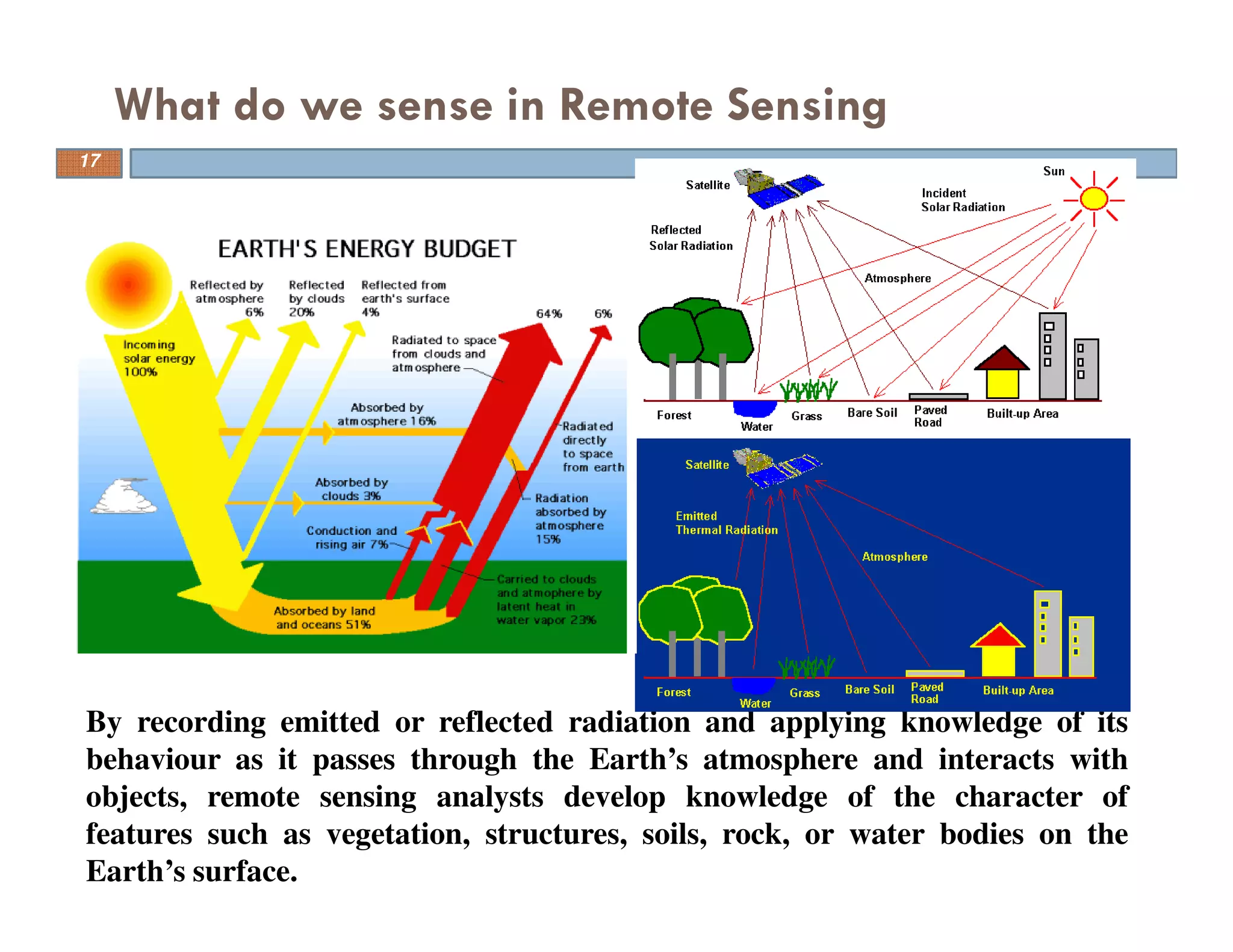
What do we sense in Remote Sensing
By recording emitted or reflected radiation and applying knowledge of its
behaviour as it passes through the Earth’s atmosphere and interacts with
objects, remote sensing analysts develop knowledge of the character of
features such as vegetation, structures, soils, rock, or water bodies on the
Earth’s surface.
17
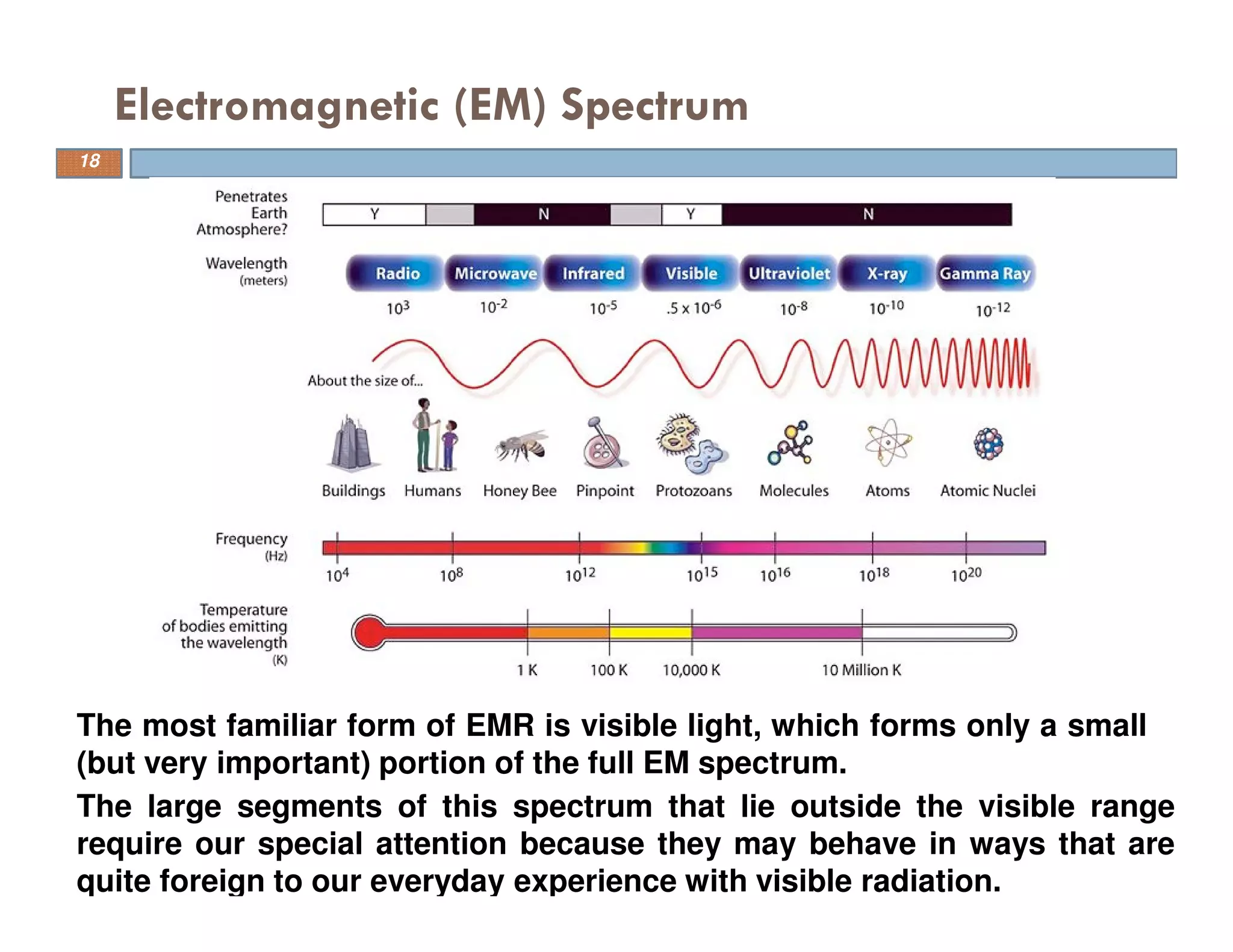
Electromagnetic (EM) Spectrum
18
The most familiar form of EMR is visible light, which forms only a small
(but very important) portion of the full EM spectrum.
The large segments of this spectrum that lie outside the visible range
require our special attention because they may behave in ways that are
quite foreign to our everyday experience with visible radiation.
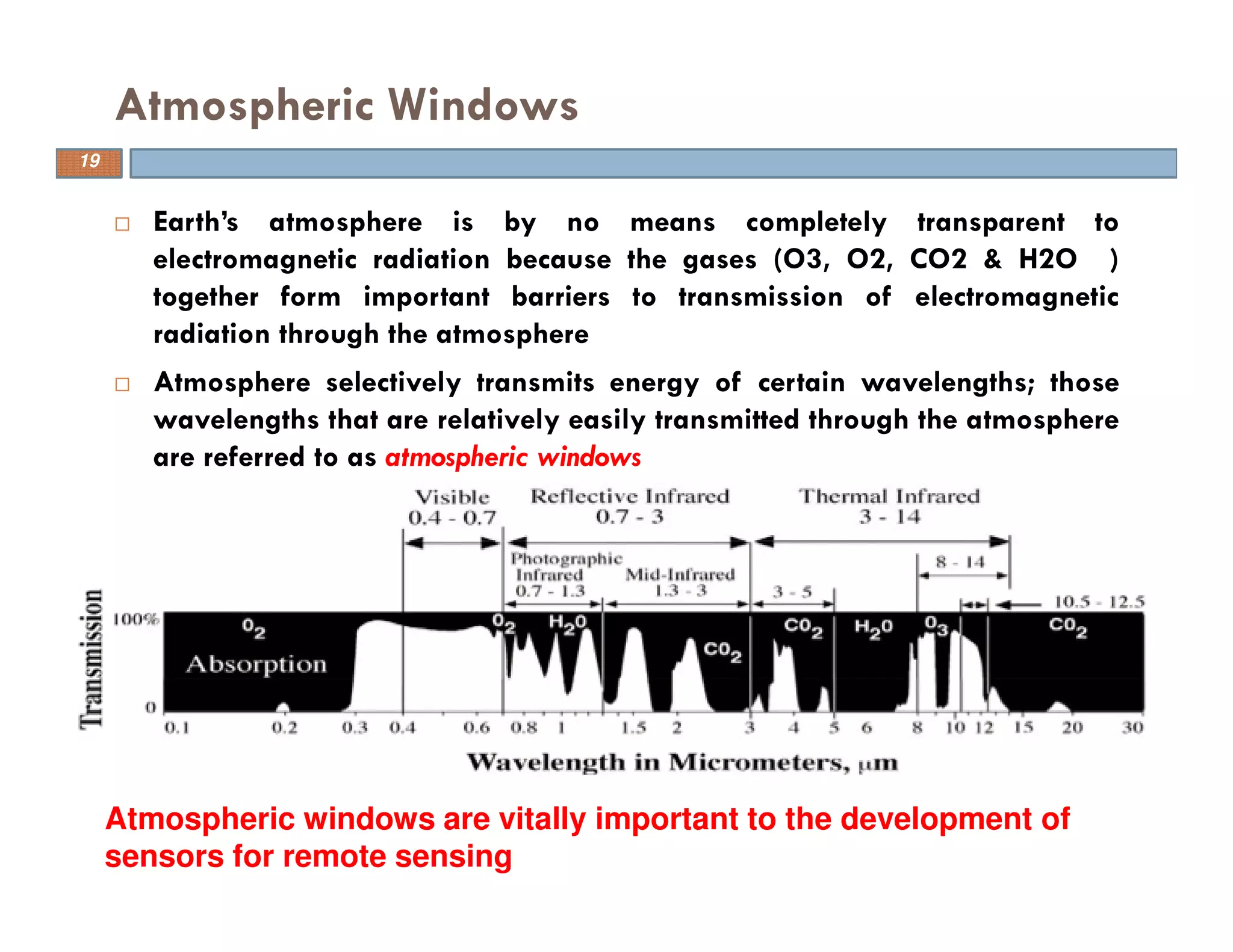
Earth’s atmosphere is by no means completely transparent to
electromagnetic radiation because the gases (O3, O2, CO2 & H2O )
together form important barriers to transmission of electromagnetic
radiation through the atmosphere
Atmosphere selectively transmits energy of certain wavelengths; those
wavelengths that are relatively easily transmitted through the atmosphere
are referred to as atmospheric windows
Atmospheric Windows
Atmospheric windows are vitally important to the development of
sensors for remote sensing
19
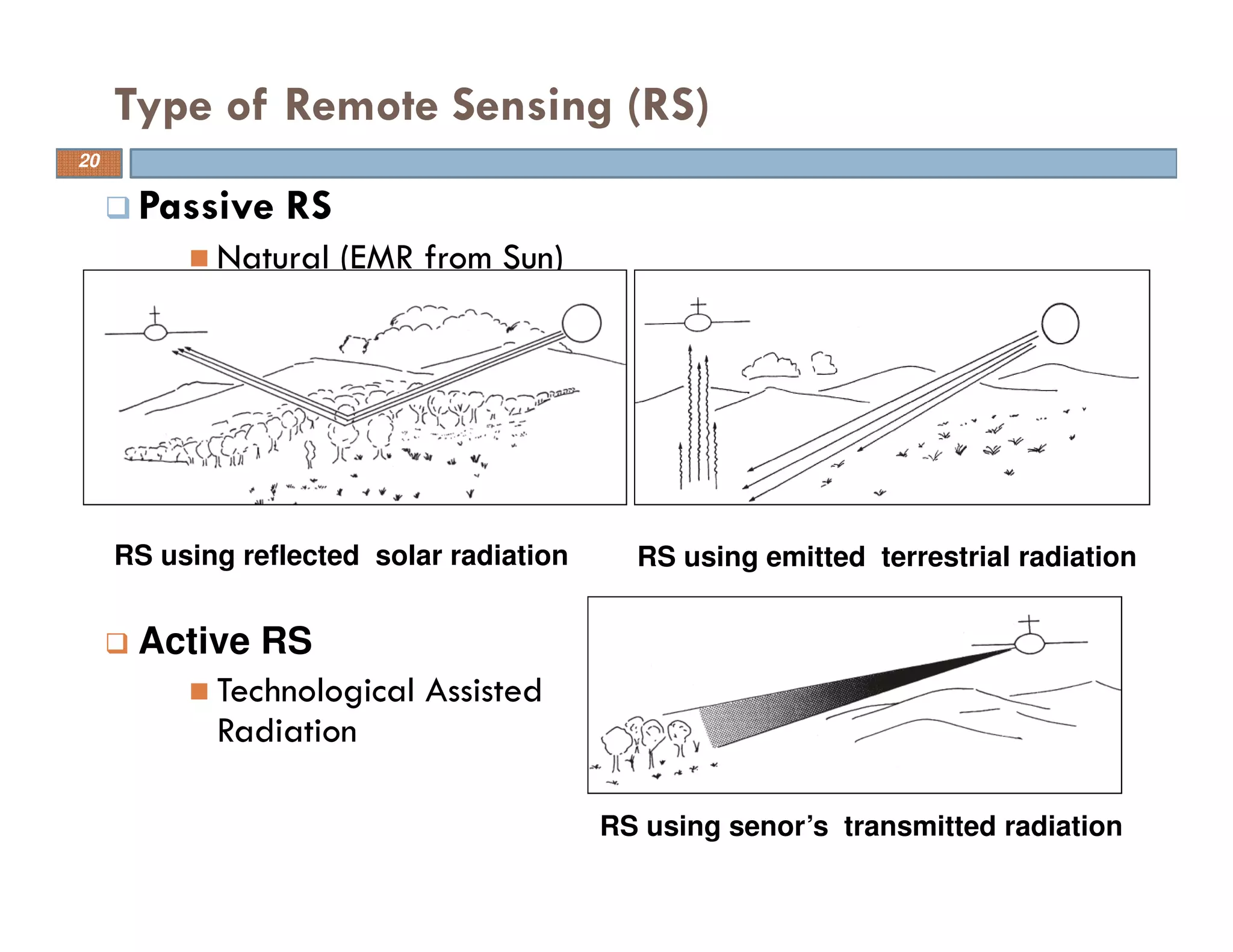
Type of Remote Sensing (RS)
20
Passive RS
Natural (EMR from Sun)
Active RS
Technological Assisted
Radiation
RS using reflected solar radiation RS using emitted terrestrial radiation
RS using senor’s transmitted radiation
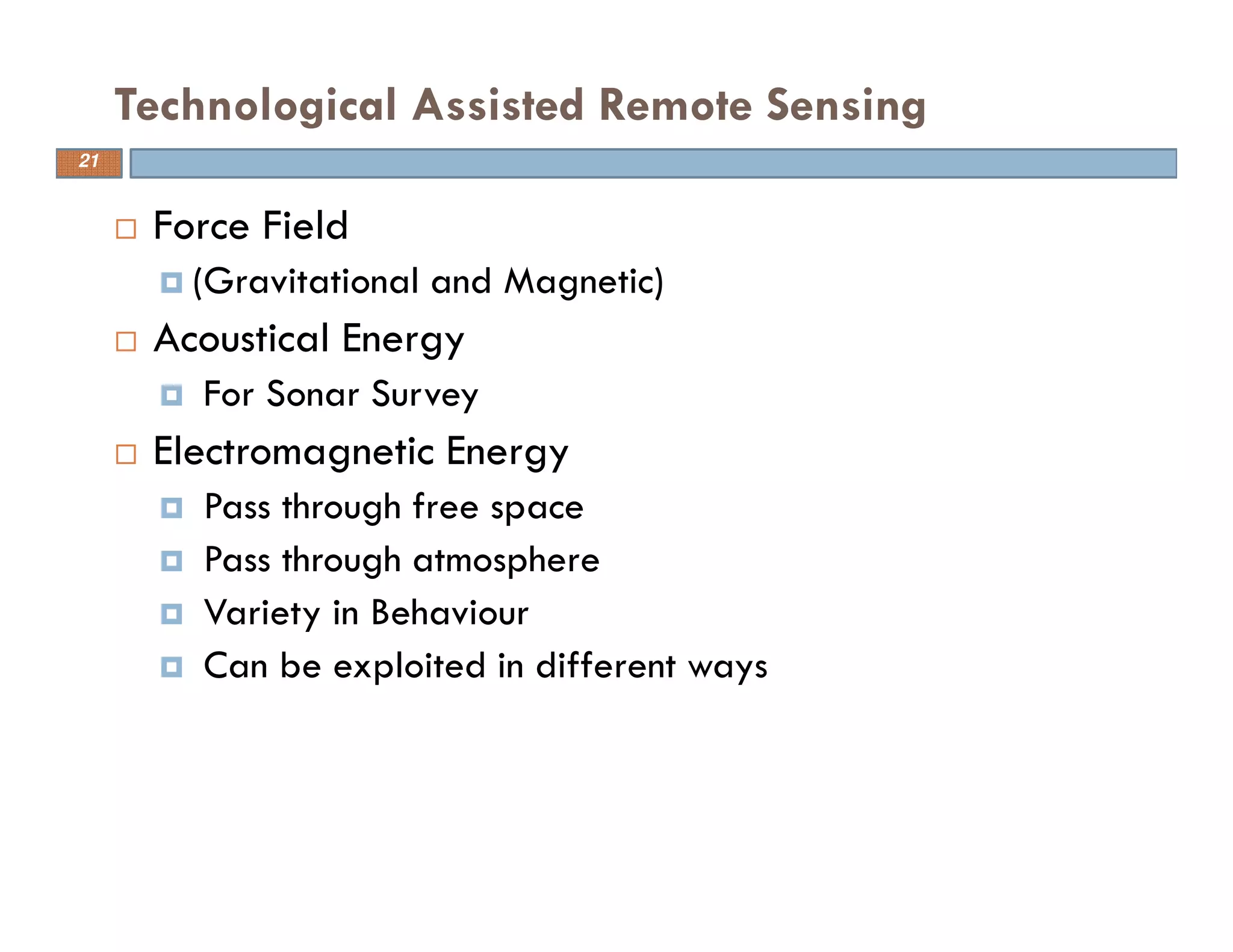
Force Field
(Gravitational and Magnetic)
Acoustical Energy
For Sonar Survey
Electromagnetic Energy
Pass through free space
Pass through atmosphere
Variety in Behaviour
Can be exploited in different ways
Technological Assisted Remote Sensing
21
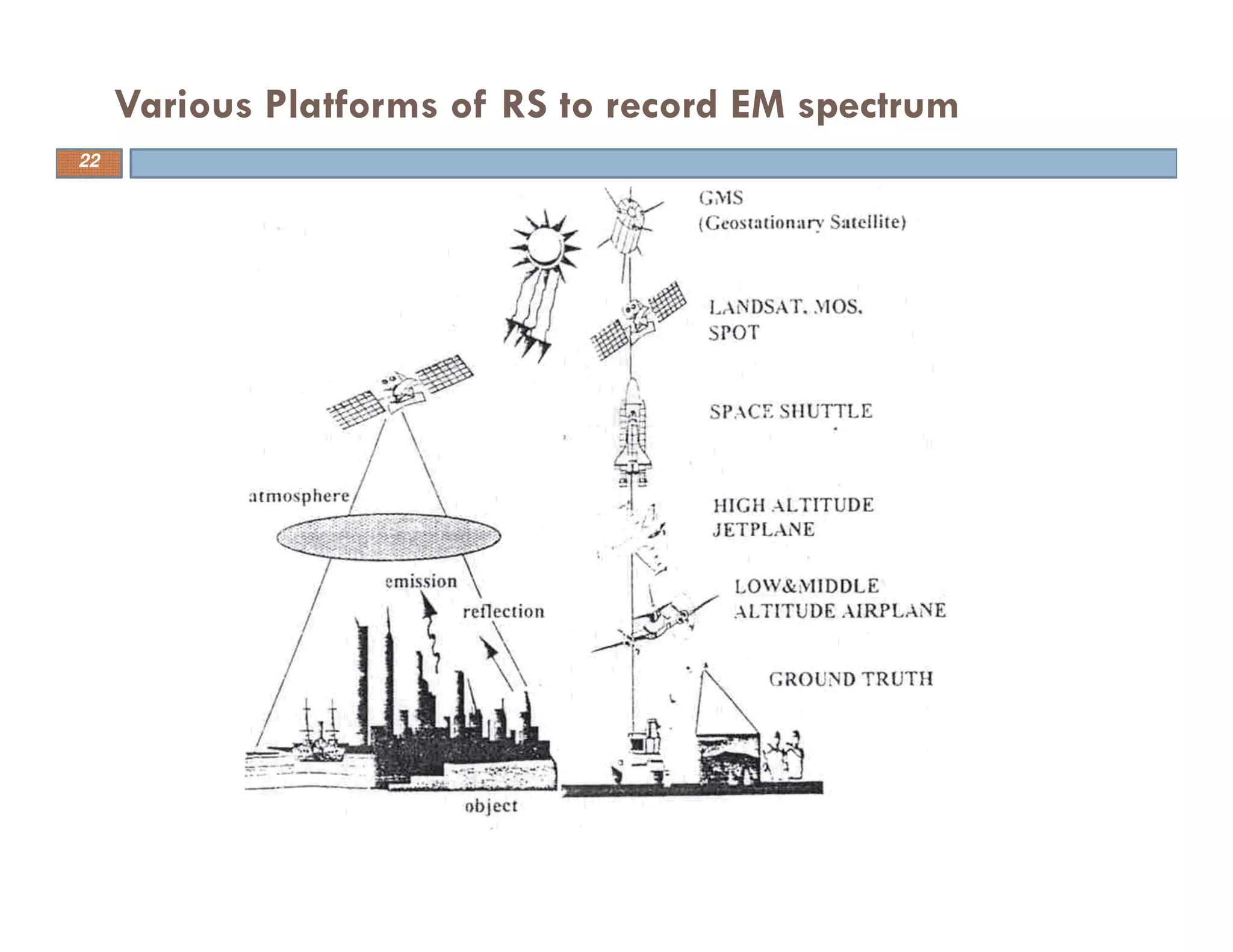
Various Platforms of RS to record EM spectrum
22
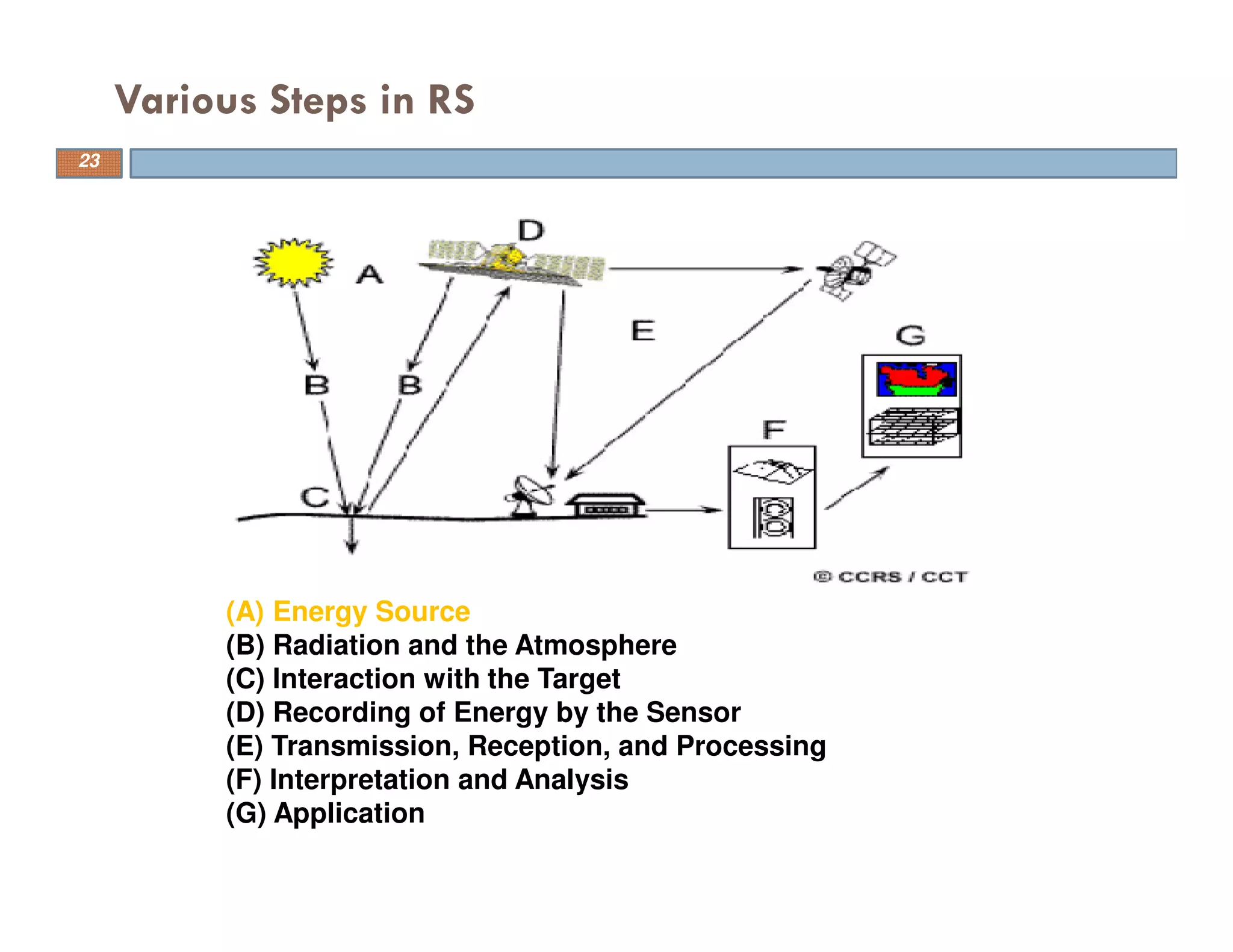
Various Steps in RS
23
(A) Energy Source
(B) Radiation and the Atmosphere
(C) Interaction with the Target
(D) Recording of Energy by the Sensor
(E) Transmission, Reception, and Processing
(F) Interpretation and Analysis
(G) Application
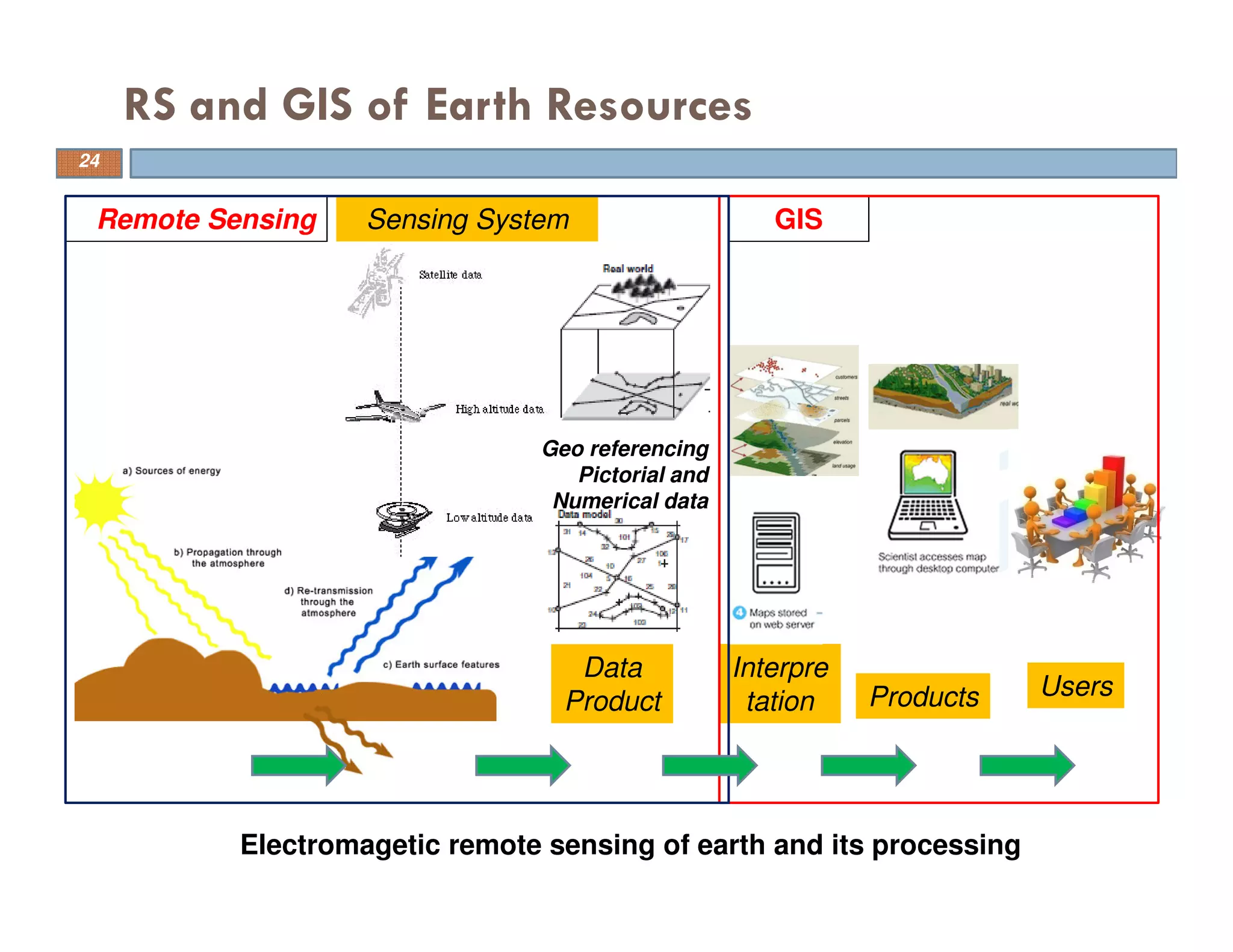
RS and GIS of Earth Resources
24
Remote Sensing GIS
Data
Product
Interpre
tation Products Users
Electromagetic remote sensing of earth and its processing
Sensing System
Geo referencing
Pictorial and
Numerical data
Geographic Information Systems (GIS) system designed to capture,
store, manipulate, analyze, manage, and present all types of
geographically referenced data
GIS are computerized systems designed for the storage, retrieval and
analysis of geographically referenced data
GIS uses advanced analytical tools to explore at a scientific level the
spatial relationships, patterns, and processes of cultural, biological,
demographic, economic, geographic, and physical phenomena
GIS stores related geographic features in separate collections of files
called map layers
Map layers can be reused easily and assembled into any number of
map compositions and overlaid for analysis
Geographic Information System (GIS)
25
Unique capabilities of GIS
Geographic Information System (GIS)
26
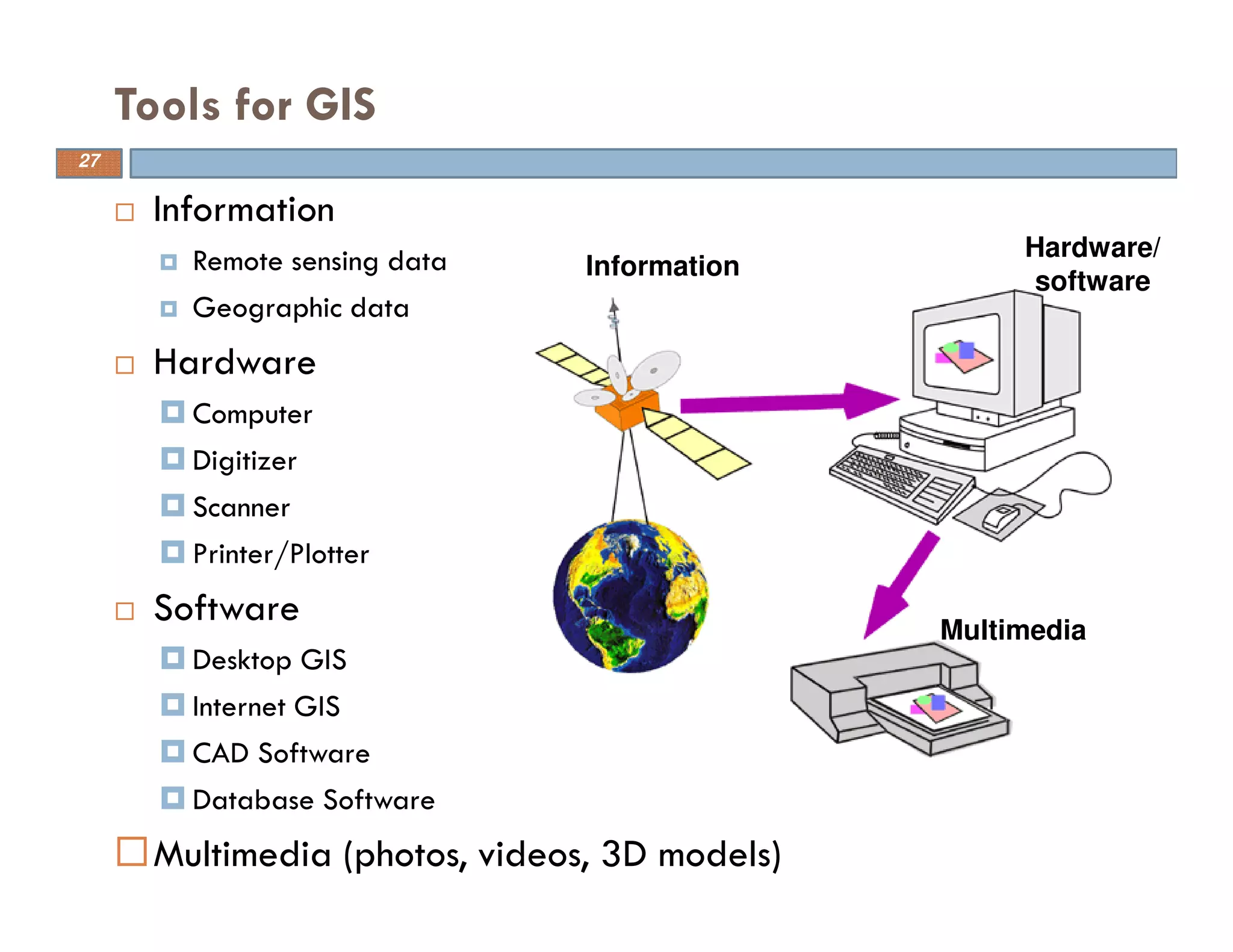
Information
Remote sensing data
Geographic data
Hardware
Computer
Digitizer
Scanner
Printer/Plotter
Software
Desktop GIS
Internet GIS
CAD Software
Database Software
Multimedia (photos, videos, 3D models)
Tools for GIS
27
Information
Hardware/
software
Multimedia
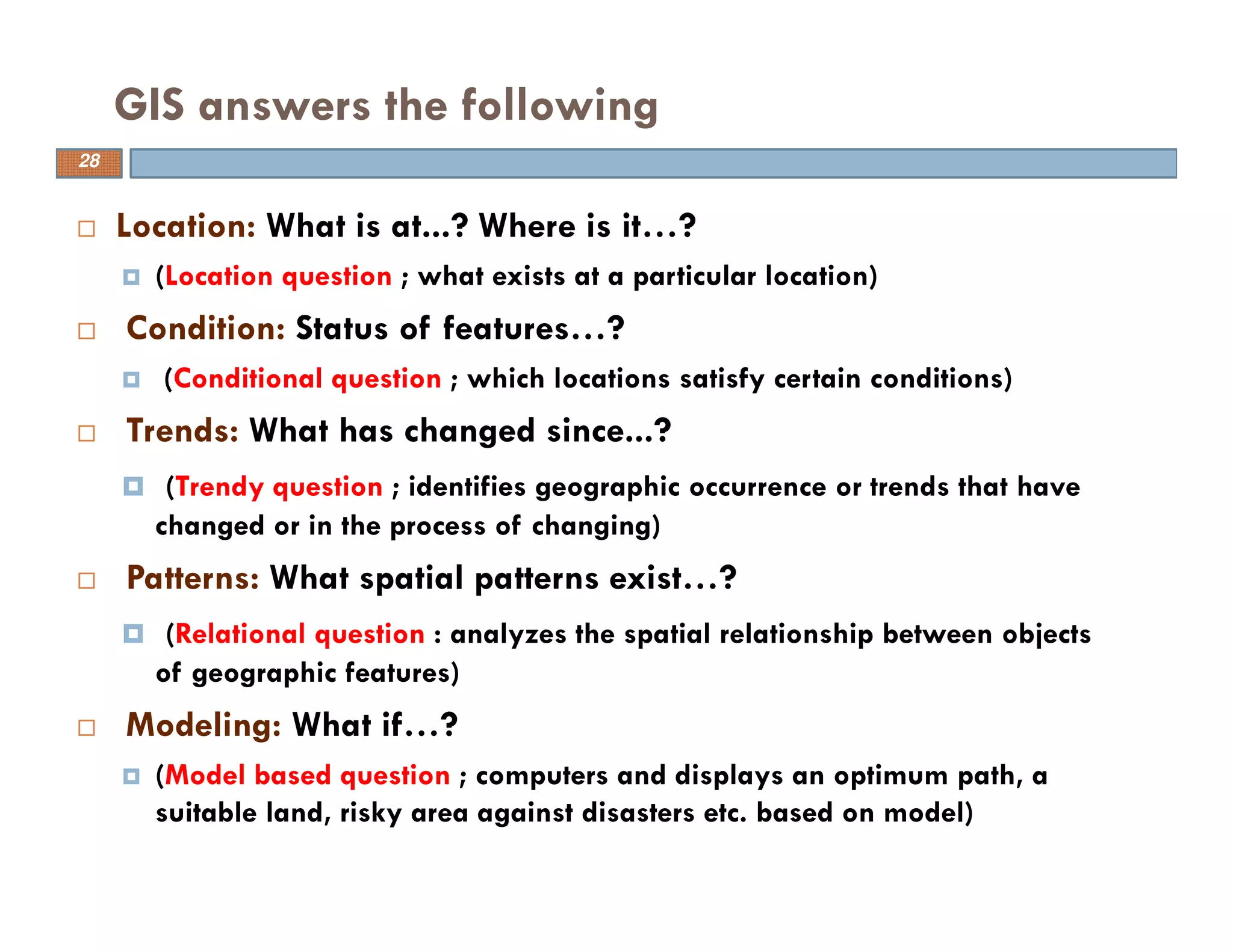
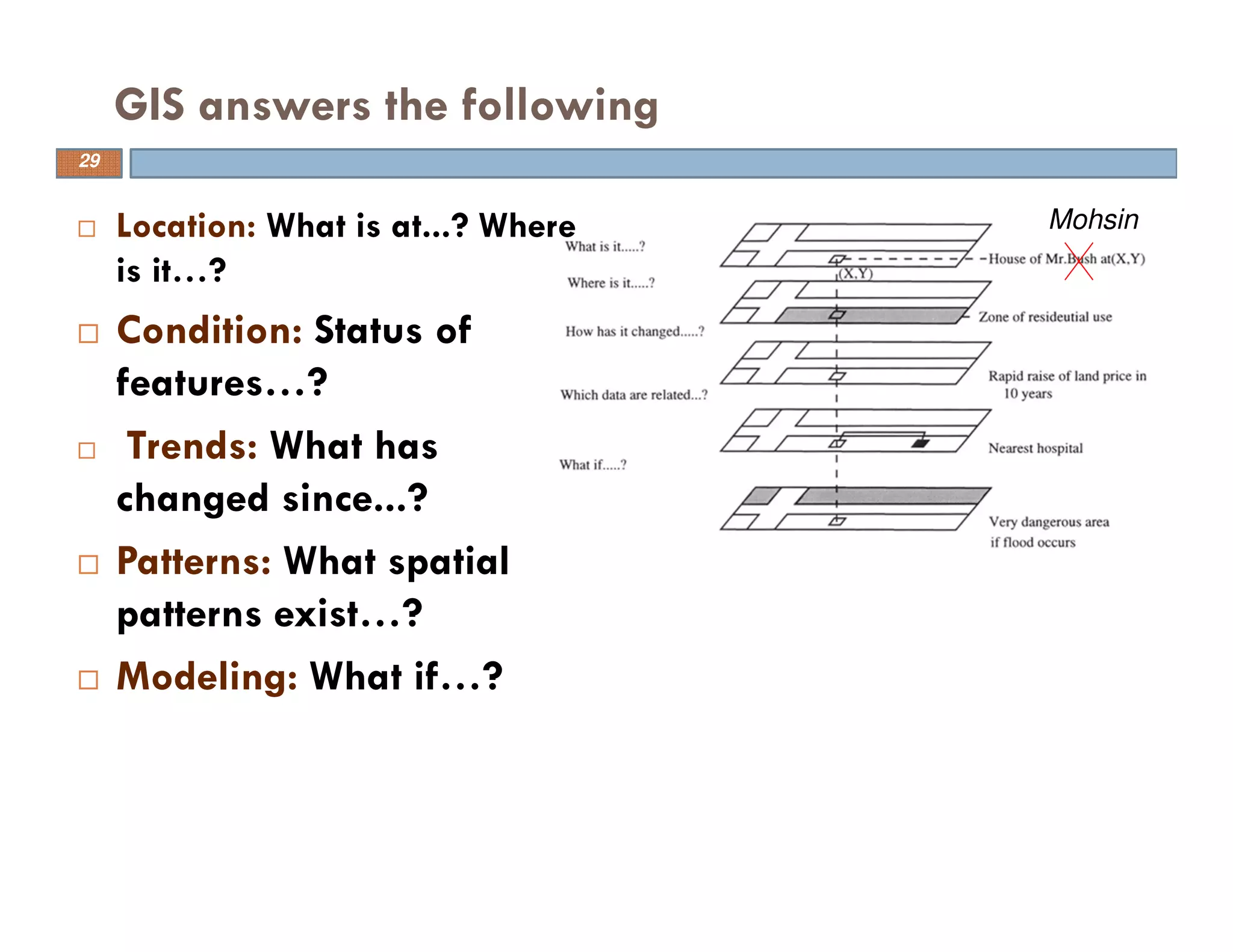
Location: What is at...? Where is it…?
(Location question ; what exists at a particular location)
Condition: Status of features…?
(Conditional question ; which locations satisfy certain conditions)
Trends: What has changed since...?
(Trendy question ; identifies geographic occurrence or trends that have
changed or in the process of changing)
Patterns: What spatial patterns exist…?
(Relational question : analyzes the spatial relationship between objects
of geographic features)
Modeling: What if…?
(Model based question ; computers and displays an optimum path, a
suitable land, risky area against disasters etc. based on model)
GIS answers the following
28
Location: What is at...? Where
is it…?
Condition: Status of
features…?
Trends: What has
changed since...?
Patterns: What spatial
patterns exist…?
Modeling: What if…?
GIS answers the following
29
Mohsin
Basic data manipulation in RS & GIS
30
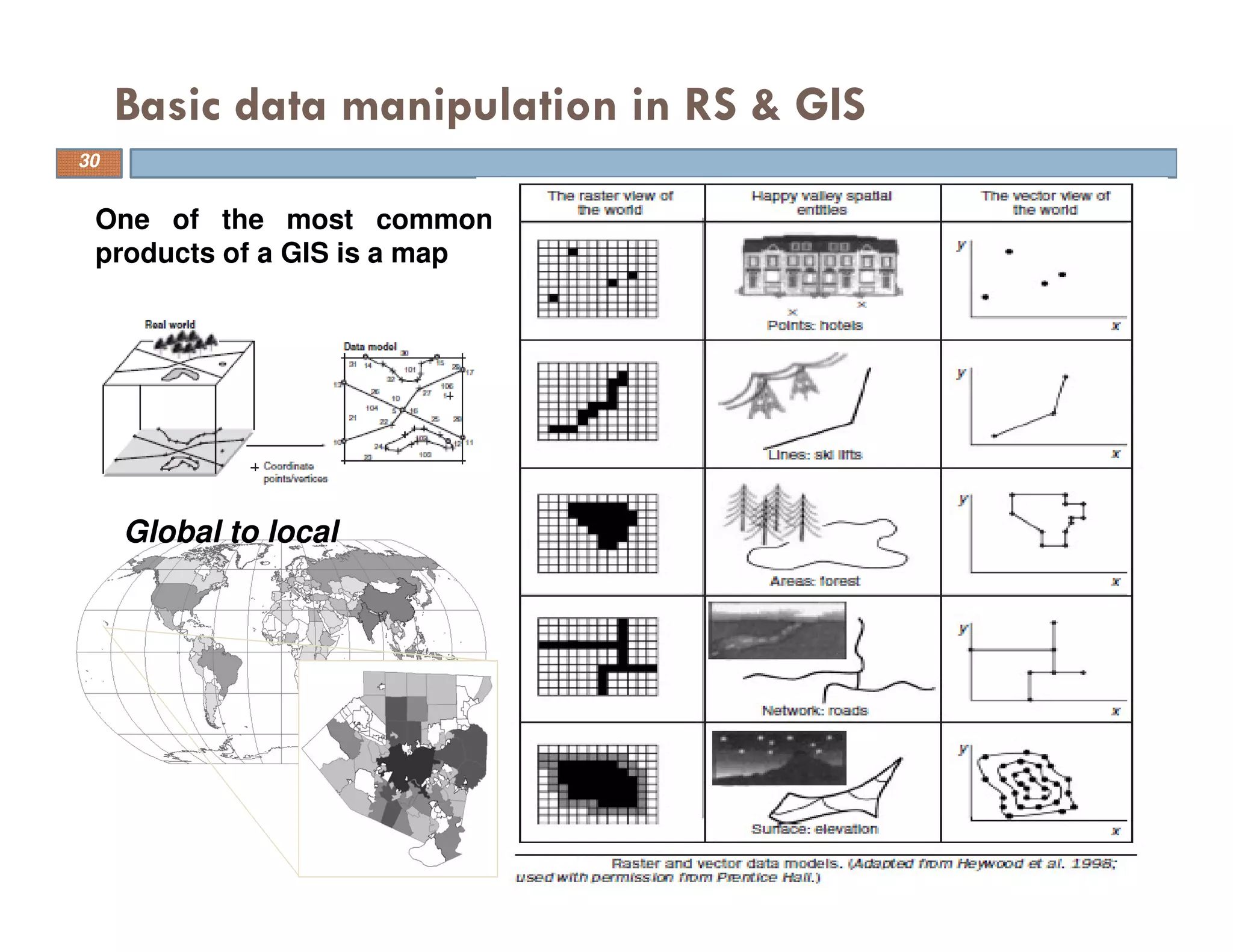
One of the most common
products of a GIS is a map
Global to local
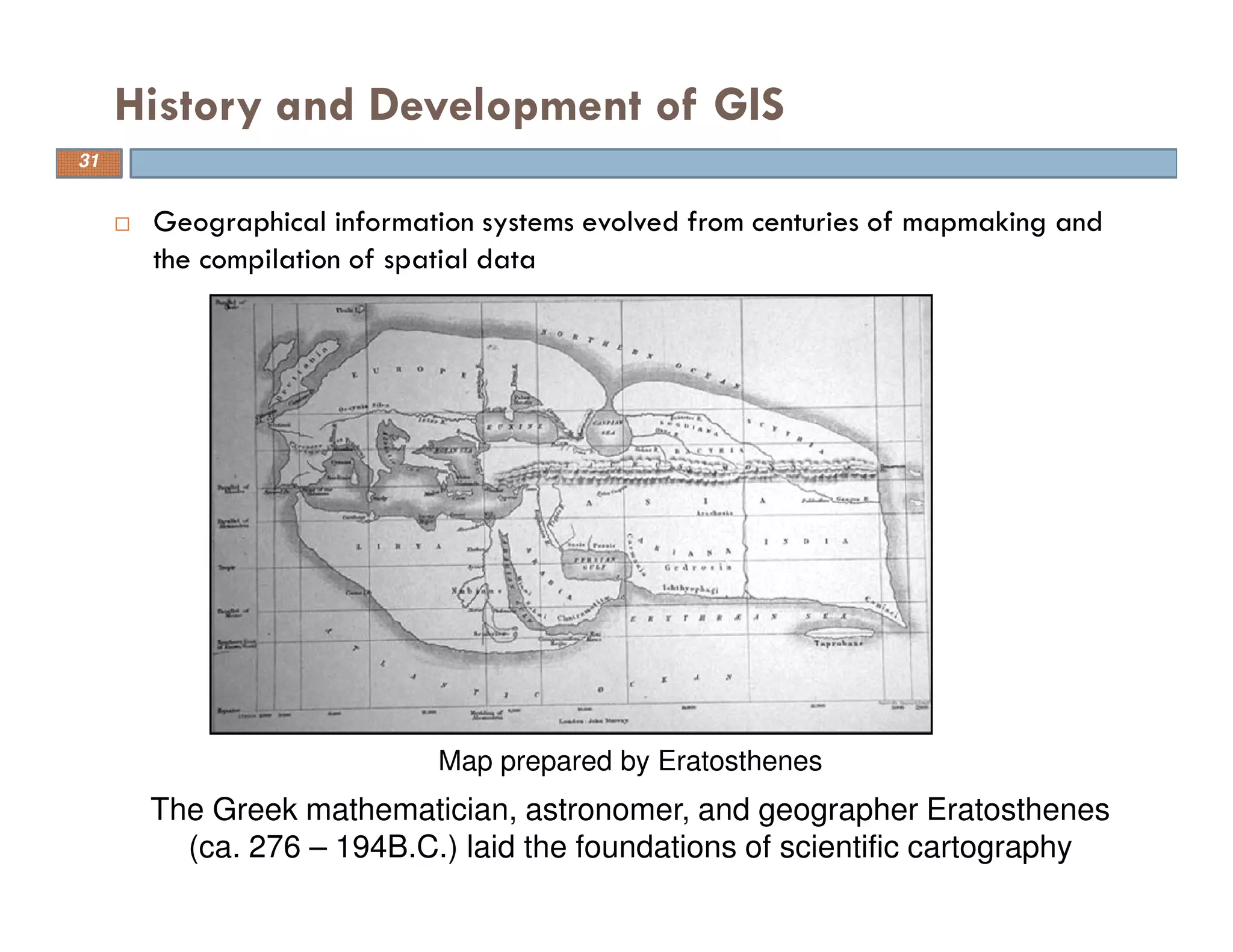
Geographical information systems evolved from centuries of mapmaking and
the compilation of spatial data
History and Development of GIS
31
Map prepared by Eratosthenes
The Greek mathematician, astronomer, and geographer Eratosthenes
(ca. 276 – 194B.C.) laid the foundations of scientific cartography
History and Development of GIS
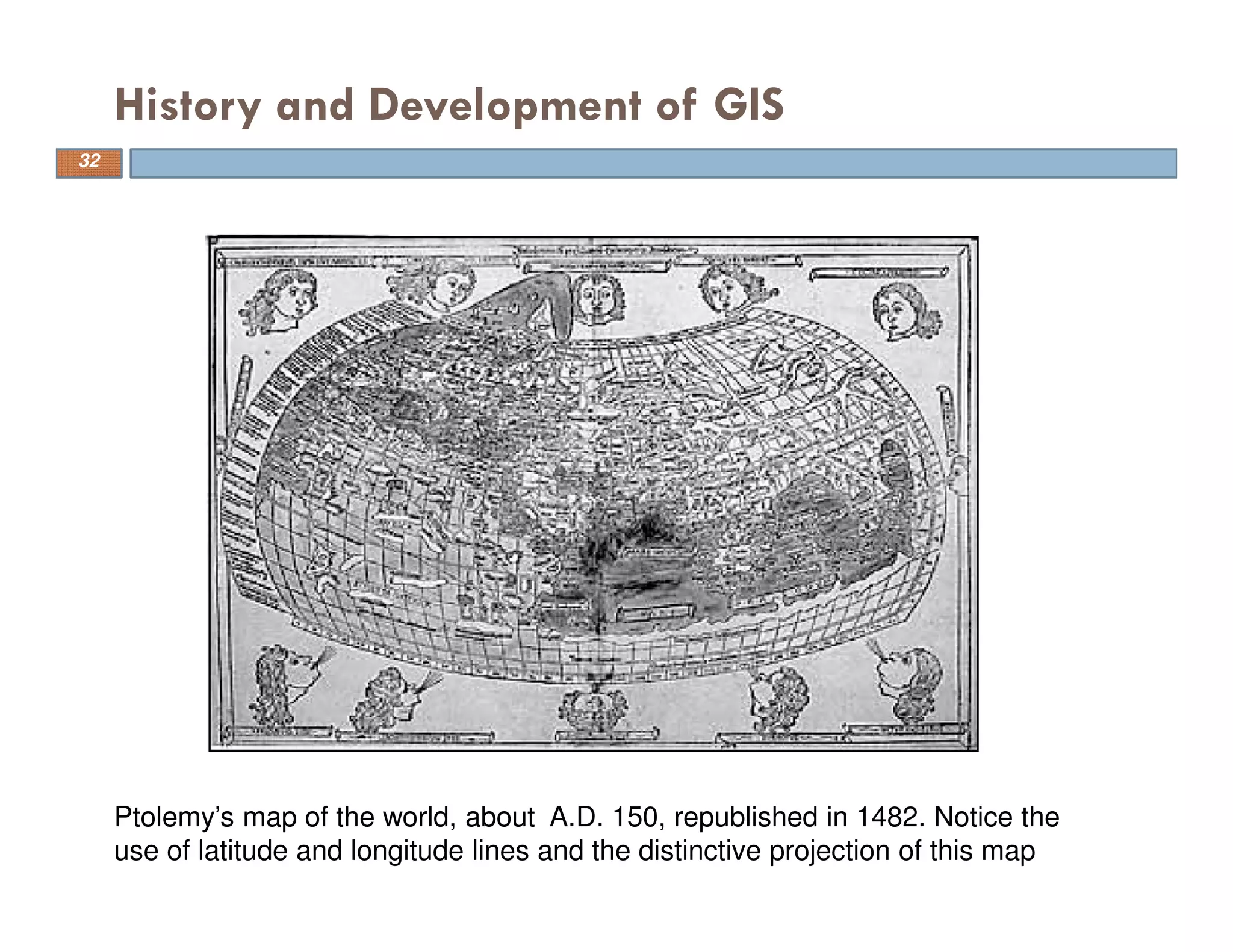
Ptolemy’s map of the world, about A.D. 150, republished in 1482. Notice the
use of latitude and longitude lines and the distinctive projection of this map
32
History and Development of GIS
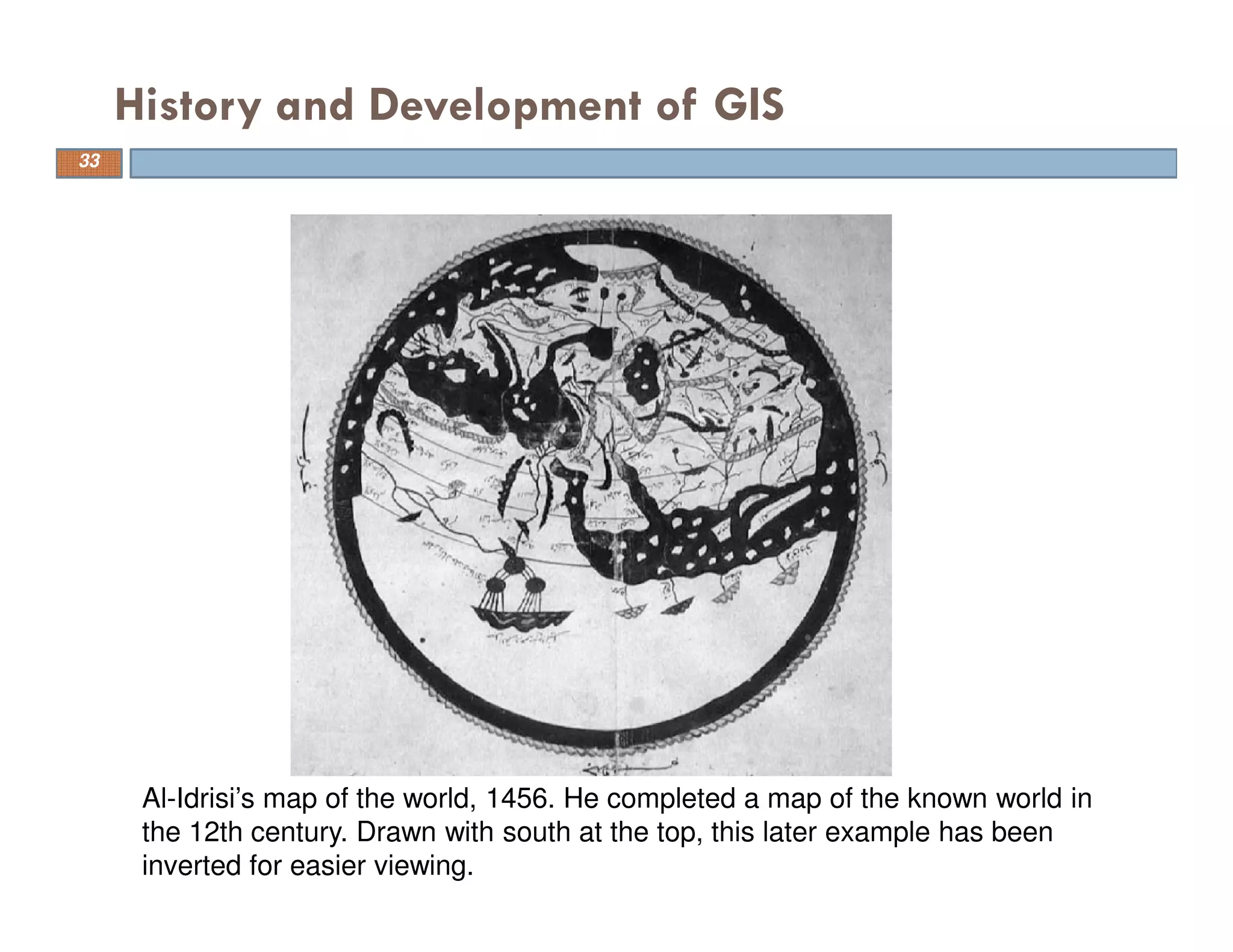
Al-Idrisi’s map of the world, 1456. He completed a map of the known world in
the 12th century. Drawn with south at the top, this later example has been
inverted for easier viewing.
33
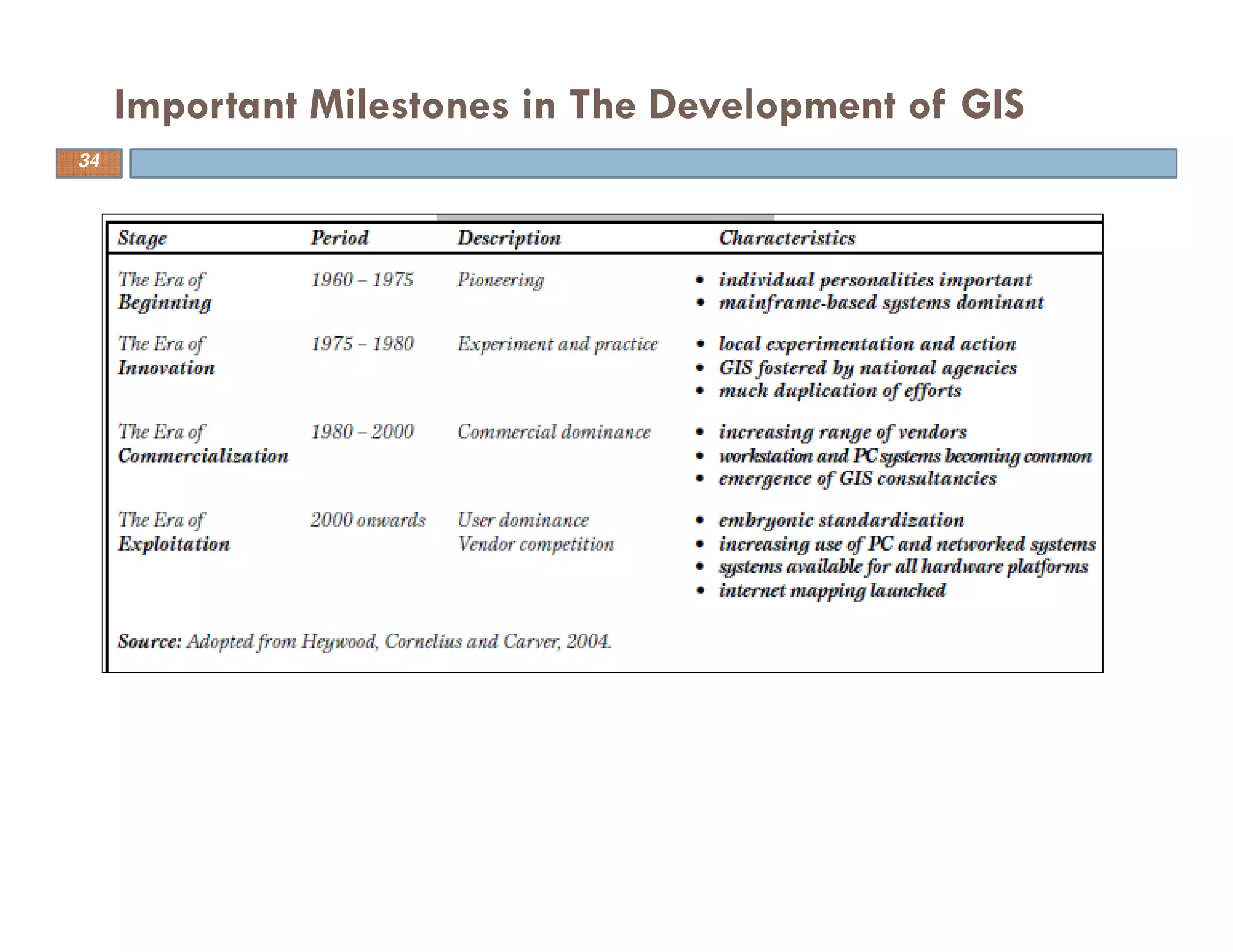
Important Milestones in The Development of GIS
34
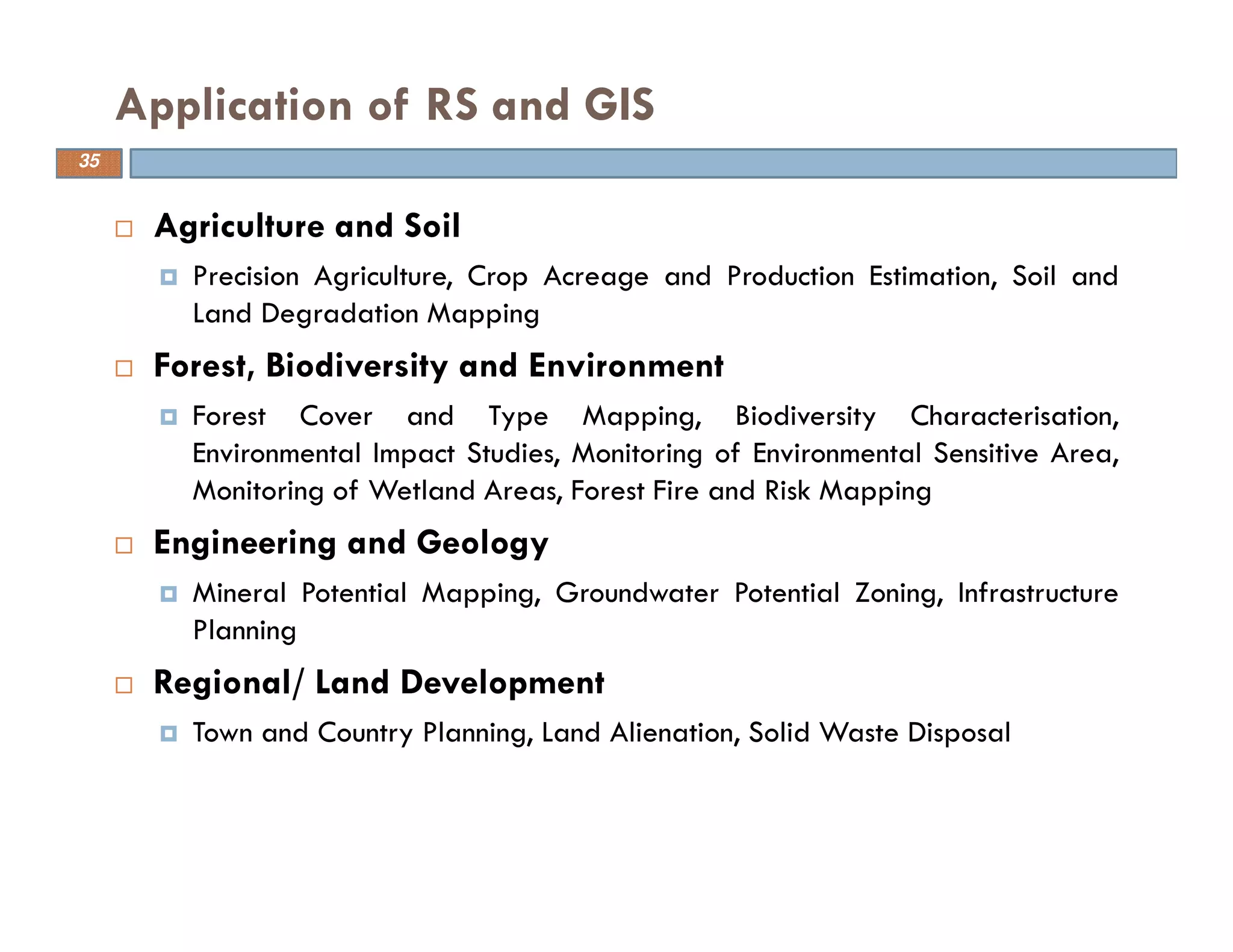
Agriculture and Soil
Precision Agriculture, Crop Acreage and Production Estimation, Soil and
Land Degradation Mapping
Forest, Biodiversity and Environment
Forest Cover and Type Mapping, Biodiversity Characterisation,
Environmental Impact Studies, Monitoring of Environmental Sensitive Area,
Monitoring of Wetland Areas, Forest Fire and Risk Mapping
Engineering and Geology
Mineral Potential Mapping, Groundwater Potential Zoning, Infrastructure
Planning
Regional/ Land Development
Town and Country Planning, Land Alienation, Solid Waste Disposal
Application of RS and GIS
35
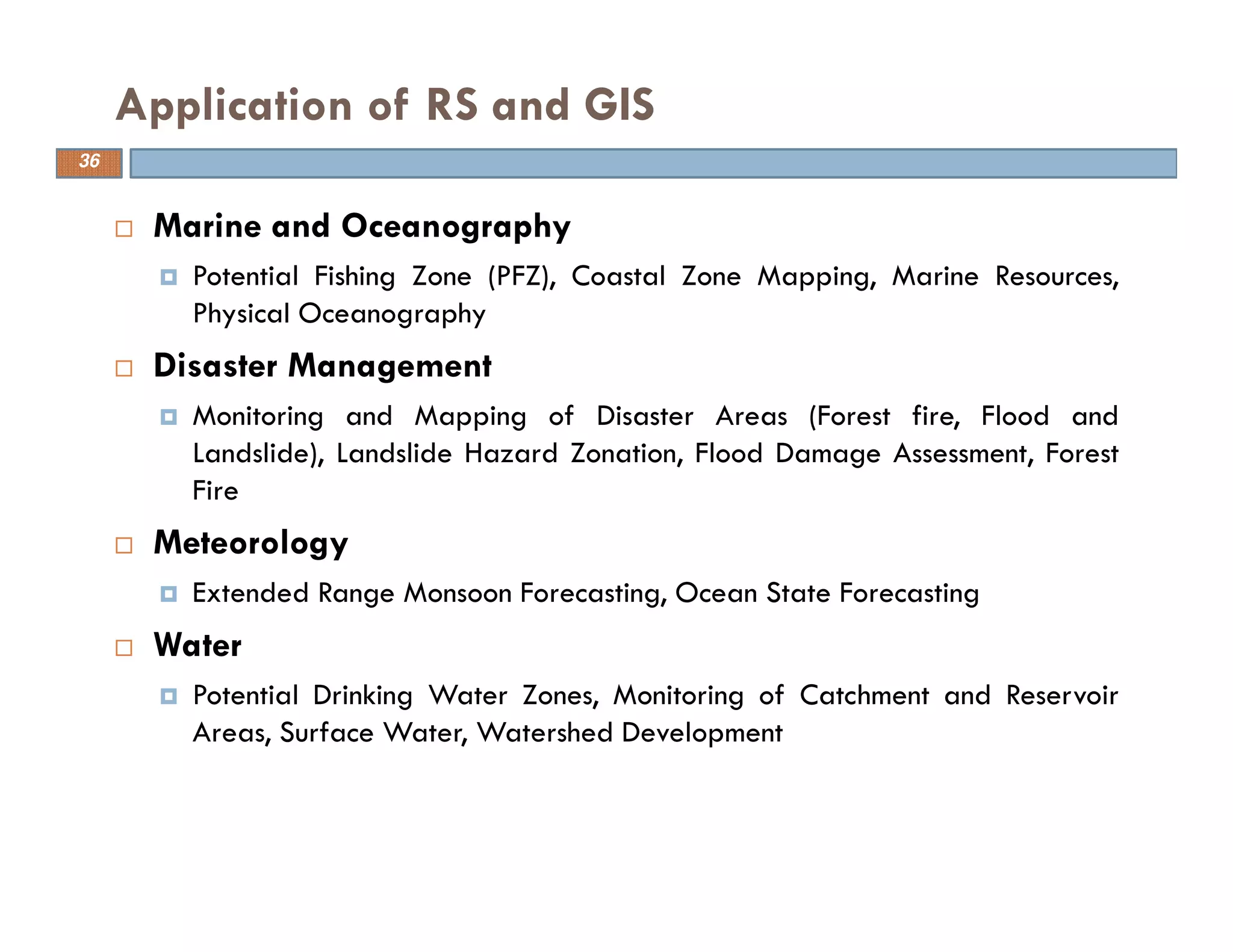
Marine and Oceanography
Potential Fishing Zone (PFZ), Coastal Zone Mapping, Marine Resources,
Physical Oceanography
Disaster Management
Monitoring and Mapping of Disaster Areas (Forest fire, Flood and
Landslide), Landslide Hazard Zonation, Flood Damage Assessment, Forest
Fire
Meteorology
Extended Range Monsoon Forecasting, Ocean State Forecasting
Water
Potential Drinking Water Zones, Monitoring of Catchment and Reservoir
Areas, Surface Water, Watershed Development
Application of RS and GIS
36
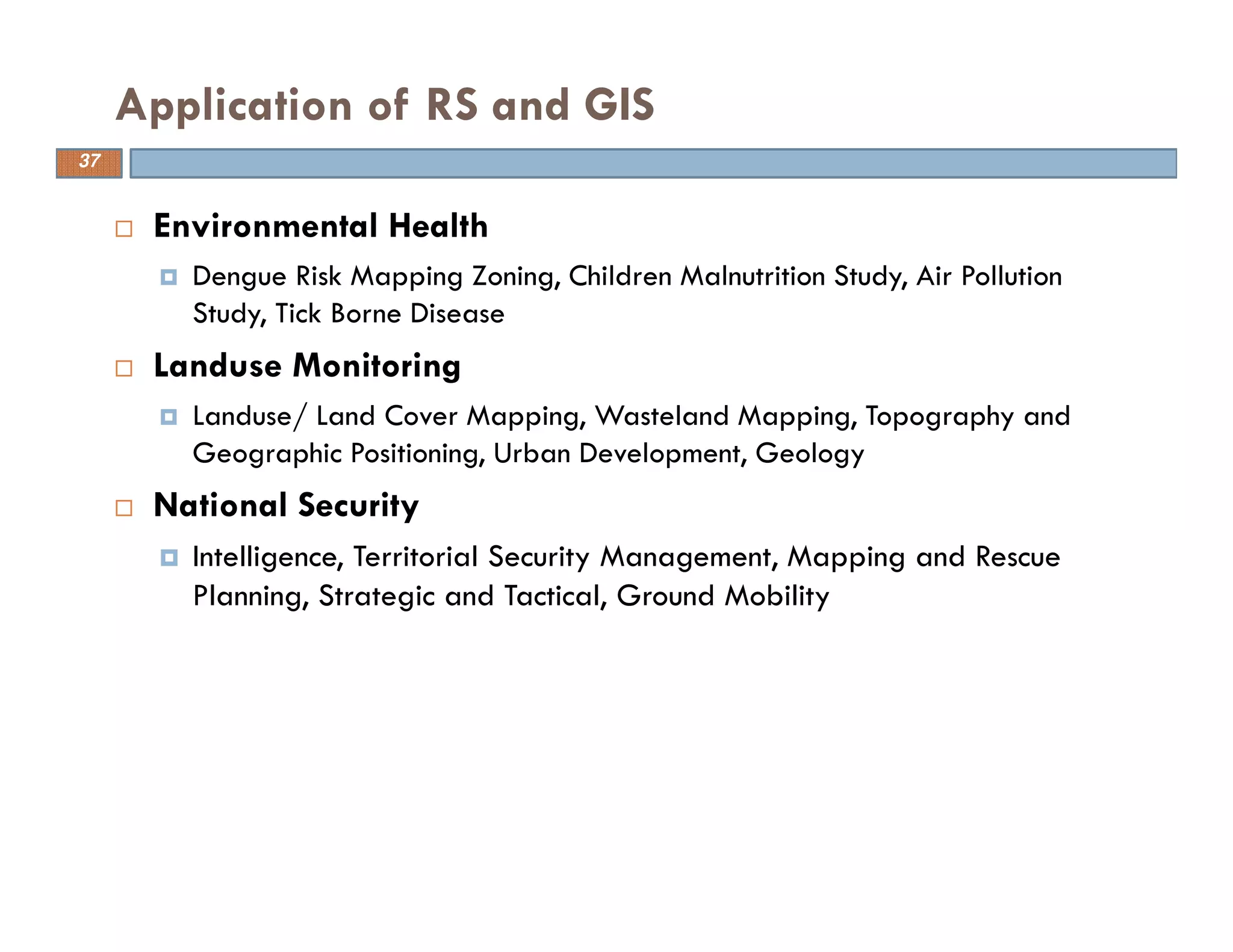
Environmental Health
Dengue Risk Mapping Zoning, Children Malnutrition Study, Air Pollution
Study, Tick Borne Disease
Landuse Monitoring
Landuse/ Land Cover Mapping, Wasteland Mapping, Topography and
Geographic Positioning, Urban Development, Geology
National Security
Intelligence, Territorial Security Management, Mapping and Rescue
Planning, Strategic and Tactical, Ground Mobility
Application of RS and GIS
37
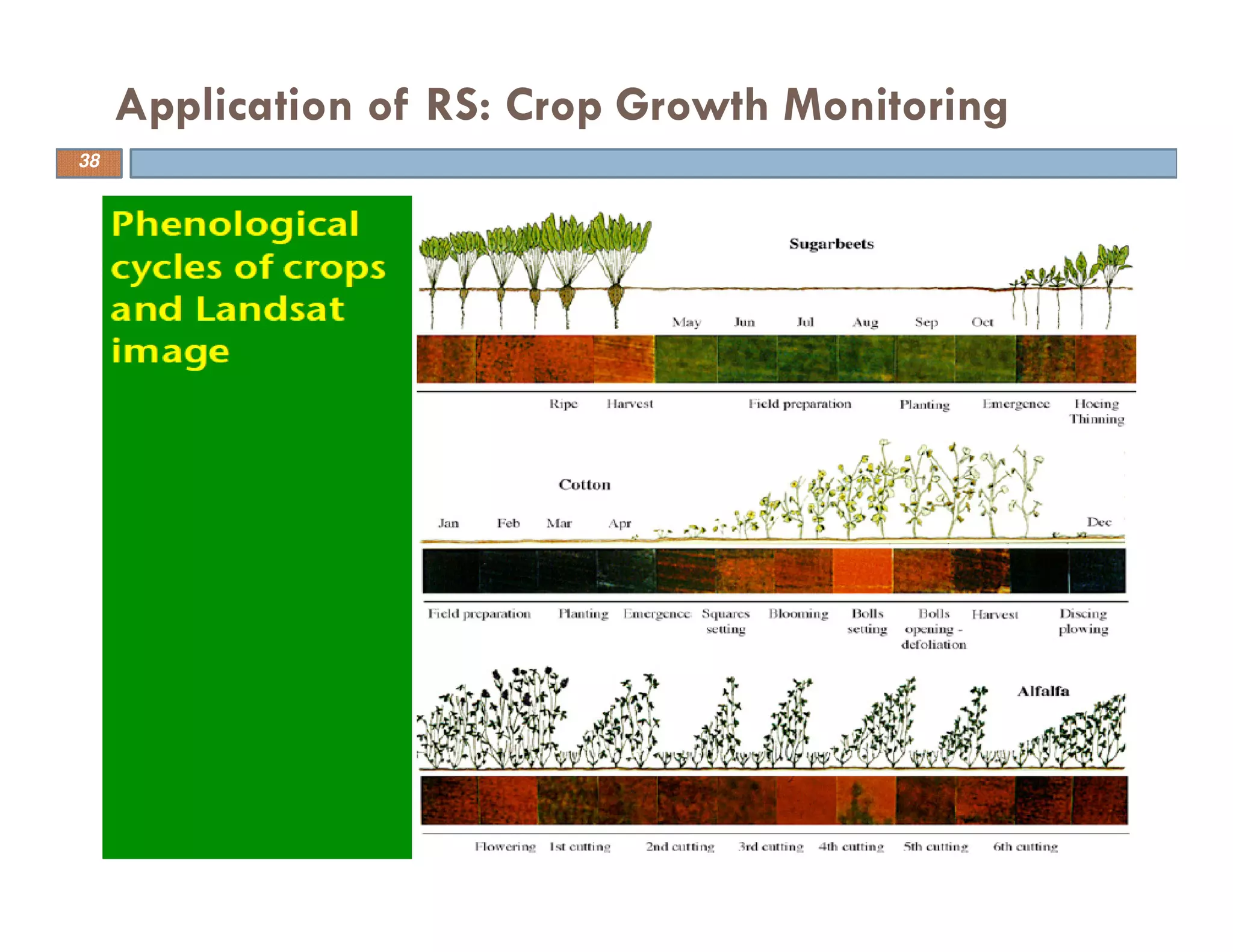
Application of RS: Crop Growth Monitoring
38
Global Normalized difference vegetation index
(NDVI) map by MODIS (2003)
Application of RS: Crop Growth Monitoring
[GSFC, 2003]
39
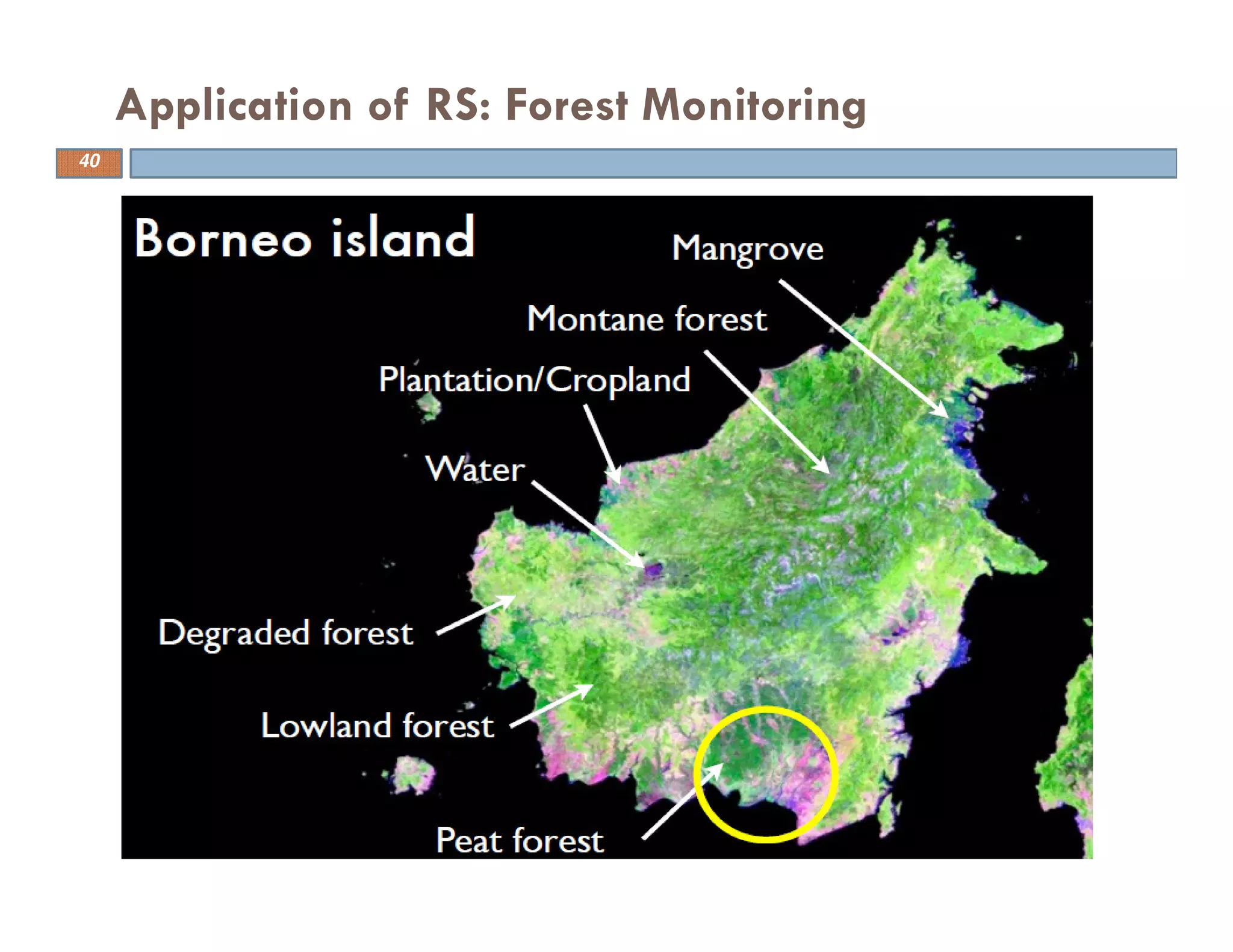
Application of RS: Forest Monitoring
40
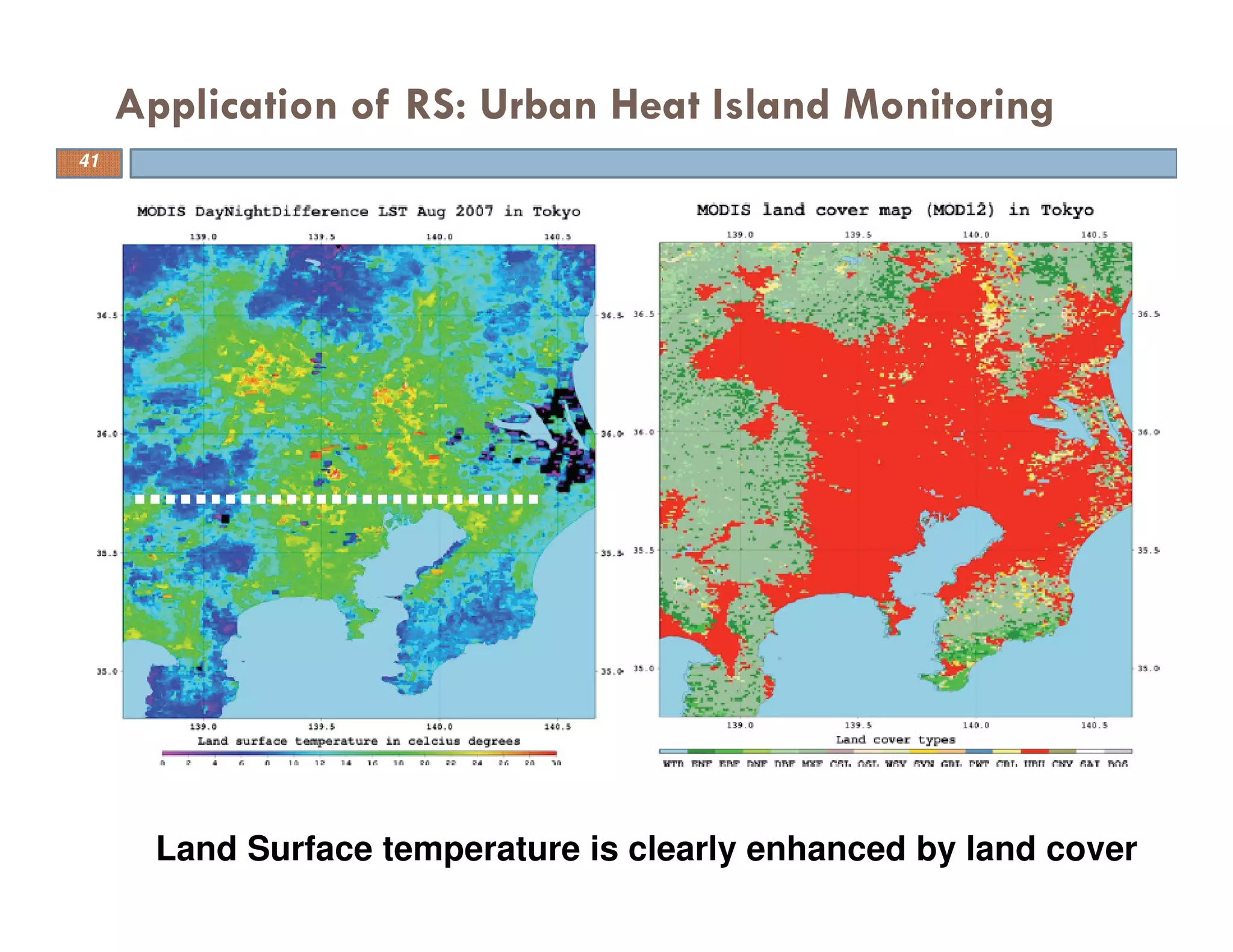
Application of RS: Urban Heat Island Monitoring
Land Surface temperature is clearly enhanced by land cover
41
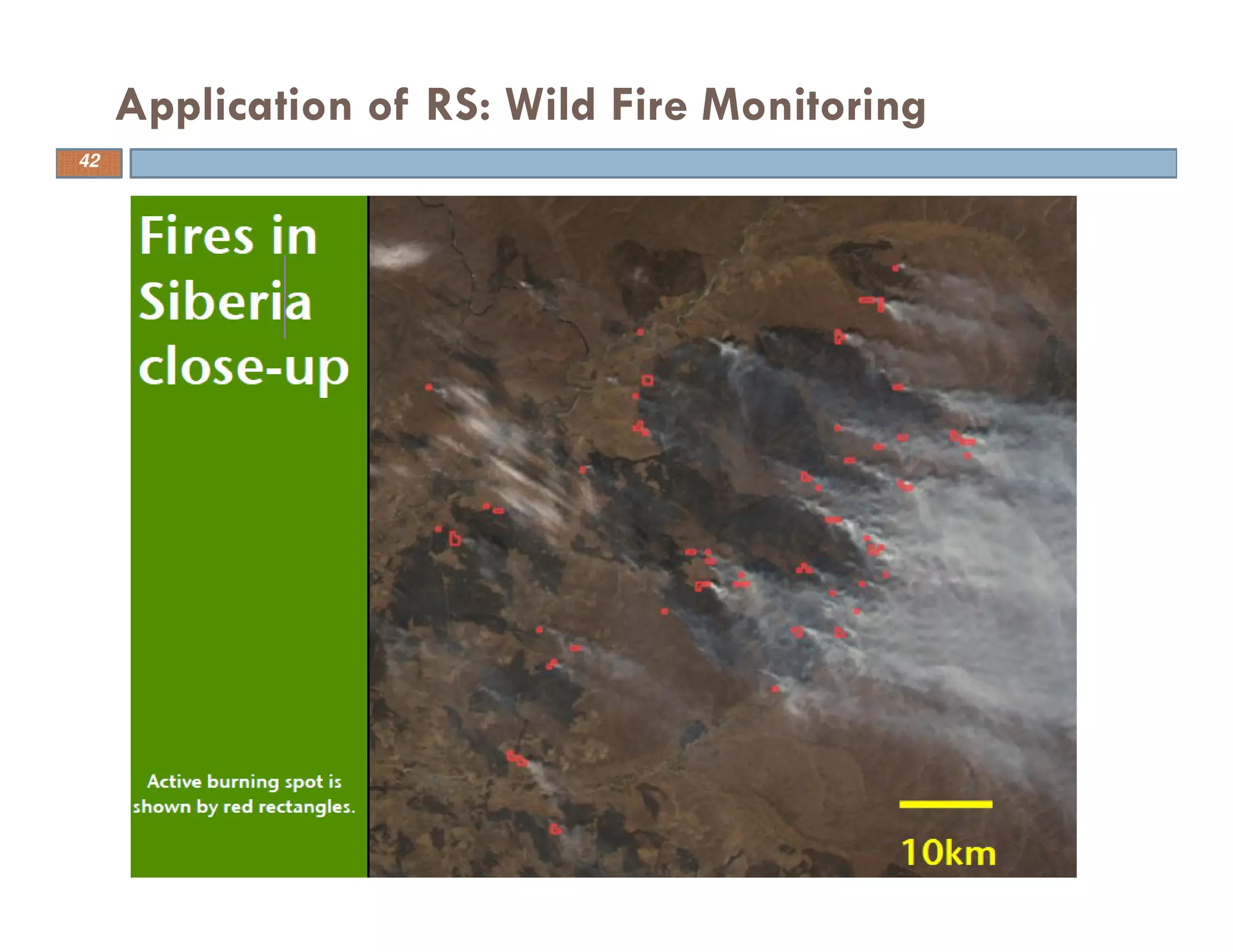
Application of RS: Wild Fire Monitoring
42
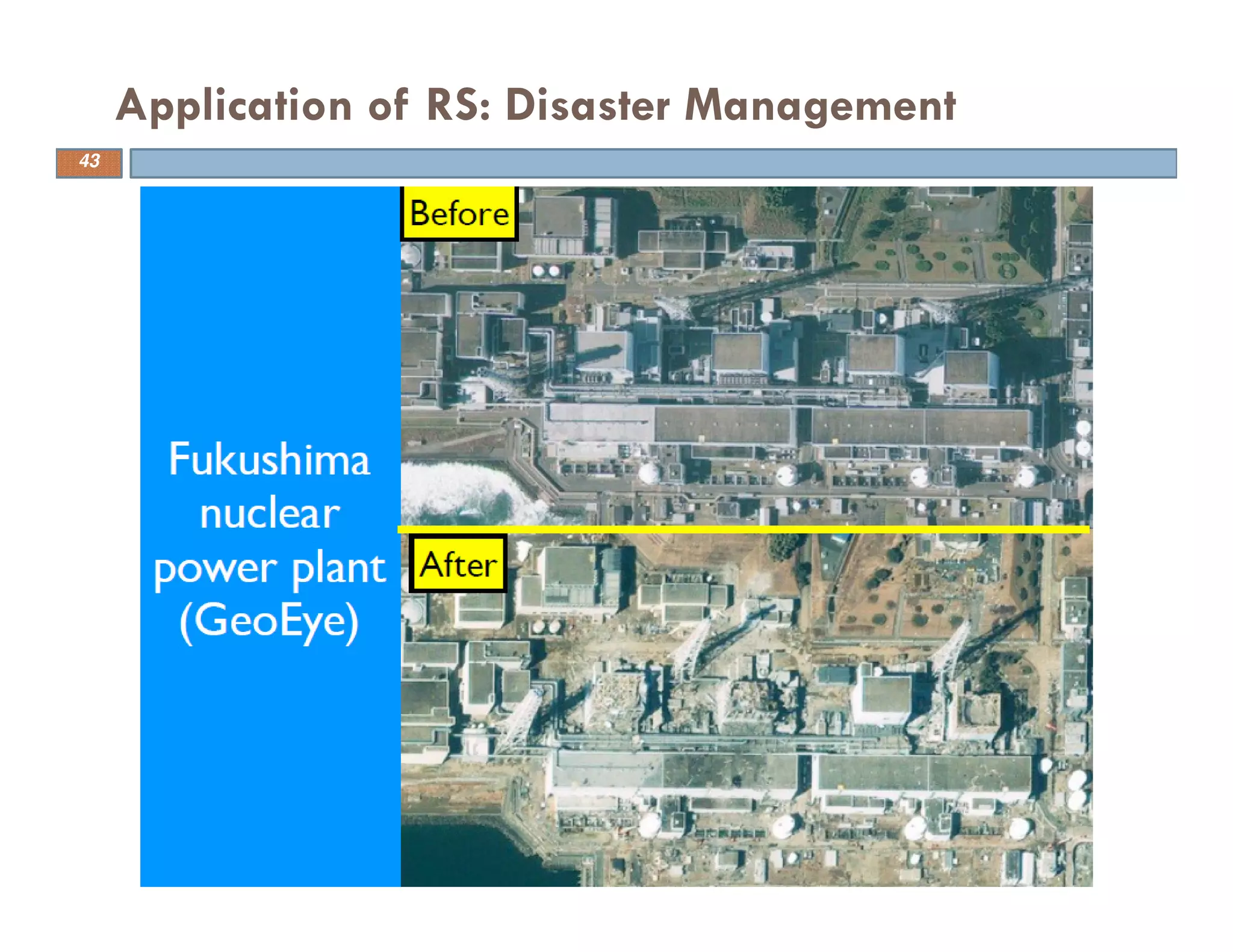
Application of RS: Disaster Management
43
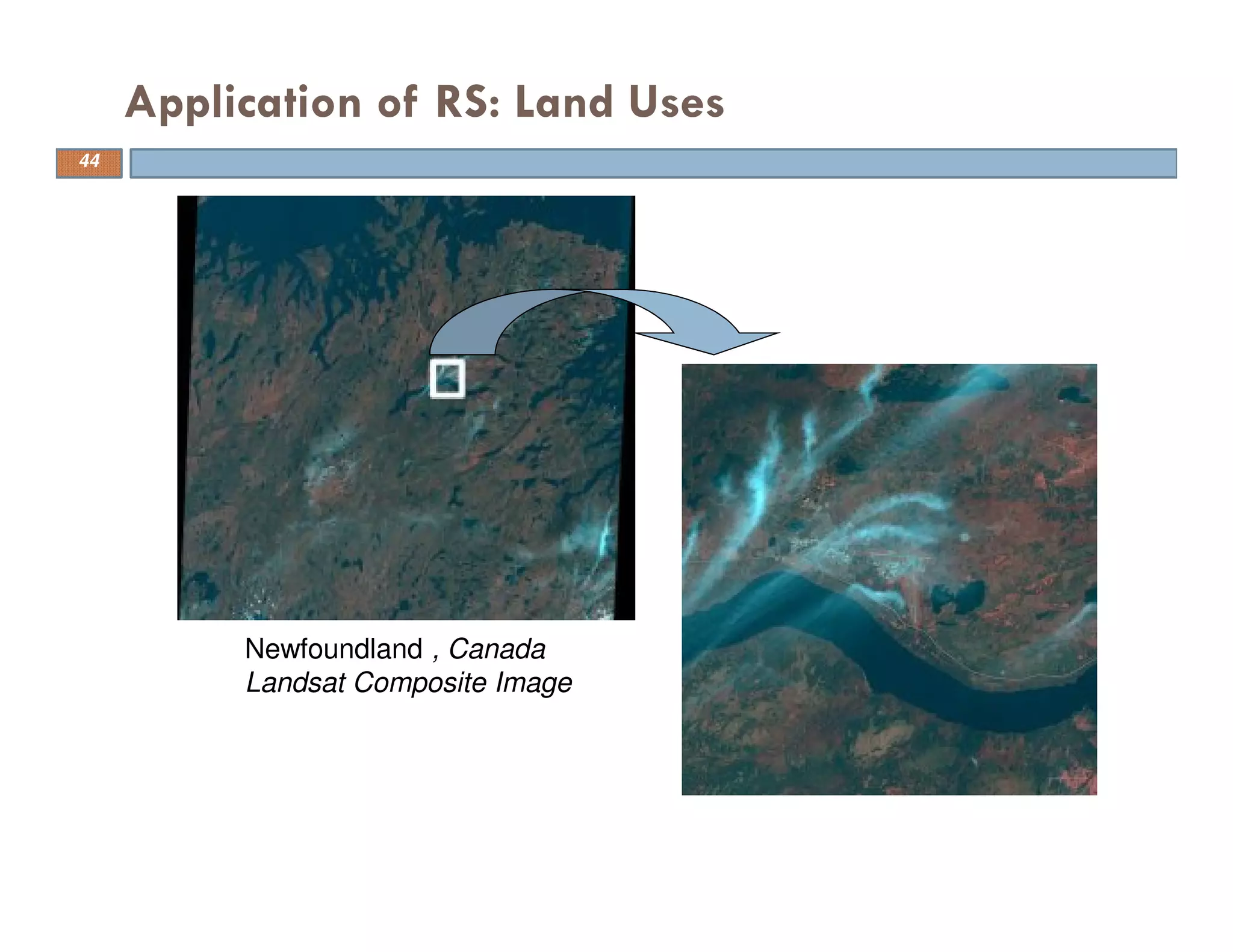
Application of RS: Land Uses
44
Newfoundland , Canada
Landsat Composite Image
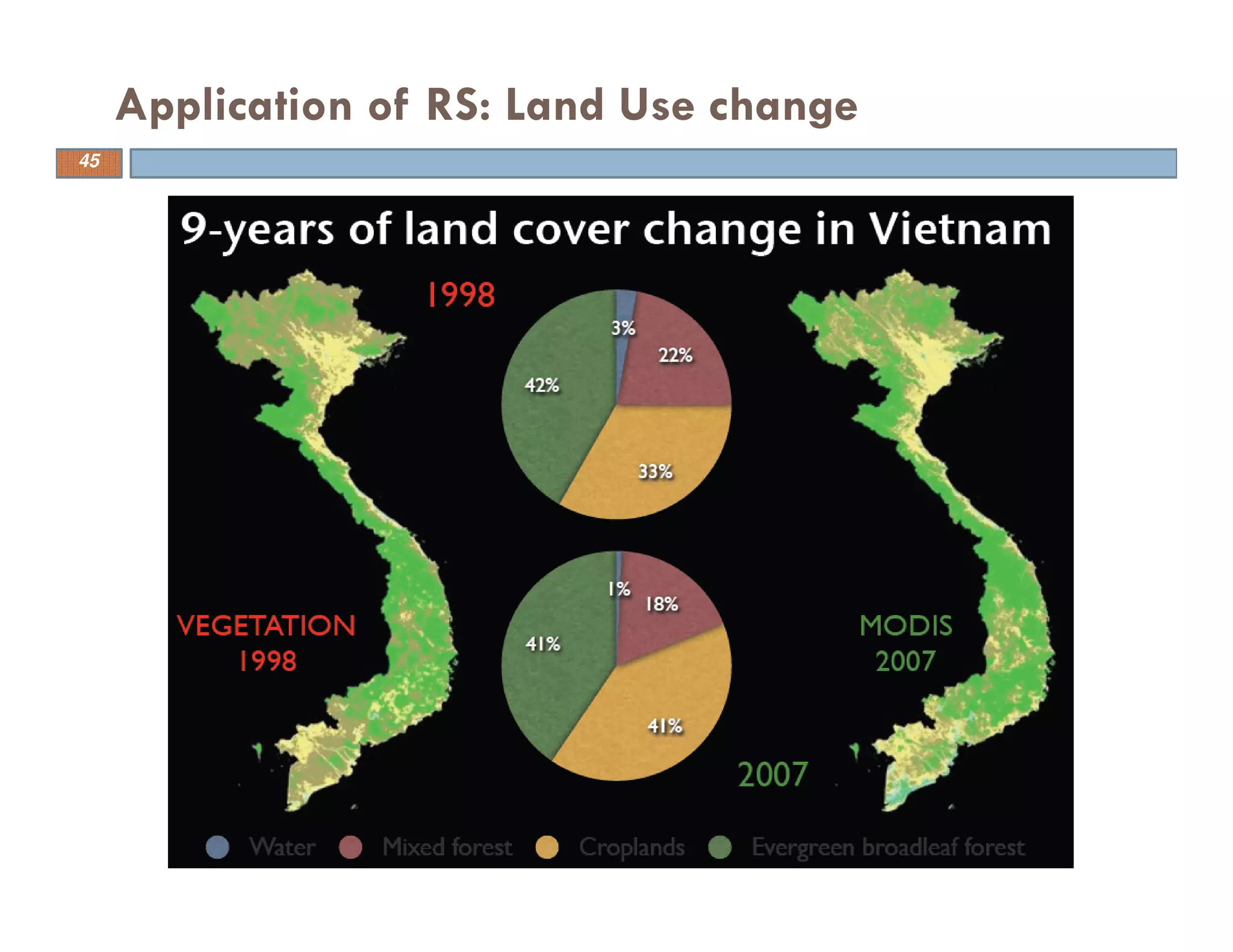
Application of RS: Land Use change
45
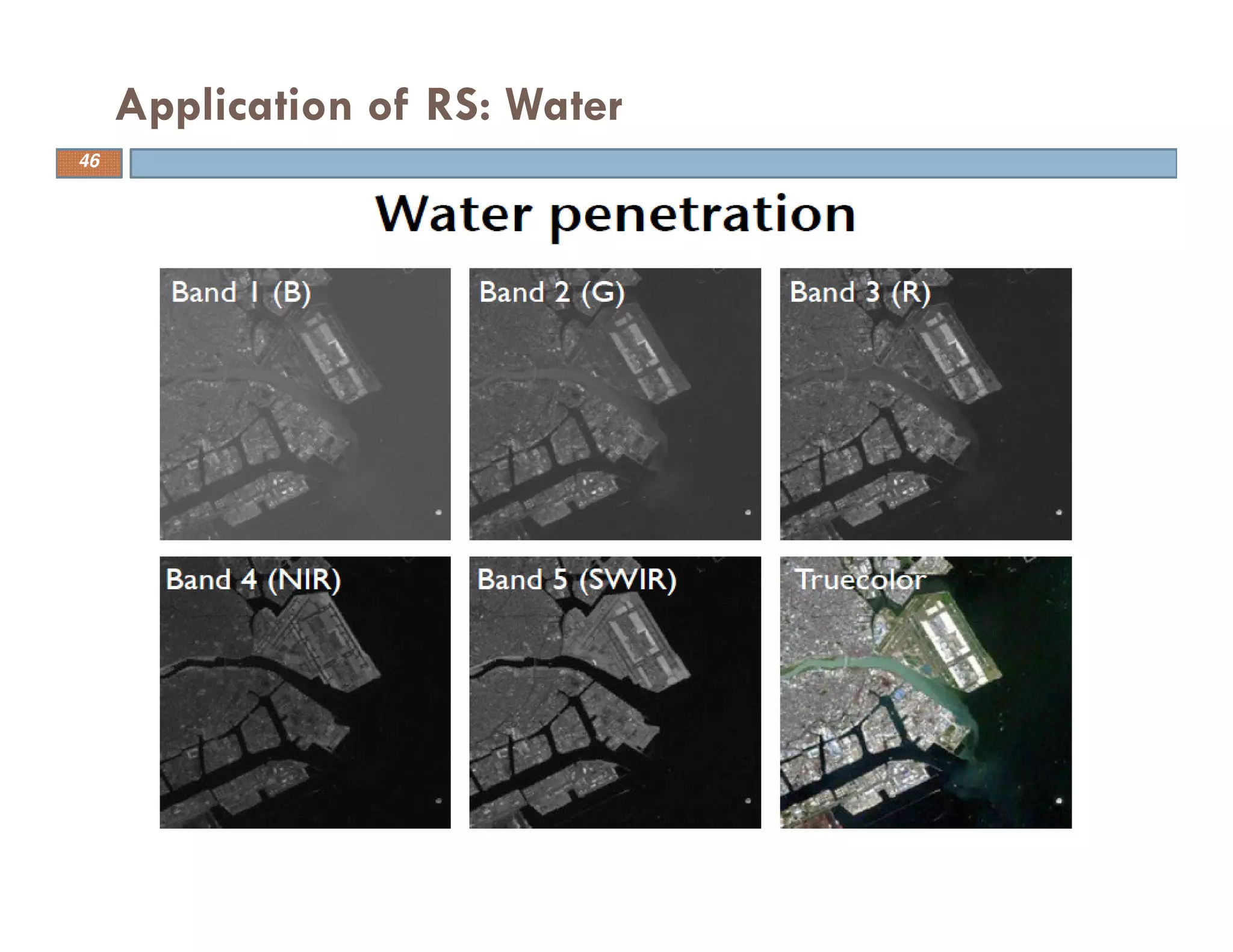
Application of RS: Water
46
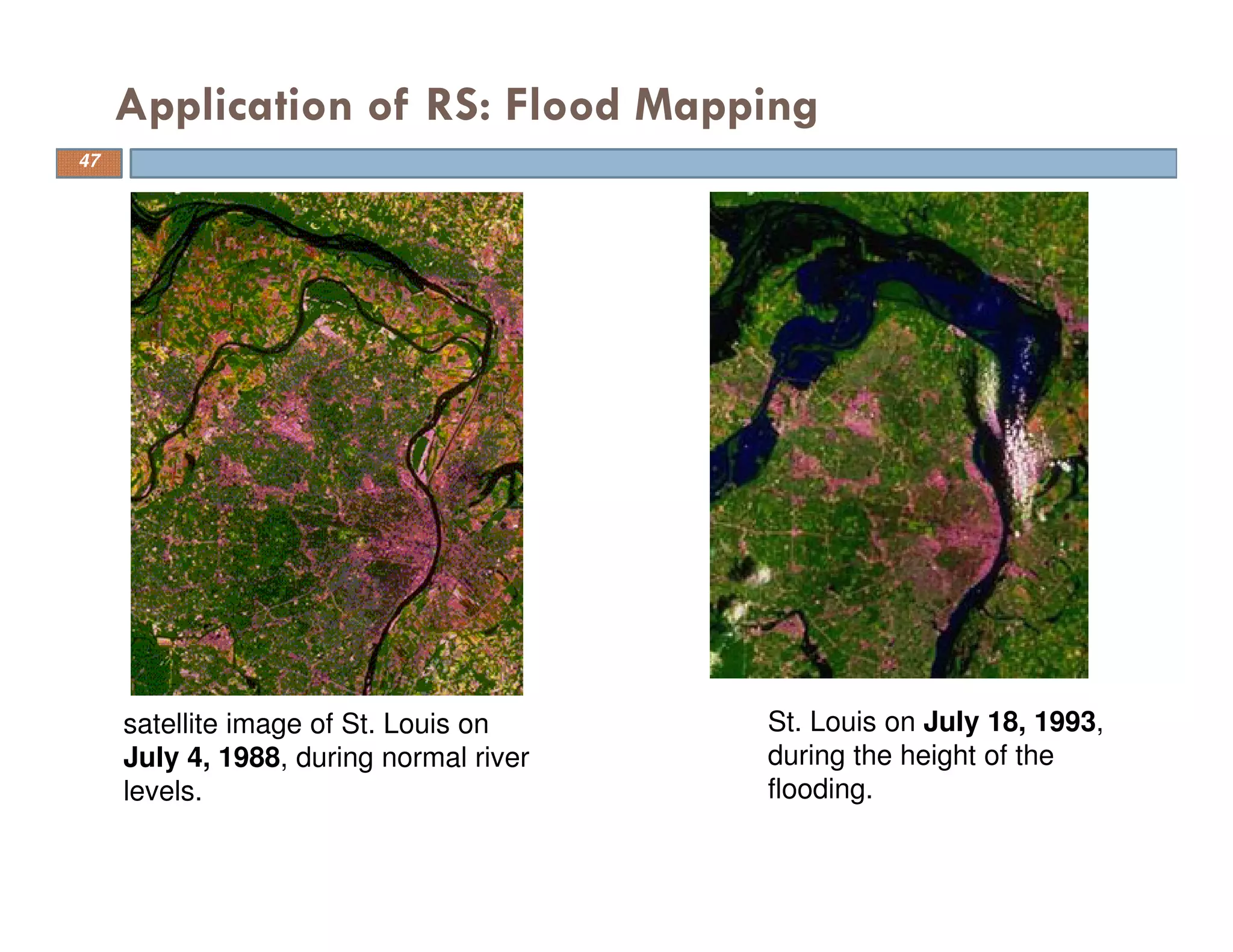
Application of RS: Flood Mapping
47
satellite image of St. Louis on
July 4, 1988, during normal river
levels.
St. Louis on July 18, 1993,
during the height of the
flooding.
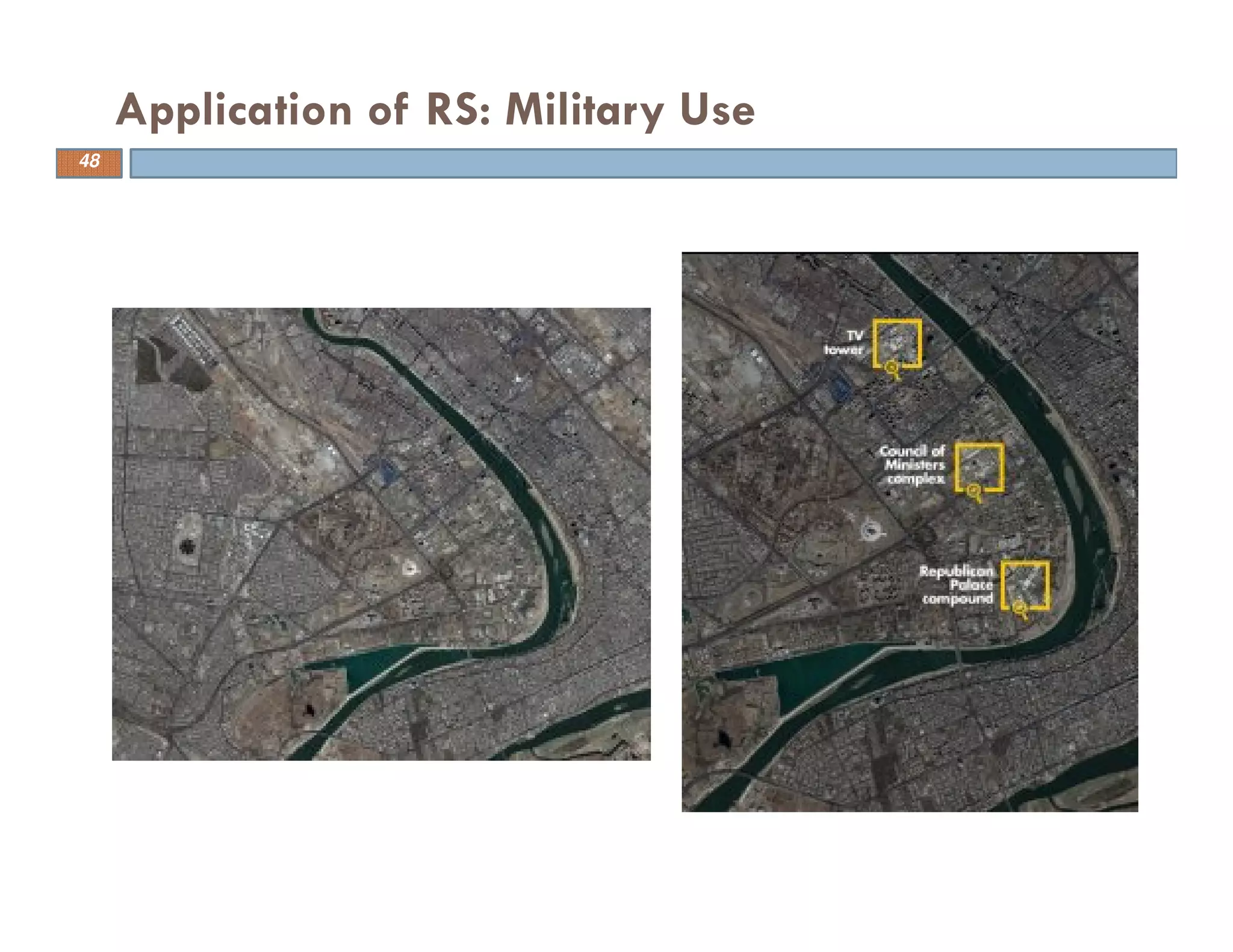
Application of RS: Military Use
48
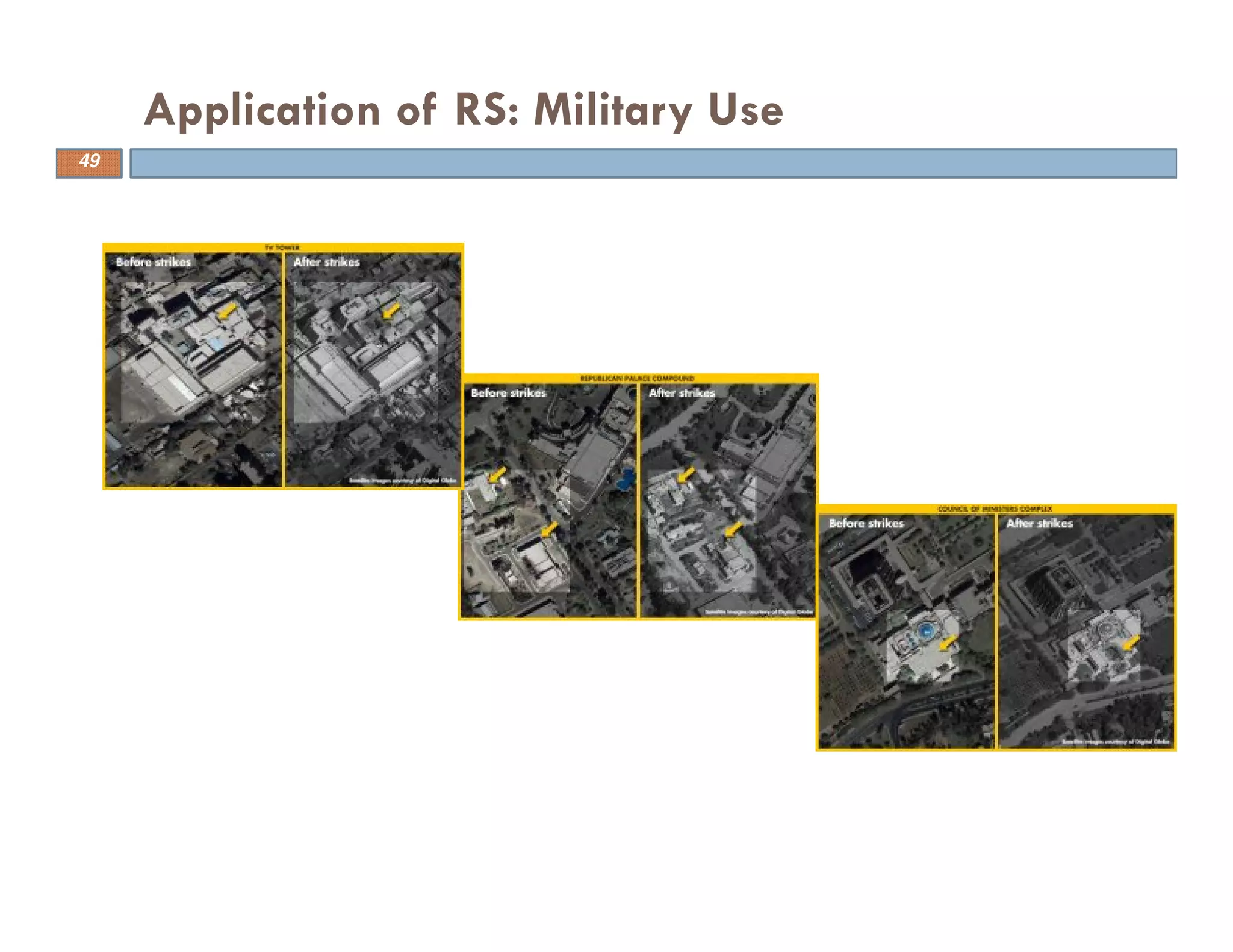
Application of RS: Military Use
49
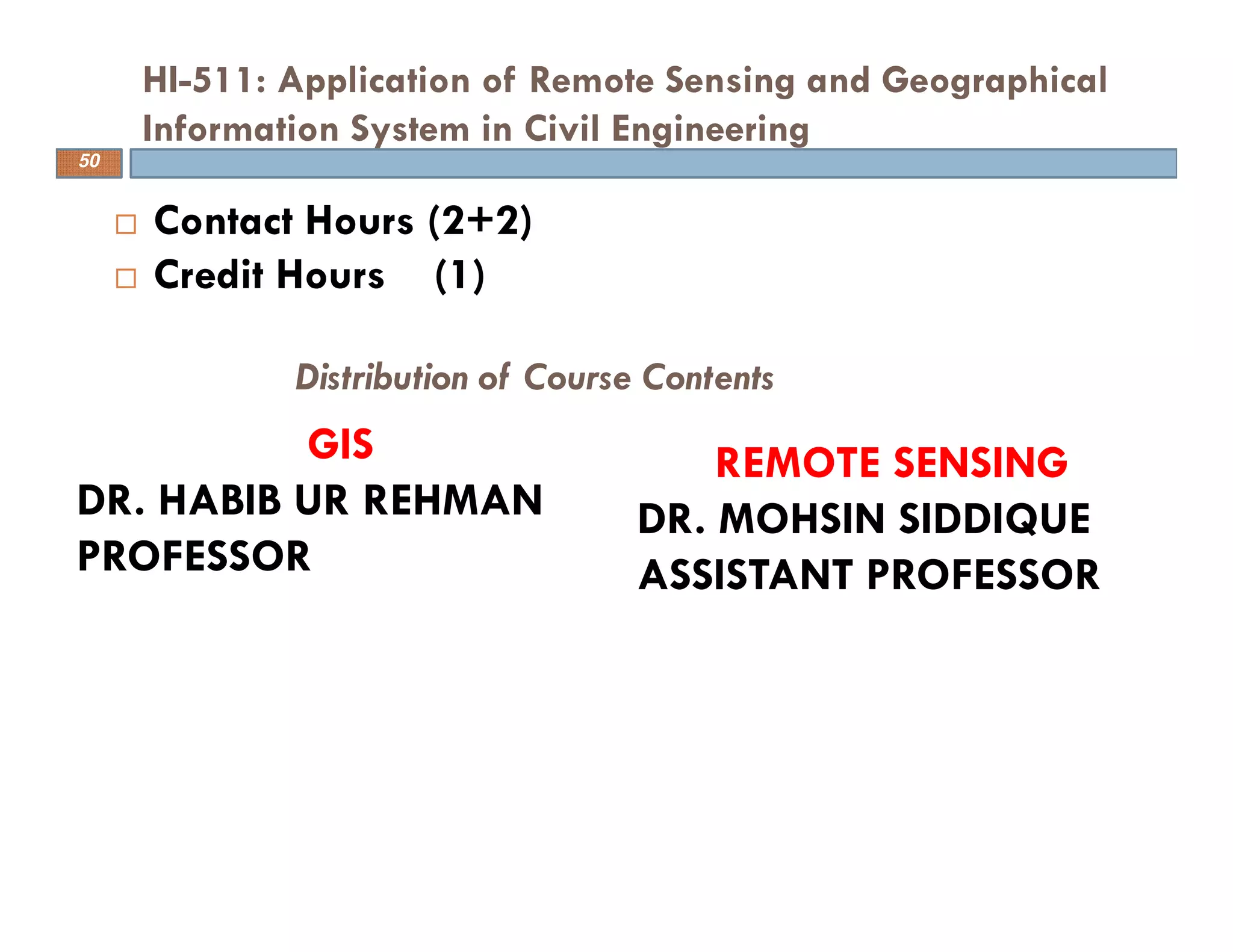
Contact Hours (2+2)
Credit Hours (1)
HI-511: Application of Remote Sensing and Geographical
Information System in Civil Engineering
50
GIS
DR. HABIB UR REHMAN
PROFESSOR
REMOTE SENSING
DR. MOHSIN SIDDIQUE
ASSISTANT PROFESSOR
Distribution of Course Contents
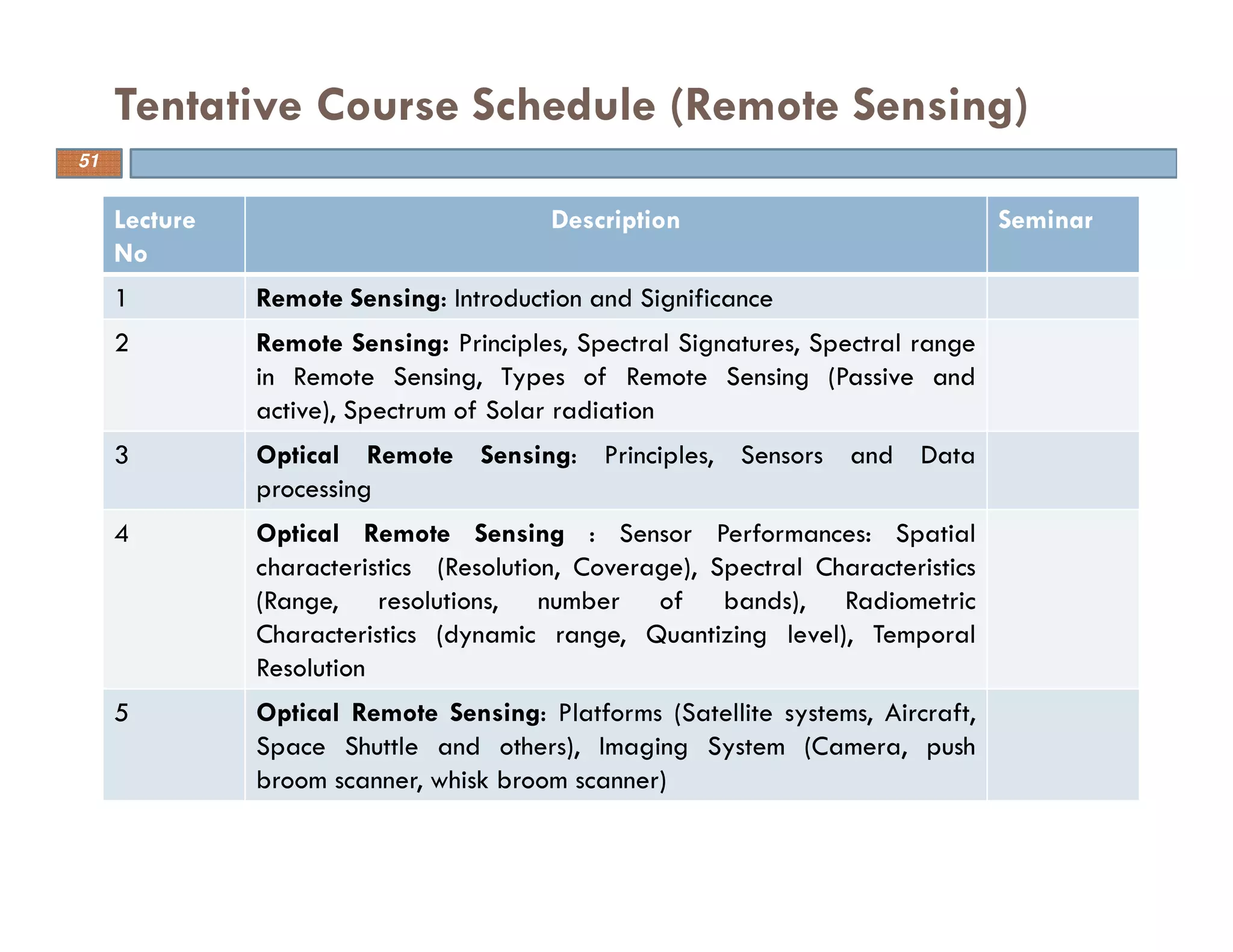
Lecture
No
Description Seminar
1 Remote Sensing: Introduction and Significance
2 Remote Sensing: Principles, Spectral Signatures, Spectral range
in Remote Sensing, Types of Remote Sensing (Passive and
active), Spectrum of Solar radiation
3 Optical Remote Sensing: Principles, Sensors and Data
processing
4 Optical Remote Sensing : Sensor Performances: Spatial
characteristics (Resolution, Coverage), Spectral Characteristics
(Range, resolutions, number of bands), Radiometric
Characteristics (dynamic range, Quantizing level), Temporal
Resolution
5 Optical Remote Sensing: Platforms (Satellite systems, Aircraft,
Space Shuttle and others), Imaging System (Camera, push
broom scanner, whisk broom scanner)
Tentative Course Schedule (Remote Sensing)
51
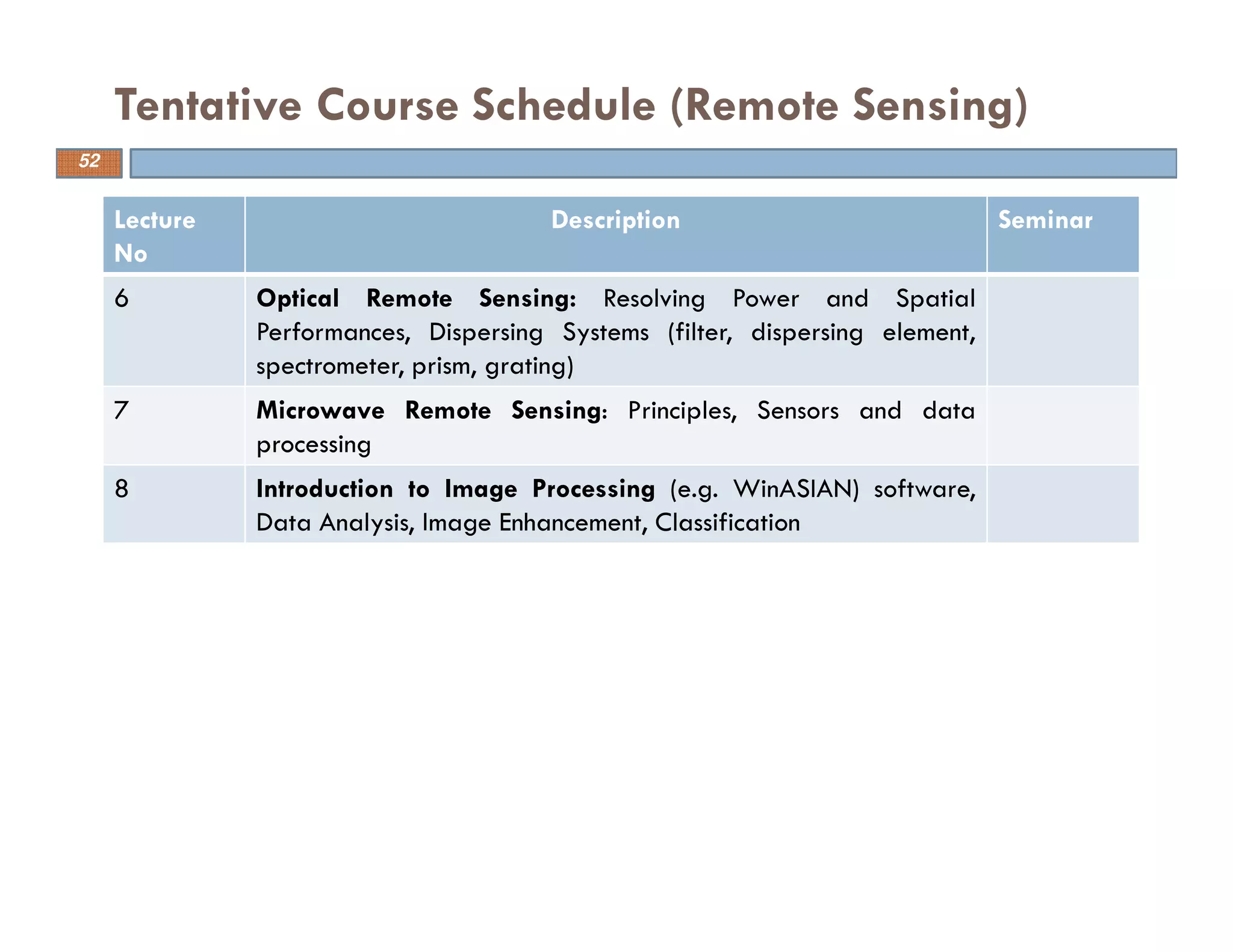
Lecture
No
Description Seminar
6 Optical Remote Sensing: Resolving Power and Spatial
Performances, Dispersing Systems (filter, dispersing element,
spectrometer, prism, grating)
7 Microwave Remote Sensing: Principles, Sensors and data
processing
8 Introduction to Image Processing (e.g. WinASIAN) software,
Data Analysis, Image Enhancement, Classification
Tentative Course Schedule (Remote Sensing)
52
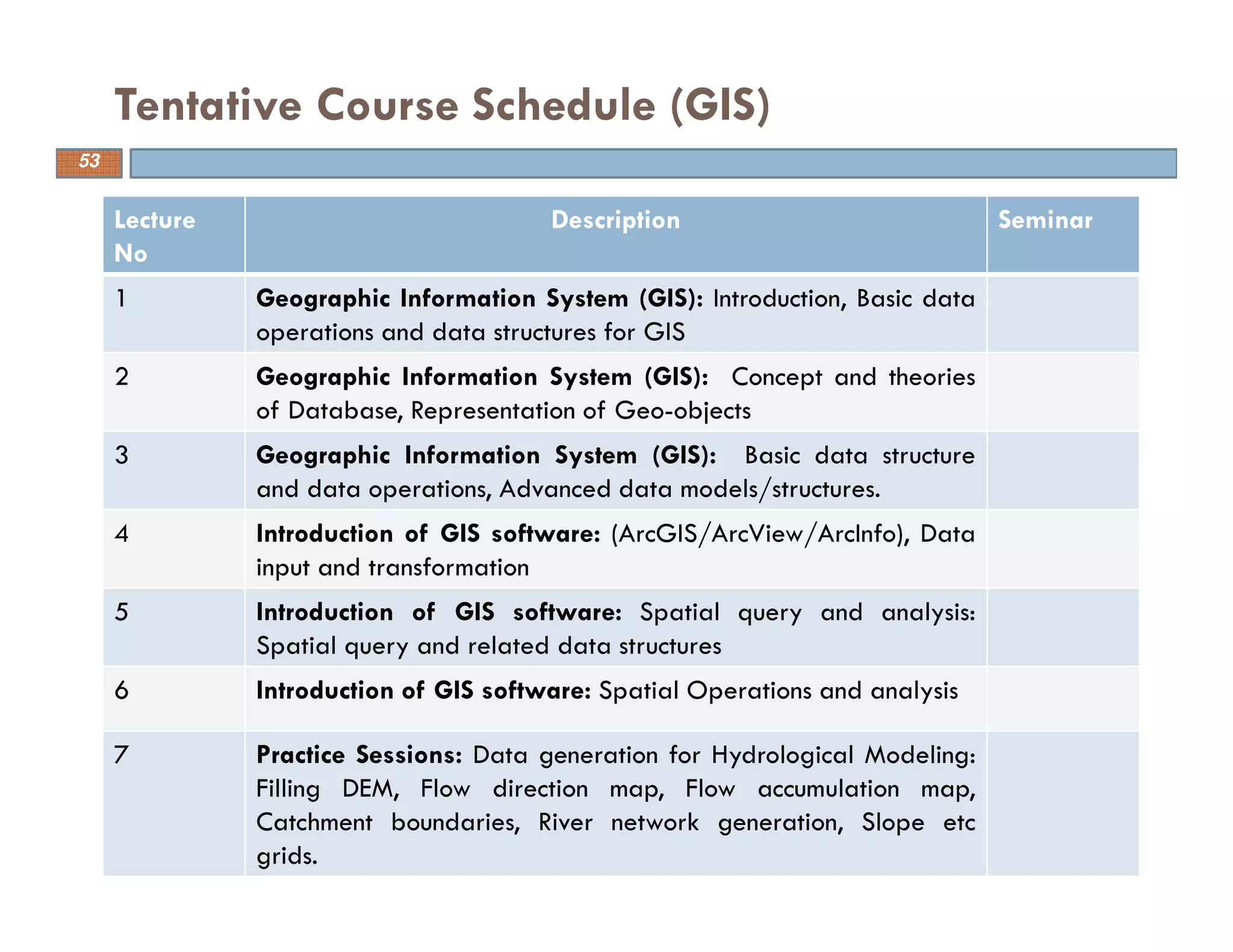
Lecture
No
Description Seminar
1 Geographic Information System (GIS): Introduction, Basic data
operations and data structures for GIS
2 Geographic Information System (GIS): Concept and theories
of Database, Representation of Geo-objects
3 Geographic Information System (GIS): Basic data structure
and data operations, Advanced data models/structures.
4 Introduction of GIS software: (ArcGIS/ArcView/ArcInfo), Data
input and transformation
5 Introduction of GIS software: Spatial query and analysis:
Spatial query and related data structures
6 Introduction of GIS software: Spatial Operations and analysis
7 Practice Sessions: Data generation for Hydrological Modeling:
Filling DEM, Flow direction map, Flow accumulation map,
Catchment boundaries, River network generation, Slope etc
grids.
Tentative Course Schedule (GIS)
53
Provide the student with a basic understanding of the science and technology
of remote sensing and geographic information system
Enable the student to understand the differences between the various satellite
remote sensing systems in existence today
Enable the student to differentiate between the different types of information
provided by these systems
Enable the student to understand the integration of remote sensing and GIS
Provide the student with basic understanding of GIS systems and their
processing of remote sensing and geographic data
Enable the student to perform basic manipulatation of data using commercial
software such as ArcGIS etc
Goal of the Course
54
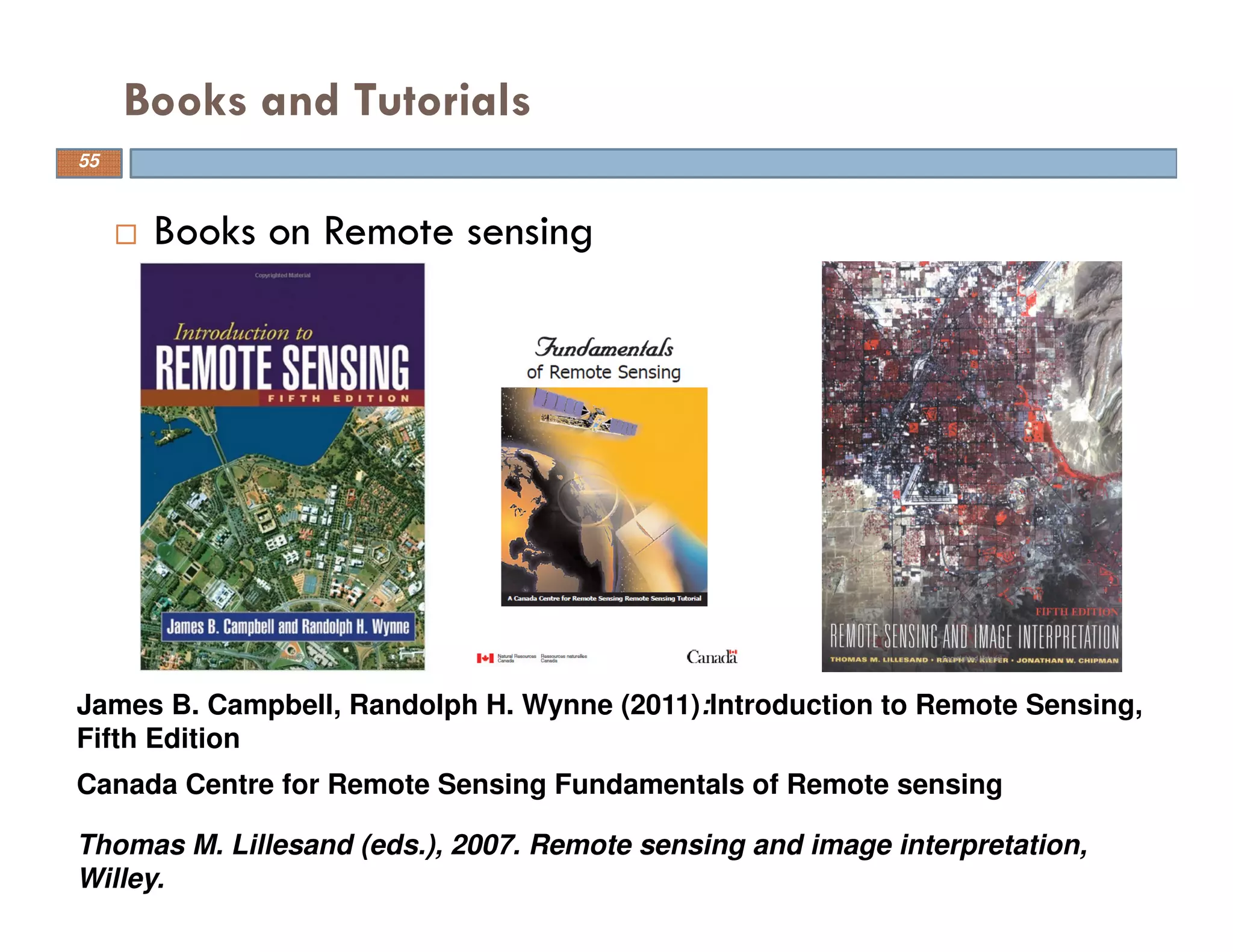
Books on Remote sensing
Books and Tutorials
55
Canada Centre for Remote Sensing Fundamentals of Remote sensing
Thomas M. Lillesand (eds.), 2007. Remote sensing and image interpretation,
Willey.
James B. Campbell, Randolph H. Wynne (2011):Introduction to Remote Sensing,
Fifth Edition
Books and Tutorials
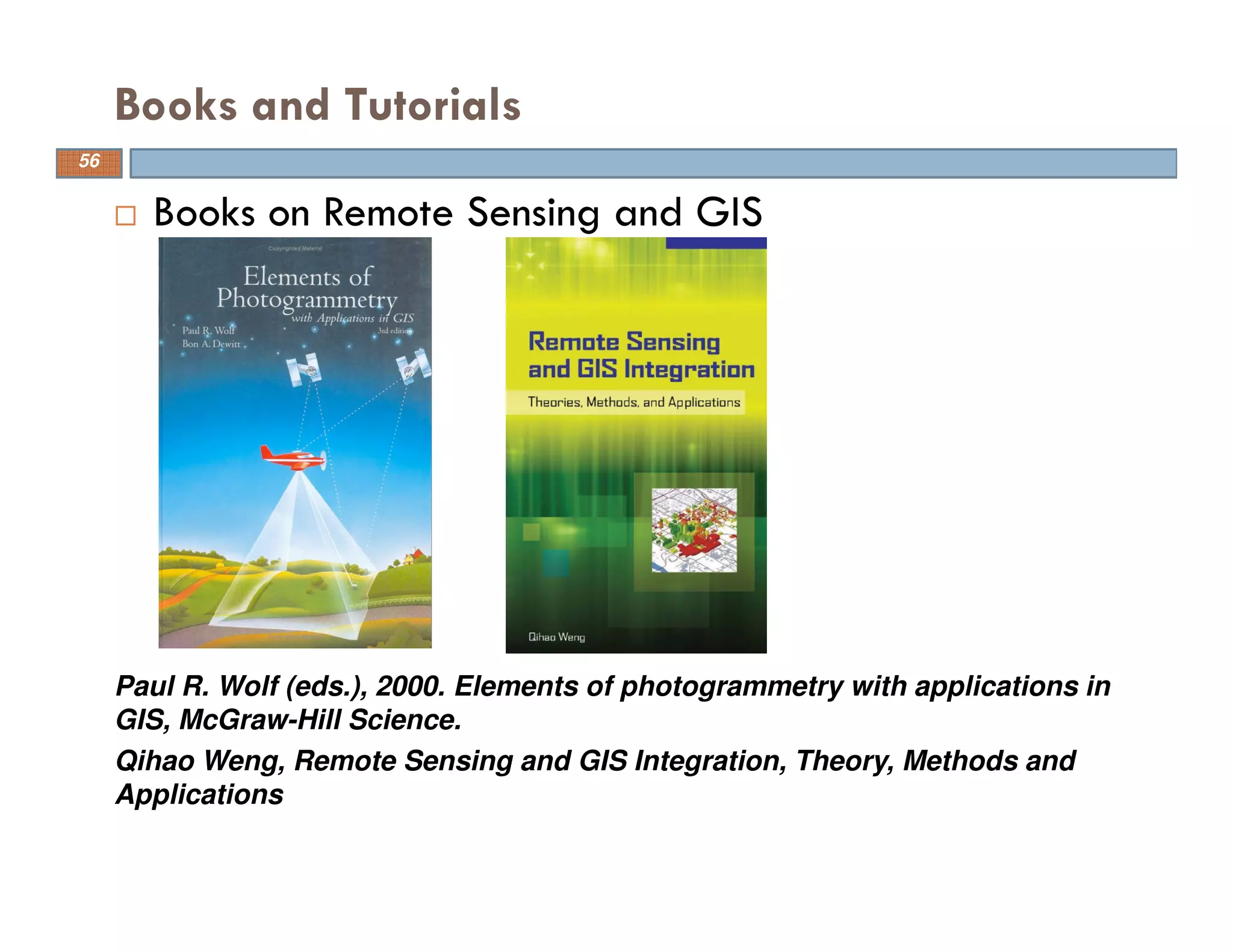
Paul R. Wolf (eds.), 2000. Elements of photogrammetry with applications in
GIS, McGraw-Hill Science.
Books on Remote Sensing and GIS
Qihao Weng, Remote Sensing and GIS Integration, Theory, Methods and
Applications
56
Books and Tutorials
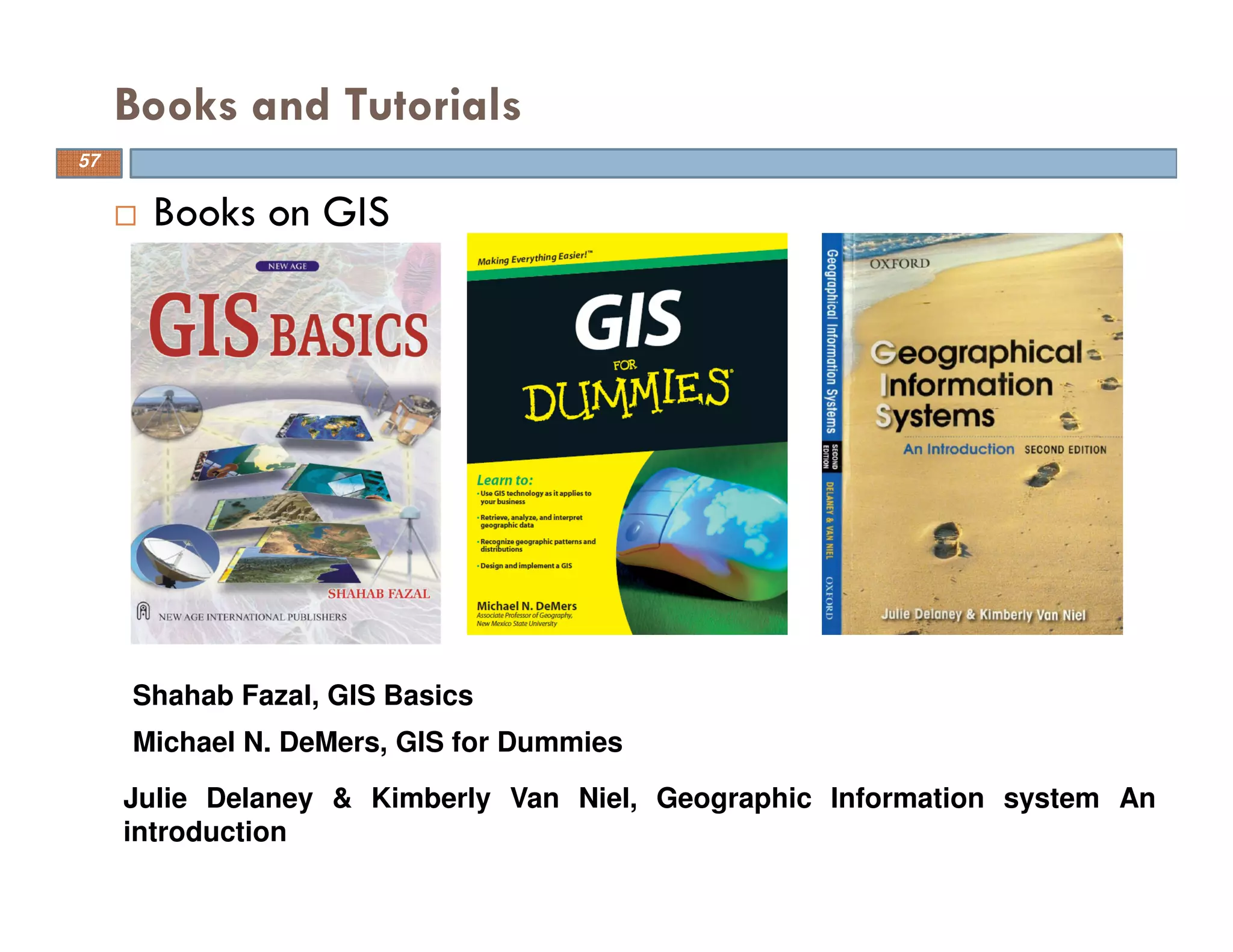
Books on GIS
Shahab Fazal, GIS Basics
Michael N. DeMers, GIS for Dummies
Julie Delaney & Kimberly Van Niel, Geographic Information system An
introduction
57
Books and Tutorials
Books on GIS
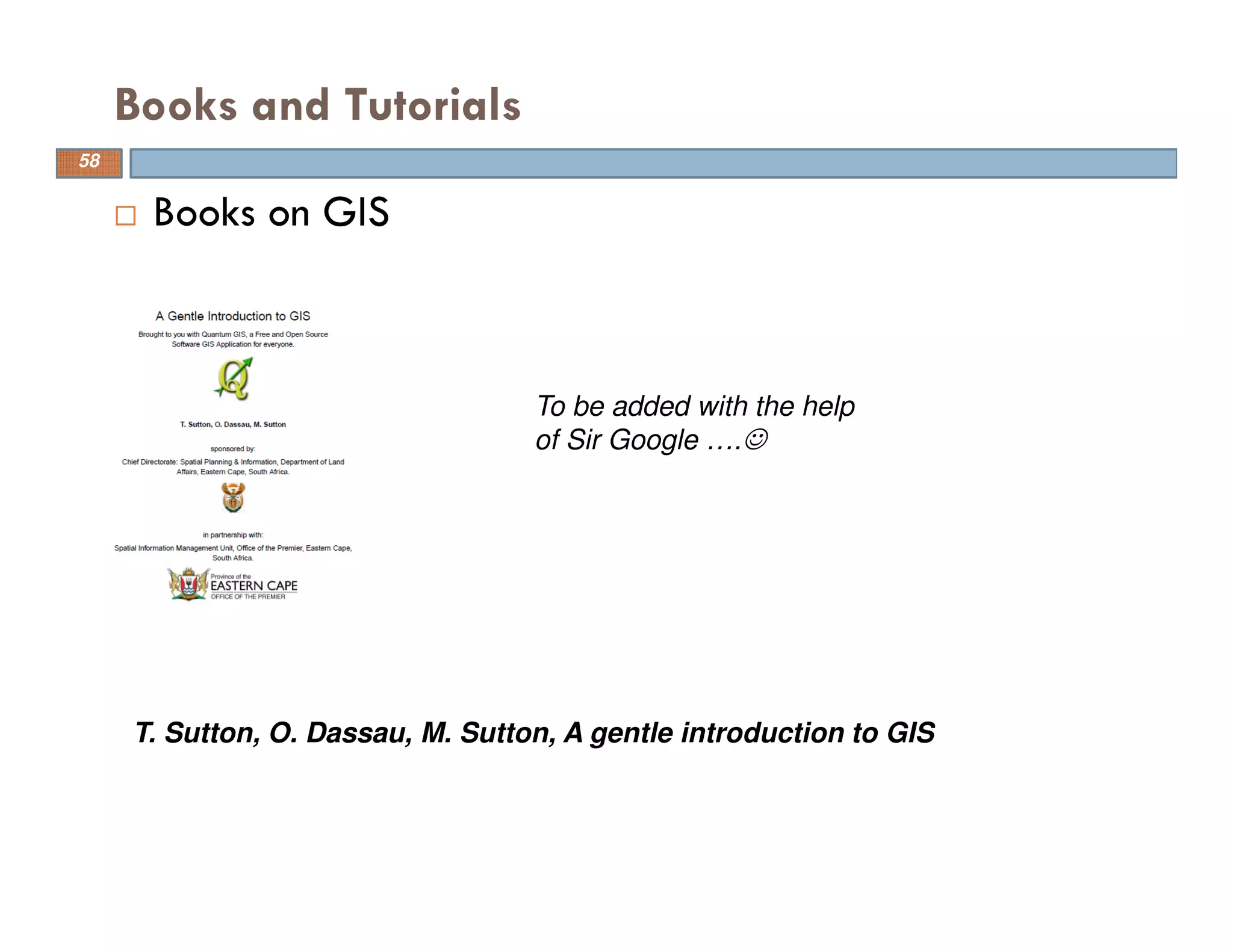
T. Sutton, O. Dassau, M. Sutton, A gentle introduction to GIS
To be added with the help
of Sir Google ….☺
58
Tutorial on Remote Sensing and GIS
Books and Tutorials
59
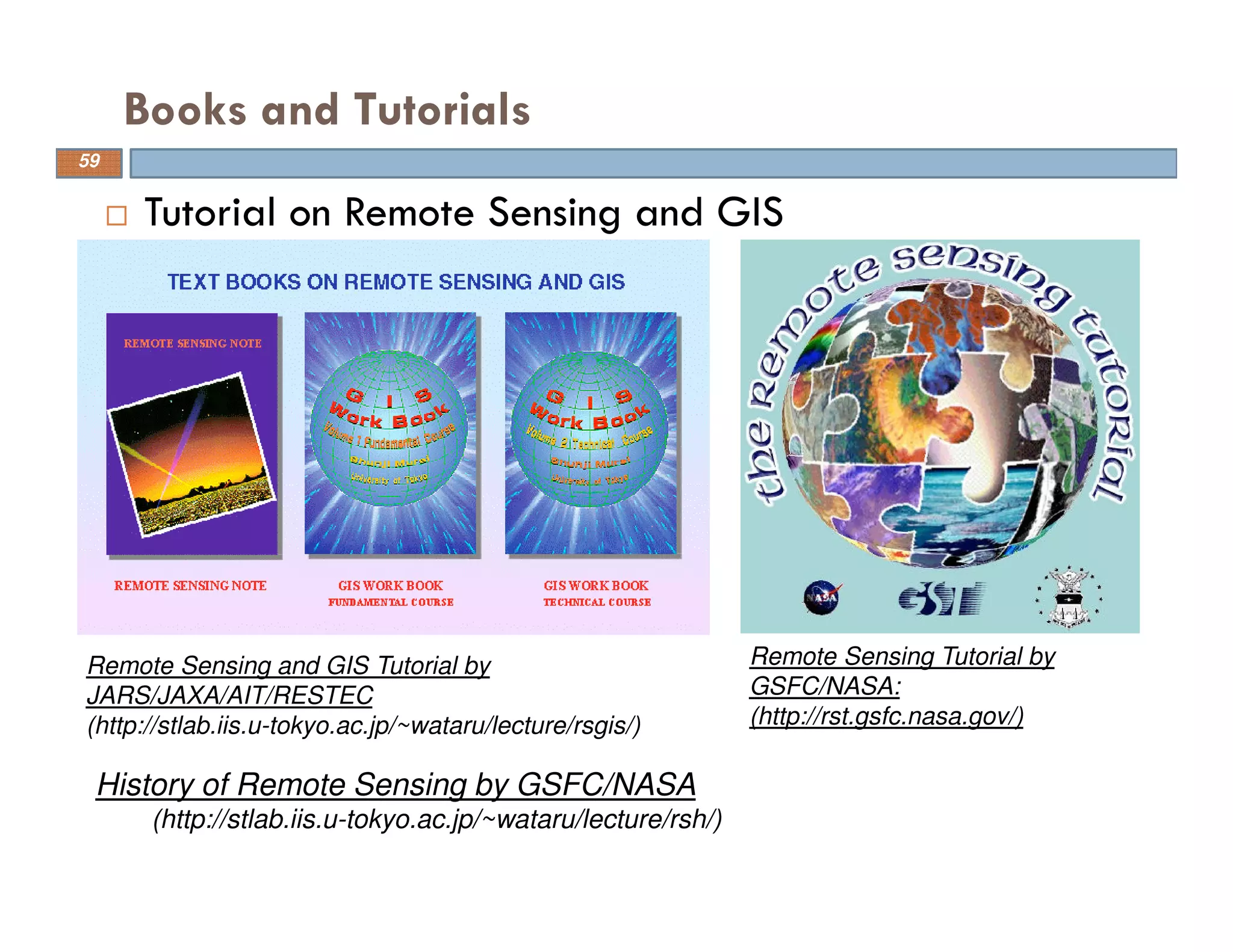
Remote Sensing Tutorial by
GSFC/NASA:
(http://rst.gsfc.nasa.gov/)
Remote Sensing and GIS Tutorial by
JARS/JAXA/AIT/RESTEC
(http://stlab.iis.u-tokyo.ac.jp/~wataru/lecture/rsgis/)
History of Remote Sensing by GSFC/NASA
(http://stlab.iis.u-tokyo.ac.jp/~wataru/lecture/rsh/)
Lecture Notes
Dr. Takauchi Wataru
http://stlab.iis.u-tokyo.ac.jp/~wataru/
Dr. Ryosuke Shibasaki
Dr. Noor Muhammad Khan
Dr. Nagesh Kumar
etc etc
Web Sources
www.google.com
www.youtube.com
www.wikipedia.org
etc etc
Other Sources
60
A seminar type assignment is being planned in which
each student is required to choose his favorite topic
related to RS and GIS
The schedule of seminar/presentation will be decided
in next week
Seminars Assignments
61
Search and Install Google earth or Use Google Maps to
locate you home
The purpose is to get interaction with remotely sensed
information and its processing using internet GIS systems
No formal submission is required. However, you have to
report about your interaction with Google earth or Google
Map
Deadline: Jan 09, 2012 (In next class)
Assignment
62
Comments….
Questions….
Suggestions….
63
I am greatly thankful to all the information sources
(regarding remote sensing and GIS) on internet that I
accessed and utilized for the preparation of present
lecture.
Thank you !
Feel free to contact

Introduction to remote sensing and gis

  • 1.
    APPLICATION OF REMOTESENSING AND GEOGRAPHICAL INFORMATION SYSTEM IN CIVIL ENGINEERING Date: INSTRUCTOR DR. MOHSIN SIDDIQUE ASSIST. PROFESSOR DEPARTMENT OF CIVIL ENGINEERING
  • 2.
    Remote Sensing (RS) Remotelysensing the useful information of object (earth) Geographic Information System (GIS) A system that deals with all types of geographically referenced data Application of Remote Sensing and Geographical Information System in Civil Engineering 2
  • 3.
    Remote Sensing (RS) Remotelysensing the useful information of object (earth) Process of recording, measuring and interpreting imagery and digital representations of energy patterns derived from noncontact sensor systems Geographic Information System (GIS) A system designed to capture, store, manipulate, analyze, manage, and present all types of geographically referenced data Application of Remote Sensing and Geographical Information System in Civil Engineering 3
  • 4.
    Can you recallGoogle Earth ? While its representation and management on geographical locations is made possible through GIS The information in the Google earth is obtained through Remote Sensing 4
  • 5.
    Can you recallGoogle Earth ? Lets look at small movies about Google earth to learn more about the remotely sensed information and its geographical referencing of the information 5
  • 6.
    Remote sensing hasbeen variously defined but basically it is the art or science of telling something about an object without touching it. (Fischer et al., 1976, p. 34) Remote sensing is the acquisition of physical data of an object without touch or contact. (Lintz and Simonett, 1976, p. 1) Remote sensing is the observation of a target by a device separated from it by some distance. (Barrett and Curtis, 1976, p. 3) The term “remote sensing” in its broadest sense merely means “reconnaissance at a distance.” (Colwell, 1966, p. 71) Remote sensing is the art, science and technology of obtaining reliable information about physical objects and the environment, through the process of recording, measuring and interpreting imagery and digital representations of energy patterns derived from noncontact sensor systems (Lecture Note by Wataru, 2009) Remote Sensing 6
  • 7.
    Remote sensing isthe science of deriving information about an object from measurements made at a distance from the object, i.e., without actually coming in contact with it. The quantity most frequently measured in present- day remote sensing systems is the electromagnetic energy emanating from objects of interest, and although there are other possibilities (e.g., seismic waves, sonic waves, and gravitational force), our attention . . . is focused upon systems which measure electromagnetic energy. (D. A. Landgrebe, quoted in Swain and Davis, 1978, p. 1) Remote sensing is the practice of deriving information about the Earth’s land and water surfaces using images acquired from an overhead perspective, using electromagnetic radiation in one or more regions of the electromagnetic spectrum, reflected or emitted from the Earth’s surface. (James B. Campbell, Randolph H. Wynne (2011): Introduction to Remote Sensing) Remote Sensing 7 Is remote sensing limited to use of electromagnetic radiation !!!?
  • 8.
    Natural: Oldest Compound Eyes Artificial: 1800:Discovery of infrared by Sir William Herschel 1826: Joseph Niepce takes first photograph 1839: Beginning of practice of photography 1850–1860: Photography from balloons 1858: Gaspard Tournachon takes first aerial photograph from a balloon 1847: Infrared spectrum shown by A. H. L. Fizeau and J. B. L. Foucault to share properties with visible light 1873: Theory of electromagnetic energy developed by James Clerk Maxwell 1909: Photography from airplanes 1914-1918 World War I: Aerial reconnaissance 1920–1930: Development and initial applications of aerial photography and photogrammetry History of Remote Sensing 8
  • 9.
    1929–1939: Economic depressiongenerates environmental crises that lead to governmental applications of aerial photography 1930–1940: Development of radars in Germany, US, and UK 1939–1945: World War II: applications of nonvisible portions of electromagnetic spectrum; training of persons in acquisition and interpretation of airphotos 1950–1960: Military research and development 1956 Colwell’s research on plant disease detection with infrared photography 1960–1970: First use of term remote sensing TIROS weather satellite Skylab remote sensing observations from space 1972: Launch of Landsat 1 1970–1980: Rapid advances in digital image processing 1980–1990: Landsat 4: new generation of Landsat sensors 1986: SPOT French Earth observation satellite 1980s: Development of hyperspectral sensors 1990s: Global remote sensing systems, lidars History of Remote Sensing 9
  • 10.
    History of RemoteSensing 10 Joseph Niepce (copyright Gernsheim Collection, U-Texas)
  • 11.
    History of RemoteSensing 11 First Aerial Photograph from Airplane: Italy 24-04-1909 (Oblique view of walls of Centocelli Italy, by Wibur Wright) The first photo taken from balloon (1858)
  • 12.
    History of RemoteSensing 12 Early aerial photography by the U.S. Navy, 1914. This photograph illustrates difficulties encountered in early efforts to match the camera with the airplane
  • 13.
    History of RemoteSensing Aerial photography, World War I Aerial photography, World War II 13
  • 14.
    History of RemoteSensing Modern day remote sensing using satellites 14
  • 15.
    Early Pictures ofSatellites 15 Saudi Arabia Eastern India, Bangladesh & Himalayas (20N, 88E) Gulf of California and Southern California
  • 16.
    History of RemoteSensing: Satellites 16
  • 17.
    What do wesense in Remote Sensing By recording emitted or reflected radiation and applying knowledge of its behaviour as it passes through the Earth’s atmosphere and interacts with objects, remote sensing analysts develop knowledge of the character of features such as vegetation, structures, soils, rock, or water bodies on the Earth’s surface. 17
  • 18.
    Electromagnetic (EM) Spectrum 18 Themost familiar form of EMR is visible light, which forms only a small (but very important) portion of the full EM spectrum. The large segments of this spectrum that lie outside the visible range require our special attention because they may behave in ways that are quite foreign to our everyday experience with visible radiation.
  • 19.
    Earth’s atmosphere isby no means completely transparent to electromagnetic radiation because the gases (O3, O2, CO2 & H2O ) together form important barriers to transmission of electromagnetic radiation through the atmosphere Atmosphere selectively transmits energy of certain wavelengths; those wavelengths that are relatively easily transmitted through the atmosphere are referred to as atmospheric windows Atmospheric Windows Atmospheric windows are vitally important to the development of sensors for remote sensing 19
  • 20.
    Type of RemoteSensing (RS) 20 Passive RS Natural (EMR from Sun) Active RS Technological Assisted Radiation RS using reflected solar radiation RS using emitted terrestrial radiation RS using senor’s transmitted radiation
  • 21.
    Force Field (Gravitational andMagnetic) Acoustical Energy For Sonar Survey Electromagnetic Energy Pass through free space Pass through atmosphere Variety in Behaviour Can be exploited in different ways Technological Assisted Remote Sensing 21
  • 22.
    Various Platforms ofRS to record EM spectrum 22
  • 23.
    Various Steps inRS 23 (A) Energy Source (B) Radiation and the Atmosphere (C) Interaction with the Target (D) Recording of Energy by the Sensor (E) Transmission, Reception, and Processing (F) Interpretation and Analysis (G) Application
  • 24.
    RS and GISof Earth Resources 24 Remote Sensing GIS Data Product Interpre tation Products Users Electromagetic remote sensing of earth and its processing Sensing System Geo referencing Pictorial and Numerical data
  • 25.
    Geographic Information Systems(GIS) system designed to capture, store, manipulate, analyze, manage, and present all types of geographically referenced data GIS are computerized systems designed for the storage, retrieval and analysis of geographically referenced data GIS uses advanced analytical tools to explore at a scientific level the spatial relationships, patterns, and processes of cultural, biological, demographic, economic, geographic, and physical phenomena GIS stores related geographic features in separate collections of files called map layers Map layers can be reused easily and assembled into any number of map compositions and overlaid for analysis Geographic Information System (GIS) 25 Unique capabilities of GIS
  • 26.
  • 27.
    Information Remote sensing data Geographicdata Hardware Computer Digitizer Scanner Printer/Plotter Software Desktop GIS Internet GIS CAD Software Database Software Multimedia (photos, videos, 3D models) Tools for GIS 27 Information Hardware/ software Multimedia
  • 28.
    Location: What isat...? Where is it…? (Location question ; what exists at a particular location) Condition: Status of features…? (Conditional question ; which locations satisfy certain conditions) Trends: What has changed since...? (Trendy question ; identifies geographic occurrence or trends that have changed or in the process of changing) Patterns: What spatial patterns exist…? (Relational question : analyzes the spatial relationship between objects of geographic features) Modeling: What if…? (Model based question ; computers and displays an optimum path, a suitable land, risky area against disasters etc. based on model) GIS answers the following 28
  • 29.
    Location: What isat...? Where is it…? Condition: Status of features…? Trends: What has changed since...? Patterns: What spatial patterns exist…? Modeling: What if…? GIS answers the following 29 Mohsin
  • 30.
    Basic data manipulationin RS & GIS 30 One of the most common products of a GIS is a map Global to local
  • 31.
    Geographical information systemsevolved from centuries of mapmaking and the compilation of spatial data History and Development of GIS 31 Map prepared by Eratosthenes The Greek mathematician, astronomer, and geographer Eratosthenes (ca. 276 – 194B.C.) laid the foundations of scientific cartography
  • 32.
    History and Developmentof GIS Ptolemy’s map of the world, about A.D. 150, republished in 1482. Notice the use of latitude and longitude lines and the distinctive projection of this map 32
  • 33.
    History and Developmentof GIS Al-Idrisi’s map of the world, 1456. He completed a map of the known world in the 12th century. Drawn with south at the top, this later example has been inverted for easier viewing. 33
  • 34.
    Important Milestones inThe Development of GIS 34
  • 35.
    Agriculture and Soil PrecisionAgriculture, Crop Acreage and Production Estimation, Soil and Land Degradation Mapping Forest, Biodiversity and Environment Forest Cover and Type Mapping, Biodiversity Characterisation, Environmental Impact Studies, Monitoring of Environmental Sensitive Area, Monitoring of Wetland Areas, Forest Fire and Risk Mapping Engineering and Geology Mineral Potential Mapping, Groundwater Potential Zoning, Infrastructure Planning Regional/ Land Development Town and Country Planning, Land Alienation, Solid Waste Disposal Application of RS and GIS 35
  • 36.
    Marine and Oceanography PotentialFishing Zone (PFZ), Coastal Zone Mapping, Marine Resources, Physical Oceanography Disaster Management Monitoring and Mapping of Disaster Areas (Forest fire, Flood and Landslide), Landslide Hazard Zonation, Flood Damage Assessment, Forest Fire Meteorology Extended Range Monsoon Forecasting, Ocean State Forecasting Water Potential Drinking Water Zones, Monitoring of Catchment and Reservoir Areas, Surface Water, Watershed Development Application of RS and GIS 36
  • 37.
    Environmental Health Dengue RiskMapping Zoning, Children Malnutrition Study, Air Pollution Study, Tick Borne Disease Landuse Monitoring Landuse/ Land Cover Mapping, Wasteland Mapping, Topography and Geographic Positioning, Urban Development, Geology National Security Intelligence, Territorial Security Management, Mapping and Rescue Planning, Strategic and Tactical, Ground Mobility Application of RS and GIS 37
  • 38.
    Application of RS:Crop Growth Monitoring 38
  • 39.
    Global Normalized differencevegetation index (NDVI) map by MODIS (2003) Application of RS: Crop Growth Monitoring [GSFC, 2003] 39
  • 40.
    Application of RS:Forest Monitoring 40
  • 41.
    Application of RS:Urban Heat Island Monitoring Land Surface temperature is clearly enhanced by land cover 41
  • 42.
    Application of RS:Wild Fire Monitoring 42
  • 43.
    Application of RS:Disaster Management 43
  • 44.
    Application of RS:Land Uses 44 Newfoundland , Canada Landsat Composite Image
  • 45.
    Application of RS:Land Use change 45
  • 46.
  • 47.
    Application of RS:Flood Mapping 47 satellite image of St. Louis on July 4, 1988, during normal river levels. St. Louis on July 18, 1993, during the height of the flooding.
  • 48.
    Application of RS:Military Use 48
  • 49.
    Application of RS:Military Use 49
  • 50.
    Contact Hours (2+2) CreditHours (1) HI-511: Application of Remote Sensing and Geographical Information System in Civil Engineering 50 GIS DR. HABIB UR REHMAN PROFESSOR REMOTE SENSING DR. MOHSIN SIDDIQUE ASSISTANT PROFESSOR Distribution of Course Contents
  • 51.
    Lecture No Description Seminar 1 RemoteSensing: Introduction and Significance 2 Remote Sensing: Principles, Spectral Signatures, Spectral range in Remote Sensing, Types of Remote Sensing (Passive and active), Spectrum of Solar radiation 3 Optical Remote Sensing: Principles, Sensors and Data processing 4 Optical Remote Sensing : Sensor Performances: Spatial characteristics (Resolution, Coverage), Spectral Characteristics (Range, resolutions, number of bands), Radiometric Characteristics (dynamic range, Quantizing level), Temporal Resolution 5 Optical Remote Sensing: Platforms (Satellite systems, Aircraft, Space Shuttle and others), Imaging System (Camera, push broom scanner, whisk broom scanner) Tentative Course Schedule (Remote Sensing) 51
  • 52.
    Lecture No Description Seminar 6 OpticalRemote Sensing: Resolving Power and Spatial Performances, Dispersing Systems (filter, dispersing element, spectrometer, prism, grating) 7 Microwave Remote Sensing: Principles, Sensors and data processing 8 Introduction to Image Processing (e.g. WinASIAN) software, Data Analysis, Image Enhancement, Classification Tentative Course Schedule (Remote Sensing) 52
  • 53.
    Lecture No Description Seminar 1 GeographicInformation System (GIS): Introduction, Basic data operations and data structures for GIS 2 Geographic Information System (GIS): Concept and theories of Database, Representation of Geo-objects 3 Geographic Information System (GIS): Basic data structure and data operations, Advanced data models/structures. 4 Introduction of GIS software: (ArcGIS/ArcView/ArcInfo), Data input and transformation 5 Introduction of GIS software: Spatial query and analysis: Spatial query and related data structures 6 Introduction of GIS software: Spatial Operations and analysis 7 Practice Sessions: Data generation for Hydrological Modeling: Filling DEM, Flow direction map, Flow accumulation map, Catchment boundaries, River network generation, Slope etc grids. Tentative Course Schedule (GIS) 53
  • 54.
    Provide the studentwith a basic understanding of the science and technology of remote sensing and geographic information system Enable the student to understand the differences between the various satellite remote sensing systems in existence today Enable the student to differentiate between the different types of information provided by these systems Enable the student to understand the integration of remote sensing and GIS Provide the student with basic understanding of GIS systems and their processing of remote sensing and geographic data Enable the student to perform basic manipulatation of data using commercial software such as ArcGIS etc Goal of the Course 54
  • 55.
    Books on Remotesensing Books and Tutorials 55 Canada Centre for Remote Sensing Fundamentals of Remote sensing Thomas M. Lillesand (eds.), 2007. Remote sensing and image interpretation, Willey. James B. Campbell, Randolph H. Wynne (2011):Introduction to Remote Sensing, Fifth Edition
  • 56.
    Books and Tutorials PaulR. Wolf (eds.), 2000. Elements of photogrammetry with applications in GIS, McGraw-Hill Science. Books on Remote Sensing and GIS Qihao Weng, Remote Sensing and GIS Integration, Theory, Methods and Applications 56
  • 57.
    Books and Tutorials Bookson GIS Shahab Fazal, GIS Basics Michael N. DeMers, GIS for Dummies Julie Delaney & Kimberly Van Niel, Geographic Information system An introduction 57
  • 58.
    Books and Tutorials Bookson GIS T. Sutton, O. Dassau, M. Sutton, A gentle introduction to GIS To be added with the help of Sir Google ….☺ 58
  • 59.
    Tutorial on RemoteSensing and GIS Books and Tutorials 59 Remote Sensing Tutorial by GSFC/NASA: (http://rst.gsfc.nasa.gov/) Remote Sensing and GIS Tutorial by JARS/JAXA/AIT/RESTEC (http://stlab.iis.u-tokyo.ac.jp/~wataru/lecture/rsgis/) History of Remote Sensing by GSFC/NASA (http://stlab.iis.u-tokyo.ac.jp/~wataru/lecture/rsh/)
  • 60.
    Lecture Notes Dr. TakauchiWataru http://stlab.iis.u-tokyo.ac.jp/~wataru/ Dr. Ryosuke Shibasaki Dr. Noor Muhammad Khan Dr. Nagesh Kumar etc etc Web Sources www.google.com www.youtube.com www.wikipedia.org etc etc Other Sources 60
  • 61.
    A seminar typeassignment is being planned in which each student is required to choose his favorite topic related to RS and GIS The schedule of seminar/presentation will be decided in next week Seminars Assignments 61
  • 62.
    Search and InstallGoogle earth or Use Google Maps to locate you home The purpose is to get interaction with remotely sensed information and its processing using internet GIS systems No formal submission is required. However, you have to report about your interaction with Google earth or Google Map Deadline: Jan 09, 2012 (In next class) Assignment 62
  • 63.
    Comments…. Questions…. Suggestions…. 63 I am greatlythankful to all the information sources (regarding remote sensing and GIS) on internet that I accessed and utilized for the preparation of present lecture. Thank you ! Feel free to contact