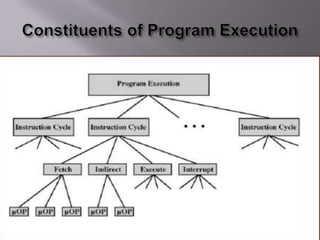
•Instruction cycle has a number of smaller units
1.Fetch
2. Indirect
3. Execute
4.Interrupt

• Micro-operations
Each part of the cycle has a number of smaller
steps called micro-operations
• Micro-operations are Fundamental atomic
operations of the processor
It includes four Registers.
• Memory Address Register (MAR)
— Connected to address bus
— Specifies address for read or write op
• Memory Buffer Register (MBR)
— Connected to data bus
— Holds data to write or last data read
• Program Counter (PC)
— Holds address of next instruction to be fetched
• Instruction Register (IR)
— Holds last instruction fetched
Clock
• Repetitive sequence of pulses
• Useful for measuring duration of micro-ops
• Different control signals at different times within instruction
cycle
• Need a counter with different control signals for t1, t2 etc.
The notation represents successive time units.
• First time unit:
Move contents of PC to MAR.
• Second time unit:
Move contents of memory location from MAR to MBR.
Increment by I the contents of the PC.
• Third time unit:
Move contents of MBR to IR.
• The fetch cycle actually consists of
3 steps
&
4 micro ops
• Each micro-op consists of moving data in or out of a Register
AS
• Address of next instruction is in PC
t1: MAR <- (PC)
• Data from data bus copied into MBR
• PC incremented
t2: MBR <- (memory)
PC <- (PC) +I
• Data (instruction) moved from MBR to IR
t3: IR <- (MBR)
• Proper

sequence must be followed

i. MAR <- (PC) must precede MBR <-(memory)

cycle

ii. Conflicts must be avoided
iii. Must not read & write same register in same

iv. MBR <- (memory) & IR <- (MBR) must not be in
same cycle
v. Also PC <- (PC) +1 involves addition

• Might need to Use ALU
• May need additional micro operations.
• If an instruction specifies an indirect addressing
• Then indirect cycles precedes the execution cycle.
i-Instruction fetched
ii-Fetch source operands
• It includes the following micro-operations:
i. The address field of the instruction is transferred to the MAR
t1: MAR <- (IR address) - address field of IR
ii. This is then used to fetch the address of the operand.
t2: MBR <- (memory)
iii. The address field of the IR is updated from the MBR, so that it
now contains a direct rather than an indirect address.
t3: IR address <- (MBR address)
• Now MBR contains direct address of operand
IR is updated with direct address of operand
IR is now in same state as if direct addressing .
• Fetch, Indirect and Interrupt cycles are simple
and predictable
• Execute cycle is different for each instruction
• There are A number of different sequences of microoperations
•Example: ADD R1,X
IR contains the ADD instruction
i. The address portion of the IR is loaded into the MAR
t1: MAR <- (IR address)
ii. The referenced memory location is read
t2: MBR <- (memory)
iii. Finally, the contents of R1 and MBR are added by ALU.
t3: R1 <- R1 + (MBR)
• Additional micro-operations may be required
i. To extract the register reference from the IR
ii. To stage the ALU inputs or outputs in some intermediate registers.
• More complex example:
ISZ X (increment and skip if zero):
The content of location X is incremented by 1.If the result is 0,the next instruction
is skipped . A possible sequence of micro-operations is
t1: MAR ← (IR(address))
t2: MBR ← Memory
t3: MBR ← (MBR) + 1
t4: Memory ← (MBR)
• This test and action can be implemented as one micro-operation:
Conditional action is “the PC is incremented if MBR=0”
If ((MBR) = 0) then (PC ← (PC) + I)
• Also that this micro-operation can be performed during the same time unit during
which the updated value in MBR is stored back to memory
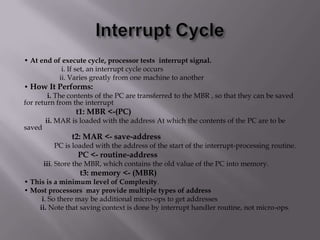
• At end of execute cycle, processor tests interrupt signal.
i. If set, an interrupt cycle occurs
ii. Varies greatly from one machine to another
• How It Performs:
i. The contents of the PC are transferred to the MBR , so that they can be saved
for return from the interrupt

t1: MBR <-(PC)
saved

ii. MAR is loaded with the address At which the contents of the PC are to be

t2: MAR <- save-address
PC is loaded with the address of the start of the interrupt-processing routine.

PC <- routine-address
iii. Store the MBR, which contains the old value of the PC into memory.

t3: memory <- (MBR)
• This is a minimum level of Complexity.
• Most processors may provide multiple types of address
i. So there may be additional micro-ops to get addresses
ii. Note that saving context is done by interrupt handler routine, not micro-ops.
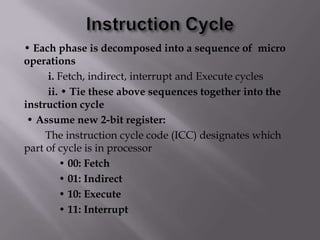
• Each phase is decomposed into a sequence of micro
operations
i. Fetch, indirect, interrupt and Execute cycles
ii. • Tie these above sequences together into the
instruction cycle
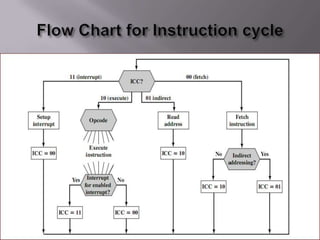
• Assume new 2-bit register:
The instruction cycle code (ICC) designates which
part of cycle is in processor
• 00: Fetch
• 01: Indirect
• 10: Execute
• 11: Interrupt
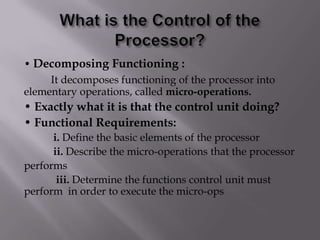
• Decomposing Functioning :
It decomposes functioning of the processor into
elementary operations, called micro-operations.

• Exactly what it is that the control unit doing?
• Functional Requirements:
i. Define the basic elements of the processor
ii. Describe the micro-operations that the processor
performs
iii. Determine the functions control unit must
perform in order to execute the micro-ops
• Basic Elements of processor
i.Registers
ii.Internal data pahs
iii.External data paths
iv.ALU
v.Control Unit
• Types of Micro-operation
i. Transfer data between registers
ii. Transfer data from register to external interface
iii. Transfer data from external interface to register
iv. Perform arithmetic or logical operations using
registers
• Control Unit performs two basic tasks
i. Sequencing
Causing the CPU to step through a series of micro
operations

ii. Execution
Causing the performance of each micro operations.

• How it Performs?
Ans:
• Key to operation is the use of control signals
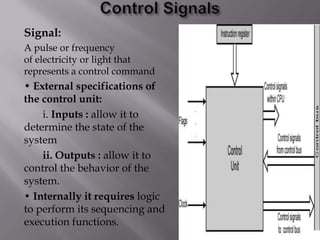
Signal:
A pulse or frequency
of electricity or light that
represents a control command

• External specifications of
the control unit:
i. Inputs : allow it to
determine the state of the
system
ii. Outputs : allow it to
control the behavior of the
system.
• Internally it requires logic
to perform its sequencing and
execution functions.
• Clock

i. This is how the control unit “keeps time.”
ii. The control unit causes one micro-operation or more to be performed
for each clock pulse.
iii. processor cycle time, or the clock cycle time.
• Instruction register:

i. The op code and addressing mode of the current instruction are used

to

determine which micro-operations to perform during the execute cycle.
• Flags:

i. To determine the status of the processor
ii. To see the outcome of previous ALU operations.
For example
The increment-and-skip-if-zero (ISZ) instruction, the control unit will increment
the PC if the zero flag is set.
• Control signals from control bus:
The control bus portion of the system bus provides signals to the control unit.
• Control signals within the processor: These are two
types:
i. That cause data to be moved from one register to
another
ii. To activate specific ALU functions.
• Control signals to control bus: These are also of two
types :
i. Control signals to memory,
ii. Control signals to the I/O modules.
• Three types of control signals are used:
i. those that activate an ALU function,
ii. those that activate a data path
iii. those that are signals on the external system bus
Micro operation control of processor

Micro operation control of processor

  • 2.
    •Instruction cycle hasa number of smaller units 1.Fetch 2. Indirect 3. Execute 4.Interrupt • Micro-operations Each part of the cycle has a number of smaller steps called micro-operations • Micro-operations are Fundamental atomic operations of the processor
  • 4.
    It includes fourRegisters. • Memory Address Register (MAR) — Connected to address bus — Specifies address for read or write op • Memory Buffer Register (MBR) — Connected to data bus — Holds data to write or last data read • Program Counter (PC) — Holds address of next instruction to be fetched • Instruction Register (IR) — Holds last instruction fetched
  • 5.
    Clock • Repetitive sequenceof pulses • Useful for measuring duration of micro-ops • Different control signals at different times within instruction cycle • Need a counter with different control signals for t1, t2 etc. The notation represents successive time units. • First time unit: Move contents of PC to MAR. • Second time unit: Move contents of memory location from MAR to MBR. Increment by I the contents of the PC. • Third time unit: Move contents of MBR to IR.
  • 6.
    • The fetchcycle actually consists of 3 steps & 4 micro ops • Each micro-op consists of moving data in or out of a Register AS • Address of next instruction is in PC t1: MAR <- (PC) • Data from data bus copied into MBR • PC incremented t2: MBR <- (memory) PC <- (PC) +I • Data (instruction) moved from MBR to IR t3: IR <- (MBR)
  • 7.
    • Proper sequence mustbe followed i. MAR <- (PC) must precede MBR <-(memory) cycle ii. Conflicts must be avoided iii. Must not read & write same register in same iv. MBR <- (memory) & IR <- (MBR) must not be in same cycle v. Also PC <- (PC) +1 involves addition • Might need to Use ALU • May need additional micro operations.
  • 8.
    • If aninstruction specifies an indirect addressing • Then indirect cycles precedes the execution cycle. i-Instruction fetched ii-Fetch source operands • It includes the following micro-operations: i. The address field of the instruction is transferred to the MAR t1: MAR <- (IR address) - address field of IR ii. This is then used to fetch the address of the operand. t2: MBR <- (memory) iii. The address field of the IR is updated from the MBR, so that it now contains a direct rather than an indirect address. t3: IR address <- (MBR address) • Now MBR contains direct address of operand IR is updated with direct address of operand IR is now in same state as if direct addressing .
  • 9.
    • Fetch, Indirectand Interrupt cycles are simple and predictable • Execute cycle is different for each instruction • There are A number of different sequences of microoperations •Example: ADD R1,X IR contains the ADD instruction i. The address portion of the IR is loaded into the MAR t1: MAR <- (IR address) ii. The referenced memory location is read t2: MBR <- (memory) iii. Finally, the contents of R1 and MBR are added by ALU. t3: R1 <- R1 + (MBR)
  • 10.
    • Additional micro-operationsmay be required i. To extract the register reference from the IR ii. To stage the ALU inputs or outputs in some intermediate registers. • More complex example: ISZ X (increment and skip if zero): The content of location X is incremented by 1.If the result is 0,the next instruction is skipped . A possible sequence of micro-operations is t1: MAR ← (IR(address)) t2: MBR ← Memory t3: MBR ← (MBR) + 1 t4: Memory ← (MBR) • This test and action can be implemented as one micro-operation: Conditional action is “the PC is incremented if MBR=0” If ((MBR) = 0) then (PC ← (PC) + I) • Also that this micro-operation can be performed during the same time unit during which the updated value in MBR is stored back to memory
  • 11.
    • At endof execute cycle, processor tests interrupt signal. i. If set, an interrupt cycle occurs ii. Varies greatly from one machine to another • How It Performs: i. The contents of the PC are transferred to the MBR , so that they can be saved for return from the interrupt t1: MBR <-(PC) saved ii. MAR is loaded with the address At which the contents of the PC are to be t2: MAR <- save-address PC is loaded with the address of the start of the interrupt-processing routine. PC <- routine-address iii. Store the MBR, which contains the old value of the PC into memory. t3: memory <- (MBR) • This is a minimum level of Complexity. • Most processors may provide multiple types of address i. So there may be additional micro-ops to get addresses ii. Note that saving context is done by interrupt handler routine, not micro-ops.
  • 12.
    • Each phaseis decomposed into a sequence of micro operations i. Fetch, indirect, interrupt and Execute cycles ii. • Tie these above sequences together into the instruction cycle • Assume new 2-bit register: The instruction cycle code (ICC) designates which part of cycle is in processor • 00: Fetch • 01: Indirect • 10: Execute • 11: Interrupt
  • 14.
    • Decomposing Functioning: It decomposes functioning of the processor into elementary operations, called micro-operations. • Exactly what it is that the control unit doing? • Functional Requirements: i. Define the basic elements of the processor ii. Describe the micro-operations that the processor performs iii. Determine the functions control unit must perform in order to execute the micro-ops
  • 15.
    • Basic Elementsof processor i.Registers ii.Internal data pahs iii.External data paths iv.ALU v.Control Unit • Types of Micro-operation i. Transfer data between registers ii. Transfer data from register to external interface iii. Transfer data from external interface to register iv. Perform arithmetic or logical operations using registers
  • 16.
    • Control Unitperforms two basic tasks i. Sequencing Causing the CPU to step through a series of micro operations ii. Execution Causing the performance of each micro operations. • How it Performs? Ans: • Key to operation is the use of control signals
  • 17.
    Signal: A pulse orfrequency of electricity or light that represents a control command • External specifications of the control unit: i. Inputs : allow it to determine the state of the system ii. Outputs : allow it to control the behavior of the system. • Internally it requires logic to perform its sequencing and execution functions.
  • 18.
    • Clock i. Thisis how the control unit “keeps time.” ii. The control unit causes one micro-operation or more to be performed for each clock pulse. iii. processor cycle time, or the clock cycle time. • Instruction register: i. The op code and addressing mode of the current instruction are used to determine which micro-operations to perform during the execute cycle. • Flags: i. To determine the status of the processor ii. To see the outcome of previous ALU operations. For example The increment-and-skip-if-zero (ISZ) instruction, the control unit will increment the PC if the zero flag is set. • Control signals from control bus: The control bus portion of the system bus provides signals to the control unit.
  • 19.
    • Control signalswithin the processor: These are two types: i. That cause data to be moved from one register to another ii. To activate specific ALU functions. • Control signals to control bus: These are also of two types : i. Control signals to memory, ii. Control signals to the I/O modules. • Three types of control signals are used: i. those that activate an ALU function, ii. those that activate a data path iii. those that are signals on the external system bus