Software 
development Life 
cycle 
BCA 5th 
Semester 
DEEPAK SHARMA 
12KSSB6031
CONTENTS 
1. Software Development Life Cycle Models[SDLC] 
2. Types of SDLC Models 
3.Waterfall Model 
4. Iterative Model 
5. Spiral Model
Software Development Life Cycle 
Definition: 
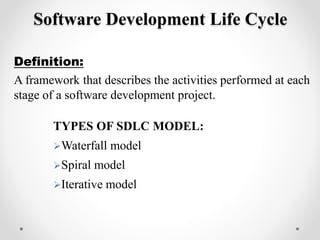
A framework that describes the activities performed at each 
stage of a software development project. 
TYPES OF SDLC MODEL: 
Waterfall model 
Spiral model 
Iterative model
WATER FALL MODEL 
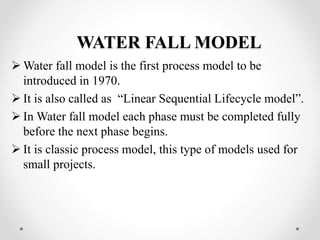
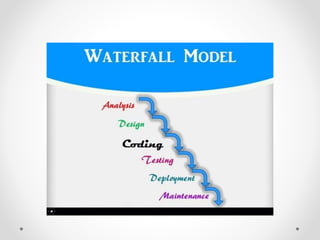
Water fall model is the first process model to be 
introduced in 1970. 
 It is also called as “Linear Sequential Lifecycle model”. 
 In Water fall model each phase must be completed fully 
before the next phase begins. 
 It is classic process model, this type of models used for 
small projects.
WATERFALL MODEL 
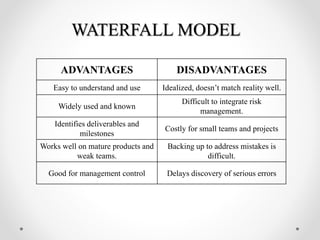
ADVANTAGES DISADVANTAGES 
Easy to understand and use Idealized, doesn’t match reality well. 
Widely used and known 
Difficult to integrate risk 
management. 
Identifies deliverables and 
milestones 
Costly for small teams and projects 
Works well on mature products and 
weak teams. 
Backing up to address mistakes is 
difficult. 
Good for management control Delays discovery of serious errors
SPIRAL MODEL 
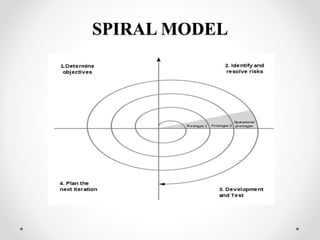
 The spiral model is the combination of classic water fall model 
and risk analysis. 
 It is iterative, every iteration reduces risk at that particular stage 
of project. 
 In 1970 water fall model has been adopted as a general standard 
by many GOVT. 
 But there are many difficulties in that model. 
 In 1988 spiral model introduced by “BOEHM”.
SPIRAL MODEL
SPIRAL MODEL 
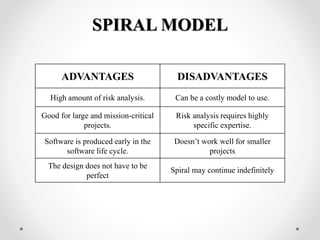
ADVANTAGES DISADVANTAGES 
High amount of risk analysis. Can be a costly model to use. 
Good for large and mission-critical 
projects. 
Risk analysis requires highly 
specific expertise. 
Software is produced early in the 
software life cycle. 
Doesn’t work well for smaller 
projects 
The design does not have to be 
perfect 
Spiral may continue indefinitely
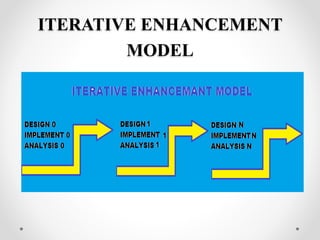
ITERATIVE ENHANCEMENT 
MODEL 
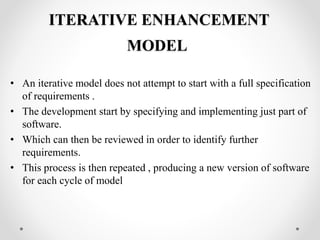
• An iterative model does not attempt to start with a full specification 
of requirements . 
• The development start by specifying and implementing just part of 
software. 
• Which can then be reviewed in order to identify further 
requirements. 
• This process is then repeated , producing a new version of software 
for each cycle of model
ITERATIVE ENHANCEMENT 
MODEL
ITERATIVE 
ENHANCEMENT MODEL 
ADVANTAGES 
 Requirements of complete 
system are clearly defined 
and understand. 
 Used in big projects. 
 Major requirements must be 
defined. 
DISADVANTAGES 
 Each phase of an iteration is 
rigid with no overlap. 
 Costly system architecture.
1.sdlc

1.sdlc

  • 1.
    Software development Life cycle BCA 5th Semester DEEPAK SHARMA 12KSSB6031
  • 2.
    CONTENTS 1. SoftwareDevelopment Life Cycle Models[SDLC] 2. Types of SDLC Models 3.Waterfall Model 4. Iterative Model 5. Spiral Model
  • 3.
    Software Development LifeCycle Definition: A framework that describes the activities performed at each stage of a software development project. TYPES OF SDLC MODEL: Waterfall model Spiral model Iterative model
  • 4.
    WATER FALL MODEL Water fall model is the first process model to be introduced in 1970.  It is also called as “Linear Sequential Lifecycle model”.  In Water fall model each phase must be completed fully before the next phase begins.  It is classic process model, this type of models used for small projects.
  • 6.
    WATERFALL MODEL ADVANTAGESDISADVANTAGES Easy to understand and use Idealized, doesn’t match reality well. Widely used and known Difficult to integrate risk management. Identifies deliverables and milestones Costly for small teams and projects Works well on mature products and weak teams. Backing up to address mistakes is difficult. Good for management control Delays discovery of serious errors
  • 7.
    SPIRAL MODEL The spiral model is the combination of classic water fall model and risk analysis.  It is iterative, every iteration reduces risk at that particular stage of project.  In 1970 water fall model has been adopted as a general standard by many GOVT.  But there are many difficulties in that model.  In 1988 spiral model introduced by “BOEHM”.
  • 8.
  • 9.
    SPIRAL MODEL ADVANTAGESDISADVANTAGES High amount of risk analysis. Can be a costly model to use. Good for large and mission-critical projects. Risk analysis requires highly specific expertise. Software is produced early in the software life cycle. Doesn’t work well for smaller projects The design does not have to be perfect Spiral may continue indefinitely
  • 10.
    ITERATIVE ENHANCEMENT MODEL • An iterative model does not attempt to start with a full specification of requirements . • The development start by specifying and implementing just part of software. • Which can then be reviewed in order to identify further requirements. • This process is then repeated , producing a new version of software for each cycle of model
  • 11.
  • 12.
    ITERATIVE ENHANCEMENT MODEL ADVANTAGES  Requirements of complete system are clearly defined and understand.  Used in big projects.  Major requirements must be defined. DISADVANTAGES  Each phase of an iteration is rigid with no overlap.  Costly system architecture.