Addressing
We would like to be able to
reference a large range of locations
in main memory or, for some
systems, virtual memory. To achieve
this objective, a variety of addressing
techniques has been employed.
Type of Addressing








Immediate
Direct
Indirect
Register
Register indirect
Displacement
Stack
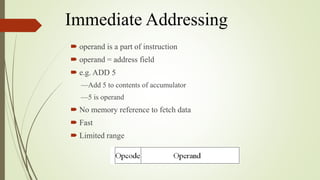
Immediate Addressing
 operand is a part of instruction

 operand = address field
 e.g. ADD 5
—Add 5 to contents of accumulator
—5 is operand

 No memory reference to fetch data
 Fast
 Limited range
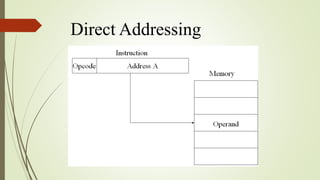
Direct Addressing
Address field contains address of operand
Effective address (EA) = address field (A)
e.g. ADD A —Add contents of cell A to accumulator
—Look in memory at address A for operand

Single memory reference to access data
No additional calculations to work out effective
address
Limited address space
Direct Addressing
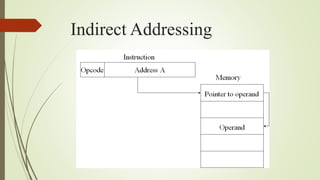
Indirect Addressing
 Memory cell pointed to by address field contains the address of (pointer
to) the operand
 EA = (A)
—Look

in A, find address (A) and look there for operand

e.g. ADD (A)
—Add contents of cell pointed to by contents of A to accumulator

 Large address space
 2 𝑛 where n = word length
 May be nested, multilevel, cascaded

 —e.g. EA = (((A)))
 Multiple memory accesses to find operand
 Hence slower
Indirect Addressing
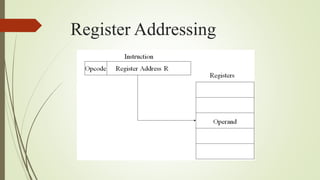
Register Addressing
 Operand is held in register named in address filed

 EA = R
 Limited number of registers
 Very small address field needed
—Shorter instructions

—Faster instruction fetch

 No memory access
 Very fast execution
 Very limited address space
 Multiple registers helps performance
—Requires good assembly programming or compiler writing
Register Addressing
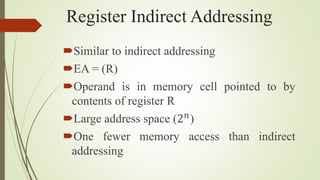
Register Indirect Addressing
Similar to indirect addressing
EA = (R)
Operand is in memory cell pointed to by
contents of register R
Large address space (2 𝑛 )
One fewer memory access than indirect
addressing
Register Indirect Addressing
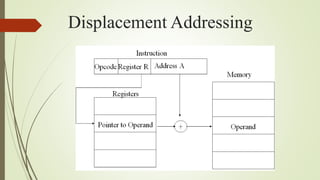
Displacement Addressing
EA = A + (R)
Address field hold two values
—A = base value
—R = register that holds displacement
—or vice versa
Displacement Addressing
Stack Addressing
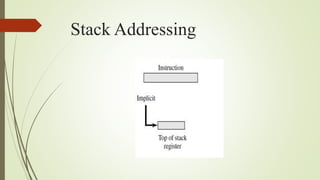
Operand is (implicitly) on top of stack
e.g.
—ADD Pop top two items from stack and add

The stack mode of addressing is a form of implied
addressing
the machine instructions need not include a memory
reference but implicitly operate on top of stack.
Stack Addressing
Summary

Addressing

  • 2.
    Addressing We would liketo be able to reference a large range of locations in main memory or, for some systems, virtual memory. To achieve this objective, a variety of addressing techniques has been employed.
  • 3.
  • 4.
    Immediate Addressing  operandis a part of instruction  operand = address field  e.g. ADD 5 —Add 5 to contents of accumulator —5 is operand  No memory reference to fetch data  Fast  Limited range
  • 5.
    Direct Addressing Address fieldcontains address of operand Effective address (EA) = address field (A) e.g. ADD A —Add contents of cell A to accumulator —Look in memory at address A for operand Single memory reference to access data No additional calculations to work out effective address Limited address space
  • 6.
  • 7.
    Indirect Addressing  Memorycell pointed to by address field contains the address of (pointer to) the operand  EA = (A) —Look in A, find address (A) and look there for operand e.g. ADD (A) —Add contents of cell pointed to by contents of A to accumulator  Large address space  2 𝑛 where n = word length  May be nested, multilevel, cascaded  —e.g. EA = (((A)))  Multiple memory accesses to find operand  Hence slower
  • 8.
  • 9.
    Register Addressing  Operandis held in register named in address filed  EA = R  Limited number of registers  Very small address field needed —Shorter instructions —Faster instruction fetch  No memory access  Very fast execution  Very limited address space  Multiple registers helps performance —Requires good assembly programming or compiler writing
  • 10.
  • 11.
    Register Indirect Addressing Similarto indirect addressing EA = (R) Operand is in memory cell pointed to by contents of register R Large address space (2 𝑛 ) One fewer memory access than indirect addressing
  • 12.
  • 13.
    Displacement Addressing EA =A + (R) Address field hold two values —A = base value —R = register that holds displacement —or vice versa
  • 14.
  • 15.
    Stack Addressing Operand is(implicitly) on top of stack e.g. —ADD Pop top two items from stack and add The stack mode of addressing is a form of implied addressing the machine instructions need not include a memory reference but implicitly operate on top of stack.
  • 16.
  • 17.