Artificial Neural
network model &
hidden layers in
multilayer artificial
neural networks
Outline
• Introduction
• Single Layer
• Multi Layer
• Learning
• Backpropogation Algorithm
Introduction
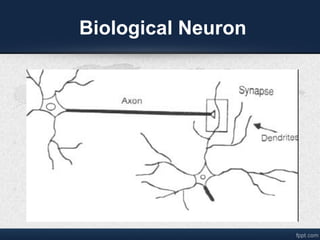
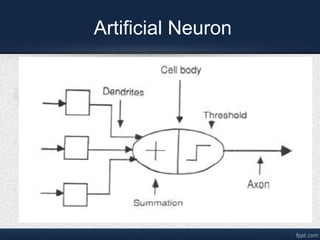
• Artificial Neural Network are computational models
inspired by biological neural network used for
processing large number of inputs which are mostly
unknown.
What is Problem?
•Our world is full of data. After collection and organization,
data, if we are lucky, becomes information. In today's
interconnected world, information exists in electronic form
that can be stored and transmitted instantly. Challenge is to
understand, integrate, and apply information to generate
useful knowledge.
What is Solution?
• Interpretation requires data acquisition, cleaning
(preparing the data for analysis), analysis, and
presentation in a way that permits knowledgeable
decision making and action. Key is to extract
information about data from relationships buried
within the data itself.
Why Human System?
•Human brain is most powerful pattern recognition engine ever
invented.
Biological Neuron
Artificial Neuron
Artificial Neuron
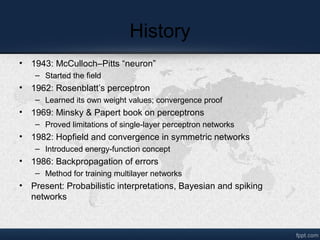
History
• 1943: McCulloch–Pitts “neuron”
– Started the field
• 1962: Rosenblatt’s perceptron
– Learned its own weight values; convergence proof
• 1969: Minsky & Papert book on perceptrons
– Proved limitations of single-layer perceptron networks
• 1982: Hopfield and convergence in symmetric networks
– Introduced energy-function concept
• 1986: Backpropagation of errors
– Method for training multilayer networks
• Present: Probabilistic interpretations, Bayesian and spiking
networks
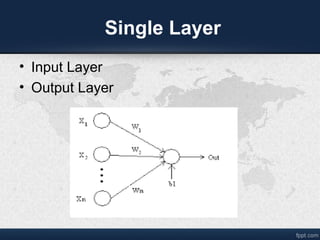
Single Layer
• Input Layer
• Output Layer
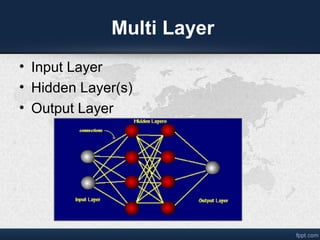
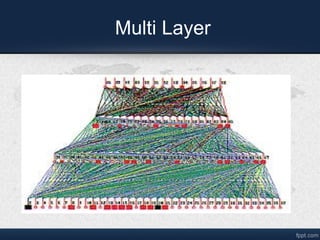
Multi Layer
• Input Layer
• Hidden Layer(s)
• Output Layer
Multi Layer
• Instead of programming computational system
to do specific tasks, teach system how to
perform task
• To do this, generate Artificial Intelligence
System- AI
• AI systems must be adaptive – able to learn
from data on a continuous basis
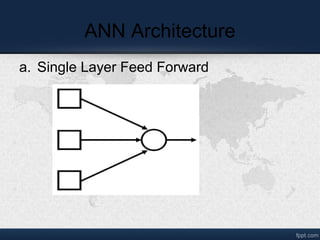
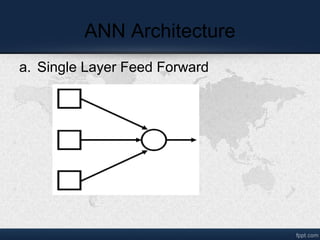
ANN Architecture
a. Single Layer Feed Forward
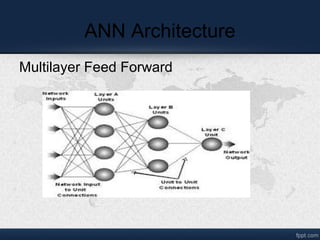
ANN Architecture
Multilayer Feed Forward
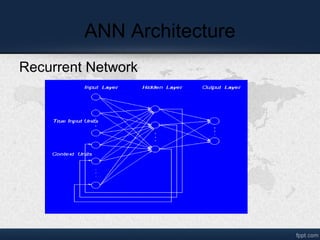
ANN Architecture
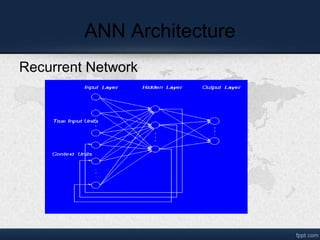
Recurrent Network
ANN Architecture
a. Single Layer Feed Forward
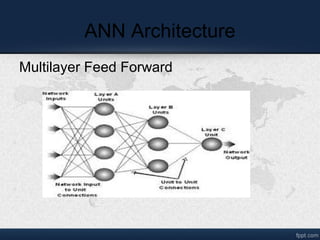
ANN Architecture
Multilayer Feed Forward
ANN Architecture
Recurrent Network
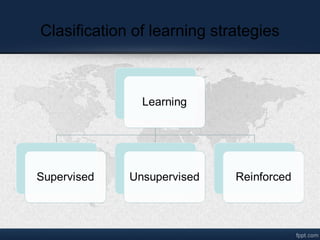
Clasification of learning strategies
Supervised
• Process of using desired output for
training the NN
• It employees a teacher to assist the
network by telling the network what the
desired response to a given input
• Weights are modified according to the
required output
• Not practicable in all cases
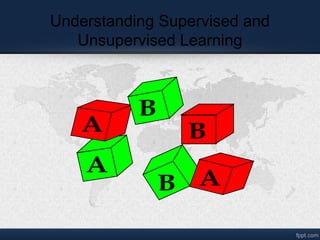
Understanding Supervised and
Unsupervised Learning
A
BA
B A
B
Two possible Solutions…
A
B
A
B
A
B
A
B A
B
A
B
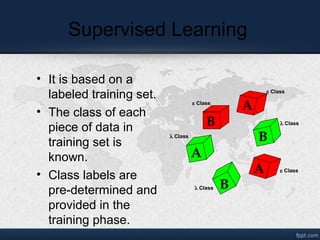
Supervised Learning
• It is based on a
labeled training set.
• The class of each
piece of data in
training set is
known.
• Class labels are
pre-determined and
provided in the
training phase.
A
B
A
B
A
B
ε Class
λ Class
λ Class
λ Class
ε Class
ε Class
26
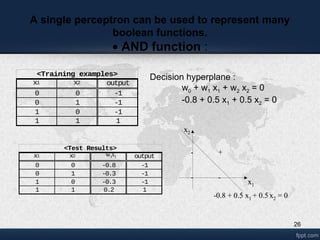
A single perceptron can be used to represent many
boolean functions.
• AND function :
x1 x2 output
0 0 -1
0 1 -1
1 0 -1
1 1 1
<Training examples>
Decision hyperplane :
w0 + w1 x1 + w2 x2 = 0
-0.8 + 0.5 x1 + 0.5 x2 = 0
x1 x2 wixi output
0 0 -0.8 -1
0 1 -0.3 -1
1 0 -0.3 -1
1 1 0.2 1
<Test Results>
-
-
-
+
x1
x2
-0.8 + 0.5 x1 + 0.5 x2 = 0
-
-
-
+
x1
x2
-0.8 + 0.5 x1 + 0.5 x2 = 0
27
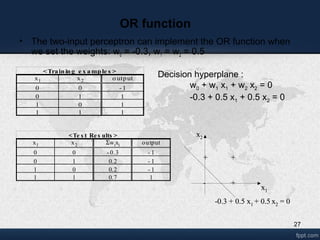
OR function
• The two-input perceptron can implement the OR function when
we set the weights: w0 = -0.3, w1 = w2 = 0.5
x1 x2 o utput
0 0 - 1
0 1 1
1 0 1
1 1 1
<Training e x ample s >
Decision hyperplane :
w0 + w1 x1 + w2 x2 = 0
-0.3 + 0.5 x1 + 0.5 x2 = 0
x1 x2 Σwixi output
0 0 -0.3 - 1
0 1 0.2 - 1
1 0 0.2 - 1
1 1 0.7 1
<Te s t Re s ults >
-
+
+
+
x1
x2
-0.3 + 0.5 x1 + 0.5 x2 = 0
-
+
+
+
x1
x2
-0.3 + 0.5 x1 + 0.5 x2 = 0
Unsupervised
• No teacher Required
• Similar to the students learning on their
own
• Adaption rules
• Adaption rule generate error signals
Reinforced
• A teacher is assumed to b present but
right answer is not given to the network
• Network is given an indication whether
output is right or wrong
• Network use this indication to improve
performance
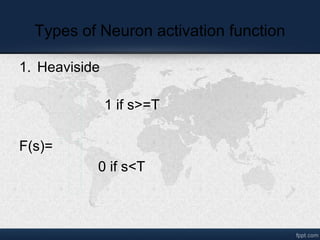
Types of Neuron activation function
1. Heaviside
1 if s>=T
F(s)=
0 if s<T
2. Linear
f(s)=s
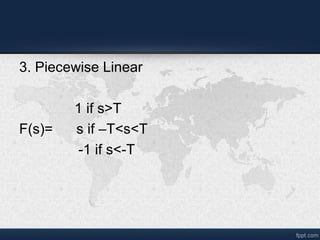
3. Piecewise Linear
1 if s>T
F(s)= s if –T<s<T
-1 if s<-T
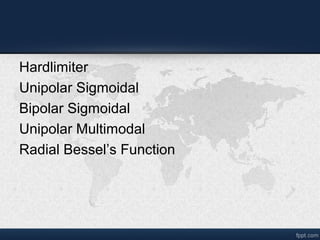
Hardlimiter
Unipolar Sigmoidal
Bipolar Sigmoidal
Unipolar Multimodal
Radial Bessel’s Function
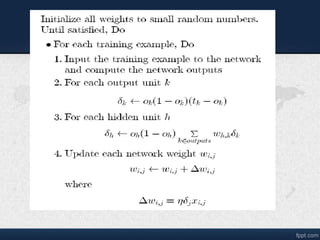
Backpropogation Algorithm
36
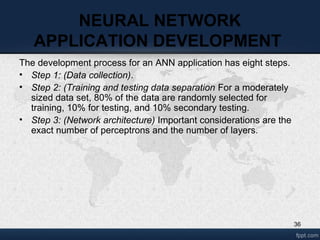
NEURAL NETWORK
APPLICATION DEVELOPMENT
The development process for an ANN application has eight steps.
• Step 1: (Data collection).
• Step 2: (Training and testing data separation For a moderately
sized data set, 80% of the data are randomly selected for
training, 10% for testing, and 10% secondary testing.
• Step 3: (Network architecture) Important considerations are the
exact number of perceptrons and the number of layers.
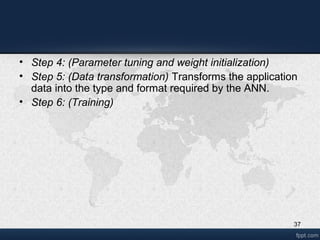
37
• Step 4: (Parameter tuning and weight initialization)
• Step 5: (Data transformation) Transforms the application
data into the type and format required by the ANN.
• Step 6: (Training)
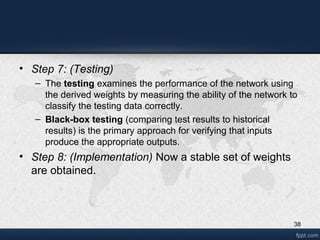
38
• Step 7: (Testing)
– The testing examines the performance of the network using
the derived weights by measuring the ability of the network to
classify the testing data correctly.
– Black-box testing (comparing test results to historical
results) is the primary approach for verifying that inputs
produce the appropriate outputs.
• Step 8: (Implementation) Now a stable set of weights
are obtained.
Thank You for your
Attention..!!
.
.
We welcome any Questions….

Artificial neural network model & hidden layers in multilayer artificial neural networks

  • 1.
    Artificial Neural network model& hidden layers in multilayer artificial neural networks
  • 2.
    Outline • Introduction • SingleLayer • Multi Layer • Learning • Backpropogation Algorithm
  • 3.
    Introduction • Artificial NeuralNetwork are computational models inspired by biological neural network used for processing large number of inputs which are mostly unknown.
  • 4.
    What is Problem? •Ourworld is full of data. After collection and organization, data, if we are lucky, becomes information. In today's interconnected world, information exists in electronic form that can be stored and transmitted instantly. Challenge is to understand, integrate, and apply information to generate useful knowledge.
  • 5.
    What is Solution? •Interpretation requires data acquisition, cleaning (preparing the data for analysis), analysis, and presentation in a way that permits knowledgeable decision making and action. Key is to extract information about data from relationships buried within the data itself.
  • 6.
    Why Human System? •Humanbrain is most powerful pattern recognition engine ever invented.
  • 7.
  • 8.
  • 9.
  • 10.
    History • 1943: McCulloch–Pitts“neuron” – Started the field • 1962: Rosenblatt’s perceptron – Learned its own weight values; convergence proof • 1969: Minsky & Papert book on perceptrons – Proved limitations of single-layer perceptron networks • 1982: Hopfield and convergence in symmetric networks – Introduced energy-function concept • 1986: Backpropagation of errors – Method for training multilayer networks • Present: Probabilistic interpretations, Bayesian and spiking networks
  • 11.
    Single Layer • InputLayer • Output Layer
  • 12.
    Multi Layer • InputLayer • Hidden Layer(s) • Output Layer
  • 13.
  • 14.
    • Instead ofprogramming computational system to do specific tasks, teach system how to perform task • To do this, generate Artificial Intelligence System- AI • AI systems must be adaptive – able to learn from data on a continuous basis
  • 15.
    ANN Architecture a. SingleLayer Feed Forward
  • 16.
  • 17.
  • 18.
    ANN Architecture a. SingleLayer Feed Forward
  • 19.
  • 20.
  • 21.
  • 22.
    Supervised • Process ofusing desired output for training the NN • It employees a teacher to assist the network by telling the network what the desired response to a given input • Weights are modified according to the required output • Not practicable in all cases
  • 23.
  • 24.
  • 25.
    Supervised Learning • Itis based on a labeled training set. • The class of each piece of data in training set is known. • Class labels are pre-determined and provided in the training phase. A B A B A B ε Class λ Class λ Class λ Class ε Class ε Class
  • 26.
    26 A single perceptroncan be used to represent many boolean functions. • AND function : x1 x2 output 0 0 -1 0 1 -1 1 0 -1 1 1 1 <Training examples> Decision hyperplane : w0 + w1 x1 + w2 x2 = 0 -0.8 + 0.5 x1 + 0.5 x2 = 0 x1 x2 wixi output 0 0 -0.8 -1 0 1 -0.3 -1 1 0 -0.3 -1 1 1 0.2 1 <Test Results> - - - + x1 x2 -0.8 + 0.5 x1 + 0.5 x2 = 0 - - - + x1 x2 -0.8 + 0.5 x1 + 0.5 x2 = 0
  • 27.
    27 OR function • Thetwo-input perceptron can implement the OR function when we set the weights: w0 = -0.3, w1 = w2 = 0.5 x1 x2 o utput 0 0 - 1 0 1 1 1 0 1 1 1 1 <Training e x ample s > Decision hyperplane : w0 + w1 x1 + w2 x2 = 0 -0.3 + 0.5 x1 + 0.5 x2 = 0 x1 x2 Σwixi output 0 0 -0.3 - 1 0 1 0.2 - 1 1 0 0.2 - 1 1 1 0.7 1 <Te s t Re s ults > - + + + x1 x2 -0.3 + 0.5 x1 + 0.5 x2 = 0 - + + + x1 x2 -0.3 + 0.5 x1 + 0.5 x2 = 0
  • 28.
    Unsupervised • No teacherRequired • Similar to the students learning on their own • Adaption rules • Adaption rule generate error signals
  • 29.
    Reinforced • A teacheris assumed to b present but right answer is not given to the network • Network is given an indication whether output is right or wrong • Network use this indication to improve performance
  • 30.
    Types of Neuronactivation function 1. Heaviside 1 if s>=T F(s)= 0 if s<T
  • 31.
  • 32.
    3. Piecewise Linear 1if s>T F(s)= s if –T<s<T -1 if s<-T
  • 33.
    Hardlimiter Unipolar Sigmoidal Bipolar Sigmoidal UnipolarMultimodal Radial Bessel’s Function
  • 34.
  • 36.
    36 NEURAL NETWORK APPLICATION DEVELOPMENT Thedevelopment process for an ANN application has eight steps. • Step 1: (Data collection). • Step 2: (Training and testing data separation For a moderately sized data set, 80% of the data are randomly selected for training, 10% for testing, and 10% secondary testing. • Step 3: (Network architecture) Important considerations are the exact number of perceptrons and the number of layers.
  • 37.
    37 • Step 4:(Parameter tuning and weight initialization) • Step 5: (Data transformation) Transforms the application data into the type and format required by the ANN. • Step 6: (Training)
  • 38.
    38 • Step 7:(Testing) – The testing examines the performance of the network using the derived weights by measuring the ability of the network to classify the testing data correctly. – Black-box testing (comparing test results to historical results) is the primary approach for verifying that inputs produce the appropriate outputs. • Step 8: (Implementation) Now a stable set of weights are obtained.
  • 39.
    Thank You foryour Attention..!! . .
  • 40.
    We welcome anyQuestions….