1
OUTLINE
Need of a Proposal (why do we need a proposal?)
Definition
Types
Elements of Winning Business Proposals
Criteria for Proposals
Writing Process
 Prewriting
 Writing
 Rewriting
2
Need of a Proposal
Proposals are a starting point for your Audience to
understand your ideas by identifying the key issues,
methods, sources of your plan to develop the project.
A proposal will help you complete your project
because you have move ahead and made a plan.
3
Definition and Types
Definition:
 A written offer from a seller to a prospective buyer.
 Business proposals are often a key step in the complex sales
process.
Types:
 Solicited and Unsolicited Business Proposals
 External and Internal Proposals
4
Solicited and Unsolicited Business
Proposal(cont. . .)
Solicited Business Proposal
 “Solicited” means “to be requested”.
 When individual or organization completes a project, they’ll
request that interested parties bid for the project i.e. submit a
proposal because it was requested.
5
Solicited and Unsolicited Business
Proposal
Unsolicited Business Proposal
 The one which is not requested.
 At some point, your small business wants to do business with
larger company.
 A well written business proposal can win the hearts and
minds of the targeted Audience.
6
External And Internal Proposals
Internal Proposal
 A proposal for a party within the organization such as boss of
your company or government agency.
External Proposal
 A proposal written for an individual or organization outside
your organization.
7
Example
Unsolicited Business Proposal
Solicited Business Proposal
External Proposal
Internal Proposal
8
Elements of Winning Business
Proposals(cont. . .)
Solutions
Benefits
Credibility
Samples
Targeted
9
Elements of Winning Business
Proposals(cont. . .)
Solutions
 After you have written a lead paragraph on company’s needs
and problems, follow up with solid presentation of how your
business can provide them solutions.
 The key here is to promise solutions you can deliver.
Benefits
 Your business proposal should clearly outline the company
benefits to be gained by doing business with you.
 If your small business can meet tight deadlines, state it in
your benefit section.
10
Elements of Winning Business
Proposals(cont. . .)
Credibility
 If you have worked with clients in the same field or have an
award winning business, then third party endorsements will
build credibility.
Samples
 A Business Proposal with samples and evidence of your
ability to deliver is vital to gaining the winning bid.
 A small sample of your work can show your ability to do
work.
11
Elements of Winning Business
Proposals
Targeted
 A winning Proposal is all about communication.
 Speak in a language spoken by your intended Audience.
 For example, if your proposal evaluators are from
Engineering background, use appropriate jargon.
12
Criteria for Proposals
 Basic Elements
 Title Page
 Cover Letter
 Table of Content
 List of illustration
 Executive Summary
 Introduction and Discussion
 Conclusion
13
Title Page for External Proposals
14
Title Page for Internal Proposals
15
Cover Letter(cont. . .)
Your Cover Letter provides the reader an overview of
what is to follow. It tells reader:
 Why Are you writing?
 What you are writing about (subject of the proposal)
 When the action should occur?
 Why that day is important?
16
Table of Content
Different Readers have different area of interest.
Help the reader the section of their interest.
Table of Content should be Accurate.
17
Table of Content (example)
18
List of illustrations(cont. . .)
If your proposal contain figures or tables you should
provide a List of illustrations.
List should be Clear and Informative.
Don’t waste your and reader’s time by providing a
poor list of illustration.
19
List of illustrations(example)
20
Abstract(or Executive Summary)
Abstract is a brief overview of key points.
Abstract should focus on the following:
 The Problem necessitating your proposal.
 Your suggested Solutions .
 The Benefits.
Avoid High tech terminology and Concepts.
21
Introduction and Discussion
Introduction should include two primary sections:
 Purpose
 Problem
In Discussion section, you will sell your product,
service and suggested solution.
22
Conclusion
Sum up your proposal.
Provide your reader a sense of Closure.
Be, specified. State amount and percentages
Can be made accessible through highlighting
techniques.
23
Writing Process(cont. . .)
Prewriting Writing Rewriting
24
Writing Process(cont. . .)
Prewriting
 Examine your purposes.
 Determine your goals.
 Consider your Audience
 Gather Data
 Determine how the content will be provided.
25
Writing Process(cont. . .)
Writing
 Review your rewriting.
 Organize the Data.
 Write using Sufficing Techniques.
 Format your writing according to the Criteria of Effective
Proposals.
26
Writing Process
Rewriting
 Add Missing details.
 Delete Wordiness.
 Avoid Biased Language
 Simplify word usage.
 Correct Errors.
 Reformat your text for ease of access.
 Enhance the Tone of your Proposal.
 Review the Text.
27
Sample Proposal
A company named “Rocket Soft wares” build a
computer software. This company wants to do
business with a larger company. So this company
writes a proposal to that company.
28
Title Page
29
Cover Letter
30
Table of Content
31
Executive Summary
32
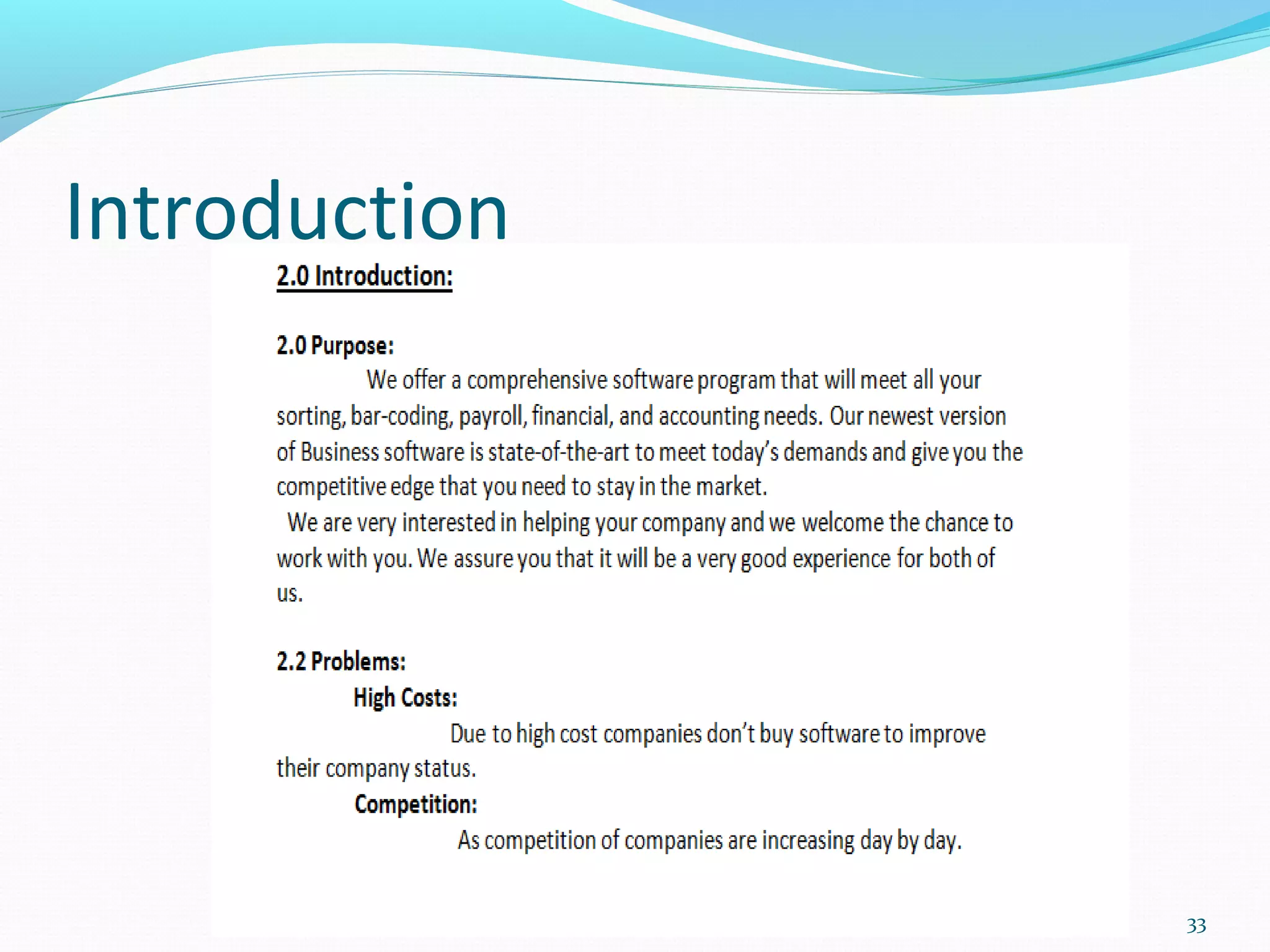
Introduction
33
Proposal
34
Conclusion
35
Thank You…..
36

Business proposal

  • 1.
  • 2.
    OUTLINE Need of aProposal (why do we need a proposal?) Definition Types Elements of Winning Business Proposals Criteria for Proposals Writing Process  Prewriting  Writing  Rewriting 2
  • 3.
    Need of aProposal Proposals are a starting point for your Audience to understand your ideas by identifying the key issues, methods, sources of your plan to develop the project. A proposal will help you complete your project because you have move ahead and made a plan. 3
  • 4.
    Definition and Types Definition: A written offer from a seller to a prospective buyer.  Business proposals are often a key step in the complex sales process. Types:  Solicited and Unsolicited Business Proposals  External and Internal Proposals 4
  • 5.
    Solicited and UnsolicitedBusiness Proposal(cont. . .) Solicited Business Proposal  “Solicited” means “to be requested”.  When individual or organization completes a project, they’ll request that interested parties bid for the project i.e. submit a proposal because it was requested. 5
  • 6.
    Solicited and UnsolicitedBusiness Proposal Unsolicited Business Proposal  The one which is not requested.  At some point, your small business wants to do business with larger company.  A well written business proposal can win the hearts and minds of the targeted Audience. 6
  • 7.
    External And InternalProposals Internal Proposal  A proposal for a party within the organization such as boss of your company or government agency. External Proposal  A proposal written for an individual or organization outside your organization. 7
  • 8.
    Example Unsolicited Business Proposal SolicitedBusiness Proposal External Proposal Internal Proposal 8
  • 9.
    Elements of WinningBusiness Proposals(cont. . .) Solutions Benefits Credibility Samples Targeted 9
  • 10.
    Elements of WinningBusiness Proposals(cont. . .) Solutions  After you have written a lead paragraph on company’s needs and problems, follow up with solid presentation of how your business can provide them solutions.  The key here is to promise solutions you can deliver. Benefits  Your business proposal should clearly outline the company benefits to be gained by doing business with you.  If your small business can meet tight deadlines, state it in your benefit section. 10
  • 11.
    Elements of WinningBusiness Proposals(cont. . .) Credibility  If you have worked with clients in the same field or have an award winning business, then third party endorsements will build credibility. Samples  A Business Proposal with samples and evidence of your ability to deliver is vital to gaining the winning bid.  A small sample of your work can show your ability to do work. 11
  • 12.
    Elements of WinningBusiness Proposals Targeted  A winning Proposal is all about communication.  Speak in a language spoken by your intended Audience.  For example, if your proposal evaluators are from Engineering background, use appropriate jargon. 12
  • 13.
    Criteria for Proposals Basic Elements  Title Page  Cover Letter  Table of Content  List of illustration  Executive Summary  Introduction and Discussion  Conclusion 13
  • 14.
    Title Page forExternal Proposals 14
  • 15.
    Title Page forInternal Proposals 15
  • 16.
    Cover Letter(cont. ..) Your Cover Letter provides the reader an overview of what is to follow. It tells reader:  Why Are you writing?  What you are writing about (subject of the proposal)  When the action should occur?  Why that day is important? 16
  • 17.
    Table of Content DifferentReaders have different area of interest. Help the reader the section of their interest. Table of Content should be Accurate. 17
  • 18.
    Table of Content(example) 18
  • 19.
    List of illustrations(cont.. .) If your proposal contain figures or tables you should provide a List of illustrations. List should be Clear and Informative. Don’t waste your and reader’s time by providing a poor list of illustration. 19
  • 20.
  • 21.
    Abstract(or Executive Summary) Abstractis a brief overview of key points. Abstract should focus on the following:  The Problem necessitating your proposal.  Your suggested Solutions .  The Benefits. Avoid High tech terminology and Concepts. 21
  • 22.
    Introduction and Discussion Introductionshould include two primary sections:  Purpose  Problem In Discussion section, you will sell your product, service and suggested solution. 22
  • 23.
    Conclusion Sum up yourproposal. Provide your reader a sense of Closure. Be, specified. State amount and percentages Can be made accessible through highlighting techniques. 23
  • 24.
    Writing Process(cont. ..) Prewriting Writing Rewriting 24
  • 25.
    Writing Process(cont. ..) Prewriting  Examine your purposes.  Determine your goals.  Consider your Audience  Gather Data  Determine how the content will be provided. 25
  • 26.
    Writing Process(cont. ..) Writing  Review your rewriting.  Organize the Data.  Write using Sufficing Techniques.  Format your writing according to the Criteria of Effective Proposals. 26
  • 27.
    Writing Process Rewriting  AddMissing details.  Delete Wordiness.  Avoid Biased Language  Simplify word usage.  Correct Errors.  Reformat your text for ease of access.  Enhance the Tone of your Proposal.  Review the Text. 27
  • 28.
    Sample Proposal A companynamed “Rocket Soft wares” build a computer software. This company wants to do business with a larger company. So this company writes a proposal to that company. 28
  • 29.
  • 30.
  • 31.
  • 32.
  • 33.
  • 34.
  • 35.
  • 36.