Presentation Topic:
DRAM(Dynamic RAM) and its
types.
What is RAM?
• RAM is extra memory that provides space for
the Central Processing Unit (CPU) to read and
write data.

• The more RAM your computer has, the less
the CPU has to read data from your hard disk.
This usually allows your computer to run
faster since RAM is faster than the hard disk.
Cont..
• Ram is volatile, meaning is does not retain data
when the electric power is turned off or fails, so
if you turn of your computer, all memory stored
in RAM is lost.
• When your computer is turned on again, the
BIOS reads your operating system and related
files from the hard disk and loads them back into
RAM.
Types Of RAM:
 SRAM(Static Random Access Memory)
 DRAM(Dynamic Random Access Memory)
Dynamic random-access
memory (DRAM):is a type of
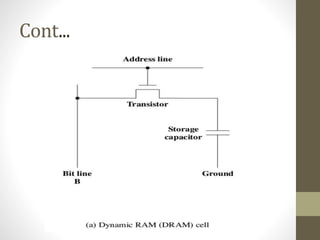
random-access memory that stores each bit of data in a
separate capacitor within an integrated circuit. The capacitor
can be either charged or discharged; these two states are
taken to represent the two values of a bit, conventionally
called 0 and 1. Since even "nonconducting" transistors
always leak a small amount, the capacitors will slowly
discharge, and the information eventually fades unless the
capacitor charge is refreshed periodically. Because of this
refresh requirement
Cont...
• The main memory (the "RAM") in personal
computers is dynamic RAM (DRAM). It is the
RAM in desktops, laptops and workstation
computers as well as some of the RAM of video
game consoles
Cont...
Types Of DRAM:There are four main types of
RAM:
• SDRAM
• DDR
• Rambus DRAM
• DRAM
SDRAM
(Synchronous DRAM)
• SDRAM started out running at 66 MHz, while
older fast page mode DRAM and EDO max out at
50 MHz. SDRAM is able to scale to 133 MHz
(PC133) officially, and unofficially up to 180MHz
or higher. SDRAM is pretty much outdated now.
More recent types of RAM, such as DDR and
RDRAM, are required to get proper performance.
DDR
(Double Data Rate SDRAM)
• Double data rate SDRAM (DDR) was a later development
of SDRAM, used in PC memory beginning in 2000.
Subsequent versions are numbered sequentially (DDR2,
DDR3, etc.). DDR SDRAM internally performs doublewidth accesses at the clock rate, and uses a double data
rate interface to transfer one half on each clock edge.
DDR2 and DDR3 increased this factor to 4× and 8×,
respectively, delivering 4-word and 8-word bursts over 2
and 4 clock cycles, respectively. The internal access rate
is mostly unchanged (200 million per second for DDR400, DDR2-800 and DDR3-1600 memory), but each
access transfers more data
RDRAM
(Rambus DRAM)
• RDRAM is a serial memory technology that
arrived in three types, PC600, PC700, and PC800.
PC800 RDRAM has double the maximum
throughput of old PC100 SDRAM, but a higher
latency. RDRAM designs with multiple channels,
such as those in Pentium 4 motherboards, are
currently at the top of the heap in memory
throughput, especially when paired with PC1066
RDRAM memory.
DRAM memory module
formats
• Single In-line Memory Module, SIMM:
This type of DRAM or memory package
holds up to eight nine RAM chips (8 in
Macs and 9 in PCs where the 9th chip is
used for parity checking). Another
important factor is the bus width, which
for SIMMS is 32 bits.
Cont.
• Dual In-line Memory Module, DIMM: With the
increase in data bus width, DIMMs began to
replace SIMMs as the predominant type of
memory module. The main difference between a
SIMM and a DIMM is that a DIMM has separate
electrical contacts on each side of the module,
while the contacts on a SIMM are on both sides
are redundant. Standard SIMMs also have a 32bit data bus, while standard DIMMs have a 64bit data bus.
Cont.
• Rambus In-line Memory Module, RIMM:
This type of DRAM memory package is
essentially the same as a DIMM but is
referred to as RIMMs because of their
manufacturer and proprietary slot
required
Major Manufacturers
•
•
•
•
•
•
•
•
•
•
•
•
•
•

Corsair Memory
Crucial Technology
EDGE Tech Corp
GEIL
G.Skill
Hynix
Infineon Technologies
Kingston Technologies
Micron Technology
PNY
OCZ Technology
Rambus
Samsung
SimpleTech

Dram and its types

  • 1.
  • 2.
    What is RAM? •RAM is extra memory that provides space for the Central Processing Unit (CPU) to read and write data. • The more RAM your computer has, the less the CPU has to read data from your hard disk. This usually allows your computer to run faster since RAM is faster than the hard disk.
  • 3.
    Cont.. • Ram isvolatile, meaning is does not retain data when the electric power is turned off or fails, so if you turn of your computer, all memory stored in RAM is lost. • When your computer is turned on again, the BIOS reads your operating system and related files from the hard disk and loads them back into RAM.
  • 4.
    Types Of RAM: SRAM(Static Random Access Memory)  DRAM(Dynamic Random Access Memory)
  • 5.
    Dynamic random-access memory (DRAM):isa type of random-access memory that stores each bit of data in a separate capacitor within an integrated circuit. The capacitor can be either charged or discharged; these two states are taken to represent the two values of a bit, conventionally called 0 and 1. Since even "nonconducting" transistors always leak a small amount, the capacitors will slowly discharge, and the information eventually fades unless the capacitor charge is refreshed periodically. Because of this refresh requirement
  • 6.
    Cont... • The mainmemory (the "RAM") in personal computers is dynamic RAM (DRAM). It is the RAM in desktops, laptops and workstation computers as well as some of the RAM of video game consoles
  • 7.
  • 8.
    Types Of DRAM:Thereare four main types of RAM: • SDRAM • DDR • Rambus DRAM • DRAM
  • 9.
    SDRAM (Synchronous DRAM) • SDRAMstarted out running at 66 MHz, while older fast page mode DRAM and EDO max out at 50 MHz. SDRAM is able to scale to 133 MHz (PC133) officially, and unofficially up to 180MHz or higher. SDRAM is pretty much outdated now. More recent types of RAM, such as DDR and RDRAM, are required to get proper performance.
  • 10.
    DDR (Double Data RateSDRAM) • Double data rate SDRAM (DDR) was a later development of SDRAM, used in PC memory beginning in 2000. Subsequent versions are numbered sequentially (DDR2, DDR3, etc.). DDR SDRAM internally performs doublewidth accesses at the clock rate, and uses a double data rate interface to transfer one half on each clock edge. DDR2 and DDR3 increased this factor to 4× and 8×, respectively, delivering 4-word and 8-word bursts over 2 and 4 clock cycles, respectively. The internal access rate is mostly unchanged (200 million per second for DDR400, DDR2-800 and DDR3-1600 memory), but each access transfers more data
  • 11.
    RDRAM (Rambus DRAM) • RDRAMis a serial memory technology that arrived in three types, PC600, PC700, and PC800. PC800 RDRAM has double the maximum throughput of old PC100 SDRAM, but a higher latency. RDRAM designs with multiple channels, such as those in Pentium 4 motherboards, are currently at the top of the heap in memory throughput, especially when paired with PC1066 RDRAM memory.
  • 12.
    DRAM memory module formats •Single In-line Memory Module, SIMM: This type of DRAM or memory package holds up to eight nine RAM chips (8 in Macs and 9 in PCs where the 9th chip is used for parity checking). Another important factor is the bus width, which for SIMMS is 32 bits.
  • 13.
    Cont. • Dual In-lineMemory Module, DIMM: With the increase in data bus width, DIMMs began to replace SIMMs as the predominant type of memory module. The main difference between a SIMM and a DIMM is that a DIMM has separate electrical contacts on each side of the module, while the contacts on a SIMM are on both sides are redundant. Standard SIMMs also have a 32bit data bus, while standard DIMMs have a 64bit data bus.
  • 14.
    Cont. • Rambus In-lineMemory Module, RIMM: This type of DRAM memory package is essentially the same as a DIMM but is referred to as RIMMs because of their manufacturer and proprietary slot required
  • 15.
    Major Manufacturers • • • • • • • • • • • • • • Corsair Memory CrucialTechnology EDGE Tech Corp GEIL G.Skill Hynix Infineon Technologies Kingston Technologies Micron Technology PNY OCZ Technology Rambus Samsung SimpleTech