Downloaded 930 times

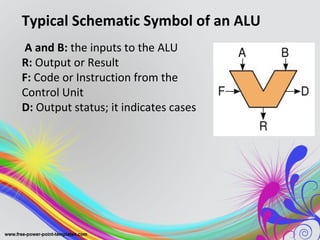

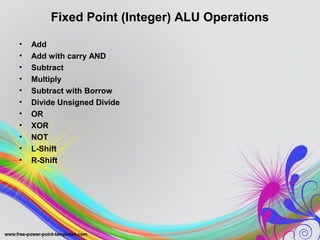

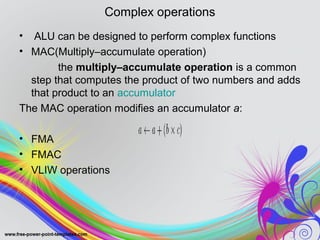
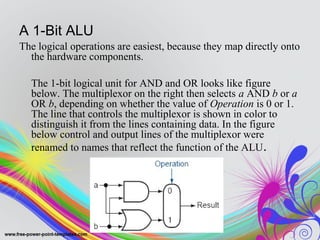
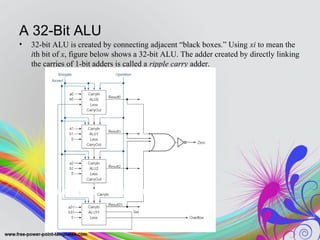

An Arithmetic Logic Unit (ALU) is a digital circuit that performs arithmetic and logical operations on binary numbers, essential for CPUs, GPUs, and other computing circuits. Proposed by John von Neumann in 1945, ALUs can handle fixed-point and floating-point operations, and their design can range from simple 1-bit operations to complex functions like multiply-accumulate. The ALU processes data using a specific numeric format, typically two's complement, to facilitate efficient calculations.


![20230809133941_[11] 27 Datapath Introduction_1 NEW.pptx](https://cdn.slidesharecdn.com/ss_thumbnails/202308091339411127datapathintroduction1new-251108061328-e0605b9a-thumbnail.jpg?width=640&height=640&fit=bounds)


