Distance Vector Multicast RoutingProtocol (DVMRP)
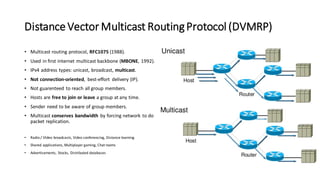
• Multicast routing protocol, RFC1075 (1988).
• Used in first internet multicast backbone (MBONE, 1992).
• IPv4 address types: unicast, broadcast, multicast.
• Not connection-oriented, best-effort delivery (IP).
• Not guarenteed to reach all group members.
• Hosts are free to join or leave a group at any time.
• Sender need to be aware of group members.
• Multicast conserves bandwidth by forcing network to do
packet replication.
• Radio / VIdeo broadcasts, Video conferencing, Distance learning
• Shared applications, Multiplayer gaming, Chat rooms
• Advertisements, Stocks, Distributed databases
MulticastBackbone (MBONE)
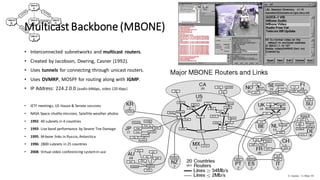
• Interconnected subnetworks and multicast routers.
• Created by Jacobson, Deering, Casner (1992).
• Uses tunnels for connecting through unicast routers.
• Uses DVMRP, MOSPF for routing along with IGMP.
• IP Address: 224.2.0.0 (audio 64kbps, video 120 kbps)
• IETF meetings, US House & Senate sessions
• NASA Space shuttle missions, Satellite weather photos
• 1992: 40 subnets in 4 countries
• 1993: Live band performance by Severe Tire Damage
• 1995: M-bone links in Russia, Antarctica
• 1996: 2800 subnets in 25 countries
• 2008: Virtual video conferencing systemin use
MulticastAddressing
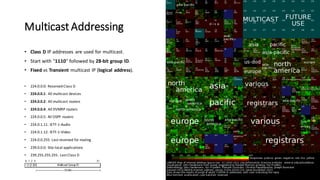
• Class D IP addresses are used for multicast.
• Start with "1110" followed by 28-bit group ID.
• Fixed vs Transient multicast IP (logical address).
• 224.0.0.0: Reserved Class D
• 224.0.0.1: All multicast devices
• 224.0.0.2: All multicast routers
• 224.0.0.4: All DVMRP routers
• 224.0.0.5: All OSPF routers
• 224.0.1.11: IETF-1-Audio
• 224.0.1.12: IETF-1-Video
• 224.0.0.255: Last reserved for routing
• 239.0.0.0: Site-local applications
• 239.255.255.255: Last Class D
Distance Vector Routing (eg. RIP)
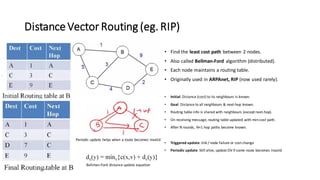
• Find the least cost path between 2 nodes.
• Also called Bellman-Ford algorithm (distributed).
• Each node maintains a routing table.
• Originally used in ARPAnet, RIP (now used rarely).
• Initial: Distance (cost) to its neighbours is known.
• Goal: Distance to all neighbours & next-hop known.
• Routing table info is shared with neighbours (except next-hop).
• On receiving message, routing table updated with min-cost path.
• After N rounds, N+1 hop paths become known.
• Triggered update: link / node failure or cost change
• Periodic update: Still alive, update DV if some route becomes invalid
Periodic update helps when a route becomes invalid
Bellman-Ford distance update equation
MulticastFlooding
• Router / Host sends packet on all interfaces.
• If router has been seen packet before, its discarded.
• Used on local network for multicast communication.
• Filtering can be done with Multicast MAC address.
Each Host Receives the Multicast Stream
Multicast Stream is filtered by Switch through Multicast MAC address
InternetGroupManagementProtocol (IGMP)
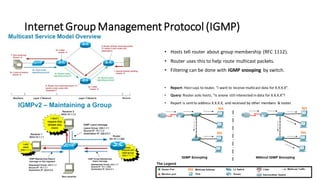
• Hosts tell router about group membership (RFC 1112).
• Router uses this to help route multicast packets.
• Filtering can be done with IGMP snooping by switch.
• Report: Host says to router, "I want to receive multicast data for X.X.X.X".
• Query: Router asks hosts, "Is anone still interested in data for X.X.X.X"?
• Report is sent to address X.X.X.X, and received by other members & router.
Reverse PathMulticasting(RPM)
• Forward packet that arrives on shortest path to source.
• Router discards packet if it arrives on any other interface.
• Delivery tree is truncated if leaf subnet has no members.
• Prune message is sent if all child links are truncated.
• Opt: Forward only if on downstream router's shortest path.
• Duplicates are possible since shortest path is source-based.
RPB
TRPB
RPM
Reverse Path Broadcasting (RPB)
Truncated Reverse Path Broadcasting (TRPB)
Opt. Reverse Path Broadcasting (RPB) RPB
Reverse Path Multicasting (RPM)
Net3 recieves 2 packets
DVMRP
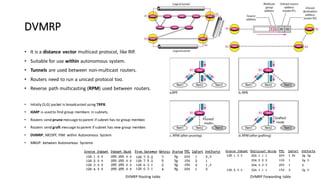
• It is a distance vector multicast protocol, like RIP.
• Suitable for use within autonomous system.
• Tunnels are used between non-multicast routers.
• Routers need to run a unicast protocol too.
• Reverse path multicasting (RPM) used between routers.
• Intially (S,G) packet is broadcasted using TRPB.
• IGMP is used to find group members in subnets.
• Routers send prune message to parent if subnet has no group member.
• Routers send graft message to parent if subnet has new group member.
• DVMRP, MOSPF, PIM: within Autonomous System
• MBGP: between Autonomous Systems
DVMRP Routing table DVMRP Forwarding table
DVMRP Datagrams
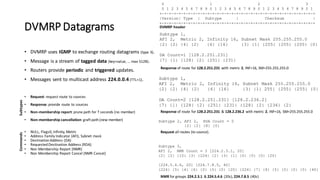
• DVMRP uses IGMP to exchange routing datagrams (type 3).
• Message is a stream of tagged data (key=value, … max 512B).
• Routers provide periodic and triggered updates.
• Messages sent to multicast address 224.0.0.4 (TTL=1).
• Request: request route to sources
• Response: provide route to sources
• Non-membership report: prune path for T seconds (no member)
• Non-membership cancellation: graft path (new member)
• NULL, Flags0, Infinity, Metric
• Address Family Indicator (AFI), Subnet mask
• Destination Address (DA)
• Requested Destination Address (RDA)
• Non Membership Report (NMR)
• Non Membership Report Cancel (NMR Cancel)
CommandsSubtypes
NMR for groups 224.2.3.1 & 224.5.4.6 (20s), 224.7.8.5 (40s)
Request all routes (to source).
Response of route for 128.2.251.231 & 128.2.236.2 with metric 2, INF=16, SM=255.255.255.0
Response of route for 128.2.251.231 with metric 2, INF=16, SM=255.255.255.0
DVMRP header

Distance Vector Multicast Routing Protocol (DVMRP) : Presentation

  • 1.
    Distance Vector MulticastRoutingProtocol (DVMRP) • Multicast routing protocol, RFC1075 (1988). • Used in first internet multicast backbone (MBONE, 1992). • IPv4 address types: unicast, broadcast, multicast. • Not connection-oriented, best-effort delivery (IP). • Not guarenteed to reach all group members. • Hosts are free to join or leave a group at any time. • Sender need to be aware of group members. • Multicast conserves bandwidth by forcing network to do packet replication. • Radio / VIdeo broadcasts, Video conferencing, Distance learning • Shared applications, Multiplayer gaming, Chat rooms • Advertisements, Stocks, Distributed databases
  • 2.
    MulticastBackbone (MBONE) • Interconnectedsubnetworks and multicast routers. • Created by Jacobson, Deering, Casner (1992). • Uses tunnels for connecting through unicast routers. • Uses DVMRP, MOSPF for routing along with IGMP. • IP Address: 224.2.0.0 (audio 64kbps, video 120 kbps) • IETF meetings, US House & Senate sessions • NASA Space shuttle missions, Satellite weather photos • 1992: 40 subnets in 4 countries • 1993: Live band performance by Severe Tire Damage • 1995: M-bone links in Russia, Antarctica • 1996: 2800 subnets in 25 countries • 2008: Virtual video conferencing systemin use
  • 3.
    MulticastAddressing • Class DIP addresses are used for multicast. • Start with "1110" followed by 28-bit group ID. • Fixed vs Transient multicast IP (logical address). • 224.0.0.0: Reserved Class D • 224.0.0.1: All multicast devices • 224.0.0.2: All multicast routers • 224.0.0.4: All DVMRP routers • 224.0.0.5: All OSPF routers • 224.0.1.11: IETF-1-Audio • 224.0.1.12: IETF-1-Video • 224.0.0.255: Last reserved for routing • 239.0.0.0: Site-local applications • 239.255.255.255: Last Class D
  • 4.
    Distance Vector Routing(eg. RIP) • Find the least cost path between 2 nodes. • Also called Bellman-Ford algorithm (distributed). • Each node maintains a routing table. • Originally used in ARPAnet, RIP (now used rarely). • Initial: Distance (cost) to its neighbours is known. • Goal: Distance to all neighbours & next-hop known. • Routing table info is shared with neighbours (except next-hop). • On receiving message, routing table updated with min-cost path. • After N rounds, N+1 hop paths become known. • Triggered update: link / node failure or cost change • Periodic update: Still alive, update DV if some route becomes invalid Periodic update helps when a route becomes invalid Bellman-Ford distance update equation
  • 5.
    MulticastFlooding • Router /Host sends packet on all interfaces. • If router has been seen packet before, its discarded. • Used on local network for multicast communication. • Filtering can be done with Multicast MAC address. Each Host Receives the Multicast Stream Multicast Stream is filtered by Switch through Multicast MAC address
  • 6.
    InternetGroupManagementProtocol (IGMP) • Hoststell router about group membership (RFC 1112). • Router uses this to help route multicast packets. • Filtering can be done with IGMP snooping by switch. • Report: Host says to router, "I want to receive multicast data for X.X.X.X". • Query: Router asks hosts, "Is anone still interested in data for X.X.X.X"? • Report is sent to address X.X.X.X, and received by other members & router.
  • 7.
    Reverse PathMulticasting(RPM) • Forwardpacket that arrives on shortest path to source. • Router discards packet if it arrives on any other interface. • Delivery tree is truncated if leaf subnet has no members. • Prune message is sent if all child links are truncated. • Opt: Forward only if on downstream router's shortest path. • Duplicates are possible since shortest path is source-based. RPB TRPB RPM Reverse Path Broadcasting (RPB) Truncated Reverse Path Broadcasting (TRPB) Opt. Reverse Path Broadcasting (RPB) RPB Reverse Path Multicasting (RPM) Net3 recieves 2 packets
  • 8.
    DVMRP • It isa distance vector multicast protocol, like RIP. • Suitable for use within autonomous system. • Tunnels are used between non-multicast routers. • Routers need to run a unicast protocol too. • Reverse path multicasting (RPM) used between routers. • Intially (S,G) packet is broadcasted using TRPB. • IGMP is used to find group members in subnets. • Routers send prune message to parent if subnet has no group member. • Routers send graft message to parent if subnet has new group member. • DVMRP, MOSPF, PIM: within Autonomous System • MBGP: between Autonomous Systems DVMRP Routing table DVMRP Forwarding table
  • 9.
    DVMRP Datagrams • DVMRPuses IGMP to exchange routing datagrams (type 3). • Message is a stream of tagged data (key=value, … max 512B). • Routers provide periodic and triggered updates. • Messages sent to multicast address 224.0.0.4 (TTL=1). • Request: request route to sources • Response: provide route to sources • Non-membership report: prune path for T seconds (no member) • Non-membership cancellation: graft path (new member) • NULL, Flags0, Infinity, Metric • Address Family Indicator (AFI), Subnet mask • Destination Address (DA) • Requested Destination Address (RDA) • Non Membership Report (NMR) • Non Membership Report Cancel (NMR Cancel) CommandsSubtypes NMR for groups 224.2.3.1 & 224.5.4.6 (20s), 224.7.8.5 (40s) Request all routes (to source). Response of route for 128.2.251.231 & 128.2.236.2 with metric 2, INF=16, SM=255.255.255.0 Response of route for 128.2.251.231 with metric 2, INF=16, SM=255.255.255.0 DVMRP header