









Topic

RAID
Redundant Array
Independent Disk
Raid History
S.L.E.D.
Single Large Expensive Disks
Single drive used to store data.
 Capacity: good

Problem:
Data cant be read and write quickly
 If SLED fail then all data loss.

Raid
RAID Overview:
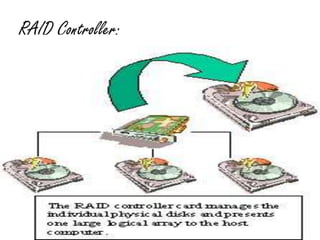
The heart of the RAID storage system is
controller card. The task of the controller
card is to
Manage Individual Hard Disk Drives
Provide a Logical Array Configuration
Perform Redundant or Fault Tolerant
Operations
Raid
Patented 1987
Built in 1989
Updated several times

That’s all I could find. Until I made
these updates….
RAID
RAID: Redundant Arrays of
Independent Disks
Hence, the I in RAID now
stands for“independent”instead
of “inexpensive”.
RAID:Multiple disk drives
provides reliability via
redundancy.
commonly used to address
the performance and reliability
issues.
Redundancy:
Mirroring
Duplicate every disk
Gives good error recovery

Data stripping
A method of concatenating multiple
drives into one logical storage unit.

the data is split into different parts.

Parity:
Splitting data onto blocks with the
help of XOR operation
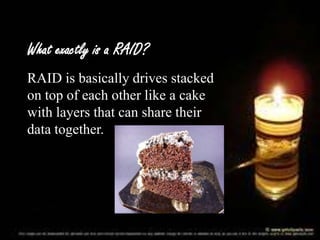
What exactly is a RAID?
RAID is basically drives stacked
on top of each other like a cake
with layers that can share their
data together.
Features Of RAID Levels:
RAID 0 – Data Striping
RAID 1 - Mirroring
RAID 2 – Hamming Code
RAID 3 – Single Check Disk per
Group
There are more lavels like 4,5,6 10.
RAID Level 0:
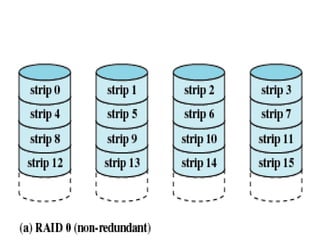
RAID level 0:
Simplest RAID implementation
Includes striping but no redundancy
Highest-performance
High risk of data loss
Multiple drives involved
Could lose all data in array with
one drive failure
Cont………..!!
Block level striping

Notes:
If two different I/O requests are
pending for two different blocks of
data, in all likelihood the two blocks are
located in two different disks, then the
requests can be issued in parallel
If a single request is spread across
multiple logically contiguous strips, the
request can be handled in parallel.
Recommended Applications

Video Production and Editing
Image Editing
Pre-Press Applications
gaming systems.

Disadvantage:

Relaibility problem –no mirroring or parity bits.

Advantage:

speed enhancement
Maximum utilization of physical drive storage
capacity, because no room is taken for redundant data
or data-parity storage
RAID Level1:
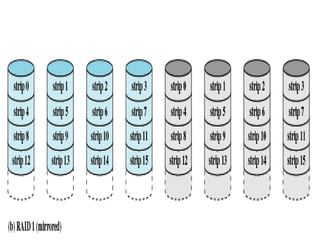
RAID Level 1:

Highest level of redundancy
Each drive has a mirrored copy in array

No striping at this level
Improves read performance over single
disks because multiple disks can be read at
once
Slower write performance because two
disks must be accessed for each modified
data item to maintain mirroring

High storage overhead
Only half array stores unique data
Most suitable where reliability is primary
concern.
Cont……..!!!!!!
Performance:
If we use independent
disk controllers for each
disk, then we can increase
the read or write speeds
by doing operations in
parallel.
Application:

Accounting
Financial

Advantage:
Provide best Performance
Provide Fault tolerance

Disadvantage:
High cost.
Requires twice the disk space
RAID Level 2:
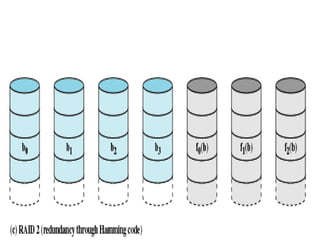
RAID Level 2:

Implements redundancy via striping
Striped at bit level
Uses Hamming ECC to check data
integrity
ECC data stored on separate drive
Significant overhead in storage and
performance .
RAID 2 is the only RAID level
that can repair errors, the other
RAID levels can only detect them
Cont……….!!!!!

Read – all disks are
simultaneously accessed
Write - all disks are
simultaneously accessed
Write penalty – computation of
the Hamming ECC
Used when many disk errors
occur, but given the high reliability
of individual disks, rarely used.
Advantages:
Random Read Performance= Fair
Sequential Read Performance= Very Good
Sequential Write Performance= Very Good

Disadvantages

:

Random Write Performance= Poor
Requires a complex controller
High overhead for check disks
Not used in modern systems
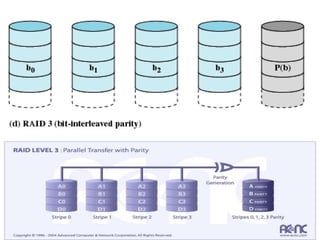
RAID Level 3:
RAID Level 3:
Also stripes at the byte level
Uses XOR to calculate parity for ECC
Much simpler than Hamming ECC
Requires only one disk for parity
information regardless of the size of the
array
Cannot determine which bit contains error,
but this information can be gathered easily
by inspecting the array for a failed disk
High transfer rates, but only one request
serviced at a time
Cont………!!!
In the case of a disk failure,
All data are available 
missing data can be calculated
from the parity bit
Write: just maintain the parity
such that later it can be
regenerated.
Failed disk to be replaced and
the data regenerated
Cont….!!!!!!!!!!

BYTE level striping and XOR ECC allows
for one check disk: lowest overhead possible
Example…
A:0101 XOR B:0011 = Check:0110
A is gone?
B:0011 XOR Check:0110 = 0101 (A)
Raid 1 3
Raid 1 3
Raid 1 3
Raid 1 3

Raid 1 3

  • 2.
  • 3.
  • 4.
    S.L.E.D. Single Large ExpensiveDisks Single drive used to store data.  Capacity: good Problem: Data cant be read and write quickly  If SLED fail then all data loss. 
  • 5.
  • 6.
    RAID Overview: The heartof the RAID storage system is controller card. The task of the controller card is to Manage Individual Hard Disk Drives Provide a Logical Array Configuration Perform Redundant or Fault Tolerant Operations
  • 8.
  • 9.
    Patented 1987 Built in1989 Updated several times That’s all I could find. Until I made these updates….
  • 10.
    RAID RAID: Redundant Arraysof Independent Disks Hence, the I in RAID now stands for“independent”instead of “inexpensive”. RAID:Multiple disk drives provides reliability via redundancy. commonly used to address the performance and reliability issues.
  • 11.
    Redundancy: Mirroring Duplicate every disk Givesgood error recovery Data stripping A method of concatenating multiple drives into one logical storage unit. the data is split into different parts. Parity: Splitting data onto blocks with the help of XOR operation
  • 12.
    What exactly isa RAID? RAID is basically drives stacked on top of each other like a cake with layers that can share their data together.
  • 13.
    Features Of RAIDLevels: RAID 0 – Data Striping RAID 1 - Mirroring RAID 2 – Hamming Code RAID 3 – Single Check Disk per Group There are more lavels like 4,5,6 10.
  • 14.
  • 15.
    RAID level 0: SimplestRAID implementation Includes striping but no redundancy Highest-performance High risk of data loss Multiple drives involved Could lose all data in array with one drive failure
  • 16.
    Cont………..!! Block level striping Notes: Iftwo different I/O requests are pending for two different blocks of data, in all likelihood the two blocks are located in two different disks, then the requests can be issued in parallel If a single request is spread across multiple logically contiguous strips, the request can be handled in parallel.
  • 17.
    Recommended Applications Video Productionand Editing Image Editing Pre-Press Applications gaming systems. Disadvantage: Relaibility problem –no mirroring or parity bits. Advantage: speed enhancement Maximum utilization of physical drive storage capacity, because no room is taken for redundant data or data-parity storage
  • 19.
  • 20.
    RAID Level 1: Highestlevel of redundancy Each drive has a mirrored copy in array No striping at this level Improves read performance over single disks because multiple disks can be read at once Slower write performance because two disks must be accessed for each modified data item to maintain mirroring High storage overhead Only half array stores unique data Most suitable where reliability is primary concern.
  • 21.
    Cont……..!!!!!! Performance: If we useindependent disk controllers for each disk, then we can increase the read or write speeds by doing operations in parallel.
  • 22.
    Application: Accounting Financial Advantage: Provide best Performance ProvideFault tolerance Disadvantage: High cost. Requires twice the disk space
  • 24.
  • 25.
    RAID Level 2: Implementsredundancy via striping Striped at bit level Uses Hamming ECC to check data integrity ECC data stored on separate drive Significant overhead in storage and performance . RAID 2 is the only RAID level that can repair errors, the other RAID levels can only detect them
  • 26.
    Cont……….!!!!! Read – alldisks are simultaneously accessed Write - all disks are simultaneously accessed Write penalty – computation of the Hamming ECC Used when many disk errors occur, but given the high reliability of individual disks, rarely used.
  • 27.
    Advantages: Random Read Performance=Fair Sequential Read Performance= Very Good Sequential Write Performance= Very Good Disadvantages : Random Write Performance= Poor Requires a complex controller High overhead for check disks Not used in modern systems
  • 29.
  • 30.
    RAID Level 3: Alsostripes at the byte level Uses XOR to calculate parity for ECC Much simpler than Hamming ECC Requires only one disk for parity information regardless of the size of the array Cannot determine which bit contains error, but this information can be gathered easily by inspecting the array for a failed disk High transfer rates, but only one request serviced at a time
  • 31.
    Cont………!!! In the caseof a disk failure, All data are available  missing data can be calculated from the parity bit Write: just maintain the parity such that later it can be regenerated. Failed disk to be replaced and the data regenerated
  • 32.
    Cont….!!!!!!!!!! BYTE level stripingand XOR ECC allows for one check disk: lowest overhead possible Example… A:0101 XOR B:0011 = Check:0110 A is gone? B:0011 XOR Check:0110 = 0101 (A)