Chapter 4 The Processor [Adapted from  Computer Organization and Design, 4 th  Edition ,  Patterson & Hennessy, © 2008, MK] [Also adapted from  lecture slide  by Mary Jane Irwin,  www.cse.psu.edu/~mji ]
Introduction CPU performance factors Instruction count Determined by ISA and compiler CPI and Cycle time Determined by CPU hardware We will examine two MIPS implementations A simplified version A more realistic pipelined version Simple subset, shows most aspects Memory reference:  lw ,  sw Arithmetic/logical:  add ,  sub ,  and ,  or ,  slt Control transfer:  beq ,  j Chapter 4 — The Processor —  §4.1 Introduction
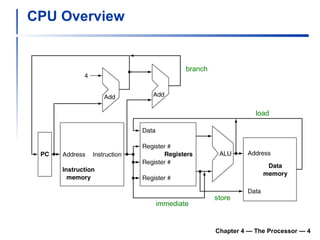
Instruction Execution For every instruction, the first two steps are identical PC    instruction memory,  fetch instruction Register numbers    register file,  read registers Depending on instruction class Use ALU to calculate Arithmetic and logical operations execution Memory address calculation for load/store Branch for comparison Access data memory for load/store PC    target address (for branch) or PC + 4 Chapter 4 — The Processor —
CPU Overview Chapter 4 — The Processor —  branch store load immediate
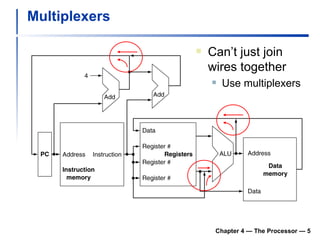
Multiplexers Chapter 4 — The Processor —  Can’t just join wires together Use multiplexers
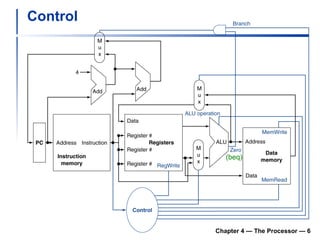
Control Chapter 4 — The Processor —  (beq)
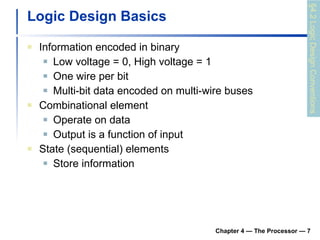
Logic Design Basics Information encoded in binary Low voltage = 0, High voltage = 1 One wire per bit Multi-bit data encoded on multi-wire buses Combinational element Operate on data Output is a function of input State (sequential) elements Store information Chapter 4 — The Processor —  §4.2 Logic Design Conventions
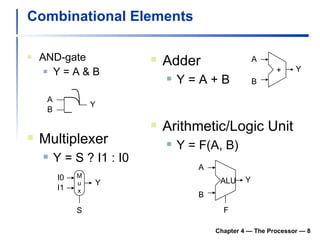
Combinational Elements AND-gate Y = A & B Chapter 4 — The Processor —  Multiplexer Y = S ? I1 : I0 Adder Y = A + B Arithmetic/Logic Unit Y = F(A, B) A B Y I0 I1 Y M u x S A B Y + A B Y ALU F
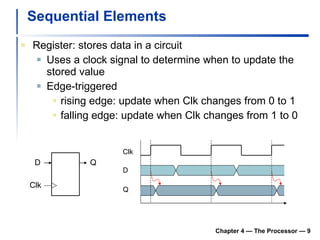
Sequential Elements Register: stores data in a circuit Uses a clock signal to determine when to update the stored value Edge-triggered rising edge: update when Clk changes from 0 to 1 falling edge: update when Clk changes from 1 to 0 Chapter 4 — The Processor —  D Clk Q Clk D Q
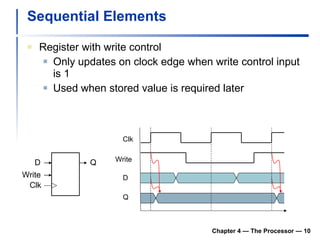
Sequential Elements Register with write control Only updates on clock edge when write control input is 1 Used when stored value is required later Chapter 4 — The Processor —  D Clk Q Write Write D Q Clk
Clocking Methodology Edge-triggered clocking Combinational logic transforms data during clock cycles between clock edges Input from state elements, output to state element Longest delay determines clock period Chapter 4 — The Processor —  [ Edge-triggered clocking ] Of course, the clock cycle must be long enough so that the inputs are stable
Building a Datapath Datapath Elements that process data and addresses in the CPU Registers, ALUs, mux’s, memories, … We will build a MIPS datapath incrementally Refining the overview design Chapter 4 — The Processor —  §4.3 Building a Datapath
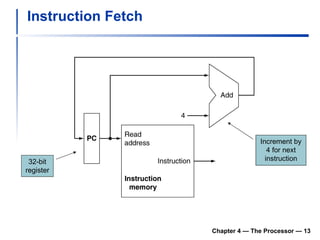
Instruction Fetch Chapter 4 — The Processor —  32-bit register Increment by 4 for next instruction
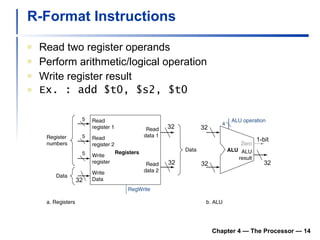
R-Format Instructions Read two register operands Perform arithmetic/logical operation Write register result Ex. : add $t0, $s2, $t0 Chapter 4 — The Processor —  32 32 32 32 32 32 1-bit
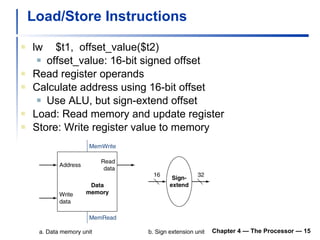
Load/Store Instructions lw  $t1,  offset_value($t2) offset_value: 16-bit signed offset Read register operands Calculate address using 16-bit offset Use ALU, but sign-extend offset Load: Read memory and update register Store: Write register value to memory Chapter 4 — The Processor —
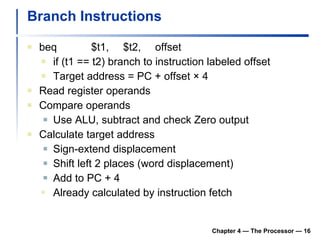
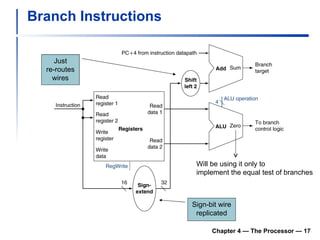
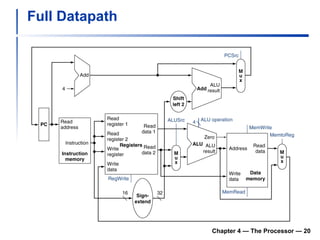
Branch Instructions beq $t1, $t2, offset if (t1 == t2) branch to instruction labeled offset Target address = PC + offset × 4 Read register operands Compare operands Use ALU, subtract and check Zero output Calculate target address Sign-extend displacement Shift left 2 places (word displacement) Add to PC + 4 Already calculated by instruction fetch Chapter 4 — The Processor —
Branch Instructions Chapter 4 — The Processor —  Just re-routes wires Sign-bit wire replicated Will be using it only to  implement the equal test of branches
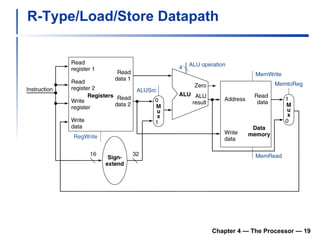
Composing the Elements First-cut data path does an instruction in one clock cycle Each datapath element can only do one function at a time Hence, we need separate instruction and data memories To share a datapath element between two different instruction classes use multiplexers and control signal Chapter 4 — The Processor —
R-Type/Load/Store Datapath Chapter 4 — The Processor —
Full Datapath Chapter 4 — The Processor —
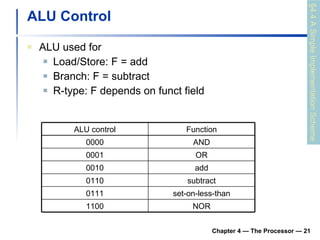
ALU Control ALU used for Load/Store: F = add Branch: F = subtract R-type: F depends on funct field Chapter 4 — The Processor —  §4.4 A Simple Implementation Scheme ALU control Function 0000 AND 0001 OR 0010 add 0110 subtract 0111 set-on-less-than 1100 NOR
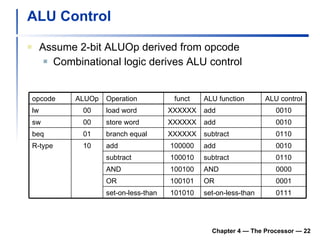
ALU Control Assume 2-bit ALUOp derived from opcode Combinational logic derives ALU control Chapter 4 — The Processor —  opcode ALUOp Operation funct ALU function ALU control lw 00 load word XXXXXX add 0010 sw 00 store word XXXXXX add 0010 beq 01 branch equal XXXXXX subtract 0110 R-type 10 add 100000 add 0010 subtract 100010 subtract 0110 AND 100100 AND 0000 OR 100101 OR 0001 set-on-less-than 101010 set-on-less-than 0111
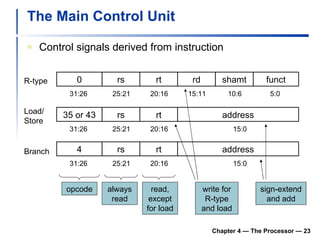
The Main Control Unit Control signals derived from instruction Chapter 4 — The Processor —  R-type Load/ Store Branch opcode always read read, except for load write for R-type and load sign-extend and add 0 rs rt rd shamt funct 31:26 5:0 25:21 20:16 15:11 10:6 35 or 43 rs rt address 31:26 25:21 20:16 15:0 4 rs rt address 31:26 25:21 20:16 15:0
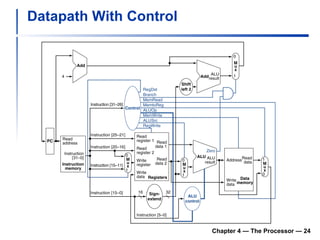
Datapath With Control Chapter 4 — The Processor —
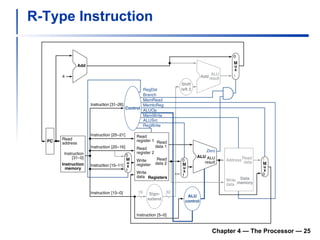
R-Type Instruction Chapter 4 — The Processor —
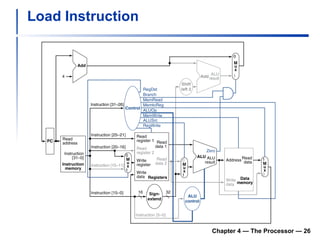
Load Instruction Chapter 4 — The Processor —
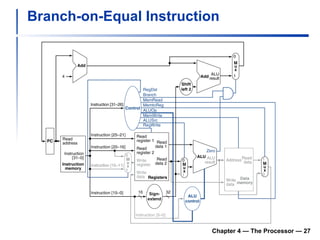
Branch-on-Equal Instruction Chapter 4 — The Processor —
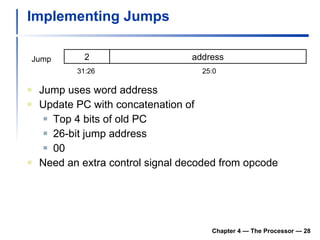
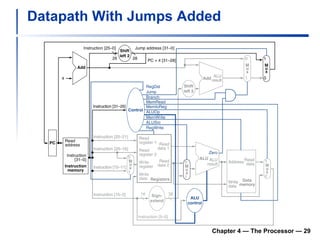
Implementing Jumps Jump uses word address Update PC with concatenation of Top 4 bits of old PC 26-bit jump address 00 Need an extra control signal decoded from opcode Chapter 4 — The Processor —  Jump 2 address 31:26 25:0
Datapath With Jumps Added Chapter 4 — The Processor —
Performance Issues Longest delay determines clock period Critical path: load instruction Instruction memory    register file    ALU    data memory    register file Not feasible to vary period for different instructions Violates design principle Making the common case fast We will improve performance by pipelining Chapter 4 — The Processor —
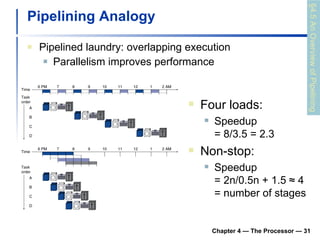
Pipelining Analogy Pipelined laundry: overlapping execution Parallelism improves performance Chapter 4 — The Processor —  §4.5 An Overview of Pipelining Four loads: Speedup = 8/3.5 = 2.3 Non-stop: Speedup = 2n/0.5n + 1.5 ≈ 4 = number of stages
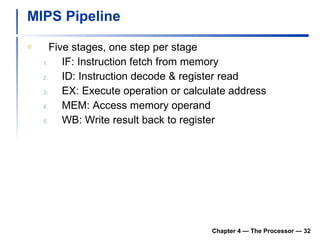
MIPS Pipeline Five stages, one step per stage IF: Instruction fetch from memory ID: Instruction decode & register read EX: Execute operation or calculate address MEM: Access memory operand WB: Write result back to register Chapter 4 — The Processor —
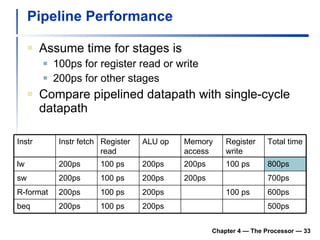
Pipeline Performance Assume time for stages is 100ps for register read or write 200ps for other stages Compare pipelined datapath with single-cycle datapath Chapter 4 — The Processor —  Instr Instr fetch Register read ALU op Memory access Register write Total time lw 200ps 100 ps 200ps 200ps 100 ps 800ps sw 200ps 100 ps 200ps 200ps 700ps R-format 200ps 100 ps 200ps 100 ps 600ps beq 200ps 100 ps 200ps 500ps
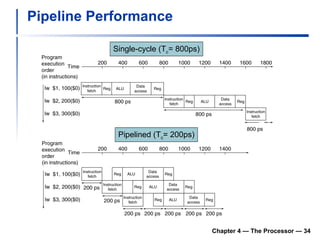
Pipeline Performance Chapter 4 — The Processor —  Single-cycle (T c = 800ps) Pipelined (T c = 200ps)
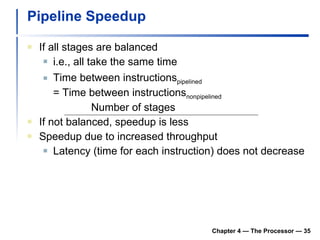
Pipeline Speedup If all stages are balanced i.e., all take the same time Time between instructions pipelined = Time between instructions nonpipelined Number of stages If not balanced, speedup is less Speedup due to increased throughput Latency (time for each instruction) does not decrease Chapter 4 — The Processor —
Pipelining and ISA Design MIPS ISA designed for pipelining All instructions are 32-bits Easier to fetch and decode in one cycle c.f. x86: 1- to 17-byte instructions Few and regular instruction formats Can decode and read registers in one step Load/store addressing Can calculate address in 3 rd  stage, access memory in 4 th  stage Alignment of memory operands Memory access takes only one cycle Chapter 4 — The Processor —
Hazards Situations that prevent starting the next instruction in the next cycle Structure hazards A required resource is busy Data hazard Need to wait for previous instruction to complete its data read/write Control hazard Deciding on control action depends on previous instruction Chapter 4 — The Processor —
Structure Hazards Conflict for use of a resource In MIPS pipeline with a single memory Load/store requires data access Instruction fetch would have to  stall  for that cycle Would cause a pipeline “bubble” Hence, pipelined datapaths require separate instruction/data memories Or separate instruction/data caches Chapter 4 — The Processor —
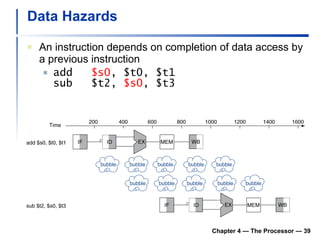
Data Hazards An instruction depends on completion of data access by a previous instruction add $s0 , $t0, $t1 sub $t2,  $s0 , $t3 Chapter 4 — The Processor —
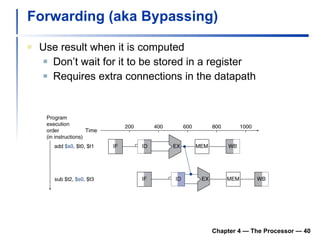
Forwarding (aka Bypassing) Use result when it is computed Don’t wait for it to be stored in a register Requires extra connections in the datapath Chapter 4 — The Processor —
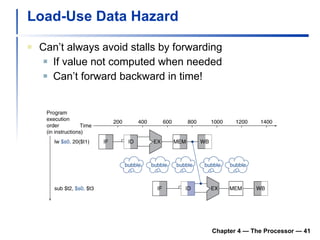
Load-Use Data Hazard Can’t always avoid stalls by forwarding If value not computed when needed Can’t forward backward in time! Chapter 4 — The Processor —
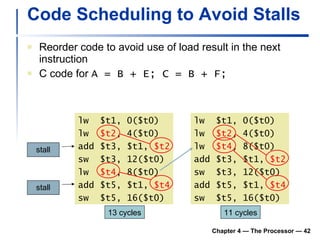
Code Scheduling to Avoid Stalls Reorder code to avoid use of load result in the next instruction C code for  A = B + E; C = B + F; Chapter 4 — The Processor —  lw $t1, 0($t0) lw $t2 , 4($t0) add $t3, $t1,  $t2 sw $t3, 12($t0) lw $t4 , 8($t0) add $t5, $t1,  $t4 sw $t5, 16($t0) stall stall lw $t1, 0($t0) lw $t2 , 4($t0) lw $t4 , 8($t0) add $t3, $t1,  $t2 sw $t3, 12($t0) add $t5, $t1,  $t4 sw $t5, 16($t0) 11 cycles 13 cycles
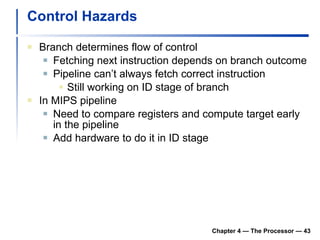
Control Hazards Branch determines flow of control Fetching next instruction depends on branch outcome Pipeline can’t always fetch correct instruction Still working on ID stage of branch In MIPS pipeline Need to compare registers and compute target early in the pipeline Add hardware to do it in ID stage Chapter 4 — The Processor —
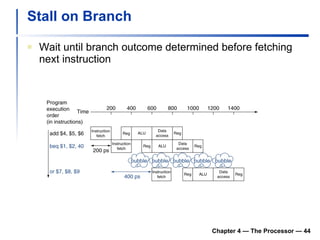
Stall on Branch Wait until branch outcome determined before fetching next instruction Chapter 4 — The Processor —
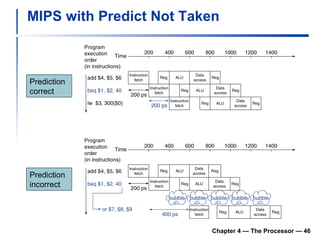
Branch Prediction Longer pipelines can’t readily determine branch outcome early Stall penalty becomes unacceptable Predict outcome of branch Only stall if prediction is wrong In MIPS pipeline Can predict branches not taken Fetch instruction after branch, with no delay Chapter 4 — The Processor —
MIPS with Predict Not Taken Chapter 4 — The Processor —  Prediction correct Prediction incorrect

Chapter 4 The Processor

  • 1.
    Chapter 4 TheProcessor [Adapted from Computer Organization and Design, 4 th Edition , Patterson & Hennessy, © 2008, MK] [Also adapted from lecture slide by Mary Jane Irwin, www.cse.psu.edu/~mji ]
  • 2.
    Introduction CPU performancefactors Instruction count Determined by ISA and compiler CPI and Cycle time Determined by CPU hardware We will examine two MIPS implementations A simplified version A more realistic pipelined version Simple subset, shows most aspects Memory reference: lw , sw Arithmetic/logical: add , sub , and , or , slt Control transfer: beq , j Chapter 4 — The Processor — §4.1 Introduction
  • 3.
    Instruction Execution Forevery instruction, the first two steps are identical PC  instruction memory, fetch instruction Register numbers  register file, read registers Depending on instruction class Use ALU to calculate Arithmetic and logical operations execution Memory address calculation for load/store Branch for comparison Access data memory for load/store PC  target address (for branch) or PC + 4 Chapter 4 — The Processor —
  • 4.
    CPU Overview Chapter4 — The Processor — branch store load immediate
  • 5.
    Multiplexers Chapter 4— The Processor — Can’t just join wires together Use multiplexers
  • 6.
    Control Chapter 4— The Processor — (beq)
  • 7.
    Logic Design BasicsInformation encoded in binary Low voltage = 0, High voltage = 1 One wire per bit Multi-bit data encoded on multi-wire buses Combinational element Operate on data Output is a function of input State (sequential) elements Store information Chapter 4 — The Processor — §4.2 Logic Design Conventions
  • 8.
    Combinational Elements AND-gateY = A & B Chapter 4 — The Processor — Multiplexer Y = S ? I1 : I0 Adder Y = A + B Arithmetic/Logic Unit Y = F(A, B) A B Y I0 I1 Y M u x S A B Y + A B Y ALU F
  • 9.
    Sequential Elements Register:stores data in a circuit Uses a clock signal to determine when to update the stored value Edge-triggered rising edge: update when Clk changes from 0 to 1 falling edge: update when Clk changes from 1 to 0 Chapter 4 — The Processor — D Clk Q Clk D Q
  • 10.
    Sequential Elements Registerwith write control Only updates on clock edge when write control input is 1 Used when stored value is required later Chapter 4 — The Processor — D Clk Q Write Write D Q Clk
  • 11.
    Clocking Methodology Edge-triggeredclocking Combinational logic transforms data during clock cycles between clock edges Input from state elements, output to state element Longest delay determines clock period Chapter 4 — The Processor — [ Edge-triggered clocking ] Of course, the clock cycle must be long enough so that the inputs are stable
  • 12.
    Building a DatapathDatapath Elements that process data and addresses in the CPU Registers, ALUs, mux’s, memories, … We will build a MIPS datapath incrementally Refining the overview design Chapter 4 — The Processor — §4.3 Building a Datapath
  • 13.
    Instruction Fetch Chapter4 — The Processor — 32-bit register Increment by 4 for next instruction
  • 14.
    R-Format Instructions Readtwo register operands Perform arithmetic/logical operation Write register result Ex. : add $t0, $s2, $t0 Chapter 4 — The Processor — 32 32 32 32 32 32 1-bit
  • 15.
    Load/Store Instructions lw $t1, offset_value($t2) offset_value: 16-bit signed offset Read register operands Calculate address using 16-bit offset Use ALU, but sign-extend offset Load: Read memory and update register Store: Write register value to memory Chapter 4 — The Processor —
  • 16.
    Branch Instructions beq$t1, $t2, offset if (t1 == t2) branch to instruction labeled offset Target address = PC + offset × 4 Read register operands Compare operands Use ALU, subtract and check Zero output Calculate target address Sign-extend displacement Shift left 2 places (word displacement) Add to PC + 4 Already calculated by instruction fetch Chapter 4 — The Processor —
  • 17.
    Branch Instructions Chapter4 — The Processor — Just re-routes wires Sign-bit wire replicated Will be using it only to implement the equal test of branches
  • 18.
    Composing the ElementsFirst-cut data path does an instruction in one clock cycle Each datapath element can only do one function at a time Hence, we need separate instruction and data memories To share a datapath element between two different instruction classes use multiplexers and control signal Chapter 4 — The Processor —
  • 19.
    R-Type/Load/Store Datapath Chapter4 — The Processor —
  • 20.
    Full Datapath Chapter4 — The Processor —
  • 21.
    ALU Control ALUused for Load/Store: F = add Branch: F = subtract R-type: F depends on funct field Chapter 4 — The Processor — §4.4 A Simple Implementation Scheme ALU control Function 0000 AND 0001 OR 0010 add 0110 subtract 0111 set-on-less-than 1100 NOR
  • 22.
    ALU Control Assume2-bit ALUOp derived from opcode Combinational logic derives ALU control Chapter 4 — The Processor — opcode ALUOp Operation funct ALU function ALU control lw 00 load word XXXXXX add 0010 sw 00 store word XXXXXX add 0010 beq 01 branch equal XXXXXX subtract 0110 R-type 10 add 100000 add 0010 subtract 100010 subtract 0110 AND 100100 AND 0000 OR 100101 OR 0001 set-on-less-than 101010 set-on-less-than 0111
  • 23.
    The Main ControlUnit Control signals derived from instruction Chapter 4 — The Processor — R-type Load/ Store Branch opcode always read read, except for load write for R-type and load sign-extend and add 0 rs rt rd shamt funct 31:26 5:0 25:21 20:16 15:11 10:6 35 or 43 rs rt address 31:26 25:21 20:16 15:0 4 rs rt address 31:26 25:21 20:16 15:0
  • 24.
    Datapath With ControlChapter 4 — The Processor —
  • 25.
    R-Type Instruction Chapter4 — The Processor —
  • 26.
    Load Instruction Chapter4 — The Processor —
  • 27.
    Branch-on-Equal Instruction Chapter4 — The Processor —
  • 28.
    Implementing Jumps Jumpuses word address Update PC with concatenation of Top 4 bits of old PC 26-bit jump address 00 Need an extra control signal decoded from opcode Chapter 4 — The Processor — Jump 2 address 31:26 25:0
  • 29.
    Datapath With JumpsAdded Chapter 4 — The Processor —
  • 30.
    Performance Issues Longestdelay determines clock period Critical path: load instruction Instruction memory  register file  ALU  data memory  register file Not feasible to vary period for different instructions Violates design principle Making the common case fast We will improve performance by pipelining Chapter 4 — The Processor —
  • 31.
    Pipelining Analogy Pipelinedlaundry: overlapping execution Parallelism improves performance Chapter 4 — The Processor — §4.5 An Overview of Pipelining Four loads: Speedup = 8/3.5 = 2.3 Non-stop: Speedup = 2n/0.5n + 1.5 ≈ 4 = number of stages
  • 32.
    MIPS Pipeline Fivestages, one step per stage IF: Instruction fetch from memory ID: Instruction decode & register read EX: Execute operation or calculate address MEM: Access memory operand WB: Write result back to register Chapter 4 — The Processor —
  • 33.
    Pipeline Performance Assumetime for stages is 100ps for register read or write 200ps for other stages Compare pipelined datapath with single-cycle datapath Chapter 4 — The Processor — Instr Instr fetch Register read ALU op Memory access Register write Total time lw 200ps 100 ps 200ps 200ps 100 ps 800ps sw 200ps 100 ps 200ps 200ps 700ps R-format 200ps 100 ps 200ps 100 ps 600ps beq 200ps 100 ps 200ps 500ps
  • 34.
    Pipeline Performance Chapter4 — The Processor — Single-cycle (T c = 800ps) Pipelined (T c = 200ps)
  • 35.
    Pipeline Speedup Ifall stages are balanced i.e., all take the same time Time between instructions pipelined = Time between instructions nonpipelined Number of stages If not balanced, speedup is less Speedup due to increased throughput Latency (time for each instruction) does not decrease Chapter 4 — The Processor —
  • 36.
    Pipelining and ISADesign MIPS ISA designed for pipelining All instructions are 32-bits Easier to fetch and decode in one cycle c.f. x86: 1- to 17-byte instructions Few and regular instruction formats Can decode and read registers in one step Load/store addressing Can calculate address in 3 rd stage, access memory in 4 th stage Alignment of memory operands Memory access takes only one cycle Chapter 4 — The Processor —
  • 37.
    Hazards Situations thatprevent starting the next instruction in the next cycle Structure hazards A required resource is busy Data hazard Need to wait for previous instruction to complete its data read/write Control hazard Deciding on control action depends on previous instruction Chapter 4 — The Processor —
  • 38.
    Structure Hazards Conflictfor use of a resource In MIPS pipeline with a single memory Load/store requires data access Instruction fetch would have to stall for that cycle Would cause a pipeline “bubble” Hence, pipelined datapaths require separate instruction/data memories Or separate instruction/data caches Chapter 4 — The Processor —
  • 39.
    Data Hazards Aninstruction depends on completion of data access by a previous instruction add $s0 , $t0, $t1 sub $t2, $s0 , $t3 Chapter 4 — The Processor —
  • 40.
    Forwarding (aka Bypassing)Use result when it is computed Don’t wait for it to be stored in a register Requires extra connections in the datapath Chapter 4 — The Processor —
  • 41.
    Load-Use Data HazardCan’t always avoid stalls by forwarding If value not computed when needed Can’t forward backward in time! Chapter 4 — The Processor —
  • 42.
    Code Scheduling toAvoid Stalls Reorder code to avoid use of load result in the next instruction C code for A = B + E; C = B + F; Chapter 4 — The Processor — lw $t1, 0($t0) lw $t2 , 4($t0) add $t3, $t1, $t2 sw $t3, 12($t0) lw $t4 , 8($t0) add $t5, $t1, $t4 sw $t5, 16($t0) stall stall lw $t1, 0($t0) lw $t2 , 4($t0) lw $t4 , 8($t0) add $t3, $t1, $t2 sw $t3, 12($t0) add $t5, $t1, $t4 sw $t5, 16($t0) 11 cycles 13 cycles
  • 43.
    Control Hazards Branchdetermines flow of control Fetching next instruction depends on branch outcome Pipeline can’t always fetch correct instruction Still working on ID stage of branch In MIPS pipeline Need to compare registers and compute target early in the pipeline Add hardware to do it in ID stage Chapter 4 — The Processor —
  • 44.
    Stall on BranchWait until branch outcome determined before fetching next instruction Chapter 4 — The Processor —
  • 45.
    Branch Prediction Longerpipelines can’t readily determine branch outcome early Stall penalty becomes unacceptable Predict outcome of branch Only stall if prediction is wrong In MIPS pipeline Can predict branches not taken Fetch instruction after branch, with no delay Chapter 4 — The Processor —
  • 46.
    MIPS with PredictNot Taken Chapter 4 — The Processor — Prediction correct Prediction incorrect

Editor's Notes

  • #2 Morgan Kaufmann Publishers 15 October 2009 Chapter 4 — The Processor
  • #3 Morgan Kaufmann Publishers 15 October 2009 Chapter 4 — The Processor
  • #4 Morgan Kaufmann Publishers 15 October 2009 Chapter 4 — The Processor
  • #5 Morgan Kaufmann Publishers 15 October 2009 Chapter 4 — The Processor
  • #6 Morgan Kaufmann Publishers 15 October 2009 Chapter 4 — The Processor
  • #7 Morgan Kaufmann Publishers 15 October 2009 Chapter 4 — The Processor
  • #8 Morgan Kaufmann Publishers 15 October 2009 Chapter 4 — The Processor
  • #9 Morgan Kaufmann Publishers 15 October 2009 Chapter 4 — The Processor
  • #10 Morgan Kaufmann Publishers 15 October 2009 Chapter 4 — The Processor
  • #11 Morgan Kaufmann Publishers 15 October 2009 Chapter 4 — The Processor
  • #12 Morgan Kaufmann Publishers 15 October 2009 Chapter 4 — The Processor
  • #13 Morgan Kaufmann Publishers 15 October 2009 Chapter 4 — The Processor
  • #14 Morgan Kaufmann Publishers 15 October 2009 Chapter 4 — The Processor
  • #15 Morgan Kaufmann Publishers 15 October 2009 Chapter 4 — The Processor
  • #16 Morgan Kaufmann Publishers 15 October 2009 Chapter 4 — The Processor
  • #17 Morgan Kaufmann Publishers 15 October 2009 Chapter 4 — The Processor
  • #18 Morgan Kaufmann Publishers 15 October 2009 Chapter 4 — The Processor
  • #19 Morgan Kaufmann Publishers 15 October 2009 Chapter 4 — The Processor
  • #20 Morgan Kaufmann Publishers 15 October 2009 Chapter 4 — The Processor
  • #21 Morgan Kaufmann Publishers 15 October 2009 Chapter 4 — The Processor
  • #22 Morgan Kaufmann Publishers 15 October 2009 Chapter 4 — The Processor
  • #23 Morgan Kaufmann Publishers 15 October 2009 Chapter 4 — The Processor
  • #24 Morgan Kaufmann Publishers 15 October 2009 Chapter 4 — The Processor
  • #25 Morgan Kaufmann Publishers 15 October 2009 Chapter 4 — The Processor
  • #26 Morgan Kaufmann Publishers 15 October 2009 Chapter 4 — The Processor
  • #27 Morgan Kaufmann Publishers 15 October 2009 Chapter 4 — The Processor
  • #28 Morgan Kaufmann Publishers 15 October 2009 Chapter 4 — The Processor
  • #29 Morgan Kaufmann Publishers 15 October 2009 Chapter 4 — The Processor
  • #30 Morgan Kaufmann Publishers 15 October 2009 Chapter 4 — The Processor
  • #31 Morgan Kaufmann Publishers 15 October 2009 Chapter 4 — The Processor
  • #32 Morgan Kaufmann Publishers 15 October 2009 Chapter 4 — The Processor
  • #33 Morgan Kaufmann Publishers 15 October 2009 Chapter 4 — The Processor
  • #34 Morgan Kaufmann Publishers 15 October 2009 Chapter 4 — The Processor
  • #35 Morgan Kaufmann Publishers 15 October 2009 Chapter 4 — The Processor
  • #36 Morgan Kaufmann Publishers 15 October 2009 Chapter 4 — The Processor
  • #37 Morgan Kaufmann Publishers 15 October 2009 Chapter 4 — The Processor
  • #38 Morgan Kaufmann Publishers 15 October 2009 Chapter 4 — The Processor
  • #39 Morgan Kaufmann Publishers 15 October 2009 Chapter 4 — The Processor
  • #40 Morgan Kaufmann Publishers 15 October 2009 Chapter 4 — The Processor
  • #41 Morgan Kaufmann Publishers 15 October 2009 Chapter 4 — The Processor
  • #42 Morgan Kaufmann Publishers 15 October 2009 Chapter 4 — The Processor
  • #43 Morgan Kaufmann Publishers 15 October 2009 Chapter 4 — The Processor
  • #44 Morgan Kaufmann Publishers 15 October 2009 Chapter 4 — The Processor
  • #45 Morgan Kaufmann Publishers 15 October 2009 Chapter 4 — The Processor
  • #46 Morgan Kaufmann Publishers 15 October 2009 Chapter 4 — The Processor
  • #47 Morgan Kaufmann Publishers 15 October 2009 Chapter 4 — The Processor