HIGH LEVEL DATA LINK CONTROL 
PROTOCOL 
(HDLC)
High-Level Data Link Control 
(HDLC) 
• HDLC was defined by ISO for use on both point-to- 
point and multipoint data links. 
• It supports full-duplex communication 
• Other similar protocols are 
(i)Synchronous Data Link Control (SDLC) by IBM 
(ii)Advanced Data Communication Control Procedure 
(ADCCP) by ANSI 
(iii)Link Access Procedure, Balanced (LAP-B) by 
CCITT, as part of its X.25 packet-switched network 
standard
HDLC Overview 
Broadly HDLC features are as follows: 
1.It is most widely accepted protocol.It offers a 
high level of flexibility ,adaptability,reliability and 
efficiency. 
2.Full duplex communication is possible. 
3.It is Bit-oriented protocol ie use bits to stuff flags 
occurring in data 
4.Flow control-adjust window size based on 
receiver capability.
HDLC Overview 
To make HDLC protocol applicable to various 
network configrations,three types of stations 
have been defined: 
1.Primary Station 
2.Secondary Station 
3.Combined Station 
• There are three types of data transfer mode :- 
1.Normal Response mode(NRM)
2.Asynchronous Response mode(ARM) 
3.Asynchronous Balanced mode(ABM) 
• Three types of frames 
1.Unnumbered or U-frame 
2.Information or I-frame 
3.Supervisory or S-frame
HDLC 
• The three stations are discussed as: 
1.Primary station 
• It looks after data link management. 
• In case of communication between primary 
and secondary station,primary station has 
responsibility of connecting and 
disconnecting the data link. 
• Frames issued by the primary station are 
called commands. 
.
2.Secondary station, 
• Operates under the control of the primary 
station. 
• Frames issued by a secondary station are 
called responses. 
3.Combined station, 
• Acts as both as primary and secondary 
station. 
• It issue both commands and responses
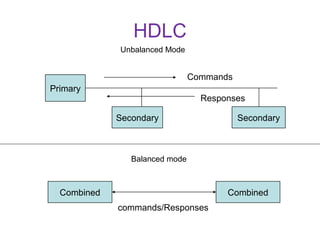
HDLC 
Primary 
Commands 
Responses 
Unbalanced Mode 
Secondary Secondary 
Balanced mode 
Combined Combined 
commands/Responses
HDLC 
• The three modes of data transfer operations are: 
1.Normal Response Mode (NRM) 
(i)This mode is suitable for point to point and 
point to multipoint configrations. 
(ii)Primary station controls the overall data 
link management. 
2.Asynchronous Response Mode (ARM) 
• In ARM secondary station can transmit 
response(frame) without taking permission 
from primary station.
• Reduces overhead as no frames need to be 
sent to allow secondary nodes to transmit. 
• Transmission proceeds when channel is 
detected idle , used mostly in point-to-point-links. 
• NRM is more disciplined than ARM. 
3.Asynchronous Balanced Mode (ABM) 
• Mainly used in point-to-point links, for 
communication between combined stations 
• Information frames can be transmitted in full 
duplex manner.
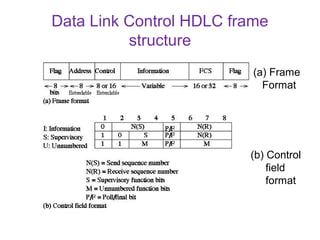
Data Link Control HDLC frame 
structure 
(a) Frame 
Format 
(b) Control 
field 
format
HDLC 
• There are three different classes of frames used in 
HDLC 
1.Unnumbered frames, used for exchanging session 
management and control information between 
communicating devices. 
2.Information frames, which carry actual information. If 
the first bit in control field is 0 it is identified as I-frame. 
3.Supervisory frames, which are used for error and flow 
control purposes and hence contain send and receive 
sequence numbers.If first two bits of control field are 
1 and 0 it is identified as S-frame.
Flag field is unique 8-bit word pattern(01111110) used to 
identify start and end of each frame and to fill idle time 
between consecutive frames. 
Address field consist of secondary station. 
Control field carries sequence number of frame,ACKs etc. 
Frame check Sequence is used for error detection in 
address.It is 16 bit CRC code for error detection. 
Four types of S-frames are possible corresponding to four 
values of ‘S’ 
1.SS=00corresponds to receive ready(RR) frames 
2.SS=01corresponds to Reject frame which are used by 
receiver to send NAK when error has occurred. 
3.SS=10corresponds to Receive not Ready(NRN) frame 
and is used for flow control.
4.SS=11corresponds to selective repeat Frame which 
indicates to transmiter to retransmit the frame indicated in 
N(R) subfield 
N(R) corresponds to value of ACK when piggybacking is 
used.(to include flow and error control information is 
piggybacking) 
P/F can have two possible values 0 or 1. 
• When P/F=1,it means poll when frame is sent by primary 
station to secondary station(when address field contains 
address of receiver). 
• When P/F=0,it means final when frame is sent by 
secondary station to primary(when address field contains 
address of sender).
THANK YOU 
Muro Newcovenant 
University of Dar es Salaam 
Tanzania

HDLC

  • 1.
    HIGH LEVEL DATALINK CONTROL PROTOCOL (HDLC)
  • 2.
    High-Level Data LinkControl (HDLC) • HDLC was defined by ISO for use on both point-to- point and multipoint data links. • It supports full-duplex communication • Other similar protocols are (i)Synchronous Data Link Control (SDLC) by IBM (ii)Advanced Data Communication Control Procedure (ADCCP) by ANSI (iii)Link Access Procedure, Balanced (LAP-B) by CCITT, as part of its X.25 packet-switched network standard
  • 3.
    HDLC Overview BroadlyHDLC features are as follows: 1.It is most widely accepted protocol.It offers a high level of flexibility ,adaptability,reliability and efficiency. 2.Full duplex communication is possible. 3.It is Bit-oriented protocol ie use bits to stuff flags occurring in data 4.Flow control-adjust window size based on receiver capability.
  • 4.
    HDLC Overview Tomake HDLC protocol applicable to various network configrations,three types of stations have been defined: 1.Primary Station 2.Secondary Station 3.Combined Station • There are three types of data transfer mode :- 1.Normal Response mode(NRM)
  • 5.
    2.Asynchronous Response mode(ARM) 3.Asynchronous Balanced mode(ABM) • Three types of frames 1.Unnumbered or U-frame 2.Information or I-frame 3.Supervisory or S-frame
  • 6.
    HDLC • Thethree stations are discussed as: 1.Primary station • It looks after data link management. • In case of communication between primary and secondary station,primary station has responsibility of connecting and disconnecting the data link. • Frames issued by the primary station are called commands. .
  • 7.
    2.Secondary station, •Operates under the control of the primary station. • Frames issued by a secondary station are called responses. 3.Combined station, • Acts as both as primary and secondary station. • It issue both commands and responses
  • 8.
    HDLC Primary Commands Responses Unbalanced Mode Secondary Secondary Balanced mode Combined Combined commands/Responses
  • 9.
    HDLC • Thethree modes of data transfer operations are: 1.Normal Response Mode (NRM) (i)This mode is suitable for point to point and point to multipoint configrations. (ii)Primary station controls the overall data link management. 2.Asynchronous Response Mode (ARM) • In ARM secondary station can transmit response(frame) without taking permission from primary station.
  • 10.
    • Reduces overheadas no frames need to be sent to allow secondary nodes to transmit. • Transmission proceeds when channel is detected idle , used mostly in point-to-point-links. • NRM is more disciplined than ARM. 3.Asynchronous Balanced Mode (ABM) • Mainly used in point-to-point links, for communication between combined stations • Information frames can be transmitted in full duplex manner.
  • 11.
    Data Link ControlHDLC frame structure (a) Frame Format (b) Control field format
  • 12.
    HDLC • Thereare three different classes of frames used in HDLC 1.Unnumbered frames, used for exchanging session management and control information between communicating devices. 2.Information frames, which carry actual information. If the first bit in control field is 0 it is identified as I-frame. 3.Supervisory frames, which are used for error and flow control purposes and hence contain send and receive sequence numbers.If first two bits of control field are 1 and 0 it is identified as S-frame.
  • 13.
    Flag field isunique 8-bit word pattern(01111110) used to identify start and end of each frame and to fill idle time between consecutive frames. Address field consist of secondary station. Control field carries sequence number of frame,ACKs etc. Frame check Sequence is used for error detection in address.It is 16 bit CRC code for error detection. Four types of S-frames are possible corresponding to four values of ‘S’ 1.SS=00corresponds to receive ready(RR) frames 2.SS=01corresponds to Reject frame which are used by receiver to send NAK when error has occurred. 3.SS=10corresponds to Receive not Ready(NRN) frame and is used for flow control.
  • 14.
    4.SS=11corresponds to selectiverepeat Frame which indicates to transmiter to retransmit the frame indicated in N(R) subfield N(R) corresponds to value of ACK when piggybacking is used.(to include flow and error control information is piggybacking) P/F can have two possible values 0 or 1. • When P/F=1,it means poll when frame is sent by primary station to secondary station(when address field contains address of receiver). • When P/F=0,it means final when frame is sent by secondary station to primary(when address field contains address of sender).
  • 15.
    THANK YOU MuroNewcovenant University of Dar es Salaam Tanzania