PRESENTATION ON
CHECKSUM
NAME : POOJA JAISWAL
CHECK SUM
 Error-detecting technique
 Applied to a message of any length
 Mostly used at network and transport layer rather
data-link layer.
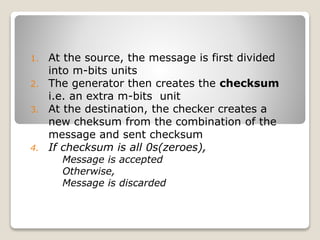
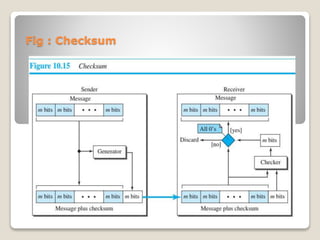
1. At the source, the message is first divided
into m-bits units
2. The generator then creates the checksum
i.e. an extra m-bits unit
3. At the destination, the checker creates a
new cheksum from the combination of the
message and sent checksum
4. If checksum is all 0s(zeroes),
Message is accepted
Otherwise,
Message is discarded
Fig : Checksum
Method 1.
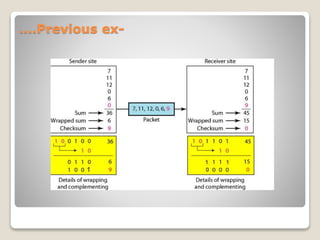
Example-
4-bit numbers are: 7, 11, 12, 0, 6
Message to be sent:7,11,12,0,6,36
[7+11+12+0+6=36]
Receiver adds actual nos. and compares with
the sum(36)
If the two are the same
receiver assumes no error, nos. accepted
and sum discarded.
Else
an error somewhere and data are not
accepted.
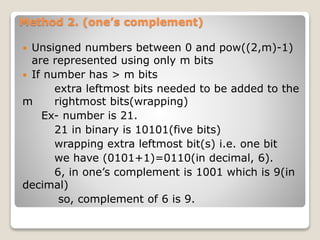
Method 2. (one’s complement)
 Unsigned numbers between 0 and pow((2,m)-1)
are represented using only m bits
 If number has > m bits
extra leftmost bits needed to be added to the
m rightmost bits(wrapping)
Ex- number is 21.
21 in binary is 10101(five bits)
wrapping extra leftmost bit(s) i.e. one bit
we have (0101+1)=0110(in decimal, 6).
6, in one’s complement is 1001 which is 9(in
decimal)
so, complement of 6 is 9.
….Previous ex-
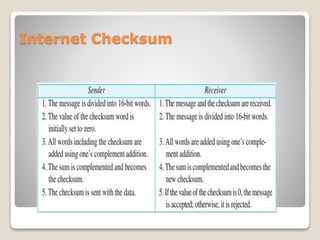
Internet Checksum
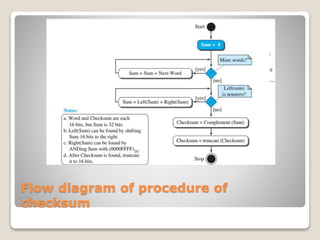
Flow diagram of procedure of
checksum
Performance (Checksum)
•Traditional checksum uses a small number of bits (16) to
detect errors in a message of any size (sometimes
thousands of bits).
•However, it is not as strong as the CRC in error-checking
capability.
•For example:
if the value of one word is incremented and the value
of another word is decremented by the same amount, the
two errors cannot be detected because the sum and
checksum remain the same.
•Also, if the values of several words are incremented but the
sum and the checksum do not change, the errors are not
detected.
•Fletcher and Adler have proposed some weighted
checksums that eliminate the first problem.
•However, the tendency in the Internet, particularly in
designing new protocols, is to replace the checksum with a
CRC.

Check sum

  • 1.
  • 2.
    CHECK SUM  Error-detectingtechnique  Applied to a message of any length  Mostly used at network and transport layer rather data-link layer.
  • 3.
    1. At thesource, the message is first divided into m-bits units 2. The generator then creates the checksum i.e. an extra m-bits unit 3. At the destination, the checker creates a new cheksum from the combination of the message and sent checksum 4. If checksum is all 0s(zeroes), Message is accepted Otherwise, Message is discarded
  • 4.
  • 5.
    Method 1. Example- 4-bit numbersare: 7, 11, 12, 0, 6 Message to be sent:7,11,12,0,6,36 [7+11+12+0+6=36] Receiver adds actual nos. and compares with the sum(36) If the two are the same receiver assumes no error, nos. accepted and sum discarded. Else an error somewhere and data are not accepted.
  • 6.
    Method 2. (one’scomplement)  Unsigned numbers between 0 and pow((2,m)-1) are represented using only m bits  If number has > m bits extra leftmost bits needed to be added to the m rightmost bits(wrapping) Ex- number is 21. 21 in binary is 10101(five bits) wrapping extra leftmost bit(s) i.e. one bit we have (0101+1)=0110(in decimal, 6). 6, in one’s complement is 1001 which is 9(in decimal) so, complement of 6 is 9.
  • 7.
  • 8.
  • 9.
    Flow diagram ofprocedure of checksum
  • 10.
    Performance (Checksum) •Traditional checksumuses a small number of bits (16) to detect errors in a message of any size (sometimes thousands of bits). •However, it is not as strong as the CRC in error-checking capability. •For example: if the value of one word is incremented and the value of another word is decremented by the same amount, the two errors cannot be detected because the sum and checksum remain the same. •Also, if the values of several words are incremented but the sum and the checksum do not change, the errors are not detected. •Fletcher and Adler have proposed some weighted checksums that eliminate the first problem. •However, the tendency in the Internet, particularly in designing new protocols, is to replace the checksum with a CRC.