INSTRUCTION CYCLE
INSTRUCTION Instruction is command which is given by the user to computer.
Instruction cycle The time period during which one instruction is fetched from memory and execute when a computer given an instruction in machine language. Each instruction is further divided into sequence of phases. After the execution the program counter is incremented to point to the next instruction.
Phases Fetch an instruction from memory Decode the instruction Execute the instruction
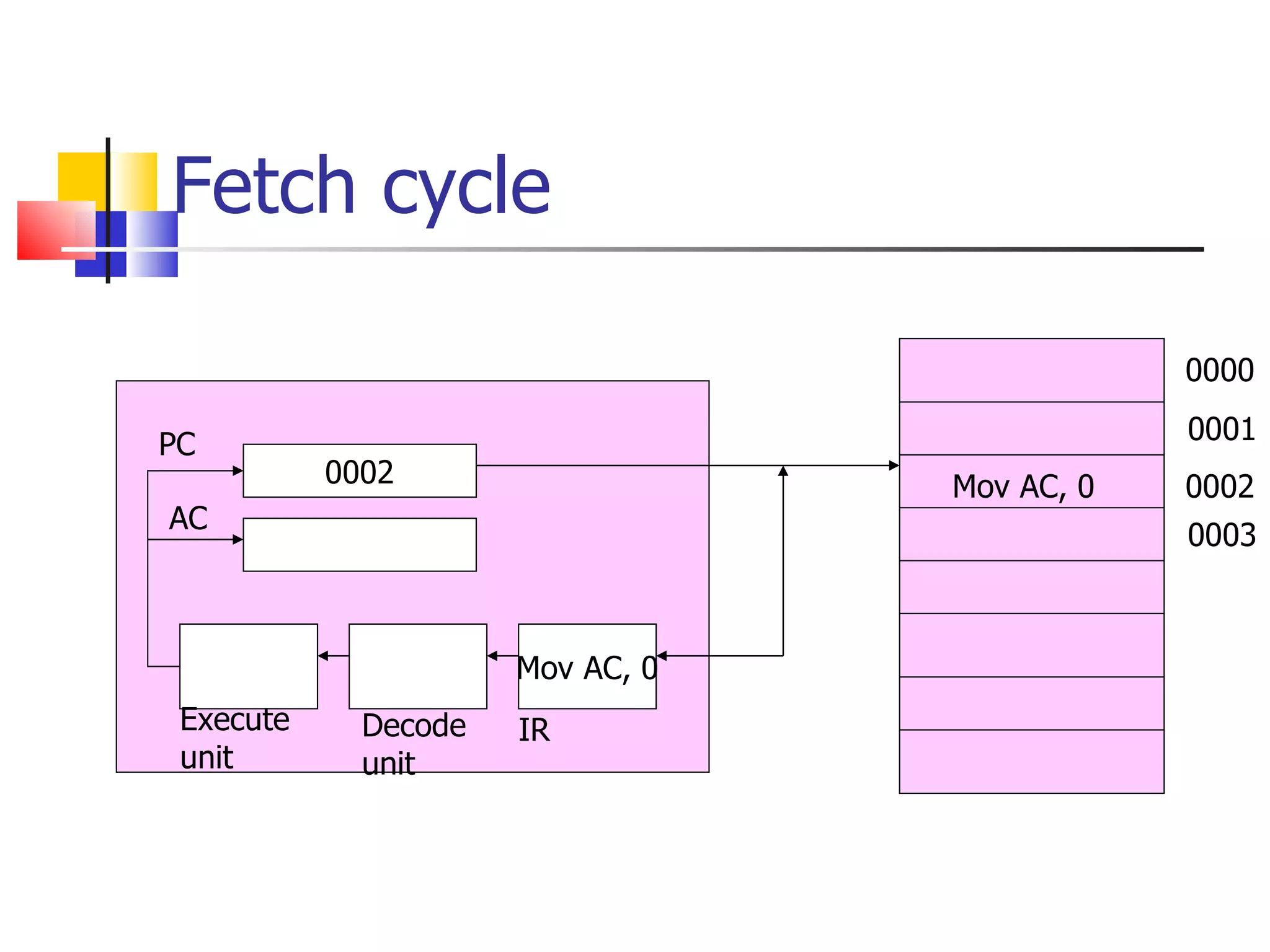
Fetch cycle In this phase the sequence counter is initialized to 0. The address of first instruction from PC is loaded into address register during the first clock cycle.
Fetch cycle 0002 Mov AC, 0 Mov AC, 0 0000 0001 0002 0003 IR Decode unit Execute  unit PC AC
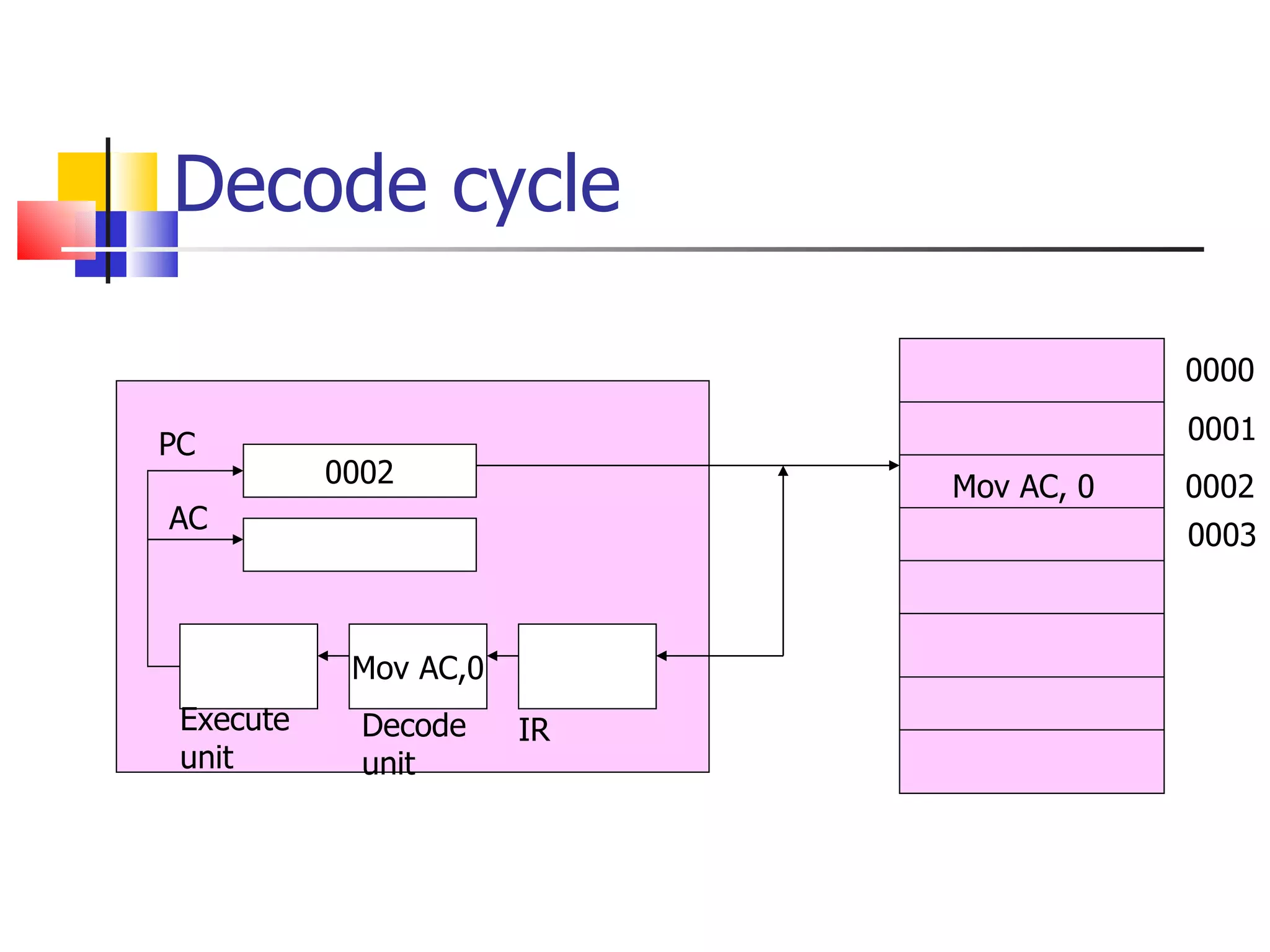
Decode cycle The instruction is decoded by the instruction decoder of a processor. All the bits of the instruction under execution stored in IR are analyzed and decode in third clock cycle.
Decode cycle 0002 Mov AC,0 Mov AC, 0 0000 0001 0002 0003 IR Decode unit Execute  unit PC AC
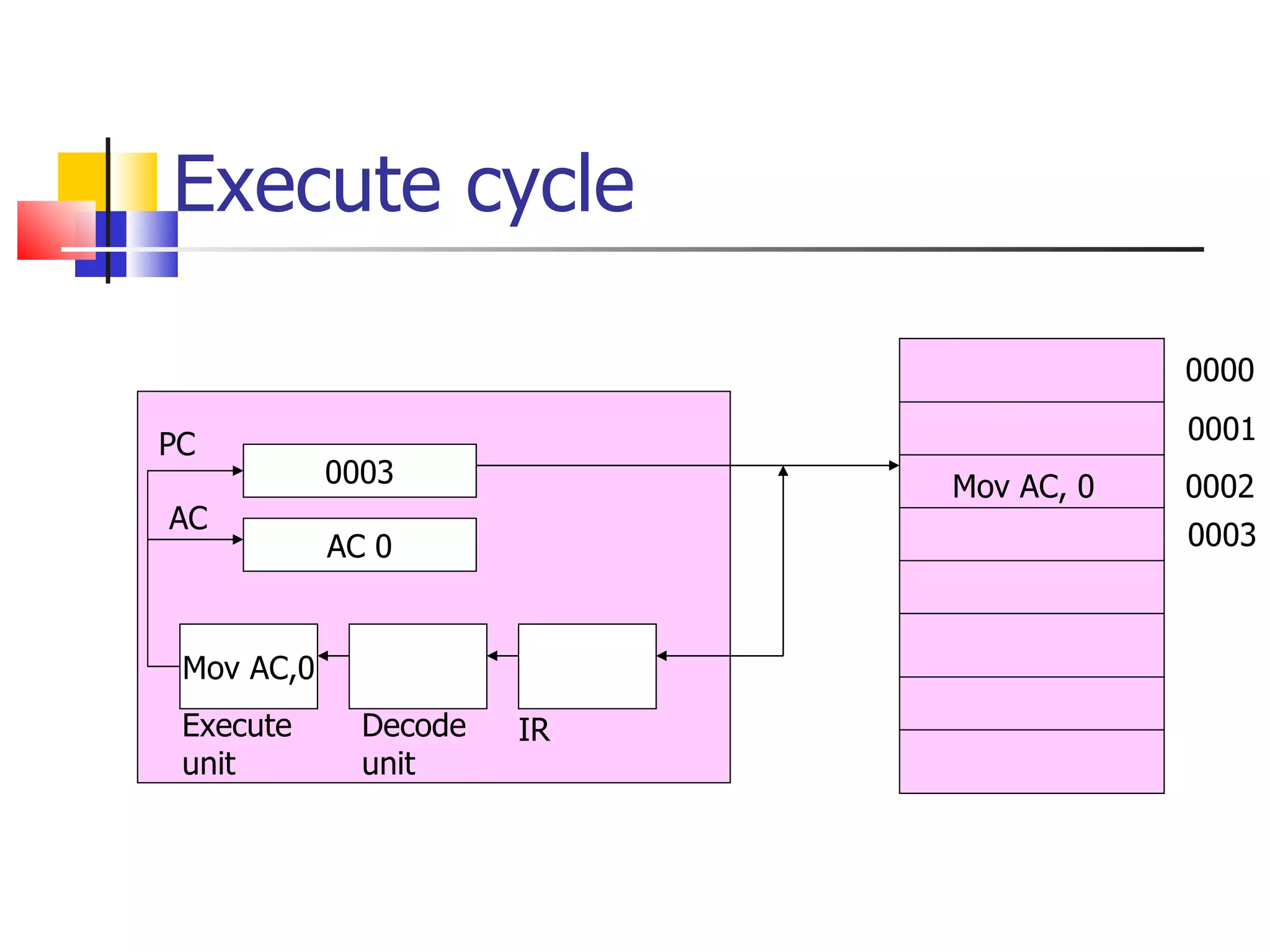
Execute cycle In the last phase, the processor execute the instruction. This involves setting the contents of the internal register AC to constant value 0.
Execute cycle 0003 AC 0 Mov AC,0 Mov AC, 0 0000 0001 0002 0003 IR Decode unit Execute  unit PC AC
SC  0 AR  PC IR  M[AR], PC  PC+1 Decode  IR(12-14)  IR(15), AR  IR(0-11) D I I Execute reg. reference Execute I/O reference Execute memory reference Execute memory reference Nothing AR  M[AR] =0  Memory reference I/O or reg. reference 1= =1 0= =1 0= I
Fetch operation The circuit comprises of various registers, memory unit I/O devices, control and timing unit ALU and a common bus. AR  PC IR  M[AR], PC  PC+1 The instruction read from memory is then placed in the instruction register.
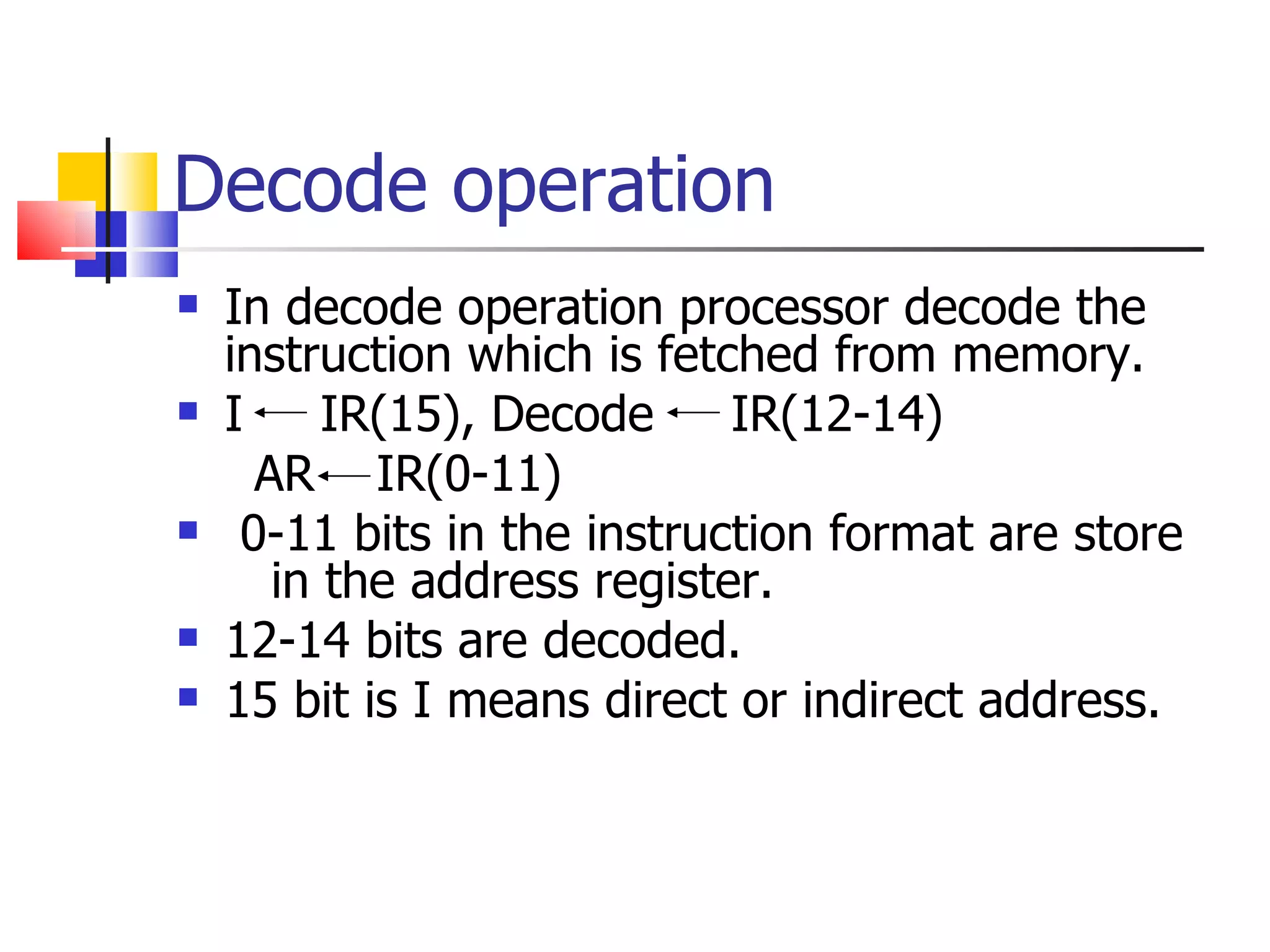
Decode operation In decode operation processor decode the instruction which is fetched from memory. I  IR(15), Decode  IR(12-14)  AR  IR(0-11) 0-11 bits in the instruction format are store  in the address register. 12-14 bits are decoded. 15 bit is I means direct or indirect address.
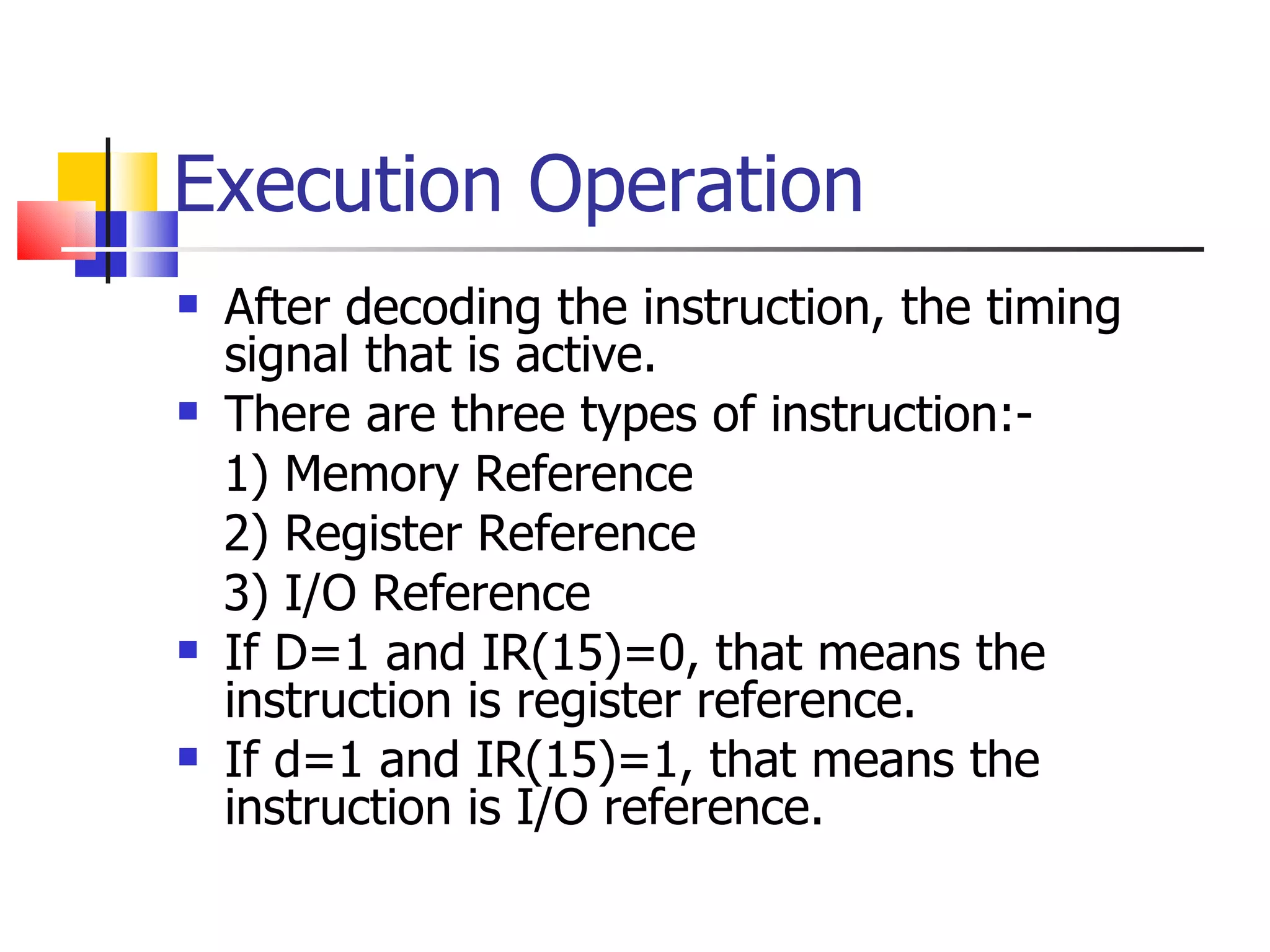
Execution Operation After decoding the instruction, the timing signal that is active. There are three types of instruction:- 1) Memory Reference 2) Register Reference 3) I/O Reference If D=1 and IR(15)=0, that means the instruction is register reference. If d=1 and IR(15)=1, that means the instruction is I/O reference.
Execution Operation If D=0 and IR(15)=0, that means memory reference instruction is direct address instruction. If D=0 and IR(15)=1, that means memory reference instruction is indirect address instruction. AR  M[AR], AR holds the address part of the instruction After the instruction is executed, SC is cleared to 0 and control returns to the fetch phase.
THANKS

Instruction cycle

  • 1.
  • 2.
    INSTRUCTION Instruction iscommand which is given by the user to computer.
  • 3.
    Instruction cycle Thetime period during which one instruction is fetched from memory and execute when a computer given an instruction in machine language. Each instruction is further divided into sequence of phases. After the execution the program counter is incremented to point to the next instruction.
  • 4.
    Phases Fetch aninstruction from memory Decode the instruction Execute the instruction
  • 5.
    Fetch cycle Inthis phase the sequence counter is initialized to 0. The address of first instruction from PC is loaded into address register during the first clock cycle.
  • 6.
    Fetch cycle 0002Mov AC, 0 Mov AC, 0 0000 0001 0002 0003 IR Decode unit Execute unit PC AC
  • 7.
    Decode cycle Theinstruction is decoded by the instruction decoder of a processor. All the bits of the instruction under execution stored in IR are analyzed and decode in third clock cycle.
  • 8.
    Decode cycle 0002Mov AC,0 Mov AC, 0 0000 0001 0002 0003 IR Decode unit Execute unit PC AC
  • 9.
    Execute cycle Inthe last phase, the processor execute the instruction. This involves setting the contents of the internal register AC to constant value 0.
  • 10.
    Execute cycle 0003AC 0 Mov AC,0 Mov AC, 0 0000 0001 0002 0003 IR Decode unit Execute unit PC AC
  • 11.
    SC 0AR PC IR M[AR], PC PC+1 Decode IR(12-14) IR(15), AR IR(0-11) D I I Execute reg. reference Execute I/O reference Execute memory reference Execute memory reference Nothing AR M[AR] =0 Memory reference I/O or reg. reference 1= =1 0= =1 0= I
  • 12.
    Fetch operation Thecircuit comprises of various registers, memory unit I/O devices, control and timing unit ALU and a common bus. AR PC IR M[AR], PC PC+1 The instruction read from memory is then placed in the instruction register.
  • 13.
    Decode operation Indecode operation processor decode the instruction which is fetched from memory. I IR(15), Decode IR(12-14) AR IR(0-11) 0-11 bits in the instruction format are store in the address register. 12-14 bits are decoded. 15 bit is I means direct or indirect address.
  • 14.
    Execution Operation Afterdecoding the instruction, the timing signal that is active. There are three types of instruction:- 1) Memory Reference 2) Register Reference 3) I/O Reference If D=1 and IR(15)=0, that means the instruction is register reference. If d=1 and IR(15)=1, that means the instruction is I/O reference.
  • 15.
    Execution Operation IfD=0 and IR(15)=0, that means memory reference instruction is direct address instruction. If D=0 and IR(15)=1, that means memory reference instruction is indirect address instruction. AR M[AR], AR holds the address part of the instruction After the instruction is executed, SC is cleared to 0 and control returns to the fetch phase.
  • 16.