More free powerpoints at http://www.worldofteaching.com
Magnets have been known for centuries.
The Chinese and Greeks knew about the
“magical” properties of magnets. The
ancient Greeks used a stone substance
called “magnetite.” They discovered that the
stone always pointed in the same direction.
Later, stones of magnetite called
“lodestones” were used in navigation.
William Gilbert, an
English physician,
first proposed in
1600 that the earth
itself is a magnet,
and he predicted that
the Earth would be
found to have
magnetic poles.
What is Magnetism?

         Magnetism is the
         force of
         attraction or
         repulsion of a
         magnetic
         material due to
         the arrangement
         of its atoms,
         particularly its
         electrons.
All magnetic
phenomena result from
    forces between
  electric charges in
        motion.
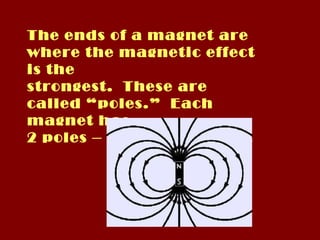
The ends of a magnet are
where the magnetic effect
is the
strongest. These are
called “poles.” Each
magnet has
2 poles – 1 north, 1 south.
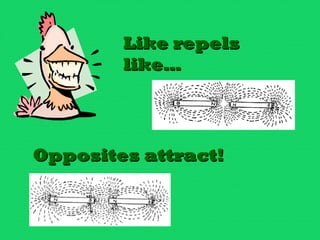
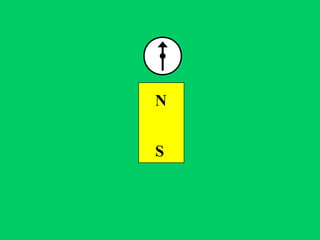
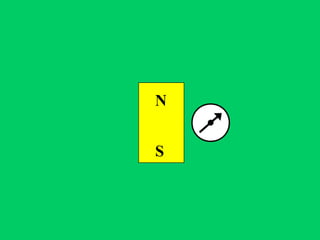
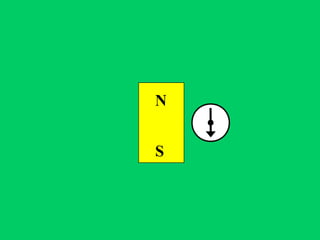
Like repels
        like…


Opposites attract!
Poles of a magnet
      always
  Come in pairs!
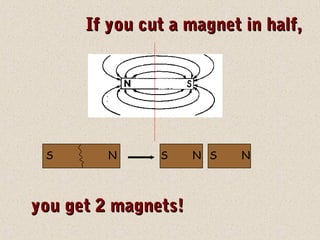
If you cut a magnet in half,


 S       N     S     N S   N


you get 2 magnets!
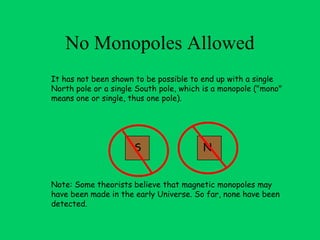
No Monopoles Allowed
It has not been shown to be possible to end up with a single
North pole or a single South pole, which is a monopole ("mono"
means one or single, thus one pole). 


                      S                 N


Note: Some theorists believe that magnetic monopoles may
have been made in the early Universe. So far, none have been
detected.
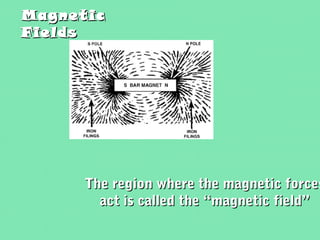
Magnetic
Fields


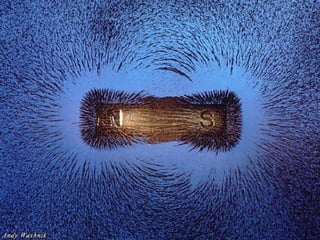
      The region where the magnetic forces
        act is called the “magnetic field”
Defining Magnetic Field Direction
        Magnetic Field vectors as written as B


   Direction of magnetic field at any point is defined
   as the direction of motion of a charged particle on
   which the magnetic field would not exert a force.


  Magnitude of the B-vector is proportional to the
  force acting on the moving charge, magnitude of the
  moving charge, the magnitude of its velocity, and the
  angle between v and the B-field. Unit is the Tesla or
  the Gauss (1 T = 10,000 G).
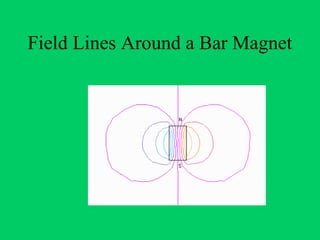
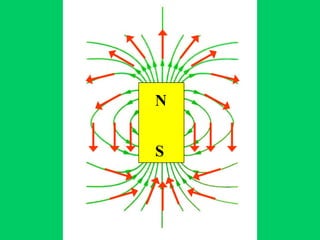
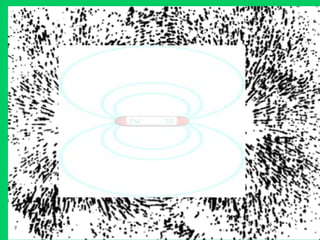
Field Lines Around a Bar Magnet
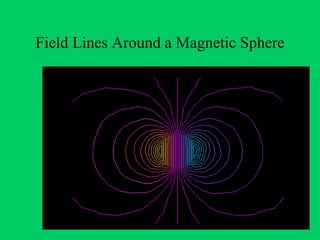
Field Lines Around a Magnetic Sphere
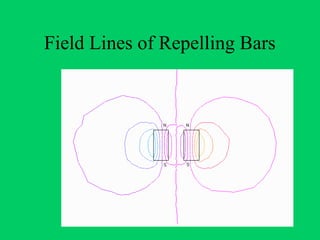
Field Lines of Repelling Bars
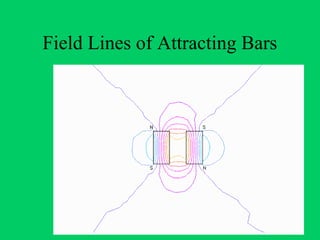
Field Lines of Attracting Bars
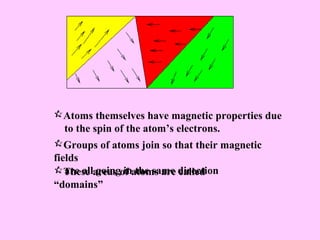
Atoms themselves have magnetic properties due
   to the spin of the atom’s electrons.
Groups of atoms join so that their magnetic
fields
These areas of atoms are direction
   are all going in the same called
“domains”
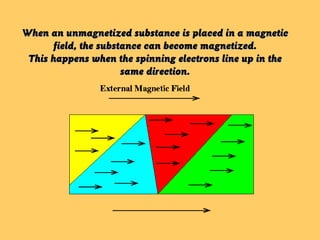
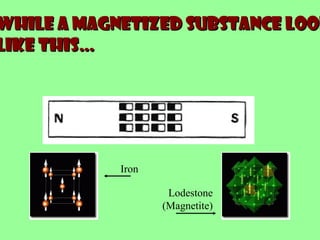
When an unmagnetized substance is placed in a magnetic
      field, the substance can become magnetized.
 This happens when the spinning electrons line up in the
                      same direction.
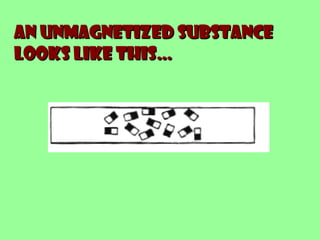
An unmagnetized substance
looks like this…
While a magnetized substance look
like this…


            Iron

                    Lodestone
                   (Magnetite)
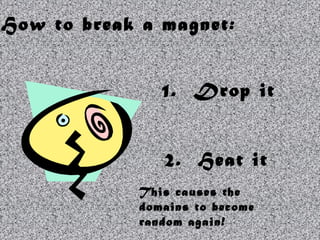
How to break a magnet:


                1. Drop it


                2. Heat it
             This causes the
             domains to become
             random again!
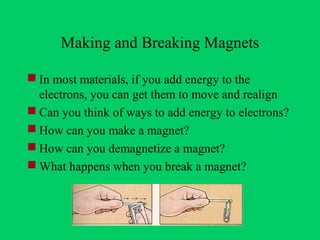
Making and Breaking Magnets

 In most materials, if you add energy to the
  electrons, you can get them to move and realign
 Can you think of ways to add energy to electrons?
 How can you make a magnet?
 How can you demagnetize a magnet?
 What happens when you break a magnet?
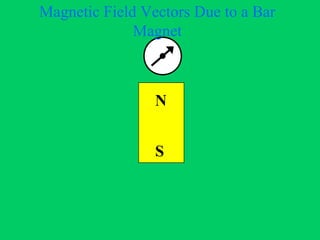
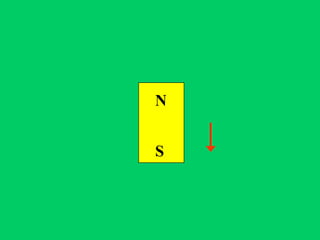
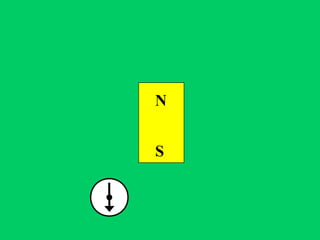
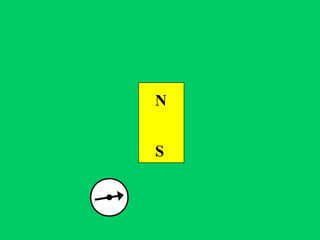
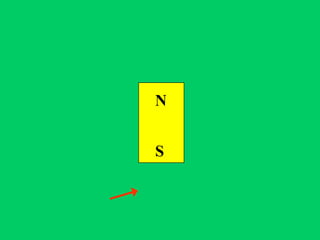
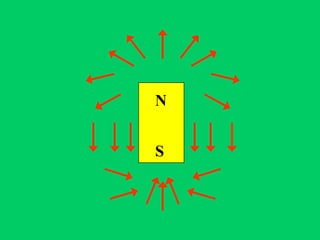
Magnetic Field Vectors Due to a Bar
              Magnet


                 N


                 S
N


S
N


S
N


S
N


S
N


S
N


S
N


S
N


S
N


S
Magnetic Field Lines
• The direction of the magnetic field at any
  point is tangent to the magnetic field line at
  that point.
N


S
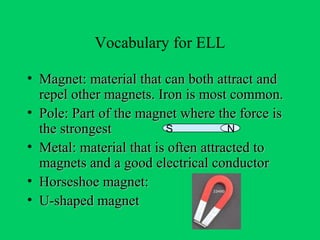
Vocabulary for ELL

• Magnet: material that can both attract and
  repel other magnets. Iron is most common.
• Pole: Part of the magnet where the force is
  the strongest          S           N
• Metal: material that is often attracted to
  magnets and a good electrical conductor
• Horseshoe magnet:
• U-shaped magnet
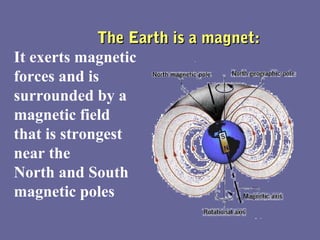
The Earth is a magnet:
It exerts magnetic
forces and is
surrounded by a
magnetic field
that is strongest
near the
North and South
magnetic poles
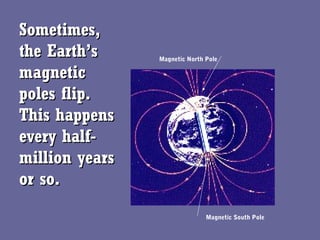
Sometimes,
the Earth’s     Magnetic North Pole

magnetic
poles flip.
This happens
every half-
million years
or so.
                               Magnetic South Pole
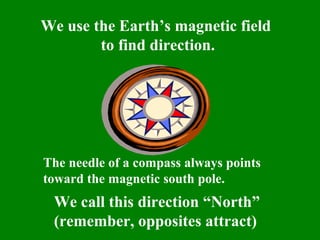
We use the Earth’s magnetic field
        to find direction.


The needle of a compass always points
toward the magnetic south pole.
 We call this direction “North”
 (remember, opposites attract)
Vocabulary for ELL
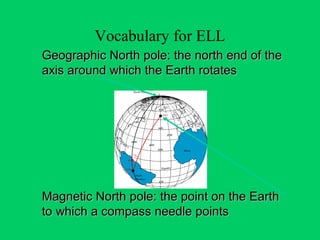
Geographic North pole: the north end of the
axis around which the Earth rotates


Magnetic North pole: the point on the Earth
to which a compass needle points
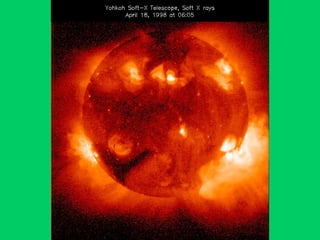
The sun has a magnetic field, too.
It extends far above the sun’s
surface.


                               Other planets in the solar
                               system also have these
                               magnetic fields
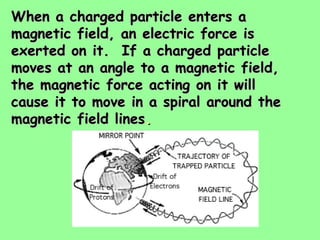
When a charged particle enters a
magnetic field, an electric force is
exerted on it. If a charged particle
moves at an angle to a magnetic field,
the magnetic force acting on it will
cause it to move in a spiral around the
magnetic field lines.
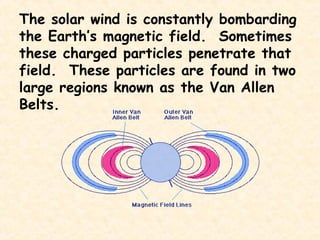
The solar wind is constantly bombarding
the Earth’s magnetic field. Sometimes
these charged particles penetrate that
field. These particles are found in two
large regions known as the Van Allen
Belts.
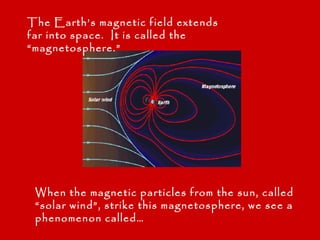
The Earth’s magnetic field extends
far into space. It is called the
“magnetosphere.”


 When the magnetic particles from the sun, called
 “solar wind”, strike this magnetosphere, we see a
 phenomenon called…
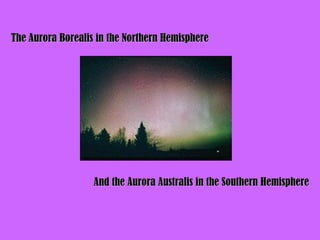
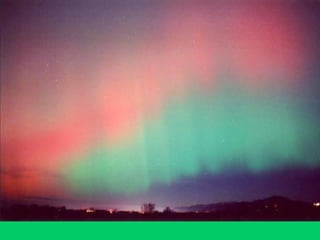
The Aurora Borealis in the Northern Hemisphere


                   And the Aurora Australis in the Southern Hemisphere
Electricity and Magnetism
 Electric forces hold atoms and
molecules together.
 Electricity controls our thinking, feeling,
muscles and metabolic processes.
 Electricity and magnetism underpin
much of our current technology (e.g.
computers).
 Electricity and magnetism are linked
on a fundamental level.
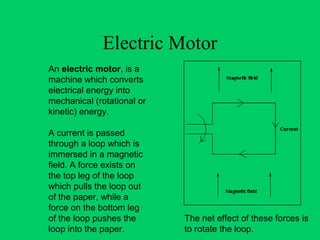
Electric Motor
An electric motor, is a
machine which converts
electrical energy into
mechanical (rotational or
kinetic) energy.

A current is passed
through a loop which is
immersed in a magnetic
field. A force exists on
the top leg of the loop
which pulls the loop out
of the paper, while a
force on the bottom leg
of the loop pushes the      The net effect of these forces is
loop into the paper.        to rotate the loop.
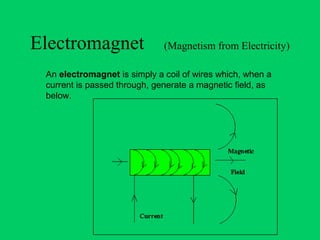
Electromagnet                 (Magnetism from Electricity)

 An electromagnet is simply a coil of wires which, when a
 current is passed through, generate a magnetic field, as
 below.
Magnetic Properties of Matter
In other words….materials which produce
magnetic fields with no apparent circulation of
charge.


All substances - solid, gas, and liquid - react to
the presence of a magnetic field on some level.
Remember why?

How much they react causes them to be put into
several material “types”.
Top Ten List
       What We Will Learn About Magnetism

1. There are North Poles and South Poles.

2. Like poles repel, unlike poles attract.

3. Magnetic forces attract only magnetic materials.

4. Magnetic forces act at a distance.

5. While magnetized, temporary magnets act like permanent
magnets.
Top Ten Continued
9. A charged particle experiences no magnetic force when
moving parallel to a magnetic field, but when it is moving
perpendicular to the field it experiences a force perpendicular
to both the field and the direction of motion.

10. A current-carrying wire in a perpendicular magnetic field
experiences a force in a direction perpendicular to both the
wire and the field.
Let’s Play!

Magnetism

  • 1.
    More free powerpointsat http://www.worldofteaching.com
  • 2.
    Magnets have beenknown for centuries. The Chinese and Greeks knew about the “magical” properties of magnets. The ancient Greeks used a stone substance called “magnetite.” They discovered that the stone always pointed in the same direction. Later, stones of magnetite called “lodestones” were used in navigation.
  • 3.
    William Gilbert, an Englishphysician, first proposed in 1600 that the earth itself is a magnet, and he predicted that the Earth would be found to have magnetic poles.
  • 4.
    What is Magnetism? Magnetism is the force of attraction or repulsion of a magnetic material due to the arrangement of its atoms, particularly its electrons.
  • 5.
    All magnetic phenomena resultfrom forces between electric charges in motion.
  • 6.
    The ends ofa magnet are where the magnetic effect is the strongest. These are called “poles.” Each magnet has 2 poles – 1 north, 1 south.
  • 7.
    Like repels like… Opposites attract!
  • 8.
    Poles of amagnet always Come in pairs!
  • 9.
    If you cuta magnet in half, S N S N S N you get 2 magnets!
  • 10.
    No Monopoles Allowed Ithas not been shown to be possible to end up with a single North pole or a single South pole, which is a monopole ("mono" means one or single, thus one pole).  S N Note: Some theorists believe that magnetic monopoles may have been made in the early Universe. So far, none have been detected.
  • 11.
    Magnetic Fields The region where the magnetic forces act is called the “magnetic field”
  • 12.
    Defining Magnetic FieldDirection Magnetic Field vectors as written as B Direction of magnetic field at any point is defined as the direction of motion of a charged particle on which the magnetic field would not exert a force. Magnitude of the B-vector is proportional to the force acting on the moving charge, magnitude of the moving charge, the magnitude of its velocity, and the angle between v and the B-field. Unit is the Tesla or the Gauss (1 T = 10,000 G).
  • 14.
    Field Lines Arounda Bar Magnet
  • 15.
    Field Lines Arounda Magnetic Sphere
  • 16.
    Field Lines ofRepelling Bars
  • 17.
    Field Lines ofAttracting Bars
  • 18.
    Atoms themselves havemagnetic properties due to the spin of the atom’s electrons. Groups of atoms join so that their magnetic fields These areas of atoms are direction are all going in the same called “domains”
  • 19.
    When an unmagnetizedsubstance is placed in a magnetic field, the substance can become magnetized. This happens when the spinning electrons line up in the same direction.
  • 20.
  • 21.
    While a magnetizedsubstance look like this… Iron Lodestone (Magnetite)
  • 22.
    How to breaka magnet: 1. Drop it 2. Heat it This causes the domains to become random again!
  • 23.
    Making and BreakingMagnets  In most materials, if you add energy to the electrons, you can get them to move and realign  Can you think of ways to add energy to electrons?  How can you make a magnet?  How can you demagnetize a magnet?  What happens when you break a magnet?
  • 24.
    Magnetic Field VectorsDue to a Bar Magnet N S
  • 25.
  • 26.
  • 27.
  • 28.
  • 29.
  • 30.
  • 31.
  • 32.
  • 33.
  • 34.
    Magnetic Field Lines •The direction of the magnetic field at any point is tangent to the magnetic field line at that point.
  • 35.
  • 37.
    Vocabulary for ELL •Magnet: material that can both attract and repel other magnets. Iron is most common. • Pole: Part of the magnet where the force is the strongest S N • Metal: material that is often attracted to magnets and a good electrical conductor • Horseshoe magnet: • U-shaped magnet
  • 38.
    The Earth isa magnet: It exerts magnetic forces and is surrounded by a magnetic field that is strongest near the North and South magnetic poles
  • 39.
    Sometimes, the Earth’s Magnetic North Pole magnetic poles flip. This happens every half- million years or so. Magnetic South Pole
  • 40.
    We use theEarth’s magnetic field to find direction. The needle of a compass always points toward the magnetic south pole. We call this direction “North” (remember, opposites attract)
  • 41.
    Vocabulary for ELL GeographicNorth pole: the north end of the axis around which the Earth rotates Magnetic North pole: the point on the Earth to which a compass needle points
  • 42.
    The sun hasa magnetic field, too. It extends far above the sun’s surface. Other planets in the solar system also have these magnetic fields
  • 44.
    When a chargedparticle enters a magnetic field, an electric force is exerted on it. If a charged particle moves at an angle to a magnetic field, the magnetic force acting on it will cause it to move in a spiral around the magnetic field lines.
  • 45.
    The solar windis constantly bombarding the Earth’s magnetic field. Sometimes these charged particles penetrate that field. These particles are found in two large regions known as the Van Allen Belts.
  • 46.
    The Earth’s magneticfield extends far into space. It is called the “magnetosphere.” When the magnetic particles from the sun, called “solar wind”, strike this magnetosphere, we see a phenomenon called…
  • 47.
    The Aurora Borealisin the Northern Hemisphere And the Aurora Australis in the Southern Hemisphere
  • 49.
    Electricity and Magnetism Electric forces hold atoms and molecules together.  Electricity controls our thinking, feeling, muscles and metabolic processes.  Electricity and magnetism underpin much of our current technology (e.g. computers).  Electricity and magnetism are linked on a fundamental level.
  • 50.
    Electric Motor An electricmotor, is a machine which converts electrical energy into mechanical (rotational or kinetic) energy. A current is passed through a loop which is immersed in a magnetic field. A force exists on the top leg of the loop which pulls the loop out of the paper, while a force on the bottom leg of the loop pushes the The net effect of these forces is loop into the paper. to rotate the loop.
  • 51.
    Electromagnet (Magnetism from Electricity) An electromagnet is simply a coil of wires which, when a current is passed through, generate a magnetic field, as below.
  • 52.
    Magnetic Properties ofMatter In other words….materials which produce magnetic fields with no apparent circulation of charge. All substances - solid, gas, and liquid - react to the presence of a magnetic field on some level. Remember why? How much they react causes them to be put into several material “types”.
  • 53.
    Top Ten List What We Will Learn About Magnetism 1. There are North Poles and South Poles. 2. Like poles repel, unlike poles attract. 3. Magnetic forces attract only magnetic materials. 4. Magnetic forces act at a distance. 5. While magnetized, temporary magnets act like permanent magnets.
  • 54.
    Top Ten Continued 9.A charged particle experiences no magnetic force when moving parallel to a magnetic field, but when it is moving perpendicular to the field it experiences a force perpendicular to both the field and the direction of motion. 10. A current-carrying wire in a perpendicular magnetic field experiences a force in a direction perpendicular to both the wire and the field.
  • 56.