6.3 – Magnetic Force and Field
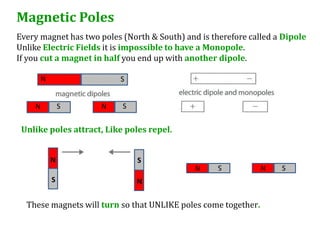
Magnetic Poles
Every magnet has two poles (North & South) and is therefore called a Dipole
Unlike Electric Fields it is impossible to have a Monopole.
If you cut a magnet in half you end up with another dipole.

        N                 S


    N           S    N     S

 Unlike poles attract, Like poles repel.


            N                  S              N     S
                                                                N   S
            S                  N

  These magnets will turn so that UNLIKE poles come together.
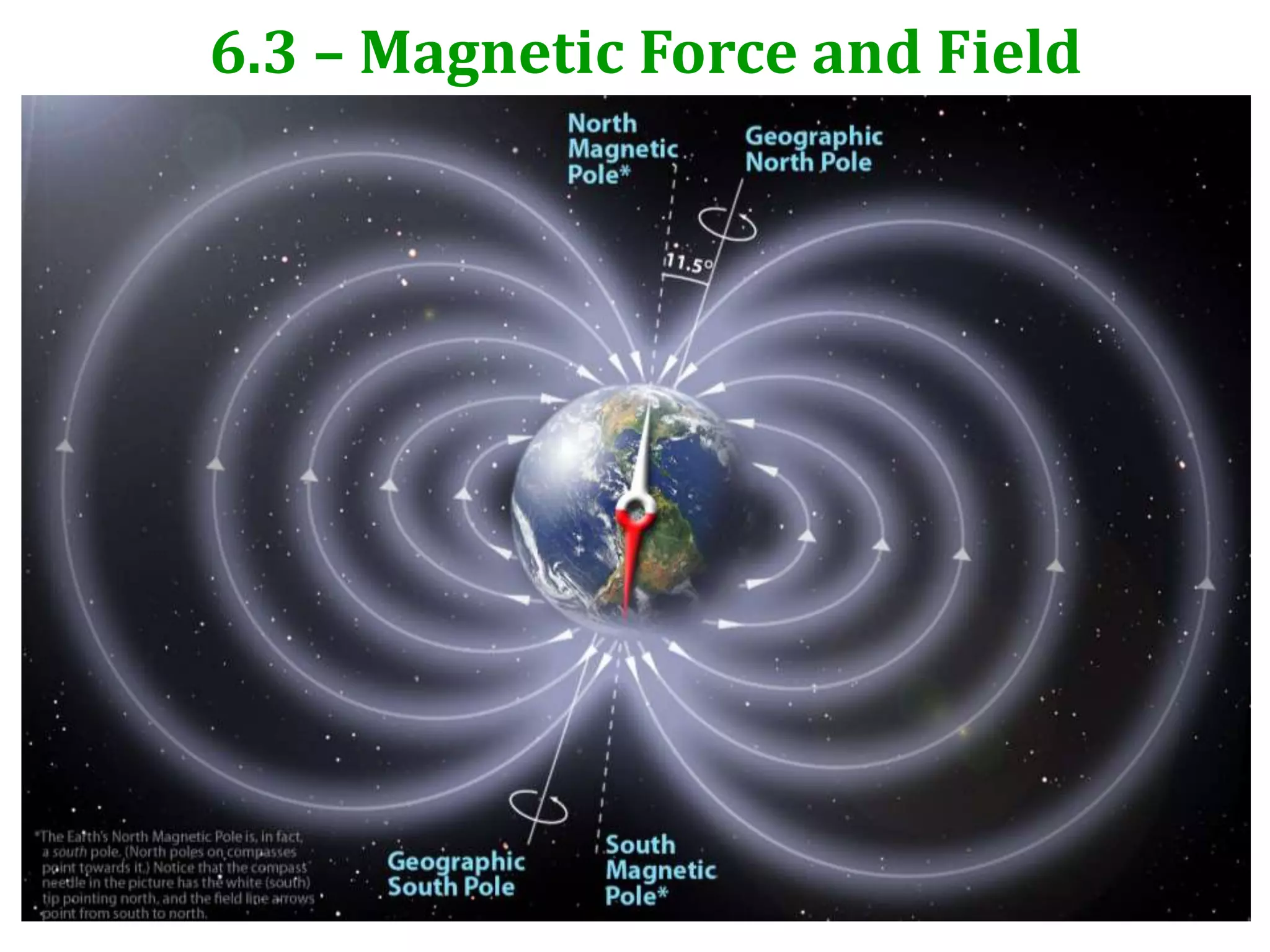
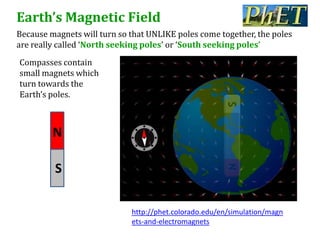
Earth’s Magnetic Field
Because magnets will turn so that UNLIKE poles come together, the poles
are really called ‘North seeking poles’ or ‘South seeking poles’
Compasses contain
small magnets which
turn towards the
Earth’s poles.


         N

         S

                             http://phet.colorado.edu/en/simulation/magn
                             ets-and-electromagnets
Magnetic Field Lines
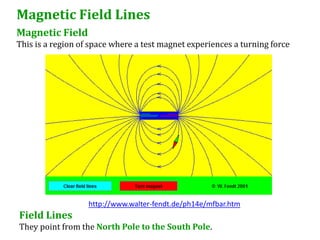
Magnetic Field
This is a region of space where a test magnet experiences a turning force


                   http://www.walter-fendt.de/ph14e/mfbar.htm
Field Lines
They point from the North Pole to the South Pole.
Magnetic Flux Density (B)
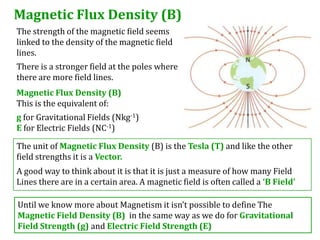
The strength of the magnetic field seems
linked to the density of the magnetic field
lines.
There is a stronger field at the poles where
there are more field lines.
Magnetic Flux Density (B)
This is the equivalent of:
g for Gravitational Fields (Nkg-1)
E for Electric Fields (NC-1)

The unit of Magnetic Flux Density (B) is the Tesla (T) and like the other
field strengths it is a Vector.
A good way to think about it is that it is just a measure of how many Field
Lines there are in a certain area. A magnetic field is often called a ‘B Field’

Until we know more about Magnetism it isn’t possible to define The
Magnetic Field Density (B) in the same way as we do for Gravitational
Field Strength (g) and Electric Field Strength (E)
Fields Caused by Currents
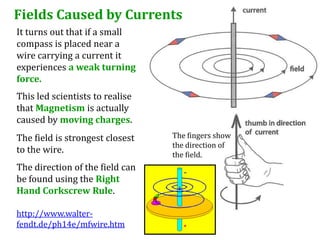
It turns out that if a small
compass is placed near a
wire carrying a current it
experiences a weak turning
force.
This led scientists to realise
that Magnetism is actually
caused by moving charges.
The field is strongest closest   The fingers show
                                 the direction of
to the wire.                     the field.
The direction of the field can
be found using the Right
Hand Corkscrew Rule.

http://www.walter-
fendt.de/ph14e/mfwire.htm
Field inside a coil
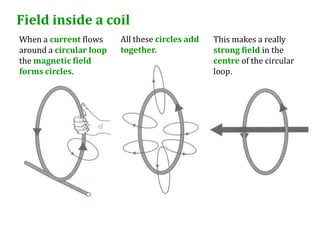
When a current flows     All these circles add   This makes a really
around a circular loop   together.               strong field in the
the magnetic field                               centre of the circular
forms circles.                                   loop.
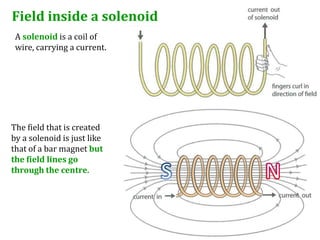
Field inside a solenoid
 A solenoid is a coil of
 wire, carrying a current.


The field that is created
by a solenoid is just like
that of a bar magnet but
the field lines go
through the centre.
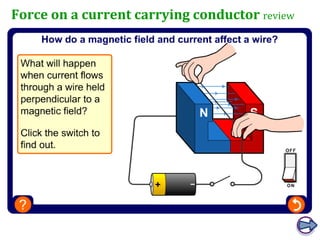
Force on a current carrying conductor review
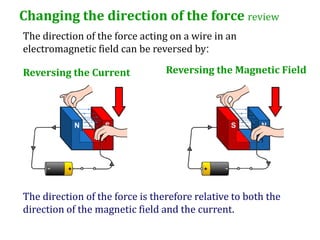
Changing the direction of the force review
The direction of the force acting on a wire in an
electromagnetic field can be reversed by:

Reversing the Current            Reversing the Magnetic Field


The direction of the force is therefore relative to both the
direction of the magnetic field and the current.
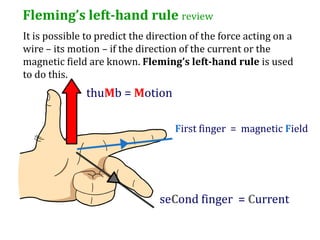
Fleming’s left-hand rule review
It is possible to predict the direction of the force acting on a
wire – its motion – if the direction of the current or the
magnetic field are known. Fleming’s left-hand rule is used
to do this.
               thuMb = Motion

                                   First finger = magnetic Field


                                seCond finger = Current
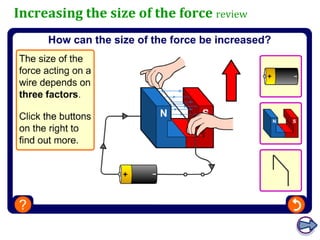
Increasing the size of the force review
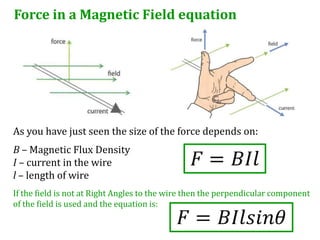
Force in a Magnetic Field equation


As you have just seen the size of the force depends on:
B – Magnetic Flux Density
I – current in the wire
l – length of wire
If the field is not at Right Angles to the wire then the perpendicular component
of the field is used and the equation is:
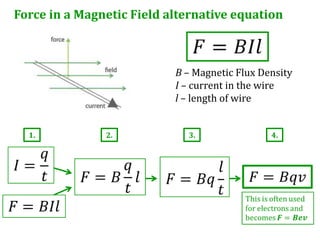
Force in a Magnetic Field alternative equation


                           B – Magnetic Flux Density
                           I – current in the wire
                           l – length of wire


  1.           2.            3.                4.
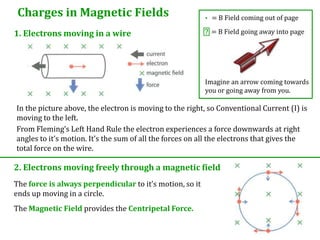
Charges in Magnetic Fields                               . = B Field coming out of page
1. Electrons moving in a wire                             ⨯ B Field going away into page
                                                            =


                                                          Imagine an arrow coming towards
                                                          you or going away from you.

In the picture above, the electron is moving to the right, so Conventional Current (I) is
moving to the left.
From Fleming’s Left Hand Rule the electron experiences a force downwards at right
angles to it’s motion. It’s the sum of all the forces on all the electrons that gives the
total force on the wire.

2. Electrons moving freely through a magnetic field
The force is always perpendicular to it’s motion, so it
ends up moving in a circle.
The Magnetic Field provides the Centripetal Force.
What forces are there between two current carrying wires?

Step 1 – What does I2 do to I1 ?
Use the Right Hand Corkscrew rule to see what the field lines do.
Step 2 – Which way does I1 move?
Use Fleming’s Left Hand Rule
to see what the force is on I1
                                                        F
Now repeat for the other wire:
Force caused by I2 on I1   Force caused by I1 on I2


                  F

                                          F


          The two wires move together!
If the currents are flowing in opposite directions:


 I                                              I


If the currents are flowing in opposite directions:
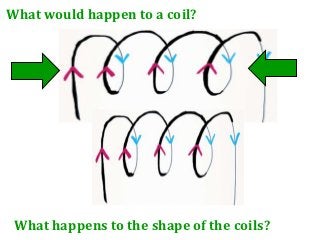
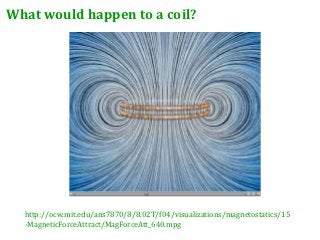
What would happen to a coil?


 What happens to the shape of the coils?
What would happen to a coil?


  http://ocw.mit.edu/ans7870/8/8.02T/f04/visualizations/magnetostatics/15
  -MagneticForceAttract/MagForceAtt_640.mpg
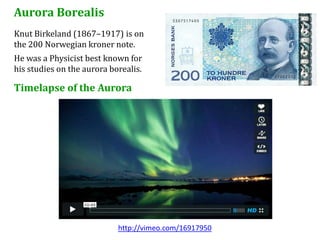
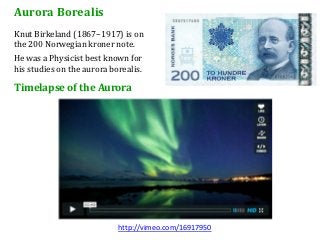
Aurora Borealis
Knut Birkeland (1867–1917) is on
the 200 Norwegian kroner note.
He was a Physicist best known for
his studies on the aurora borealis.

Timelapse of the Aurora


                            http://vimeo.com/16917950
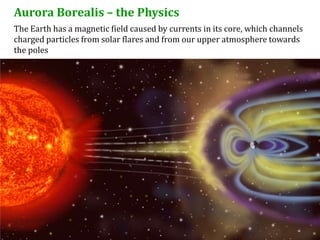
Aurora Borealis – the Physics
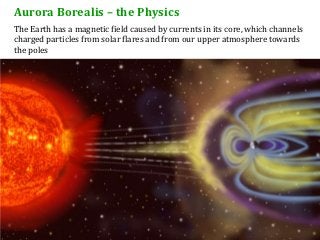
The Earth has a magnetic field caused by currents in its core, which channels
charged particles from solar flares and from our upper atmosphere towards
the poles
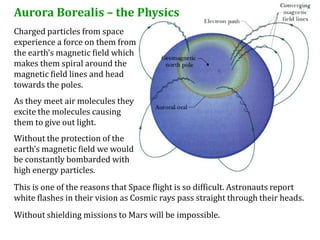
Aurora Borealis – the Physics
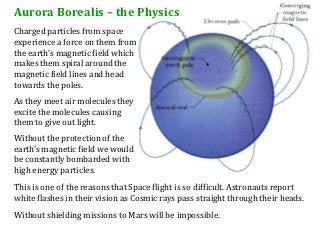
Charged particles from space
experience a force on them from
the earth’s magnetic field which
makes them spiral around the
magnetic field lines and head
towards the poles.
As they meet air molecules they
excite the molecules causing
them to give out light.
Without the protection of the
earth’s magnetic field we would
be constantly bombarded with
high energy particles.
This is one of the reasons that Space flight is so difficult. Astronauts report
white flashes in their vision as Cosmic rays pass straight through their heads.
Without shielding missions to Mars will be impossible.

6.3 - Magnetic Force and Field

  • 1.
    6.3 – MagneticForce and Field
  • 2.
    Magnetic Poles Every magnethas two poles (North & South) and is therefore called a Dipole Unlike Electric Fields it is impossible to have a Monopole. If you cut a magnet in half you end up with another dipole. N S N S N S Unlike poles attract, Like poles repel. N S N S N S S N These magnets will turn so that UNLIKE poles come together.
  • 3.
    Earth’s Magnetic Field Becausemagnets will turn so that UNLIKE poles come together, the poles are really called ‘North seeking poles’ or ‘South seeking poles’ Compasses contain small magnets which turn towards the Earth’s poles. N S http://phet.colorado.edu/en/simulation/magn ets-and-electromagnets
  • 4.
    Magnetic Field Lines MagneticField This is a region of space where a test magnet experiences a turning force http://www.walter-fendt.de/ph14e/mfbar.htm Field Lines They point from the North Pole to the South Pole.
  • 5.
    Magnetic Flux Density(B) The strength of the magnetic field seems linked to the density of the magnetic field lines. There is a stronger field at the poles where there are more field lines. Magnetic Flux Density (B) This is the equivalent of: g for Gravitational Fields (Nkg-1) E for Electric Fields (NC-1) The unit of Magnetic Flux Density (B) is the Tesla (T) and like the other field strengths it is a Vector. A good way to think about it is that it is just a measure of how many Field Lines there are in a certain area. A magnetic field is often called a ‘B Field’ Until we know more about Magnetism it isn’t possible to define The Magnetic Field Density (B) in the same way as we do for Gravitational Field Strength (g) and Electric Field Strength (E)
  • 6.
    Fields Caused byCurrents It turns out that if a small compass is placed near a wire carrying a current it experiences a weak turning force. This led scientists to realise that Magnetism is actually caused by moving charges. The field is strongest closest The fingers show the direction of to the wire. the field. The direction of the field can be found using the Right Hand Corkscrew Rule. http://www.walter- fendt.de/ph14e/mfwire.htm
  • 7.
    Field inside acoil When a current flows All these circles add This makes a really around a circular loop together. strong field in the the magnetic field centre of the circular forms circles. loop.
  • 8.
    Field inside asolenoid A solenoid is a coil of wire, carrying a current. The field that is created by a solenoid is just like that of a bar magnet but the field lines go through the centre.
  • 9.
    Force on acurrent carrying conductor review
  • 10.
    Changing the directionof the force review The direction of the force acting on a wire in an electromagnetic field can be reversed by: Reversing the Current Reversing the Magnetic Field The direction of the force is therefore relative to both the direction of the magnetic field and the current.
  • 11.
    Fleming’s left-hand rulereview It is possible to predict the direction of the force acting on a wire – its motion – if the direction of the current or the magnetic field are known. Fleming’s left-hand rule is used to do this. thuMb = Motion First finger = magnetic Field seCond finger = Current
  • 12.
    Increasing the sizeof the force review
  • 13.
    Force in aMagnetic Field equation As you have just seen the size of the force depends on: B – Magnetic Flux Density I – current in the wire l – length of wire If the field is not at Right Angles to the wire then the perpendicular component of the field is used and the equation is:
  • 14.
    Force in aMagnetic Field alternative equation B – Magnetic Flux Density I – current in the wire l – length of wire 1. 2. 3. 4.
  • 15.
    Charges in MagneticFields . = B Field coming out of page 1. Electrons moving in a wire ⨯ B Field going away into page = Imagine an arrow coming towards you or going away from you. In the picture above, the electron is moving to the right, so Conventional Current (I) is moving to the left. From Fleming’s Left Hand Rule the electron experiences a force downwards at right angles to it’s motion. It’s the sum of all the forces on all the electrons that gives the total force on the wire. 2. Electrons moving freely through a magnetic field The force is always perpendicular to it’s motion, so it ends up moving in a circle. The Magnetic Field provides the Centripetal Force.
  • 16.
    What forces arethere between two current carrying wires? Step 1 – What does I2 do to I1 ? Use the Right Hand Corkscrew rule to see what the field lines do. Step 2 – Which way does I1 move? Use Fleming’s Left Hand Rule to see what the force is on I1 F
  • 17.
    Now repeat forthe other wire: Force caused by I2 on I1 Force caused by I1 on I2 F F The two wires move together!
  • 18.
    If the currentsare flowing in opposite directions: I I If the currents are flowing in opposite directions:
  • 19.
    What would happento a coil? What happens to the shape of the coils?
  • 20.
    What would happento a coil? http://ocw.mit.edu/ans7870/8/8.02T/f04/visualizations/magnetostatics/15 -MagneticForceAttract/MagForceAtt_640.mpg
  • 21.
    Aurora Borealis Knut Birkeland(1867–1917) is on the 200 Norwegian kroner note. He was a Physicist best known for his studies on the aurora borealis. Timelapse of the Aurora http://vimeo.com/16917950
  • 22.
    Aurora Borealis –the Physics The Earth has a magnetic field caused by currents in its core, which channels charged particles from solar flares and from our upper atmosphere towards the poles
  • 23.
    Aurora Borealis –the Physics Charged particles from space experience a force on them from the earth’s magnetic field which makes them spiral around the magnetic field lines and head towards the poles. As they meet air molecules they excite the molecules causing them to give out light. Without the protection of the earth’s magnetic field we would be constantly bombarded with high energy particles. This is one of the reasons that Space flight is so difficult. Astronauts report white flashes in their vision as Cosmic rays pass straight through their heads. Without shielding missions to Mars will be impossible.