ELECTRICITY
Science 6th
2018- 2019
Gloria Hernández
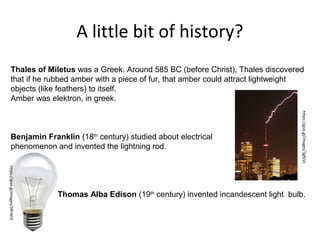
A little bit of history?
Thales of Miletus was a Greek. Around 585 BC (before Christ), Thales discovered
that if he rubbed amber with a piece of fur, that amber could attract lightweight
objects (like feathers) to itself.
Amber was elektron, in greek.
Benjamin Franklin (18th
century) studied about electrical
phenomenon and invented the lightning rod.
Thomas Alba Edison (19th
century) invented incandescent light bulb.
https://goo.gl/images/3RrWi3
https://goo.gl/images/3gfxVc
We use electricity every day, but:
- What is electricity?
- Where does it come from?
- How does it work?
To understand this we need to know
about atoms and their structure.
https://goo.gl/images/h83QtQ
ATOMS?
Matter is made of atoms. Atoms are tiny particles.
https://www.youtube.com/watch?
v=hc0EtPPpZUU
ELECTRICAL CHARGES
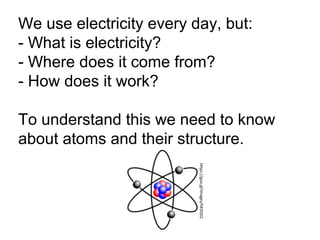
Electricity begins with the smallest particle in matter, called
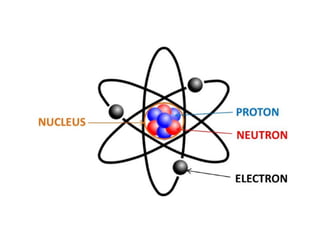
the atom. Atoms are made up of protons and neutrons inside
a nucleus and electrons moving around outside the nucleus.
Protons have a positive electric charge and electrons have a
negative electric charge. Neutrons have no charge.
If an object has the same number of protons and electrons, it
is electrically neutral. However, sometimes, electrons move
easily from one object to another and this makes the object
electrically charged.
STATIC ELECTRICITY:
Static electricity is a form of electricity that
doesn’t flow (it makes the name). Electrical
storms are an example of this static electricity.
Ice particles in the clouds move very fast and
rub together. This makes the cloud negatively
charged at the bottom. The ground below is
positively charged. If the electrical charge in the
cloud is great enough, it will meet the positive
charges from the ground. This causes a huge
amount of energy to convert into light, heat
and sound.
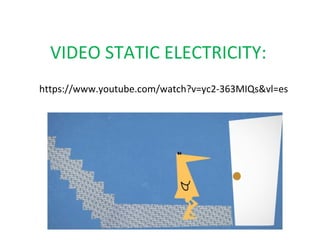
VIDEO STATIC ELECTRICITY:
https://www.youtube.com/watch?v=yc2-363MIQs&vl=es
CURRENT ELECTRICITY
The movement of electrons from one object to
another creates electrical current.
Some materials, such as rubber or plastic, are
more resistant to the movement of electrons.
They are called insulators.
Other materials, like cooper or silver, have very
loosely held electrons so this makes them
excellent conductors.
CURRENT ELECTRICITY->
ELECTRICAL CIRCUIT
Electrical current can be produced
and transported in a closed electrical
circuit.
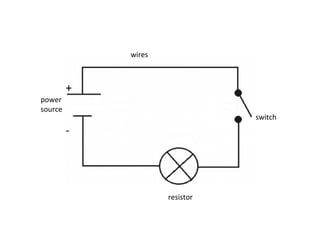
ELECTRICAL CIRCUIT
An electrical circuit has the following parts:
-A power source which provides energy. For
example, a battery.
- wires which conduct electricity.
-A switch which opens and closes the circuit.
-A resistor which changes electricity to different
forms of energy. For example, a light bulb.
power
source
+
-
switch
resistor
wires
ELECTRICITY SAFETY TIPS
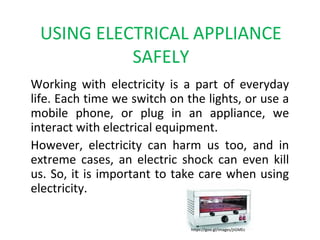
USING ELECTRICAL APPLIANCE
SAFELY
Working with electricity is a part of everyday
life. Each time we switch on the lights, or use a
mobile phone, or plug in an appliance, we
interact with electrical equipment.
However, electricity can harm us too, and in
extreme cases, an electric shock can even kill
us. So, it is important to take care when using
electricity.
https://goo.gl/images/jtGMEc
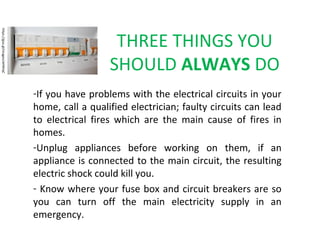
THREE THINGS YOU
SHOULD ALWAYS DO
-If you have problems with the electrical circuits in your
home, call a qualified electrician; faulty circuits can lead
to electrical fires which are the main cause of fires in
homes.
-Unplug appliances before working on them, if an
appliance is connected to the main circuit, the resulting
electric shock could kill you.
- Know where your fuse box and circuit breakers are so
you can turn off the main electricity supply in an
emergency.
https://goo.gl/images/aHWtqC
THREE THINGS YOU SHOULD
NEVER DO
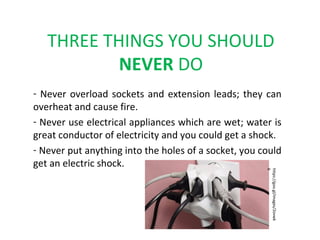
- Never overload sockets and extension leads; they can
overheat and cause fire.
- Never use electrical appliances which are wet; water is
great conductor of electricity and you could get a shock.
- Never put anything into the holes of a socket, you could
get an electric shock.
https://goo.gl/images/2ovwk
6
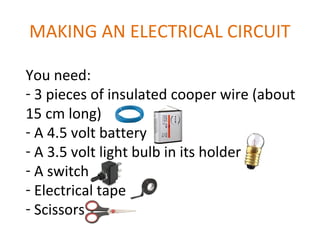
MAKING AN ELECTRICAL CIRCUIT
You need:
- 3 pieces of insulated cooper wire (about
15 cm long)
- A 4.5 volt battery
- A 3.5 volt light bulb in its holder
- A switch
- Electrical tape
- Scissors

Electricity web

  • 1.
  • 2.
    A little bitof history? Thales of Miletus was a Greek. Around 585 BC (before Christ), Thales discovered that if he rubbed amber with a piece of fur, that amber could attract lightweight objects (like feathers) to itself. Amber was elektron, in greek. Benjamin Franklin (18th century) studied about electrical phenomenon and invented the lightning rod. Thomas Alba Edison (19th century) invented incandescent light bulb. https://goo.gl/images/3RrWi3 https://goo.gl/images/3gfxVc
  • 3.
    We use electricityevery day, but: - What is electricity? - Where does it come from? - How does it work? To understand this we need to know about atoms and their structure. https://goo.gl/images/h83QtQ
  • 4.
    ATOMS? Matter is madeof atoms. Atoms are tiny particles. https://www.youtube.com/watch? v=hc0EtPPpZUU
  • 6.
    ELECTRICAL CHARGES Electricity beginswith the smallest particle in matter, called the atom. Atoms are made up of protons and neutrons inside a nucleus and electrons moving around outside the nucleus. Protons have a positive electric charge and electrons have a negative electric charge. Neutrons have no charge. If an object has the same number of protons and electrons, it is electrically neutral. However, sometimes, electrons move easily from one object to another and this makes the object electrically charged.
  • 7.
    STATIC ELECTRICITY: Static electricityis a form of electricity that doesn’t flow (it makes the name). Electrical storms are an example of this static electricity. Ice particles in the clouds move very fast and rub together. This makes the cloud negatively charged at the bottom. The ground below is positively charged. If the electrical charge in the cloud is great enough, it will meet the positive charges from the ground. This causes a huge amount of energy to convert into light, heat and sound.
  • 8.
  • 9.
    CURRENT ELECTRICITY The movementof electrons from one object to another creates electrical current. Some materials, such as rubber or plastic, are more resistant to the movement of electrons. They are called insulators. Other materials, like cooper or silver, have very loosely held electrons so this makes them excellent conductors.
  • 10.
    CURRENT ELECTRICITY-> ELECTRICAL CIRCUIT Electricalcurrent can be produced and transported in a closed electrical circuit.
  • 11.
    ELECTRICAL CIRCUIT An electricalcircuit has the following parts: -A power source which provides energy. For example, a battery. - wires which conduct electricity. -A switch which opens and closes the circuit. -A resistor which changes electricity to different forms of energy. For example, a light bulb.
  • 12.
  • 13.
  • 14.
    USING ELECTRICAL APPLIANCE SAFELY Workingwith electricity is a part of everyday life. Each time we switch on the lights, or use a mobile phone, or plug in an appliance, we interact with electrical equipment. However, electricity can harm us too, and in extreme cases, an electric shock can even kill us. So, it is important to take care when using electricity. https://goo.gl/images/jtGMEc
  • 15.
    THREE THINGS YOU SHOULDALWAYS DO -If you have problems with the electrical circuits in your home, call a qualified electrician; faulty circuits can lead to electrical fires which are the main cause of fires in homes. -Unplug appliances before working on them, if an appliance is connected to the main circuit, the resulting electric shock could kill you. - Know where your fuse box and circuit breakers are so you can turn off the main electricity supply in an emergency. https://goo.gl/images/aHWtqC
  • 16.
    THREE THINGS YOUSHOULD NEVER DO - Never overload sockets and extension leads; they can overheat and cause fire. - Never use electrical appliances which are wet; water is great conductor of electricity and you could get a shock. - Never put anything into the holes of a socket, you could get an electric shock. https://goo.gl/images/2ovwk 6
  • 17.
    MAKING AN ELECTRICALCIRCUIT You need: - 3 pieces of insulated cooper wire (about 15 cm long) - A 4.5 volt battery - A 3.5 volt light bulb in its holder - A switch - Electrical tape - Scissors