1
• A PARAMETER is a number that
  describes a population statistic

• A STATISTIC is a number that describes
  a characteristic in the sample data


                                      2
• Inferential statistics
  – Draw conclusion from data
  – Sample
     • Describe data
  – Use sample statistic to infer population
    parameter
     • Estimation
     • Hypothesis testing


                                               3
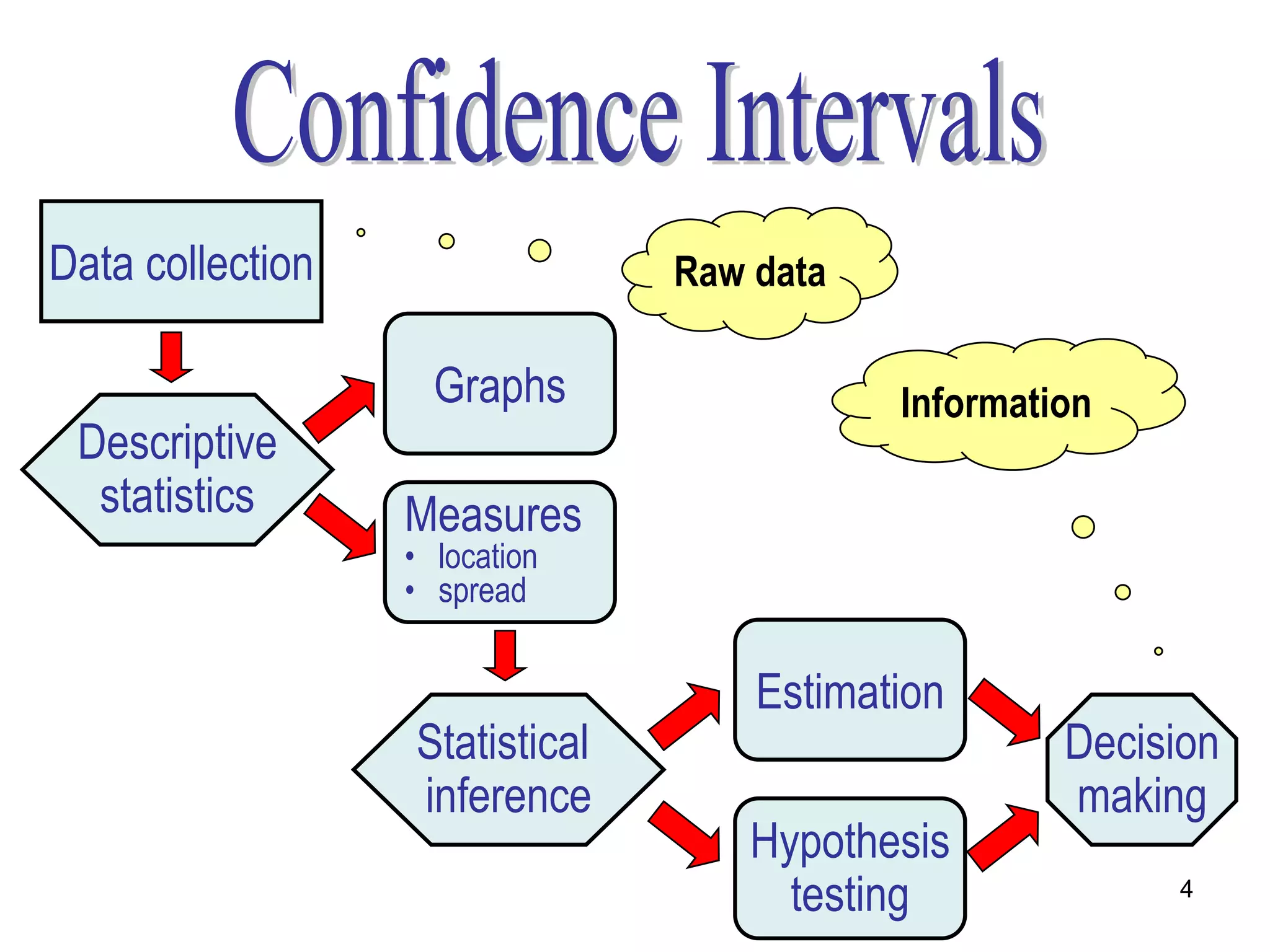
Data collection                 Raw data

                    Graphs                 Information
 Descriptive
  statistics      Measures
                  • location
                  • spread


                                    Estimation
                  Statistical                       Decision
                  inference                         making
                                    Hypothesis
                                      testing            4
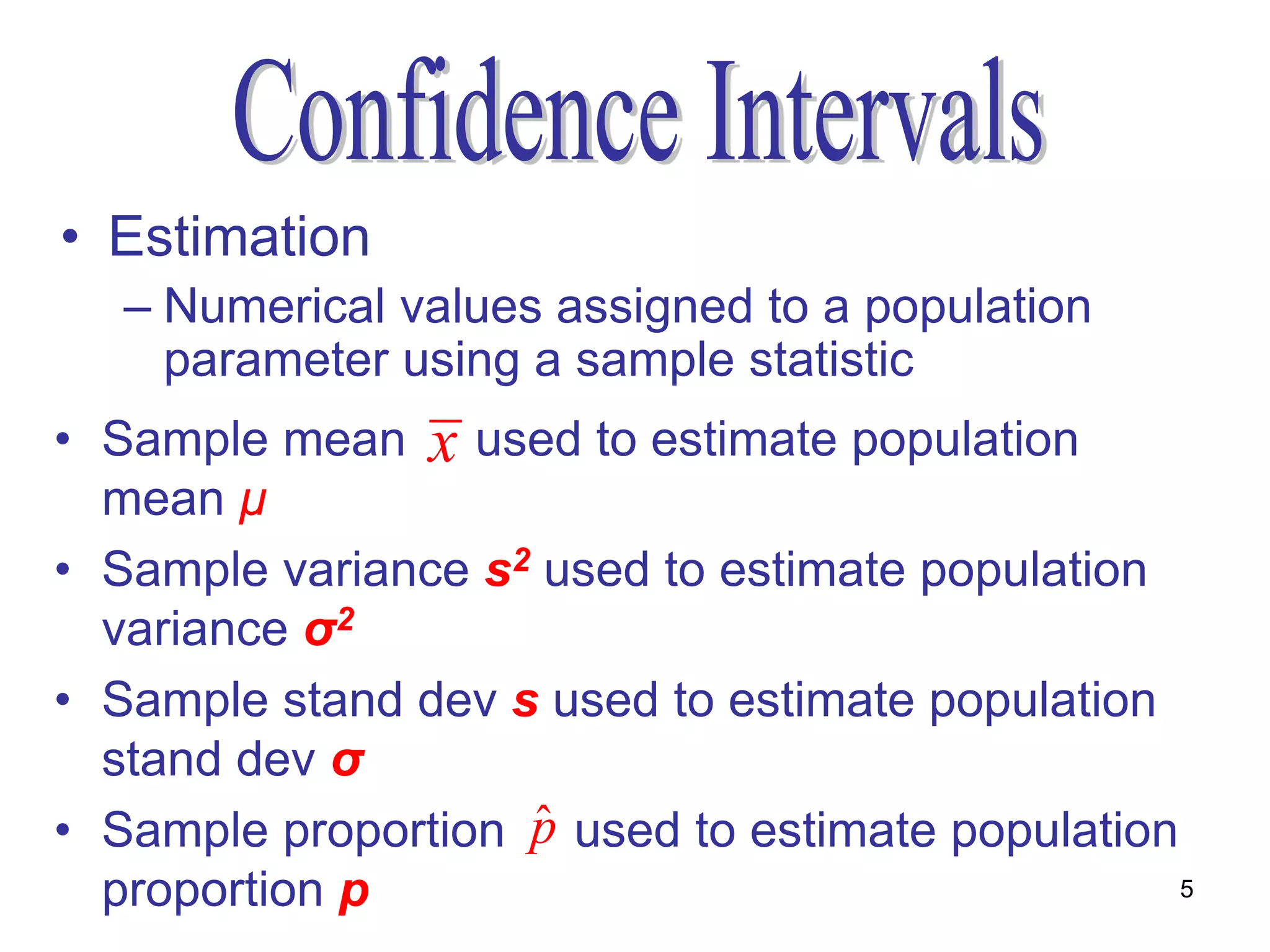
• Estimation
   – Numerical values assigned to a population
     parameter using a sample statistic
• Sample mean x used to estimate population
  mean μ
• Sample variance s2 used to estimate population
  variance σ2
• Sample stand dev s used to estimate population
  stand dev σ
                    ˆ
• Sample proportion p used to estimate population
  proportion p                                    5
• Steps in estimation
  – Select sample
  – Get required information from the sample
  – Calculate sample statistic
  – Assign values to population parameter


                                               6
• Read example 7.1 page 214


                              7
• Sample statistic used to estimate a
  population parameter is called an
  ESTIMATOR

• An estimator is a rule that tells us how to
  calculate the estimate and it is generally
  expressed as a formula

                                            8
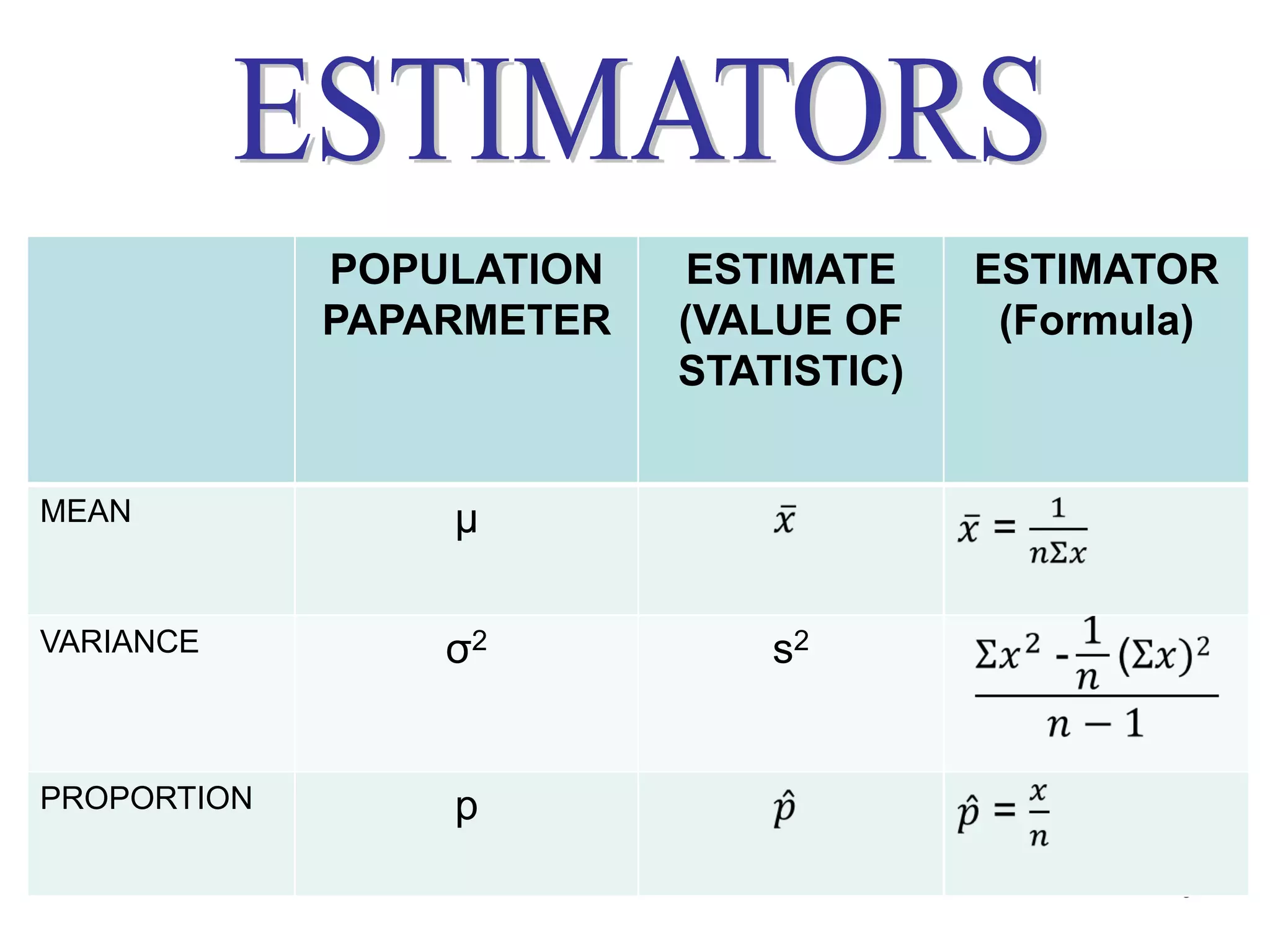
POPULATION    ESTIMATE    ESTIMATOR
             PAPARMETER   (VALUE OF     (Formula)
                          STATISTIC)


MEAN             µ

VARIANCE         σ2           s2


PROPORTION       p
                                               9
• Two types of estimate:-

  –Point estimates
  –Interval estimates


                            10
• A single number that is calculated from
  sample data

• Resulting number then used to estimate
  the true value of the corresponding
  population parameter


                                            11
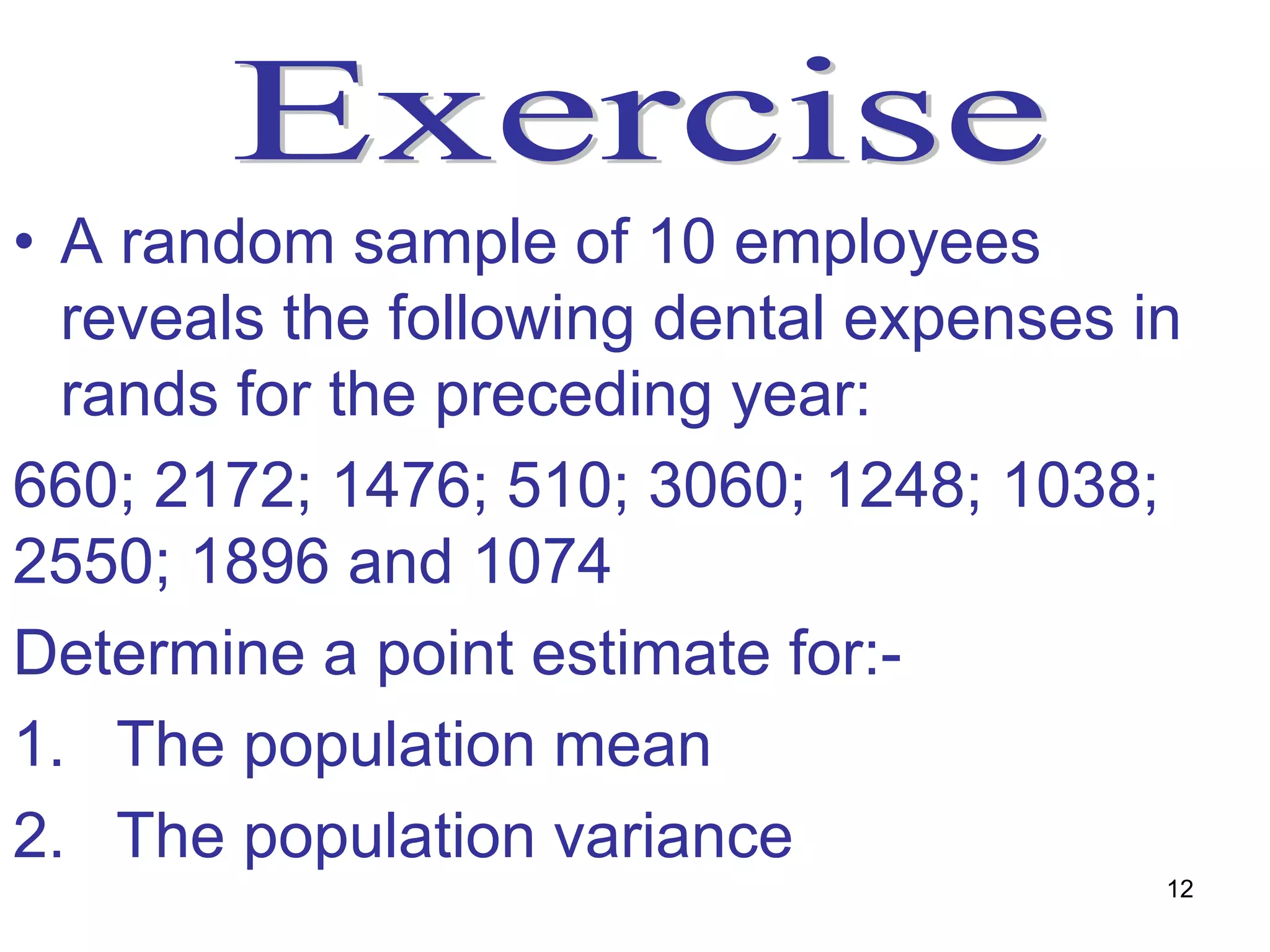
• A random sample of 10 employees
  reveals the following dental expenses in
  rands for the preceding year:
660; 2172; 1476; 510; 3060; 1248; 1038;
2550; 1896 and 1074
Determine a point estimate for:-
1. The population mean
2. The population variance
                                         12
• Answer p215


                13
• If we take another random sample of 10
  employees the mean obtained for this random
  sample will almost certainly differ from the one
  you have just calculated
• Point estimates do not provide information
  about how close the point estimate is to the
  population parameter
• Point estimates do not consider the sample
  size or variability of the population from which
  the sample was taken
                                               14
• Sample size and variability of population will
  affect the accuracy of the estimate so a point
  estimate is really not very useful

• This problem can be overcome by using
  INTERVAL ESTIMATES


                                             15
• No 1 – 6 page 216


                      16
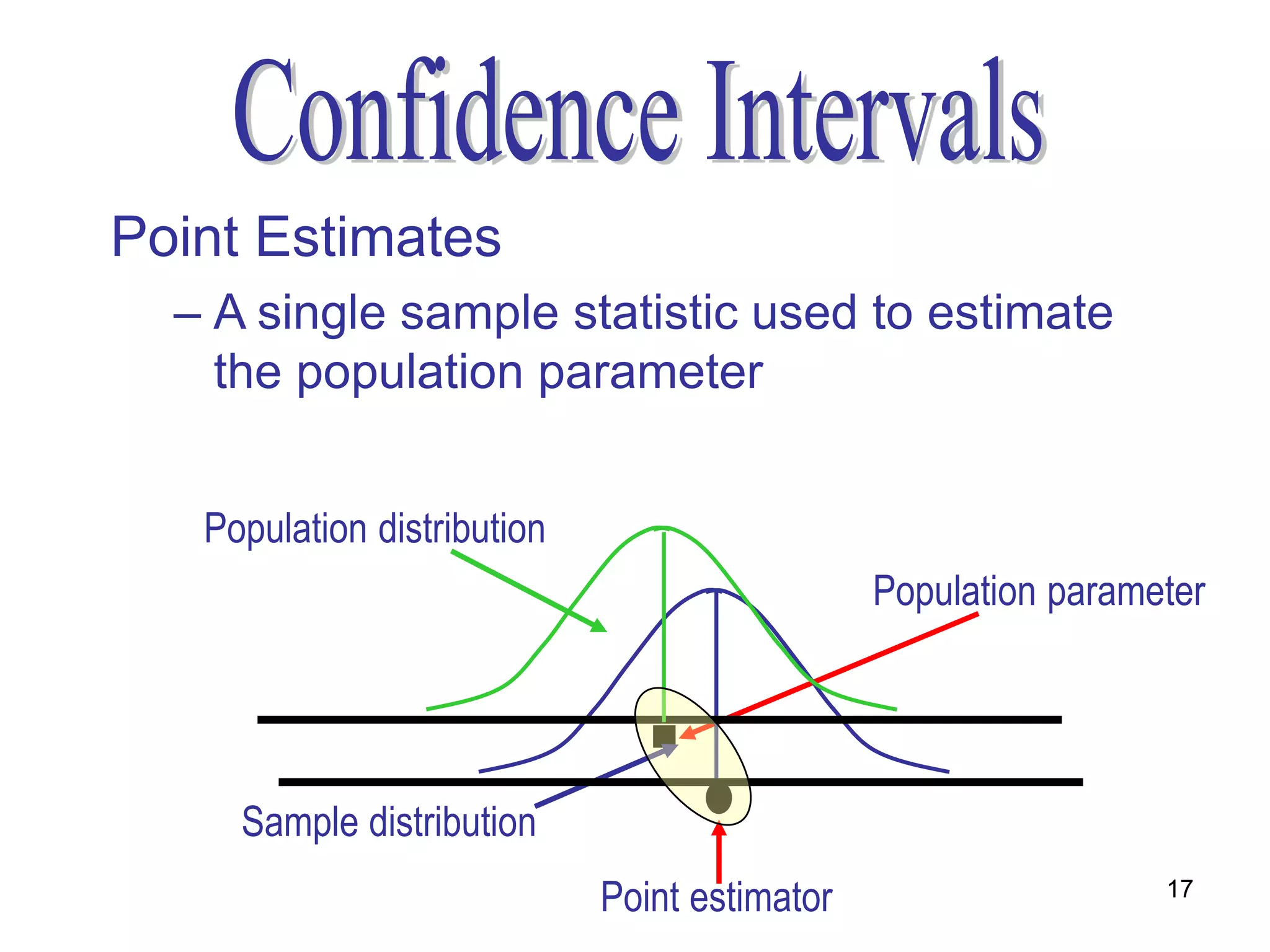
Point Estimates
  – A single sample statistic used to estimate
    the population parameter


   Population distribution
                                               Population parameter


     Sample distribution
                             Point estimator                    17
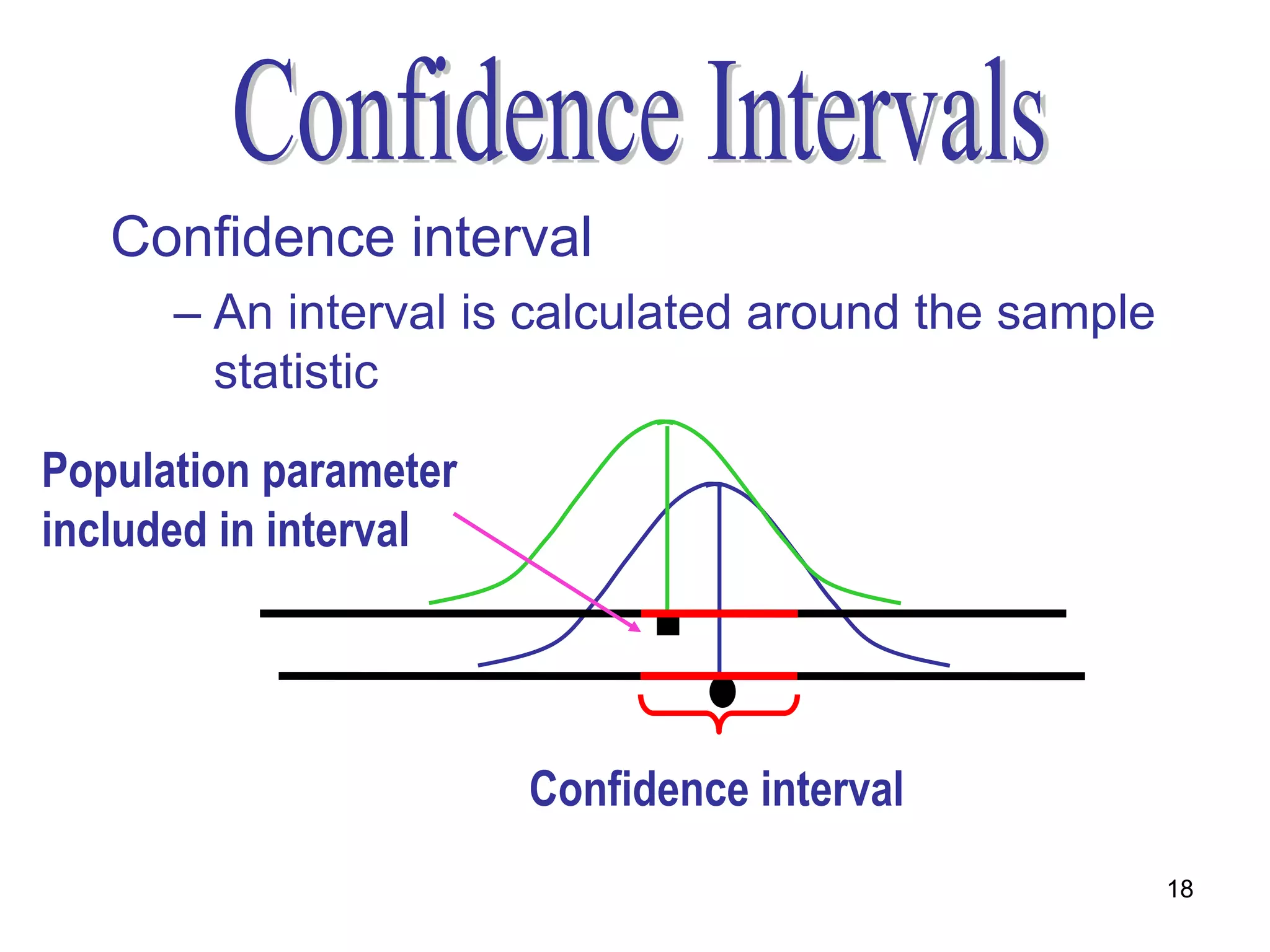
Confidence interval
      – An interval is calculated around the sample
        statistic

Population parameter
included in interval


                       Confidence interval
                                                      18
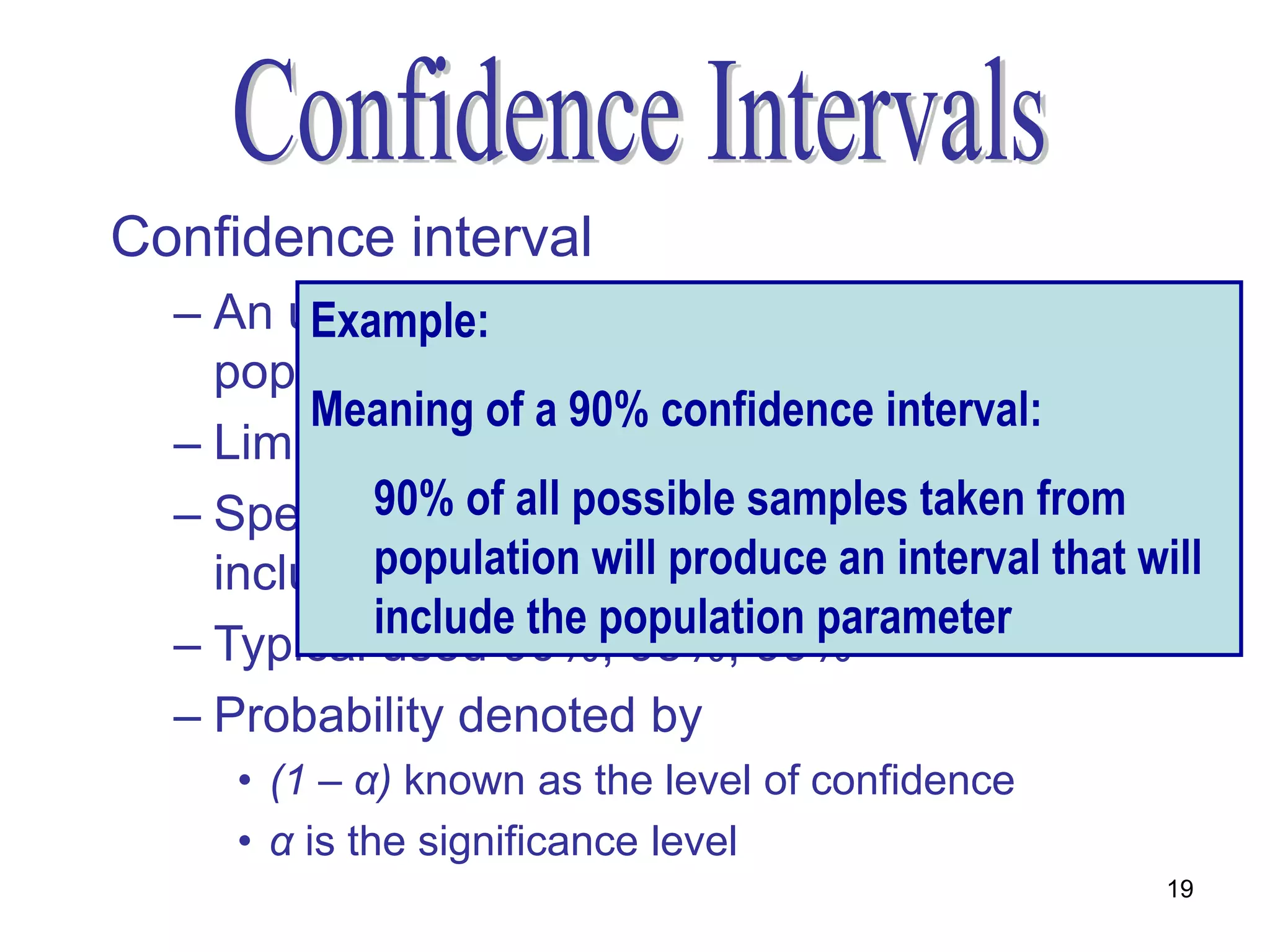
Confidence interval
  – An upper and lower limit within in which the
         Example:
    population parameter is expected to lie
         Meaning of a 90% confidence interval:
  – Limits will vary from sample to sample
  – Specify90% of all possible samples taken from
             the probability that the interval will
    include population will produce an interval that will
             the parameter
            include the population parameter
  – Typical used 90%, 95%, 99%
  – Probability denoted by
     • (1 – α) known as the level of confidence
     • α is the significance level
                                                       19
• An interval estimate consists of a range of
  values with an upper & lower limit
• The population parameter is expected to lie
  within this interval with a certain level of
  confidence
• Limits of an interval vary from sample to sample
  therefore we must also specify the probability
  that an interval will contain the parameter
• Ideally probability should be as high as possible

                                                  20
SO REMEMBER
•We can choose the probability
•Probability is denoted by (1-α)
•Typical values are 0.9 (90%); 0.95 (95%) and 0.99 (99%)
•The probability is known as the LEVEL OF CONFIDENCE
•α is known as the SIGNIFICANCE LEVEL
•α corresponds to an area under a curve
•Since we take the confidence level into account when we
estimate an interval, the interval is called CONFIDENCE
INTERVAL

                                                       21
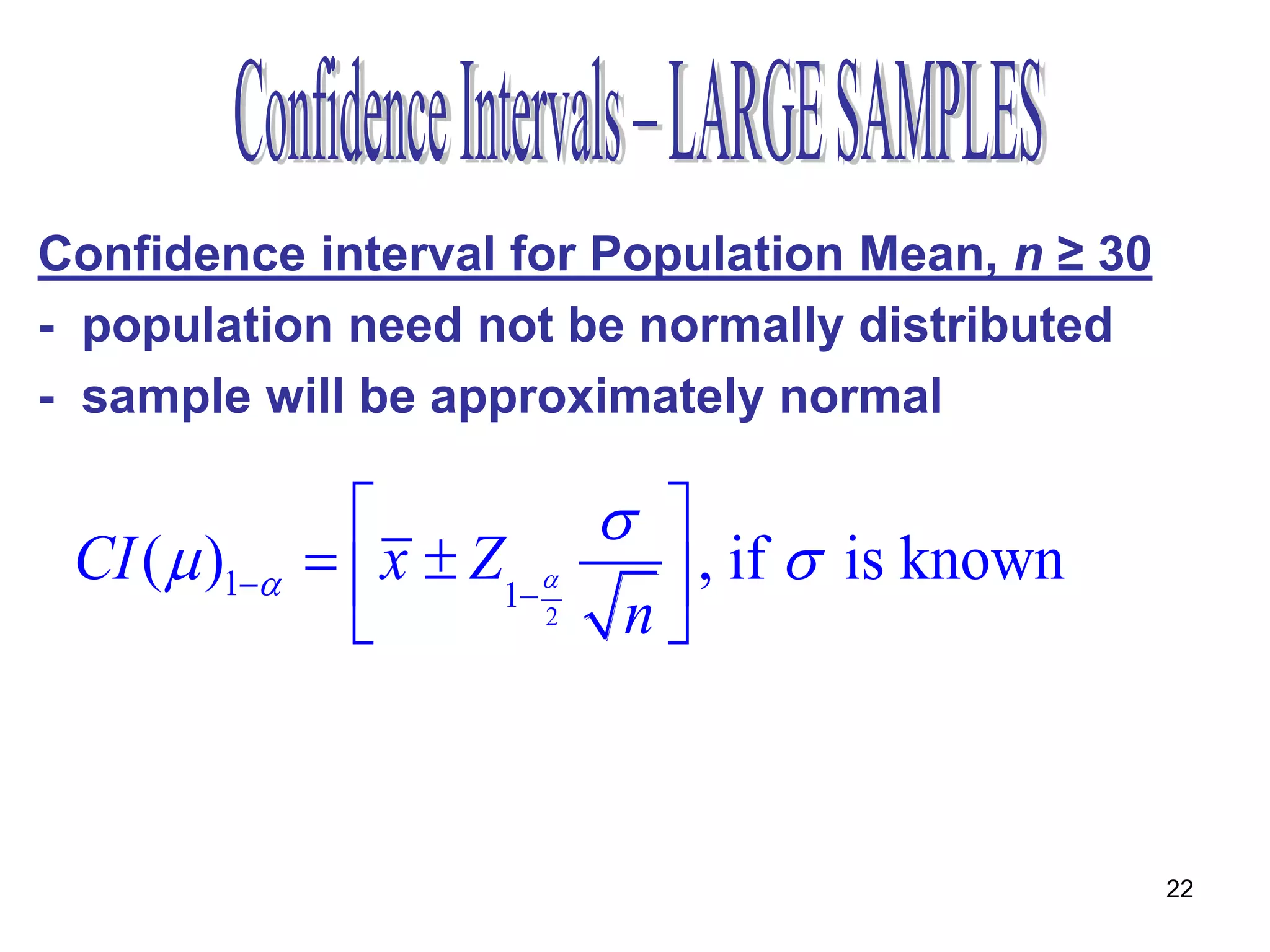
Confidence interval for Population Mean, n ≥ 30
- population need not be normally distributed
- sample will be approximately normal

                             
 CI (  )1     x  Z1     , if  is known
                          2  n
                            s 
 CI (  )1     x  Z1     , if  is not known
                          2  n
                                                       22
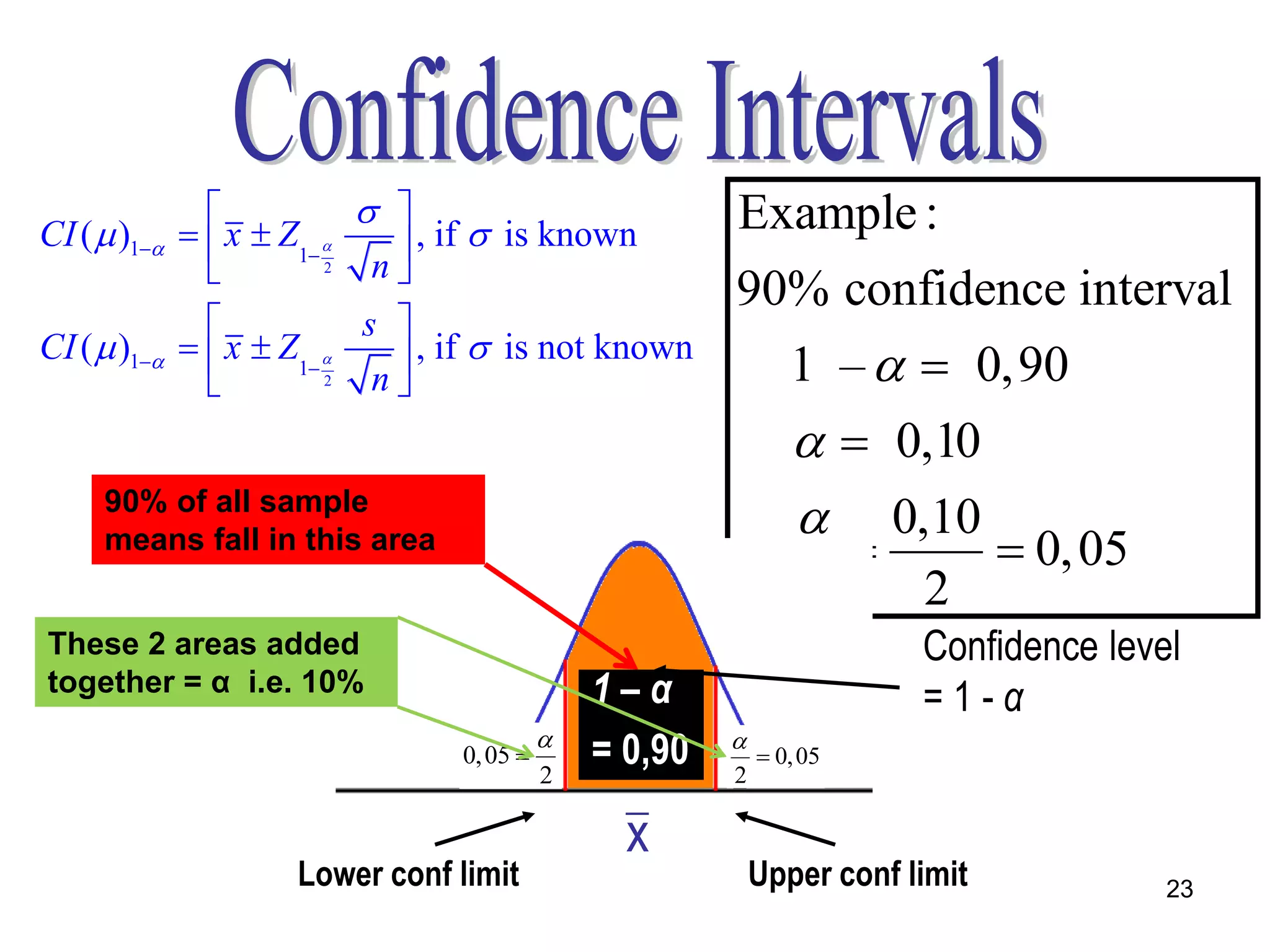
                                     Example :
CI (  )1   x  Z1     , if  is known
                       2  n
                                                      90% confidence interval
                         s 
CI (  )1   x  Z1     , if  is not known
                       2  n                           1 –   0,90
                                                          0,10
                                              1
    90% of all sample
                                                         0,10
    means fall in this area                                      0, 05
                                                         2    2
These 2 areas added                                                 Confidence level
together = α i.e. 10%                        1–α                    =1-α
                                         
                                              1-α       0, 05
                                                      
                               0, 05 
                                         2
                                             = 0,90   2
                                                      2

                                               x
                   Lower conf limit                     Upper conf limit           23
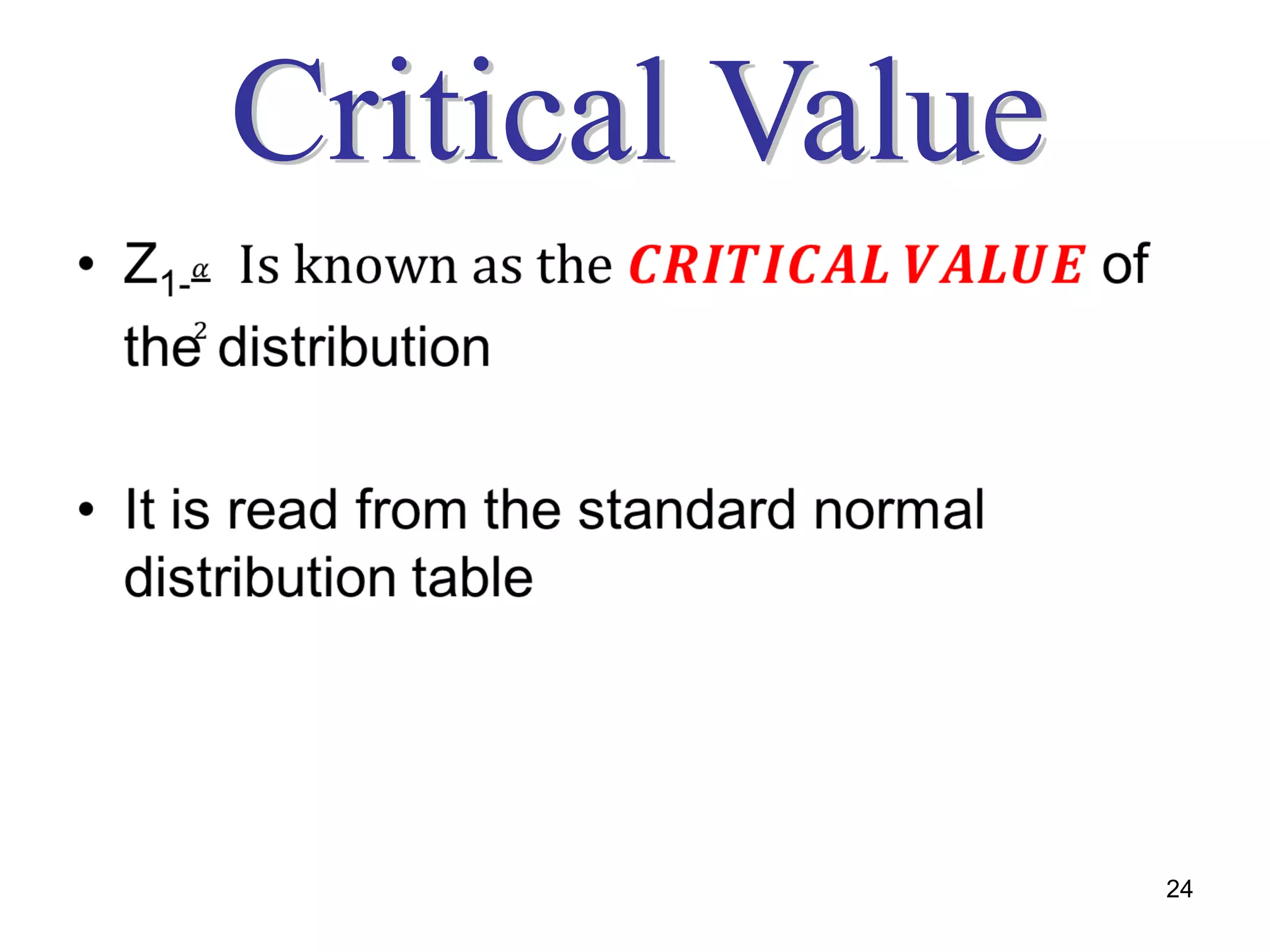
24
See handout


              25
A random sample of repair costs for 150
hotel rooms gave a mean repair cost of
R84.30 and a standard deviation of R37.20.
Construct a 95% confidence interval for the
mean repair cost for a population of 2000
hotel rooms


                                          26
Example 7.3 p218


                   27
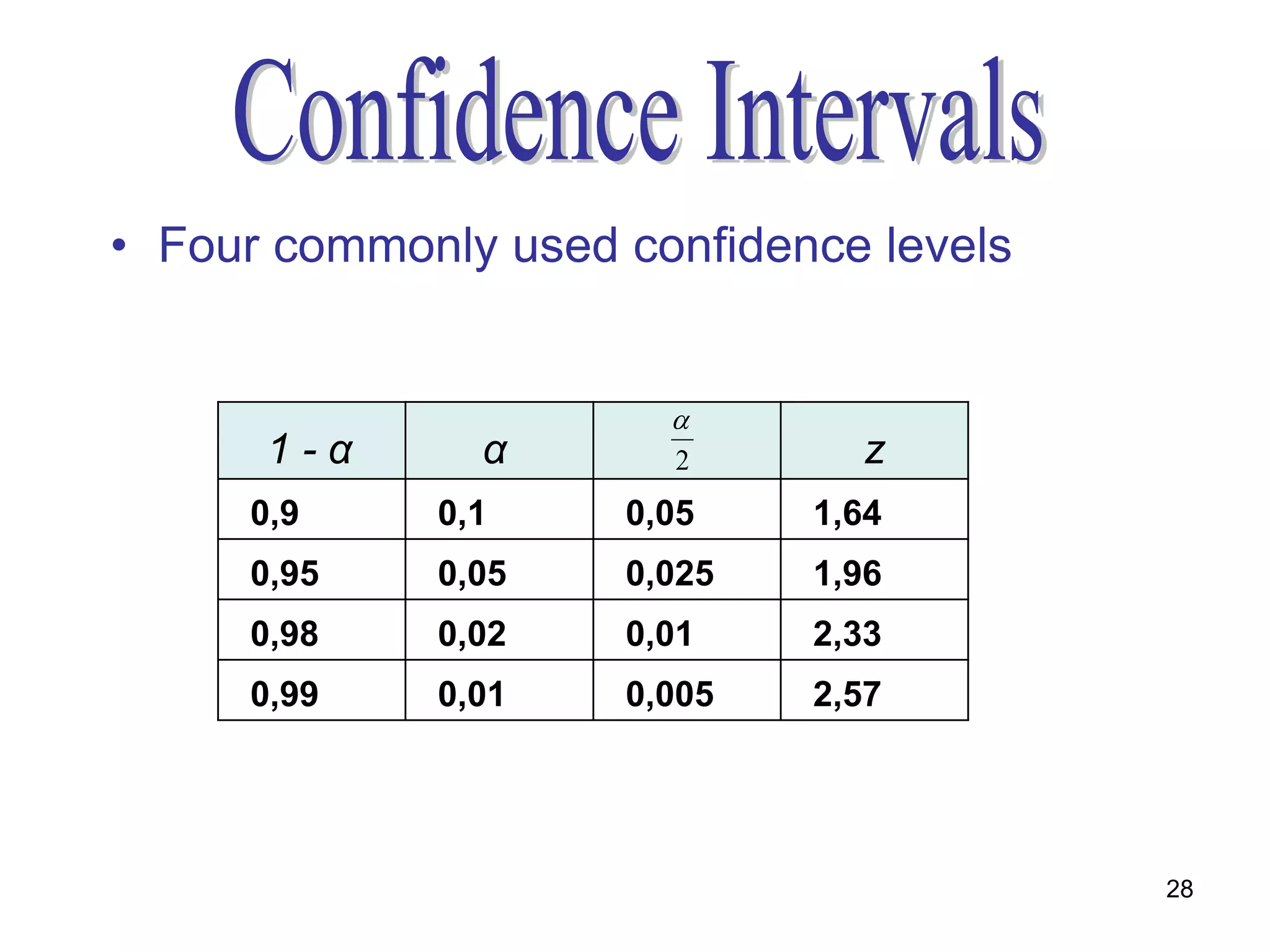
• Four commonly used confidence levels


                       
      1-α      α       2       z
     0,9     0,1     0,05    1,64
     0,95    0,05    0,025   1,96
     0,98    0,02    0,01    2,33
     0,99    0,01    0,005   2,57


                                         28
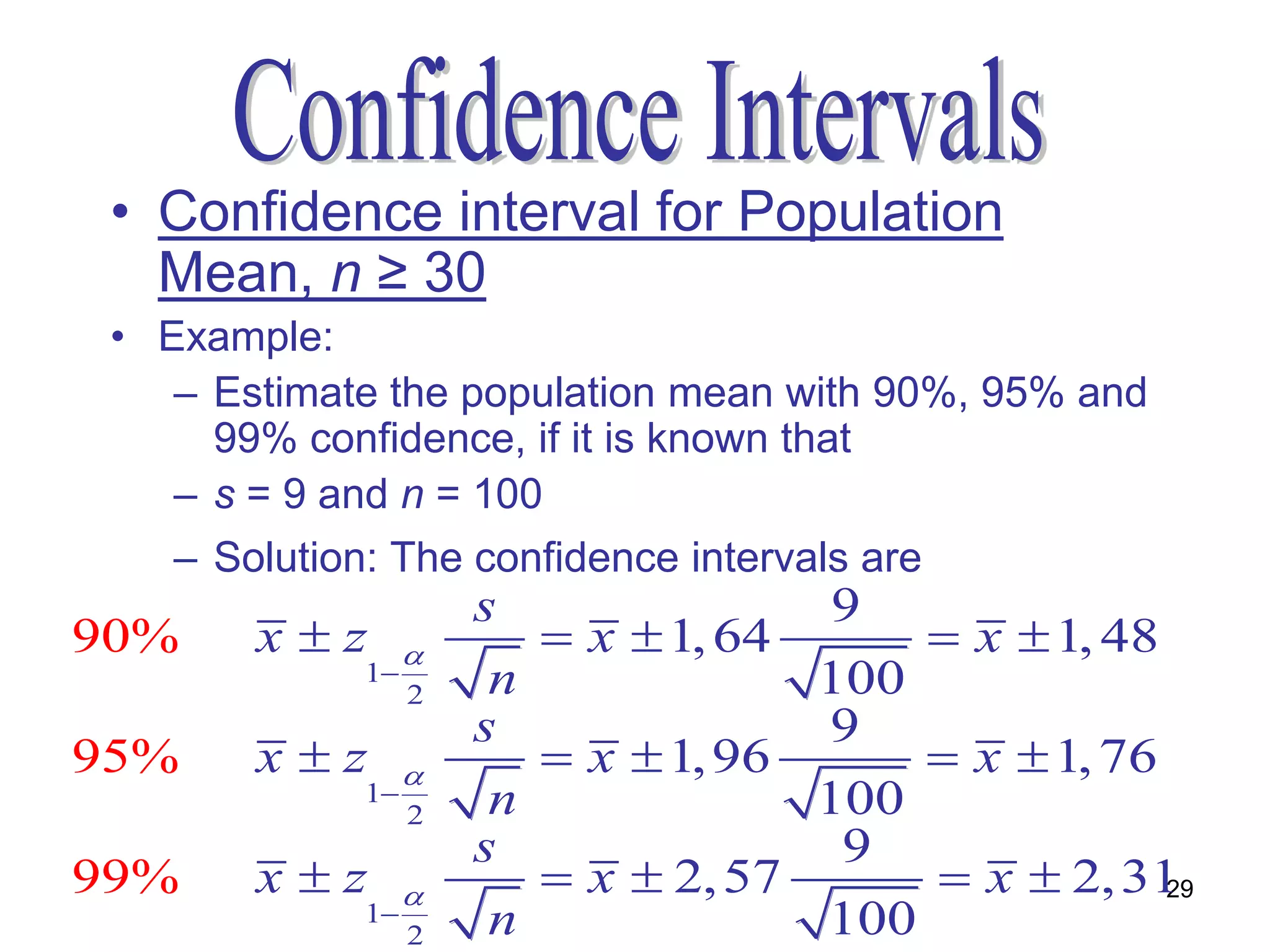
• Confidence interval for Population
   Mean, n ≥ 30
 • Example:
    – Estimate the population mean with 90%, 95% and
      99% confidence, if it is known that
    – s = 9 and n = 100
    – Solution: The confidence intervals are
                      s                 9
90%     xz              x  1, 64        x  1, 48
             1        n               100
                  2
                      s                9
95%     xz              x  1, 96        x  1, 76
             1        n               100
                  2
                      s                 9
99%     xz              x  2, 57        x  2, 31 29
             1        n               100
                  2
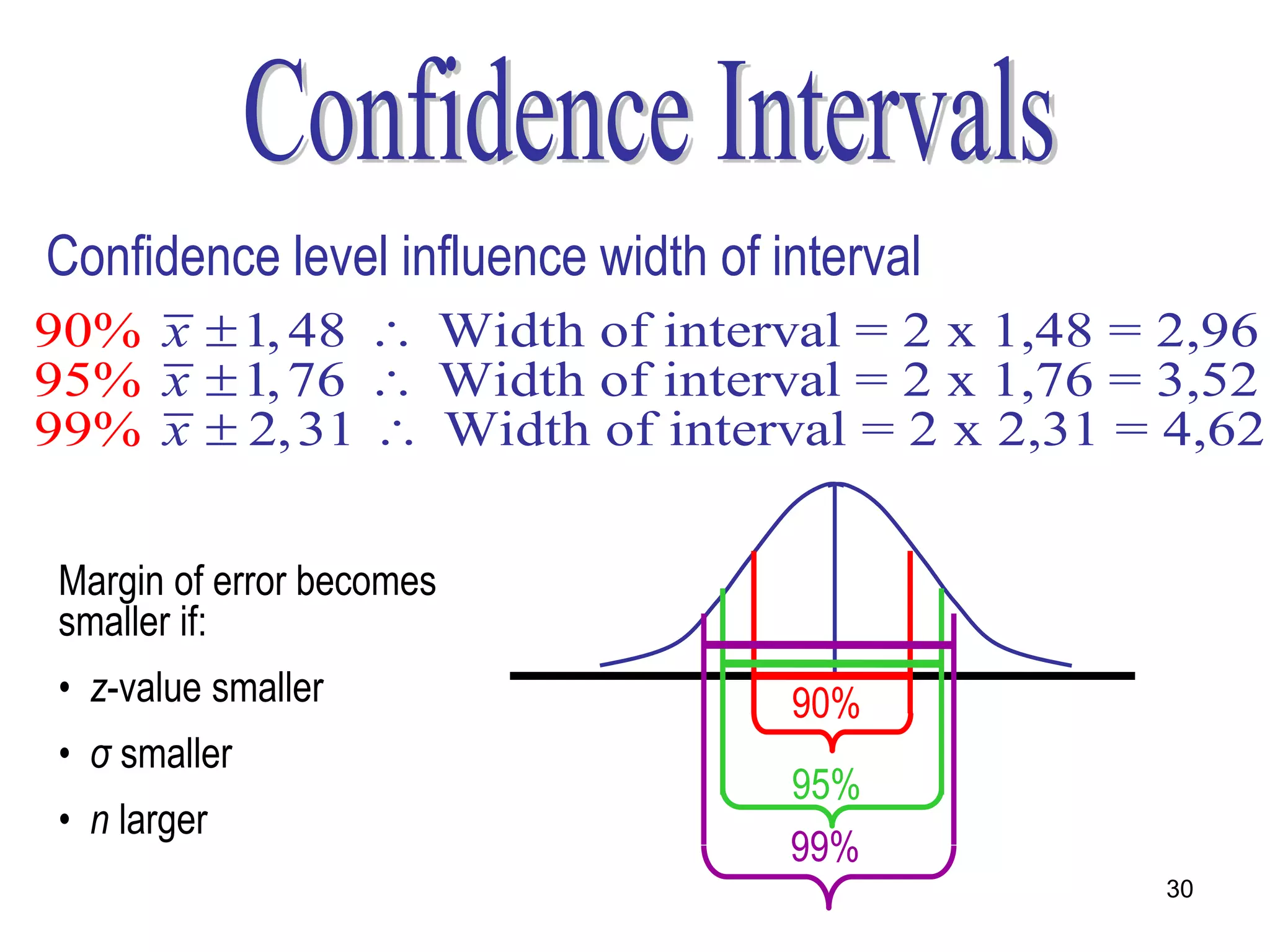
Confidence level influence width of interval
90% x  1, 48  Width of interval = 2 x 1,48 = 2,96
95% x  1, 76  Width of interval = 2 x 1,76 = 3,52
99% x  2, 31  Width of interval = 2 x 2,31 = 4,62


 Margin of error becomes
 smaller if:
 • z-value smaller                   90%
 • σ smaller
                                     95%
 • n larger
                                     99%
                                               30
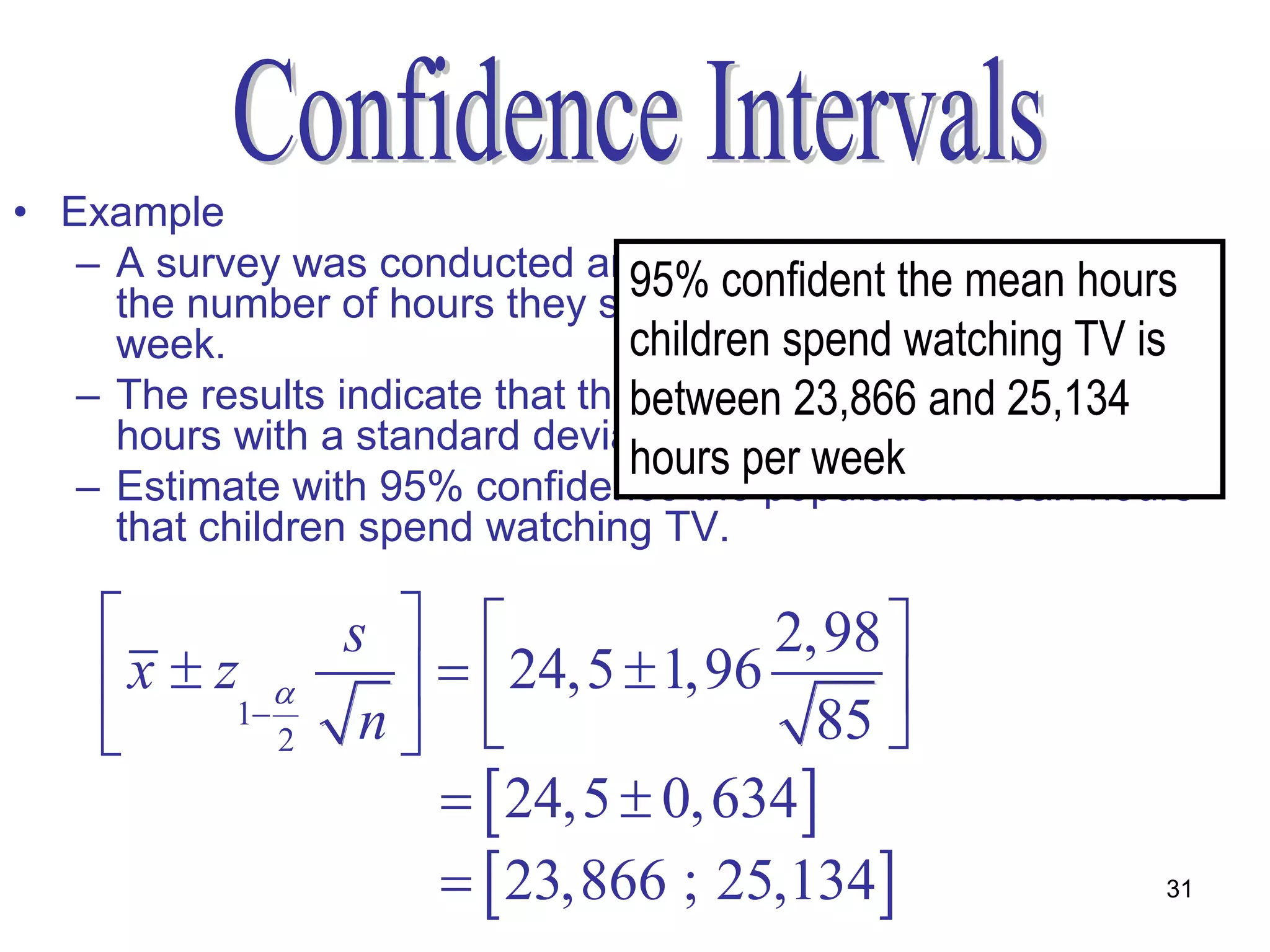
• Example
   – A survey was conducted amongst 85 childrenmean hours
                                  95% confident the to determine
     the number of hours they spend in front of the TV every
     week.                        children spend watching TV is
   – The results indicate that thebetween 23,866 and 25,134 24,5
                                   mean for the sample was
     hours with a standard deviation of 2,98 hours.
                                  hours per week
   – Estimate with 95% confidence the population mean hours
     that children spend watching TV.

               s                 2,98 
     x  z1       24,5  1,96      
             2  n                  85 
                      24,5  0, 634
                      23,866 ; 25,134                     31
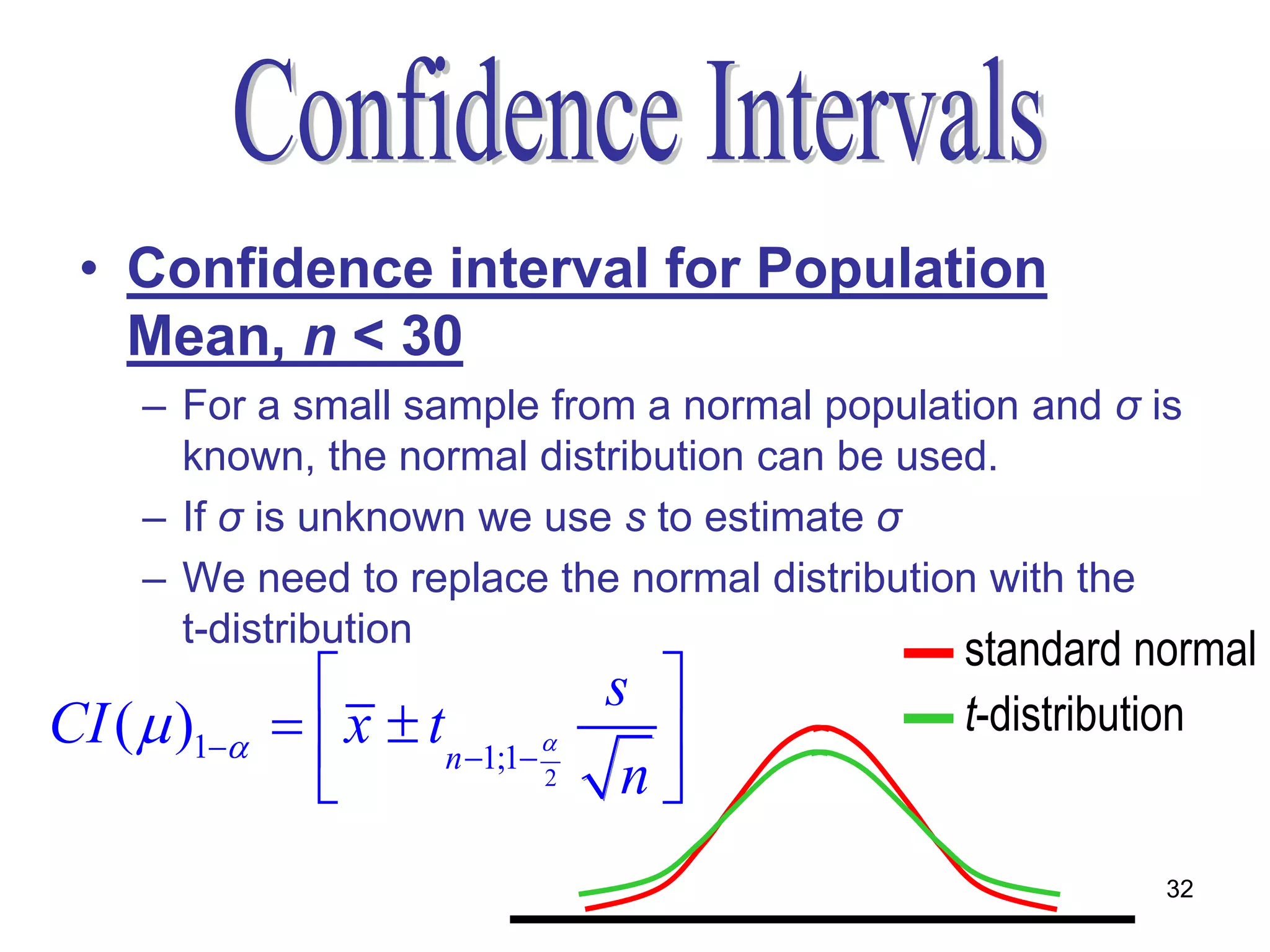
• Confidence interval for Population
   Mean, n < 30
     – For a small sample from a normal population and σ is
       known, the normal distribution can be used.
     – If σ is unknown we use s to estimate σ
     – We need to replace the normal distribution with the
       t-distribution
                                            ▬ standard normal
                                s 
CI (  )1     x  tn 1;1    
                                            ▬ t-distribution
                              2  n
                                                          32
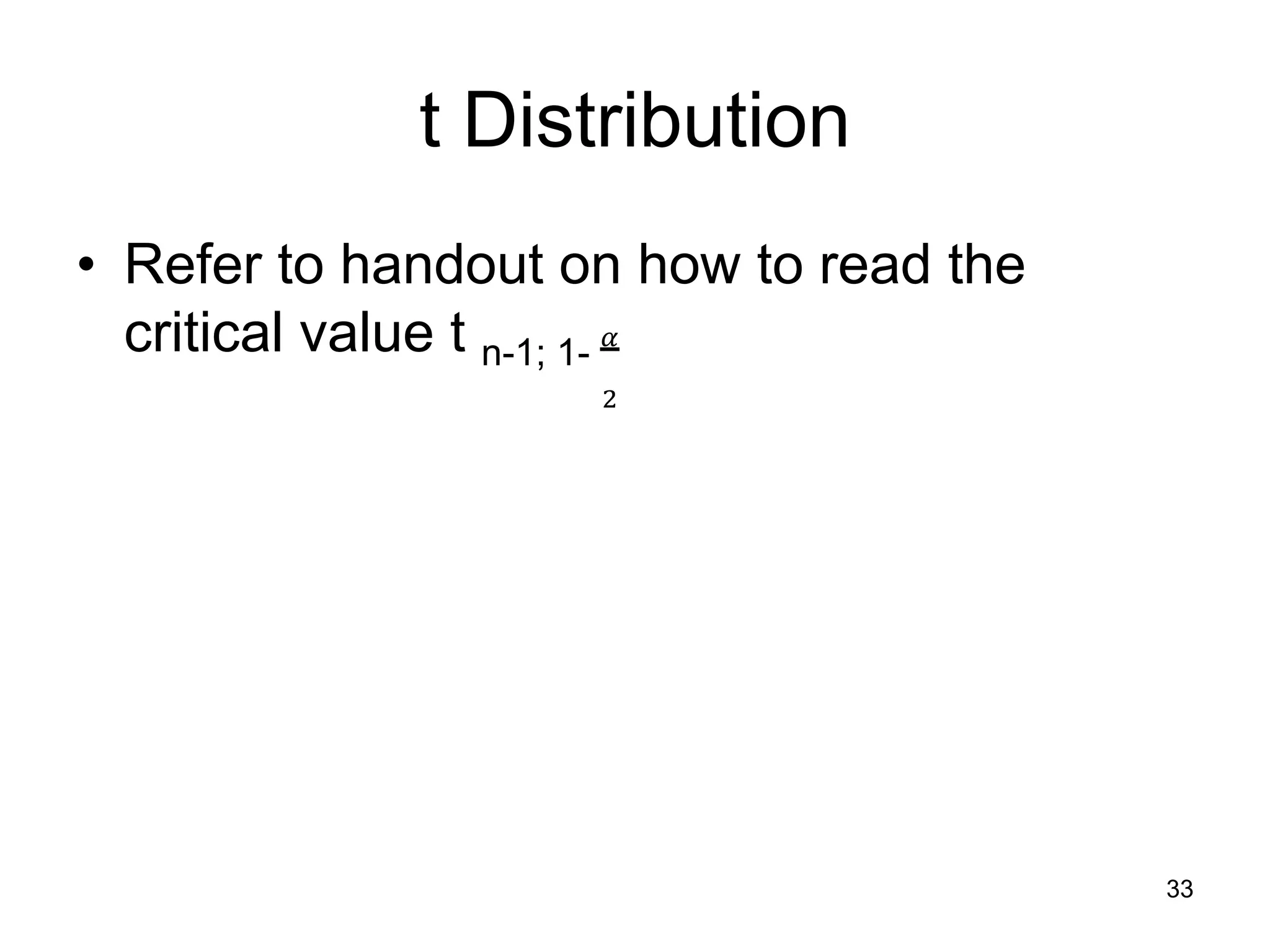
t Distribution
• Refer to handout on how to read the
  critical value t n-1; 1- 𝛼
                    2


                                        33
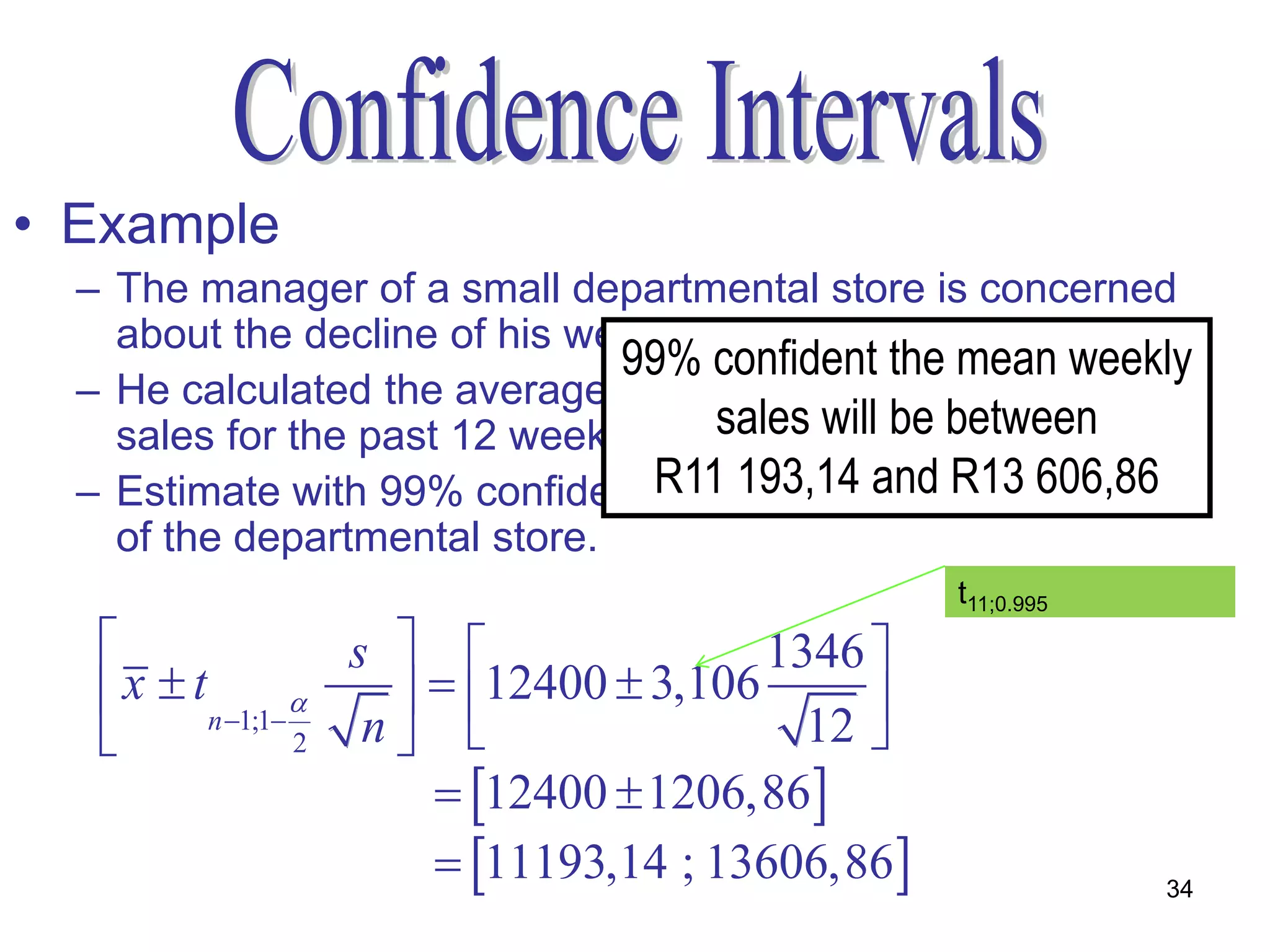
• Example
  – The manager of a small departmental store is concerned
    about the decline of his weekly sales.
                               99% confident the mean weekly
  – He calculated the average and standard deviation of his
    sales for the past 12 weeks, x =sales will be between
                                     R12400 and s = R1346
  – Estimate with 99% confidence the populationR13 606,86
                                 R11 193,14 and mean sales
    of the departmental store.
                                                   t11;0.995
                   s                  1346 
    x  tn 1;1      12400  3,106      
                 2  n                   12 
                         12400  1206,86
                         11193,14 ; 13606,86                34
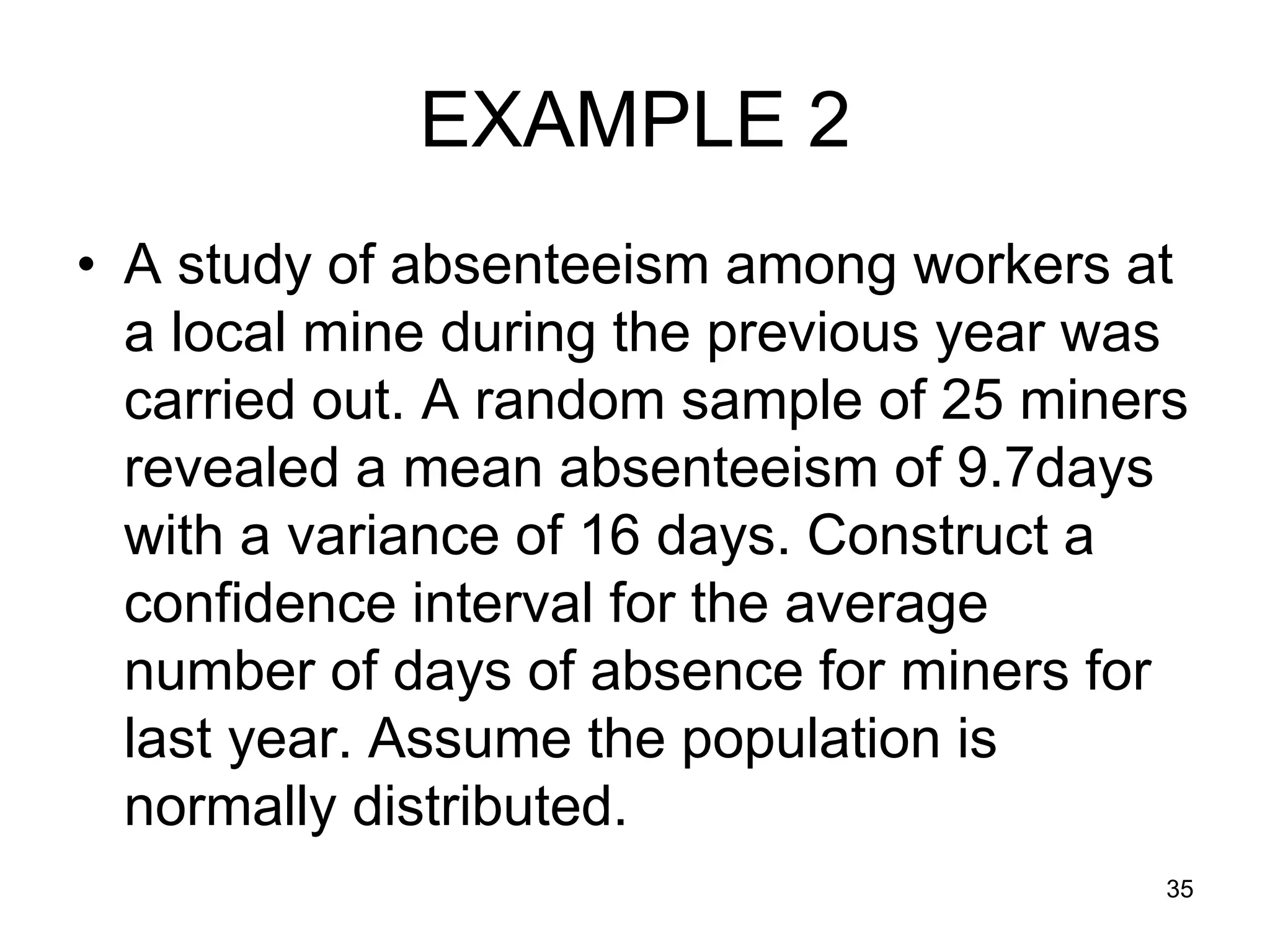
EXAMPLE 2
• A study of absenteeism among workers at
  a local mine during the previous year was
  carried out. A random sample of 25 miners
  revealed a mean absenteeism of 9.7days
  with a variance of 16 days. Construct a
  confidence interval for the average
  number of days of absence for miners for
  last year. Assume the population is
  normally distributed.
                                          35
EXAMPLE 2 - ANSWER
• Example 7.6, page 222 textbook


                                   36
CLASSWORK
• Do concept questions 7 – 19, page 223
  textbook


                                          37
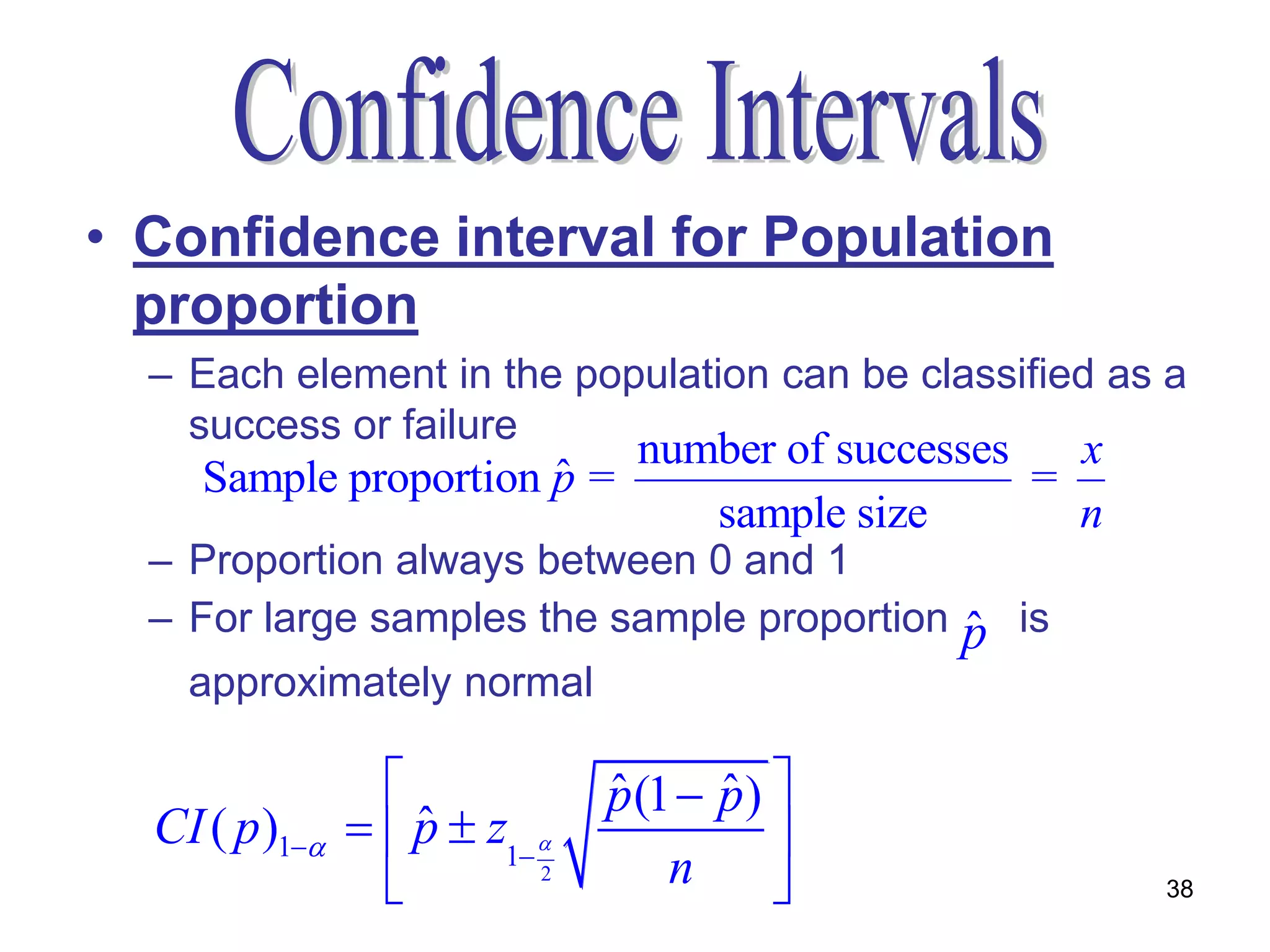
• Confidence interval for Population
  proportion
  – Each element in the population can be classified as a
    success or failure
                           number of successes   x
                       ˆ
     Sample proportion p =                     =
                              sample size        n
  – Proportion always between 0 and 1
  – For large samples the sample proportion    ˆ
                                               p is
    approximately normal

                               p (1  p ) 
                                ˆ      ˆ
  CI ( p )1     p  z1 
                    ˆ                      
                           2       n                 38
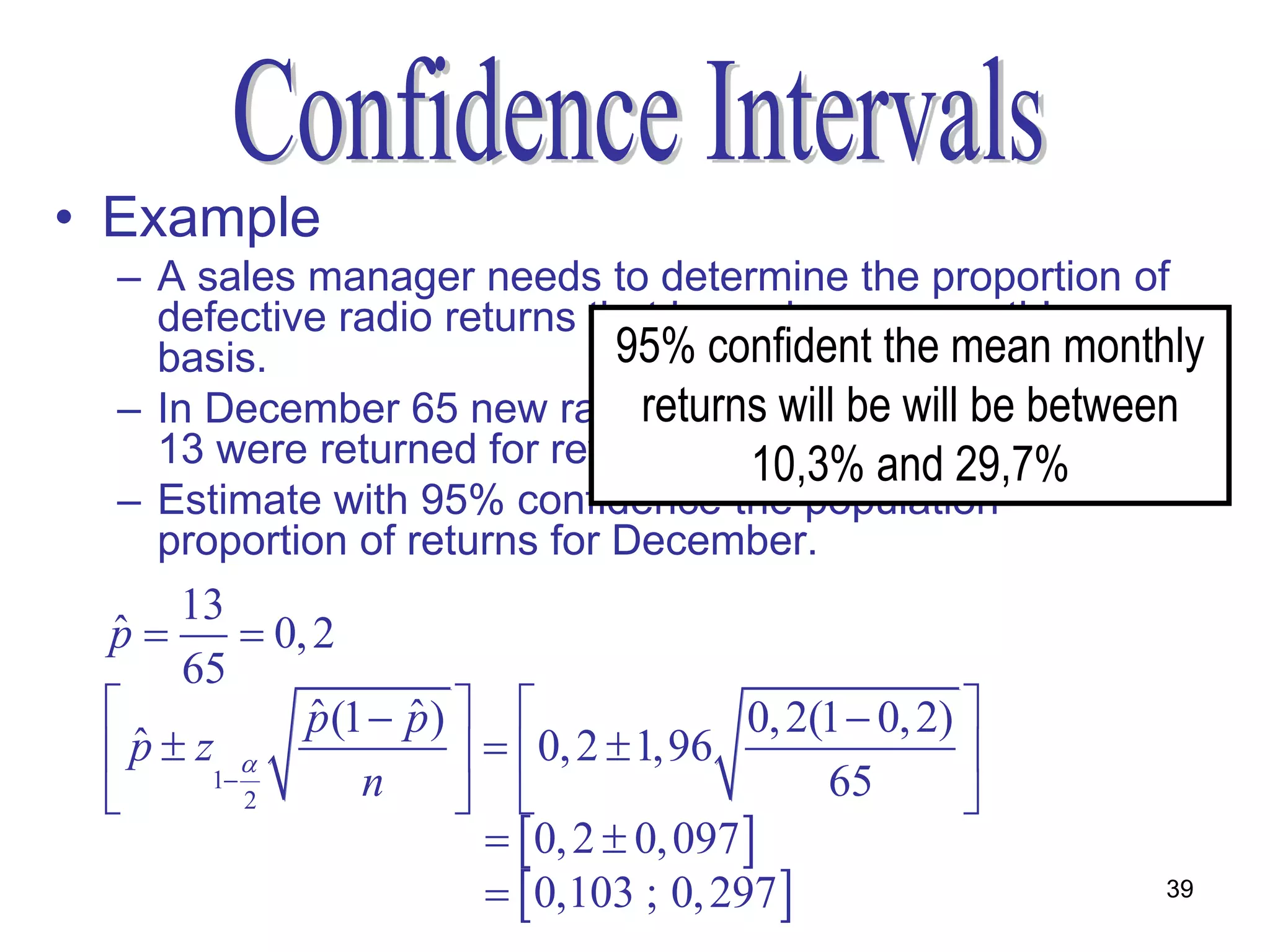
• Example
  – A sales manager needs to determine the proportion of
    defective radio returns that is made on a monthly
    basis.                    95% confident the mean monthly
  – In December 65 new radios werewill be will in January
                               returns sold and be between
    13 were returned for rework. 10,3% and 29,7%
  – Estimate with 95% confidence the population
    proportion of returns for December.
      13
 p
 ˆ          0, 2
      65
              p (1  p )  
                ˆ     ˆ                       0, 2(1  0, 2) 
  p  z1 
   ˆ                         0, 2  1,96                  
          2       n                             65        
                              0, 2  0, 097 
                              0,103 ; 0, 297                  39
EXAMPLE 2
• A cellphone retailer is experiencing
  problems with a high % of returns. The
  quality control manager wants to estimate
  the % of all sales that result in returns. A
  sample of 40 sales showed that 8
  cellphones were returned. Construct a
  99% confidence interval for the % of all
  sales that result in returns

                                                 40
EXAMPLE 2
• Answer – example 7.9 page 225, textbook


                                        41
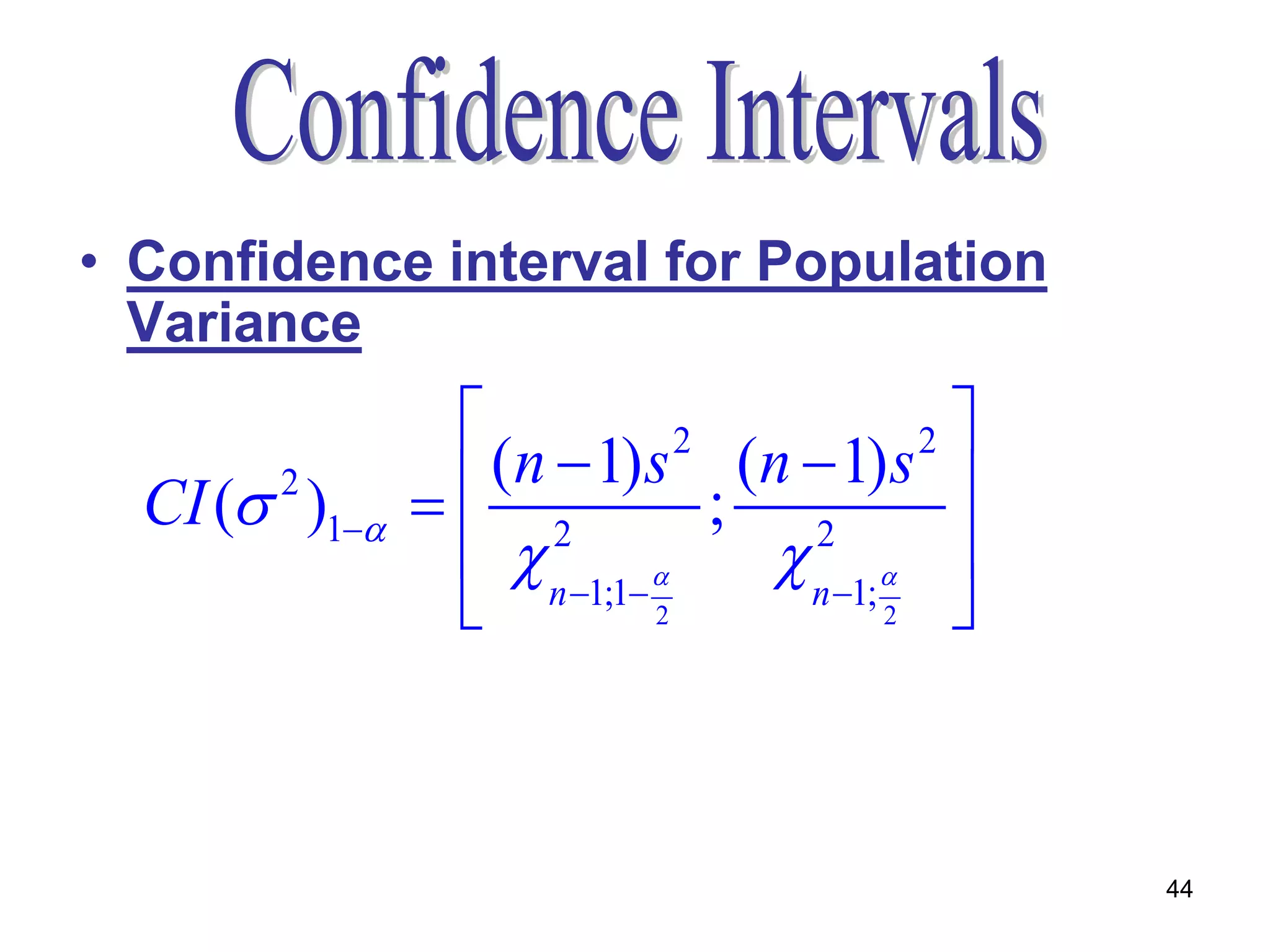
• Confidence interval for Population
  Variance
  – Population variance very often important
  – Very often required for quality control
  – Sample drawn from a normal population
  – Sample variance is based on a random
    sample of size n
  – Distribution of s2 resulted from repeated
    sampling is a χ2 (chi-square) distribution
                                                 42
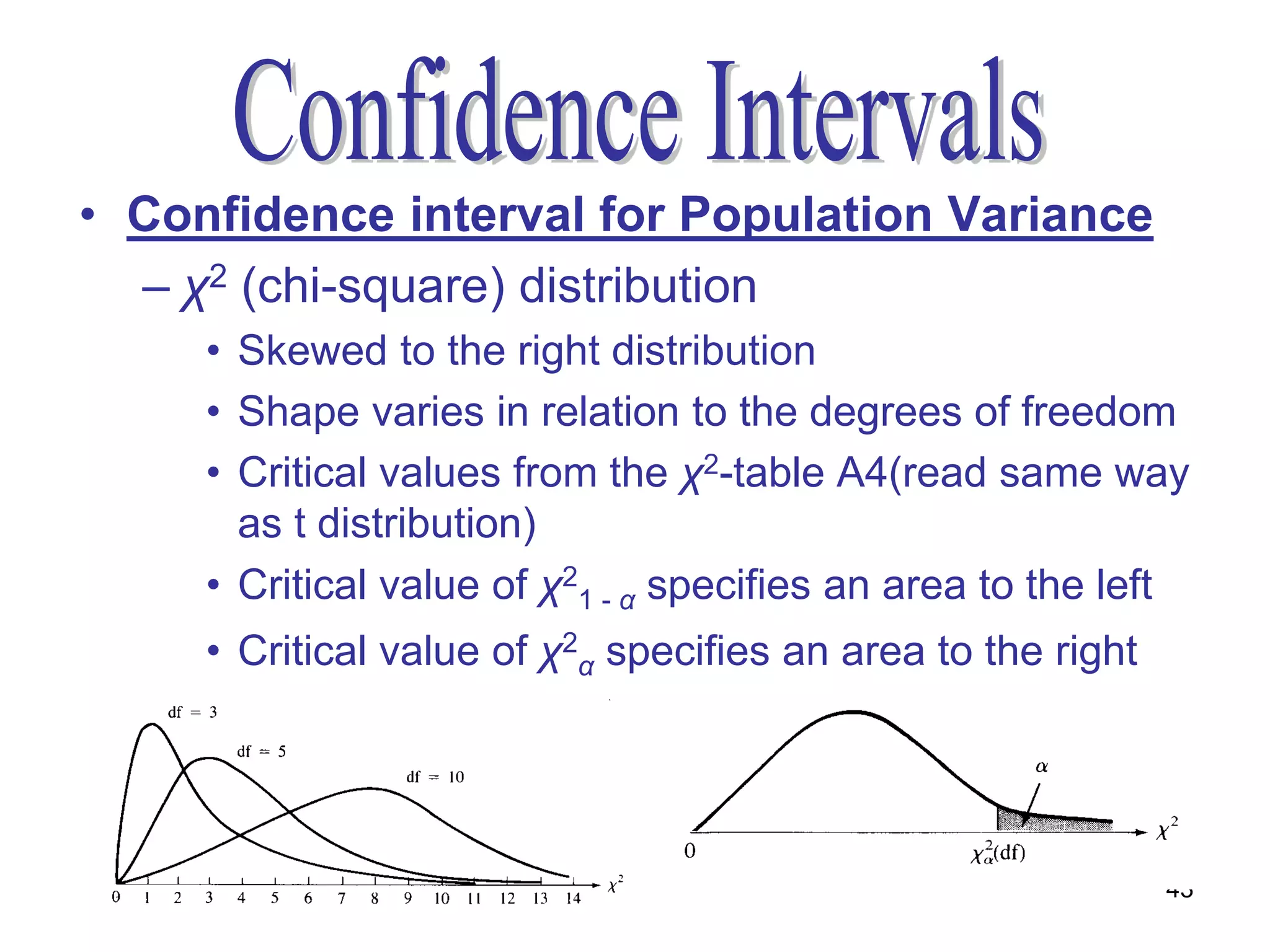
• Confidence interval for Population Variance
  – χ2 (chi-square) distribution
     • Skewed to the right distribution
     • Shape varies in relation to the degrees of freedom
     • Critical values from the χ2-table A4(read same way
       as t distribution)
     • Critical value of χ21 - α specifies an area to the left
     • Critical value of χ2α specifies an area to the right


                                                              43
• Confidence interval for Population
  Variance
                                          2
                  (n  1) s (n  1) s 
                              2
  CI ( )1
       2
                2             ; 2
                  n 1;1       n 1; 
                           2            2  


                                                44
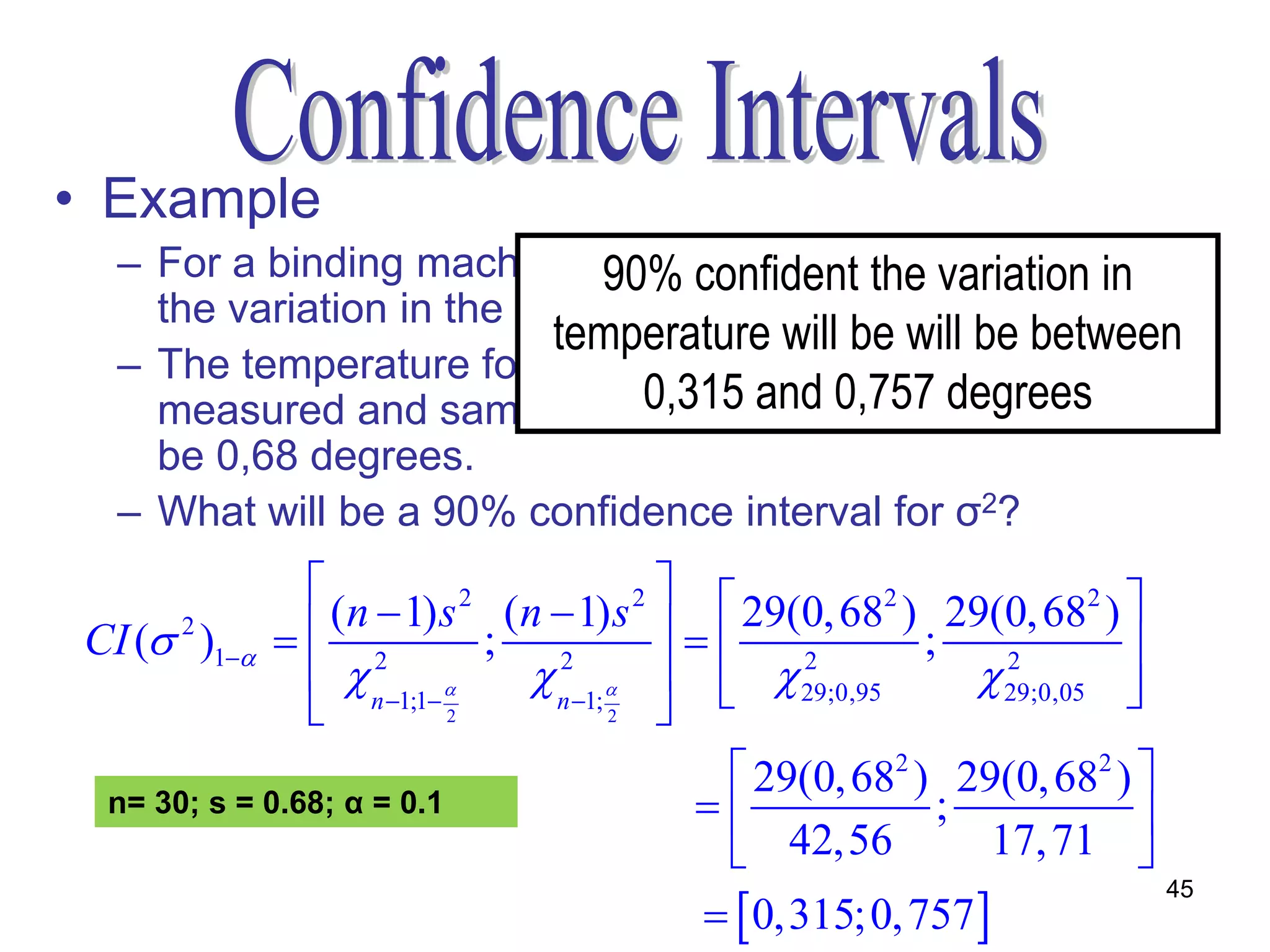
• Example
   – For a binding machine to work on its optimum capacity
                              90% confident the variation in
     the variation in the temperature of the room is vital.
                            temperature will be will be between
   – The temperature for 30 consecutive hours were
     measured and sample standard and 0,757 were found to
                                0,315 deviation degrees
     be 0,68 degrees.
   – What will be a 90% confidence interval for σ2?
                                         
                  (n  1) s 2 (n  1) s 2   29(0, 682 ) 29(0, 682 ) 
 CI ( 2 )1   2           ; 2                        ;            
                  n 1;1     n 1;    29;0,95
                                             
                                                  2
                                                               29;0,05 
                                                                2
                                                                        
                           2          2  
                                               29(0, 682 ) 29(0, 682 ) 
  n= 30; s = 0.68; α = 0.1                                ;            
                                               42,56          17, 71 
                                             0,315;0, 757 
                                                                             45
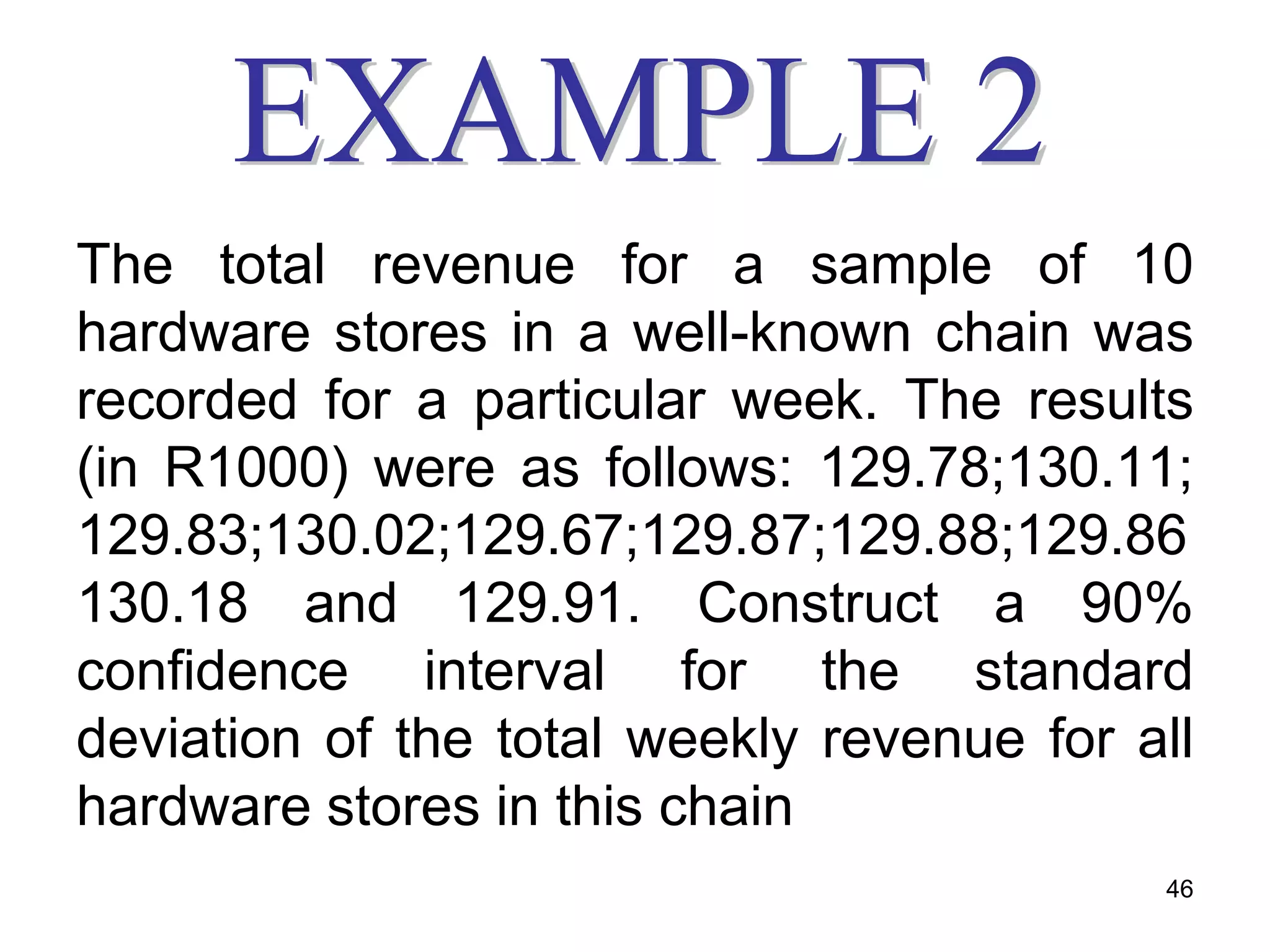
The total revenue for a sample of 10
hardware stores in a well-known chain was
recorded for a particular week. The results
(in R1000) were as follows: 129.78;130.11;
129.83;130.02;129.67;129.87;129.88;129.86
130.18 and 129.91. Construct a 90%
confidence interval for the standard
deviation of the total weekly revenue for all
hardware stores in this chain
                                           46
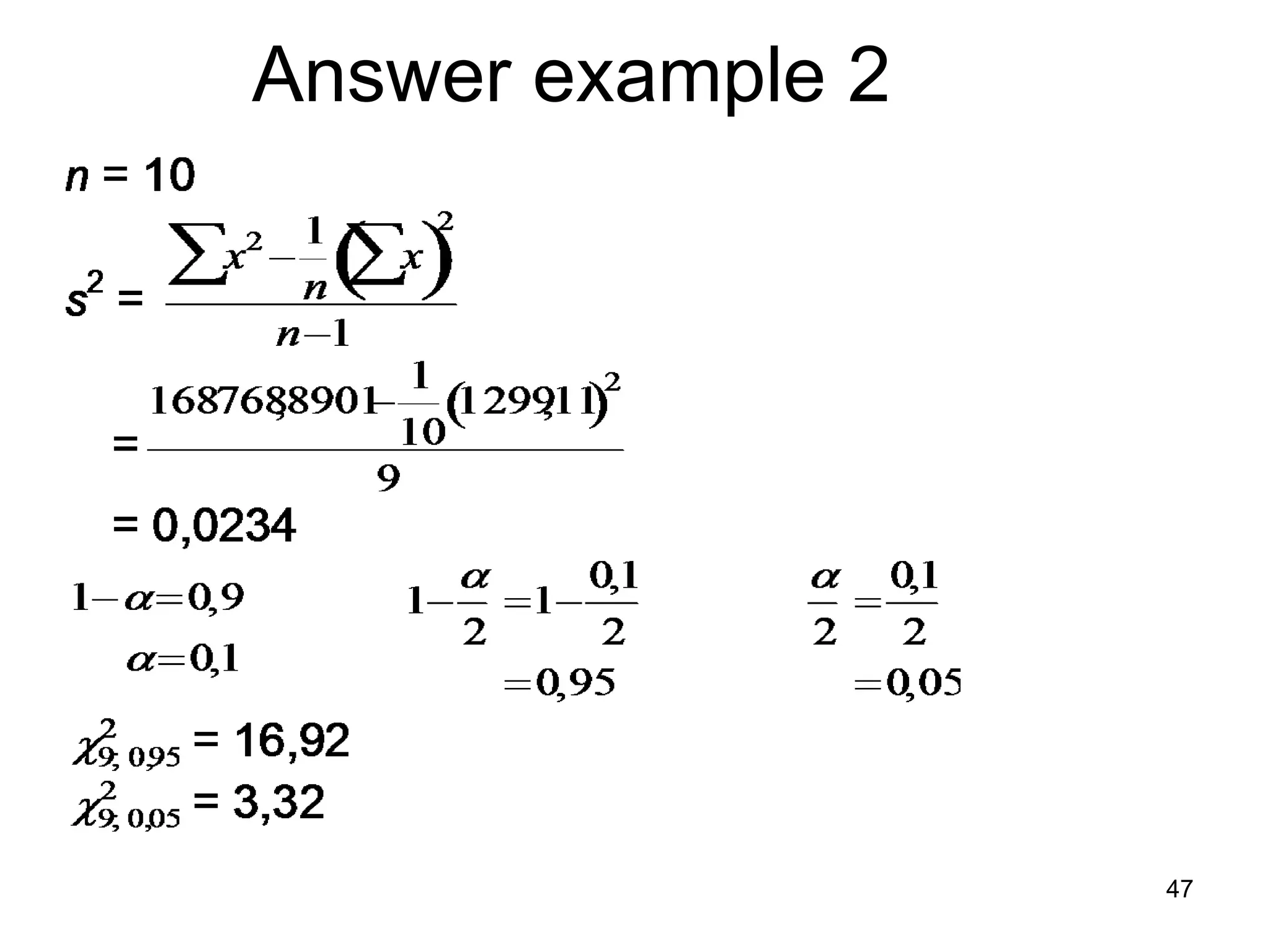
Answer example 2


                   47
Answer example 2 contd
                                
            n 1s 2 n 1s 2 
CI( )0,9 =  2
    2
                         ; 2      
             n1;1   n1; 
                     2       2 
            90,0234 90,0234
          =             ;          
             16,92         3,32 
        = [0,0124;0,0634]
CI()0,9 = [ 0,0124 ; 0,0634 ]
       = [0,1114;0,2518]                48
CONCEPT QUESTIONS
• Nos 20 – 28, page 228 textbook


                                   49
Where are we?
• So far we have looked at interval estimation
  procedures for µ, p and σ2 for a SINGLE
  POPULATION
• We are now going to look at interval estimation
  procedures for:-
  – The difference between two population means
  – The difference between two population proportions
  – The ratio of two population variances


                                                        50
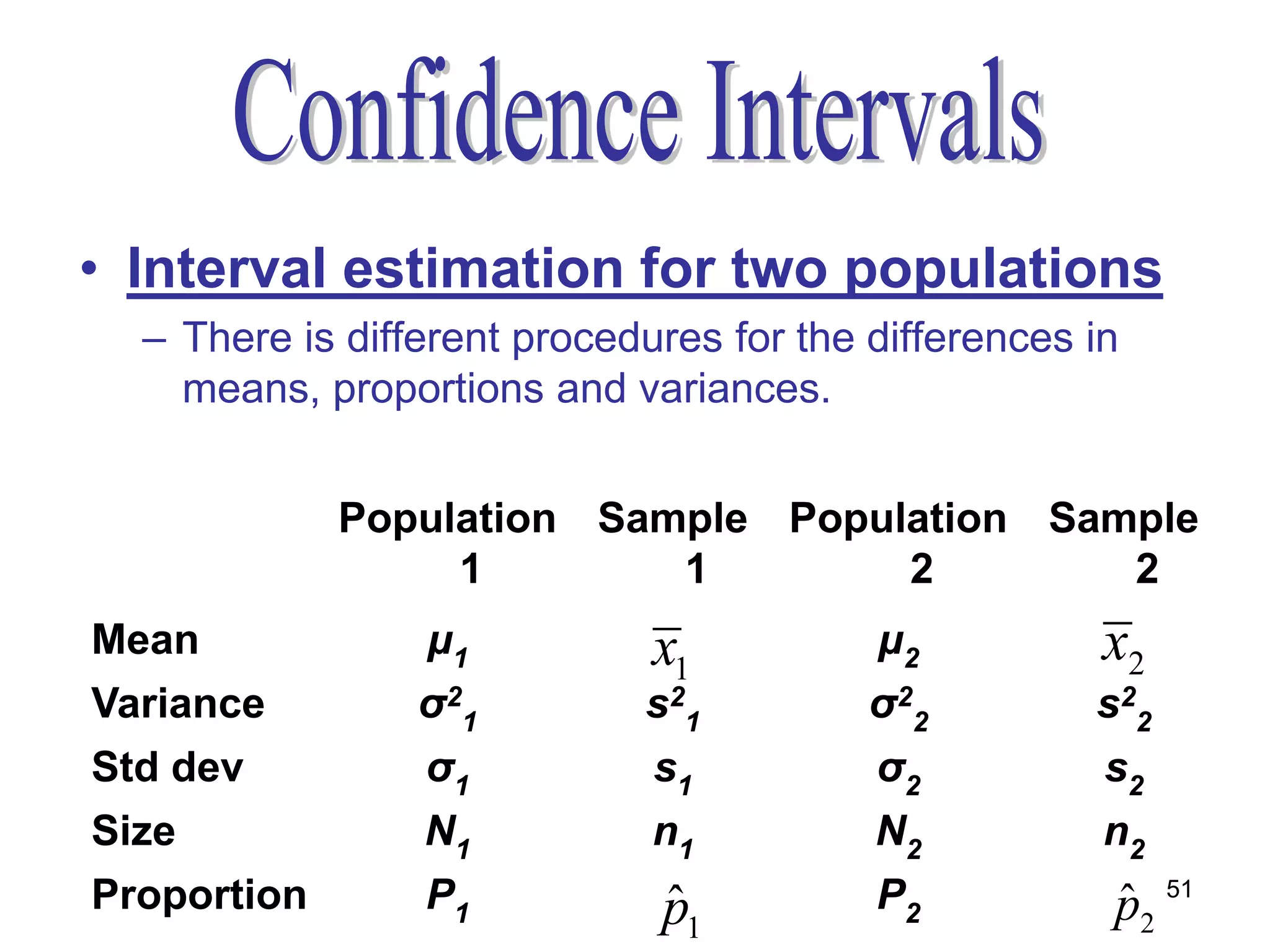
• Interval estimation for two populations
  – There is different procedures for the differences in
    means, proportions and variances.


             Population Sample Population Sample
                  1        1        2        2
Mean             μ1           x1          μ2           x2
Variance         σ 21        s21          σ 22        s22
Std dev          σ1           s1          σ2           s2
Size             N1           n1          N2           n2
Proportion       P1           ˆ
                              p1          P2           ˆ
                                                       p2 51
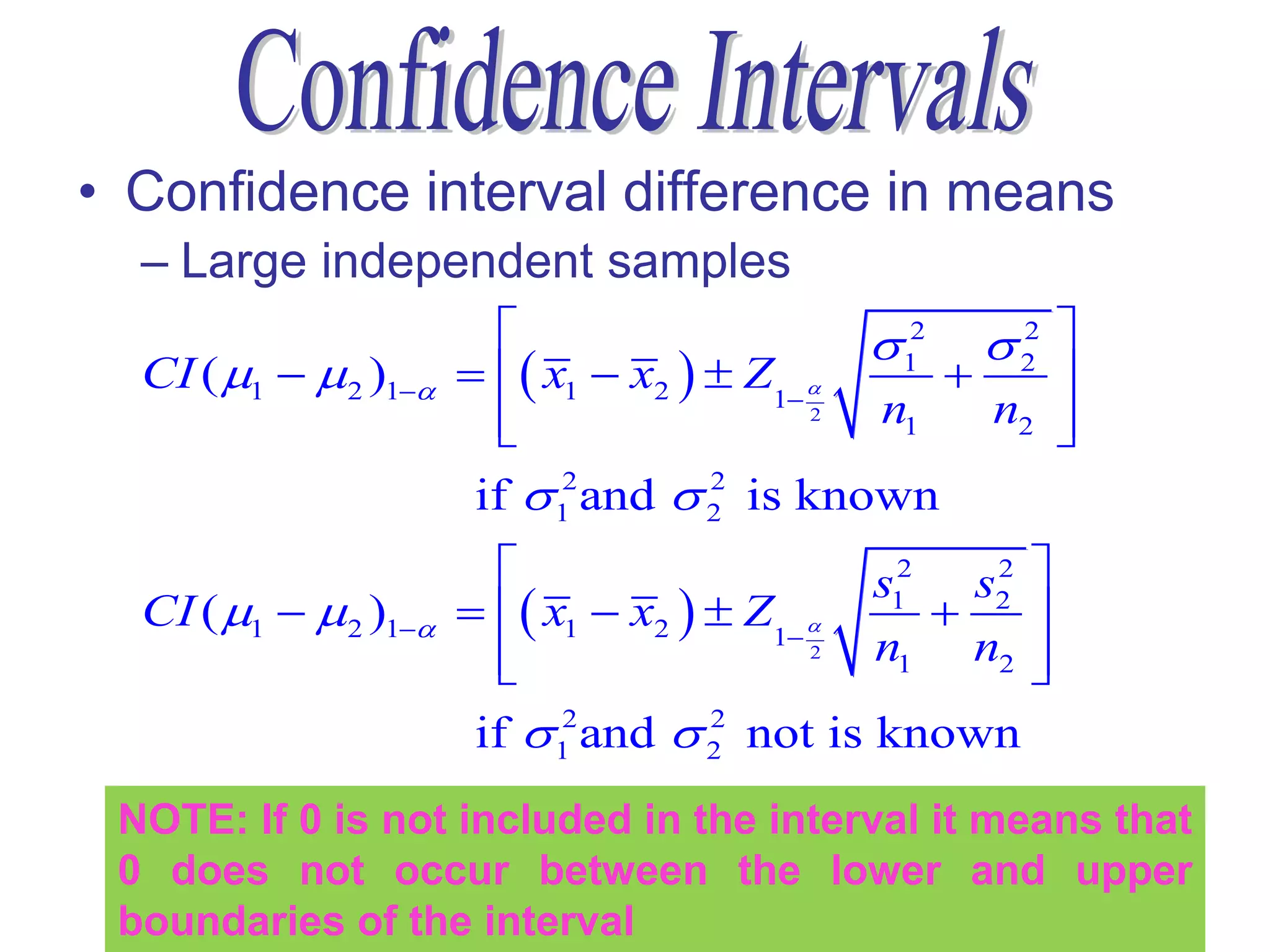
• Confidence interval difference in means
  – Large independent samples
                                              12  2
                                                     2    
  CI ( 1   2 )1     x1  x2   Z1             
                         
                         
                                            2 n1    n2    
                                                          
                        if  12 and  2 is known
                                      2


                                              s12 s2 
                                                    2
  CI ( 1   2 )1     x1  x2   Z1         
                         
                         
                                            2  n1 n2 
                        if  12 and  2 not is known
                                      2


 NOTE: If 0 is not included in the interval it means that
 0 does not occur between the lower and upper          52
 boundaries of the interval
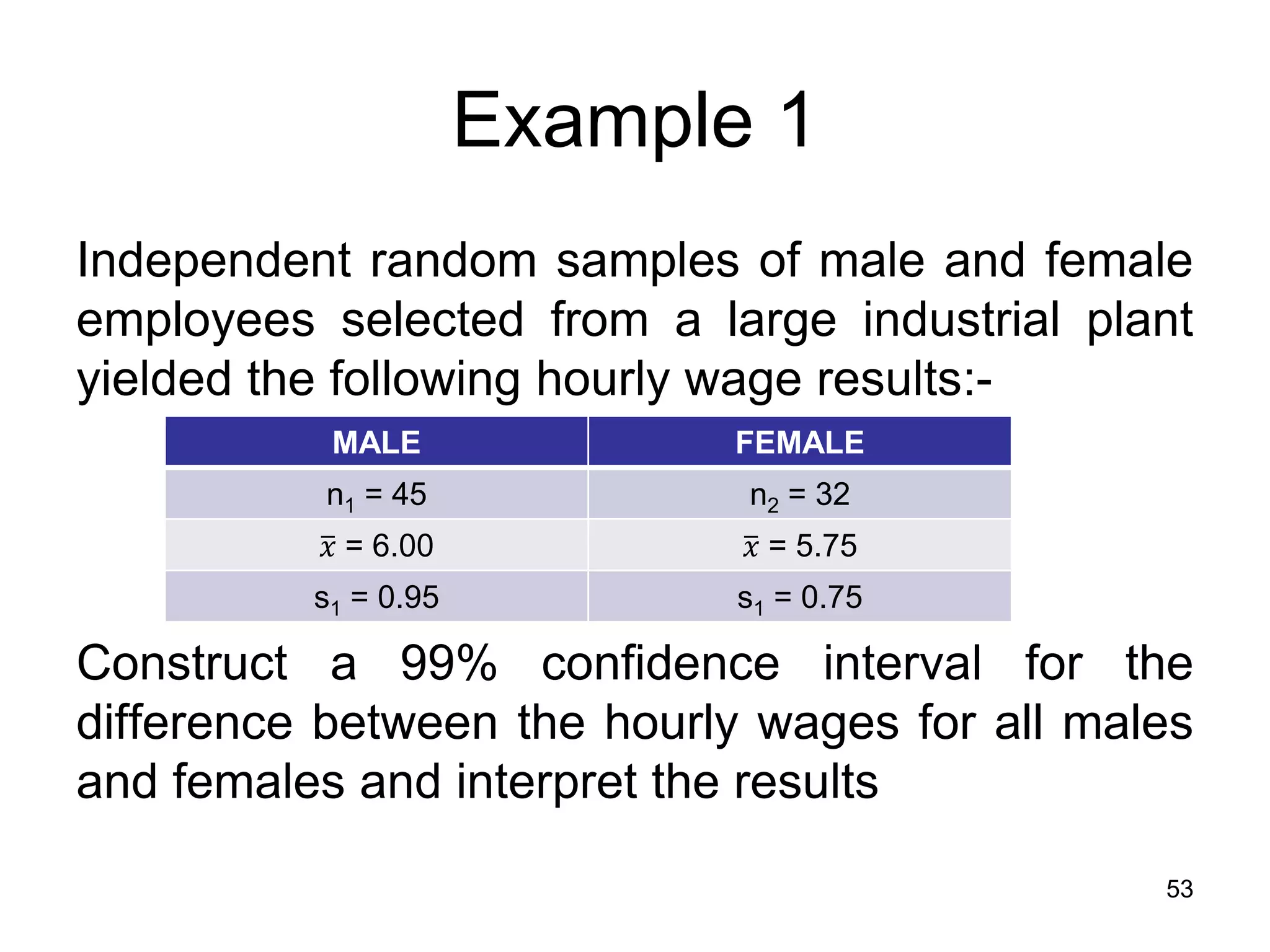
Example 1
Independent random samples of male and female
employees selected from a large industrial plant
yielded the following hourly wage results:-
           MALE             FEMALE
          n1 = 45            n2 = 32
           𝑥 = 6.00          𝑥 = 5.75
          s1 = 0.95          s1 = 0.75

Construct a 99% confidence interval for the
difference between the hourly wages for all males
and females and interpret the results

                                               53
Example 1- Answer
                             0,01
1   0,99          1  1
                       2       2
     0,01
                          0,995
Z 0,995=   2,57
                                       2    2 
CI(1 – 2 = 
          )0,99    x1  x 2   Z  s1  s2 
                  
                  
                                   1
                                      2
                                        n1 n 2 
                                                
                                                   2 
                   6  5,75  2,57 0,95  0,75 
                                              2
                   
                =           
                                           45      32 
                                                   
                  = [–0,2486;0,7486]                 54
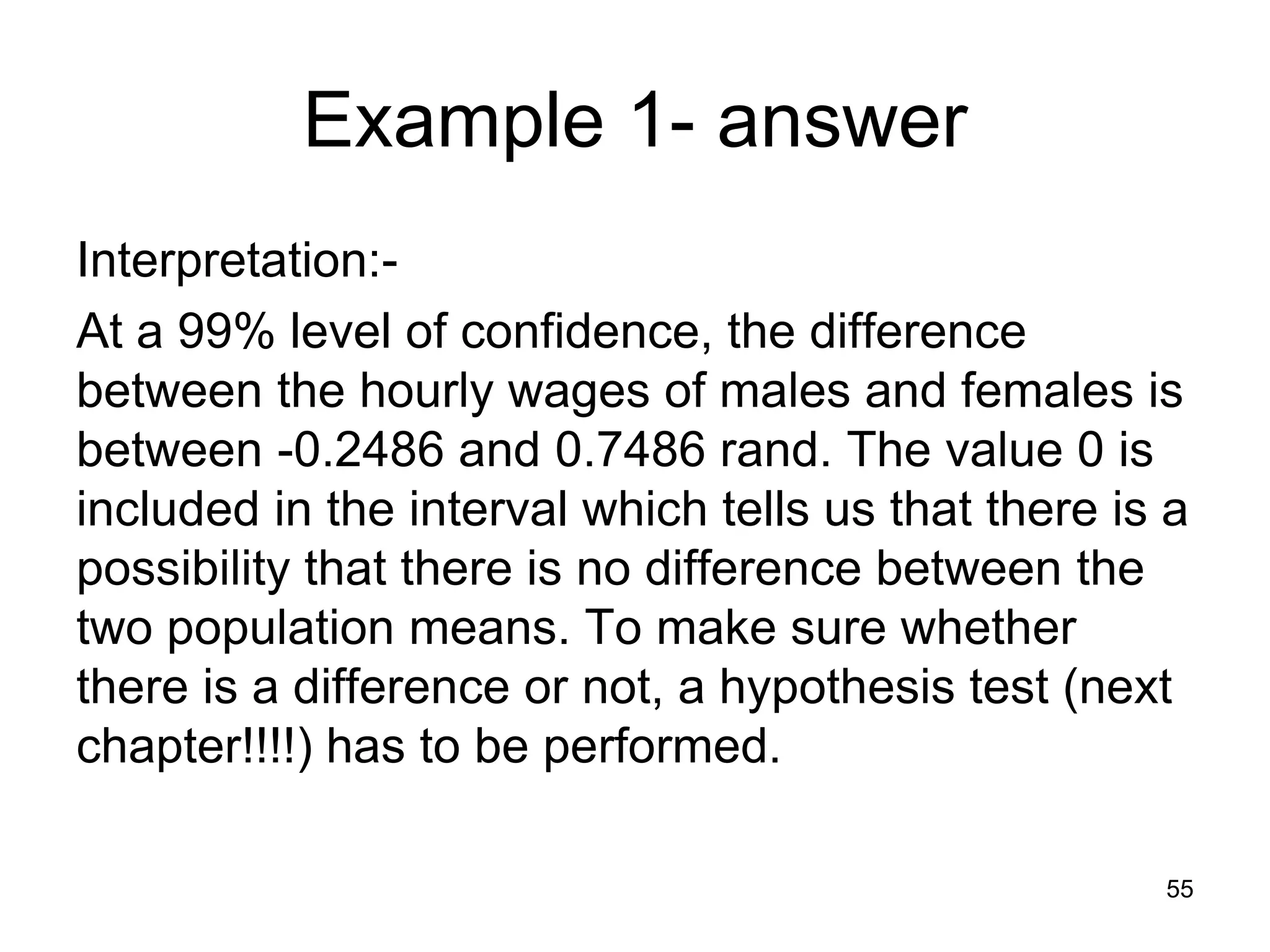
Example 1- answer
Interpretation:-
At a 99% level of confidence, the difference
between the hourly wages of males and females is
between -0.2486 and 0.7486 rand. The value 0 is
included in the interval which tells us that there is a
possibility that there is no difference between the
two population means. To make sure whether
there is a difference or not, a hypothesis test (next
chapter!!!!) has to be performed.

                                                     55
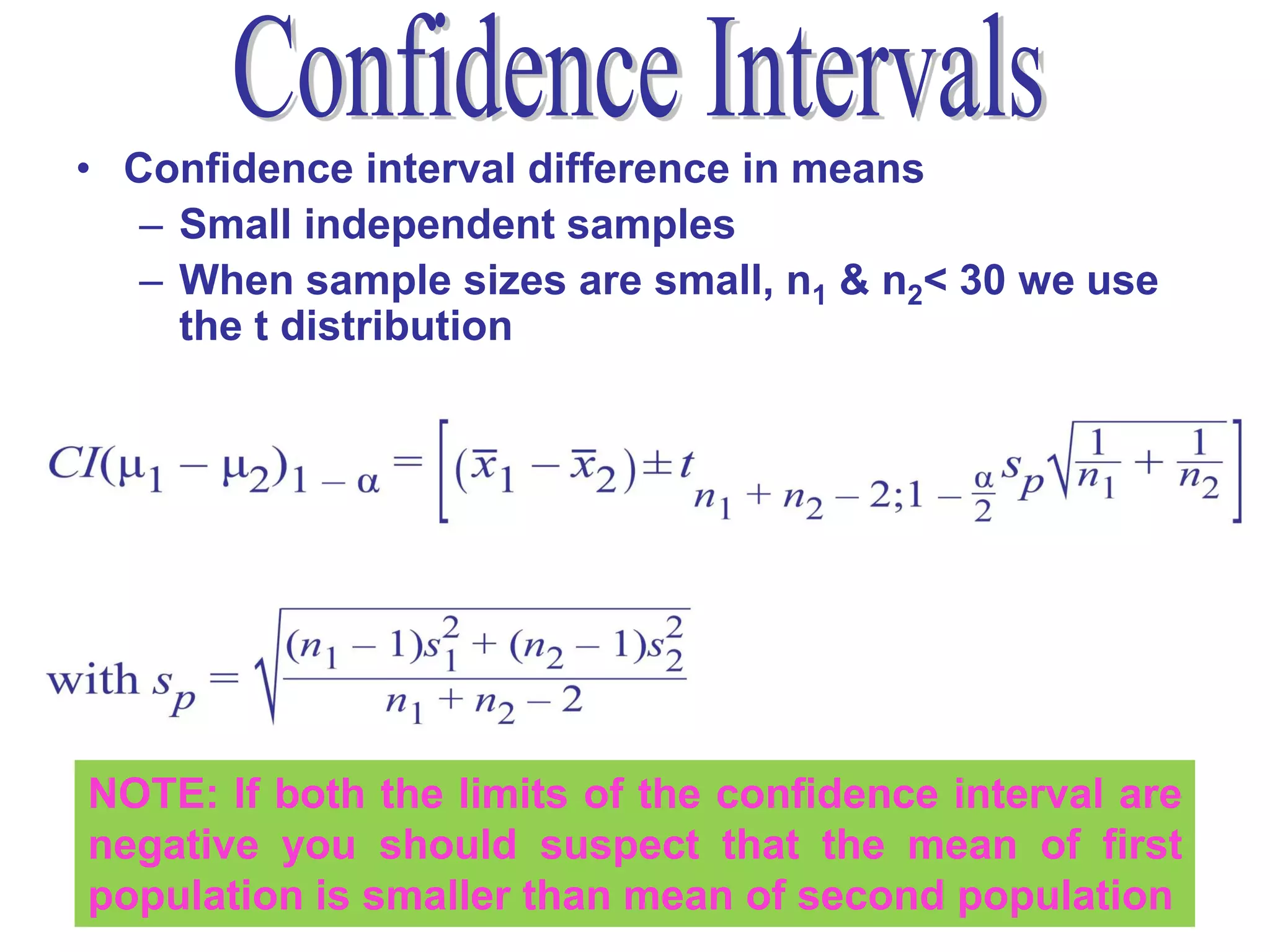
• Confidence interval difference in means
   – Small independent samples
   – When sample sizes are small, n1 & n2< 30 we use
     the t distribution


NOTE: If both the limits of the confidence interval are
negative you should suspect that the mean of first
population is smaller than mean of second population56
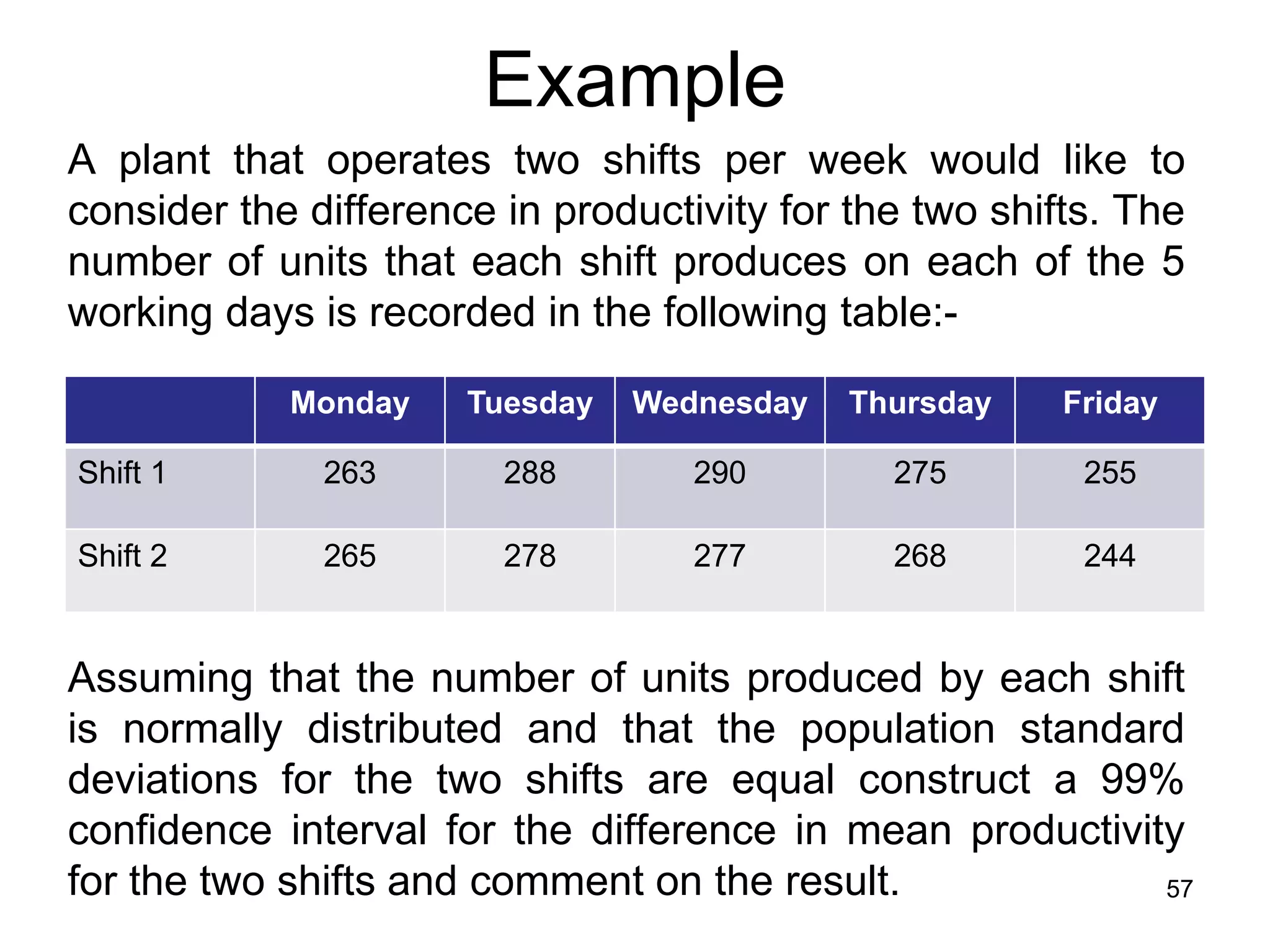
Example
A plant that operates two shifts per week would like to
consider the difference in productivity for the two shifts. The
number of units that each shift produces on each of the 5
working days is recorded in the following table:-

            Monday    Tuesday   Wednesday   Thursday    Friday

Shift 1       263       288        290        275        255

Shift 2       265       278        277        268        244


Assuming that the number of units produced by each shift
is normally distributed and that the population standard
deviations for the two shifts are equal construct a 99%
confidence interval for the difference in mean productivity
for the two shifts and comment on the result.             57
x
                                              Example 1 - answer
                                                          x2
                        1
          x1                                   x2 
                    n1                                 n2
                 1 371                              1 332
                                                 
                   5                                  5
                274, 2                            266, 4

                                                                                       
                               1              2                                          1                2
                        2                                                            2
                       x1               x1                                         x2              x2
           2                  n1                                     2                  n2
          s1                                                       s2   
                           n1 1
                                                                                     n 2 1
                233,7                                                    188,3

          sp    =
                  n1 1s12  n 2 1s2
                                        2

                                 n1  n 2  2
                                                    
                =
                  51(233,7)  51(188,3)
                                   5 5 2
              = 14,5258
                                                        0,01
          1   0,99                     1           1
                                                2       2
               0,01
                                                     0,995
          t 8; 0,995   = 3,355
                                                                                   1   1      
        CI(1 – 2 =  x1  x 2   t
                    )0,99                                                    sp              
                                         
                                                           n1 n 2 2;1
                                                                             2
                                                                                     n1 n 2     
                                                                                                

                                                                                                              1 1
                                      = [(274,2 – 266,4)  3,355(14,5258)                                       ]
                                                                                                              5 5
                            
                         = [–23,0221;38,6221]
          At the 99% confidence level, because zero is included in the interval, it is possible that there
                                                                                                         58
                                                     
          is no significant difference between the two shifts with respect to productivity.
CONCEPT QUESTIONS
• Nos 29 -39, p 235 – 237, textbook


                                      59
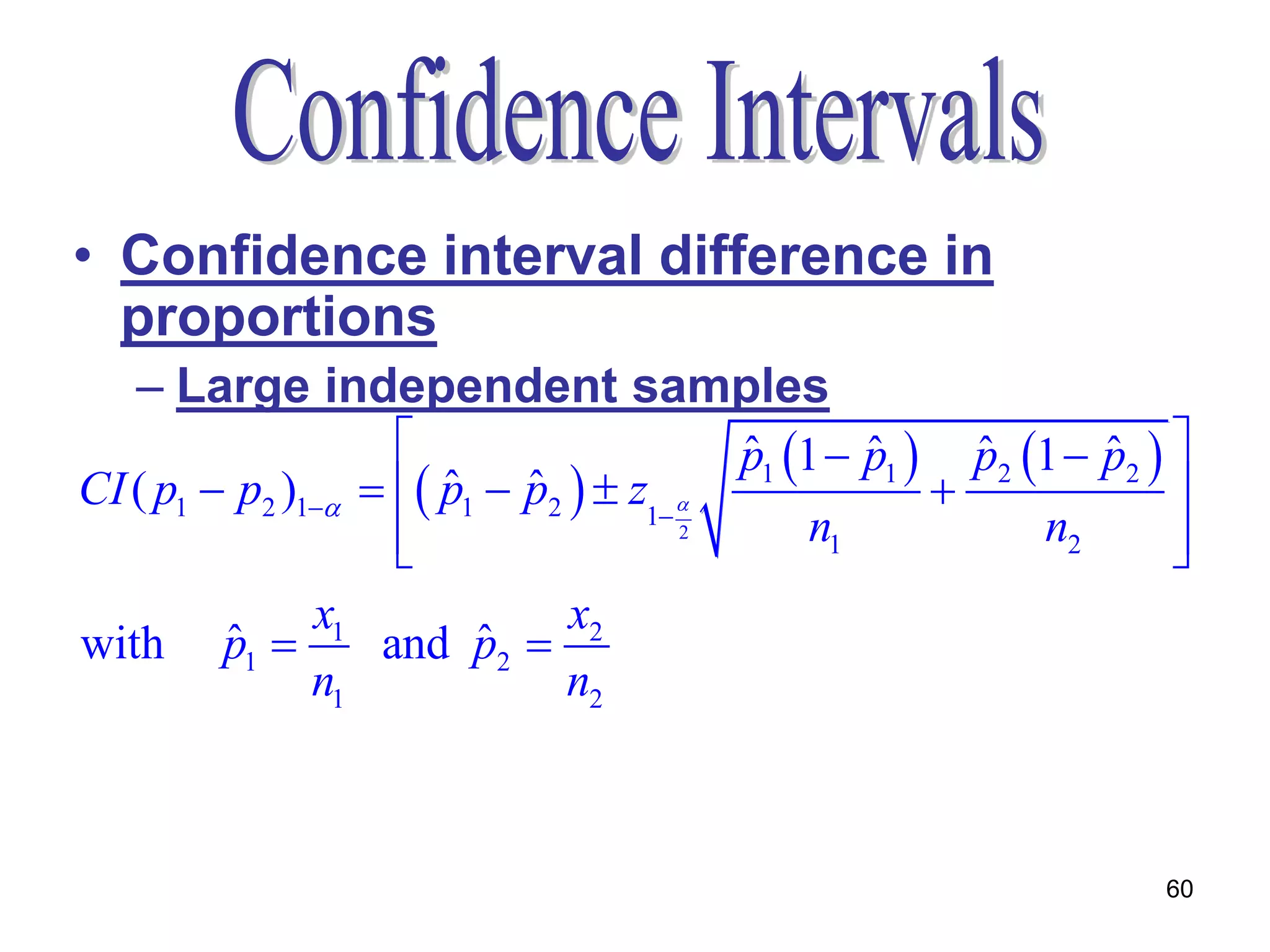
• Confidence interval difference in
  proportions
   – Large independent samples
                                        p1 1  p1  p2 1  p2  
                                         ˆ       ˆ     ˆ      ˆ
CI ( p1  p2 )1   p1  p2   z1 
                       ˆ ˆ                                        
                    
                    
                                       2      n1          n2       
                                                                   
             x1          x2
with    p1 
        ˆ       and p2 
                    ˆ
             n1          n2


                                                                  60
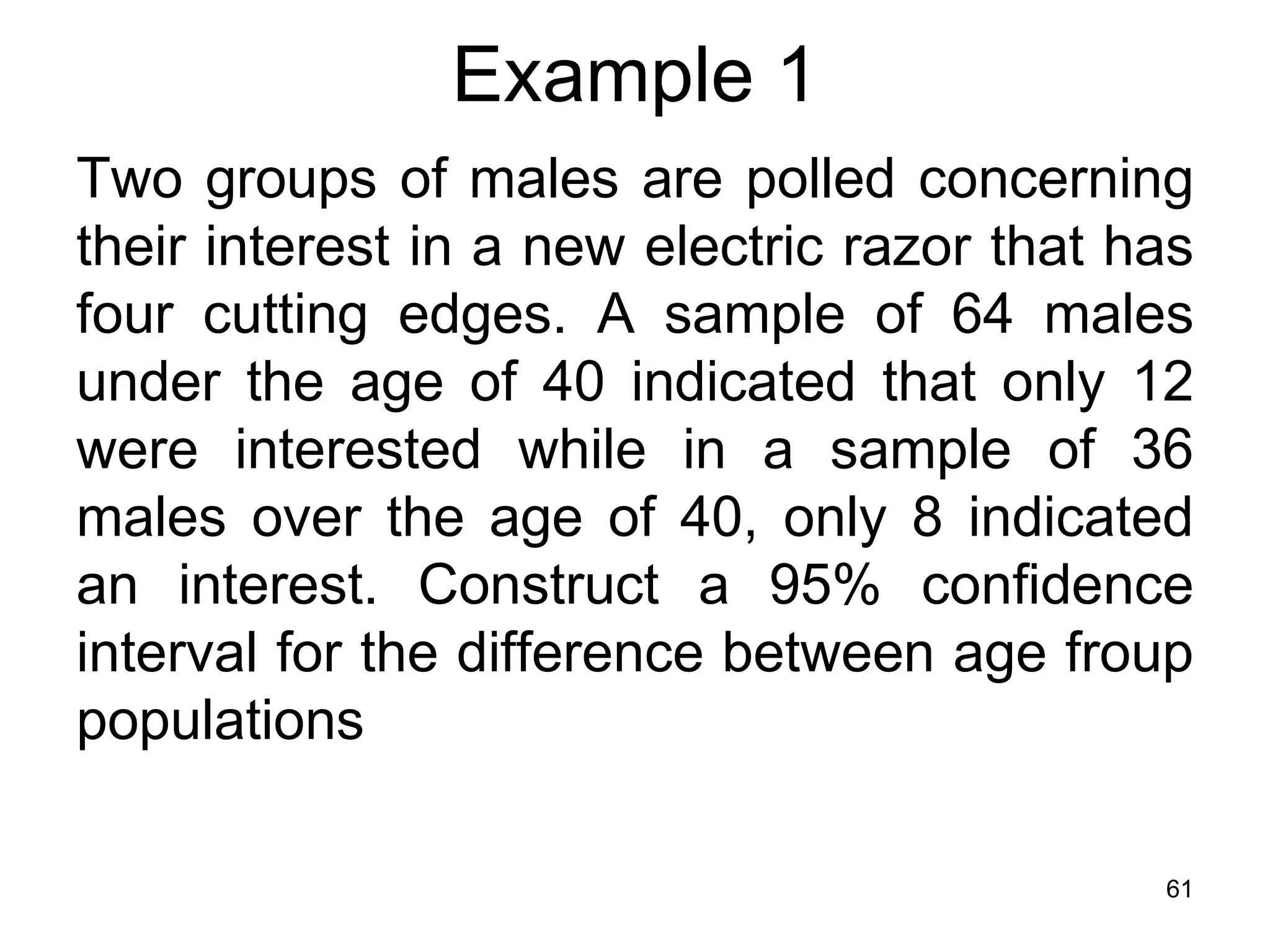
Example 1
Two groups of males are polled concerning
their interest in a new electric razor that has
four cutting edges. A sample of 64 males
under the age of 40 indicated that only 12
were interested while in a sample of 36
males over the age of 40, only 8 indicated
an interest. Construct a 95% confidence
interval for the difference between age froup
populations

                                             61
Example 1 - answer
                            12
                      ˆ
Under 40: n1 = 64 and p1 =       = 0,1875.
                             64
                            8
                      ˆ
Over 40: n2 = 36 and p2 =       = 0,2222.
                           36
1   0,95    1   1 0,05
                   
                    2        2
     0,05
             
                    0,975
Z 0,975   = 1,96
                                     p11 p1  p2 1 p2  
                                       ˆ     ˆ     ˆ      ˆ
CI( p1  p2 ) = 
             0,9   p1  p2   Z 
                     ˆ ˆ                         +            
                  
                  
                                  1
                                     2
                                          n1          n2      
                                                              
                                               0,18750,8125 0,22220,7778 
                 =  0,1875 0,2222 1,96
                                                                             
                     
                                                     64             36       
                                                                               
        
                   = [–0,2008;0,1314]
                                                                             62
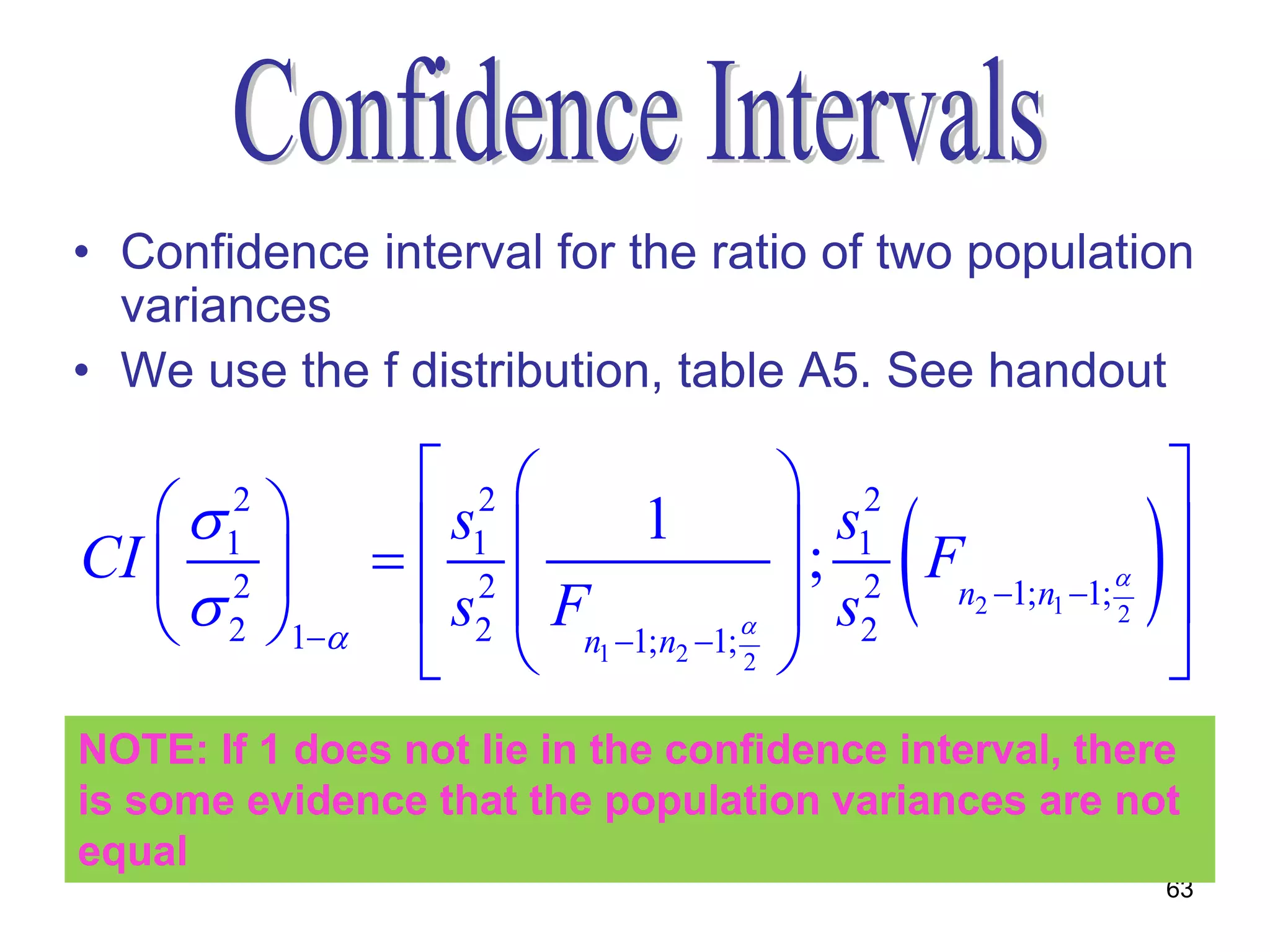
• Confidence interval for the ratio of two population
  variances
• We use the f distribution, table A5. See handout

                 2                       2                           
    
                                                                   
       2
CI   1         s1 
                2
                             1             ; s1 F                      
                 s2  F                                                
                                                                

     1
       2
                                          s2 2  n2 1; n1 1;
                                                                2

                      n1 1; n2 1;
                                                                       
       2
                                      2


NOTE: If 1 does not lie in the confidence interval, there
is some evidence that the population variances are not
equal
                                                                        63
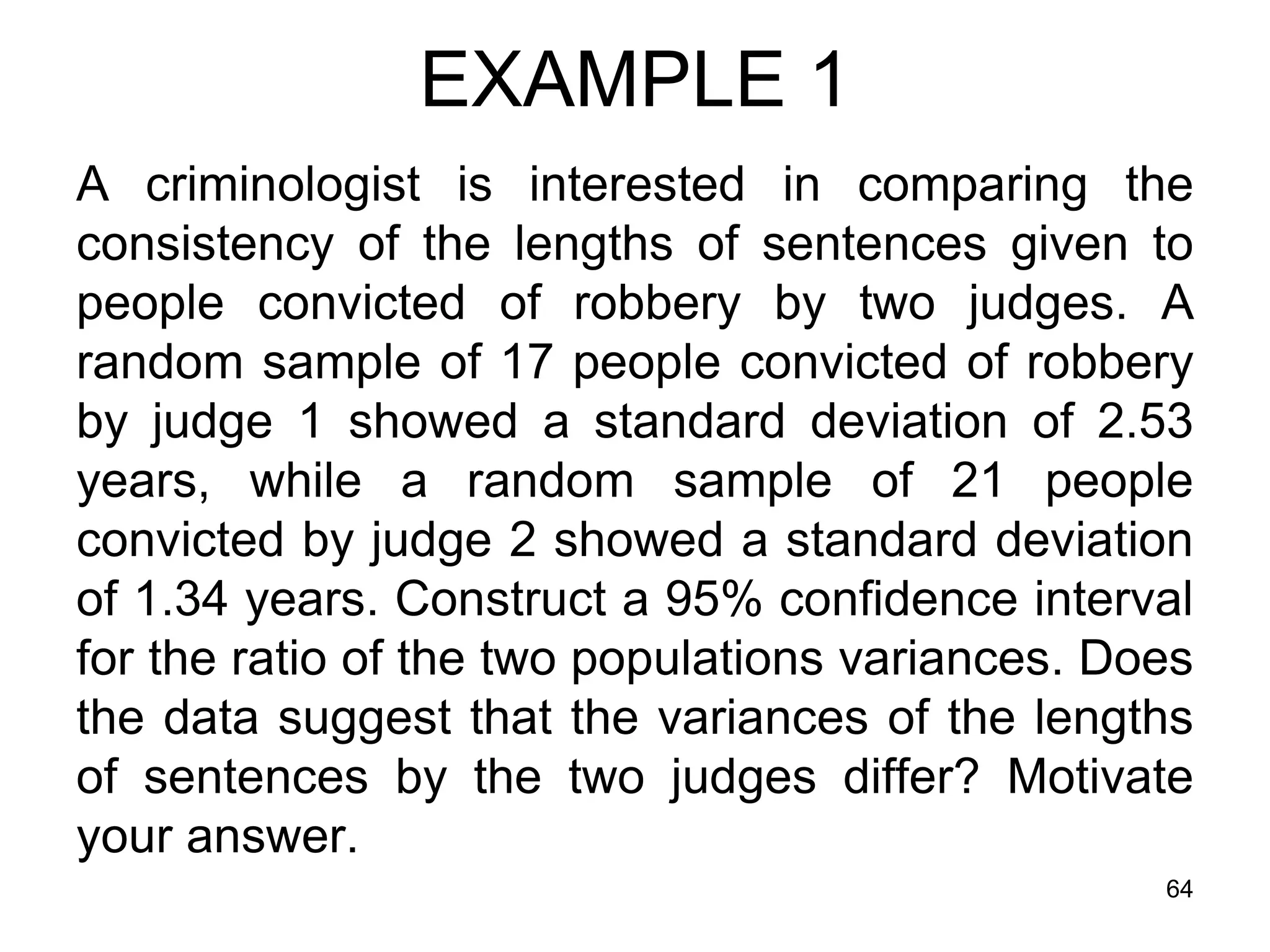
EXAMPLE 1
A criminologist is interested in comparing the
consistency of the lengths of sentences given to
people convicted of robbery by two judges. A
random sample of 17 people convicted of robbery
by judge 1 showed a standard deviation of 2.53
years, while a random sample of 21 people
convicted by judge 2 showed a standard deviation
of 1.34 years. Construct a 95% confidence interval
for the ratio of the two populations variances. Does
the data suggest that the variances of the lengths
of sentences by the two judges differ? Motivate
your answer.
                                                  64
Example 1 - answer
    Judge 1: n = 17 and s = 2,53.
                          1                    1
    Judge 2: n2 = 21 and s2 = 1,34.
                                       0,05
    1   0,95                         
                                      2     2
         0,05
                                         0,025
    F                   = F16; 20; 0,025
     n1 1;n 2 1;
                     2

                          = 2,55
    F                 = F20; 16; 0,025
     n 2 1;n1 1;
                     2
                              = 2,68
                                                                      
                          s 2              s 2                   
                                                                            
        12                              1          1 
                                                                         
                               1
    CI( 2 )0,95 =            2               2 F
                                                 ;                          
       2                          F                      n 2 1; n1 1; 
                            s2  n 1;n 1;  s2                 2 
                                 1     2
                                              2                           
                              2,53 2 
                                 1  2,53 2,68 
                                                           2

                                                           2         
                           =         2 
                                                ;
                                               
                            1,34 2,55  1,34
                                                                      
                                                                        
           
               = [1,3979;9,5536]
    Yes, at the 95% level of confidence it is possible that the variances differ because 1 is not
                                                                                         65
          
    included in the interval.
CONCEPT QUESTIONS
• Concept questions 40 – 47, p 241,
  textbook


                                      66
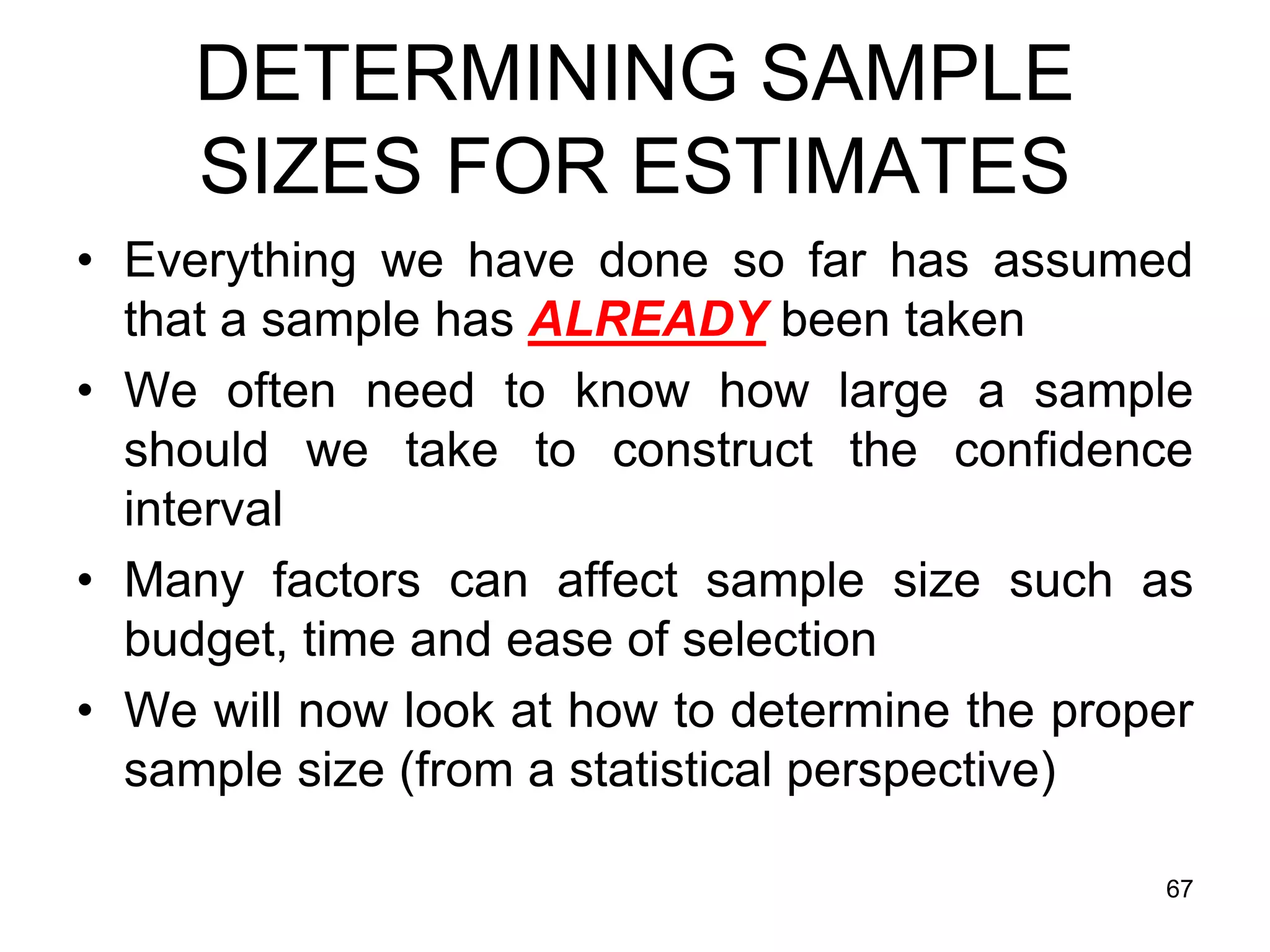
DETERMINING SAMPLE
     SIZES FOR ESTIMATES
• Everything we have done so far has assumed
  that a sample has ALREADY been taken
• We often need to know how large a sample
  should we take to construct the confidence
  interval
• Many factors can affect sample size such as
  budget, time and ease of selection
• We will now look at how to determine the proper
  sample size (from a statistical perspective)

                                               67
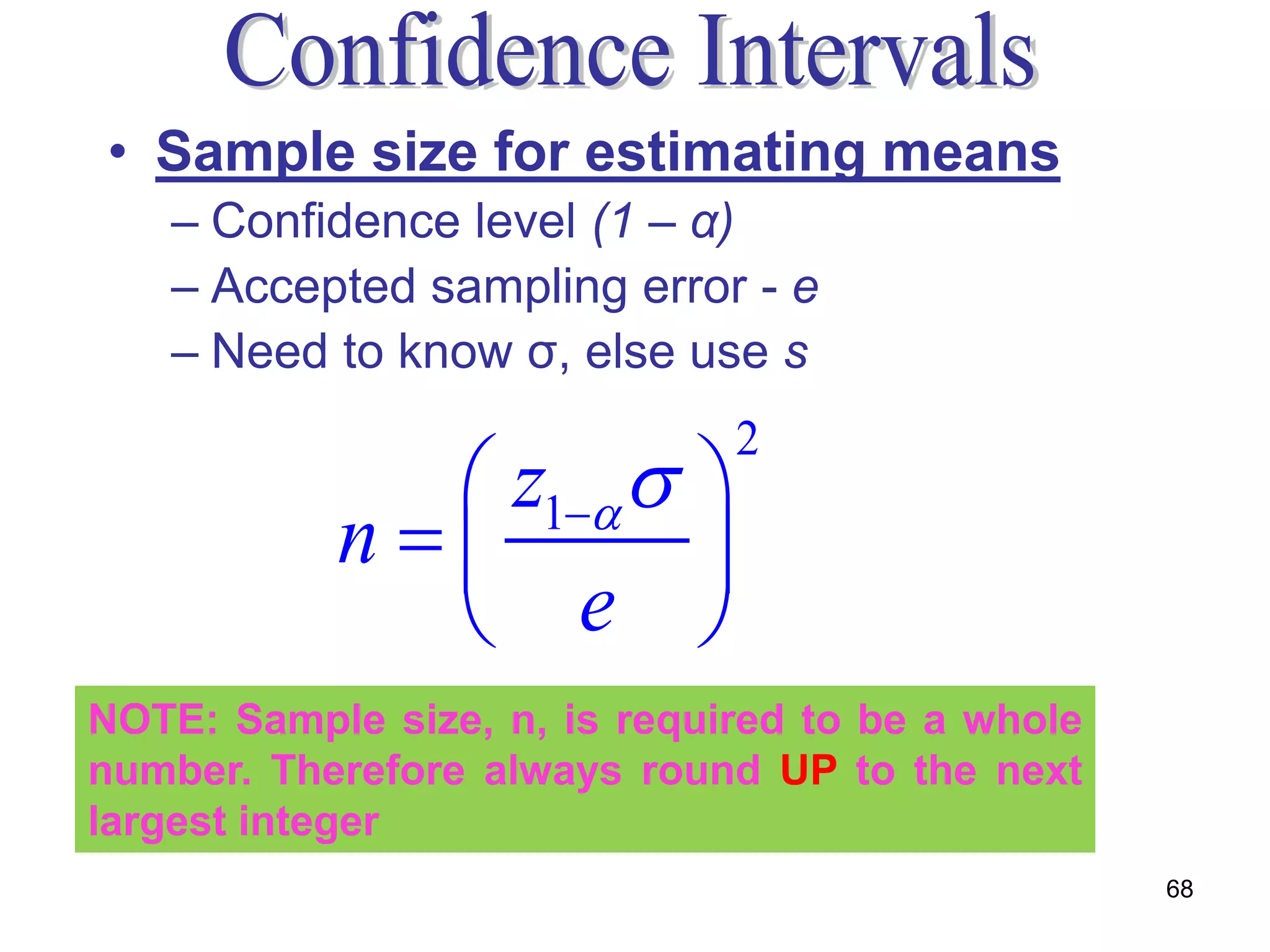
• Sample size for estimating means
   – Confidence level (1 – α)
   – Accepted sampling error - e
   – Need to know σ, else use s

              z1  
                              2

           n        
              e 
NOTE: Sample size, n, is required to be a whole
number. Therefore always round UP to the next
largest integer
                                                  68
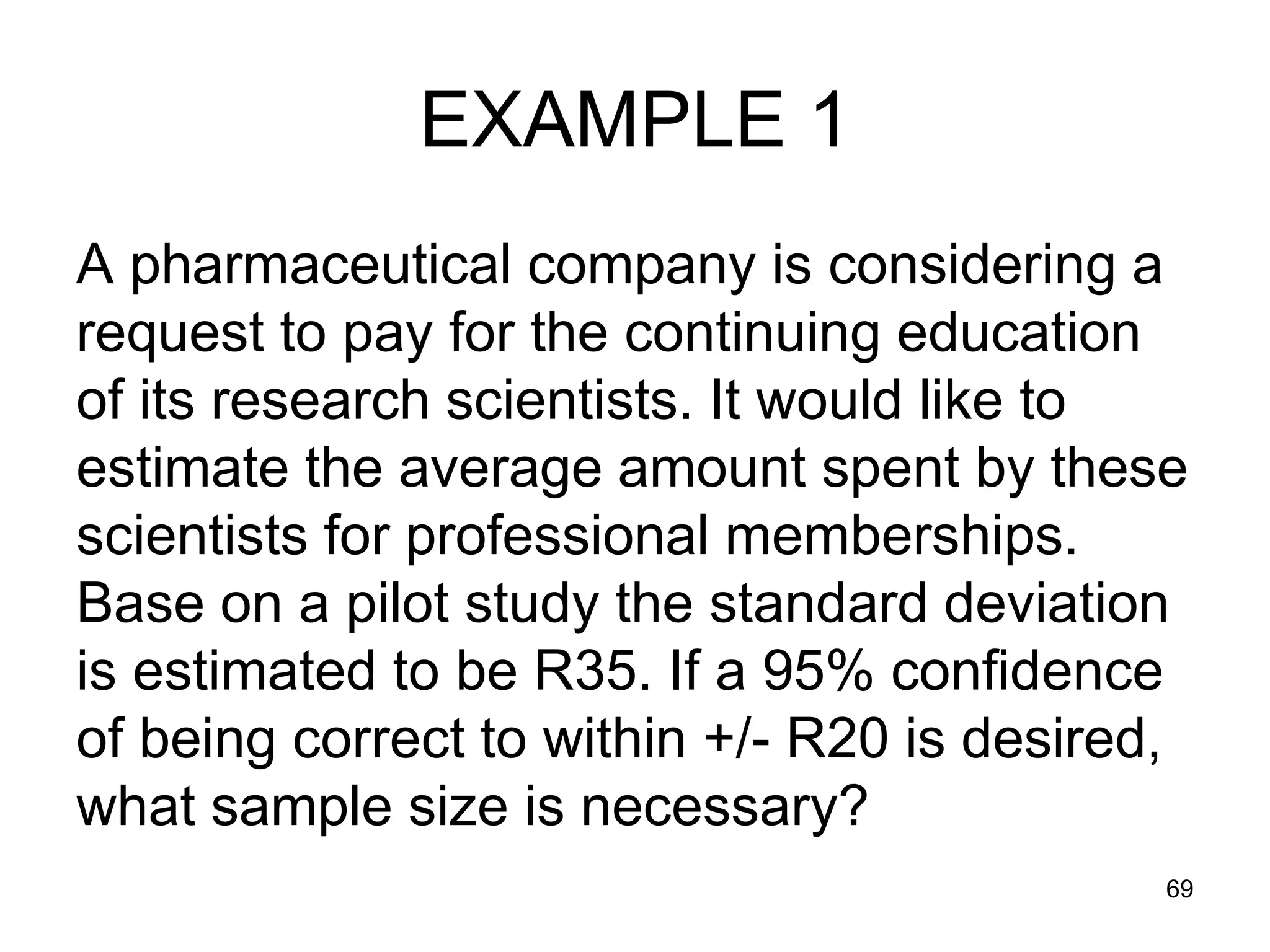
EXAMPLE 1
A pharmaceutical company is considering a
request to pay for the continuing education
of its research scientists. It would like to
estimate the average amount spent by these
scientists for professional memberships.
Base on a pilot study the standard deviation
is estimated to be R35. If a 95% confidence
of being correct to within +/- R20 is desired,
what sample size is necessary?
                                             69
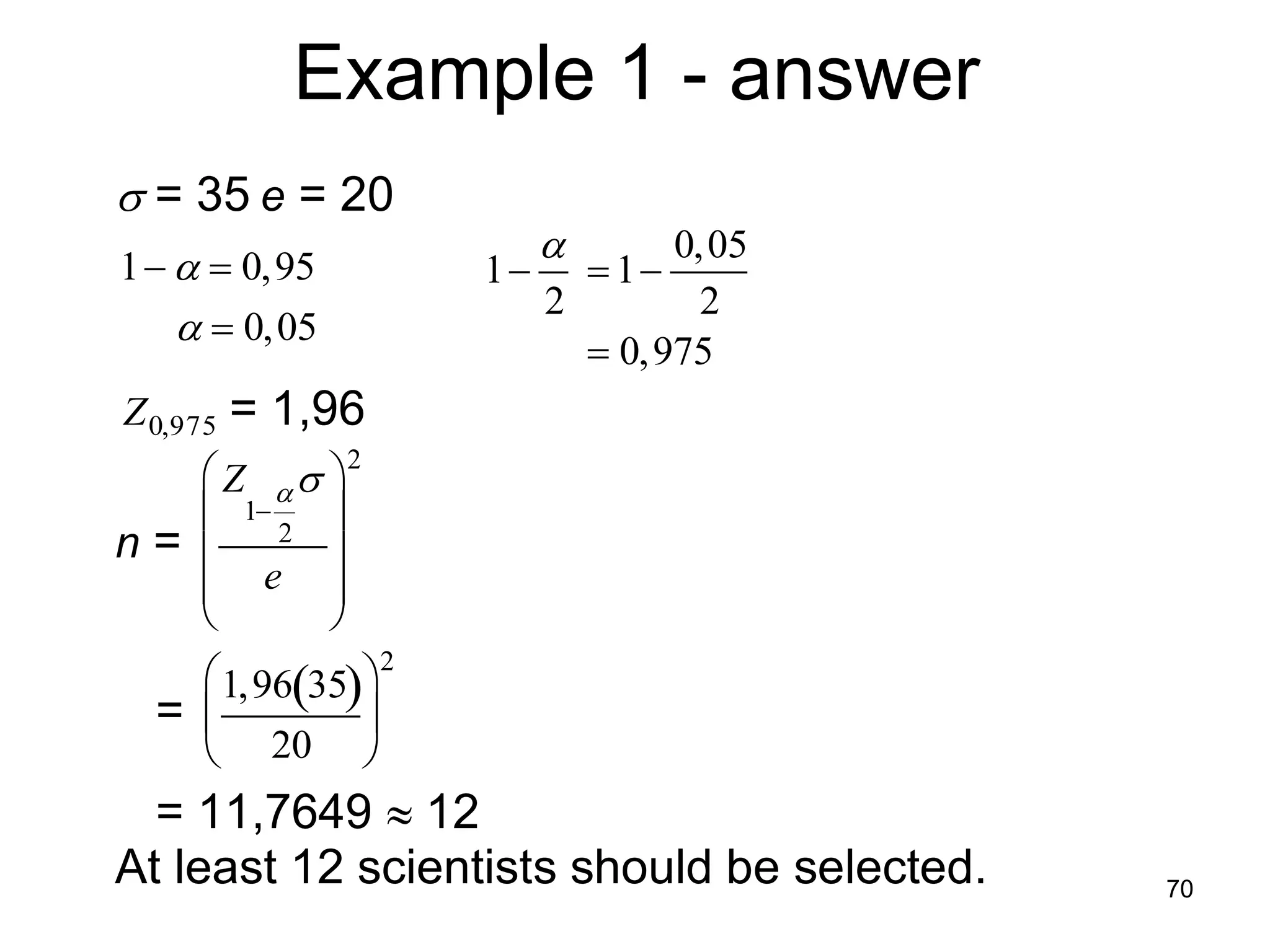
Example 1 - answer
      = 35 e = 20
                                0,05
     1   0,95        1  1
                          2       2
          0,05
                             0,975
     Z 0,975   = 1,96
                   2
         Z   
          1 2 
                  
     n = 
            e 
                
                    2
          1,9635 
         
       =         
          20 

       = 11,7649  12
     At least 12 scientists should be selected.   70

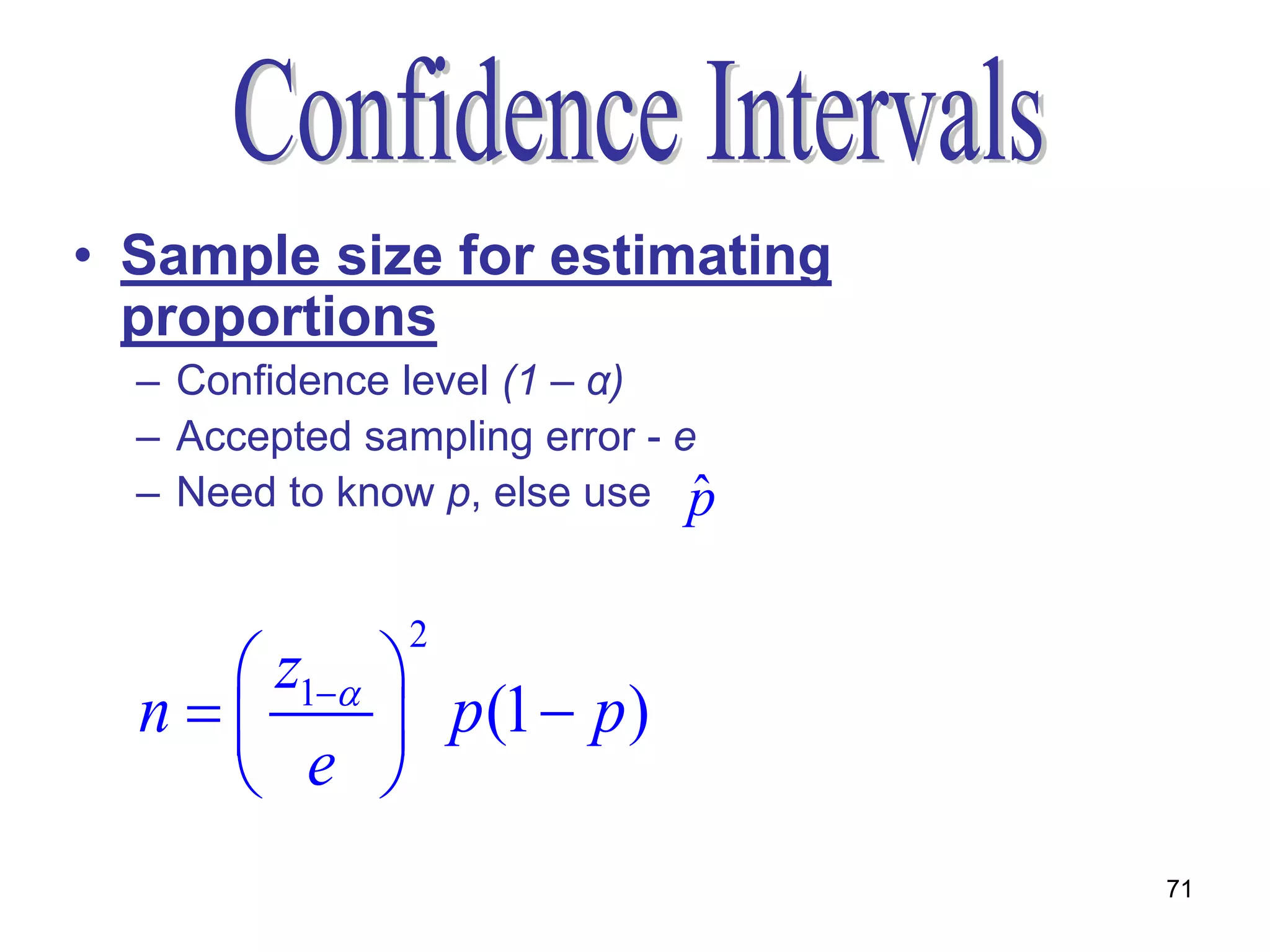
• Sample size for estimating
  proportions
  – Confidence level (1 – α)
  – Accepted sampling error - e
  – Need to know p, else use p ˆ

                2
     z1 
  n       p (1  p )
     e 
                                   71
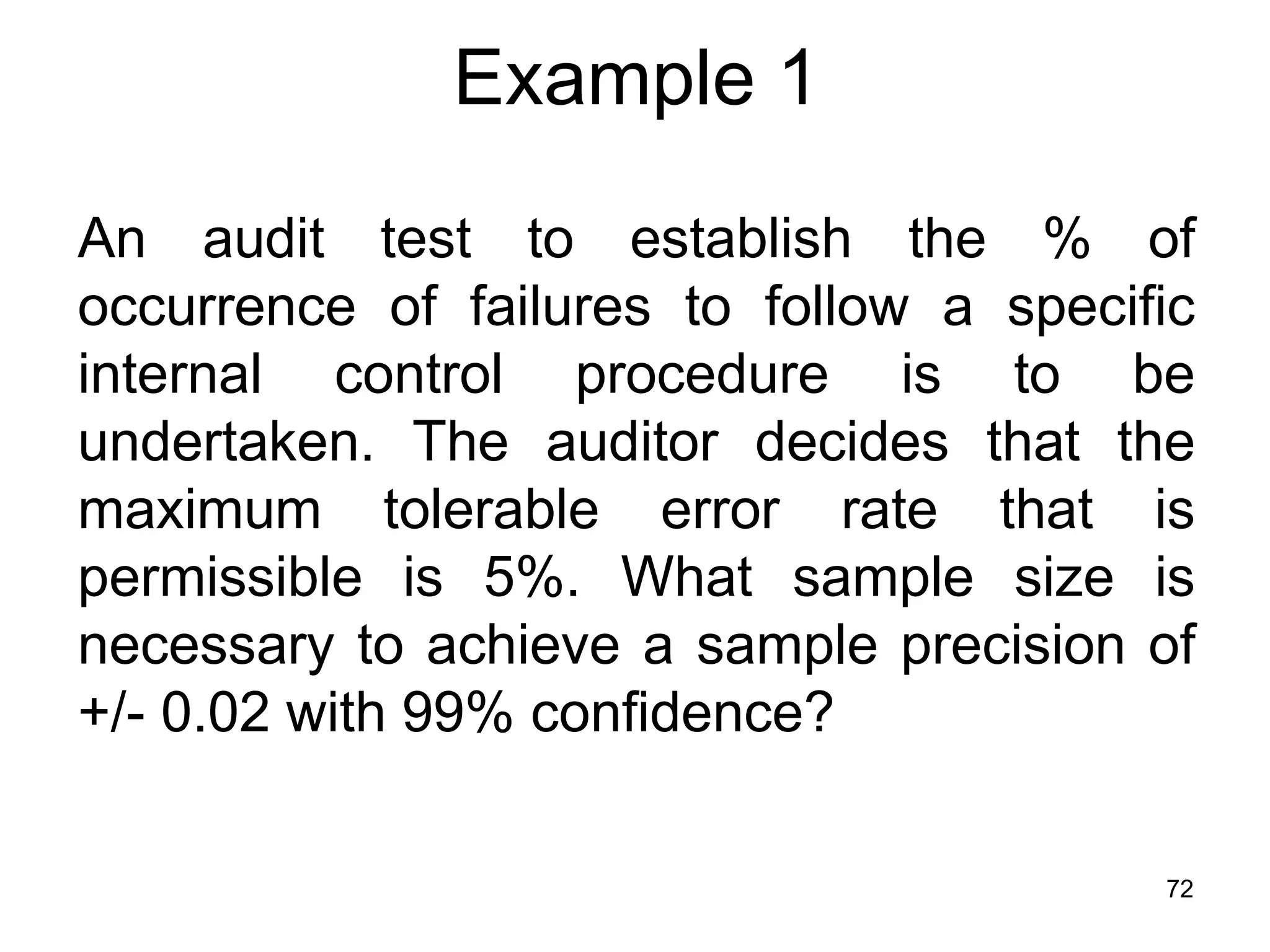
Example 1
An audit test to establish the % of
occurrence of failures to follow a specific
internal control procedure is to be
undertaken. The auditor decides that the
maximum tolerable error rate that is
permissible is 5%. What sample size is
necessary to achieve a sample precision of
+/- 0.02 with 99% confidence?

                                         72
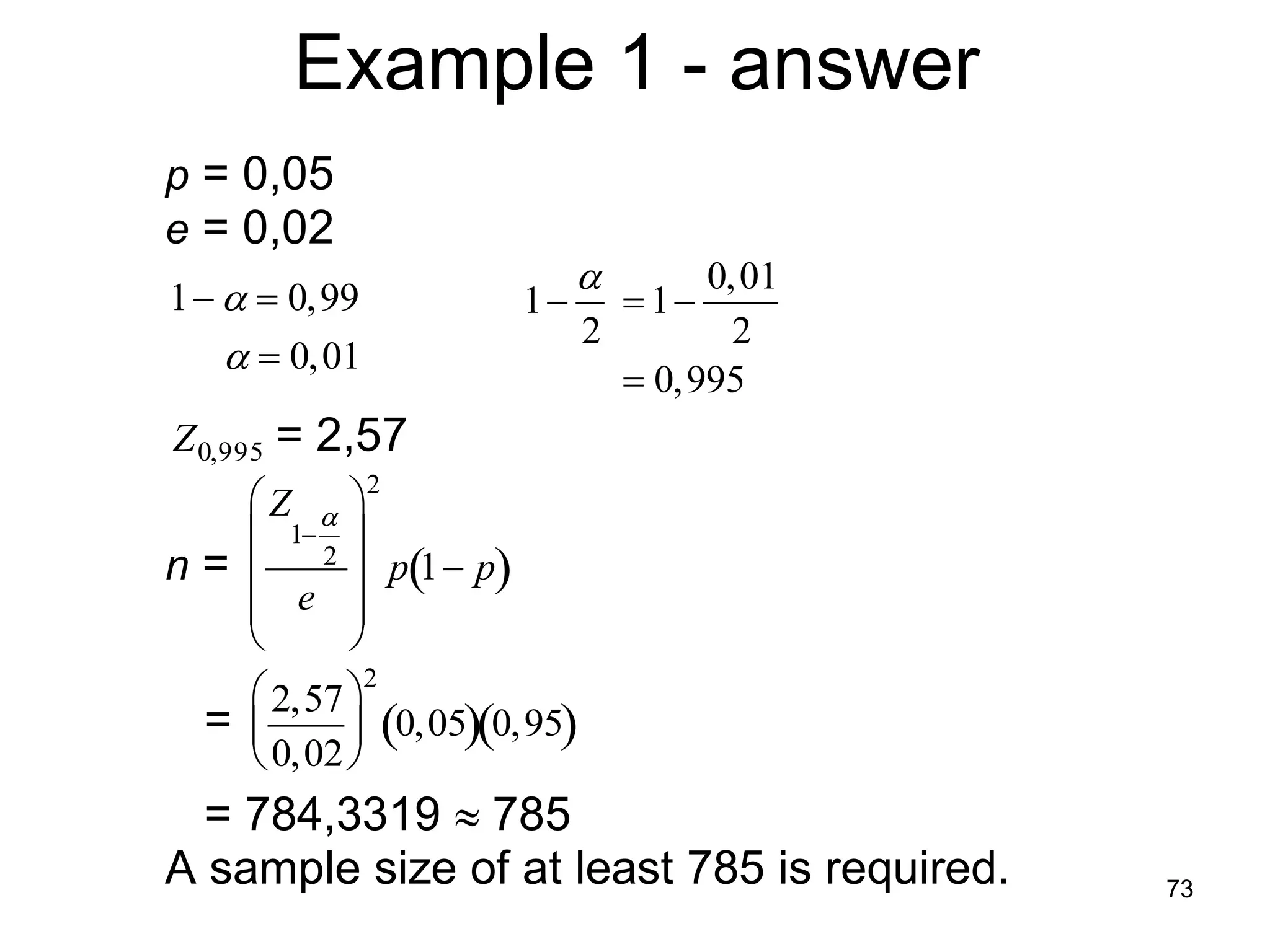
Example 1 - answer
          p = 0,05
          e = 0,02
                                         0,01
          1   0,99            1  1
                                   2       2
               0,01
                                      0,995
          Z 0,995   = 2,57
                       2
              Z  
             1 2 
                       p 1 p
          n =              
             e 
                    
                       2
              2,57 
            =        0,050,95
              0,02 
          = 784,3319  785
          A sample size of at least 785 is required.   73
     
Classwork
• Questions 48 – 52, pages 244 – 245 ,
  textbook
• Self review test, p245, text book
• Izimvo Exchange 1 and 2
• Activity 1,2,3
• Revision Exercise 1,2,3 and 4


                                         74
HOMEWORK
• Supplementary questions, p249 – 253,
  textbook


                                         75

Statistics lecture 8 (chapter 7)

  • 1.
  • 2.
    • A PARAMETERis a number that describes a population statistic • A STATISTIC is a number that describes a characteristic in the sample data 2
  • 3.
    • Inferential statistics – Draw conclusion from data – Sample • Describe data – Use sample statistic to infer population parameter • Estimation • Hypothesis testing 3
  • 4.
    Data collection Raw data Graphs Information Descriptive statistics Measures • location • spread Estimation Statistical Decision inference making Hypothesis testing 4
  • 5.
    • Estimation – Numerical values assigned to a population parameter using a sample statistic • Sample mean x used to estimate population mean μ • Sample variance s2 used to estimate population variance σ2 • Sample stand dev s used to estimate population stand dev σ ˆ • Sample proportion p used to estimate population proportion p 5
  • 6.
    • Steps inestimation – Select sample – Get required information from the sample – Calculate sample statistic – Assign values to population parameter 6
  • 7.
    • Read example7.1 page 214 7
  • 8.
    • Sample statisticused to estimate a population parameter is called an ESTIMATOR • An estimator is a rule that tells us how to calculate the estimate and it is generally expressed as a formula 8
  • 9.
    POPULATION ESTIMATE ESTIMATOR PAPARMETER (VALUE OF (Formula) STATISTIC) MEAN µ VARIANCE σ2 s2 PROPORTION p 9
  • 10.
    • Two typesof estimate:- –Point estimates –Interval estimates 10
  • 11.
    • A singlenumber that is calculated from sample data • Resulting number then used to estimate the true value of the corresponding population parameter 11
  • 12.
    • A randomsample of 10 employees reveals the following dental expenses in rands for the preceding year: 660; 2172; 1476; 510; 3060; 1248; 1038; 2550; 1896 and 1074 Determine a point estimate for:- 1. The population mean 2. The population variance 12
  • 13.
  • 14.
    • If wetake another random sample of 10 employees the mean obtained for this random sample will almost certainly differ from the one you have just calculated • Point estimates do not provide information about how close the point estimate is to the population parameter • Point estimates do not consider the sample size or variability of the population from which the sample was taken 14
  • 15.
    • Sample sizeand variability of population will affect the accuracy of the estimate so a point estimate is really not very useful • This problem can be overcome by using INTERVAL ESTIMATES 15
  • 16.
    • No 1– 6 page 216 16
  • 17.
    Point Estimates – A single sample statistic used to estimate the population parameter Population distribution Population parameter Sample distribution Point estimator 17
  • 18.
    Confidence interval – An interval is calculated around the sample statistic Population parameter included in interval Confidence interval 18
  • 19.
    Confidence interval – An upper and lower limit within in which the Example: population parameter is expected to lie Meaning of a 90% confidence interval: – Limits will vary from sample to sample – Specify90% of all possible samples taken from the probability that the interval will include population will produce an interval that will the parameter include the population parameter – Typical used 90%, 95%, 99% – Probability denoted by • (1 – α) known as the level of confidence • α is the significance level 19
  • 20.
    • An intervalestimate consists of a range of values with an upper & lower limit • The population parameter is expected to lie within this interval with a certain level of confidence • Limits of an interval vary from sample to sample therefore we must also specify the probability that an interval will contain the parameter • Ideally probability should be as high as possible 20
  • 21.
    SO REMEMBER •We canchoose the probability •Probability is denoted by (1-α) •Typical values are 0.9 (90%); 0.95 (95%) and 0.99 (99%) •The probability is known as the LEVEL OF CONFIDENCE •α is known as the SIGNIFICANCE LEVEL •α corresponds to an area under a curve •Since we take the confidence level into account when we estimate an interval, the interval is called CONFIDENCE INTERVAL 21
  • 22.
    Confidence interval forPopulation Mean, n ≥ 30 - population need not be normally distributed - sample will be approximately normal    CI (  )1   x  Z1   , if  is known  2 n  s  CI (  )1   x  Z1   , if  is not known  2 n 22
  • 23.
      Example : CI (  )1   x  Z1   , if  is known  2 n 90% confidence interval  s  CI (  )1   x  Z1   , if  is not known  2 n 1 –   0,90   0,10 1 90% of all sample  0,10 means fall in this area   0, 05 2 2 These 2 areas added Confidence level together = α i.e. 10% 1–α =1-α  1-α   0, 05  0, 05  2 = 0,90 2 2 x Lower conf limit Upper conf limit 23
  • 24.
  • 25.
  • 26.
    A random sampleof repair costs for 150 hotel rooms gave a mean repair cost of R84.30 and a standard deviation of R37.20. Construct a 95% confidence interval for the mean repair cost for a population of 2000 hotel rooms 26
  • 27.
  • 28.
    • Four commonlyused confidence levels  1-α α 2 z 0,9 0,1 0,05 1,64 0,95 0,05 0,025 1,96 0,98 0,02 0,01 2,33 0,99 0,01 0,005 2,57 28
  • 29.
    • Confidence intervalfor Population Mean, n ≥ 30 • Example: – Estimate the population mean with 90%, 95% and 99% confidence, if it is known that – s = 9 and n = 100 – Solution: The confidence intervals are s 9 90% xz   x  1, 64  x  1, 48 1 n 100 2 s 9 95% xz   x  1, 96  x  1, 76 1 n 100 2 s 9 99% xz   x  2, 57  x  2, 31 29 1 n 100 2
  • 30.
    Confidence level influencewidth of interval 90% x  1, 48  Width of interval = 2 x 1,48 = 2,96 95% x  1, 76  Width of interval = 2 x 1,76 = 3,52 99% x  2, 31  Width of interval = 2 x 2,31 = 4,62 Margin of error becomes smaller if: • z-value smaller 90% • σ smaller 95% • n larger 99% 30
  • 31.
    • Example – A survey was conducted amongst 85 childrenmean hours 95% confident the to determine the number of hours they spend in front of the TV every week. children spend watching TV is – The results indicate that thebetween 23,866 and 25,134 24,5 mean for the sample was hours with a standard deviation of 2,98 hours. hours per week – Estimate with 95% confidence the population mean hours that children spend watching TV.  s   2,98   x  z1     24,5  1,96   2 n  85    24,5  0, 634   23,866 ; 25,134 31
  • 32.
    • Confidence intervalfor Population Mean, n < 30 – For a small sample from a normal population and σ is known, the normal distribution can be used. – If σ is unknown we use s to estimate σ – We need to replace the normal distribution with the t-distribution ▬ standard normal  s  CI (  )1   x  tn 1;1   ▬ t-distribution  2 n 32
  • 33.
    t Distribution • Referto handout on how to read the critical value t n-1; 1- 𝛼 2 33
  • 34.
    • Example – The manager of a small departmental store is concerned about the decline of his weekly sales. 99% confident the mean weekly – He calculated the average and standard deviation of his sales for the past 12 weeks, x =sales will be between R12400 and s = R1346 – Estimate with 99% confidence the populationR13 606,86 R11 193,14 and mean sales of the departmental store. t11;0.995  s   1346   x  tn 1;1    12400  3,106   2 n  12   12400  1206,86  11193,14 ; 13606,86  34
  • 35.
    EXAMPLE 2 • Astudy of absenteeism among workers at a local mine during the previous year was carried out. A random sample of 25 miners revealed a mean absenteeism of 9.7days with a variance of 16 days. Construct a confidence interval for the average number of days of absence for miners for last year. Assume the population is normally distributed. 35
  • 36.
    EXAMPLE 2 -ANSWER • Example 7.6, page 222 textbook 36
  • 37.
    CLASSWORK • Do conceptquestions 7 – 19, page 223 textbook 37
  • 38.
    • Confidence intervalfor Population proportion – Each element in the population can be classified as a success or failure number of successes x ˆ Sample proportion p = = sample size n – Proportion always between 0 and 1 – For large samples the sample proportion ˆ p is approximately normal  p (1  p )  ˆ ˆ CI ( p )1   p  z1  ˆ   2 n  38
  • 39.
    • Example – A sales manager needs to determine the proportion of defective radio returns that is made on a monthly basis. 95% confident the mean monthly – In December 65 new radios werewill be will in January returns sold and be between 13 were returned for rework. 10,3% and 29,7% – Estimate with 95% confidence the population proportion of returns for December. 13 p ˆ  0, 2 65  p (1  p )   ˆ ˆ 0, 2(1  0, 2)   p  z1  ˆ    0, 2  1,96   2 n   65    0, 2  0, 097    0,103 ; 0, 297  39
  • 40.
    EXAMPLE 2 • Acellphone retailer is experiencing problems with a high % of returns. The quality control manager wants to estimate the % of all sales that result in returns. A sample of 40 sales showed that 8 cellphones were returned. Construct a 99% confidence interval for the % of all sales that result in returns 40
  • 41.
    EXAMPLE 2 • Answer– example 7.9 page 225, textbook 41
  • 42.
    • Confidence intervalfor Population Variance – Population variance very often important – Very often required for quality control – Sample drawn from a normal population – Sample variance is based on a random sample of size n – Distribution of s2 resulted from repeated sampling is a χ2 (chi-square) distribution 42
  • 43.
    • Confidence intervalfor Population Variance – χ2 (chi-square) distribution • Skewed to the right distribution • Shape varies in relation to the degrees of freedom • Critical values from the χ2-table A4(read same way as t distribution) • Critical value of χ21 - α specifies an area to the left • Critical value of χ2α specifies an area to the right 43
  • 44.
    • Confidence intervalfor Population Variance  2 (n  1) s (n  1) s  2 CI ( )1 2  2 ; 2   n 1;1   n 1;   2 2  44
  • 45.
    • Example – For a binding machine to work on its optimum capacity 90% confident the variation in the variation in the temperature of the room is vital. temperature will be will be between – The temperature for 30 consecutive hours were measured and sample standard and 0,757 were found to 0,315 deviation degrees be 0,68 degrees. – What will be a 90% confidence interval for σ2?   (n  1) s 2 (n  1) s 2   29(0, 682 ) 29(0, 682 )  CI ( 2 )1   2 ; 2  ;    n 1;1   n 1;    29;0,95  2  29;0,05  2   2 2   29(0, 682 ) 29(0, 682 )  n= 30; s = 0.68; α = 0.1  ;   42,56 17, 71    0,315;0, 757  45
  • 46.
    The total revenuefor a sample of 10 hardware stores in a well-known chain was recorded for a particular week. The results (in R1000) were as follows: 129.78;130.11; 129.83;130.02;129.67;129.87;129.88;129.86 130.18 and 129.91. Construct a 90% confidence interval for the standard deviation of the total weekly revenue for all hardware stores in this chain 46
  • 47.
  • 48.
    Answer example 2contd   n 1s 2 n 1s 2  CI( )0,9 =  2 2 ; 2   n1;1   n1;   2 2  90,0234 90,0234 =  ;   16,92 3,32   = [0,0124;0,0634] CI()0,9 = [ 0,0124 ; 0,0634 ]  = [0,1114;0,2518] 48
  • 49.
    CONCEPT QUESTIONS • Nos20 – 28, page 228 textbook 49
  • 50.
    Where are we? •So far we have looked at interval estimation procedures for µ, p and σ2 for a SINGLE POPULATION • We are now going to look at interval estimation procedures for:- – The difference between two population means – The difference between two population proportions – The ratio of two population variances 50
  • 51.
    • Interval estimationfor two populations – There is different procedures for the differences in means, proportions and variances. Population Sample Population Sample 1 1 2 2 Mean μ1 x1 μ2 x2 Variance σ 21 s21 σ 22 s22 Std dev σ1 s1 σ2 s2 Size N1 n1 N2 n2 Proportion P1 ˆ p1 P2 ˆ p2 51
  • 52.
    • Confidence intervaldifference in means – Large independent samples   12  2 2  CI ( 1   2 )1   x1  x2   Z1      2 n1 n2   if  12 and  2 is known 2  s12 s2  2 CI ( 1   2 )1   x1  x2   Z1      2 n1 n2  if  12 and  2 not is known 2 NOTE: If 0 is not included in the interval it means that 0 does not occur between the lower and upper 52 boundaries of the interval
  • 53.
    Example 1 Independent randomsamples of male and female employees selected from a large industrial plant yielded the following hourly wage results:- MALE FEMALE n1 = 45 n2 = 32 𝑥 = 6.00 𝑥 = 5.75 s1 = 0.95 s1 = 0.75 Construct a 99% confidence interval for the difference between the hourly wages for all males and females and interpret the results 53
  • 54.
    Example 1- Answer  0,01 1   0,99 1  1 2 2   0,01  0,995 Z 0,995= 2,57  2 2  CI(1 – 2 =  )0,99  x1  x 2   Z  s1  s2    1 2 n1 n 2    2   6  5,75  2,57 0,95  0,75  2  =   45 32     = [–0,2486;0,7486] 54
  • 55.
    Example 1- answer Interpretation:- Ata 99% level of confidence, the difference between the hourly wages of males and females is between -0.2486 and 0.7486 rand. The value 0 is included in the interval which tells us that there is a possibility that there is no difference between the two population means. To make sure whether there is a difference or not, a hypothesis test (next chapter!!!!) has to be performed. 55
  • 56.
    • Confidence intervaldifference in means – Small independent samples – When sample sizes are small, n1 & n2< 30 we use the t distribution NOTE: If both the limits of the confidence interval are negative you should suspect that the mean of first population is smaller than mean of second population56
  • 57.
    Example A plant thatoperates two shifts per week would like to consider the difference in productivity for the two shifts. The number of units that each shift produces on each of the 5 working days is recorded in the following table:- Monday Tuesday Wednesday Thursday Friday Shift 1 263 288 290 275 255 Shift 2 265 278 277 268 244 Assuming that the number of units produced by each shift is normally distributed and that the population standard deviations for the two shifts are equal construct a 99% confidence interval for the difference in mean productivity for the two shifts and comment on the result. 57
  • 58.
    x Example 1 - answer  x2 1 x1  x2  n1 n2 1 371 1 332   5 5  274, 2  266, 4       1 2 1 2 2 2 x1  x1 x2  x2 2 n1 2 n2 s1  s2   n1 1  n 2 1  233,7  188,3 sp = n1 1s12  n 2 1s2 2 n1  n 2  2   = 51(233,7)  51(188,3)  5 5 2  = 14,5258  0,01 1   0,99 1  1  2 2   0,01  0,995 t 8; 0,995 = 3,355  1 1   CI(1 – 2 =  x1  x 2   t )0,99   sp     n1 n 2 2;1 2 n1 n 2    1 1 = [(274,2 – 266,4)  3,355(14,5258)  ] 5 5  = [–23,0221;38,6221] At the 99% confidence level, because zero is included in the interval, it is possible that there 58  is no significant difference between the two shifts with respect to productivity.
  • 59.
    CONCEPT QUESTIONS • Nos29 -39, p 235 – 237, textbook 59
  • 60.
    • Confidence intervaldifference in proportions – Large independent samples  p1 1  p1  p2 1  p2   ˆ ˆ ˆ ˆ CI ( p1  p2 )1   p1  p2   z1  ˆ ˆ     2 n1 n2   x1 x2 with p1  ˆ and p2  ˆ n1 n2 60
  • 61.
    Example 1 Two groupsof males are polled concerning their interest in a new electric razor that has four cutting edges. A sample of 64 males under the age of 40 indicated that only 12 were interested while in a sample of 36 males over the age of 40, only 8 indicated an interest. Construct a 95% confidence interval for the difference between age froup populations 61
  • 62.
    Example 1 -answer 12 ˆ Under 40: n1 = 64 and p1 = = 0,1875. 64 8 ˆ Over 40: n2 = 36 and p2 = = 0,2222. 36 1   0,95  1   1 0,05  2 2   0,05    0,975 Z 0,975 = 1,96  p11 p1  p2 1 p2   ˆ ˆ ˆ ˆ CI( p1  p2 ) =  0,9  p1  p2   Z  ˆ ˆ +    1 2 n1 n2    0,18750,8125 0,22220,7778  =  0,1875 0,2222 1,96      64 36    = [–0,2008;0,1314] 62
  • 63.
    • Confidence intervalfor the ratio of two population variances • We use the f distribution, table A5. See handout  2  2      2 CI   1  s1   2 1  ; s1 F   s2  F     1 2   s2 2 n2 1; n1 1; 2   n1 1; n2 1;   2 2 NOTE: If 1 does not lie in the confidence interval, there is some evidence that the population variances are not equal 63
  • 64.
    EXAMPLE 1 A criminologistis interested in comparing the consistency of the lengths of sentences given to people convicted of robbery by two judges. A random sample of 17 people convicted of robbery by judge 1 showed a standard deviation of 2.53 years, while a random sample of 21 people convicted by judge 2 showed a standard deviation of 1.34 years. Construct a 95% confidence interval for the ratio of the two populations variances. Does the data suggest that the variances of the lengths of sentences by the two judges differ? Motivate your answer. 64
  • 65.
    Example 1 -answer Judge 1: n = 17 and s = 2,53. 1 1 Judge 2: n2 = 21 and s2 = 1,34.  0,05 1   0,95  2 2   0,05  0,025 F  = F16; 20; 0,025 n1 1;n 2 1; 2  = 2,55 F   = F20; 16; 0,025 n 2 1;n1 1; 2 = 2,68      s 2   s 2     12 1 1    1 CI( 2 )0,95 =  2   2 F ;  2 F n 2 1; n1 1;  s2  n 1;n 1;  s2  2    1 2 2    2,53 2    1  2,53 2,68  2 2  =  2  ;   1,34 2,55  1,34     = [1,3979;9,5536] Yes, at the 95% level of confidence it is possible that the variances differ because 1 is not 65  included in the interval.
  • 66.
    CONCEPT QUESTIONS • Conceptquestions 40 – 47, p 241, textbook 66
  • 67.
    DETERMINING SAMPLE SIZES FOR ESTIMATES • Everything we have done so far has assumed that a sample has ALREADY been taken • We often need to know how large a sample should we take to construct the confidence interval • Many factors can affect sample size such as budget, time and ease of selection • We will now look at how to determine the proper sample size (from a statistical perspective) 67
  • 68.
    • Sample sizefor estimating means – Confidence level (1 – α) – Accepted sampling error - e – Need to know σ, else use s  z1   2 n   e  NOTE: Sample size, n, is required to be a whole number. Therefore always round UP to the next largest integer 68
  • 69.
    EXAMPLE 1 A pharmaceuticalcompany is considering a request to pay for the continuing education of its research scientists. It would like to estimate the average amount spent by these scientists for professional memberships. Base on a pilot study the standard deviation is estimated to be R35. If a 95% confidence of being correct to within +/- R20 is desired, what sample size is necessary? 69
  • 70.
    Example 1 -answer  = 35 e = 20  0,05 1   0,95 1  1 2 2   0,05  0,975 Z 0,975 = 1,96 2 Z     1 2   n =   e    2 1,9635   =    20   = 11,7649  12 At least 12 scientists should be selected. 70 
  • 71.
    • Sample sizefor estimating proportions – Confidence level (1 – α) – Accepted sampling error - e – Need to know p, else use p ˆ 2  z1  n  p (1  p )  e  71
  • 72.
    Example 1 An audittest to establish the % of occurrence of failures to follow a specific internal control procedure is to be undertaken. The auditor decides that the maximum tolerable error rate that is permissible is 5%. What sample size is necessary to achieve a sample precision of +/- 0.02 with 99% confidence? 72
  • 73.
    Example 1 -answer p = 0,05 e = 0,02  0,01 1   0,99 1  1 2 2   0,01  0,995 Z 0,995 = 2,57 2 Z     1 2  p 1 p n =       e    2 2,57  =   0,050,95 0,02   = 784,3319  785 A sample size of at least 785 is required. 73 
  • 74.
    Classwork • Questions 48– 52, pages 244 – 245 , textbook • Self review test, p245, text book • Izimvo Exchange 1 and 2 • Activity 1,2,3 • Revision Exercise 1,2,3 and 4 74
  • 75.
    HOMEWORK • Supplementary questions,p249 – 253, textbook 75